

ChatGPT and generative AI chatbots: challenges and opportunities for science, medicine and medical leaders
Open accessThe DOI matches its Crossref record; 19 of the 19 references it cites were found in a registry or an index.
Abstract
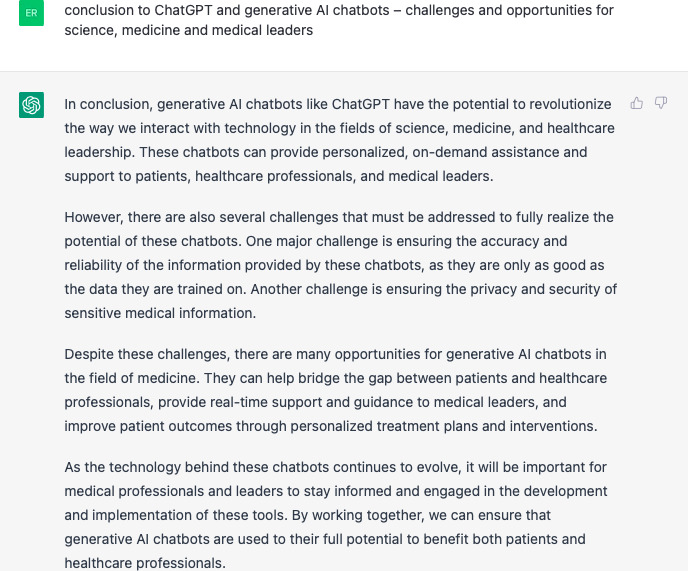
© Author(s) (or their employer(s)) 2023. Reuse permitted under CC BYNC. No commercial reuse. See rights and permissions. Published by BMJ. INTRODUCTION By now, most readers will have heard of the Chat Generative Pretrained Transformer (ChatGPT) artificial intelligence (AI) chatbot tool released to the public by the AI company OpenAI on 30 November 2022, to be used for free (at least for now), and which, by January 2023, had reached over 100 million users, making it the fastest growing consumer application to date. The ability of ChatGPT and other similar generative AI tools to generate text that appear to be similar to those created by human has led to both critics and supporters of this new technology. These new AI technologies have created challenges for medical leaders in the health system and offer new opportunities as well. This paper summarises these challenges and opportunities and provides a potential way forward. The main concern that AI tools such as ChatGPT raise is their ability to generate blocks of text that are so fluent and wellwritten that they are indistinguishable from content authored by human beings, which raises concerns of its use in fraud and plagiarism. Part of the problem is that ChatGPTgenerated text can be difficult to distinguish from humangenerated ones even for specialist AItext detection software, leading to its creator, OpenAI, to release its own AI detection tool; however, this tool itself is not entirely accurate as it concluded that the first few text passages from the Bible were likely to be AIgenerated during a test.
Overview
The claims and statistics of this paper haven’t been checked yet.
Free: it reads the open-access text and checks the first 5 claims that cite a source we can check. Create a free account to check every claim.
Integrity signals
Registry
Cites
Statistics
Figures
Verification
Claims the paper makes
The claims and statistics of this paper haven’t been checked yet.
Free: it reads the open-access text and checks the first 5 claims that cite a source we can check. Create a free account to check every claim.
Claims other papers make about this one
Each is checked against this paper’s own text: does it say what the citing paper says it does?
In the citing paper
“With the rapid expansion of AI, medical educators have become increasingly concerned about the associated risks.”
From A scoping review of artificial intelligence in medical education: BEME Guide No. 84 (2024) · cites this paper as Loh 2023
In the citing paper
“Other works have cautioned the community concerning AI's potential to undermine the integrity of academic publishing (Masters 2023b;Loh 2023).”
From A scoping review of artificial intelligence in medical education: BEME Guide No. 84 (2024) · cites this paper as Loh 2023
Self-check
Percentages, sums and reported differences re-computed from the paper’s own numbers.
The self-check needs the paper’s full text.
Citations
Cites
Kung, T. H., Cheatham, M., Medenilla, A., Sillos, C., De Leon, L., Elepaño, C., Madriaga, M., Aggabao, R., Diaz-Candido, G., Maningo, J., et al. (2023) · PLOS Digital Health · doi:10.1371/journal.pdig.0000198 · Cited by 4,115
Kung, T. H., Cheatham, M., ChatGPT, Medenilla, A., Sillos, C., De Leon, L., Elepaño, C., Madriaga, M., Aggabao, R., Diaz-Candido, G., et al. (2022) · doi:10.1101/2022.12.19.22283643 · Cited by 4,115
ChatGPT: five priorities for research
van Dis, E. A. M., Bollen, J., Zuidema, W., van Rooij, R., & Bockting, C. L. (2023) · Nature · doi:10.1038/d41586-023-00288-7 · Cited by 1,842
ChatGPT is fun, but not an author
Thorp, H. H. (2023) · Science · doi:10.1126/science.adg7879 · Cited by 1,437
Gao, C. A., Howard, F. M., Markov, N. S., Dyer, E. C., Ramesh, S., Luo, Y., & Pearson, A. T. (2022) · doi:10.1101/2022.12.23.521610 · Cited by 1,099
Gao, C. A., Howard, F. M., Markov, N. S., Dyer, E. C., Ramesh, S., Luo, Y., & Pearson, A. T. (2023) · npj Digital Medicine · doi:10.1038/s41746-023-00819-6 · Cited by 1,099
ChatGPT listed as author on research papers: many scientists disapprove
Stokel-Walker, C. (2023) · Nature · doi:10.1038/d41586-023-00107-z · Cited by 868
What ChatGPT and generative AI mean for science
Stokel-Walker, C., & Van Noorden, R. (2023) · Nature · doi:10.1038/d41586-023-00340-6 · Cited by 828 · cited 1×
“23 Some researchers have suggested that ChatGPT may even democratise the dissemination of scientific knowledge by allowing scientists to publish in other languages due to the ability of such tools to translate scientific terms effectively.”
BackgroundChatGPT: the future of discharge summaries?
Patel, S. B., & Lam, K. (2023) · The Lancet Digital Health · doi:10.1016/s2589-7500(23)00021-3 · Cited by 728
Tools such as ChatGPT threaten transparent science; here are our ground rules for their use
(2023) · Nature · doi:10.1038/d41586-023-00191-1 · Cited by 605
Research works printed but not linked: 3
- Nori H King N McKinner SM et al Capabilities of GPT-4 on medical challenge problems arXiv 2023 Available https://www.microsoft.com/en-us/research/publication/capabilities-of-gpt-4-on-medical-challenge-problems/
- Fourth International Conference on Machine Learning Clarification on large language model policy LLM Available https://icml.cc/Conferences/2023/llm-policy Accessed 6-Mar-2023
- Gal U ChatGPT is a data privacy nightmare. if you’ve ever posted online, you ought to be concerned The Conversation 2023 Available https://theconversation.com/chatgpt-is-a-data-privacy-nightmare-if-youve-ever-posted-online-you-ought-to-be-concerned-199283 · DOI
Cited by
Items 101–129 of 129
Akpan, U. S. (2024) · Springer eBooks · doi:10.1007/978-3-031-68530-9_1 · Cited by 1
Deskripsi Penggunaan ChatGPT pada Mahasiswa Tahun Ketiga Fakultas Keperawatan di Universitas X
Sudarja, K., Margareth, D. W., Simanjuntak, J. P., Endarrini, M., & Cendana, W. (2025) · Journal of Practice Learning and Educational Development · doi:10.58737/jpled.v5i2.446
Saropi, N., Mansur, H., & Utama, A. H. (2025) · Akademika · doi:10.34005/ak.v14i01.4614
Artificial Intelligence: The Prevalent Coauthor Among Early-Career Surgeons
Altorfer, F. C. S., Loggia, G., Avrumova, F., & Lebl, D. R. (2025) · The International Journal of Spine Surgery · doi:10.14444/8778
Exploring the Use of Generative AI in Software Development: A Preliminary Study
Mar’i, F., Nerisafitra, P., Marianingsih, S., Hanjaya, S., Aisyah, Y., Primatama, D., & Sutaji, D. (2025) · E3S Web of Conferences · doi:10.1051/e3sconf/202564504002
Application of artificial intelligence to overcome clinical information overload in cancer
Stenzl, A., Ghith, J., & Schijvenaars, B. J. A. (2025) · Oxford University Press eBooks · doi:10.1093/med/9780192867636.003.0022
Chatbots: Evolution, Technologies, and Applications
Shrivastav, A., Sankathala, S., Chaturvedi, K., Saraf, A. H., Patre, K., & Das, S. (2025) · Advances in computational intelligence and robotics book series · doi:10.4018/979-8-3373-8011-7.ch004
Hosseiniravandi, M., Sheykhotayefeh, M., & Khodaveisi, T. (2025) · مجله دانشگاه علوم پزشکی تربت حیدریه · doi:10.61882/jmsthums.13.3.78
Morley, J. (2023) · Oxford University Research Archive (ORA) (University of Oxford) · doi:10.5287/ora-jxprn9ry5 · Cited by 9
Mohd Dan, A. S., Linoby, A., Kasim, S. S., Lamat, S. A., Zaki, S., & Sazali, R. (2024) · UiTM Institutional Repositories (Universiti Teknologi MARA)
UiTM Negeri Sembilan Branch, S. C. (2024) · UiTM Institutional Repositories (Universiti Teknologi MARA)
Eriksson, J. (2025) · DiVA (Luleå University of Technology)
Hamer, J., Kool, L., Hijstek, B., van Eeden, Q., & Das, D. (2023) · KNAW Research Portal (The Royal Netherlands Academy of Arts and Sciences) · Cited by 2
University Lecturers’ and Students’ Perceptions and Use of Genai Technologies
Chen, Z., Leo, K. C., Sheffield, R. S., & Fairhurst, N. N. (2026) · Acta Pedagogia Asiana · doi:10.53623/apga.v5i1.955
“Furthermore, GenAI might undermine academic integrity, raise concerns about the reliability and accuracy of the information it provides, and present issues related to potential data biases, privacy, misinformation, and manipulation [5].”
Czech, E., Margariti, E., Morgan, C., Whone, A. L., Craddock, I. J., Durrant, A. C., Kirk, D., O’Kane, A. A., & O'Hara, K. (2026) · JMIR Formative Research · doi:10.2196/92174
Huong, L. T. L., Lien, H. T. K., & Nam, L. V. (2025) · Tạp chí Công nghiệp Kinh tế và Quản lý · doi:10.62831/202526049
Ningthoujam, C., & Raj, A. (2026) · Lecture notes in networks and systems · doi:10.1007/978-3-032-13555-1_3
Food industry 5.0: between evolution and revolution in food and agriculture
Hassoun, A. (2026) · Elsevier eBooks · doi:10.1016/b978-0-443-36591-1.00010-0 · Cited by 1
AI in cancer education and screening: Improving patient awareness and quality of life
Sharma, D., Pal, D., & Sharma, L. (2026) · Elsevier eBooks · doi:10.1016/b978-0-443-45004-4.00001-3
A Framework in Generative AI for Preventing Suicidal Thoughts
Surya, K., & Kumar, R. (2026) · Communications in computer and information science · doi:10.1007/978-3-032-17184-9_9
Gençel, N., & Yılmaz, E. (2026) · International Journal of Technology in Education · doi:10.46328/ijte.6277
Regulating Generative AI in Healthcare: Protocol for a Scoping Review (Preprint)Preprint
Ashraf, M., Corso, M.-M., Fleetcroft, C., Menon, V., Mateen, B. A., Denniston, A. K., & Hogg, H. D. J. (2026) · doi:10.2196/preprints.106167
YAPAY ZEKA TURİZM ARAŞTIRMALARINA KATKIDA BULUNABİLİR Mİ? CHATGPT’YE GÖRE TURİST REHBERLİĞİ MESLEĞİ
Taşkın, G. A., & Karaş, Y. K. (2026) · Karamanoğlu Mehmetbey Üniversitesi Sosyal Ve Ekonomik Araştırmalar Dergisi · doi:10.18493/kmusekad.1657991
Gwinnutt, J. M., de Oliveira, R., Haviland, M. J., Heidt, J., Eldridge, E. H., Pereira, L. M., Bratton, E., Nanavati, J., & Mack, C. D. (2026) · Pharmacoepidemiology and Drug Safety · doi:10.1002/pds.70452
Cerri, A., Zanardo, M., Lega, F., Bottinelli, E., Menicanti, L., Biondi-Zoccai, G. V., & BIONDI-ZOCCAI, G. (2026) · Leadership in health services · doi:10.1108/lhs-02-2026-0032
Aguilar, M. G. W., Sari, A. S., Sukur, S. G., Kirana, K. C., & Widyastuti, I. (2025) · Journal of Local Government Issues · doi:10.22219/logos.v9i2.44494
Pemanfaatan Teknologi Ai Dalam Mendukung Penulisan Artikel Ilmiah Bagi Guru Ipa
Purnomo, A. R., Hariyono, E., Budiyanto, M., & Setiawan, B. (2026) · Jurnal Abdi Media Pengabdian Kepada Masyarakat · doi:10.26740/abdi.v11i2.37469
Udiyana, I. B. G., Jelantik, I. G. A. A. I. D. L., Supartha, A. A. A. R. P., Cahyathi, I. G. A. W. A., & Ni Putu Dhanan Kumaradewi, M. (2026) · SENTRI Jurnal Riset Ilmiah · doi:10.55681/sentri.v5i5.6202
Kalem, B., Gülel, H. G., Veskoukis, T., Meisenzahl, E. M., Kujovic, M., & Theisen, C. (2026) · Acta Neuropsychiatrica · doi:10.1017/neu.2026.10100
“…care, and growing tendency to seek health information online, together with the increasingly widespread use of ChatGPT to search for information (Loh, 2024; Iqbal et al ., 2025), make it even more important to ensure the accuracy of psychoeducational responses so that patients are not…”
Metadata
- Authors
- Loh, E.
- Affiliations
- St Vincent's Health (AU)
- Corresponding author
- Loh, Erwin
- ORCID
- Loh, Erwin
- Venue
- BMJ Leader
- Publisher
- BMJ
- Published
- 2023-05-02
- Volume
- 8
- Issue
- 1
- Pages
- 51-54
- ISSN
- 2398-631X (ISSN-L)
- PMC
- PMC12038121
- OpenAlex
- W4367676590
- Semantic Scholar
- d2d1e26ab7807b37b6f92966dcdacd6b4a97212d
- Cited by
- 116
- References
- 17
- Citations by year
- 2026: 20 · 2025: 36 · 2024: 52 · 2023: 8
- FWCI
- 4.31
- Type
- journal article
- Language
- en
- Open access
- hybrid
- doi.org
- Licence
- Locations
- BMJ Leader (publishedVersion, cc-by-nc)
- PubMed Central (publishedVersion, cc-by-nc)
- PubMed (publishedVersion)
- Topics
- Health Sciences › Medicine › Health Informatics › Artificial Intelligence in Healthcare and Education
- Physical Sciences › Computer Science › Artificial Intelligence › Artificial Intelligence Applications
- Physical Sciences › Computer Science › Artificial Intelligence › Ethics and Social Impacts of AI
- Keywords
- ChatGPT, generative AI, AI chatbots, medical education, clinical decision-making, clinical leadership, artificial intelligence in healthcare, opportunities and challenges
About these checks
Registry, retraction, Cites and statistics results are computed, not judged, with one exception: a printed reference that no index lists is read once by a model before it counts as a citation error. Claims are extracted by a model and kept only when their quote appears verbatim in the text; each cited source is then checked, with a model’s help, for whether it says what the claim relies on. Those verdicts can be wrong — read the claim’s quote and the cited source before relying on one.
Statistics and arithmetic are recomputed, not judged.
Confidence bands are shown only for fields calibrated on our annotated test set. None is calibrated yet, so no band is shown.
What counts as a claim ›How we measure confidence ›How we check this ›
Are you an author, or do you see a problem with this page? Request a review
Data sources
Bibliographic data: Semantic Scholar, OpenAlex, Crossref.
Contains information from the Semantic Scholar Academic Graph Datasets, made available under the ODC Attribution License (ODC-BY 1.0).
Semantic Scholar’s data is described in: Kinney, R., et al. (2023). The Semantic Scholar Open Data Platform. arXiv:2301.10140.
