

Advancing progress on tobacco control in low-income and middle-income countries through economic analysis
Open accessThe DOI matches its Crossref record; 16 of the 17 references it cites were found in a registry or an index; 7 of the 15 sources its claims cite were checked for support.
Abstract
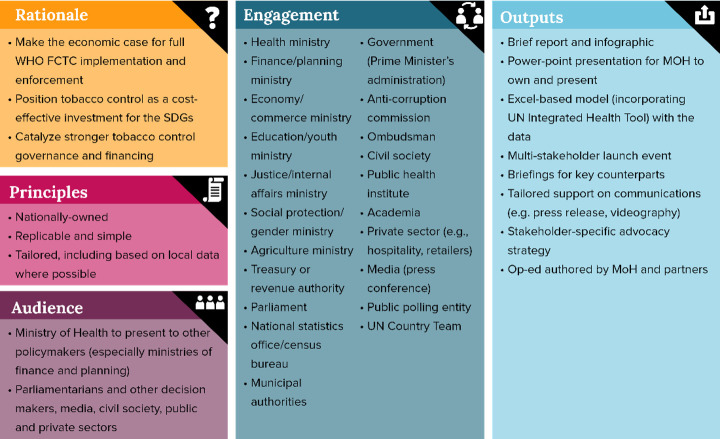
This paper overviews the approach, observed tobacco control advancements and learnings from 21 LMICs, including Colombia, showing improved collaboration and policy coherence between health and economic stakeholders after investment-case work.
Overview
CoChat Summary
TL;DR
The paper reviews 21 national tobacco control investment cases completed in LMICs through the FCTC 2030 project and reports that 17 of the 21 countries subsequently made tobacco control advances aligned with the cases’ findings and recommendations. The authors argue that combining economic analysis with political-economy analysis can help reposition tobacco control as an economic and development priority, not only a health issue.
Key findings
- The project supported 21 LMICs between 2017 and 2022 to complete national investment cases: Armenia, Cabo Verde, Cambodia, Chad, Colombia, Costa Rica, El Salvador, Eswatini, Georgia, Ghana, Jordan, Laos, Madagascar, Myanmar, Nepal, Samoa, Sierra Leone, Sri Lanka, Suriname, Tunisia and Zambia.
- The authors identified 30 actions aligned with investment case findings and recommendations across 17 of the 21 countries.
- Reported policy advances included: 4 countries strengthening tobacco tax regimes, 5 strengthening smoke-free policies, 2 raising awareness of tobacco harms, 4 increasing limits on tobacco advertising/promotion/sponsorship, 1 adopting plain packaging legislation, and 2 establishing cessation programmes.
- Governance and coordination advances were also reported: 8 countries formed institutions/activities to coordinate and strengthen tobacco control planning and stakeholder engagement, and 2 countries took legislative action to prevent tobacco industry interference in policymaking.
Methods
- Descriptive overview of the FCTC 2030 tobacco control investment case approach and observed tobacco control advancements across the 21 countries.
- The investment cases combined customised economic estimates of tobacco’s impact with qualitative institutional and context analysis (ICA) based on desk research and key informant interviews.
- The economic component assessed the burden of tobacco use, costs of implementing selected WHO FCTC demand-reduction measures, health and economic benefits, and return on investment over 5- and 15-year periods.
Limitations
- The paper states that it is challenging to draw conclusions about attribution and that it does not analyse the causal chain linking the investment cases to policy change.
- It is an overview of near-term actions; countries that completed cases earlier had more time for policy effects to emerge.
- The text also makes evident that the findings are based on reported and observed country actions rather than a formal causal evaluation of the 21-country cases (stated in the paper’s discussion).
Model-written summary. Check it against the paper before relying on it.
Integrity signals
Registry
Cites
Statistics
Figures
Verification
Claims the paper makes
7 Valid · 3 Not valid · 8 Not checked · 38 Own results and interpretations
The cited sources support only part of this claim — read each source’s verdict below.
In the paper
“Reinforcing these barriers is low awareness of the full, society-wide harms of tobacco, particularly in LMICs facing or at risk of high burdens.19”
§ Advancing progress on tobacco control in low-income and middle-income countries through economic analysis > Introduction > Objectives of the WHO FCTC and FCTC 2030 project
What the sources say
- Partly supportedcites [19] Hoe C, Kennedy RD, Spires M, et al. Improving the implementation of tobacco control policies in low-and middle-income countries: a proposed framework. BMJ Glob Health 2019; 4: e002078. 10.1136/bmjgh-2019-002078 PMC6936550 31908876 sourceExperimental — accuracy not yet measured
The framework’s social-climate discussion (page not available in our copy) links public awareness and education to effective tobacco-control implementation, and its introduction identifies LMICs as facing particular implementation challenges. It does not say that awareness of tobacco’s full society-wide harms is low or identify that specific lack of awareness as a barrier. (LLM, conf=0.82)
plainstates a cause- Asserted: passes — The authors put it forward as true.
- Checkable: passes — It can be checked against evidence.
- Load-bearing: passes — The paper’s conclusions depend on it.
- Based: passes — The paper gives a reason why it holds.
- Partly supported
Every source the paper cites for this claim was checked and supports it.
In the paper
“reviews of sustainable development planning in multiple countries have confirmed relatively low attention to tobacco control.6”
§ Advancing progress on tobacco control in low-income and middle-income countries through economic analysis > Introduction
What the sources say
- Supportedcites [6] Small R, Linou N, Webb D, et al. Tobacco control in the sustainable development goals: a precarious inclusion? Lancet Public Health 2017; 2. 10.1016/S2468-2667(17)30100-7 29253365 source
The source's own content analysis of SDG design fora (27 970 web-based submissions, 72 national consultation reports, nine global thematic consultation reports, five high-level UN synthesis reports, plus the Open Working Group record) states that 'Tobacco control was discussed far less frequently than many other health priorities, ranking third-to-last in composite score', with national consultation reports from top cigarette-consuming and -producing countries such as China and Indonesia not mentioning tobacco at all. The accompanying table backs the 'relatively low attention' point quantitatively (tobacco-related terms overall score 255, versus HIV/AIDS 2524, reproductive 1069, maternal 955, NCDs 593, malaria 455). The only looseness is that the citation rests on one review covering many countries' consultation documents rather than several separate country reviews, and the material examined is the SDG design/consultation process rather than later national sustainable development frameworks (which the authors say they are 'concerned' may not reflect the FCTC); neither changes the substance attributed here. (LLM, conf=0.85)
plain- Asserted: passes — The authors put it forward as true.
- Checkable: passes — It can be checked against evidence.
- Load-bearing: passes — The paper’s conclusions depend on it.
- Based: passes — The paper gives a reason why it holds.
- Supported
The cited sources support only part of this claim — read each source’s verdict below.
In the paper
“An example is Georgia where the Ministry of Health (MoH) used its investment case to support the adoption and partial implementation of comprehensive tobacco control legislation.”
§ Advancing progress on tobacco control in low-income and middle-income countries through economic analysis > Results: observed tobacco control advancements in the 21 countries
What the sources say
- Partly supportedcites [23] Jackson-Morris A, Nugent R. Tailored support for national NCD policy and programme implementation: an over-looked priority. BMJ Glob Health 2020; 5: e002598. 10.1136/bmjgh-2020-002598 PMC7449589 32847822 sourceExperimental — accuracy not yet measured
In “The impact of NCD investment cases” (page not provided), the paper says Georgia’s Health Ministry brought a pilot tobacco-control investment case into debate over stalled legislation, after which Parliament agreed to multiple policy changes. It does not say the legislation was comprehensive or that it was partially implemented. (LLM, conf=0.87)
plainstates a causeSingle case- Asserted: passes — The authors put it forward as true.
- Checkable: passes — It can be checked against evidence.
- Load-bearing: unclear — It is unclear whether the paper’s conclusions depend on it.
- Based: passes — The paper gives a reason why it holds.
- Partly supported
A result the paper reports from its own data — it cites no other source for it, so there is none to check. The quote shows it is in the paper.
In the paper
“four countries instituted greater limits on tobacco advertising, promotion and sponsorship”
§ Advancing progress on tobacco control in low-income and middle-income countries through economic analysis > Results: observed tobacco control advancements in the 21 countries
plain- Asserted: passes — The authors put it forward as true.
- Checkable: passes — It can be checked against evidence.
- Load-bearing: unclear — It is unclear whether the paper’s conclusions depend on it.
- Based: passes — The paper gives a reason why it holds.
A result the paper reports from its own data — it cites no other source for it, so there is none to check. The quote shows it is in the paper.
In the paper
“two countries made changes to raise awareness of the harms of tobacco use”
§ Advancing progress on tobacco control in low-income and middle-income countries through economic analysis > Results: observed tobacco control advancements in the 21 countries
plain- Asserted: passes — The authors put it forward as true.
- Checkable: passes — It can be checked against evidence.
- Load-bearing: unclear — It is unclear whether the paper’s conclusions depend on it.
- Based: passes — The paper gives a reason why it holds.
27 more claims
Create a free account to see all 56 claims and every source verdict.
- Probably not a substantial claim. 21
- It may state two separate claims as one. 10
Citations
Cites
Global economic cost of smoking-attributable diseases
Goodchild, M., Nargis, N., & Tursan d'Espaignet, E. (2018) · Tobacco Control · doi:10.1136/tobaccocontrol-2016-053305 · Cited by 669
Curbing the epidemic: governments and the economics of tobacco control
Bank, T. W. (1999) · Tobacco Control · doi:10.1136/tc.8.2.196 · Cited by 433
The economics of global tobacco control
Jha, P. (2000) · BMJ · doi:10.1136/bmj.321.7257.358 · Cited by 255
He, H., Pan, Z., Wu, J., Hu, C., Bai, L., & Lyu, J. (2022) · Nicotine & Tobacco Research · doi:10.1093/ntr/ntab265 · Cited by 153
Ma, C., Heiland, E. G., Li, Z., Zhao, M., Liang, Y., & Xi, B. (2021) · The Lancet Global Health · doi:10.1016/s2214-109x(21)00365-x · Cited by 129
Zhang, H., Ma, S., Han, T., Qu, G., Cheng, C., Uy, J. P., Shaikh, M. B., Zhou, Q., Song, E. J., & Sun, C. (2021) · European Journal of Integrative Medicine · doi:10.1016/j.eujim.2021.101313 · Cited by 88
Weishaar, H., Collin, J., Smith, K., Grüning, T., Mandal, S., & Gilmore, A. (2012) · PLoS Medicine · doi:10.1371/journal.pmed.1001249 · Cited by 68
Bertram, M., Banatvala, N., Kulikov, A., Belausteguigoitia, I., Sandoval, R., Hennis, A., Webb, D., & Tarlton, D. (2019) · BMJ · doi:10.1136/bmj.l1648 · Cited by 29
Self-citationSiddiqi, K., Elsey, H., Khokhar, M. A., Marshall, A., Pokhrel, S., Arora, M., Crankson, S., Mehra, R., Morello, P., Collin, J., et al. (2023) · Nicotine & Tobacco Research · doi:10.1093/ntr/ntad022 · Cited by 29
Hoe, C., Kennedy, R. D., Spires, M., Tamplin, S., & Cohen, J. E. (2019) · BMJ Global Health · doi:10.1136/bmjgh-2019-002078 · Cited by 23
Research works printed but not linked: 2
- Chaloupka F, Drope J, Siu E, et al. Tobacconomics cigarette tax scorecard, 2nd edition. Chicago, IL Health Policy Center, Institute for Health Research and Policy, University of Illinois Chicago; 2021. Available: www.tobacconomics.org
- McDaid D, Park A-L. Evidence on financing and budgeting mechanisms to support Intersectoral actions between health, education, social welfare and labour sectors [ World Health Organization. Regional Office for Europe]. 2016. Available: https://apps.who.int/iris/handle/10665/326309 [Accessed 03 Mar 2021]. 27809424
Cited by
Tobacco control in low-income and middle-income countries: findings from WHO FCTC investment cases
Tauras, J. A. (2024) · Tobacco Control · doi:10.1136/tc-2024-058717 · Cited by 32
“Small et al 8 found that tobacco control advancements were observed in 16 of the 21 LMICs where the investment cases were carried out.”
BackgroundInfluentialMann, N., Spencer, G., Hutchinson, B. W., Ngongo, C. J., Tarlton, D., Webb, D., Grafton, D., & Nugent, R. A. (2024) · Tobacco Control · doi:10.1136/tc-2023-058337 · Cited by 18
Self-citationEquity implications of tobacco taxation: results from WHO FCTC investment cases
Spencer, G., Nugent, R. A., Mann, N., Hutchinson, B. W., Ngongo, C. J., Tarlton, D., Small, R., & Webb, D. (2024) · Tobacco Control · doi:10.1136/tc-2023-058338 · Cited by 16
Self-citationEvolving methodology of national tobacco control investment cases
Nugent, R. A., Hutchinson, B. W., Mann, N., Ngongo, C. J., Spencer, G., Grafton, D., & Small, R. (2024) · Tobacco Control · doi:10.1136/tc-2023-058336 · Cited by 4
Self-citationHe, J., He, J., Wu, Z., et al. (2025) · Tobacco Induced Diseases · doi:10.18332/tid/200546 · Cited by 3
“Tobacco use is prevalent worldwide, with approximately 1.3 billion smokers, contributing to >8 million deaths annually, of which >7 million are due to direct smoking and 1.2 million result from secondhand smoke (SHS) exposure 1,2 .”
Influential
Metadata
- Authors
- Small, R., Nugent, R., Webb, D., Hutchinson, B., Spencer, G., Ngongo, C., Chestnov, R., & Tarlton, D.
- Affiliations
- United Nations Development Programme (US)
- RTI International (US)
- Corresponding author
- Small, Roy
- ORCID
- Venue
- Tobacco Control
- Publisher
- BMJ
- Published
- 2024-05
- Volume
- 33
- Issue
- Suppl 1
- Pages
- s3-s9
- ISSN
- 0964-4563 (ISSN-L)
- 1468-3318
- PMC
- PMC11103286
- OpenAlex
- W4396577967
- Semantic Scholar
- d6732d168a7805582b1908e94bf18ea49bc56d8d
- Cited by
- 14
- References
- 17
- Citations by year
- 2026: 2 · 2025: 6 · 2024: 6
- FWCI
- 3.95
- Type
- journal article
- Language
- en
- Open access
- hybrid
- doi.org
- Locations
- Tobacco Control (publishedVersion, cc-by)
- PubMed Central (publishedVersion, cc-by)
- PubMed (publishedVersion)
- HighWire Press Open Archive (submittedVersion)
- Funders
- United Nations Development Programme (00100989)
- Topics
- Health Sciences › Medicine › Public Health, Environmental and Occupational Health › Smoking Behavior and Cessation
- Health Sciences › Medicine › Public Health, Environmental and Occupational Health › Global Public Health Policies and Epidemiology
- Social Sciences › Economics, Econometrics and Finance › Economics and Econometrics › Health Systems, Economic Evaluations, Quality of Life
- Keywords
- Framework Convention on Tobacco Control, low- and middle-income countries, tobacco control, policy coherence, country ownership, sustainable development
- MeSH terms
- Smoking Prevention, Tobacco Control, Developing Countries, World Health Organization, Tobacco Use
About these checks
Registry, retraction, Cites and statistics results are computed, not judged, with one exception: a printed reference that no index lists is read once by a model before it counts as a citation error. Claims are extracted by a model and kept only when their quote appears verbatim in the text; each cited source is then checked, with a model’s help, for whether it says what the claim relies on. Those verdicts can be wrong — read the claim’s quote and the cited source before relying on one.
The claim verdicts this report counts are experimental: their accuracy is not yet measured.
A language model drew the claims from the paper on 2026-10-10, under version 3 of the claim definition (model deepseek-v4.1-flash, prompt extract-v3).
A second model labelled each claim on 2026-10-10 (model jev-1.13-20260917, definition revision gold-guideline-v0.2).
Cited sources are checked with a language model’s help (gpt-6-sol and qwen3.8-omni-flash).
Statistics and arithmetic are recomputed, not judged.
Confidence bands are shown only for fields calibrated on our annotated test set. None is calibrated yet, so no band is shown.
What counts as a claim ›How we measure confidence ›How we check this ›
Are you an author, or do you see a problem with this page? Request a review
Data sources
Bibliographic data: Semantic Scholar, OpenAlex, Crossref.
Contains information from the Semantic Scholar Academic Graph Datasets, made available under the ODC Attribution License (ODC-BY 1.0).
Semantic Scholar’s data is described in: Kinney, R., et al. (2023). The Semantic Scholar Open Data Platform. arXiv:2301.10140.
