

The DOI matches its Crossref record; 36 of the 36 references it cites were found in a registry or an index.
Home-based rehabilitation for COPD using minimal resources: a randomised, controlled equivalence trial
Open accessAbstract
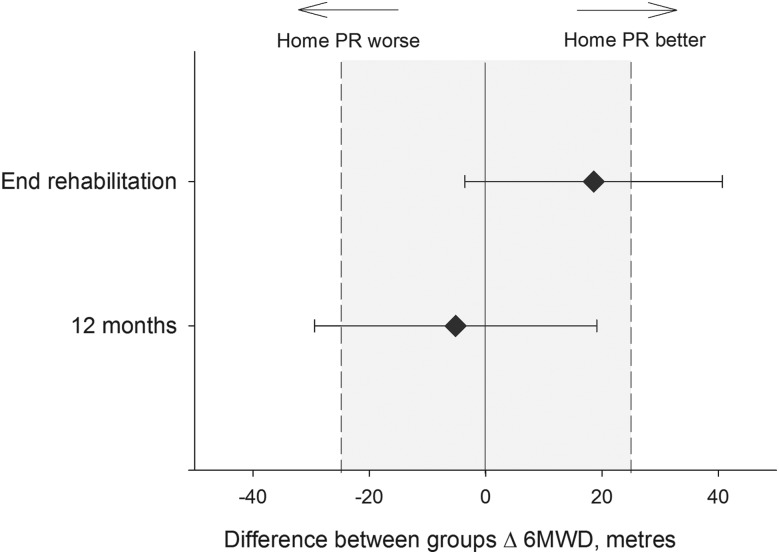
BACKGROUND: Pulmonary rehabilitation is a cornerstone of care for COPD but uptake of traditional centre-based programmes is poor. We assessed whether home-based pulmonary rehabilitation, delivered using minimal resources, had equivalent outcomes to centre-based pulmonary rehabilitation. METHODS: A randomised controlled equivalence trial with 12 months follow-up. Participants with stable COPD were randomly assigned to receive 8 weeks of pulmonary rehabilitation by either the standard outpatient centre-based model, or a new home-based model including one home visit and seven once-weekly telephone calls from a physiotherapist. The primary outcome was change in 6 min walk distance (6MWD). RESULTS: We enrolled 166 participants to receive centre-based rehabilitation (n=86) or home-based rehabilitation (n=80). Intention-to-treat analysis confirmed non-inferiority of home-based rehabilitation for 6MWD at end-rehabilitation and the confidence interval (CI) did not rule out superiority (mean difference favouring home group 18.6 m, 95% CI -3.3 to 40.7). At 12 months the CI did not exclude inferiority (-5.1 m, -29.2 to 18.9). Between-group differences for dyspnoea-related quality of life did not rule out superiority of home-based rehabilitation at programme completion (1.6 points, -0.3 to 3.5) and groups were equivalent at 12 months (0.05 points, -2.0 to 2.1). The per-protocol analysis showed the same pattern of findings. Neither group maintained postrehabilitation gains at 12 months. CONCLUSIONS: This home-based pulmonary rehabilitation model, delivered with minimal resources, produced short-term clinical outcomes that were equivalent to centre-based pulmonary rehabilitation. Neither model was effective in maintaining gains at 12 months. Home-based pulmonary rehabilitation could be considered for people with COPD who cannot access centre-based pulmonary rehabilitation. TRIAL REGISTRATION NUMBER: NCT01423227, clinicaltrials.gov.
Overview
The claims and statistics of this paper haven’t been checked yet.
Free: it reads the open-access text and checks the first 5 claims that cite a source we can check. Create a free account to check every claim.
Integrity signals
Registry
Cites
Statistics
Figures



Verification
Claims the paper makes
The claims and statistics of this paper haven’t been checked yet.
Free: it reads the open-access text and checks the first 5 claims that cite a source we can check. Create a free account to check every claim.
Claims other papers make about this one
Each is checked against this paper’s own text: does it say what the citing paper says it does?
The source backs part of the claim, not all of it — or backs it for a different population, condition or comparison.
In the citing paper
“Secondly, in order to remain comparable with previous literature, we followed the procedure of several previous studies that implemented PA counselling alongside standard care PR [10,12,13,15], of which pedometers were not provided to the control group.”
From Behavioural modification interventions alongside pulmonary rehabilitation improve COPD patients’ experiences of physical activity (2021) · cites this paper as [13]
Experimental — accuracy not yet measured
Self-check
Percentages, sums and reported differences re-computed from the paper’s own numbers.
The self-check needs the paper’s full text.
Citations
Cites
The Hospital Anxiety and Depression Scale
Zigmond, A. S., & Snaith, R. P. (1983) · Acta Psychiatrica Scandinavica · doi:10.1111/j.1600-0447.1983.tb09716.x · Cited by 47,139
Vestbo, J., Hurd, S. S., Agustí, A. G., Jones, P. W., Vogelmeier, C., Anzueto, A., Barnes, P. J., Fabbri, L. M., Martinez, F. J., Nishimura, M., et al. (2013) · American Journal of Respiratory and Critical Care Medicine · doi:10.1164/rccm.201204-0596pp · Cited by 15,983
Depression and quality of life in older persons: A review
Sivertsen, H., Bjørkløf, G. H., Engedal, K., Selbæk, G., & Helvik, A.-S. (2015) · Dementia and Geriatric Cognitive Disorders · doi:10.1159/000437299 · Cited by 14,152
Spruit, M. A., Singh, S. J., Garvey, C., ZuWallack, R., Nici, L., Rochester, C., Hill, K., Holland, A. E., Lareau, S. C., Man, W. D.-C., et al. (2013) · American Journal of Respiratory and Critical Care Medicine · doi:10.1164/rccm.201309-1634st · Cited by 3,938 · cited 2×
“17 The strengths of this study include a rigorous methodology, powering for equivalence and successful blinding of outcome assessors.”
MethodResultSelf-citationBestall, J. C., Paul, E. A., Garrod, R., Garnham, R., Jones, P. W., & Wedzicha, J. A. (1999) · Thorax · doi:10.1136/thx.54.7.581 · Cited by 2,927
Fit Yourself and Take Your Lungs to Heart
Palange, P., & Bonini, M. (2013) · Respiration · doi:10.1159/000350831 · Cited by 2,779
Pulmonary rehabilitation for chronic obstructive pulmonary disease
McCarthy, B., Casey, D., Devane, D., Murphy, K., Murphy, E., & Lacasse, Y. (2015) · Cochrane Database of Systematic Reviews · doi:10.1002/14651858.cd003793.pub3 · Cited by 2,643
Holland, A. E., Spruit, M. A., Troosters, T., Puhan, M. A., Pepin, V., Saey, D., McCormack, M. C., Carlin, B. W., Sciurba, F. C., Pitta, F., et al. (2014) · European Respiratory Journal · doi:10.1183/09031936.00150314 · Cited by 2,530
Self-citationPiaggio, G., Elbourne, D. R., Pocock, S. J., Evans, S. J. W., Altman, D. G., & CONSORT Group, F. T. (2012) · JAMA · doi:10.1001/jama.2012.87802 · Cited by 2,428
Comorbidities and Risk of Mortality in Patients with Chronic Obstructive Pulmonary Disease
Divo, M., Cote, C., de Torres, J. P., Casanova, C., Marin, J. M., Pinto-Plata, V., Zulueta, J., Cabrera, C., Zagaceta, J., Hunninghake, G., et al. (2012) · American Journal of Respiratory and Critical Care Medicine · doi:10.1164/rccm.201201-0034oc · Cited by 1,275
Research works printed but not linked: 1
- Marks, 2013, Monitoring pulmonary rehabilitation and long-term oxygen therapy for people with COPD in Australia: a discussion paper
Cited by
Rochester, C. L., Alison, J. A., Carlin, B., Jenkins, A. R., Cox, N. S., Bauldoff, G., Bhatt, S. P., Bourbeau, J., Burtin, C., Camp, P. G., et al. (2023) · American Journal of Respiratory and Critical Care Medicine · doi:10.1164/rccm.202306-1066st · Cited by 458
Self-citationDefining Modern Pulmonary Rehabilitation. An Official American Thoracic Society Workshop Report
Holland, A. E., Cox, N. S., Houchen-Wolloff, L., Rochester, C. L., Garvey, C., ZuWallack, R., Nici, L., Limberg, T., Lareau, S. C., Yawn, B. P., et al. (2021) · Annals of the American Thoracic Society · doi:10.1513/annalsats.202102-146st · Cited by 469
Self-citationTelerehabilitation for chronic respiratory disease
Cox, N. S., Dal Corso, S., Hansen, H., McDonald, C. F., Hill, C. J., Zanaboni, P., Alison, J. A., O'Halloran, P., Macdonald, H., & Holland, A. E. (2021) · Cochrane Database of Systematic Reviews · doi:10.1002/14651858.cd013040.pub2 · Cited by 326
Self-citationAustralian and New Zealand Pulmonary Rehabilitation Guidelines
Alison, J. A., McKeough, Z. J., Johnston, K., McNamara, R. J., Spencer, L. M., Jenkins, S. C., Hill, C. J., McDonald, V. M., Frith, P., Cafarella, P., et al. (2017) · Respirology · doi:10.1111/resp.13025 · Cited by 310
Self-citationCox, N. S., Oliveira, C. C., Lahham, A., & Holland, A. E. (2017) · Journal of Physiotherapy · doi:10.1016/j.jphys.2017.02.002 · Cited by 264
Self-citation
Metadata
- Authors
- Holland, A. E., Mahal, A., Hill, C. J., Lee, A. L., Burge, A. T., Cox, N. S., Moore, R., Nicolson, C., O'Halloran, P., Lahham, A., Gillies, R., & McDonald, C. F.
- Affiliations
- La Trobe University (AU)
- The University of Melbourne (AU)
- Institute for Breathing and Sleep (AU)
- Corresponding author
- Holland, Anne E
- ORCID
- Venue
- Thorax
- Publisher
- BMJ
- Published
- 2016-09-26
- Volume
- 72
- Issue
- 1
- Pages
- 57-65
- ISSN
- 0040-6376 (ISSN-L)
- 1468-3296
- PMC
- PMC5329049
- OpenAlex
- W2526766163
- Cited by
- 446
- References
- 36
- Citations by year
- 2026: 29 · 2025: 38 · 2024: 42 · 2023: 42 · 2022: 60 · 2021: 93 · 2020: 49 · 2019: 40 · 2018: 30 · 2017: 22 · 2016: 1
- FWCI
- 27.73
- Type
- journal article
- Language
- en
- Open access
- hybrid
- doi.org
- Licence
- cc-by-nc
- Locations
- Thorax (publishedVersion, cc-by-nc)
- PubMed Central (publishedVersion, cc-by-nc)
- PubMed (publishedVersion)
- eCite Digital Repository (University of Tasmania) (submittedVersion, cc-by-nc)
- Figshare (submittedVersion, cc-by-nc)
- Minerva Access (University of Melbourne) (submittedVersion, cc-by-nc)
- HighWire Press Open Archive (submittedVersion)
- La Trobe University
- Funders
- National Health and Medical Research Council (1046353)
- Lung Foundation Australia
- Topics
- Health Sciences › Medicine › Pulmonary and Respiratory Medicine › Chronic Obstructive Pulmonary Disease (COPD) Research
- Health Sciences › Medicine › Pulmonary and Respiratory Medicine › Respiratory Support and Mechanisms
- Health Sciences › Medicine › Pulmonary and Respiratory Medicine › Inhalation and Respiratory Drug Delivery
- Keywords
- chronic obstructive pulmonary disease, home-based pulmonary rehabilitation, 6-minute walk distance, non-inferiority, access to rehabilitation services
- MeSH terms
- Walk Test, Aged, Aged, 80 and over, Dyspnea, Female, Home Care Services, House Calls, Humans, Male, Middle Aged, Quality of Life, Rehabilitation Centers, Telephone, Therapeutic Equivalency, Single-Blind Method, Pulmonary Disease, Chronic Obstructive, Intention to Treat Analysis
About these checks
Registry, retraction, Cites and statistics results are computed, not judged, with one exception: a printed reference that no index lists is read once by a model before it counts as a citation error. Claims are extracted by a model and kept only when their quote appears verbatim in the text; each cited source is then checked, with a model’s help, for whether it says what the claim relies on. Those verdicts can be wrong — read the claim’s quote and the cited source before relying on one.
Statistics and arithmetic are recomputed, not judged.
Confidence bands are shown only for fields calibrated on our annotated test set. None is calibrated yet, so no band is shown.
What counts as a claim ›How we measure confidence ›How we check this ›
Are you an author, or do you see a problem with this page? Request a review
How to cite
Cite CoChat for the checks on this page, and the paper for its own findings.
- This page
- CoChat. (2026). Citation check: Home-based rehabilitation for COPD using minimal resources: a randomised, controlled equivalence trial. https://app.cochat.ai/papers/10.1136/thoraxjnl-2016-208514
- The paper
- Holland, A. E., Mahal, A., Hill, C. J., Lee, A. L., Burge, A. T., Cox, N. S., Moore, R., Nicolson, C., O'Halloran, P., Lahham, A., Gillies, R., & McDonald, C. F. (2017). Home-based rehabilitation for COPD using minimal resources: a randomised, controlled equivalence trial. Thorax. https://doi.org/10.1136/thoraxjnl-2016-208514
Data sources
Bibliographic data: Semantic Scholar, OpenAlex, Crossref.
Contains information from the Semantic Scholar Academic Graph Datasets, made available under the ODC Attribution License (ODC-BY 1.0).
Semantic Scholar’s data is described in: Kinney, R., et al. (2023). The Semantic Scholar Open Data Platform. arXiv:2301.10140.
