

EXTRA: An Exact First-Order Algorithm for Decentralized Consensus Optimization
Open accessThe DOI matches its Crossref record; 47 of the 47 references it cites were found in a registry or an index; 7 of the 19 sources its claims cite were checked for support.
Abstract
Recently, there has been growing interest in solving consensus optimization problems in a multiagent network. In this paper, we develop a decentralized algorithm for the consensus optimization problem $\mathrm{minimize}_{x\in\mathbb{R}^p}~\bar{f}(x)=\frac{1}{n}\sum_{i=1}^n f_i(x),$ which is defined over a connected network of $n$ agents, where each function $f_i$ is held privately by agent $i$ and encodes the agent's data and objective. All the agents shall collaboratively find the minimizer while each agent can only communicate with its neighbors. Such a computation scheme avoids a data fusion center or long-distance communication and offers better load balance to the network. This paper proposes a novel decentralized exact first-order algorithm (abbreviated as EXTRA) to solve the consensus optimization problem. “Exact” means that it can converge to the exact solution. EXTRA uses a fixed, large step size, which can be determined independently of the network size or topology. The local variable of every agent $i$ converges uniformly and consensually to an exact minimizer of $\bar{f}$. In contrast, the well-known decentralized gradient descent (DGD) method must use diminishing step sizes in order to converge to an exact minimizer. EXTRA and DGD have the same choice of mixing matrices and similar per-iteration complexity. EXTRA, however, uses the gradients of the last two iterates, unlike DGD which uses just that of the last iterate. EXTRA has the best known convergence rates among the existing synchronized first-order decentralized algorithms for minimizing convex Lipschitz--differentiable functions. Specifically, if the $f_i$'s are convex and have Lipschitz continuous gradients, EXTRA has an ergodic convergence rate $O(\frac{1}{k})$ in terms of the first-order optimality residual. In addition, as long as $\bar{f}$ is (restricted) strongly convex (not all individual $f_i$'s need to be so), EXTRA converges to an optimal solution at a linear rate $O(C^{-k})$ for some constant $C>1$.
Overview
CoChat Summary
TL;DR
EXTRA is a synchronous decentralized exact first-order algorithm for consensus optimization that can use a fixed step size independent of network size and converges to an exact solution. It achieves an ergodic O(1/k) rate for convex Lipschitz-differentiable objectives and a linear rate under restricted strong convexity.
Key findings
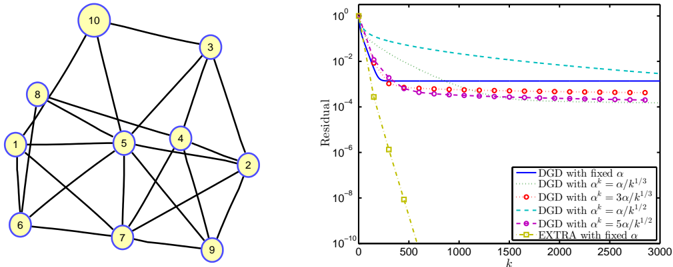
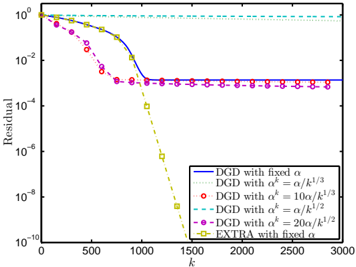
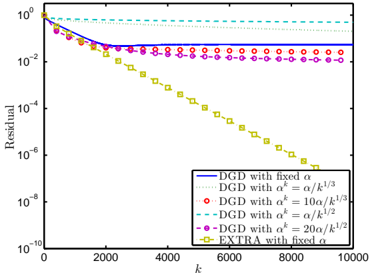
- EXTRA uses a fixed large step size and converges exactly, unlike DGD with a fixed step size, which stalls in an O(α)-neighborhood and requires diminishing step sizes for exact convergence.
- Under Assumptions 1–3 and step size \(0<\alpha<2\lambda_{\min}(\tilde W)/L_f\), the sequence \(z_k\) converges to an optimal \(z^*\), with contraction factor \(\zeta=1-\alpha L_f/(2\lambda_{\min}(\tilde W))\); running-average progress is \(O(1/k)\), running-best progress is \(o(1/k)\), and running-average optimality residuals are \(O(1/k)\).
- If \(g(x)=f(x)+\frac{1}{4\alpha}\|x\|^2_{\tilde W-W}\) is restricted strongly convex with constant \(\mu_g>0\), then with proper step size \(\alpha<2\mu_g\lambda_{\min}(\tilde W)/L_f^2\), \(\|z_k-z^*\|_G^2\) converges Q-linearly at \(O((1+\delta)^{-k})\), and \(\|x_k-x^*\|_{\tilde W}^2\) converges R-linearly at the same rate.
- Numerical experiments: in decentralized least squares with \(n=10\), \(m_i=1\), \(p=5\), connectivity ratio \(r=0.5\), \(L_f=1\), and \(\|x^*-x_0\|=300\), DGD with fixed step size and EXTRA show similar linear convergence for the first 200 iterations, after which DGD slows and stalls while EXTRA continues. In decentralized logistic regression with \(n=200\), \(r=0.2\), \(m_i=10\), \(p=20\), and 2000 samples, EXTRA outperforms DGD and shows linear exact convergence.
Methods
- Design: a synchronous decentralized first-order algorithm where each agent holds a local copy \(x^{(i)}\) and communicates only with neighbors; EXTRA is derived by taking the difference of two DGD updates and uses gradients of the last two iterates.
- Data/sample: numerical tests on decentralized least squares, decentralized robust least squares with Huber loss, and decentralized logistic regression over randomly generated connected networks.
- Analysis: convergence is established under mixing-matrix assumptions, convex Lipschitz-differentiable objectives, and solution existence; rates are derived via a contraction recursion, ergodic averaging, and restricted strong convexity.
Limitations
- The paper states EXTRA is “far from perfect” and that more work is needed to adapt it to asynchronous and dynamic network settings; these are left as open questions.
- The paper notes it is open whether \(\|z_k-z_{k+1}\|_G^2\) is monotonic; if monotonicity could be shown, the rates would hold for the last point in the running sequence. It also states that proving linear convergence under the numerically observed larger step size \(O(1/L_f)\) remains open.
- The paper states that determining \(\mu_g\) or a lower bound is tricky except when each \(f_i\) is restricted strongly convex, and that deriving an optimal step size and explicit linear rate is “quite tricky and messy.” The numerical results are described as preliminary.
Model-written summary. Check it against the paper before relying on it.
Integrity signals
Registry
Cites
Statistics
Figures
Verification
Claims the paper makes
6 Valid · 1 Not valid · 9 Not checked · 58 Own results and interpretations
At least one cited source doesn’t support this claim or points to a different paper, and none confirmed it — see the verdicts below.
In the paper
“On the other hand, properly reducing α k enables exact convergence , namely, that each x k ( i ) converges to the same exact solution.”
What the sources say
- Misattributedcites [36] [36] K. Yuan, Q. Ling, and W. Yin , On the Convergence of Decentralized Gradient Descent , arXiv preprint arXiv:1310.7063, (2013). 1.1, 2.1, 2.4, 4.1, 4.1, 4.2, 4.3 - sourceExperimental — accuracy not yet measured
Our copy disclaims the diminishing-stepsize result for itself: §1.3 (Contribution and notation) states 'Since our analysis uses a fixed stepsize, the local solutions will not be asymptotically consensual. To adapt our analysis to diminishing stepsizes, significant changes will be needed,' and every rate in Theorems 2-3 and Remarks 1-3 lands in an O(alpha/(1-beta))-neighborhood rather than the exact solution. The only place the paper states the claim's point is §1.2 (Related methods): 'Convergence to x* can be achieved by using diminishing stepsizes in [8,11,29] at the price of slower rates of convergence' — i.e., it credits exact convergence under diminishing stepsizes to other works it cites, without reporting or relying on it. Reference [8] in our copy is Duchi, Agarwal and Wainwright, 'Dual averaging for distributed optimization: convergence analysis and network scaling,' IEEE TAC 57 (2012) (with [11] Jakovetic, Xavier, Moura and [29] also credited). (LLM, conf=0.82) It matches “Dual averaging for distributed optimization: convergence analysis and network scaling” (2012) instead.
Checked by a reasoning model — may be wrong.
plainstates a cause- Asserted: passes — The authors put it forward as true.
- Checkable: passes — It can be checked against evidence.
- Load-bearing: passes — The paper’s conclusions depend on it.
- Based: passes — The paper gives a reason why it holds.
- Misattributed
Every source the paper cites for this claim was checked and supports it.
In the paper
“In contrast, the well-known decentralized gradient descent (DGD) method must use diminishing step sizes in order to converge to an exact minimizer.”
- Also stated in: § EXTRA: AN EXACT FIRST-ORDER ALGORITHM FOR DECENTRALIZED CONSENSUS OPTIMIZATION ∗ · p. 4 · plain
“properly reducing α k enables exact convergence , namely, that each x k ( i ) converges to the same exact solution.”
What the sources say
- Supportedcites [36] [36] K. Yuan, Q. Ling, and W. Yin , On the Convergence of Decentralized Gradient Descent , arXiv preprint arXiv:1310.7063, (2013). 1.1, 2.1, 2.4, 4.1, 4.1, 4.2, 4.3 - source
Section 1.2 (Related methods) states that with a fixed stepsize the listed algorithms 'and iteration (4) in particular' converge to a neighborhood of x* rather than x* itself, and that convergence to x* can be achieved by using diminishing stepsizes (at the price of slower rates) — exactly the necessity the claim attributes. Section 1.3 reinforces this: 'Since our analysis uses a fixed stepsize, the local solutions will not be asymptotically consensual,' and the Abstract/Theorems 2-3 give only O(α/(1-β))-neighborhood landing levels for fixed α. The only mild caveat is that the diminishing-stepsize exact-convergence results are credited to references [8,11,29] rather than proved here for iteration (4), but the paper's own statement of the fixed-stepsize limitation for DGD covers the claim. (LLM, conf=0.85)
boostedstates a cause- Asserted: passes — The authors put it forward as true.
- Checkable: passes — It can be checked against evidence.
- Load-bearing: passes — The paper’s conclusions depend on it.
- Based: passes — The paper gives a reason why it holds.
- Also stated in: § EXTRA: AN EXACT FIRST-ORDER ALGORITHM FOR DECENTRALIZED CONSENSUS OPTIMIZATION ∗ · p. 4 · plain
Every source the paper cites for this claim was checked and supports it.
In the paper
“(iii) min t ≤ k { a t } = o ( 1 k ) .”
What the sources say
- Supportedcites [6] [6] D. Davis and W. Yin , Convergence Rates of Splitting Algorithms for Optimization . arXiv preprint arXiv:1406.4834, 2014. 1 - source
Section 2 ('Summable sequence convergence lemma', Lemma 3, p. 8) states Part 4 'No monotonicity', defining the best-so-far sequence and asserting that '(a_j^best) is monotonically nonincreasing and the above bounds continue to hold when a_k is replaced with a_k^best', while the Part 1a proof on the same page gives a_k = o(1/(Λ_k − Λ_⌈k/2⌉)) = o(1/(k+1)) when (λ_j) is bounded away from 0 (i.e. unweighted summability). Together these yield exactly the claim: a nonnegative sequence with finite sum has running minimum o(1/k) (the source writes o(1/(k+1)), the same rate up to index shift). The remark on p. 9 confirms the setting — Part 1 generalizes the known result that a nonnegative, summable, monotonic sequence converges at o(1/(k+1)) — and p. 12 applies Lemma 3 to a running minimum, min_{i=0,…,k}{‖e_i‖}. (LLM, conf=0.85)
plainstates a cause- Asserted: passes — The authors put it forward as true.
- Checkable: passes — It can be checked against evidence.
- Load-bearing: passes — The paper’s conclusions depend on it.
- Based: passes — The paper gives a reason why it holds.
- Supported
A conclusion the paper draws from its own results — it cites no other source for it, so there is none to check. The quote shows it is in the paper.
In the paper
“An EXTRA update is, therefore, a DGD update with a cumulative correction term.”
plainstates a cause- Asserted: passes — The authors put it forward as true.
- Checkable: passes — It can be checked against evidence.
- Load-bearing: passes — The paper’s conclusions depend on it.
- Based: passes — The paper gives a reason why it holds.
A conclusion the paper draws from its own results — it cites no other source for it, so there is none to check. The quote shows it is in the paper.
In the paper
“In this subsection we prove that EXTRA with a proper step size reaches linear convergence if the original objective ¯ f is restricted strongly convex.”
plainstates a cause- Asserted: passes — The authors put it forward as true.
- Checkable: passes — It can be checked against evidence.
- Load-bearing: passes — The paper’s conclusions depend on it.
- Based: passes — The paper gives a reason why it holds.
31 more claims
Create a free account to see all 74 claims and to verify the 7 references still open.
- Probably not a substantial claim. 21
- It may state two separate claims as one. 26
- The quote only partly states this claim. 1
Claims other papers make about this one
Each is checked against this paper’s own text: does it say what the citing paper says it does?
The source backs part of the claim, not all of it — or backs it for a different population, condition or comparison.
In the citing paper
“EXTRA converges at an o (1 /k ) rate when the objective function in (1) is convex, and it has a Q-linear rate when the objective function is strongly convex.”
From Achieving Geometric Convergence for Distributed Optimization Over Time-Varying Graphs (2017) · cites this paper as [62]
Experimental — accuracy not yet measuredThe cited source says what the claim attributes to it.
In the citing paper
“Proposition 1 ( [62]). Assume null { I -W } = span { 1 } where W ∈ R n × n . If x ∗ satisfies conditions: (i) x ∗ = Wx ∗ (consensus), (ii) 1 ⊤ ∇ f ( x ∗ ) = 0 (optimality), then the rows of x ∗ are the same as each other and the transpose of each row is an optimal solution of the problem (1) .”
From Achieving Geometric Convergence for Distributed Optimization Over Time-Varying Graphs (2017) · cites this paper as [62]
Self-check
Percentages, sums and reported differences re-computed from the paper’s own numbers.
Each contradiction between two passages listed here was confirmed by an independent check.
Rated minor: it would not touch a result — a value no result rests on, a p-value that stays on the same side of the significance level, or a conflict that is clerical, resolved elsewhere in the paper, or outside its own findings.
In the paper
§ Algorithm 1: EXTRA · p. 9
“null { U } = (span { 1 } ) ⊥”
§ Algorithm 1: EXTRA · p. 7
“null { W -˜ W } = span { 1 } , null { I -˜ W } ⊇ span { 1 } .”
Citations
Cites
Distributed Subgradient Methods for Multi-Agent Optimization
Nedic, A., & Ozdaglar, A. (2009) · IEEE Transactions on Automatic Control · doi:10.1109/tac.2008.2009515 · Cited by 3,719 · cited 1×
“1) include the (sub)gradient method [21, 25, 36], the (sub)gradient-push method [23, 24], the fast (sub)gradient method [5, 14], and the dual averaging method [8].”
MethodFast linear iterations for distributed averaging
Xiao, L., & Boyd, S. (2004) · Systems & Control Letters · doi:10.1016/j.sysconle.2004.02.022 · Cited by 2,706
Distributed Optimization Over Time-Varying Directed Graphs
Nedic, A., & Olshevsky, A. (2015) · IEEE Transactions on Automatic Control · doi:10.1109/tac.2014.2364096 · Cited by 1,187
Distributed average consensus with least-mean-square deviation
Xiao, L., Boyd, S., & Kim, S.-J. (2007) · Journal of Parallel and Distributed Computing · doi:10.1016/j.jpdc.2006.08.010 · Cited by 1,107
Optimal decentralized protocol for electric vehicle charging
Gan, L., Topcu, U., & Low, S. H. (2013) · IEEE Transactions on Power Systems · doi:10.1109/tpwrs.2012.2210288 · Cited by 997
Dual Averaging for Distributed Optimization: Convergence Analysis and Network Scaling
Duchi, J. C., Agarwal, A., & Wainwright, M. J. (2012) · IEEE Transactions on Automatic Control · doi:10.1109/tac.2011.2161027 · Cited by 947
On the Linear Convergence of the ADMM in Decentralized Consensus Optimization
Shi, W., Ling, Q., Yuan, K., Wu, G., & Yin, W. (2014) · IEEE Transactions on Signal Processing · doi:10.1109/tsp.2014.2304432 · Cited by 820
Self-citationDistributed Stochastic Subgradient Projection Algorithms for Convex Optimization
Sundhar Ram, S., Nedić, A., & Veeravalli, V. V. (2010) · Journal of Optimization Theory and Applications · doi:10.1007/s10957-010-9737-7 · Cited by 814 · cited 1×
“1) has additional constraints that force x into a bounded set, which also leads to bounded (sub)gradients and a Hessian, projected first-order algorithms are applicable [27, 37].”
BackgroundOn Distributed Convex Optimization Under Inequality and Equality Constraints
Zhu, M., & Martinez, S. (2012) · IEEE Transactions on Automatic Control · doi:10.1109/tac.2011.2167817 · Cited by 759
Fastest Mixing Markov Chain on a Graph
Boyd, S., Diaconis, P., & Xiao, L. (2004) · SIAM Review · doi:10.1137/s0036144503423264 · Cited by 744
Research works printed but not linked: 3
- [5] I. Chen , Fast Distributed First-Order Methods , master's thesis, Department of Electrical Engineering and Computer Science, Massachusetts Institute of Technology, 2012. 1.1, 2.1, 2.4, 4.1 -
- [15] B. Johansson , On Distributed Optimization in Networked Systems , PhD thesis, KTH, 2008. 1 -
- [31] J. Tsitsiklis , Problems in Decentralized Decision Making and Computation , PhD thesis, Department of Electrical Engineering and Computer Science, Massachusetts Institute of Technology, 1984. 2.4 -
Cited by
Items 501–600 of 1,315
Li, B., Cen, S., Chen, Y., & Chi, Y. (2019) · arXiv (Cornell University) · doi:10.48550/arxiv.1909.05844 · Cited by 134
Decentralized Accelerated Gradient Methods With Increasing Penalty ParametersPreprint
Li, H., Fang, C., Yin, W., et al. (2018) · arXiv (Cornell University) · doi:10.48550/arxiv.1810.01053 · Cited by 11
Self-citationFast decentralized non-convex finite-sum optimization with recursive variance reductionPreprint
Xin, R., Khan, U. A., & Kar, S. (2020) · arXiv (Cornell University) · doi:10.48550/arxiv.2008.07428 · Cited by 11
“For example, a stochastic variant of EXTRA [36], Exact Diffusion [54], and NIDS [19], called D2 [40], removes the bounded dissimilarity assumption in DSGD based on a bias-correction principle.”
DJAM: Distributed Jacobi asynchronous method for learning personal models
Almeida, I., & Xavier, J. (2018) · IEEE Signal Processing Letters · doi:10.1109/lsp.2018.2859596 · Cited by 10
“They use techniques ranging from distributed (sub)gradient descent [4], [5] to more elaborate techniques such as EXTRA [6], distributed ADMM [7], [8], dual averaging [9], and distributed Augmented Lagrangean (AL) [10].”
ADMM for Dynamic Average Consensus over Imperfect Networks
Bastianello, N., & Carli, R. (2022) · IFAC-PapersOnLine · doi:10.1016/j.ifacol.2022.07.264 · Cited by 10
Zhao, Y., Liao, X., & He, X. (2023) · IEEE Transactions on Control of Network Systems · doi:10.1109/tcns.2023.3237496 · Cited by 10
Naderi, S., & Blondin, M. J. (2023) · IEEE Access · doi:10.1109/access.2023.3341295 · Cited by 14
Huang, Y., Meng, Z., & Sun, J. Q. (2024) · IEEE Transactions on Systems Man and Cybernetics Systems · doi:10.1109/tsmc.2024.3405453 · Cited by 10
Distributed Stochastic Projection-Free Algorithm for Constrained Optimization
Jiang, X., Zeng, X., Xie, L., et al. (2024) · IEEE Transactions on Automatic Control · doi:10.1109/tac.2024.3481040 · Cited by 10
“Mostdistributed algorithmsarebuiltontheaverageconsensusideatofinda solutionofanoptimizationproblem[5],[6],[7],[8].”
Distributed Optimization over General Directed Networks with Random Sleep Scheme
Wang, Z., Zheng, L., & Li, H. (2020) · International Journal of Control Automation and Systems · doi:10.1007/s12555-018-9543-9 · Cited by 10
The Barzilai–Borwein Method for distributed optimization over unbalanced directed networks
Hu, J., Chen, X., Zheng, L., Zhang, L., & Li, H. (2021) · Engineering Applications of Artificial Intelligence · doi:10.1016/j.engappai.2020.104151 · Cited by 13
Distributed Resource Allocation Over Time-Varying Balanced Digraphs With Discrete-Time Communication
Su, L., Li, M., Gupta, V., & Chesi, G. (2021) · IEEE Transactions on Control of Network Systems · doi:10.1109/tcns.2021.3112770 · Cited by 13
On the Decentralized Stochastic Gradient Descent With Markov Chain Sampling
Sun, T., Li, D., & Wang, B. (2023) · IEEE Transactions on Signal Processing · doi:10.1109/tsp.2023.3297053 · Cited by 16
Tian, Y., & How, J. P. (2023) · IEEE Transactions on Robotics · doi:10.1109/tro.2023.3327635 · Cited by 9
Exact spectral-like gradient method for distributed optimization
Jakovetić, D., Krejić, N., & Jerinkić, N. K. (2019) · Computational Optimization and Applications · doi:10.1007/s10589-019-00131-8 · Cited by 11
On the Exponential Convergence Rate of Proximal Gradient Flow Algorithms
Hassan-Moghaddam, S., & Jovanović, M. R. (2018) · Proceedings of the IEEE Conference on Decision & Control, including the Symposium on Adaptive Processes · doi:10.1109/cdc.2018.8618968 · Cited by 10
Event-Triggered Consensus-Based Optimization Algorithm for Smooth and Strongly Convex Cost Functions
Hayashi, N., Sugiura, T., Kajiyama, Y., & Takai, S. (2018) · IEEE Conference on Decision and Control (CDC) · doi:10.1109/cdc.2018.8618863 · Cited by 12
Distributed Low-rank Matrix Factorization With Exact Consensus
Zhu, Z., Li, Q., Yang, X., Tang, G., & Wakin, M. B. (2019) · neural information processing systems · Cited by 23
Graph Simplification-Aided ADMM for Decentralized Composite Optimization
Wang, B., Fang, J., Duan, H., & Li, H. (2019) · IEEE Transactions on Cybernetics · doi:10.1109/tcyb.2019.2953538 · Cited by 11
“Note that for other methods, such as the PG-EXTRA [30] and the distributed linearized ADMM [35], the number of messages being exchanged among nodes per iteration is the same as that of our proposed algorithm.”
Decentralized Stochastic Non-Convex Optimization over Weakly Connected Time-Varying Digraphs
Lu, S., & Wu, C. W. (2020) · IEEE International Conference on Acoustics Speech and Signal Processing · doi:10.1109/icassp40776.2020.9053238 · Cited by 20
Distributed accelerated optimization algorithms: Insights from an ODE
Chen, R., Yang, T., & Chai, T. (2020) · Science China Technological Sciences · doi:10.1007/s11431-020-1596-8 · Cited by 10
Hu, J., Xia, D., Cheng, H., Feng, L., Ji, L., Guo, J., & Li, H. (2020) · Asian Journal of Control · doi:10.1002/asjc.2483 · Cited by 10
“There have been some remarkable works, including ADMM [15], EXTRA [16], and PG-EXTRA [17].”
MethodResultConvergence of an accelerated distributed optimisation algorithm over time‐varying directed networks
Hu, J., Yan, Y., Li, H., Wang, Z., Xia, D., & Guo, J. (2020) · IET Control Theory and Applications · doi:10.1049/cth2.12022 · Cited by 10
A Unified Algorithmic Framework for Distributed Composite Optimization
Xu, J., Tian, Y., Sun, Y., & Scutari, G. (2020) · IEEE Conference on Decision and Control (CDC) · doi:10.1109/cdc42340.2020.9303791 · Cited by 10
Yi, P., & Li, L. (2021) · Journal of Systems Science and Complexity · doi:10.1007/s11424-020-0071-3 · Cited by 12
S-NEAR-DGD: A Flexible Distributed Stochastic Gradient Method for Inexact Communication
Iakovidou, C., & Wei, E. (2022) · IEEE Transactions on Automatic Control · doi:10.1109/tac.2022.3151734 · Cited by 13
Inexact Primal-Dual Algorithm for DMPC With Coupled Constraints Using Contraction Theory
Su, Y., Shi, Y., & Sun, C. (2021) · IEEE Transactions on Cybernetics · doi:10.1109/tcyb.2021.3080818 · Cited by 11
“A natural choice for solving such a distributed consensus-based optimization problem (DCOP) is the primal-dual method, which provides a unified framework not only for representing most existing first-order methods [16], [17] but also for facilitating the derivation of some novel meth-ods [18], [19].”
Adaptive Stochastic ADMM for Decentralized Reinforcement Learning in Edge IoT
Lei, W., Ye, Y., Xiao, M., Skoglund, M., & Han, Z. (2022) · IEEE Internet of Things Journal · doi:10.1109/jiot.2022.3187067 · Cited by 12
Two-Step Fixed-Point Proximity Algorithms for Multi-block Separable Convex Problems
Qia, L., Xu, Y., & Zhang, N. (2016) · Journal of Scientific Computing · doi:10.1007/s10915-016-0278-6 · Cited by 9
“To this end, we first review a lemma presented in [31].”
Hamedani, E. Y., & Aybat, N. S. (2017) · Allerton Conference on Communication, Control, and Computing · doi:10.1109/allerton.2017.8262781 · Cited by 11
Distributed Second-Order Methods With Increasing Number of Working Nodes
Jerinkić, N. K., Jakovetić, D., Krejić, N., & Bajović, D. (2019) · IEEE Transactions on Automatic Control · doi:10.1109/tac.2019.2922191 · Cited by 10
“on Context and motivation. The problem of distributed minimization of a sum of nodes’ local costs across a (connected) network has received a signicant and growing interest in the past decade, e.g., [17, 10, 20, 14]. Such problem arises in various application domains, including wireless sensor networks, e.g., [23], sm…”
An Exponentially Convergent Primal-Dual Algorithm for Nonsmooth Composite Minimization
Ding, D., Hu, B., Dhingra, N. K., et al. (2018) · Proceedings of the IEEE Conference on Decision & Control, including the Symposium on Adaptive Processes · doi:10.1109/cdc.2018.8619760 · Cited by 10
Jiang, X., Zeng, X., Sun, J. Q., & Chen, J. (2020) · IEEE Transactions on Cybernetics · doi:10.1109/tcyb.2020.2989835 · Cited by 11
On Nonconvex Decentralized Gradient DescentPreprint
Zeng, J., & Yin, W. (2016) · arXiv (Cornell University) · doi:10.48550/arxiv.1608.05766 · Cited by 10
“When fi’s are convex, the existing algorithms include the (sub)gradient methods [5], [6], [10], [13], [15], [23], [27], and the primaldual domain methods such as the decentralized alternating direction method of multipliers (DADMM) [19], [20] and EXTRA [21], [22].”
InfluentialSelf-citationWalkman: A Communication-Efficient Random-Walk Algorithm for Decentralized OptimizationPreprint
Mao, X., Yuan, K., Hu, Y., et al. (2018) · arXiv (Cornell University) · doi:10.48550/arxiv.1804.06568 · Cited by 10
“This approach includes well-known algorithms such as diffusion [5], [6] and consensus [11], [12], distributed ADMM (D-ADMM) [13]–[15], EXTRA [16], PG-EXTRA [17], DIGing [18], exact diffusion [19], NIDS [20], and beyond.”
BackgroundMethodSelf-citationGraph-Dependent Implicit Regularisation for Distributed Stochastic Subgradient DescentPreprint
Richards, D., & Rebeschini, P. (2018) · arXiv (Cornell University) · doi:10.48550/arxiv.1809.06958 · Cited by 12
“…setting that we consider, which includes Johansson et al. (2007); Nedic and Ozdaglar (2009); Nedi´c et al. (2009); Johansson et al. (2009); Ram et al. (2010); Lobel and Ozdaglar (2011); Matei and Baras (2011); Boyd et al. (2011); Duchi et al. (2012); Shi et al. (2015); Mokhtari and Ribeiro (2016).”
Gradient-Free Nash Equilibrium Seeking in N-Cluster Games with Uncoordinated Constant Step-SizesPreprint
Pang, Y., & Hu, G. (2020) · arXiv (Cornell University) · doi:10.48550/arxiv.2008.13088 · Cited by 10
Removing Data Heterogeneity Influence Enhances Network Topology Dependence of Decentralized SGDPreprint
Yuan, K., Alghunaim, S. A., & Huang, X. (2021) · arXiv (Cornell University) · doi:10.48550/arxiv.2105.08023 · Cited by 37
“The proof of the above lemma is simple and can be referred to [39, Lemma 3.1].”
BackgroundMethodInfluentialBlueFog: Make Decentralized Algorithms Practical for Optimization and Deep LearningPreprint
Ying, B., Yuan, K., Hu, H., Chen, Y., & Yin, W. (2021) · arXiv (Cornell University) · doi:10.48550/arxiv.2111.04287 · Cited by 35
Self-citationByzantine-Robust Decentralized Learning via Remove-then-Clip Aggregation
Yang, C., & Ghaderi, J. (2024) · Proceedings of the AAAI Conference on Artificial Intelligence · doi:10.1609/aaai.v38i19.30173 · Cited by 25
Distributed Quasi-Newton Method for Multi-Agent Optimization
Shorinwa, O., & Schwager, M. (2024) · IEEE Transactions on Signal Processing · doi:10.1109/tsp.2024.3424436 · Cited by 15
Liu, H., Yu, W., Wen, G., et al. (2024) · IEEE Transactions on Control of Network Systems · doi:10.1109/tcns.2024.3469048 · Cited by 9
“Togetaclearoverviewofthestateoftheart,TableI presentsadetailedcomparisonoftheresultsin[10],[11],[12], [13], [14], [15], [16], [17], [18], [19], [20], [21], [22], [23], [24], [25], [26], and [27].”
Lin, Y., Li, W., Zhang, B., & Du, J. (2024) · IEEE Transactions on Automatic Control · doi:10.1109/tac.2024.3492329 · Cited by 13
“First, the error is corrected by a cumulative correction term in EXTRA [8].”
Yang, Z., He, W., & Yang, S. (2025) · IEEE Transactions on Signal Processing · doi:10.1109/tsp.2025.3544517 · Cited by 13
“By decomposing the large-scale optimization problem into sequences of smaller ones, distributed algorithms have achieved impressive results [5], [6], [7], [8], [9], [10], [11].”
Exact diffusion strategy for optimization by networked agents
Yuan, K., Ying, B., Zhao, X., & Sayed, A. H. (2017) · European Signal Processing Conference (EUSIPCO) · doi:10.23919/eusipco.2017.8081185 · Cited by 7
ET-DASG: An Efficient Decentralized Algorithm for Convex Optimization Over Networks
Lü, Q., Liao, X., Deng, S., & Li, H. (2022) · IEEE Transactions on Network Science and Engineering · doi:10.1109/tnse.2022.3153386 · Cited by 10
A Decentralized Primal-Dual Framework for Non-Convex Smooth Consensus Optimization
Mancino-Ball, G., Xu, Y., & Chen, J. (2023) · IEEE Transactions on Signal Processing · doi:10.1109/tsp.2023.3239799 · Cited by 27
“Recent works such as 𝐷 2 [31], DSGT [32], and D-GET [11] make use of stochastic gradient updates mixed with a gradient tracking scheme and draw inspiration from their non-stochastic and centralized counterparts [6], [33].”
BackgroundMethodInfluentialNabla Fractional Distributed Optimization Algorithm Over Unbalanced Graphs
Hong, X., Wei, Y., Zhou, S., et al. (2024) · IEEE Control Systems Letters · doi:10.1109/lcsys.2024.3367917 · Cited by 9
“In terms of temporal characteristics, the current approaches for solving distributed optimization problems can be grouped into two main categories: discrete-time algorithms [2], [3], [4], [5], [6] and continuous-time algorithms [7], [8], [9].”
BackgroundFast distributed optimization over directed graphs
Xi, C., Wu, Q., & Khany, U. A. (2016) · Proceedings of the ... American Control Conference/Proceedings of the American Control Conference · doi:10.1109/acc.2016.7526694 · Cited by 9
Systematic Design of Decentralized Algorithms for Consensus Optimization
Han, S. (2019) · IEEE Control Systems Letters · doi:10.1109/lcsys.2019.2920342 · Cited by 12
“This includes, among others, the distributed gradient descent method [10] (which is, in fact, decentralized despite its name), DIGing [9], [14], and EXTRA [15].”
Multi-cluster distributed optimization via random sleep strategy
Shi, C., & Yang, G. (2019) · Journal of the Franklin Institute · doi:10.1016/j.jfranklin.2019.03.021 · Cited by 11
Regularized Diffusion Adaptation via Conjugate Smoothing
Vlaski, S., Vandenberghe, L., & Sayed, A. H. (2021) · IEEE Transactions on Automatic Control · doi:10.1109/tac.2021.3081073 · Cited by 9
Zimmermann, J., Tatarenko, T., Willert, V., & Adamy, J. (2020) · IEEE Conference on Decision and Control (CDC) · doi:10.1109/cdc42340.2020.9304360 · Cited by 12
Distributed Learning Systems with First-order Methods
Liu, J., & Zhang, C. (2020) · doi:10.1561/9781680837018 · Cited by 11
Accelerating local SGD for non-IID data using variance reduction
Liang, X., Shen, S., Chen, E., Liu, J., Liu, Q., Cheng, Y., & Pan, Z. (2022) · Frontiers of Computer Science · doi:10.1007/s11704-021-1018-0 · Cited by 11
Decentralized ADMM with compressed and event-triggered communication
Zhang, Z., Yang, S., & Xu, W. (2023) · Neural Networks · doi:10.1016/j.neunet.2023.06.001 · Cited by 13
A Communication-Efficient Decentralized Newton's Method With Provably Faster Convergence
Liu, H., Zhang, J., So, A. M., & Ling, Q. H. (2023) · IEEE Transactions on Signal and Information Processing over Networks · doi:10.1109/tsipn.2023.3290397 · Cited by 16
Self-citationA Chebyshev-Accelerated Primal-Dual Method for Distributed Optimization
Seidman, J. H., Fazlyab, M., Pappas, G. J., & Preciado, V. M. (2018) · IEEE Conference on Decision and Control (CDC) · doi:10.1109/cdc.2018.8618899 · Cited by 8
Gradient-Free Multi-Agent Nonconvex Nonsmooth Optimization
Hajinezhad, D., & Zavlanos, M. M. (2018) · IEEE Conference on Decision and Control (CDC) · doi:10.1109/cdc.2018.8619333 · Cited by 9
Distributed Algorithms for Solving Locally Coupled Optimization Problems on Agent Networks
Hu, J., Xiao, Y., & Liu, J. (2018) · IEEE Conference on Decision and Control (CDC) · doi:10.1109/cdc.2018.8619467 · Cited by 8
Revisiting EXTRA for Smooth Distributed OptimizationPreprint
Li, H., & Lin, Z. (2020) · arXiv (Cornell University) · doi:10.48550/arxiv.2002.10110 · Cited by 9
Dual-Free Stochastic Decentralized Optimization with Variance ReductionPreprint
Hendrikx, H., Bach, F., & Massoulié, L. (2020) · arXiv (Cornell University) · doi:10.48550/arxiv.2006.14384 · Cited by 20
“Note that the parameters of accelerated DVR can also be set such that T ε = ˜ O √ κ comm m + τ/ √ γ log ε − 1 , which recovers the convergence rate of optimal batch algorithms, but loses the finite-sum speedup.”
InfluentialAccelerated Gradient Tracking over Time-varying Graphs for Decentralized OptimizationPreprint
Li, H., & Lin, Z. (2021) · arXiv (Cornell University) · doi:10.48550/arxiv.2104.02596 · Cited by 42
“Besides gradient tracking, EXTRA is another important family of decentralized optimization algorithms.”
InfluentialOn the Convergence Properties of a Distributed Projected Subgradient Algorithm
Li, W., Chen, Z., Lou, Y., & Hong, Y. (2023) · IEEE Transactions on Automatic Control · doi:10.1109/tac.2023.3284599 · Cited by 9
Regret Analysis of Distributed Online LQR Control for Unknown LTI Systems
Chang, T.-J., & Shahrampour, S. (2023) · IEEE Transactions on Automatic Control · doi:10.1109/tac.2023.3299551 · Cited by 8
Sebastián, E., Franceschelli, M., Gasparri, A., Montijano, E., & Sagüés, C. (2024) · IEEE Control Systems Letters · doi:10.1109/lcsys.2024.3400699 · Cited by 11
Distributed Optimization and Scaling Design for Solving Sylvester Equations
Cheng, S., Yu, X., Zeng, X., et al. (2024) · Journal of Systems Science and Complexity · doi:10.1007/s11424-024-3407-6 · Cited by 8
“Remark 5.1 In network systems with connected and undirected graphs, there are some existing methods, including the Laplacian-based method and the Metropolis-based method, for the agents to construct doubly stochastic matrix by local information exchange [42] .”
InfluentialMulti-agent Online Optimization
Yuan, D., Proutière, A., & Shi, G. (2024) · Foundations and Trends® in Optimization · doi:10.1561/2400000037 · Cited by 18
Distributed Economic Dispatch Algorithms of Microgrids Integrating Grid-Connected and Isolated Modes
Liu, Z., Zhang, Y., Zhang, Y., & Wang, F. (2025) · IEEE/CAA Journal of Automatica Sinica · doi:10.1109/jas.2024.124695 · Cited by 12
Sun, Y., & Shahrampour, S. (2020) · IEEE Control Systems Letters · doi:10.1109/lcsys.2020.3040934 · Cited by 8
“Therefore, a number of works (see e.g., [10]–[13]) have proposed the idea of gradient tracking to overcome this hurdle.”
BackgroundDecentralized Learning With Lazy and Approximate Dual Gradients
Liu, Y., Sun, Y., & Yin, W. (2021) · IEEE Transactions on Signal Processing · doi:10.1109/tsp.2021.3056915 · Cited by 12
Self-citationSNAP: A Communication Efficient Distributed Machine Learning Framework for Edge Computing
Zhao, Y., Fan, J., Su, L., Song, T., Wang, S., & Qiao, C. (2020) · IEEE International Conference on Distributed Computing Systems (ICDCS) · doi:10.1109/icdcs47774.2020.00072 · Cited by 13
“This is used in many multi-agent collaboration works [18], [21], [22].”
InfluentialLin, Y., Shames, I., & Nešić, D. (2021) · IEEE Transactions on Control of Network Systems · doi:10.1109/tcns.2021.3065644 · Cited by 11
DN-ADMM: Distributed Newton ADMM for Multi-agent Optimization
Li, Y., Freris, N. M., Voulgaris, P. G., & Stipanović, D. M. (2021) · IEEE Conference on Decision and Control (CDC) · doi:10.1109/cdc45484.2021.9683317 · Cited by 10
Variance Reduction-Boosted Byzantine Robustness in Decentralized Stochastic Optimization
Peng, J., Li, W., & Ling, Q. H. (2022) · IEEE International Conference on Acoustics Speech and Signal Processing · doi:10.1109/icassp43922.2022.9746340 · Cited by 11
Self-citationDecentralized Statistical Inference with Unrolled Graph Neural Networks
Wang, H., Shen, Y., Wang, Z., Li, D., Zhang, J., Letaief, K. B., & Lu, J. (2021) · IEEE Conference on Decision and Control (CDC) · doi:10.1109/cdc45484.2021.9682857 · Cited by 8
“PG-EXTRA: PG-EXTRA [5] is a decentralized proximal gradient method, which is an extension of the decentralized exact first-order algorithm (EXTRA) [26].”
A Hessian Inversion-Free Exact Second Order Method for Distributed Consensus Optimization
Jakovetić, D., Krejić, N., & Jerinkić, N. K. (2022) · IEEE Transactions on Signal and Information Processing over Networks · doi:10.1109/tsipn.2022.3203860 · Cited by 8
Distributed Composite Optimization Over Relay-Assisted Networks
Shi, C., & Yang, G. (2020) · IEEE Transactions on Systems Man and Cybernetics Systems · doi:10.1109/tsmc.2019.2963452 · Cited by 8
“In addition, Shi et al. [37] combined the proximal gradient method with the decentralized exact first-order algo-rithm (EXTRA) [36] to design an algorithm for composite optimization, called proximal gradient EXTRA (PG-EXTRA).”
InfluentialMomentum methods for stochastic optimization over time-varying directed networks
Cui, Z., Fan, Q., & Jia, C. (2020) · Signal Processing · doi:10.1016/j.sigpro.2020.107614 · Cited by 12
Distributed optimization for multi-agent system over unbalanced graphs with linear convergence rate
Cheng, S., & Liang, S. (2020) · Kybernetika · doi:10.14736/kyb-2020-3-0559 · Cited by 9
Randomized Gossiping With Effective Resistance Weights: Performance Guarantees and Applications
Can, B., Soori, S., Aybat, N. S., Dehnavi, M. M., & Gürbüzbalaban, M. (2022) · IEEE Transactions on Control of Network Systems · doi:10.1109/tcns.2022.3161201 · Cited by 10
Bilevel Distributed Optimization in Directed Networks
Yousefian, F. (2021) · Proceedings of the ... American Control Conference/Proceedings of the American Control Conference · doi:10.23919/acc50511.2021.9483429 · Cited by 22
Communication Efficient Curvature Aided Primal-Dual Algorithms for Decentralized Optimization
Li, Y., Voulgaris, P. G., Stipanović, D. M., & Freris, N. M. (2023) · IEEE Transactions on Automatic Control · doi:10.1109/tac.2023.3244904 · Cited by 10
“For the case with no regularizer ( g ( · ) ≡ 0 ), [9], [11], [13] exploit the history of gradient and iterate values to achieve linear convergence rate for strongly convex objectives.”
Maros, M., & Jaldén, J. (2019) · IEEE International Conference on Acoustics Speech and Signal Processing · doi:10.1109/icassp.2019.8683797 · Cited by 8
“If the individual objective functions, fi, are strongly convex and have Lipschitz continuous gradients, linearly converging methods such as the decentralized exact first-order algorithm (EXTRA) [17] have previously been proposed.”
MethodDecentralized Consensus Algorithm with Delayed and Stochastic GradientsPreprint
Sirb, B., & Ye, X. (2016) · arXiv (Cornell University) · doi:10.48550/arxiv.1604.05649 · Cited by 8
“A correction technique is developed for decentralized gradient descent with convergence rate as O (1 /T ) with constant step size in [34], which results in a saddle-point algorithm as pointed out in [24].”
Asynchronous Decentralized Successive Convex ApproximationPreprint
Tian, Y., Sun, Y., & Scutari, G. (2019) · arXiv (Cornell University) · doi:10.48550/arxiv.1909.10144 · Cited by 10
Variance-Reduced Decentralized Stochastic Optimization with Gradient Tracking--Part I: GT-SAGAPreprint
Xin, R., Khan, U. A., & Kar, S. (2019) · arXiv (Cornell University) · doi:10.48550/arxiv.1909.11774 · Cited by 14
Asynchronous Speedup in Decentralized Optimization
Even, M., Hendrikx, H., & Massoulié, L. (2024) · IEEE Transactions on Automatic Control · doi:10.1109/tac.2024.3454386 · Cited by 23
Wang, Z., Wang, D., Xu, X., et al. (2025) · IEEE Transactions on Network Science and Engineering · doi:10.1109/tnse.2025.3527466 · Cited by 7
“…includes subgradient and stochastic gradient-free oracle, the convergence analysis of the algorithm (5) cannot follow the method provided in [2], [3], [4], [8] for the distributed subgradient algorithms or [14], [15], [16] for the distributed stochastic gradient-free algorithms, which poses…”
Compressed gradient tracking algorithms for distributed nonconvex optimization
Xu, L., Yi, X., Wen, G., Shi, Y., Johansson, K. H., & Yang, T. (2025) · Automatica · doi:10.1016/j.automatica.2025.112286 · Cited by 15
“It represents a broader class of compressors utilized in distributed optimization algorithms.”
A gradient‐free distributed optimization method for convex sum of nonconvex cost functions
Pang, Y., & Hu, G. (2022) · International Journal of Robust and Nonlinear Control · doi:10.1002/rnc.6266 · Cited by 8
Accelerated Dual Averaging Methods for Decentralized Constrained Optimization
Liu, C., Shi, Y., Li, H., & Du, W. (2022) · IEEE Transactions on Automatic Control · doi:10.1109/tac.2022.3173062 · Cited by 9
“For example, the authors in [5] proposed the EXTRA algorithm that adds a cumulative correction term to DGD to achieve consensual optimization.”
Distributed (ATC) Gradient Descent for High Dimension Sparse Regression
Yao, J., Scutari, G., Sun, Y., & Honnappa, H. (2023) · IEEE Transactions on Information Theory · doi:10.1109/tit.2023.3267742 · Cited by 11
Distributed Solving Linear Algebraic Equations with Switched Fractional Order Dynamics
Yu, W., Cheng, S., & He, S. (2023) · Journal of Systems Science and Complexity · doi:10.1007/s11424-023-1350-6 · Cited by 7
Distributed Consensus Optimization via ADMM-Tracking Gradient
Carnevale, G., Bastianello, N., Ruggero Carli, A., & Notarstefano, G. (2023) · IEEE Conference on Decision and Control (CDC) · doi:10.1109/cdc49753.2023.10383363 · Cited by 7
Primal-Dual Algorithm for Distributed Optimization with Coupled Constraints
Gong, K., & Zhang, L. (2024) · Journal of Optimization Theory and Applications · doi:10.1007/s10957-024-02393-7 · Cited by 12
“Typical of such algorithms are EXTRA [40], PG-EXTRA [41], NIDS [18], ABC [48], and DCPA [5], etc.”
Quantization avoids saddle points in distributed optimization
Bo, Y., & Wang, Y. (2024) · Proceedings of the National Academy of Sciences · doi:10.1073/pnas.2319625121 · Cited by 15
Mu, C., Ding, T., Yuan, Y., Zhang, B., Han, Z., & Shahidehpour, M. (2024) · IEEE Transactions on Power Systems · doi:10.1109/tpwrs.2024.3422219 · Cited by 8
“The most general W is a symmetric, doubly stochastic matrix [43], which indicates that W = W T , W 1 = 1 , 1 T W = 1 T ( 1 is a column vector with all elements being 1).”
CEDAS: A Compressed Decentralized Stochastic Gradient Method With Improved Convergence
Huang, K., & Pu, S. (2024) · IEEE Transactions on Automatic Control · doi:10.1109/tac.2024.3471854 · Cited by 24
COCA: Communication-Censored ADMM for Decentralized Consensus Optimization
Liu, Y., Xu, W., Wu, G., Tian, Z., & Ling, Q. H. (2018) · Asilomar Conference on Signals, Systems and Computers (ACSSC) · doi:10.1109/acssc.2018.8645302 · Cited by 8
Self-citation
Metadata
- Authors
- Shi, W., Ling, Q., Wu, G., & Yin, W.
- Venue
- SIAM Journal on Optimization
- Published
- 2015-01
- Volume
- 25
- Issue
- 2
- Pages
- 944-966
- ISSN
- 1052-6234 (ISSN-L)
- 1095-7189
- OpenAlex
- W1571416372
- Cited by
- 1,261
- References
- 25
- Citations by year
- 2026: 75 · 2025: 116 · 2024: 131 · 2023: 131 · 2022: 145 · 2021: 138 · 2020: 158 · 2019: 140 · 2018: 97 · 2017: 62 · 2016: 43 · 2015: 21
- FWCI
- 85.01
- Type
- journal article
- Language
- en
- Open access
- green
- arxiv.org
- Locations
- SIAM Journal on Optimization (publishedVersion)
- arXiv (Cornell University) (submittedVersion)
- arXiv (Cornell University)
- Funders
- National Science Foundation (0748839, 1317602)
- National Natural Science Foundation of China (61004137)
- China Scholarship Council
- Ministry of Industry and Information Technology of the People's Republic of China
- Topics
- Physical Sciences › Engineering › Control and Systems Engineering › Distributed Control Multi-Agent Systems
- Physical Sciences › Computer Science › Artificial Intelligence › Stochastic Gradient Optimization Techniques
- Physical Sciences › Computer Science › Computer Networks and Communications › Distributed Sensor Networks and Detection Algorithms
- Keywords
- multi-agent systems, large step size, linear convergence, ergodic convergence rate, strongly convex functions, distributed optimization
About these checks
Registry, retraction, Cites and statistics results are computed, not judged, with one exception: a printed reference that no index lists is read once by a model before it counts as a citation error. Claims are extracted by a model and kept only when their quote appears verbatim in the text; each cited source is then checked, with a model’s help, for whether it says what the claim relies on. Those verdicts can be wrong — read the claim’s quote and the cited source before relying on one.
The claim verdicts this report counts are experimental: their accuracy is not yet measured.
A language model drew the claims from the paper on 2026-10-10, under version 3 of the claim definition (model deepseek-v4.1-flash, prompt extract-v3).
A second model labelled each claim on 2026-10-10 (model jev-1.13-20260917, definition revision gold-guideline-v0.2).
Cited sources are checked with a language model’s help (qwen3.8-omni-flash).
Statistics and arithmetic are recomputed, not judged.
Confidence bands are shown only for fields calibrated on our annotated test set. None is calibrated yet, so no band is shown.
What counts as a claim ›How we measure confidence ›How we check this ›
Are you an author, or do you see a problem with this page? Request a review
Data sources
Bibliographic data: Semantic Scholar, OpenAlex, Crossref.
Contains information from the Semantic Scholar Academic Graph Datasets, made available under the ODC Attribution License (ODC-BY 1.0).
Semantic Scholar’s data is described in: Kinney, R., et al. (2023). The Semantic Scholar Open Data Platform. arXiv:2301.10140.
