

EXTRA: An Exact First-Order Algorithm for Decentralized Consensus Optimization
Open accessThe DOI matches its Crossref record; 47 of the 47 references it cites were found in a registry or an index; 7 of the 19 sources its claims cite were checked for support.
Abstract
Recently, there has been growing interest in solving consensus optimization problems in a multiagent network. In this paper, we develop a decentralized algorithm for the consensus optimization problem $\mathrm{minimize}_{x\in\mathbb{R}^p}~\bar{f}(x)=\frac{1}{n}\sum_{i=1}^n f_i(x),$ which is defined over a connected network of $n$ agents, where each function $f_i$ is held privately by agent $i$ and encodes the agent's data and objective. All the agents shall collaboratively find the minimizer while each agent can only communicate with its neighbors. Such a computation scheme avoids a data fusion center or long-distance communication and offers better load balance to the network. This paper proposes a novel decentralized exact first-order algorithm (abbreviated as EXTRA) to solve the consensus optimization problem. “Exact” means that it can converge to the exact solution. EXTRA uses a fixed, large step size, which can be determined independently of the network size or topology. The local variable of every agent $i$ converges uniformly and consensually to an exact minimizer of $\bar{f}$. In contrast, the well-known decentralized gradient descent (DGD) method must use diminishing step sizes in order to converge to an exact minimizer. EXTRA and DGD have the same choice of mixing matrices and similar per-iteration complexity. EXTRA, however, uses the gradients of the last two iterates, unlike DGD which uses just that of the last iterate. EXTRA has the best known convergence rates among the existing synchronized first-order decentralized algorithms for minimizing convex Lipschitz--differentiable functions. Specifically, if the $f_i$'s are convex and have Lipschitz continuous gradients, EXTRA has an ergodic convergence rate $O(\frac{1}{k})$ in terms of the first-order optimality residual. In addition, as long as $\bar{f}$ is (restricted) strongly convex (not all individual $f_i$'s need to be so), EXTRA converges to an optimal solution at a linear rate $O(C^{-k})$ for some constant $C>1$.
Overview
CoChat Summary
TL;DR
EXTRA is a synchronous decentralized exact first-order algorithm for consensus optimization that can use a fixed step size independent of network size and converges to an exact solution. It achieves an ergodic O(1/k) rate for convex Lipschitz-differentiable objectives and a linear rate under restricted strong convexity.
Key findings
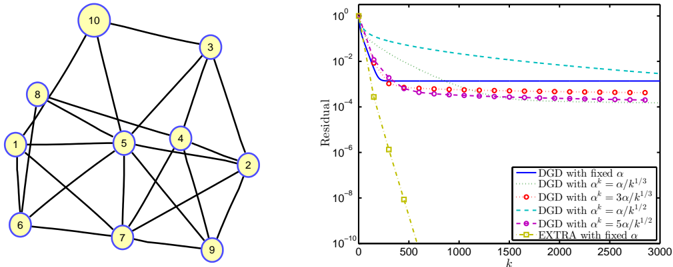
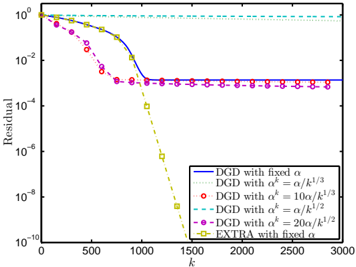
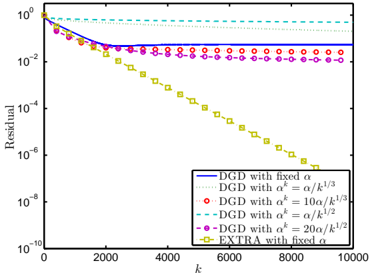
- EXTRA uses a fixed large step size and converges exactly, unlike DGD with a fixed step size, which stalls in an O(α)-neighborhood and requires diminishing step sizes for exact convergence.
- Under Assumptions 1–3 and step size \(0<\alpha<2\lambda_{\min}(\tilde W)/L_f\), the sequence \(z_k\) converges to an optimal \(z^*\), with contraction factor \(\zeta=1-\alpha L_f/(2\lambda_{\min}(\tilde W))\); running-average progress is \(O(1/k)\), running-best progress is \(o(1/k)\), and running-average optimality residuals are \(O(1/k)\).
- If \(g(x)=f(x)+\frac{1}{4\alpha}\|x\|^2_{\tilde W-W}\) is restricted strongly convex with constant \(\mu_g>0\), then with proper step size \(\alpha<2\mu_g\lambda_{\min}(\tilde W)/L_f^2\), \(\|z_k-z^*\|_G^2\) converges Q-linearly at \(O((1+\delta)^{-k})\), and \(\|x_k-x^*\|_{\tilde W}^2\) converges R-linearly at the same rate.
- Numerical experiments: in decentralized least squares with \(n=10\), \(m_i=1\), \(p=5\), connectivity ratio \(r=0.5\), \(L_f=1\), and \(\|x^*-x_0\|=300\), DGD with fixed step size and EXTRA show similar linear convergence for the first 200 iterations, after which DGD slows and stalls while EXTRA continues. In decentralized logistic regression with \(n=200\), \(r=0.2\), \(m_i=10\), \(p=20\), and 2000 samples, EXTRA outperforms DGD and shows linear exact convergence.
Methods
- Design: a synchronous decentralized first-order algorithm where each agent holds a local copy \(x^{(i)}\) and communicates only with neighbors; EXTRA is derived by taking the difference of two DGD updates and uses gradients of the last two iterates.
- Data/sample: numerical tests on decentralized least squares, decentralized robust least squares with Huber loss, and decentralized logistic regression over randomly generated connected networks.
- Analysis: convergence is established under mixing-matrix assumptions, convex Lipschitz-differentiable objectives, and solution existence; rates are derived via a contraction recursion, ergodic averaging, and restricted strong convexity.
Limitations
- The paper states EXTRA is “far from perfect” and that more work is needed to adapt it to asynchronous and dynamic network settings; these are left as open questions.
- The paper notes it is open whether \(\|z_k-z_{k+1}\|_G^2\) is monotonic; if monotonicity could be shown, the rates would hold for the last point in the running sequence. It also states that proving linear convergence under the numerically observed larger step size \(O(1/L_f)\) remains open.
- The paper states that determining \(\mu_g\) or a lower bound is tricky except when each \(f_i\) is restricted strongly convex, and that deriving an optimal step size and explicit linear rate is “quite tricky and messy.” The numerical results are described as preliminary.
Model-written summary. Check it against the paper before relying on it.
Integrity signals
Registry
Cites
Statistics
Figures
Verification
Claims the paper makes
6 Valid · 1 Not valid · 9 Not checked · 58 Own results and interpretations
At least one cited source doesn’t support this claim or points to a different paper, and none confirmed it — see the verdicts below.
In the paper
“On the other hand, properly reducing α k enables exact convergence , namely, that each x k ( i ) converges to the same exact solution.”
What the sources say
- Misattributedcites [36] [36] K. Yuan, Q. Ling, and W. Yin , On the Convergence of Decentralized Gradient Descent , arXiv preprint arXiv:1310.7063, (2013). 1.1, 2.1, 2.4, 4.1, 4.1, 4.2, 4.3 - sourceExperimental — accuracy not yet measured
Our copy disclaims the diminishing-stepsize result for itself: §1.3 (Contribution and notation) states 'Since our analysis uses a fixed stepsize, the local solutions will not be asymptotically consensual. To adapt our analysis to diminishing stepsizes, significant changes will be needed,' and every rate in Theorems 2-3 and Remarks 1-3 lands in an O(alpha/(1-beta))-neighborhood rather than the exact solution. The only place the paper states the claim's point is §1.2 (Related methods): 'Convergence to x* can be achieved by using diminishing stepsizes in [8,11,29] at the price of slower rates of convergence' — i.e., it credits exact convergence under diminishing stepsizes to other works it cites, without reporting or relying on it. Reference [8] in our copy is Duchi, Agarwal and Wainwright, 'Dual averaging for distributed optimization: convergence analysis and network scaling,' IEEE TAC 57 (2012) (with [11] Jakovetic, Xavier, Moura and [29] also credited). (LLM, conf=0.82) It matches “Dual averaging for distributed optimization: convergence analysis and network scaling” (2012) instead.
Checked by a reasoning model — may be wrong.
plainstates a cause- Asserted: passes — The authors put it forward as true.
- Checkable: passes — It can be checked against evidence.
- Load-bearing: passes — The paper’s conclusions depend on it.
- Based: passes — The paper gives a reason why it holds.
- Misattributed
Every source the paper cites for this claim was checked and supports it.
In the paper
“In contrast, the well-known decentralized gradient descent (DGD) method must use diminishing step sizes in order to converge to an exact minimizer.”
- Also stated in: § EXTRA: AN EXACT FIRST-ORDER ALGORITHM FOR DECENTRALIZED CONSENSUS OPTIMIZATION ∗ · p. 4 · plain
“properly reducing α k enables exact convergence , namely, that each x k ( i ) converges to the same exact solution.”
What the sources say
- Supportedcites [36] [36] K. Yuan, Q. Ling, and W. Yin , On the Convergence of Decentralized Gradient Descent , arXiv preprint arXiv:1310.7063, (2013). 1.1, 2.1, 2.4, 4.1, 4.1, 4.2, 4.3 - source
Section 1.2 (Related methods) states that with a fixed stepsize the listed algorithms 'and iteration (4) in particular' converge to a neighborhood of x* rather than x* itself, and that convergence to x* can be achieved by using diminishing stepsizes (at the price of slower rates) — exactly the necessity the claim attributes. Section 1.3 reinforces this: 'Since our analysis uses a fixed stepsize, the local solutions will not be asymptotically consensual,' and the Abstract/Theorems 2-3 give only O(α/(1-β))-neighborhood landing levels for fixed α. The only mild caveat is that the diminishing-stepsize exact-convergence results are credited to references [8,11,29] rather than proved here for iteration (4), but the paper's own statement of the fixed-stepsize limitation for DGD covers the claim. (LLM, conf=0.85)
boostedstates a cause- Asserted: passes — The authors put it forward as true.
- Checkable: passes — It can be checked against evidence.
- Load-bearing: passes — The paper’s conclusions depend on it.
- Based: passes — The paper gives a reason why it holds.
- Also stated in: § EXTRA: AN EXACT FIRST-ORDER ALGORITHM FOR DECENTRALIZED CONSENSUS OPTIMIZATION ∗ · p. 4 · plain
Every source the paper cites for this claim was checked and supports it.
In the paper
“(iii) min t ≤ k { a t } = o ( 1 k ) .”
What the sources say
- Supportedcites [6] [6] D. Davis and W. Yin , Convergence Rates of Splitting Algorithms for Optimization . arXiv preprint arXiv:1406.4834, 2014. 1 - source
Section 2 ('Summable sequence convergence lemma', Lemma 3, p. 8) states Part 4 'No monotonicity', defining the best-so-far sequence and asserting that '(a_j^best) is monotonically nonincreasing and the above bounds continue to hold when a_k is replaced with a_k^best', while the Part 1a proof on the same page gives a_k = o(1/(Λ_k − Λ_⌈k/2⌉)) = o(1/(k+1)) when (λ_j) is bounded away from 0 (i.e. unweighted summability). Together these yield exactly the claim: a nonnegative sequence with finite sum has running minimum o(1/k) (the source writes o(1/(k+1)), the same rate up to index shift). The remark on p. 9 confirms the setting — Part 1 generalizes the known result that a nonnegative, summable, monotonic sequence converges at o(1/(k+1)) — and p. 12 applies Lemma 3 to a running minimum, min_{i=0,…,k}{‖e_i‖}. (LLM, conf=0.85)
plainstates a cause- Asserted: passes — The authors put it forward as true.
- Checkable: passes — It can be checked against evidence.
- Load-bearing: passes — The paper’s conclusions depend on it.
- Based: passes — The paper gives a reason why it holds.
- Supported
A conclusion the paper draws from its own results — it cites no other source for it, so there is none to check. The quote shows it is in the paper.
In the paper
“An EXTRA update is, therefore, a DGD update with a cumulative correction term.”
plainstates a cause- Asserted: passes — The authors put it forward as true.
- Checkable: passes — It can be checked against evidence.
- Load-bearing: passes — The paper’s conclusions depend on it.
- Based: passes — The paper gives a reason why it holds.
A conclusion the paper draws from its own results — it cites no other source for it, so there is none to check. The quote shows it is in the paper.
In the paper
“In this subsection we prove that EXTRA with a proper step size reaches linear convergence if the original objective ¯ f is restricted strongly convex.”
plainstates a cause- Asserted: passes — The authors put it forward as true.
- Checkable: passes — It can be checked against evidence.
- Load-bearing: passes — The paper’s conclusions depend on it.
- Based: passes — The paper gives a reason why it holds.
31 more claims
Create a free account to see all 74 claims and to verify the 7 references still open.
- Probably not a substantial claim. 21
- It may state two separate claims as one. 26
- The quote only partly states this claim. 1
Claims other papers make about this one
Each is checked against this paper’s own text: does it say what the citing paper says it does?
The source backs part of the claim, not all of it — or backs it for a different population, condition or comparison.
In the citing paper
“EXTRA converges at an o (1 /k ) rate when the objective function in (1) is convex, and it has a Q-linear rate when the objective function is strongly convex.”
From Achieving Geometric Convergence for Distributed Optimization Over Time-Varying Graphs (2017) · cites this paper as [62]
Experimental — accuracy not yet measuredThe cited source says what the claim attributes to it.
In the citing paper
“Proposition 1 ( [62]). Assume null { I -W } = span { 1 } where W ∈ R n × n . If x ∗ satisfies conditions: (i) x ∗ = Wx ∗ (consensus), (ii) 1 ⊤ ∇ f ( x ∗ ) = 0 (optimality), then the rows of x ∗ are the same as each other and the transpose of each row is an optimal solution of the problem (1) .”
From Achieving Geometric Convergence for Distributed Optimization Over Time-Varying Graphs (2017) · cites this paper as [62]
Self-check
Percentages, sums and reported differences re-computed from the paper’s own numbers.
Each contradiction between two passages listed here was confirmed by an independent check.
Rated minor: it would not touch a result — a value no result rests on, a p-value that stays on the same side of the significance level, or a conflict that is clerical, resolved elsewhere in the paper, or outside its own findings.
In the paper
§ Algorithm 1: EXTRA · p. 9
“null { U } = (span { 1 } ) ⊥”
§ Algorithm 1: EXTRA · p. 7
“null { W -˜ W } = span { 1 } , null { I -˜ W } ⊇ span { 1 } .”
Citations
Cites
Distributed Subgradient Methods for Multi-Agent Optimization
Nedic, A., & Ozdaglar, A. (2009) · IEEE Transactions on Automatic Control · doi:10.1109/tac.2008.2009515 · Cited by 3,719 · cited 1×
“1) include the (sub)gradient method [21, 25, 36], the (sub)gradient-push method [23, 24], the fast (sub)gradient method [5, 14], and the dual averaging method [8].”
MethodFast linear iterations for distributed averaging
Xiao, L., & Boyd, S. (2004) · Systems & Control Letters · doi:10.1016/j.sysconle.2004.02.022 · Cited by 2,706
Distributed Optimization Over Time-Varying Directed Graphs
Nedic, A., & Olshevsky, A. (2015) · IEEE Transactions on Automatic Control · doi:10.1109/tac.2014.2364096 · Cited by 1,187
Distributed average consensus with least-mean-square deviation
Xiao, L., Boyd, S., & Kim, S.-J. (2007) · Journal of Parallel and Distributed Computing · doi:10.1016/j.jpdc.2006.08.010 · Cited by 1,107
Optimal decentralized protocol for electric vehicle charging
Gan, L., Topcu, U., & Low, S. H. (2013) · IEEE Transactions on Power Systems · doi:10.1109/tpwrs.2012.2210288 · Cited by 997
Dual Averaging for Distributed Optimization: Convergence Analysis and Network Scaling
Duchi, J. C., Agarwal, A., & Wainwright, M. J. (2012) · IEEE Transactions on Automatic Control · doi:10.1109/tac.2011.2161027 · Cited by 947
On the Linear Convergence of the ADMM in Decentralized Consensus Optimization
Shi, W., Ling, Q., Yuan, K., Wu, G., & Yin, W. (2014) · IEEE Transactions on Signal Processing · doi:10.1109/tsp.2014.2304432 · Cited by 820
Self-citationDistributed Stochastic Subgradient Projection Algorithms for Convex Optimization
Sundhar Ram, S., Nedić, A., & Veeravalli, V. V. (2010) · Journal of Optimization Theory and Applications · doi:10.1007/s10957-010-9737-7 · Cited by 814 · cited 1×
“1) has additional constraints that force x into a bounded set, which also leads to bounded (sub)gradients and a Hessian, projected first-order algorithms are applicable [27, 37].”
BackgroundOn Distributed Convex Optimization Under Inequality and Equality Constraints
Zhu, M., & Martinez, S. (2012) · IEEE Transactions on Automatic Control · doi:10.1109/tac.2011.2167817 · Cited by 759
Fastest Mixing Markov Chain on a Graph
Boyd, S., Diaconis, P., & Xiao, L. (2004) · SIAM Review · doi:10.1137/s0036144503423264 · Cited by 744
Research works printed but not linked: 3
- [5] I. Chen , Fast Distributed First-Order Methods , master's thesis, Department of Electrical Engineering and Computer Science, Massachusetts Institute of Technology, 2012. 1.1, 2.1, 2.4, 4.1 -
- [15] B. Johansson , On Distributed Optimization in Networked Systems , PhD thesis, KTH, 2008. 1 -
- [31] J. Tsitsiklis , Problems in Decentralized Decision Making and Computation , PhD thesis, Department of Electrical Engineering and Computer Science, Massachusetts Institute of Technology, 1984. 2.4 -
Cited by
Items 801–900 of 1,315
Mu, C., Ding, T., Chang, X., Zhu, S., Xue, Y., Han, Z., & Shahidehpour, M. (2025) · IEEE Transactions on Systems Man and Cybernetics Systems · doi:10.1109/tsmc.2025.3572363 · Cited by 4
“A framework for generating W is presented in [34].”
Finite-Time-Consensus-Based Methods for Distributed optimization
Qu, Z., Wu, X., & Lu, J. (2019) · Chinese Control Conference (CCC) · doi:10.23919/chicc.2019.8865722 · Cited by 4
A Convergence-preserving Data Integrity Attack on Distributed Optimization Using Local Information
Ding, T., Xu, Q., Zhu, S., & Guan, X. (2020) · IEEE Conference on Decision and Control (CDC) · doi:10.1109/cdc42340.2020.9304245 · Cited by 5
“All the normal agents adopt the update rule as in [8] x Substituting (8) into (9), we obtain another form of the behavior of the discovered attacker, i.e., We apply this attack behavior (29) into EXTRA.”
MethodA Distributed Proximal Primal-Dual Algorithm for Nonsmooth Optimization with Coupling Constraints
Wu, X., Wang, H., & Lu, J. (2020) · IEEE Conference on Decision and Control (CDC) · doi:10.1109/cdc42340.2020.9303937 · Cited by 2
Impact of Redundancy on Resilience in Distributed Optimization and Learning
Liu, S., Gupta, N., & Vaidya, N. H. (2023) · International Conference on Distributed Computing and Networking (ICDCN) · doi:10.1145/3571306.3571393 · Cited by 3
“We showed that, under ( f, r ; (cid:15) )-redundancy, Algorithm 1 with DGD achieves ( f, r ; O ( (cid:15) ))-resilience for optimization, and Algorithm 1 with D-SGD can solve resilient distributed stochastic optimization problems with error margins proportional to (cid:15) .”
InfluentialD2L: Decentralized dictionary learning over dynamic networks
Daneshmand, A., Sun, Y., Scutari, G., & Facchinei, F. (2017) · IEEE International Conference on Acoustics Speech and Signal Processing · doi:10.1109/icassp.2017.7952924 · Cited by 3
An Approximately-Zero-Gradient-Sum Algorithm for Consensus Optimization
Wei, H., Qu, Z., Wu, X., Wang, H., & Lu, J. (2018) · International Conference on Control, Automation, Robotics and Vision (ICARCV) · doi:10.1109/icarcv.2018.8581380 · Cited by 2
“, [2], [3], [4], [5], [6], [7], [8], [9], [10], [11]).”
Fast Decentralized Data Analytics in IoT Wireless Networks
Zhao, L. (2019) · IEEE Access · doi:10.1109/access.2019.2960494 · Cited by 3
A Proximal Dual Consensus Method for Linearly Coupled Multi-Agent Non-Convex Optimization
Zhang, J., Ge, S., Chang, T., & Luo, Z.-Q. T. (2020) · IEEE International Conference on Acoustics Speech and Signal Processing · doi:10.1109/icassp40776.2020.9054236 · Cited by 5
“,BN ] is the incidence matrix of the network graph and q is the zero vector, (P) corresponds to a consensus formulation of the finite sum minimization problem minx ∑N i=1 fi(x), and there exist rich results in the literature [5, 12–16].”
BackgroundTang, Y., Zhu, H., & Lv, X. (2020) · IET Control Theory and Applications · doi:10.1049/cth2.12075 · Cited by 4
Cheng, H., Li, H., & Wang, Z. (2020) · International Journal of Systems Science · doi:10.1080/00207721.2020.1815098 · Cited by 3
EFIX: Exact fixed point methods for distributed optimization
Jakovetić, D., Krejić, N., & Jerinkić, N. K. (2022) · Journal of Global Optimization · doi:10.1007/s10898-022-01221-4 · Cited by 3
Lan, G., Ouyang, Y., & Zhou, Y. (2023) · SIAM Journal on Optimization · doi:10.1137/20m138956x · Cited by 11
Distributed Networked Learning with Correlated Data
Hong, L., García, A., & Eksin, C. (2020) · IEEE Conference on Decision and Control (CDC) · doi:10.1109/cdc42340.2020.9304091 · Cited by 2
Constrained Distributed Nonconvex Optimization over Time-varying Directed Graphs
He, Z., He, J., Chen, C., & Guan, X. (2020) · IEEE Conference on Decision and Control (CDC) · doi:10.1109/cdc42340.2020.9304164 · Cited by 4
Distributed networked learning with correlated data
Hong, L., García, A., & Eksin, C. (2022) · Automatica · doi:10.1016/j.automatica.2021.110134 · Cited by 5
Distributed Optimization for Second-Order Multi-Agent Systems over Directed Networks
Yang, F., Yu, Z., Huang, D., et al. (2022) · Mathematics · doi:10.3390/math10203803 · Cited by 3
Distributed Off-Policy Temporal Difference Learning Using Primal-Dual Method
Lee, D., Kim, D. W., & Hu, J. (2022) · IEEE Access · doi:10.1109/access.2022.3211395 · Cited by 3
“The main paradigm used in most of these methods is based on the averaging consensus algorithm [15], which is popular for solving distributed optimization problems [16], [17], [18], [19], [20], [21].”
MethodInfluentialA General Framework to Distribute Iterative Algorithms With Localized Information Over Networks
Timoudas, T. O., Zhang, S., Magnússon, S., & Fischione, C. (2023) · IEEE Transactions on Automatic Control · doi:10.1109/tac.2023.3279901 · Cited by 3
Nested Distributed Gradient Methods with Stochastic Computation Errors
Iakovidou, C., & Wei, E. (2019) · Allerton Conference on Communication, Control, and Computing · doi:10.1109/allerton.2019.8919853 · Cited by 2
Linear convergence in optimization over directed graphs with row-stochastic matricesPreprint
Xi, C., Mai, V. S., Xin, R., et al. (2016) · arXiv (Cornell University) · doi:10.48550/arxiv.1611.06160 · Cited by 3
“To accelerate the convergence, DEX-TRA, [33] combines push-sum consensus, [26, 27], and EX-TRA, [20], and converges linearly under the strong-convexity assumption with the step-size being chosen in some interval.”
BackgroundMethodInfluentialHan, S. (2018) · arXiv (Cornell University) · Cited by 4
Local Differential Privacy in Decentralized OptimizationPreprint
Xiao, H., Ye, Y., & Devadas, S. (2019) · arXiv (Cornell University) · doi:10.48550/arxiv.1902.06101 · Cited by 5
Distributed Proximal Algorithms for Multi-Agent Optimization with Coupled Inequality ConstraintsPreprint
Li, X., Feng, G., & Xie, L. (2019) · arXiv (Cornell University) · doi:10.48550/arxiv.1907.03245 · Cited by 3
“On the other hand, the dual-decomposition-based algorithms aim at handling the alignment of all local decision variables by equality constraints, through introducing corresponding dual variables, and typical algorithms include alternating direction method of multipliers (ADMM) [11], augmented Lagrangian method [12], d…”
Zimmermann, J., Tatarenko, T., Willert, V., et al. (2020) · arXiv (Cornell University) · doi:10.48550/arxiv.2004.02854 · Cited by 3
DC-DistADMM: ADMM Algorithm for Contsrained Distributed Optimization over Directed GraphsPreprint
Khatana, V., & Salapaka, M. V. (2020) · arXiv (Cornell University) · Cited by 5
A Primal-Dual Framework for Decentralized Stochastic OptimizationPreprint
Rajawat, K., & Kumar, C. (2020) · arXiv (Cornell University) · doi:10.48550/arxiv.2012.04402 · Cited by 5
An Optimal Algorithm for Strongly Convex Minimization under Affine ConstraintsPreprint
Salim, A., Condat, L., Kovalev, D. A., et al. (2021) · arXiv (Cornell University) · doi:10.48550/arxiv.2102.11079 · Cited by 3
“Decentralized optimization is a well-known instance of Problem (1), with K a gossip matrix (or its square root), and b = 0 [Shi et al., 2015, Scaman et al., 2017, Gorbunov et al., 2019, Li et al., 2020a,b, Ye et al., 2020, Arjevani et al., 2020, Kovalev et al., 2020, Dvinskikh and Gasnikov, 2021].”
Distributed Picard Iteration.Preprint
Andrade, F. L., Figueiredo, M. A. T., & Xavier, J. (2021) · arXiv (Cornell University) · Cited by 3
Accelerating Gossip SGD with Periodic Global AveragingPreprint
Chen, Y., Yuan, K., Zhang, Y., Pan, P., Xu, Y., & Yin, W. (2021) · arXiv (Cornell University) · doi:10.48550/arxiv.2105.09080 · Cited by 32
Self-citationRegret Analysis of Distributed Online LQR Control for Unknown LTI SystemsPreprint
Chang, T.-J., & Shahrampour, S. (2021) · arXiv (Cornell University) · doi:10.48550/arxiv.2105.07310 · Cited by 3
Distributed Picard Iteration: Application to Distributed EM and Distributed PCA.Preprint
Andrade, F. L., Figueiredo, M. A. T., & Xavier, J. (2021) · arXiv (Cornell University) · Cited by 3
Essentially Decentralized Conjugate GradientsPreprint
Engelmann, A., & Faulwasser, T. (2021) · arXiv (Cornell University) · doi:10.48550/arxiv.2102.12311 · Cited by 7
Asynchronous Parallel Incremental Block-Coordinate Descent for Decentralized Machine Learning
Chen, H., Ye, Y., Xiao, M., & Skoglund, M. (2022) · IEEE Transactions on Big Data · doi:10.1109/tbdata.2022.3230335 · Cited by 5
“Most of them are gossip-based and the wellknown algorithms include decentralized gradient descent (DGD) [12], EXTRA [13], distributed alternating direction method of multipliers (D-ADMM) [14], where each agent is allowed to exchange model parameters with a subset of or even all their direct neighbours at each iteratio…”
BackgroundInfluentialGolden Ratio Proximal Gradient ADMM for Distributed Composite Convex Optimization
Yin, C., & Yang, J. (2023) · Journal of Optimization Theory and Applications · doi:10.1007/s10957-023-02336-8 · Cited by 5
A Modified Distributed Gradient Dynamics for Multiagent Optimization on Directed Networks
Jahvani, M., & Guay, M. (2025) · IEEE Transactions on Control of Network Systems · doi:10.1109/tcns.2025.3526343 · Cited by 2
“For instance, we refer to [1], [2], [3], [4], [5], [6], [7], [8], [9], [10], [11], [12], [13], [14], [15], [16], [17], [18], [19], [20], [21], [22], [23], [24], [25], [26], [27], [28], and the references therein.”
A Decentralized Primal-Dual Method With Quasi-Newton Tracking
Wang, L., Wu, H., & Zhang, H. (2025) · IEEE Transactions on Signal Processing · doi:10.1109/tsp.2025.3547787 · Cited by 2
“To ensure global convergence, EXTRA [10], [11] as well as its modification, called NIDS [12], adopts different mixing matrices at odd and even iterations.”
InfluentialDistributed Asynchronous Optimization With Inseparable Coupled Constraints and Its Application
Wang, T., Liu, W., Li, Z., Ye, Z., Peng, X., & Du, W. (2025) · IEEE Transactions on Automation Science and Engineering · doi:10.1109/tase.2025.3550740 · Cited by 3
“Later, algorithms such as distributed exact first-order algorithm (EXTRA) [15] and distributed inexact gradient method have been developed.”
A flexible gradient tracking algorithmic framework for decentralized optimization
Berahas, A. S., Bollapragada, R., & Gupta, S. (2025) · Computational Optimization and Applications · doi:10.1007/s10589-025-00685-w · Cited by 3
“Our main contributions can be summarized as follows: 123 DIGing [27], EXTRA [37] GTA-1 RGTA-2 W W W I n SONATA [38], NEXT [14, 33] GTA-2 RGTA-3 W W W W Aug-DGM [40], ATC-DIGing [28] GTA-3 Note: W is a mixing matrix 1.”
Convergence Analysis of EXTRA in Non-Convex Distributed Optimization
Qin, L., & Pu, Y. (2025) · IEEE Control Systems Letters · doi:10.1109/lcsys.2025.3577964 · Cited by 6
An adaptive gain-based fixed-time distributed algorithm for constrained optimization problems
Shi, X., Lin, Z., & Lin, Y. (2025) · Systems & Control Letters · doi:10.1016/j.sysconle.2025.106189 · Cited by 2
NPD-SG: A Noise-Resistant Primal-Dual Stochastic Gradient Diffusion Algorithm Over Networks
Wu, J., Zhou, Z., Zhang, S., & Han, H. (2025) · IEEE Transactions on Signal and Information Processing over Networks · doi:10.1109/tsipn.2025.3600760 · Cited by 2
Guo, L., Wang, L., Shi, X., & Cao, J. (2025) · IEEE Transactions on Signal and Information Processing over Networks · doi:10.1109/tsipn.2025.3600766 · Cited by 7
“In [18] and [19], the local-GT and LED algorithms have been respectively introduced, both of which integrate deterministic periodic local updates.”
Li, C., Wang, Q., & Psillakis, H. E. (2025) · IEEE Transactions on Cybernetics · doi:10.1109/tcyb.2025.3608353 · Cited by 3
“The fundamental scenario considers the optimization of a separable cost function composed of local objectives, where no constraints (including feasible set restrictions or equality/inequality conditions) are imposed [6], [11].”
Deng, S., Han, Z., Lü, Q., Li, Y., Li, H., & Xia, D. (2025) · Journal of the Franklin Institute · doi:10.1016/j.jfranklin.2025.108107 · Cited by 3
Distributed privacy-preserving optimization for multi-energy system considering carbon emission
Zhou, Y., Ye, H., & Ge, Y. (2025) · Applied Energy · doi:10.1016/j.apenergy.2025.127008 · Cited by 2
Globally Constrained Decentralized Optimization With Variable Coupling
Wang, D., Wu, X., Ou, Z., & Lu, J. (2025) · IEEE Transactions on Automatic Control · doi:10.1109/tac.2025.3629001 · Cited by 5
“Additionally, f i : R j ∈N i d j → R is the local objective function and g i : R j ∈N i d j → R p is the local inequality constraint function of node i , which are known only to node i but are associated with the decision variables of both node i and its neighbors, denoted by x N i .”
InfluentialSun, Y., Shen, L., & Tao, D. (2025) · IEEE Transactions on Pattern Analysis and Machine Intelligence · doi:10.1109/tpami.2025.3647762 · Cited by 2
“Based on [27] which analyzes the consensus in decentralized approaches, [28] provide a novel unified analysis for the non-convex decentralized learning.”
Li, C., & Wang, Q. (2026) · Journal of the Franklin Institute · doi:10.1016/j.jfranklin.2026.108403 · Cited by 2
Wang, B., Li, H., Liu, F., Cheng, Z., & Shen, S. (2026) · IEEE Transactions on Communications · doi:10.1109/tcomm.2026.3657393 · Cited by 3
“Proof: Please refer to Appendix A. Remark 2: The proposed framework is different from the existing PG based decentralized ADMM [48], [49], [50] from the following two aspects.”
He, W., Yang, Y., Yang, Z., et al. (2026) · IEEE Transactions on Smart Grid · doi:10.1109/tsg.2026.3673769 · Cited by 2
“…such that L 1 N = 0 and l ii = − P j ∈ N , j (cid:44) i l ij ; 2) for x ∈ R N , L x = 0 and L 1 / 2 x = 0 only when The first result can be obtained by the double stochastic property of W , while the latter is established based on the relationship between the null spaces of L and L 1 / 2 [24].”
Data-dependent bounds on network gradient descent
Bijral, A. S., Sarwate, A. D., & Srebro, N. (2016) · Allerton Conference on Communication, Control, and Computing · doi:10.1109/allerton.2016.7852325 · Cited by 1
Decentralized Differential Evolutionary Algorithm for Large-Scale Networked Systems
Han, G., Chen, X., & Zhao, Q. (2019) · Advances in intelligent systems and computing · doi:10.1007/978-981-13-6733-5_38 · Cited by 2
Doan, T. T., Beck, C. L., & Srikant, R. (2018) · ACM SIGMETRICS Performance Evaluation Review · doi:10.1145/3292040.3219654 · Cited by 2
GT-SAGA: A fast incremental gradient method for decentralized finite-sum minimization
Xin, R., Li, B., Kar, S., & Khan, U. A. (2020) · IEEE Conference on Decision and Control (CDC) · doi:10.1109/cdc42340.2020.9304007 · Cited by 3
“Existing decentralized VR methods include DSA [26] that combines EXTRA [27] with SAGA [10], diffusion-AVRG that combines exact diffusion [28] and AVRG [29], DSBA [30] that adds proximal mapping [31] to each iteration of DSA , ADFS [32] that applies an accelerated randomized proximal coordinate…”
Decentralized Dual Operator Splitting for Nonsmooth Composite Optimization
Li, H., Ding, W., Wang, Z., Lü, Q., Li, Y., & Xia, D. (2022) · IEEE Transactions on Network Science and Engineering · doi:10.1109/tnse.2022.3155287 · Cited by 3
Parameter Learning: a Convex Analytic Path
Theodoridis, S. (2020) · Elsevier eBooks · doi:10.1016/b978-0-12-818803-3.00017-9 · Cited by 4
Multi-agent based optimal equilibrium selection with resilience constraints for traffic flow
Liu, P., Korovin, I., Gorbachev, S. V., Gorbacheva, N., & Cao, J. (2022) · Neural Networks · doi:10.1016/j.neunet.2022.08.013 · Cited by 2
A Distributed Convex Optimization Algorithm with Continuous-Time Communication
Jahvani, M., & Guay, M. (2022) · International Symposium on Advanced Control of Industrial Processes · doi:10.1109/adconip55568.2022.9894148 · Cited by 2
Initialization-Free Distributed Constrained Optimization Algorithms with a Pre-Specified Time
Shi, X., Mu, C., Sun, C., et al. (2023) · Proceedings of the IEEE Conference on Decision & Control, including the Symposium on Adaptive Processes · doi:10.1109/cdc49753.2023.10384064 · Cited by 2
Pan, Z., Yang, H., & Liu, H. (2024) · IEEE International Conference on Acoustics Speech and Signal Processing · doi:10.1109/icassp48485.2024.10447051 · Cited by 2
Decentralized stochastic sharpness-aware minimization algorithm
Chen, S., Deng, X., Xu, D., Sun, T., & Li, D. (2024) · Neural Networks · doi:10.1016/j.neunet.2024.106325 · Cited by 3
Distributed Optimization with Gradient Tracking Over Heterogeneous Delay-Prone Directed Networks
Makridis, E., Oliva, G., Narahari, K. R., Doostmohammadian, M., Khan, U. A., & Charalambous, T. (2024) · European Control Conference (ECC) · doi:10.23919/ecc64448.2024.10590963 · Cited by 6
Stochastic Mirror Descent for Convex Optimization with Consensus Constraints
Borovykh, A., Kantas, N., Parpas, P., & Pavliotis, G. A. (2024) · SIAM Journal on Applied Dynamical Systems · doi:10.1137/22m1515197 · Cited by 4
Distributed Deep Learning for Real-World Implicit Mapping in Multi-Robot Systems
Jeong, E., Gwak, J., Kim, T., et al. (2024) · International Conference on Control, Automation and Systems (ICCAS) · doi:10.23919/iccas63016.2024.10773094 · Cited by 2
A Dual Inexact Nonsmooth Newton Method for Distributed Optimization
Niu, D., Hong, Y., & Song, E. (2024) · IEEE Transactions on Signal Processing · doi:10.1109/tsp.2024.3514676 · Cited by 5
Shahriari-Mehr, F., & Panahi, A. (2024) · IEEE Transactions on Automatic Control · doi:10.1109/tac.2024.3520513 · Cited by 4
“DIGing [23], EXTRA [24], and NEXT [25] employ this approach and use fixed step sizes.”
Guo, Z., Xin, J., & Li, Q. (2024) · IEEE Transactions on Industrial Cyber-Physical Systems · doi:10.1109/ticps.2024.3524368 · Cited by 2
Distributed Center-Based Clustering: A Unified Framework
Armacki, A., Bajović, D., Jakovetić, D., & Kar, S. (2025) · IEEE Transactions on Signal Processing · doi:10.1109/tsp.2025.3531292 · Cited by 4
“Another line of work related to ours is that of first-order meth-ods for distributed optimization, e.g., [48], [49], [50], [51], [52], [53], [54], [55], [56], [57], [58].”
Gradient-free distributed online optimization in networks
Liu, Y., Zhao, W., Zhang, N., Lv, D., & Zhang, S. (2025) · Control Theory and Technology · doi:10.1007/s11768-025-00242-0 · Cited by 3
“Since the pioneering work [6], numerous results for distributed convex optimization algorithms have been reported in [7, 8], such as distributed convex optimization with constraints [9–11], algorithms in stochastic frameworks [12–15], algorithms against adversarial attacks [16, 17], and algorithms…”
Setwise Coordinate Descent for Dual Asynchronous Decentralized Optimization
Costantini, M., Liakopoulos, N., Mertikopoulos, P., & Spyropoulos, T. (2025) · IEEE Transactions on Automatic Control · doi:10.1109/tac.2025.3543463 · Cited by 2
“…problem usually assign to each nodealocalvariable θ i andexecuteupdatesthatinterleavealocal gradient step at the nodes followed by an averaging step (usually carried out by a doubly stochastic matrix) that aggregates the update of the node with those of its neighbors [5], [6], [7], [8], [9], [10].”
Distributed inexact Newton method with adaptive step sizes
Jakovetić, D., Krejić, N., & Malaspina, G. (2025) · Computational Optimization and Applications · doi:10.1007/s10589-025-00666-z · Cited by 5
“We compare DINAS with NN [17], DAN and DAN-LA [28], Newton Tracking [27], DIGing [13] and EXTRA [14].”
A Two-timescale Primal-dual Algorithm for Decentralized Optimization with Compression
Liu, H., Yau, C.-Y., & Wai, H.-T. (2025) · IEEE International Conference on Acoustics Speech and Signal Processing · doi:10.1109/icassp49660.2025.10887649 · Cited by 2
Decentralized federated multi-view sparse subspace clustering
Lei, Y., & Chen, X. (2025) · Annals of Mathematics and Artificial Intelligence · doi:10.1007/s10472-025-09977-7 · Cited by 4
“Matrix P has a few common choices [36]: (i)Laplacian-based constant edge weight matrix; (ii) Metropolis constant edge weight matrix.”
Adaptive Weighting Push-SUM for Decentralized Optimization With Statistical Diversity
Zhou, Y., Cheng, Y., Xu, L., & Chen, E. (2025) · IEEE Transactions on Control of Network Systems · doi:10.1109/tcns.2025.3566329 · Cited by 7
“For example, DEXTRA [14] integrates EXTRA [15] with the Push-SUM protocol, while Push-LSVRG-UP [16] and Push-SAGA [17] incorporate variance reduction techniques into the Push-SUM protocol; all these algorithms achieve linear convergence rates for strongly convex functions.”
On the convergence result of the gradient-push algorithm on directed graphs with constant stepsize
Choi, W., Kim, D., & Yun, S.-B. (2025) · Journal of Global Optimization · doi:10.1007/s10898-025-01506-4 · Cited by 2
“There are also various versions of distributed optimization algorithms, such as EXTRA [32] and decen-tralizedgradienttrackingalgorithms[24,26,41].”
Ensuring System-Level Protection against Eavesdropping Adversaries in Distributed Dynamical Systems
Maity, D., & Mai, V. S. (2025) · Proceedings of the ... American Control Conference/Proceedings of the American Control Conference · doi:10.23919/acc63710.2025.11107914 · Cited by 2
Lu, C.-F., Liu, G. P., & Cui, J. (2025) · Control Engineering Practice · doi:10.1016/j.conengprac.2025.106635 · Cited by 5
Distributed Banach–Picard Iteration for Locally Contractive Maps
Andrade, F. L., Figueiredo, M. A. T., & Xavier, J. (2022) · IEEE Transactions on Automatic Control · doi:10.1109/tac.2022.3152722 · Cited by 7
INDIGO: An In Situ Distributed Gossip Framework for Sensor Networks
Ramanan, P., Kamath, G., & Song, W. (2015) · International Journal of Distributed Sensor Networks · doi:10.1155/2015/706083 · Cited by 1
ESOM: Exact second-order method for consensus optimization
Mokhtari, A., Shi, W., & Ling, Q. H. (2016) · Asilomar Conference on Signals, Systems and Computers (ACSSC) · doi:10.1109/acssc.2016.7869153 · Cited by 3
Self-citationLinearly convergent decentralized consensus optimization over directed networks
Nedić, A., Olshevsky, A., & Shi, W. (2016) · IEEE Global Conference on Signal and Information Processing · doi:10.1109/globalsip.2016.7905889 · Cited by 2
Self-citationDecentralized bundle method for nonsmooth consensus optimization
Wang, Z., Ling, Q. H., & Yin, W. (2017) · IEEE Global Conference on Signal and Information Processing · doi:10.1109/globalsip.2017.8309023 · Cited by 5
Self-citationEfficient Variance-Reduced Learning Over Multi-Agent Networks
Yuan, K., Ying, B., & Sayed, A. H. (2018) · European Signal Processing Conference (EUSIPCO) · doi:10.23919/eusipco.2018.8553100 · Cited by 2
Distributed Optimization in Multi-agent Networks Using One-bit of Relative State Information
Zhang, J., & You, K. (2018) · Systems & control · doi:10.1007/978-3-030-04630-9_13 · Cited by 2
Improved Convergence Rates of P-EXTRA for Non-smooth Distributed optimization
Wu, X., & Lu, J. (2019) · International Conference on Control and Automation · doi:10.1109/icca.2019.8899909 · Cited by 3
Generalized LASSO Problem with Equality and Inequality Constraints Using ADMM
Xu, C. Y. (2019) · Cited by 2
PAC Learning from Distributed Data in the Presence of Malicious Nodes
Yang, Z., & Bajwa, W. U. (2019) · IEEE International Workshop on Computational Advances in Multi-Sensor Adaptive Processing · doi:10.1109/camsap45676.2019.9022672 · Cited by 2
“Learning tasks in such cases have to be completed by nodes cooperating with each other over the network, with numerous distributed learning algorithms developed over the years to solve the resulting distributed problems [3–5].”
An Edge-based Stochastic Proximal Gradient Algorithm for Decentralized Composite Optimization
Zhang, L., Yan, Y., Wang, Z., & Li, H. (2021) · International Journal of Control Automation and Systems · doi:10.1007/s12555-020-0483-9 · Cited by 2
Distributed Optimization Algorithms on Structurally Balanced Signed Networks
Du, W. J., Wei, Y., & Du, M. (2021) · International Conference on Control, Automation and Systems (ICCAS) · doi:10.23919/iccas52745.2021.9650060 · Cited by 2
Linearly Convergent Distributed Optimization Methods with Compressed Innovation
Zhang, J., & You, K. (2021) · IEEE Conference on Decision and Control (CDC) · doi:10.1109/cdc45484.2021.9683720 · Cited by 2
Barazandeh, B., Curtis, K., Sarkar, C., Sriharsha, R., & Michailidis, G. C. (2022) · IEEE International Conference on Acoustics Speech and Signal Processing · doi:10.1109/icassp43922.2022.9746485 · Cited by 3
Push–Pull With Device Sampling
Hsieh, Y.-G., Laguel, Y., Iutzeler, F., & Malick, J. (2023) · IEEE Transactions on Automatic Control · doi:10.1109/tac.2023.3250339 · Cited by 5
“Thistechnique enables the use of a fixed stepsize and exhibits much better rates in theory and in practice [22], [23], [24], [25]; see also the recent work in [26].”
Distributed Optimization Algorithm for Composite Optimization Problems with Non-Smooth Function
Shi, Y., Ran, L., Tang, J., & Wu, X. (2022) · Mathematics · doi:10.3390/math10173135 · Cited by 2
PrivOpt: an intrinsically private distributed optimization algorithm
Esteki, A.-S., & Kia, S. S. (2022) · Proceedings of the ... American Control Conference/Proceedings of the American Control Conference · doi:10.23919/acc53348.2022.9867222 · Cited by 2
“In comparison to algorithms like EXTRA [3] and PI [4], in PrivOpt, z i = p i − x i is communicated with neighbors instead of the local minimizer state x i .”
MethodDistributed optimization with inexact oracle
Zhu, K., Zhang, Y., & Tang, Y. (2022) · Kybernetika · doi:10.14736/kyb-2022-4-0578 · Cited by 2
Zheng, X., Javidi, T., & Touri, B. (2023) · IEEE Control Systems Letters · doi:10.1109/lcsys.2023.3289154 · Cited by 2
Zhou, S., Peng, H., Hong, X., et al. (2023) · International Symposium on Autonomous Systems (ISAS) · doi:10.1109/isas59543.2023.10164541 · Cited by 2
Decentralized Coordination of DERs for Dynamic Economic Emission Dispatch
Dai, J., & Wang, Z. (2023) · Applied Sciences · doi:10.3390/app132212431 · Cited by 2
Second-Order Properties of Noisy Distributed Gradient Descent
Qin, L., Cantoni, M., & Pu, Y. (2023) · IEEE Conference on Decision and Control (CDC) · doi:10.1109/cdc49753.2023.10383914 · Cited by 3
Metadata
- Authors
- Shi, W., Ling, Q., Wu, G., & Yin, W.
- Venue
- SIAM Journal on Optimization
- Published
- 2015-01
- Volume
- 25
- Issue
- 2
- Pages
- 944-966
- ISSN
- 1052-6234 (ISSN-L)
- 1095-7189
- OpenAlex
- W1571416372
- Cited by
- 1,261
- References
- 25
- Citations by year
- 2026: 75 · 2025: 116 · 2024: 131 · 2023: 131 · 2022: 145 · 2021: 138 · 2020: 158 · 2019: 140 · 2018: 97 · 2017: 62 · 2016: 43 · 2015: 21
- FWCI
- 85.01
- Type
- journal article
- Language
- en
- Open access
- green
- arxiv.org
- Locations
- SIAM Journal on Optimization (publishedVersion)
- arXiv (Cornell University) (submittedVersion)
- arXiv (Cornell University)
- Funders
- National Science Foundation (0748839, 1317602)
- National Natural Science Foundation of China (61004137)
- China Scholarship Council
- Ministry of Industry and Information Technology of the People's Republic of China
- Topics
- Physical Sciences › Engineering › Control and Systems Engineering › Distributed Control Multi-Agent Systems
- Physical Sciences › Computer Science › Artificial Intelligence › Stochastic Gradient Optimization Techniques
- Physical Sciences › Computer Science › Computer Networks and Communications › Distributed Sensor Networks and Detection Algorithms
- Keywords
- multi-agent systems, large step size, linear convergence, ergodic convergence rate, strongly convex functions, distributed optimization
About these checks
Registry, retraction, Cites and statistics results are computed, not judged, with one exception: a printed reference that no index lists is read once by a model before it counts as a citation error. Claims are extracted by a model and kept only when their quote appears verbatim in the text; each cited source is then checked, with a model’s help, for whether it says what the claim relies on. Those verdicts can be wrong — read the claim’s quote and the cited source before relying on one.
The claim verdicts this report counts are experimental: their accuracy is not yet measured.
A language model drew the claims from the paper on 2026-10-10, under version 3 of the claim definition (model deepseek-v4.1-flash, prompt extract-v3).
A second model labelled each claim on 2026-10-10 (model jev-1.13-20260917, definition revision gold-guideline-v0.2).
Cited sources are checked with a language model’s help (qwen3.8-omni-flash).
Statistics and arithmetic are recomputed, not judged.
Confidence bands are shown only for fields calibrated on our annotated test set. None is calibrated yet, so no band is shown.
What counts as a claim ›How we measure confidence ›How we check this ›
Are you an author, or do you see a problem with this page? Request a review
Data sources
Bibliographic data: Semantic Scholar, OpenAlex, Crossref.
Contains information from the Semantic Scholar Academic Graph Datasets, made available under the ODC Attribution License (ODC-BY 1.0).
Semantic Scholar’s data is described in: Kinney, R., et al. (2023). The Semantic Scholar Open Data Platform. arXiv:2301.10140.
