

Women through the glass ceiling: gender asymmetries in Wikipedia
Open accessThe DOI matches its Crossref record; 20 of the 20 references it cites were found in a registry or an index.
Abstract
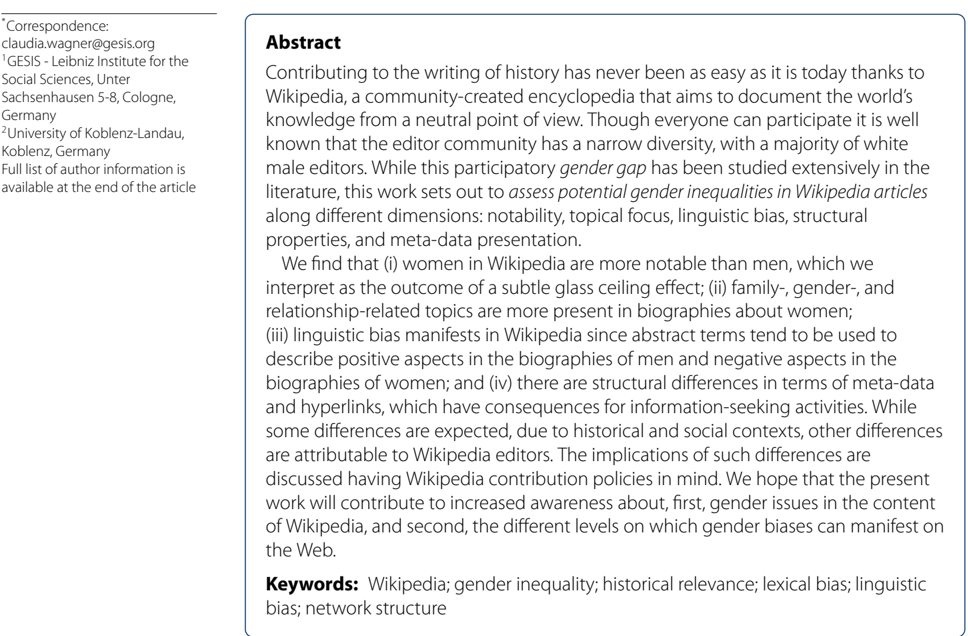
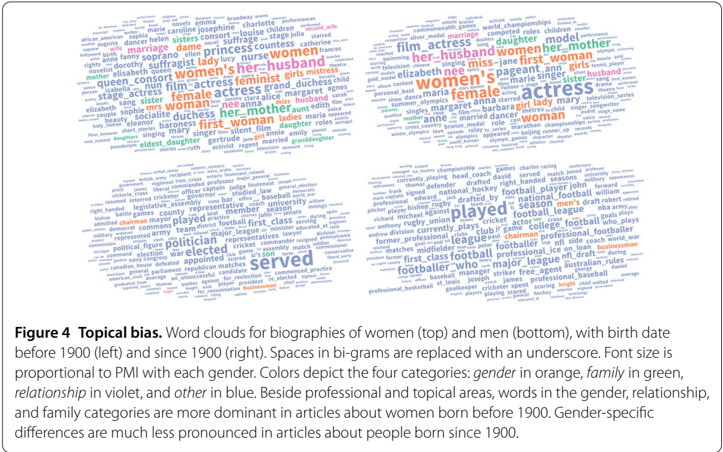
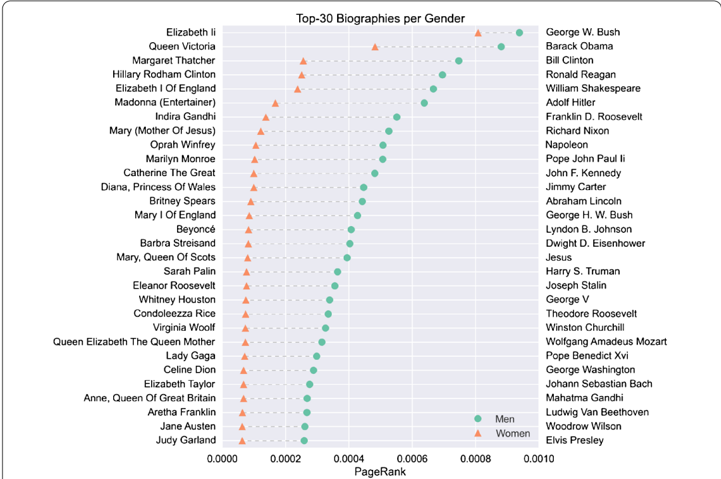
Contributing to the writing of history has never been as easy as it is today thanks to Wikipedia, a community-created encyclopedia that aims to document the world’s knowledge from a neutral point of view. Though everyone can participate it is well known that the editor community has a narrow diversity, with a majority of white male editors. While this participatory gender gap has been studied extensively in the literature, this work sets out to assess potential gender inequalities in Wikipedia articles along different dimensions: notability, topical focus, linguistic bias, structural properties, and meta-data presentation. We find that (i) women in Wikipedia are more notable than men, which we interpret as the outcome of a subtle glass ceiling effect; (ii) family-, gender-, and relationship-related topics are more present in biographies about women; (iii) linguistic bias manifests in Wikipedia since abstract terms tend to be used to describe positive aspects in the biographies of men and negative aspects in the biographies of women; and (iv) there are structural differences in terms of meta-data and hyperlinks, which have consequences for information-seeking activities. While some differences are expected, due to historical and social contexts, other differences are attributable to Wikipedia editors. The implications of such differences are discussed having Wikipedia contribution policies in mind. We hope that the present work will contribute to increased awareness about, first, gender issues in the content of Wikipedia, and second, the different levels on which gender biases can manifest on the Web.
Overview
The claims and statistics of this paper haven’t been checked yet.
Free: it reads the open-access text and checks the first 5 claims that cite a source we can check. Create a free account to check every claim.
Integrity signals
Registry
Cites
Statistics
Figures
Verification
Claims the paper makes
The claims and statistics of this paper haven’t been checked yet.
Free: it reads the open-access text and checks the first 5 claims that cite a source we can check. Create a free account to check every claim.
Claims other papers make about this one
Each is checked against this paper’s own text: does it say what the citing paper says it does?
In the citing paper
“However, our approach may not work similarly for other types of machine learning models such as those built on recurrent neural networks, which are sensitive to word order and syntax, and it does not address subtler instances of bias, such as the association of broader topics with gender (e.g., women and relationship-and family-related topics) [75].”
From Addressing age-related bias in sentiment analysis, (2018) · cites this paper as [75]
Self-check
Percentages, sums and reported differences re-computed from the paper’s own numbers.
The self-check needs the paper’s full text.
Citations
Cites
Collective dynamics of ‘small-world’ networks
Watts, D. J., & Strogatz, S. H. (1998) · Nature · doi:10.1038/30918 · Cited by 43,060
The anatomy of a large-scale hypertextual Web search engine
Brin, S., & Page, L. (1998) · Computer Networks and ISDN Systems · doi:10.1016/s0169-7552(98)00110-x · Cited by 16,004
Social categorization and intergroup behaviour
Tajfel, H., Billig, M. G., Bundy, R. P., & Flament, C. (1971) · European Journal of Social Psychology · doi:10.1002/ejsp.2420010202 · Cited by 5,562 · cited 2×
“At least three plausible explanations exist that describe why the glass-ceiling effect may be present in Wikipedia: (1) the narrow diversity of editors may foster the glass-ceiling effect since it is well known that individuals generally favor people from their in-group over people from their out-group [9, 34]; (2) me…”
BackgroundRecognizing contextual polarity in phrase-level sentiment analysis
Wilson, T., Wiebe, J., & Hoffmann, P. (2005) · Proceedings of the conference on Human Language Technology and Empirical Methods in Natural Language Processing - HLT '05 · doi:10.3115/1220575.1220619 · Cited by 3,345
DBpedia – A large-scale, multilingual knowledge base extracted from Wikipedia
Lehmann, J., Isele, R., Jakob, M., Jentzsch, A., Kontokostas, D., Mendes, P. N., Hellmann, S., Morsey, M., van Kleef, P., Auer, S., et al. (2015) · Semantic Web · doi:10.3233/sw-140134 · Cited by 3,168 · cited 1×
“DBpedia [22] is a structured version of Wikipedia that provides meta-data for articles; normalized article Uniform Resource Identifiers (URIs) that allow to interlink articles about the same entity in different language editions; normalized links between articles (taking care of redirections); and a categorization of…”
BackgroundLakoff, R. (1973) · Language in Society · doi:10.1017/s0047404500000051 · Cited by 3,138
Personality, Gender, and Age in the Language of Social Media: The Open-Vocabulary Approach
Schwartz, H. A., Eichstaedt, J. C., Kern, M. L., Dziurzynski, L., Ramones, S. M., Agrawal, M., Shah, A., Kosinski, M., Stillwell, D., Seligman, M. E. P., et al. (2013) · PLoS ONE · doi:10.1371/journal.pone.0073791 · Cited by 1,700 · cited 2×
“[30] H Andrew Schwartz, Johannes C Eichstaedt, Margaret L Kern, Lukasz Dziurzynski, Stephanie M Ramones, Megha Agrawal, Achal Shah, Michal Kosinski, David Stillwell, Martin EP Seligman, et al.”
BackgroundInfluentialGender differences in narcissism: A meta-analytic review.
Grijalva, E., Newman, D. A., Tay, L., Donnellan, M. B., Harms, P. D., Robins, R. W., & Yan, T. (2015) · Psychological Bulletin · doi:10.1037/a0038231 · Cited by 654
Language use in intergroup contexts: The linguistic intergroup bias.
Maass, A., Salvi, D., Arcuri, L., & Semin, G. R. (1989) · Journal of Personality and Social Psychology · doi:10.1037/0022-3514.57.6.981 · Cited by 654 · cited 4×
“well as our expectations for their behavior and attributes [23].”
BackgroundInfluentialWomen and news: A long and winding road
Ross, K., & Carter, C. (2011) · Media, Culture & Society · doi:10.1177/0163443711418272 · Cited by 345 · cited 1×
“Analysis of longitudinal data from the Global Media Monitoring Project (GMMP) spanning over 15 years indicates that the role of women as producers and subjects of news has seen a steady improvement, but the relative visibility of women compared to men has been stuck at 1:3 [27].”
Background
Research works printed but not linked: 16
- Lam STK, Uduwage A, Dong Z, Sen S, Musicant DR, Terveen L, Riedl J (2011) WP: clubhouse? An exploration of Wikipedia's gender imbalance. In: Proceedings of the 7th international symposium on Wikis and open collaboration, pp 1-10
- Hill BM, Shaw A (2013) The Wikipedia gender gap revisited: characterizing survey response bias with propensity score estimation. PLoS ONE 8(6):e65782
- Wagner C, Garcia D, Jadidi M, Strohmaier M (2015) It's a man's Wikipedia? Assessing gender inequality in an online encyclopedia. In: Ninth international AAAI conference on web and social media
- Beukeboom CJ (2014) Mechanisms of linguistic bias: how words reflect and maintain stereotypic expectancies. In: Social cognition and communication, pp 313-330
- Thomas G (1992) A position to command respect: women and the eleventh Britannica. Scarecrow Press, Metuchen
- Otterbacher J (2015) Linguistic bias in collaboratively produced biographies: crowdsourcing social stereotypes? In: Ninth international AAAI conference on web and social media
- Church KW, Hanks P (1990) Word association norms, mutual information, and lexicography. Comput Linguist 16(1):22-29
- Bird S, Klein E, Loper E (2009) Natural language processing with Python, 1st edn. O'Reilly Media, Sebastopol 19. Singhal A (2012) Introducing the knowledge graph: things, not strings. Official Google blog, May. https://googleblog.blogspot.co.uk/2012/05/introducing-knowledge-graph-things-not.html. Visited Oct 2015.
- Bridenthal R, Koonz C, Stuard SM (1987) Becoming visible: women in European history. Houghton Mifflin, Boston
- Skiena SS, Ward CB (2014) Who's bigger? Where historical figures really rank. Cambridge University Press, Cambridge
- Aragón P, Laniado D, Kaltenbrunner A, Volkovich Y (2012) Biographical social networks on Wikipedia: a cross-cultural study of links that made history. In: Proceedings of the eighth annual international symposium on Wikis and open collaboration, p 19
- Brown R (1995) Prejudice: its social psychology. Blackwell, Oxford
- Eom Y, Aragón P, Laniado D, Kaltenbrunner A, Gigna S, Shepelyansky DL (2014) Interactions of culture and top people of Wikipedia from ranking 24 language editions. PLoS ONE 10(3):e0114825
- APA (2000) General guidelines for reducing bias. In: Publication manual of the American Psychological Association, 6th edn. American Psychological Association, Washington
- Reagle J, Rhue L (2011) Gender bias in Wikipedia and Britannica. Int J Commun 5:1138-1158
- Murray C (2003) Human accomplishment. The pursuit of excellence in the arts and sciences. Perennial, New York
Cited by
Items 101–176 of 176
How Inclusive Are Wikipedia’s Hyperlinks in Articles Covering Polarizing Topics?
Menghini, C., Anagnostopoulos, A., & Upfal, E. (2021) · IEEE International Conference on Big Data (BigData) · doi:10.1109/bigdata52589.2021.9671943 · Cited by 6
“Recent works found the presence of cultural bias in the same articles of different languages [35] and gender biases [36], [37].”
BackgroundDemographic disparity in Wikipedia coverage: a global perspective
Yu, Y., Li, X., Li, T., Dhillon, P. S., & Romero, D. M. (2025) · EPJ Data Science · doi:10.1140/epjds/s13688-025-00530-4 · Cited by 4
Orphan Articles: The Dark Matter of Wikipedia
Arora, A., West, R., & Gerlach, M. (2024) · Proceedings of the International AAAI Conference on Web and Social Media · doi:10.1609/icwsm.v18i1.31300 · Cited by 9
“For example, visibility of biographies about women is systematically lower than for biographies about men (Wagner et al. 2015; Wagner et al. 2016).”
BackgroundQuantifying behavior-based gender discrimination on collaborative platforms
Vásárhelyi, O., & Vedres, B. (2025) · PNAS Nexus · doi:10.1093/pnasnexus/pgaf026 · Cited by 5
“Several recent publications set out to chart the gender gap in the digital economy with respect to participation and success (40 – 44).”
Thomas, P. A. (2021) · College & Research Libraries · doi:10.5860/crl.82.4.567 · Cited by 4
Leveraging Wikipedia article evolution for promotional tone detection
de Kock, C., & Vlachos, A. (2022) · Proceedings of the conference - Association for Computational Linguistics. Meeting · doi:10.18653/v1/2022.acl-long.384 · Cited by 4
“Such an imbalance in the data may be related to the findings of Wagner et al. (2016), which explores the imbalance in representations of women versus men on Wikipedia.”
BackgroundFreedman, G., Moutoux, I., Hermans, I., & Green, M. C. (2023) · Communication Monographs · doi:10.1080/03637751.2023.2285989 · Cited by 5
“The Finkbeiner test has received widespread attention in journalism (e.g., Brainard, 2013) and has been used in research on gender biases in biographies on Wikipedia (Wagner et al., 2016).”
MethodGupta, S., & Trehan, K. (2021) · Media Asia · doi:10.1080/01296612.2021.2003100 · Cited by 4
“Likewise, Wagner et al. (2016) highlight the glass ceiling for women in Wikipedia ’ s editorial as well as representation.”
BackgroundThe Person of the Author: Constructing Gendered Scholars in Religious Studies Book Reviews
Ali, K., & Serrano, L. (2022) · Journal of the American Academy of Religion · doi:10.1093/jaarel/lfac047 · Cited by 4
Exploring Imbalances on Wikipedia Through Archival Creation Theories
Robb, D. (2024) · The iJournal Student Journal of the Faculty of Information · doi:10.33137/ijournal.v10i1.44532 · Cited by 3
Wikipedia Edit-a-thons: Thinking Beyond the Warm Fuzzies
Robichaud, D. (2017) · Partnership The Canadian Journal of Library and Information Practice and Research · doi:10.21083/partnership.v11i2.3802 · Cited by 3
Wolff, C. G., & Schmidt, T. (2021) · University of Regensburg Publication Server (University of Regensburg) · doi:10.5283/epub.44931 · Cited by 4
Co-occurrence network of TV advertisements revealing Japanese lifestyle
Ito, M. I., & Ohnishi, T. (2021) · Applied Network Science · doi:10.1007/s41109-021-00393-4 · Cited by 5
Nelson, L. K., Getman, R., & Haque, S. A. (2021) · Sociological Methods & Research · doi:10.1177/00491241211067514 · Cited by 4
“…who contributes to Wikipedia (Hargittai and Shaw 2015), who gets biographical pages (Adams, Brückner, and Naslund 2019; Reagle and Rhue 2011), how the notability guideline is applied (Tripodi 2021), and how men and women are described (Graells-Garrido, Lalmas, and Menczer 2015; Wagner et al. 2016).”
BackgroundMAPPING THE NETWORKED CONTEXT OF COPERNICUS, MICHELANGELO, AND DELLA MIRANDOLA IN WIKIPEDIA
Miccio, L. A., Pérez, C. G., Suárez, J. L., & Schwartz, G. A. (2022) · Advances in Complex Systems · doi:10.1142/s0219525922400100 · Cited by 3
Too Much Information: Can AI Cope with Modern Knowledge Graphs?
Krötzsch, M. (2019) · Lecture notes in computer science · doi:10.1007/978-3-030-21462-3_2 · Cited by 4
Exploring Wikipedia Gender Diversity Over Time — The Wikipedia Gender Dashboard (WGD)
Yunus, Y., Chen, T., & Demartini, G. (2025) · International World Wide Web Conference (WWW) · doi:10.1145/3701716.3715175 · Cited by 2
“The narrow diversity among editors may play a part in the issue of gender imbalance as editors generally accommodate people from their group over other groups [14].”
Wikimedia research methodologies: a bibliometric history of peer production and AI (2005–2025)
Jankowski, S. (2026) · AI & Society · doi:10.1007/s00146-026-03359-1 · Cited by 2
Untersuchung des Gender Bias im deutschsprachigen Wikipedia
Krause, S. (2022) · doi:10.30844/akwi_2022_28 · Cited by 2
The Danish legislators database
Klint, T., Evert, A. S., Kjær, U., Pedersen, M. N., & Hjorth, F. (2023) · Electoral Studies · doi:10.1016/j.electstud.2023.102624 · Cited by 2
Linguistic Bias in Crowdsourced Biographies: A Cross-lingual Examination
Otterbacher, J., Katakis, I., & Agathangelou, P. (2019) · WORLD SCIENTIFIC eBooks · doi:10.1142/9789813274884_0012 · Cited by 2
Invisible intensities: exploring (extra)ordinary affects in a virtual space
Perry, S. A. B. (2021) · Inscriptions · doi:10.59391/inscriptions.v4i2.111 · Cited by 2
Automatically Inferring Gender Associations from LanguagePreprint
Chang, S. Y., & McKeown, K. R. (2019) · arXiv (Cornell University) · doi:10.48550/arxiv.1909.00091 · Cited by 2
“…people talk to women and men (Voigt et al., 2018), as well as how people talk about women and men, typically in specific domains such as sports journalism (Fu et al., 2016), fiction writing (Fast et al., 2016), movie scripts (Sap et al., 2017), and Wikipedia biographies (Wagner et al., 2015, 2016).”
BackgroundComputing GenderPreprint
Vásárhelyi, O., & Brooke, S. (2022) · SocArXiv (OSF Preprints) · doi:10.31235/osf.io/admcs · Cited by 3
Ferrán-Ferrer, N., Velilla, M. C., & Fernández, L. (2025) · Online Journal of Communication and Media Technologies · doi:10.30935/ojcmt/17483 · Cited by 1
Monitoring the gender gap in the coverage of biology professors on Wikipedia
Alvarez-Ponce, D., & Iyengar, N. (2026) · Proceedings of the Royal Society B Biological Sciences · doi:10.1098/rspb.2025.2566 · Cited by 1
Martínez, Y. M., Fernández, L., & Ferrán-Ferrer, N. (2025) · Data Technologies and Applications · doi:10.1108/dta-01-2025-0067 · Cited by 1
Rovira, M. S., Velilla, M. C., Pérez–Montoro, M., & Ferrán-Ferrer, N. (2026) · Digital Library Perspectives · doi:10.1108/dlp-11-2025-0265 · Cited by 1
Kratzke, S., Meral, E. O., & Rosenbusch, H. (2026) · EPJ Data Science · doi:10.1140/epjds/s13688-026-00665-y · Cited by 1
“Narrative media of all formats reflect commonly-held gender stereotypes [1, 2].”
Wikipedia, a Tool for Knowledge Dissemination on Invasive Species
Groom, Q., Lozano, V., Meeus, S., & Olmedo‐Castellanos, C. (2019) · Biodiversity Information Science and Standards · doi:10.3897/biss.3.37386 · Cited by 1
“Wikipedia has been criticized about many aspects of its content and editorship, including its quality and neutrality (Kumar et al. 2016, Wagner et al. 2016, Hargittai and Shaw 2014).”
BackgroundSpeaks, H., Falise, A. M., Grosgebauer, K., Duncan, D. T., & Carrico, A. W. (2019) · Interactive Journal of Medical Research · doi:10.2196/13871 · Cited by 1
“Wikipedia itself has been found to have a deficit of female editors, fewer notable female Wikipedia page entries than notable male Wikipedia page entries, and biased language on female Wikipedia pages [35-37].”
Simple Wikidata Analysis for Tracking and Improving Biographies in Catalan Wikipedia
Hermoso, A. (2021) · International World Wide Web Conference (WWW) · doi:10.1145/3442442.3452344 · Cited by 1
“They are also important articles to have under scrutiny because they can be a target to abuse for selfpromotion by biographed people and, in whole numbers, they can also reflect a prevalent gender bias [2][3].”
BackgroundFemale representation among notable people born in 1700–2000
Peña, P. A., & Choi, J. H. (2021) · Economics Letters · doi:10.1016/j.econlet.2021.109968 · Cited by 1
Collaborative group work and increased diversity through Wikipedia editing
Stvan, L. S. (2021) · Proceedings of the Linguistic Society of America · doi:10.3765/plsa.v6i2.5101 · Cited by 1
“One well-documented demographic divide in creating Wikipedia content relates to gender, e.g., Wagner et al. (2016) on which editors create main page edits; Cabrera et al. (2018) on which editors contribute to talk pages; and Balch (2019), noting that no more than 20% of Wikipedia editors are female.”
BackgroundWholehearted Participation: Attuning to Affect and Immanence in a Virtual Field
Perry, S. A. B. (2022) · Anthropology & Humanism · doi:10.1111/anhu.12375 · Cited by 4
Organizações e movimentos periféricos nas redes digitais ibero-americanas
Sociedade, C. –. C. D. E. D. C. E., Costa, P. R., Capoano, E., Sociedade, C. –. C. D. E. D. C. E., Ibáñez, D. B., & del Rosario, U. (2022) · doi:10.16921/ciespal.34 · Cited by 1
Effects of Locality and Rule Language on Explanations for Knowledge Graph Embeddings
Galárraga, L. A. (2023) · Lecture notes in computer science · doi:10.1007/978-3-031-30047-9_12 · Cited by 2
Through a Glass Darkly. Women in the Scientific Elite
Takács, I. (2022) · Károli könyvek. Monográfia · doi:10.56037/978-2-14-027730-6 · Cited by 1
Wikigender: A Machine Learning Model to Detect Gender Bias in WikipediaPreprint
Brun, N. B., Kypraiou, S., Altés, N. G., & Barrios, I. P. (2022) · arXiv (Cornell University) · doi:10.48550/arxiv.2211.07520 · Cited by 1
“In "Women through the glass ceiling: gender asymmetries in Wikipedia" [9], Wagner et al.”
BackgroundInfluentialThe Representation of Female Economists on WikipediaPreprint
Venus, N. (2023) · SSRN Electronic Journal · doi:10.2139/ssrn.4540744 · Cited by 1
A Multilingual Perspective on Probing Gender BiasPreprint
Stańczak, K. (2024) · arXiv (Cornell University) · doi:10.48550/arxiv.2403.10699 · Cited by 1
The unwomanly face of literary awardsPreprint
Caballer‐Tarazona, M., Perez-Vazquez, P., & Vidal-Llana, X. (2026) · Research Square · doi:10.21203/rs.3.rs-8388588/v1 · Cited by 1
Takács, I. (2019) · University of Debrecen Electronic Archive (University of Debrecen)
Auditing Wikipedia's Hyperlinks Network on Polarizing TopicsPreprint
Menghini, C., Anagnostopoulos, A., & Upfal, E. (2020) · arXiv (Cornell University)
Meier, F. (2021) · VBN Forskningsportal (Aalborg Universitet) · doi:10.5283/epub.44937
On the Alignment Between Self-Declared Gender Identity and Topical Content from Wikipedia
McDonald, D. W., & Zachry, M. R. (2021) · ACM Transactions on Social Computing · doi:10.1145/3450753
“Other work has focused on the number, breadth, and quality of biographies of women in Wikipedia, generally finding that these are lower [12, 54].”
BackgroundWorldbuilding, Gaming, and Multiliteracies in an Online First-Year Seminar
McKenzie, B. (2021) · Advances in game-based learning book series · doi:10.4018/978-1-7998-7271-9.ch012
Wikipédia no feminino. O caso da enciclopédia em língua portuguesa
Costa, P. R., de Barros, V. R. P., & Cerqueira, C. (2022) · doi:10.16921/ciespal.34.52
Stvan, L. S. (2023) · Future education and learning spaces · doi:10.1007/978-981-19-8590-4_7
How-to Guides for Specific Audiences: A Corpus and Initial Findings
Fanton, N., Faleńska, A., & Roth, M. (2023) · Proceedings of the conference - Association for Computational Linguistics. Meeting · doi:10.18653/v1/2023.acl-srw.46 · Cited by 2
Frauen in Rot: Ein Projekt zur Verringerung der Geschlechterkluft in der deutschsprachigen Wikipedia
Herrmann, B. (2024) · API Magazin · doi:10.15460/apimagazin.2024.5.1.185
O Direito da Mulher no Contexto do Mercado de Trabalho: uma Análise Bibliométrica
Dias, F. M. D. S. A., de Oliveira, V. B. S., & de Siqueira, A. C. B. (2025) · Revista de Gestão e Secretariado (Management and Administrative Professional Review) · doi:10.7769/gesec.v16i7.5074
International Women’s Day: Female biologists bring much-needed perspective to science
Thomasy, H. (2020) · The Conversation · doi:10.64628/aam.sc3adt9th
Using a Wikipedia edit-a-thon as a cross-curricular STEM representation assignment
Seredinski, A., Litchock-Morellato, F., Lange, A. K., Gordon, J. M., Rosero, K. H., Stecher, N., Ernst, B., & Yeomans, J. (2025) · Discover Education · doi:10.1007/s44217-025-00702-4
Waking Students Up to Systemic Bias: Using Wikipedia From a Critical Pedagogy Perspective
Giblin, S., & McKenzie, B. (2025) · Journal of Transformative Education · doi:10.1177/15413446251383885
“Gender bias is endemic (Sun & Peng, 2021; Wagner et al., 2016).”
Additional file 1 of Co-occurrence network of TV advertisements revealing Japanese lifestyle
Ito, M. I., & Ohnishi, T. (2021) · Figshare · doi:10.6084/m9.figshare.14992994
Corpus-based and Computational Analysis of Entity Framing
Van Den Berg, E. (2024) · heiDOK (Heidelberg University) · doi:10.11588/heidok.00034230
Graph Pattern Matching on Symmetric Multiprocessor Systems
Krause, A. (2020) · Qucosa (Saxon State and University Library Dresden)
Actualizaciones en Estudios de Género: aportes del Programa Postdoctoral en Estudios de Género
Burín, M., Campagnoliy, M. A., Quezada, R. G., De Franco, C., Morales, L. A., & Isoardi, M. E. (2021) · Repositorio Institucional UCES (Texas A&M University Libraries)
van Dijk, Z. (2021) · OAPEN (The OAPEN Foundation)
Schmahl, K. G. (2020) · Research Repository (Delft University of Technology)
Price, A. (2018) · Digital Library of the University of Innsbruck (University of Innsbruck)
Accuracy and Bias in Crowdsourced Information: Evaluating Online Knowledge RepositoriesPreprint
Micheal, D. (2025) · SSRN Electronic Journal · doi:10.2139/ssrn.5380661
Der KI-XR-Martin-Luther-Avatar. Ein technologisches Experiment Digitaler Theologie
Reimann, R. P. (2026) · Nomos Verlagsgesellschaft mbH & Co. KG eBooks · doi:10.5771/9783748916413-139
Large Language Models and Gender Bias: An Empirical AnalysisPreprint
ÇAKIR, P., & TEMİR, E. (2026) · Research Square · doi:10.21203/rs.3.rs-9577604/v1
Cross-lingual Biography Enrichment via Claim Extraction and Alignment
Song, Y., Chen, Z., Sayilov, E., & Gardent, C. (2026) · Conference on Empirical Methods in Natural Language Processing (EMNLP) · doi:10.18653/2026.emnlp-main.441
Explorando la representación de contenido local en Wikipedia en español: El caso de Argentina
Zanotti, A. (2026) · Publicaciones de la Asociación Argentina de Humanidades Digitales · doi:10.24215/27187470e080
ГЕНДЕРЛІК АСИММЕТРИЯНЫҢ ЛИНГВОМӘДЕНИ КӨРІНІСІ(2020-2025 жж. БАҚ материалы бойынша)
Нурмаганбетова, Г. Б., & Шоқым, Г. Т. (2026) · doi:10.48371/phils.2026.3.82.020
Giye: A provenance-preserving pipeline for building a person register of the Korean media art fieldPreprint
Bae, J. (2026) · SSRN Electronic Journal · doi:10.2139/ssrn.7590237
A Sentiment Analysis of Gender Bias in Digital Spaces
Moreno, A. I., & Moreno, L. R. (2026) · IntechOpen eBooks · doi:10.5772/intechopen.1018295
Where the World went Missing: Geographic Inequality in Wikipedia and AIPreprint
Ferres, J. L., Robinson, C., Ortiz, A., Blazes, M., & Becker‐Reshef, I. (2026) · Research Square · doi:10.21203/rs.3.rs-11413641/v1
Munnes, S., Harsch, C., Knobloch, M., Vogel, J. S., Hipp, L., & Schilling, E. (2022) · doi:10.3389/fdata.2022.886362.s005
Peer review history of Quantifying gender biases towards politicians on Reddit (part 3)
Marjanovic, S., Stańczak, K., & Augenstein, I. (2022) · doi:10.1371/journal.pone.0274317.r003
A little bird told me your gender: Gender inferences in social media
Fosch-Villaronga, E., Poulsen, A., Søraa, R. A., & Custers, B. H. M. (2021) · Information Processing & Management · doi:10.1016/j.ipm.2021.102541 · Cited by 98
Metadata
- Authors
- Wagner, C., Graells-Garrido, E., Garcia, D., & Menczer, F.
- Affiliations
- GESIS - Leibniz Institute for the Social Sciences (DE)
- Indiana University Bloomington (US)
- Corresponding author
- Wagner, Claudia
- Venue
- EPJ Data Science
- Published
- 2016-03-01
- Volume
- 5
- Issue
- 1
- ISSN
- 2193-1127 (ISSN-L)
- OpenAlex
- W2292253565
- Cited by
- 115
- References
- 20
- Citations by year
- 2026: 9 · 2025: 9 · 2024: 3 · 2023: 15 · 2022: 18 · 2021: 28 · 2020: 11 · 2019: 11 · 2018: 8 · 2017: 2 · 2016: 1
- FWCI
- 20.65
- Type
- journal article
- Language
- en
- Open access
- gold
- doi.org
- Locations
- EPJ Data Science (publishedVersion, cc-by)
- arXiv (Cornell University) (submittedVersion)
- Social Science Open Access Repository (GESIS – Leibniz Institute for the Social Sciences) (submittedVersion, cc-by)
- KOPS (University of Konstanz) (submittedVersion, cc-by)
- arXiv (Cornell University)
- Topics
- Social Sciences › Communication › Wikis in Education and Collaboration
- Physical Sciences › Computer Science › Artificial Intelligence › Ethics and Social Impacts of AI
- Social Sciences › Gender Studies › Gender and Technology in Education
- Keywords
- Wikipedia, gender bias, glass ceiling, notability, language bias, gender asymmetry, article metadata, hyperlink structure, information seeking
About these checks
Registry, retraction, Cites and statistics results are computed, not judged, with one exception: a printed reference that no index lists is read once by a model before it counts as a citation error. Claims are extracted by a model and kept only when their quote appears verbatim in the text; each cited source is then checked, with a model’s help, for whether it says what the claim relies on. Those verdicts can be wrong — read the claim’s quote and the cited source before relying on one.
Statistics and arithmetic are recomputed, not judged.
Confidence bands are shown only for fields calibrated on our annotated test set. None is calibrated yet, so no band is shown.
What counts as a claim ›How we measure confidence ›How we check this ›
Are you an author, or do you see a problem with this page? Request a review
Data sources
Bibliographic data: Semantic Scholar, OpenAlex, Crossref.
Contains information from the Semantic Scholar Academic Graph Datasets, made available under the ODC Attribution License (ODC-BY 1.0).
Semantic Scholar’s data is described in: Kinney, R., et al. (2023). The Semantic Scholar Open Data Platform. arXiv:2301.10140.
