

MORPHING OF TRIANGULAR MESHES IN SHAPE SPACE
Open accessThe DOI matches its Crossref record; 20 of the 20 references it cites were found in a registry or an index; none of the 5 sources its claims cite is checked for support yet.
Abstract
We present a novel approach to morph between two isometric poses of the same non-rigid object given as triangular meshes. We model the morphs as linear interpolations in a suitable shape space S. For triangulated 3D polygons, we prove that interpolating linearly in this shape space corresponds to the most isometric morph in R3. We then extend this shape space to arbitrary triangulations in 3D using a heuristic approach and show the practical use of the approach using experiments. Furthermore, we discuss a modified shape space that is useful for isometric skeleton morphing. The novelty of the presented approaches is a solution to the morphing problem that does not need to solve a minimization problem.
Overview
CoChat Summary
## TL;DR
The paper introduces a novel shape-space representation for morphing between isometric poses of triangular meshes, proving an exact result for triangulated 3D polygons and extending the idea heuristically to general meshes. It avoids nonlinear optimization and reports visually pleasing morphs on several examples, including meshes with 429, 10,002, 11,102, and 165,954 vertices.
## Key findings
- For triangulated 3D polygons, linear interpolation in the proposed shape space corresponds exactly to the most isometric morph in R³.
- The polygon algorithm computes intermediate deformation poses in O(n) time, because it only requires a traversal of the dual graph, which has O(n) complexity.
- For general connected triangular meshes, the paper proposes a heuristic based on a minimum spanning tree of the dual graph; the method does not guarantee the optimal solution, but the authors report visually pleasing results.
- Experimental results reported in Table 1 include:
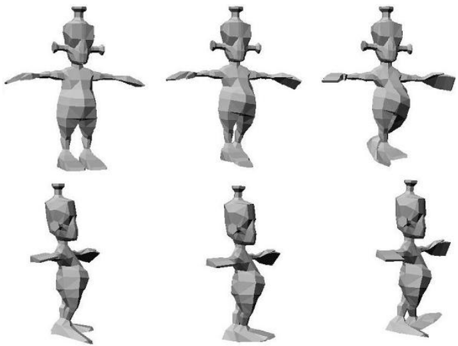
- Alien Row 1: 429 vertices, < 1 sec, Q = 0.000719
- Alien Row 2: 429 vertices, < 1 sec, Q = 0.000064
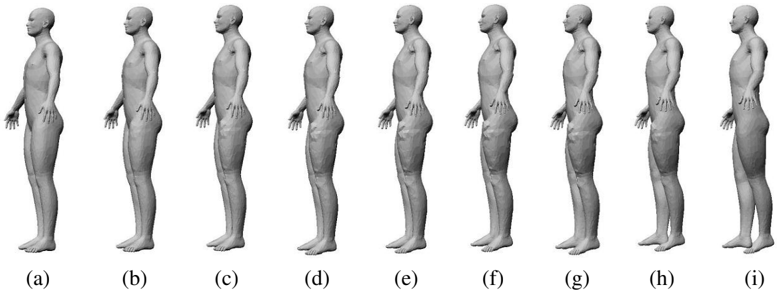
- Human: 10,002 vertices, 8 sec, Q = 0.042674
- Head: 11,102 vertices, 10 sec, Q = 0.003583
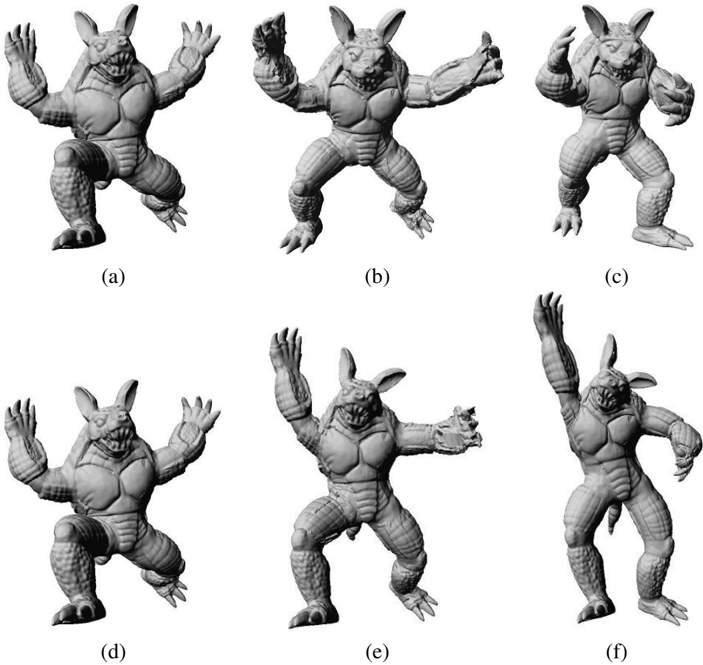
- Armadillo Row 1: 165,954 vertices, 1813 sec, Q = 12277.92
- Armadillo Row 2: 165,954 vertices, 1763 sec, Q = 70637.80
## Methods
- The paper defines a new shape space in which each shape is encoded by a root vertex, edge lengths, and triangle normal directions; interpolation uses linear interpolation for lengths and SLERP for directions.
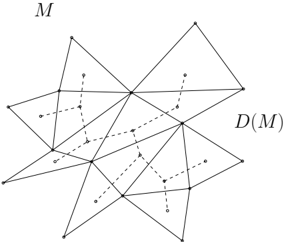
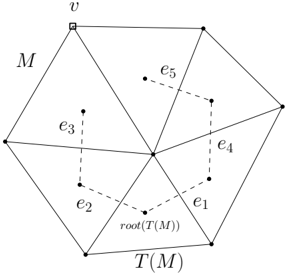
- For triangulated 3D polygons, the method reconstructs intermediate meshes by traversing the dual graph, which is a binary tree for these polygons, yielding an exact morph.
- For arbitrary triangular meshes, the method uses the dual graph’s minimum spanning tree and computes candidate vertex coordinates, then averages them; the paper also describes an exponential algorithm and a more efficient averaging algorithm.
- Experiments were run in C++ on an Intel Pentium D with 3.5 GB RAM, with OpenMP and the Boost graph library used.
## Limitations
- The paper states that for general triangular meshes the approach cannot be proven to find the optimal solution.
- It also states that the heuristic result is not invariant to the order of the vertices of the mesh, though this can be modified at the cost of higher runtime.
- Evident from the text: the inverse problem for general meshes is ill-defined—given a point in shape space, there may be no unique corresponding triangular mesh.
Model-written summary. Check it against the paper before relying on it.
Integrity signals
Registry
Cites
Statistics
Figures



Verification
Claims the paper makes
0 Valid · 10 Not valid · 5 Not checked · 61 Own results and interpretations
A result the paper states — it cites no source for it, so there is none to check. The quote shows it is in the paper.
In the paper
“For triangulated 3 D polygons, we prove that interpolating linearly in this shape space corresponds to the most isometric morph in R 3 .”
- Also stated in: § 1 Introduction · plain
“We introduce a new shape space S for triangulated 3 D polygons that has the property that interpolating linearly in shape space corresponds to the most isometric morph in R 3 .”
- Also stated in: § 3 Theory of Shape Space for Triangulated 3 D Polygons · plain
“This section introduces a novel shape space for triangulated 3 D polygons with the property that interpolating linearly in shape space corresponds to the most isometric morph in R 3 .”
boostedstates a cause- Asserted: passes — The authors put it forward as true.
- Checkable: passes — It can be checked against evidence.
- Load-bearing: passes — The paper’s conclusions depend on it.
- Based: passes — The paper gives a reason why it holds.
- Rests on 4 assumptions not shown here.
- Also stated in: § 1 Introduction · plain
A result the paper states — it cites no source for it, so there is none to check. The quote shows it is in the paper.
In the paper
“If P (0) and P (1) are not perfectly isometric, then each edge length of P ( t ) linearly interpolates between the corresponding edge lengths of P (0) and P (1) .”
plainstates a cause- Asserted: passes — The authors put it forward as true.
- Checkable: passes — It can be checked against evidence.
- Load-bearing: passes — The paper’s conclusions depend on it.
- Based: passes — The paper gives a reason why it holds.
A result the paper states — it cites no source for it, so there is none to check. The quote shows it is in the paper.
In the paper
“The existence of a mesh S ( t ) ∈ R 3 that has the underlying mesh structure M and that corresponds to s ( t ) is no longer guaranteed.”
plain- Asserted: passes — The authors put it forward as true.
- Checkable: passes — It can be checked against evidence.
- Load-bearing: passes — The paper’s conclusions depend on it.
- Based: passes — The paper gives a reason why it holds.
- Rests on an assumption not shown here.
The paper states this without a source or data behind it here, so there is nothing to check it against. The quote shows it is in the paper.
In the paper
“The dimensionality of the shape space is linear in the number of links of the skeleton.”
plainstates an association- Asserted: passes — The authors put it forward as true.
- Checkable: passes — It can be checked against evidence.
- Load-bearing: passes — The paper’s conclusions depend on it.
- Based: unclear — It is unclear why the paper says it holds.
A result the paper reports from its own data — it cites no other source for it, so there is none to check. The quote shows it is in the paper.
In the paper
“We do not include experiments obtained using these extensions of the approach as the averaging algorithm yields similar results as the less efficient algorithms in all of our experiments.”
plain- Asserted: passes — The authors put it forward as true.
- Checkable: passes — It can be checked against evidence.
- Load-bearing: passes — The paper’s conclusions depend on it.
- Based: passes — The paper gives a reason why it holds.
40 more claims
Create a free account to see all 76 claims and every source verdict.
- Borderline: one of the tests for a substantial claim is unclear. 1
- Probably not a substantial claim. 20
- It may state two separate claims as one. 15
- The quote only partly states this claim. 1
Citations
Cites
On the limited memory BFGS method for large scale optimization
Liu, D. C., & Nocedal, J. (1989) · Mathematical Programming · doi:10.1007/bf01589116 · Cited by 8,560
Shape Manifolds, Procrustean Metrics, and Complex Projective Spaces
Kendall, D. G. (1984) · Bulletin of the London Mathematical Society · doi:10.1112/blms/16.2.81 · Cited by 1,466
As-Rigid-As-Possible Surface Modeling
Sorkine‐Hornung, O., & Alexa, M. (2007) · doi:10.2312/sgp/sgp07/109-116 · Cited by 778
The farthest point strategy for progressive image sampling
Eldar, Y., Lindenbaum, M., Porat, M., & Zeevi, Y. Y. (1997) · IEEE Transactions on Image Processing · doi:10.1109/83.623193 · Cited by 693
Automatic rigging and animation of 3D characters
Baran, I., & Popović, J. (2007) · ACM SIGGRAPH 2007 papers · doi:10.1145/1275808.1276467 · Cited by 495
Analysis of planar shapes using geodesic paths on shape spaces
Klassen, E., Srivastava, A., Mio, W., & Joshi, S. H. (2004) · IEEE Transactions on Pattern Analysis and Machine Intelligence · doi:10.1109/tpami.2004.1262333 · Cited by 479
Large mesh deformation using the volumetric graph Laplacian
Zhou, K., Huang, J., Snyder, J., Liu, X., Bao, H., Guo, B., & Shum, H.-Y. (2005) · ACM Transactions on Graphics · doi:10.1145/1073204.1073219 · Cited by 315
The CAESAR project: a 3-D surface anthropometry survey
Robinette, K. M., Daanen, H., & Paquet, E. (2003) · Second International Conference on 3-D Digital Imaging and Modeling (Cat. No.PR00062) · doi:10.1109/im.1999.805368 · Cited by 294
2-D shape blending: an intrinsic solution to the vertex path problem
Sederberg, T. W., Gao, P., Wang, G., & Hong, M. (1993) · ACM SIGGRAPH Conference (SIGGRAPH) · doi:10.1145/166117.166118 · Cited by 269
Differential coordinates for local mesh morphing and deformation
Alexa, M. (2003) · The Visual Computer · doi:10.1007/s00371-002-0180-0 · Cited by 235 · cited 1×
“9 We call a morph S, 0 < t < 1 between two (possibly non-isometric) shapes S and S most isometric if it minimizes the sum of the absolute values of the differences between the corresponding edge lengths of two consecutive shapes summed over all shapes S, for t in [0, 1].”
BackgroundRecent Advances in Mesh Morphing
Alexa, M. (2002) · Computer Graphics Forum · doi:10.1111/1467-8659.00575 · Cited by 235 · cited 1×
“However, the developed methods are computationally expensive [1].”
MethodGeometric modeling in shape space
Kilian, M., Mitra, N. J., & Pottmann, H. (2007) · ACM SIGGRAPH 2007 papers · doi:10.1145/1275808.1276457 · Cited by 224 · cited 3×
“[9] used shape space representations to guide morphs and other more general deformations between shapes represented as triangular meshes.”
BackgroundMethodInfluentialAlt, H., & Guibas, L. J. (2000) · Handbook of Computational Geometry · doi:10.1016/b978-044482537-7/50004-8 · Cited by 214
Three-dimensional metamorphosis: a survey
Lazarus, F., & Verroust, A. (1998) · The Visual Computer · doi:10.1007/s003710050149 · Cited by 146 · cited 1×
“For example in computer graphics and computer animation this problem has received considerable attention [ 13 , 2]. A recent survey on this topic was written by Alexa [1].”
BackgroundLarge mesh deformation using the volumetric graph Laplacian
Zhou, K., Huang, J., Snyder, J., Liu, X., Bao, H., Guo, B., & Shum, H. (2005) · ACM SIGGRAPH Conference (SIGGRAPH) · doi:10.1145/1186822.1073219 · Cited by 66
INTRINSIC MORPHING OF COMPATIBLE TRIANGULATIONS
Surazhsky, V., & Gotsman, C. (2003) · International Journal of Shape Modeling · doi:10.1142/s0218654303000115 · Cited by 53 · cited 1×
“Surazhsky and Gotsman [19] morph by computing mean value barycentric coordinates based on an intrinsic representation of triangulated polygons.”
BackgroundKRAEVOY, V., & SHEFFER, A. (2006) · International Journal of Shape Modeling · doi:10.1142/s0218654306000822 · Cited by 38 · cited 1×
“Kraevoy and Sheffer [ 12 ] present a similar representation that is based on mean-value encodings of vertices.”
BackgroundInterpolating Polyhedral Models Using Intrinsic Shape Parameters
Sun, Y., Wang, W., & Chin, F. Y. L. (1997) · The Journal of Visualization and Computer Animation · doi:10.1002/(sici)1099-1778(199703)8:2<81::aid-vis163>3.0.co;2-w · Cited by 29
Cheng, H.-L., Edelsbrunner, H., & Fu, P. (2002) · doi:10.1109/pccga.1998.732056 · Cited by 14
Iben, H. N., O’Brien, J. F., & Demaine, E. D. (2006) · Annual Symposium on Computational Geometry (SoCG) · doi:10.1145/1137856.1137869 · Cited by 10
Research works printed but not linked: 9
- [4] Christopher M. Bishop. Pattern Recognition and Machine Learning . Springer, 2006. -
- [6] Ilya Eckstein, Jean-Philippe Pons, Yiying Tong, C. C. Jay Kuo, and Mathieu Desbrun. Generalized surface flows for mesh processing. In Symposium on Geometry Processing , pages 183-192, 2007. -
- Golub Gene, 1996, Matrix Computations
- [12] Judea Pearl. Probabilistic Reasoning in Intelligent Systems . Morgan Kaufmann, 1988. -
- [15] Ken Shoemake. Animating rotation with quaternion curves. In SIGGRAPH '85: Proceedings of the 12th annual conference on Computer graphics and interactive techniques , pages 245-254, 1985. -
- [16] Jeremy G. Siek, Lie-Quan Lee, and Andrew Lumsdaine. The boost graph library: user guide and reference manual . Addison-Wesley Longman Publishing Co., Inc., 2002. -
- [20] Emanuele Trucco and Alessandro Verri. Introductory Techniques for 3-D Computer Vision. Prentice Hall, 1998. -
- [22] Pengcheng Xi, Won-Sook Lee, and Chang Shu. Analysis of segmented human body scans. In Graphics Interface , 2007. -
- [23] Laurent Younes. Optimal matching between shapes via elastic deformations. Journal of Image and Vision Computing , 17(5,6):381-389, 1999. -
Cited by
Geometric optimization using nonlinear rotation-invariant coordinates
Sassen, J., Heeren, B., Hildebrandt, K., & Rumpf, M. (2020) · Computer Aided Geometric Design · doi:10.1016/j.cagd.2020.101829 · Cited by 12
Metadata
- Authors
- WUHRER, S., BOSE, P., CHANG, S., O'ROURKE, J., & BRUNTON, A.
- ORCID
- WUHRER, STEFANIE
- Venue
- International Journal of Shape Modeling
- Publisher
- World Scientific Pub Co Pte Lt
- Published
- 2010-06
- Volume
- 16
- Issue
- 01n02
- Pages
- 195-212
- ISSN
- 0218-6543 (ISSN-L)
- 1793-639X
- OpenAlex
- W1668992945
- Cited by
- 1
- References
- 9
- Citations by year
- 2020: 1
- FWCI
- 0.00
- Type
- journal article
- Language
- en
- Open access
- green
- arxiv.org
- Locations
- International Journal of Shape Modeling (publishedVersion)
- arXiv (Cornell University) (submittedVersion)
- NPARC (submittedVersion)
- Smith ScholarWorks (Smith College) (submittedVersion)
- arXiv (Cornell University)
- Funders
- Natural Sciences and Engineering Research Council of Canada
- Topics
- Physical Sciences › Computer Science › Computer Graphics and Computer-Aided Design › 3D Shape Modeling and Analysis
- Physical Sciences › Computer Science › Computer Graphics and Computer-Aided Design › Computational Geometry and Mesh Generation
- Physical Sciences › Computer Science › Computer Graphics and Computer-Aided Design › Computer Graphics and Visualization Techniques
- Keywords
- mesh morphing, triangular meshes, shape space, linear interpolation, 3D triangulation, shape modeling
About these checks
Registry, retraction, Cites and statistics results are computed, not judged, with one exception: a printed reference that no index lists is read once by a model before it counts as a citation error. Claims are extracted by a model and kept only when their quote appears verbatim in the text; each cited source is then checked, with a model’s help, for whether it says what the claim relies on. Those verdicts can be wrong — read the claim’s quote and the cited source before relying on one.
A language model drew the claims from the paper on 2026-10-10, under version 3 of the claim definition (model deepseek-v4.1-flash, prompt extract-v3).
A second model labelled each claim on 2026-10-10 (model jev-1.13-20260917, definition revision gold-guideline-v0.2).
Statistics and arithmetic are recomputed, not judged.
Confidence bands are shown only for fields calibrated on our annotated test set. None is calibrated yet, so no band is shown.
What counts as a claim ›How we measure confidence ›How we check this ›
Are you an author, or do you see a problem with this page? Request a review
Data sources
Bibliographic data: Semantic Scholar, OpenAlex, Crossref.
Contains information from the Semantic Scholar Academic Graph Datasets, made available under the ODC Attribution License (ODC-BY 1.0).
Semantic Scholar’s data is described in: Kinney, R., et al. (2023). The Semantic Scholar Open Data Platform. arXiv:2301.10140.
