

The DOI matches its Crossref record; 58 of the 58 references it cites were found in a registry or an index; 1 of the 33 sources its claims cite were checked for support.
Robust and accurate skeletal rigging from mesh sequences
Abstract
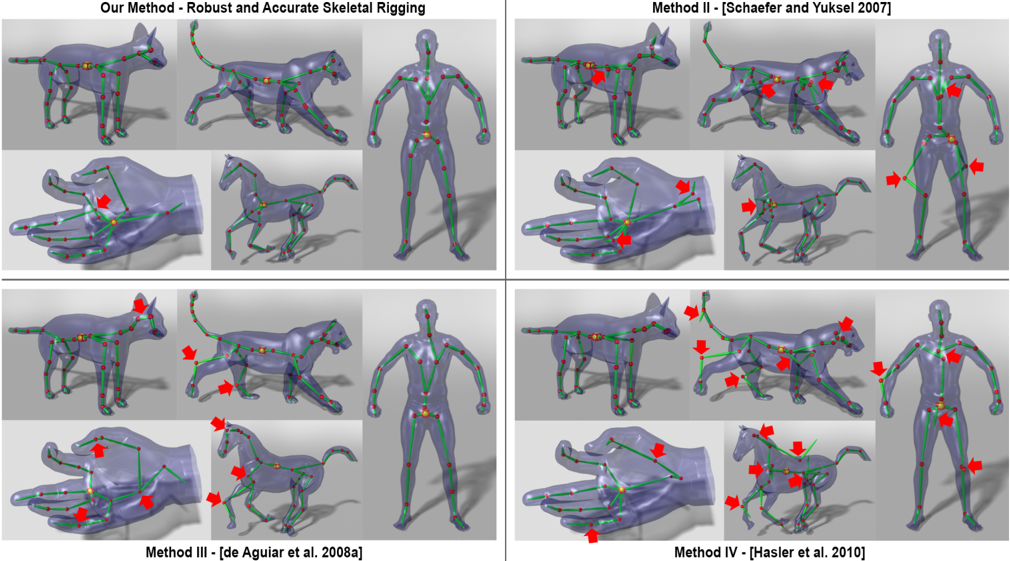
We introduce an example-based rigging approach to automatically generate linear blend skinning models with skeletal structure. Based on a set of example poses, our approach can output its skeleton, joint positions, linear blend skinning weights, and corresponding bone transformations. The output can be directly used to set up skeleton-based animation in various 3D modeling and animation software as well as game engines. Specifically, we formulate the solving of a linear blend skinning model with a skeleton as an optimization with joint constraints and weight smoothness regularization, and solve it using an iterative rigging algorithm that (i) alternatively updates skinning weights, joint locations, and bone transformations, and (ii) automatically prunes redundant bones that can be generated by an over-estimated bone initialization. Due to the automatic redundant bone pruning, our approach is more robust than existing example-based rigging approaches. Furthermore, in terms of rigging accuracy, even with a single set of parameters, our approach can soundly outperform state of the art methods on various types of experimental datasets including humans, quadrupled animals, and highly deformable models.
Overview
CoChat Summary
## TL;DR
The paper presents an example-based rigging method that automatically produces a skeleton-based linear blend skinning (LBS) model from a sequence of example poses. It improves robustness by over-initializing bones and pruning redundancies, and improves accuracy by iteratively updating weights, joint locations, and bone transformations with soft joint constraints.
## Key findings
- The method outputs the skeleton, joint positions, skinning weights, and bone transformations directly from example poses.
- On 9 test datasets, the paper reports that using a single parameter set, the method outperformed three state-of-the-art methods in robustness and accuracy.
- In Table 1, the reported RMSEs for the authors’ method are lower than the comparators across all listed datasets, e.g.:
- cat-poses: 0.25 vs. 0.68 / 1.04 / 0.63
- horse-poses: 0.21 vs. 0.54 / 1.24 / 0.75
- hand: 0.18 vs. 0.23 / 0.42 / 0.18
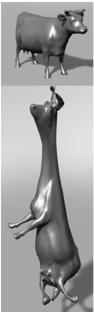
- cow: 1.52 vs. 5.41 / 5.61 / 5.58
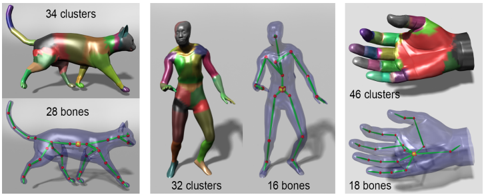
- The paper reports that the method can rig difficult models with few frames, e.g. 9 frames produced a 28-bone skeleton for the cat model.
## Methods
- Example-based rigging pipeline with three main stages: initialization from motion-driven clustering, topology reconstruction via skinning decomposition and a minimum spanning tree, and iterative rigging with block coordinate descent.
- Input: a temporally coherent set of example poses (mesh sequence) plus a rest pose; output: skeletal structure, joint locations, skinning weights, and bone transformations.
- Main analysis: optimization of an LBS model with data fitting, weight smoothness regularization, and soft joint constraints; redundant bones are pruned during iterative updates.
## Limitations
- The paper states that the method has low computational efficiency and is suitable only for offline applications.
- The paper states that results depend on the quality of the input example poses; noise, limited motion range, and asymmetry can affect output.
- The paper states that the LBS model has limited approximation power and cannot capture some complicated nonlinear deformations.
Model-written summary. Check it against the paper before relying on it.
Integrity signals
Registry
Cites
Statistics
Figures








Verification
Claims the paper makes
0 Valid · 1 Not valid · 21 Not checked · 72 Own results and interpretations
The cited sources that could be checked couldn’t confirm or dispute this claim.
In the paper
“As a tradeoff, [Anguelov et al. 2004] gives a slightly larger approximation error than [Schaefer and Yuksel 2007].”
What the sources say
- Could not verifycites Anguelov et al. 2004 doi:10.5555/1036843.1036846Experimental — accuracy not yet measured
The Experimental Results (p. 7) describe the paper’s puppet and arm datasets but do not compare approximation errors with Schaefer and Yuksel 2007. A search for that comparison and for approximation error found no supporting passage in our copy. (LLM, conf=0.78)
- Not matchedcites Schaefer and Yuksel 2007
Couldn’t be matched to a paper in Crossref, so it can’t be checked.
plain- Asserted: passes — The authors put it forward as true.
- Checkable: passes — It can be checked against evidence.
- Load-bearing: unclear — It is unclear whether the paper’s conclusions depend on it.
- Based: passes — The paper gives a reason why it holds.
- Could not verify
A result the paper states — it cites no source for it, so there is none to check. The quote shows it is in the paper.
In the paper
“We introduce an example-based rigging approach to automatically generate linear blend skinning models with skeletal structure.”
plainstates a cause- Asserted: passes — The authors put it forward as true.
- Checkable: passes — It can be checked against evidence.
- Load-bearing: passes — The paper’s conclusions depend on it.
- Based: passes — The paper gives a reason why it holds.
A result the paper states — it cites no source for it, so there is none to check. The quote shows it is in the paper.
In the paper
“Furthermore, in terms of rigging accuracy, even with a single set of parameters, our approach can soundly outperform state of the art methods on various types of experimental datasets including humans, quadrupled animals, and highly deformable models.”
plainstates a cause- Asserted: passes — The authors put it forward as true.
- Checkable: passes — It can be checked against evidence.
- Load-bearing: passes — The paper’s conclusions depend on it.
- Based: passes — The paper gives a reason why it holds.
A result the paper states — it cites no source for it, so there is none to check. The quote shows it is in the paper.
In the paper
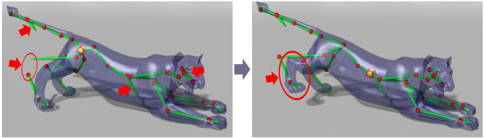
“As shown in Fig. 1, our method can robustly generate high-quality rigging models from a small set of example poses.”
plainstates a cause- Asserted: passes — The authors put it forward as true.
- Checkable: passes — It can be checked against evidence.
- Load-bearing: passes — The paper’s conclusions depend on it.
- Based: passes — The paper gives a reason why it holds.
A result the paper states — it cites no source for it, so there is none to check. The quote shows it is in the paper.
In the paper
“By formulating the solving of a LBS model with skeleton as a constrained optimization, our iterative approach can obtain more accurate joint locations, bone lengths, corresponding joint rotations, as well as the reconstruction of the example poses without accumulation of fitting errors.”
plainstates a cause- Asserted: passes — The authors put it forward as true.
- Checkable: passes — It can be checked against evidence.
- Load-bearing: passes — The paper’s conclusions depend on it.
- Based: unclear — It is unclear why the paper says it holds.
49 more claims
Create a free account to see all 94 claims and every source verdict.
- It may state two separate claims as one. 25
- Probably not a substantial claim. 19
Citations
Cites
An Algorithm for Vector Quantizer Design
Linde, Y., Buzo, A., & Gray, R. (1980) · IEEE Transactions on Communications · doi:10.1109/tcom.1980.1094577 · Cited by 7,201
On the shortest spanning subtree of a graph and the traveling salesman problem
Kruskal, J. B. (1956) · Proceedings of the American Mathematical Society · doi:10.1090/s0002-9939-1956-0078686-7 · Cited by 5,088
SCAPE: shape completion and animation of people
Anguelov, D., Srinivasan, P., Koller, D., Thrun, S., Rodgers, J., & Davis, J. (2005) · ACM Transactions on Graphics · doi:10.1145/1073204.1073207 · Cited by 1,489
A discussion of the solution for the best rotation to relate two sets of vectors
Kabsch, W. (1978) · Acta Crystallographica Section A · doi:10.1107/s0567739478001680 · Cited by 1,151 · cited 1×
“(6a) is to combine the solution proposed by Le and Deng [2012] with the solution to the Weighted Absolute Orientation problem [Kabsch 1978].”
MethodOn the Shortest Spanning Subtree of a Graph and the Traveling Salesman Problem
Kruskal, J. B. (1956) · Proceedings of the American Mathematical Society · doi:10.2307/2033241 · Cited by 1,117
Deformation transfer for triangle meshes
Sumner, R. W., & Popović, J. (2004) · ACM Transactions on Graphics · doi:10.1145/1015706.1015736 · Cited by 1,052
Articulated mesh animation from multi-view silhouettes
Vlasic, D., Baran, I., Matusik, W., & Popović, J. (2008) · ACM Transactions on Graphics · doi:10.1145/1360612.1360696 · Cited by 610
Performance capture from sparse multi-view video
de Aguiar, E., Stoll, C., Theobalt, C., Ahmed, N., Seidel, H.-P., & Thrun, S. (2008) · ACM Transactions on Graphics · doi:10.1145/1360612.1360697 · Cited by 535
Skeleton extraction by mesh contraction
Au, O. K.-C., Tai, C.-L., Chu, H.-K., Cohen-Or, D., & Lee, T.-Y. (2008) · ACM Transactions on Graphics · doi:10.1145/1360612.1360643 · Cited by 521
Automatic rigging and animation of 3D characters
Baran, I., & Popović, J. (2007) · ACM SIGGRAPH 2007 papers · doi:10.1145/1275808.1276467 · Cited by 495 · cited 2×
“Many automatic methods have been proposed to generate the skinning weights from a static 3D model [Baran and Popovi´c 2007; Jacobson et al. 2011].”
Method
Cited by
Loper, M., Mahmood, N., Romero, J., Pons-Moll, G., & J, B. M. (2015) · ACM Transactions on Graphics · doi:10.1145/2816795.2818013 · Cited by 3,734
SMPL: A Skinned Multi-Person Linear Model
Loper, M., Mahmood, N., Romero, J., Pons-Moll, G., & Black, M. J. (2023) · Seminal Graphics Papers: Pushing the Boundaries, Volume 2 · doi:10.1145/3596711.3596800 · Cited by 768
Xu, Z., Zhou, Y., Kalogerakis, E., Landreth, C., & Singh, K. (2020) · ACM Transactions on Graphics · doi:10.1145/3386569.3392379 · Cited by 126
“…2013; Dionne and de Lasa 2014; Jacobson et al. 2011; Kavan et al. 2007; Kavan and Sorkine 2012; Kavan and Žára 2005; Wareham and Lasenby 2008], to data-driven methods that produce skinning from a sequence of examples [James and Twigg 2005; Le and Deng 2014; Loper et al. 2015; Qiao et al. 2018].”
MethodLearning skeletal articulations with neural blend shapes
Li, P., Aberman, K., Hanocka, R., Liu, L., Sorkine‐Hornung, O., & Chen, B. (2021) · ACM Transactions on Graphics · doi:10.1145/3450626.3459852 · Cited by 118
Avatar reshaping and automatic rigging using a deformable model
Feng, A., Casas, D., & Shapiro, A. (2015) · Motion in Games · doi:10.1145/2822013.2822017 · Cited by 76
Robust Arbitrary-View Gait Recognition Based on 3D Partial Similarity Matching
Tang, J., Luo, J., Tjahjadi, T., & Guo, F. (2016) · IEEE Transactions on Image Processing · doi:10.1109/tip.2016.2612823 · Cited by 75
“The 3D mesh model is skinned to the given posture using the method in [35], i.”
MethodNeuroSkinning: automatic skin binding for production characters with deep graph networks
Liu, L., Zheng, Y., Tang, D., Yuan, Y., Fan, C., & Zhou, K. (2019) · ACM Transactions on Graphics · doi:10.1145/3306346.3322969 · Cited by 67
“Example-based skinning methods (e.g., [Le and Deng 2014]) typically require multiple poses/meshes of a character as input and compute the skin weights for this specific character only.”
MethodFast and deep deformation approximations
Bailey, S. W., Otte, D., Dilorenzo, P., & O'Brien, J. F. (2018) · ACM Transactions on Graphics · doi:10.1145/3197517.3201300 · Cited by 61
“Some work [De Aguiar et al. 2008; Hasler et al. 2010; Le and Deng 2014; Schaefer and Yuksel 2007] has addressed this limitation by extracting a skeleton structure with joints while also computing bone transformations and vertex-bone weights for an example animation.”
BackgroundSurvey on sparsity in geometric modeling and processing
Xu, L., Wang, R., Zhang, J., Yang, Z., Deng, J., Chen, F., & Liu, L. (2015) · Graphical Models · doi:10.1016/j.gmod.2015.06.012 · Cited by 49
“[66] introduce a robust and accurate rigging framework producing its corresponding Skeleton-based LBS model including skeletal structure, skinning weights, joint locations, and bone transformations corresponding to all the example poses.”
BackgroundMethodFast and deep facial deformations
Bailey, S. W., Omens, D., DiLorenzo, P. C., & O’Brien, J. F. (2020) · ACM Transactions on Graphics · doi:10.1145/3386569.3392397 · Cited by 49
“Similarly, Le and Deng [2014] also finds a SSD representation of the deformation, but organized in a skeletal hierarchy for easier animation afterward.”
BackgroundVirtual drill for indoor fire evacuations considering occupant physical collisions
Xu, Z., Wei, W., Jin, W., et al. (2019) · Automation in Construction · doi:10.1016/j.autcon.2019.102999 · Cited by 43
Learning 3D Deformation of Animals from 2D Images
Kanazawa, A., Kovalsky, S. Z., Basri, R., & Jacobs, D. W. (2016) · Computer Graphics Forum · doi:10.1111/cgf.12838 · Cited by 48
Animated Mesh Approximation With Sphere-Meshes
Thiery, J., Guy, É., Boubekeur, T., & Eisemann, E. (2016) · ACM Transactions on Graphics · doi:10.1145/2898350 · Cited by 36
“(iv) Onthedownside,similarlytothemethodofLeandDeng[2012], ourmethodoutputsweightsw.r.t.thespheresinourexamples, whicharefreehandlesandarenotconstrainedtorespectanyrigidityduringtheanimation;thisdiffersfromtheexplicitedges ofLeandDeng[2014],whichhavefixedlengthovertheani-mationandtheirextremitiesconnectedbyjoints.”
MethodInfluentialDirect delta mush skinning and variants
Le, B. H., & Lewis, J. P. (2019) · ACM Transactions on Graphics · doi:10.1145/3306346.3322982 · Cited by 33
Self-citationEfficient dynamic skinning with low-rank helper bone controllers
Mukai, T., & Kuriyama, S. (2016) · ACM Transactions on Graphics · doi:10.1145/2897824.2925905 · Cited by 31
“…the first subproblem estimates all optimal skinning weights w ∗ j,p , w ∗ j,h and skinning matrix S ∗ h,τ at each time frame τ ∈ T so as to best approximate the training data, and this subproblem is regarded as a skinning decomposition problem [Le and Deng 2012; Le and Deng 2014; Mukai 2015].”
BackgroundLearning Nonlinear Soft-Tissue Dynamics for Interactive Avatars
Casas, D., & Otaduy, M. Á. (2018) · Proceedings of the ACM on Computer Graphics and Interactive Techniques · doi:10.1145/3203187 · Cited by 37
“…skinning (LBS) method simply blends rigid transformations of skeletal bones, and its limitations have been addressed by defining more complex transformations and/or blending functions [Jacobson and Sorkine 2011; Kavan et al. 2008; Le and Deng 2014; Vaillant et al. 2013; Wang and Phillips 2002].”
BackgroundMethodRig animation with a tangible and modular input device
Glauser, O., Ma, W., Panozzo, D., Jacobson, A., Hilliges, O., & Sorkine‐Hornung, O. (2016) · ACM Transactions on Graphics · doi:10.1145/2897824.2925909 · Cited by 31
“Example-based methods are a popular means to solving a problem that is in some sense the inverse of ours: Given a full animation of a character’s geometry, determine a skeletal rig [Schaefer & Yuksel 2007; Le & Deng 2014].”
MethodSpline Interface for Intuitive Skinning Weight Editing
Bang, S., & Lee, S. (2018) · ACM Transactions on Graphics · doi:10.1145/3186565 · Cited by 25
“If multiple example poses or shapes are available, for example, through shape capturing, then inverse methods (Le and Deng 2012, 2014) can be applied to find optimal skinning weights that reproduce the captured shapes.”
MethodReconstructing Animatable Categories from Videos
Yang, G., Wang, C., Reddy, N. D., & Ramanan, D. (2023) · IEEE Computer Society Conference on Computer Vision and Pattern Recognition/Proceedings - IEEE Computer Society Conference on Computer Vision and Pattern Recognition/Proceedings · doi:10.1109/cvpr52729.2023.01630 · Cited by 33
“Methods for automatic skeletal rigging [23, 38, 65] either heavily rely on shape priors, or appear sensitive to input data.”
Adaptable Anatomical Models for Realistic Bone Motion Reconstruction
Zhu, L., Hu, X., & Kavan, L. (2015) · Computer Graphics Forum · doi:10.1111/cgf.12575 · Cited by 29
Animation Setup Transfer for 3D Characters
Avril, Q., Ghafourzadeh, D., Ramachandran, S., Fallahdoust, S., Ribet, S., Dionne, O., de Lasa, M., & Paquette, E. (2016) · Computer Graphics Forum · doi:10.1111/cgf.12816 · Cited by 24
A Revisit of Shape Editing Techniques: From the Geometric to the Neural Viewpoint
Yuan, Y., Lai, Y., Wu, T., Gao, L., & Liu, L. (2021) · Journal of Computer Science and Technology · doi:10.1007/s11390-021-1414-9 · Cited by 34
3D articulated skeleton extraction using a single consumer-grade depth camera
Lu, X., Deng, Z., Luo, J., Chen, W., Yeung, S.-K., & He, Y. (2019) · Computer Vision and Image Understanding · doi:10.1016/j.cviu.2019.102792 · Cited by 20
“A small edge weight indicates the large probability of two bones sharing a joint (Le and Deng, 2014).”
BackgroundMethodResultInfluentialSelf-citationSpatio-temporal Segmentation Based Adaptive Compression of Dynamic Mesh Sequences
Luo, G., Deng, Z., Zhao, X., et al. (2020) · ACM Transactions on Multimedia Computing Communications and Applications · doi:10.1145/3377475 · Cited by 20
“These spatial segmentation results can be useful for the skeleton extraction/rigging for animation generation [11, 24, 27, 31] and semantic representation of the dynamic meshes towards shape similarity measurement [1, 33, 58], and so on.”
BackgroundSelf-citationMosella-Montoro, A., & Ruiz‐Hidalgo, J. (2022) · IEEE Computer Society Conference on Computer Vision and Pattern Recognition/Proceedings - IEEE Computer Society Conference on Computer Vision and Pattern Recognition/Proceedings · doi:10.1109/cvpr52688.2022.01804 · Cited by 36
“Automatic skinning weight prediction techniques can be grouped into two different categories: geometric based methods [1,8,12,14,15,18,19,30,33,36] and data-driven solutions [13, 16, 20, 25, 31].”
BackgroundDynamic skin deformation using finite difference solutions for character animation
Chaudhry, E., Bian, S., Ugail, H., Jin, X., You, L., & Zhang, J. (2014) · Computers & Graphics · doi:10.1016/j.cag.2014.09.029 · Cited by 17
Lu, X.-Q., Chen, H.-H., Yeung, S.-K., Deng, Z., & Chen, W.-Z. (2018) · AAAI Conference on Artificial Intelligence · doi:10.1609/aaai.v32i1.12304 · Cited by 23
“2016; Ye and Yang 2014), and computer animation (Le and Deng 2014).”
BackgroundMethodResultInfluentialSelf-citationA rigged model of the breast for preoperative surgical planning
Mazier, A., Ribes, S., Gilles, B., & Bordas, S. (2021) · Journal of Biomechanics · doi:10.1016/j.jbiomech.2021.110645 · Cited by 19
“To ensure a quasi-instantaneous patient fitting, we developed a simple articulated model made of virtual bones to permit pose modifications, namely skinning (James and Twigg, 2005; Baran and Popovi, 2007; Jacobson and Sorkine, 2011; Le and Deng, 2014).”
MethodBuilding helper bone rigs from examples
Mukai, T. (2015) · ACM SIGGRAPH Symposium on Interactive 3D Graphics and Games (I3D) · doi:10.1145/2699276.2699278 · Cited by 14
DMAT: Deformable Medial Axis Transform for Animated Mesh Approximation
Yang, B., Yao, J., & Guo, X. (2018) · Computer Graphics Forum · doi:10.1111/cgf.13569 · Cited by 21
“The essential idea of example-based rigging methods [KOF04, ATTS10,HRS10,LD12,LD14] is to perform motion segmentation on the vertices of the input animation with similar rigid transformations and fit the subdomains of the motion, then estimate joint locations and bone sizes using linear or…”
MethodRigNet: Neural Rigging for Articulated Characters
Xu, Z., Zhou, Y., Kalogerakis, E., Landreth, C., & Singh, K. (2020) · arXiv · doi:10.48550/arxiv.2005.00559 · Cited by 13
“…2013; Dionne and de Lasa 2014; Jacobson et al. 2011; Kavan et al. 2007; Kavan and Sorkine 2012; Kavan and Žára 2005; Wareham and Lasenby 2008], to data-driven methods that produce skinning from a sequence of examples [James and Twigg 2005; Le and Deng 2014; Loper et al. 2015; Qiao et al. 2018].”
MethodArticulated‐Motion‐Aware Sparse Localized Decomposition
Wang, Y., Li, G., Zeng, Z., et al. (2016) · Computer Graphics Forum · doi:10.1111/cgf.13076 · Cited by 14
State of the Art in Skinning Techniques for Articulated Deformable Characters
Rumman, N. A., & Fratarcangeli, M. (2016) · International Joint Conference on Computer Vision, Imaging and Computer Graphics Theory and Applications (VISIGRAPP) · doi:10.5220/0005720101980210 · Cited by 14
“techniques have been effectively integrated with mesh deformation algorithms to further improve the quality of skinning (Wang et al., 2007; Shi et al., 2008; Schumacher et al., 2012; Le and Deng, 2014).”
BackgroundMethodCurve Skeleton Extraction From 3D Point Clouds Through Hybrid Feature Point Shifting and Clustering
Hu, H., Li, Z., Jin, X., Deng, Z., Chen, M., & Shen, Y. (2020) · Computer Graphics Forum · doi:10.1111/cgf.13906 · Cited by 15
Self-citationFast quasi-harmonic weights for geometric data interpolation
Wang, Y., & Solomon, J. (2021) · ACM Transactions on Graphics · doi:10.1145/3450626.3459801 · Cited by 21
Example-based Body Model Optimization and Skinning
Fechteler, P., Hilsmann, A., & Eisert, P. (2016) · Publikationsdatenbank der Fraunhofer-Gesellschaft (Fraunhofer-Gesellschaft) · doi:10.2312/egsh.20161001 · Cited by 13
DenseGATs: A Graph-Attention-Based Network for Nonlinear Character Deformation
Li, T., Shi, R., & Kanai, T. (2020) · ACM SIGGRAPH Symposium on Interactive 3D Graphics and Games (I3D) · doi:10.1145/3384382.3384525 · Cited by 13
A System for Efficient 3D Printed Stop-motion Face Animation
Abdrashitov, R., Jacobson, A., & Singh, K. S. (2019) · ACM Transactions on Graphics · doi:10.1145/3360510 · Cited by 17
Markerless Multiview Motion Capture with 3D Shape Model Adaptation
Fechteler, P., Hilsmann, A., & Eisert, P. (2019) · Computer Graphics Forum · doi:10.1111/cgf.13608 · Cited by 10
Transfer4D: A Framework for Frugal Motion Capture and Deformation Transfer
Maheshwari, S., Narain, R., & Hebbalaguppe, R. (2023) · IEEE Computer Society Conference on Computer Vision and Pattern Recognition/Proceedings - IEEE Computer Society Conference on Computer Vision and Pattern Recognition/Proceedings · doi:10.1109/cvpr52729.2023.01234 · Cited by 15
“We compute these skinning weights W ∈ R | V S |×| B MS | using SSDR [18], which finds the optimal weights subject to the constraints Using the reconstructed motion, the location of each joint at timestep t is obtained as:”
MethodInfluentialZhang, Y., Tan, F., Wang, S., & Yin, B. (2020) · The Visual Computer · doi:10.1007/s00371-020-01851-3 · Cited by 12
Thiery, J., & Eisemann, E. (2017) · Computer Graphics Forum · doi:10.1111/cgf.13161 · Cited by 12
L0-regularization-based skeleton optimization from consecutive point sets of kinetic human body
Zhang, Y., Shen, B., Wang, S., Kong, D., & Yin, B. (2018) · ISPRS Journal of Photogrammetry and Remote Sensing · doi:10.1016/j.isprsjprs.2018.04.016 · Cited by 10
Human pose estimation using two RGB-D sensors
Xu, W., Su, P.-C., & Cheung, S.-C. S. (2016) · Proceedings - International Conference on Image Processing · doi:10.1109/icip.2016.7532564 · Cited by 9
Automatic Generation of Dynamic Skin Deformation for Animated Characters
Bian, S., Zheng, A.-Z., Chaudhry, E., You, L., & Zhang, J. J. (2018) · Symmetry · doi:10.3390/sym10040089 · Cited by 9
“Motion-based skeleton extraction methods use motion data or multiple example poses to determine the skeleton and joint locations, and overcome the disadvantage of single shape-based skeleton extraction [6,7].”
MethodDallaire-Cote, M., Charbonneau, P., Côté, S. S.-P., Aïssaoui, R., & Labbé, D. (2016) · IEEE Conference on Virtual Reality and 3D User Interfaces (VR) · doi:10.1109/vr.2016.7504706 · Cited by 8
“There has been a great deal of work to develop real-time methods that do this using static poses or motion data [2], [3].”
BackgroundChen, X., Feng, J., & Bechmann, D. (2015) · Computer Graphics Forum · doi:10.1111/cgf.12718 · Cited by 7
Effective skeletons extraction for animated surfaces based on geometry propagation
Pang, Z., Zhao, Y. H., & Xiao, C. (2015) · Computer Animation and Virtual Worlds · doi:10.1002/cav.1658 · Cited by 8
“More recently, Le and Deng [12] can generate the skeletal structure, joint positions, skinning weights, and bone transformations that corresponding to the given example poses.”
Background3D mesh animation compression based on adaptive spatio-temporal segmentation
Luo, G., Deng, Z., Jin, X., Zhao, X., Zeng, W., Xie, W., & Seo, H. (2019) · ACM SIGGRAPH Symposium on Interactive 3D Graphics and Games (I3D) · doi:10.1145/3306131.3317017 · Cited by 10
“Many previous methods have been proposed to compute the spatial segmentations for 3D mesh animations, which can generate different spatial segmentation schemes for animations with different motions [1, 6, 13, 15, 17, 19, 38].”
BackgroundMethodSelf-citationDeep fusible skinning of animation sequences
Moutafidou, A., Toulatzis, V., & Fudos, I. (2023) · The Visual Computer · doi:10.1007/s00371-023-03130-3 · Cited by 9
MultiResGNet: Approximating Nonlinear Deformation via Multi‐Resolution Graphs
Li, T., Shi, R., & Kanai, T. (2021) · Computer Graphics Forum · doi:10.1111/cgf.142653 · Cited by 8
3D skeleton transfer for meshes and clouds
Seylan, Ç., & Sahillioğlu, Y. (2019) · Graphical Models · doi:10.1016/j.gmod.2019.101041 · Cited by 7
Human body reshaping and its application using multiple RGB-D sensors
Xu, W., Su, P.-C., & Cheung, S.-C. S. (2019) · Signal Processing Image Communication · doi:10.1016/j.image.2019.08.011 · Cited by 7
Direct delta mush skinning compression with continuous examples
Le, B. H., Villeneuve, K., & Gonzalez-Ochoa, C. (2021) · ACM Transactions on Graphics · doi:10.1145/3450626.3459779 · Cited by 8
Self-citationProxy Asset Generation for Cloth Simulation in Games
Zheng, Z., Wang, T., Feng, Q., Pan, Z., Gao, X., & Wu, K. (2024) · ACM Transactions on Graphics · doi:10.1145/3658177 · Cited by 8
“…[Bang and Lee 2018; Dionne and de Lasa 2013; Jacobson et al. 2011; Kavan et al. 2007; Kavan and Žára 2005; Thiery and Eisemann 2018], data-driven [James and Twigg 2005; Le and Deng 2014; Loper et al. 2015], and physics-based [Kim et al. 2017; Mukai and Kuriyama 2016; Si et al. 2015] methods.”
BackgroundEC-CageR: Error controllable cage reverse for animated meshes
Lu, H., Li, G., Xian, C., et al. (2014) · Computers & Graphics · doi:10.1016/j.cag.2014.09.006 · Cited by 6
“The authors further reduced the number of nonzero blending weights by introducing virtual bones in [21] and addressed the issue of accurate skeletal rigging in [22].”
BackgroundDistilling Neural Fields for Real-Time Articulated Shape Reconstruction
Tan, J. S., Yang, G., & Ramanan, D. (2023) · IEEE Computer Society Conference on Computer Vision and Pattern Recognition/Proceedings - IEEE Computer Society Conference on Computer Vision and Pattern Recognition/Proceedings · doi:10.1109/cvpr52729.2023.00455 · Cited by 15
“Automatic skeletal rigging methods [15,26] rely heavily on shape priors, or are sensitive to input data.”
MethodDiscrete shell deformation driven by adaptive sparse localized components
Liu, Y., Li, G., Wang, Y., Nie, Y., & Mao, A. (2018) · Computers & Graphics · doi:10.1016/j.cag.2018.11.005 · Cited by 6
Skeleton Extraction for Articulated Objects With the Spherical Unwrapping Profiles
Zhao, Z., Xie, W., Zuo, B., & Wang, Y. (2023) · IEEE Transactions on Visualization and Computer Graphics · doi:10.1109/tvcg.2023.3239370 · Cited by 7
“Other work [10], [13], [57], [58] performed this task with the dependence of multiple pose references under the same mesh topology, which could not be guaranteed by some scanning results from a single object.”
BackgroundNovel correspondence-based approach for consistent human skeleton extraction
Wang, K., Razzaq, A., Wu, Z., Tian, F., Ali, S., Jia, T., Wang, X., & Zhou, M. (2015) · Multimedia Tools and Applications · doi:10.1007/s11042-015-2629-y · Cited by 7
“2 finds a wide range of applications in shape analysis [9], surface reconstruction [10], character skinning through skeletal rigging [11], skeleton-driven character animation [12], object matching and shape retrieval [13,14] and shape deformation through skeleton [15].”
BackgroundRAS: A Data‐Driven Rigidity‐Aware Skinning Model For 3D Facial Animation
Liu, S. B., Liu, Y., Dong, L., & Tong, X. (2019) · Computer Graphics Forum · doi:10.1111/cgf.13892 · Cited by 6
SUPPLE: Extracting Hand Skeleton with Spherical Unwrapping Profiles
Zhao, Z., Rao, R., & Wang, Y. (2021) · International Conference on 3D Vision (3DV) · doi:10.1109/3dv53792.2021.00098 · Cited by 5
“Some other work [61, 14, 37, 24] performed this task with multiple example poses.”
BackgroundVINECS: Video-based Neural Character Skinning
Liao, Z., Golyanik, V., Habermann, M., & Theobalt, C. (2024) · IEEE Computer Society Conference on Computer Vision and Pattern Recognition/Proceedings - IEEE Computer Society Conference on Computer Vision and Pattern Recognition/Proceedings · doi:10.1109/cvpr52733.2024.00137 · Cited by 11
“Earlier works [18, 24] require meshes under different poses and then automatically detect skeleton joints and compute the skinning weights.”
MethodGeometry representations with unsupervised feature learning
Yoon, Y.-J., Lelidis, A., Öztireli, C., et al. (2016) · International Conference on Big Data and Smart Computing · doi:10.1109/bigcomp.2016.7425812 · Cited by 5
Fast Blended Transformations for Partial Shape Registration
Shtern, A., Sela, M., & Kimmel, R. (2017) · Journal of Mathematical Imaging and Vision · doi:10.1007/s10851-017-0782-9 · Cited by 7
“In this case, the example shapes are used to find the skinning weights as well as the transformations by using non-linear optimization algorithms [19,21,25,26].”
BackgroundMethodA functional skeleton transfer
Musoni, P., Marin, R., Melzi, S., & Castellani, U. (2021) · Proceedings of the ACM on Computer Graphics and Interactive Techniques · doi:10.1145/3480140 · Cited by 5
“Another approach explored in [Le and Deng 2012] and [Le and Deng 2014] employs examplebased methods to automatically generate linear blend skinning models.”
MethodData-driven weight optimization for real-time mesh deformation
Yuan, Y.-J., Lai, Y., Wu, T., Xia, S., & Gao, L. (2019) · Graphical Models · doi:10.1016/j.gmod.2019.101037 · Cited by 5
“[21] proposed a data-driven method to au105 tomatically generate LBS weights based on the skeleton.”
MethodLearning skeletal articulations with neural blend shapes
Li, P., Aberman, K., Hanocka, R., Liu, L., Sorkine-Hornung, O., & Chen, B. (2021) · ACM Transactions on Graphics · doi:10.1145/3476576.3476702 · Cited by 4
Automatic skeleton generation using hierarchical mesh segmentation
de Belen, R. A. J., & Atienza, R. (2016) · doi:10.1145/2992138.2992150 · Cited by 5
Editing mesh sequences with varying connectivity
Hácha, F., Dvořák, J., Káčereková, Z., & Váša, L. (2024) · Computers & Graphics · doi:10.1016/j.cag.2024.103943 · Cited by 4
“In the case of an unknown deformation model, it might be possible to approximate the sequence by a similar one represented by skinning [27], [12], [36] or cage-based deformation [50].”
BackgroundCo-skeletons: Consistent curve skeletons for shape families
Wu, Z., Chen, X., Yu, L., Telea, A. C., & Kosinka, J. (2020) · Computers & Graphics · doi:10.1016/j.cag.2020.05.006 · Cited by 5
“Skeletons have been used in many applications, including shape segmentation [1, 7], manipulation [2, 3], matching [16], and modeling [4].”
MethodCan Action be Imitated? Learn to Reconstruct and Transfer Human Dynamics from Videos
Fu, Y., Fu, Y., & Jiang, Y. (2021) · International Conference on Multimedia Retrieval · doi:10.1145/3460426.3463609 · Cited by 3
Facial Auto Rigging from 4D Expressions via Skinning Decomposition
Zhao, Z.-H., Weng, D.-D., Guo, H., Hou, J., & Zhou, J. (2023) · ACM Multimedia · doi:10.1145/3581783.3612934 · Cited by 2
“A skinning decomposition-based method [13] is proposed to generate skeletal rigging from mesh sequences.”
MethodInfluentialCompressed Skinning for Facial Blendshapes
Kavan, L., Doublestein, J., Pražák, M., Cioffi, M., & Roble, D. (2024) · ACM SIGGRAPH Conference (SIGGRAPH) · doi:10.1145/3641519.3657477 · Cited by 10
“To ensure that the skinning approximation is smooth, we also add a Laplacian regularization term, the same as used in previous work [Le and Deng 2014] and in the open source Dem Bones implementation.”
ResultSymmetry-aware kinematic skeleton generation of a 3D human body model
Luo, S., & Feng, J. (2020) · Multimedia Tools and Applications · doi:10.1007/s11042-020-08933-3 · Cited by 3
“To improve the accuracy of joint locations, some example-based methods [1, 11, 15] were proposed to generate a kinematic skeleton from a set of models in a variety of poses.”
MethodEvaluating the Role of Visual Fidelity in Digital Vtubers on Mandarin Chinese Character Learning
Cao, X., Tong, W., Ono, K., et al. (2025) · Informatics · doi:10.3390/informatics12010026 · Cited by 2
Example-Based Skinning Animation
Mukai, T. (2018) · Springer eBooks · doi:10.1007/978-3-319-14418-4_14 · Cited by 3
High Performance Automatic Character Skinning Based on Projection Distance
Li, J., Lin, F., Liu, X., & Wang, H. (2018) · 3D Research · doi:10.1007/s13319-018-0160-4 · Cited by 2
3D mesh pose transfer based on skeletal deformation
Yang, S., Yin, M., Li, M., Li, G., Chang, K., & Yang, F. (2023) · Computer Animation and Virtual Worlds · doi:10.1002/cav.2156 · Cited by 2
An improved $$\ell _1$$ median model for extracting 3D human body curve-skeleton
Zhang, Y., Chen, L., Tan, F., Wang, S., & Yin, B. (2021) · Multimedia Tools and Applications · doi:10.1007/s11042-021-11373-2 · Cited by 2
Temporal Parameter-Free Deep Skinning of Animated Meshes
Moutafidou, A., Toulatzis, V., & Fudos, I. (2021) · Lecture notes in computer science · doi:10.1007/978-3-030-89029-2_1 · Cited by 2
“Note that the results of [21] were converted to our ERMS metric by multiplying by D √ 3 , where D is the diagonal”
MethodInfluentialChang-E: A High-Quality Motion Capture Dataset of Chinese Classical Dunhuang Dance
Wang, Z., He, C., Yan, Z., Wang, J., Wang, Y., Liu, J., Shen, A., Zeng, M., Rushmeier, H., Xu, H., et al. (2024) · Journal on Computing and Cultural Heritage · doi:10.1145/3709000 · Cited by 8
“Some related methods enhance the generation of blend skinning and blend shapes for identity, pose, and soft-tissue dynamics of human bodies while compatible with rendering engines [6, 28].”
Multi-Descriptor Mesh Animation Compression
Qin, T., Fu, C., Li, G., et al. (2025) · IEEE International Conference on Acoustics Speech and Signal Processing · doi:10.1109/icassp49660.2025.10889493 · Cited by 1
“For generating technologies, vertex animation directly controls vertex positions and provides more realistic deformations than skeletal animation, which controls rigging [3], [4].”
Empowering Children to Create AI-Enabled Augmented Reality Experiences
Zhang, L., Zhou, S., Liaqat, A., Mak, T. C. W., Berengard, B., Qian, E., & Monroy‐Hernández, A. (2025) · ACM Symposium on User Interface Software and Technology (UIST) · doi:10.1145/3746059.3747662 · Cited by 6
Robust Biharmonic Skinning Using Geometric Fields
Dodik, A., Sitzmann, V., Solomon, J., & Stein, O. (2025) · ACM Transactions on Graphics · doi:10.1145/3771928 · Cited by 10
“See e.g. [James and Twigg 2005; Kavan et al. 2010; Le and Deng 2012, 2014; Wampler 2016] for data-driven methods in the latter category; Fig.”
Stabilizing joint rotation selection in skinning decomposition for high-fidelity facial auto rigging
Zhao, Z., Weng, D., Cheng, Y., Tian, Z., Zhou, J., & Jiang, H. (2026) · Computers & Graphics · doi:10.1016/j.cag.2026.104730 · Cited by 1
Jacobson, A. (2015) · Cited by 1
Sampling-based Rig Conversion into Non-rigid Helper Bones
Mukai, T. (2018) · Proceedings of the ACM on Computer Graphics and Interactive Techniques · doi:10.1145/3203190 · Cited by 2
“…nonnegative least-square technique [James and Twigg 2005], subspace optimization [Kavan et al. 2010], and rigid transform approximation and quadratic programming [Le and Deng 2012, 2014], which is later applied for example-based rigging with rigid helper bones [Mukai 2015; Mukai and Kuriyama 2016].”
MethodExample-Based Skinning Animation: State of the Art
Mukai, T. (2016) · Springer eBooks · doi:10.1007/978-3-319-30808-1_14-1 · Cited by 2
Deformation-Graph-Driven and Deformation Aware Spectral Pose Transfer
Zou, X., Li, G., Yin, M., Liu, Y., & Wang, Y. (2021) · Journal of Computer-Aided Design & Computer Graphics · doi:10.3724/sp.j.1089.2021.18667 · Cited by 1
Fast quasi-harmonic weights for geometric data interpolation
Wang, Y., & Solomon, J. (2021) · ACM Transactions on Graphics · doi:10.1145/3476576.3476627 · Cited by 1
Anatomically Detailed Simulation of Human Torso
Lee, S.-H., Jiang, Y., & Liu, C. K. (2023) · ACM Transactions on Graphics · doi:10.1145/3592425 · Cited by 3
“Automatic rigging methods have been proposed to accelerate the manual process by learning rig parameters from a collection of motion data [Hong et al. 2010; Le and Deng 2014; Xu et al. 2020].”
MethodAn automatic skinning method for real-time deformation
Chen, G., Wan, W., Han, K., & Feng, X. (2016) · International Conference on Audio, Language and Image Processing · doi:10.1109/icalip.2016.7846661 · Cited by 2
“978-1-5090-0654-0/16/$31.00 ©2016 IEEE 161 ICALIP 2016 Index Terms—Automatic Skinning, Skeleton Embedding, Real-Time, Bounded-Biharmonic Weights”
InfluentialImproved Vertex Skinning Algorithm Based On Dual Quaternions
Yin, H., & Mukundan, R. (2019) · IEEE International Workshop on Multimedia Signal Processing (MMSP) · doi:10.1109/mmsp.2019.8901717 · Cited by 1
Hyperspectral Inverse Skinning
Liu, S., Tan, J., Deng, Z., & Gingold, Y. I. (2020) · Computer Graphics Forum · doi:10.1111/cgf.13903 · Cited by 1
Self-citationDirect delta mush skinning compression with continuous examples
Le, B. H., Villeneuve, K., & Gonzalez-Ochoa, C. (2021) · ACM Transactions on Graphics · doi:10.1145/3476576.3476626 · Cited by 1
“There is a family of example-based skinning methods specifically designed around linear models [Hasler et al. 2010; James and Twigg 2005; Kavan et al. 2010; Le and Deng 2012, 2014].”
MethodSelf-citationFast Blended Transformations for Partial Shape RegistrationPreprint
Shtern, A., Sela, M., & Kimmel, R. (2016) · arXiv (Cornell University) · doi:10.48550/arxiv.1609.07738 · Cited by 1
“In this case, the example shapes are used to find the skinning weights as well as the transformations by using non-linear optimization algorithms [19,21,25,26].”
BackgroundMethodA Revisit of Shape Editing Techniques: from the Geometric to the Neural ViewpointPreprint
Yuan, Y., Lai, Y., Wu, T., et al. (2021) · arXiv (Cornell University) · doi:10.48550/arxiv.2103.01694 · Cited by 1
Hierarchical Neural Implicit Pose Network for Animation and Motion RetargetingPreprint
Biswas, S., Yin, K., Shugrina, M., Fidler, S., & Khamis, S. (2021) · arXiv (Cornell University) · doi:10.48550/arxiv.2112.00958 · Cited by 8
“There is a wealth of work on automatically creating LBS-style rigs for a character mesh [3, 23, 26, 28, 53], however this representation is far from perfect.”
BackgroundQMF-Blend: Quantized Matrix Factorization for Efficient Blendshape Compression
Fedotov, R., Budge, B., & Kavan, L. (2025) · SIGGRAPH Asia Conference Papers · doi:10.1145/3757377.3763961 · Cited by 1
“To avoid non-smooth, visually disturbing errors A − BC , previous skinning decomposition work usually adds Laplacian reg-ularizers [Kavan et al. 2024; Le and Deng 2014].”
Metadata
- Authors
- Le, B. H., & Deng, Z.
- Affiliations
- University of Houston (US)
- ORCID
- Deng, Zhigang
- Venue
- ACM Transactions on Graphics
- Published
- 2014-07-27
- Volume
- 33
- Issue
- 4
- Pages
- 1-10
- ISSN
- 0730-0301 (ISSN-L)
- 1557-7368
- OpenAlex
- W2152005648
- Cited by
- 111
- References
- 46
- Citations by year
- 2026: 2 · 2025: 8 · 2024: 7 · 2023: 9 · 2022: 2 · 2021: 15 · 2020: 11 · 2019: 12 · 2018: 12 · 2017: 2 · 2016: 19 · 2015: 10 · 2014: 2
- FWCI
- 9.98
- Type
- journal article
- Language
- en
- Open access
- closed
- Locations
- ACM Transactions on Graphics (publishedVersion)
- Funders
- National Institutes of Health
- National Natural Science Foundation of China (61328204)
- Division of Information and Intelligent Systems
- Topics
- Physical Sciences › Computer Science › Computer Graphics and Computer-Aided Design › 3D Shape Modeling and Analysis
- Physical Sciences › Computer Science › Computer Graphics and Computer-Aided Design › Human Motion and Animation
- Physical Sciences › Computer Science › Computer Graphics and Computer-Aided Design › Computer Graphics and Visualization Techniques
- Keywords
- linear blend skinning, skeleton estimation, joint position estimation, skeleton-based animation, 3D character animation
About these checks
Registry, retraction, Cites and statistics results are computed, not judged, with one exception: a printed reference that no index lists is read once by a model before it counts as a citation error. Claims are extracted by a model and kept only when their quote appears verbatim in the text; each cited source is then checked, with a model’s help, for whether it says what the claim relies on. Those verdicts can be wrong — read the claim’s quote and the cited source before relying on one.
The claim verdicts this report counts are experimental: their accuracy is not yet measured.
A language model drew the claims from the paper on 2026-10-10, under version 3 of the claim definition (model deepseek-v4.1-flash, prompt extract-v3).
A second model labelled each claim on 2026-10-10 (model jev-1.13-20260917, definition revision gold-guideline-v0.2).
Cited sources are checked with a language model’s help (gpt-6-sol).
Statistics and arithmetic are recomputed, not judged.
Confidence bands are shown only for fields calibrated on our annotated test set. None is calibrated yet, so no band is shown.
What counts as a claim ›How we measure confidence ›How we check this ›
Are you an author, or do you see a problem with this page? Request a review
Data sources
Bibliographic data: Semantic Scholar, OpenAlex, Crossref.
Contains information from the Semantic Scholar Academic Graph Datasets, made available under the ODC Attribution License (ODC-BY 1.0).
Semantic Scholar’s data is described in: Kinney, R., et al. (2023). The Semantic Scholar Open Data Platform. arXiv:2301.10140.
