

50 Years of CS1 at SIGCSE: A Review of the Evolution of Introductory Programming Education Research
Open accessThe DOI matches its Crossref record; 56 of the 56 references it cites were found in a registry or an index.
Abstract
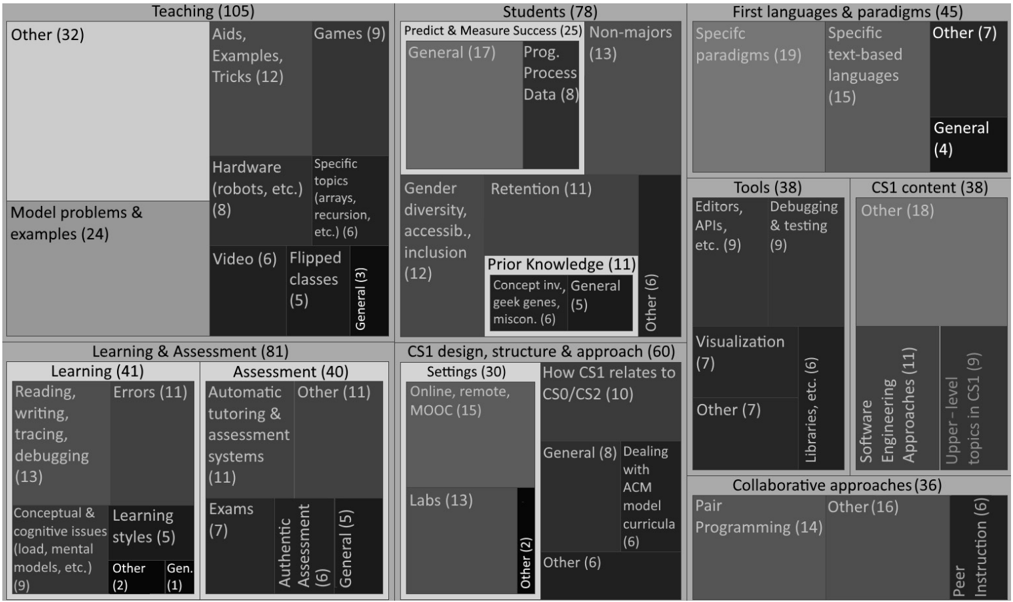
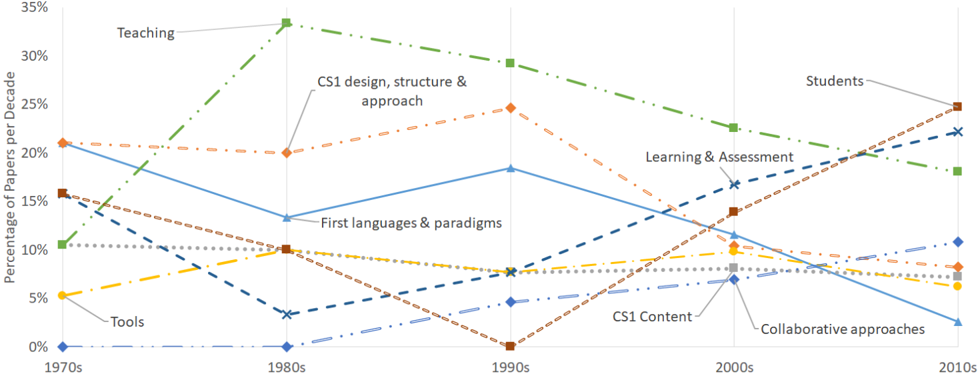
The SIGCSE Technical Symposium is celebrating its 50th year, and a constant theme throughout this history has been to better understand how novices learn to program. In this paper, we present a perspective on the evolution of introductory programming education research at the Symposium over these 50 years. We also situate the Symposium's impact in the context of the wider literature on introductory programming research. Applying a systematic approach to collecting papers presented at the Symposium that focus on novice programming / CS1, we categorized hundreds of papers according to their main focus, revealing important introductory programming topics and their trends from 1970 to 2018. Some of these topics have faded from prominence and are less relevant today while others, including many topics focused on students, such as making learning programming more appropriate from gender, diversity, accessibility and inclusion standpoints, have garnered significant attention more recently. We present discussions on these trends and in doing so, we provide a checkpoint for introductory programming research. This may provide insights for future research on how we teach novices and how they learn to program.
Overview
The claims and statistics of this paper haven’t been checked yet.
Free: it reads the open-access text and checks the first 5 claims that cite a source we can check. Create a free account to check every claim.
Integrity signals
Registry
Cites
Statistics
Figures
Verification
Claims the paper makes
The claims and statistics of this paper haven’t been checked yet.
Free: it reads the open-access text and checks the first 5 claims that cite a source we can check. Create a free account to check every claim.
Claims other papers make about this one
Each is checked against this paper’s own text: does it say what the citing paper says it does?
The check wasn’t confident either way, so it gives no verdict — never disputed.
In the citing paper
“But curricula often do not explicitly include these program-level outcomes in the learning outcomes for a particular course [38,113].”
From The Robots Are Here: Navigating the Generative AI Revolution in Computing Education (2023) · cites this paper as [38]
Experimental — accuracy not yet measuredThe check wasn’t confident either way, so it gives no verdict — never disputed.
In the citing paper
“The same is true for course activities and assessments.”
From The Robots Are Here: Navigating the Generative AI Revolution in Computing Education (2023) · cites this paper as [38]
Experimental — accuracy not yet measuredThe check wasn’t confident either way, so it gives no verdict — never disputed.
In the citing paper
“Planned versions of Copilot, scheduled for release in 2023, will include references to source code repositories when they contain code that matches suggestions. 11”
From “It’s Weird That it Knows What I Want”: Usability and Interactions with Copilot for Novice Programmers (2024) · cites this paper as [11]
Experimental — accuracy not yet measured
Self-check
Percentages, sums and reported differences re-computed from the paper’s own numbers.
The self-check needs the paper’s full text.
Citations
Cites
Introductory programming: a systematic literature review
Luxton-Reilly, A., Simon, Albluwi, I., Becker, B. A., Giannakos, M., Kumar, A. N., Ott, L., Paterson, J., Scott, M. J., Sheard, J., et al. (2018) · Proceedings Companion of the 23rd Annual ACM Conference on Innovation and Technology in Computer Science Education · doi:10.1145/3293881.3295779 · Cited by 485 · cited 4×
“Like the comparison to the ITiCSE working group mentioned above, this shows that the SIGCSE Technical Symposium occupies a significant footprint in the wider literature; approximately 25% by this measure, almost the same as the 26% when compared to [29] in the above paragraph.”
BackgroundResultInfluentialSelf-citationTeaching objects-first in introductory computer science
Cooper, S., Dann, W., & Pausch, R. (2003) · Proceedings of the 34th SIGCSE technical symposium on Computer science education · doi:10.1145/611892.611966 · Cited by 397
Online python tutor: embeddable web-based program visualization for cs education
Guo, P. J. (2013) · Proceeding of the 44th ACM technical symposium on Computer science education · doi:10.1145/2445196.2445368 · Cited by 396 · cited 1×
“As noted in Section 5.1, most of the discussion on CS1 languages has converged on Java and Python, and this is somewhat reflected in the Tools category, where several tools for Python [14, 18] and Java [35] have been introduced.”
MethodInfluentialThe effects of pair-programming on performance in an introductory programming course
McDowell, C., Werner, L., Bullock, H., & Fernald, J. (2002) · Proceedings of the 33rd SIGCSE technical symposium on Computer science education · doi:10.1145/563340.563353 · Cited by 352 · cited 1×
“It is arguable that Pair programming [33] and Peer instruction [40] could be in the same subcategory but after an extensive look at the papers involved and searching the ACM Digital Library for these topics, we decided that they warrant separate subcategories.”
Background37 Million Compilations: Investigating Novice Programming Mistakes in Large-Scale Student Data
Altadmri, A., & Brown, N. C. C. (2015) · Proceedings of the 46th ACM Technical Symposium on Computer Science Education · doi:10.1145/2676723.2677258 · Cited by 261
Programming: factors that influence success
Bergin, S., & Reilly, R. (2005) · ACM SIGCSE Bulletin · doi:10.1145/1047124.1047480 · Cited by 243
Using software testing to move students from trial-and-error to reflection-in-action
Edwards, S. H. (2004) · ACM SIGCSE Bulletin · doi:10.1145/1028174.971312 · Cited by 211
A games first approach to teaching introductory programming
Leutenegger, S., & Edgington, J. (2007) · Proceedings of the 38th SIGCSE technical symposium on Computer science education · doi:10.1145/1227310.1227352 · Cited by 195 · cited 1×
“Games first appeared in our data in 2006 [27] Table 9 shows the subcategories in this category and the corresponding number of papers published in each decade.”
BackgroundUsing software testing to move students from trial-and-error to reflection-in-action
Edwards, S. H. (2004) · Proceedings of the 35th SIGCSE technical symposium on Computer science education · doi:10.1145/971300.971312 · Cited by 189 · cited 1×
“A number of subcategories have shown remarkable interest since the turn of the century, including Reading, writing, tracing & debugging [13], how students deal with Errors [4, 32], and Learning styles, including achievement goals and mastery learning [47], and Conceptual or cognitive issues which revealed papers on to…”
BackgroundIdentifying student misconceptions of programming
Kaczmarczyk, L. C., Petrick, E. R., East, J. P., & Herman, G. L. (2010) · Proceedings of the 41st ACM technical symposium on Computer science education · doi:10.1145/1734263.1734299 · Cited by 187 · cited 1×
“Prior knowledge including Concept inventories [43], geek genes (or the non-existence thereof) andMisconceptions [24] have also only appeared since 2000.”
Background
Research works printed but not linked: 2
- 23. Association for Computing Machinery (ACM) Joint Task Force on Comput- ing Curricula and IEEE Computer Society. 2013. Computer Science Curricula 2013: Curriculum Guidelines for Undergraduate Degree Programs in Computer Science. Technical Report. New York, NY, USA. 999133.
- Proceedings of the 33rd SIGCSE Technical Symposium on Computer Science Education (SIGCSE '02)
Cited by
Items 101–131 of 131
Opportunities in Data Science Education
Hazzan, O., & Mike, K. (2023) · Springer eBooks · doi:10.1007/978-3-031-24758-3_5
The Interdisciplinarity Challenge
Hazzan, O., & Mike, K. (2023) · Springer eBooks · doi:10.1007/978-3-031-24758-3_6
Student Experiences and Academic Outcomes When Multiple Introductory Tracks Converge
Breeden, K., Bang, L., Stone, C. A., & Medero, J. (2023) · ACM Conference on Innovation and Technology in Computer Science Education (ITiCSE) · doi:10.1145/3587102.3588841 · Cited by 1
“Research into the effective teaching of college-level CS1 has led to many improvements in attracting, exciting, and retaining students of all backgrounds [5].”
BackgroundProgrammers' Views on IDE Compilation Mechanisms
Karvelas, I., Dillane, J., & Becker, B. A. (2023) · ACM Global Computing Education Conference (CompEd) · doi:10.1145/3576882.3617915
Self-citationSmith, J. M. (2023) · University of North Texas Digital Library (University of North Texas) · doi:10.12794/metadc2179234
Retracted: Analyse and Evaluate Quixbugs with Open AI Codex and Powering Next Generation Application
Tyagi, D., Tanwar, S., Mittal, N., & Badotra, S. (2023) · International Conference on Contemporary Computing and Informatics (IC3I) · doi:10.1109/ic3i59117.2023.10397753
Retractedde Holanda, M. T., Silva, D. D., Dörr, R. C., & Sousa, F. (2024) · ASEE Annual Conference & Exposition · doi:10.18260/1-2--42855
“Mmm… Donuts!” Using Real-World Scenarios in a First-Year Programming Course
Estell, J. K., Coffman-Wolph, S., & Kropp, I. (2024) · ASEE Annual Conference & Exposition · doi:10.18260/1-2--42329
Apoio à identificação e recuperação de recursos educacionais abertos para o ensino de programação
de Deus, W. S. (2024) · Digital Library of Theses and Dissertations (Universidade de São Paulo) · doi:10.11606/t.55.2024.tde-29072024-135304
Survey of Tools and Settings for Introductory C Programming
Park, S. (2024) · ASEE Annual Conference & Exposition · doi:10.18260/1-2--48042
Effect of Early Intervention on Students in a CS1 Programming Course
Mosquera, J. M. L., Castro, J. A. Q., Perdomo, E. G., & López, Á. H. A. (2024) · Communications in computer and information science · doi:10.1007/978-3-031-75147-9_4
Misconceptions in correct code
da Silva, E. P. (2024) · doi:10.47749/t/unicamp.2024.1408046
Valente, A. S. O., Warley, M. V., & de Holanda, M. T. (2025) · doi:10.5753/educomp.2025.4904
Ensinando Algoritmo para Estudantes Indígenas da Comunidade Ticuna
de Holanda, M. T., Costa, A. D. N., & Ishikawa, E. (2025) · Anais do Workshop sobre Educação em Computação (WEI) · doi:10.5753/wei.2025.8328
Building and Analyzing an Open Repository of Programming Exercises in Portuguese
Lodi, V. K., Sena, J. P. M., & Reis, J. C. S. (2025) · Simpósio Brasileiro de Sistemas Multimídia e Web (WebMedia) · doi:10.5753/webmedia_estendido.2025.16359
Ossovski, E. (2023) · osnaDocs (Osnabrück University) · doi:10.48693/344
Konzepte für die Programmierausbildung außerhalb von Informatik-Programmen
Plecr, P. (2021) · University Library Linz repository (Johannes Kepler Universitat Linz)
Predictive models of academic performance for early intervention in computer programming courses
Llanos Mosquera, J. M. (2024) · Univalle Digital Repository (University of Valle)
Modeling Programming Skills with Source Code Embeddings for Context-aware Exercise Recommendation
Silva, C. E. P., Sena, J. P. M., Reis, J. C. S., dos Santos, A. G., & Ferreira, L. A. (2026) · International Conference on Learning Analytics and Knowledge (LAK) · doi:10.1145/3785022.3785110
Nicolajsen, S. M. (2026) · IT University Of Copenhagen (IT University of Copenhagen)
ОСОБЛИВОСТІ НАВЧАННЯ МАЙБУТНІХ ВЧИТЕЛІВ ІНФОРМАТИКИ ПРОГРАМУВАННЮ
Роганов, М., Роганов, М., & Козак, Г. (2026) · Гуманізація навчально-виховного процесу · doi:10.31865/2077-1827.1(109)2026.354031
Research on Teaching Innovation in Intelligent Development Courses Driven by Intelligent Scenarios
孙, 博. (2026) · Advances in Education · doi:10.12677/ae.2026.164793
Application‐Oriented Frontend Curriculum Reconstruction: Design and Practice Research
Yang, J. (2026) · Computer Applications in Engineering Education · doi:10.1002/cae.70216
“Computer science education research shows that case‐based teaching has significant advantages in programming skill cultivation [20, 21], and case‐based teaching based on real web projects can significantly improve students' skills and practical abilities [22, 23].”
Sadad, A. H., Bari, C. M. A., & Mannan, K. A. (2026) · Pedagogical Research and Development · doi:10.64907/xkmf.v5i2.prd.1
Ledwaba, L. J., Setati, T. S., & Maluka, H. R. (2026) · International Journal of Applied Research in Business and Management · doi:10.51137/wrp.ijarbm.595
“HPC, like any other fast-paced, advanced and continuously evolving computing area—is rich with several exploratory and research opportunities, which lends itself well to meeting learning outcomes of broader Project-Based Learning (PBL), such as capstone and research courses (Becker & Quille, 2023).”
Chen, H. (2026) · Communications in computer and information science · doi:10.1007/978-3-032-33997-3_20
Towards a Distinct Programming Style for AgentSpeak(L)
Collier, R., Beaumont, K., & Ciortea, A. (2026) · Lecture notes in computer science · doi:10.1007/978-3-032-22817-8_13
Zhang, Q., Tong, J., & Liu, Y. (2026) · International Artificial Intelligence Technology Conference (AITC) · doi:10.1109/aitc70732.2026.11666553
Denny, P. C., Barbre, G., Blake, M., Hua, Y. C., Leinonen, J., Luxton-Reilly, A., Prather, J., & Reeves, B. N. (2026) · arXiv (Cornell University) · doi:10.48550/arxiv.2609.16574
Zuasnábar, D. M. H., & Santibanez, M. R. F. (2026) · Anais do ... Simpósio Brasileiro de Informática na Educação/Anais do Simpósio Brasileiro de Informática na Educação · doi:10.5753/sbie.2026.28370
"It's Weird That it Knows What I Want": Usability and Interactions with Copilot for Novice Programmers
Prather, J., Reeves, B. N., Denny, P., Becker, B. A., Leinonen, J., Luxton-Reilly, A., Powell, G., Finnie-Ansley, J., & Santos, E. A. (2023) · arXiv
“In this work we provide the first exploration of Copilot use by novices in an introductory programming (CS1) class on a typical novice programming task through observations and interviews.”
BackgroundInfluentialSelf-citation
Metadata
- Authors
- Becker, B. A., & Quille, K.
- Affiliations
- University College Dublin (IE)
- Institute of Technology Tallaght (IE)
- Venue
- Proceedings of the 50th ACM Technical Symposium on Computer Science Education
- Publisher
- ACM
- Published
- 2019-02-22
- Pages
- 338-344
- OpenAlex
- W2916708654
- Cited by
- 107
- References
- 55
- Citations by year
- 2026: 7 · 2025: 11 · 2024: 18 · 2023: 28 · 2022: 13 · 2021: 12 · 2020: 8 · 2019: 10
- FWCI
- 12.45
- Type
- conference paper
- Language
- en
- Open access
- green
- hdl.handle.net
- Licence
- Locations
- ACM Technical Symposium on Computer Science Education (SIGCSE) (publishedVersion)
- Research Repository UCD (University College Dublin) (submittedVersion, cc-by-nc-nd)
- Topics
- Physical Sciences › Computer Science › Computer Science Applications › Teaching and Learning Programming
- Physical Sciences › Computer Science › Information Systems › Information Systems Education and Curriculum Development
- Social Sciences › Gender Studies › Gender and Technology in Education
- Keywords
- CS1, introductory programming education, programming for beginners, research trends, accessibility and inclusion, programming learning
About these checks
Registry, retraction, Cites and statistics results are computed, not judged, with one exception: a printed reference that no index lists is read once by a model before it counts as a citation error. Claims are extracted by a model and kept only when their quote appears verbatim in the text; each cited source is then checked, with a model’s help, for whether it says what the claim relies on. Those verdicts can be wrong — read the claim’s quote and the cited source before relying on one.
Statistics and arithmetic are recomputed, not judged.
Confidence bands are shown only for fields calibrated on our annotated test set. None is calibrated yet, so no band is shown.
What counts as a claim ›How we measure confidence ›How we check this ›
Are you an author, or do you see a problem with this page? Request a review
Data sources
Bibliographic data: Semantic Scholar, OpenAlex, Crossref.
Contains information from the Semantic Scholar Academic Graph Datasets, made available under the ODC Attribution License (ODC-BY 1.0).
Semantic Scholar’s data is described in: Kinney, R., et al. (2023). The Semantic Scholar Open Data Platform. arXiv:2301.10140.
