

The DOI matches its Crossref record; 49 of the 49 references it cites were found in a registry or an index.
Gmail Smart Compose: Real-Time Assisted Writing
Open accessAbstract
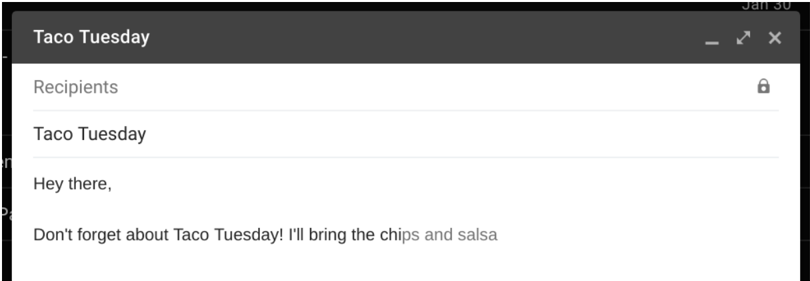
In this paper, we present Smart Compose, a novel system for generating interactive, real-time suggestions in Gmail that assists users in writing mails by reducing repetitive typing. In the design and deployment of such a large-scale and complicated system, we faced several challenges including model selection, performance evaluation, serving and other practical issues. At the core of Smart Compose is a large-scale neural language model. We leveraged state-of-the-art machine learning techniques for language model training which enabled high-quality suggestion prediction, and constructed novel serving infrastructure for high-throughput and real-time inference. Experimental results show the effectiveness of our proposed system design and deployment approach. This system is currently being served in Gmail.
Overview
The claims and statistics of this paper haven’t been checked yet.
Free: it reads the open-access text and checks the first 5 claims that cite a source we can check. Create a free account to check every claim.
Integrity signals
Registry
Cites
Statistics
Figures
Verification
Claims the paper makes
The claims and statistics of this paper haven’t been checked yet.
Free: it reads the open-access text and checks the first 5 claims that cite a source we can check. Create a free account to check every claim.
Claims other papers make about this one
Each is checked against this paper’s own text: does it say what the citing paper says it does?
The source backs part of the claim, not all of it — or backs it for a different population, condition or comparison.
In the citing paper
“Related work showed suggestions automatically after short inactivity [4,6] or gated by a utility function [24].Alternatively, recent work has also explored designs in which users explicitly request suggestions with a hotkey [7,17,26,41,48].”
From Choice Over Control: How Users Write with Large Language Models using Diegetic and Non-Diegetic Prompting (2023) · cites this paper as [7]
Experimental — accuracy not yet measuredThe source backs part of the claim, not all of it — or backs it for a different population, condition or comparison.
In the citing paper
“related work shows promising results in personalising the invocationfiltering system [5, 32].”
From A Transformer-Based Approach for Smart Invocation of Automatic Code Completion (2024) · cites this paper as [5]
Experimental — accuracy not yet measuredThe cited source says what the claim attributes to it.
In the citing paper
“Therefore, systems in which the UI did not afford text prompts explicitly made the implicit choice of only using diegetic information as their input to the LLM [6,7,26,41].”
From Choice Over Control: How Users Write with Large Language Models using Diegetic and Non-Diegetic Prompting (2023) · cites this paper as [7]
The cited source says what the claim attributes to it.
In the citing paper
“Our attacks directly apply to any language model, including those trained on sensitive and non-public data [10,16].”
From Extracting Training Data from Large Language Models (2020) · cites this paper as [10]
In the citing paper
“Our choice of using beam search aligns our system with mass-deployed next-phrase suggestion systems such as [27].”
From Interacting with Next-Phrase Suggestions: How Suggestion Systems Aid and Influence the Cognitive Processes of Writing (2023) · cites this paper as [27]
5 more claims about this paper
Create a free account to see every claim other papers make about this one.
Self-check
Percentages, sums and reported differences re-computed from the paper’s own numbers.
The self-check needs the paper’s full text.
Citations
Cites
Vaswani, A., Shazeer, N., Parmar, N., Uszkoreit, J., Jones, L., Gomez, A. N., Kaiser, L., & Polosukhin, I. (2017) · arXiv · doi:10.48550/arxiv.1706.03762 · Cited by 120,404 · cited 2×
“[48].”
MethodHochreiter, S., & Schmidhuber, J. (1997) · Neural Computation · doi:10.1162/neco.1997.9.8.1735 · Cited by 102,318
Adam: A Method for Stochastic Optimization
Kingma, D. P., & Ba, J. (2014) · arXiv · doi:10.48550/arxiv.1412.6980 · Cited by 98,946 · cited 1×
“We use the Adam optimizer [31] and adjust the learning rate according to the schedule proposed for RNMT+ models in Chen et al.”
MethodBERT: Pre-training of Deep Bidirectional Transformers for Language Understanding
Devlin, J., Chang, M.-W., Lee, K., & Toutanova, K. (2018) · arXiv · doi:10.48550/arxiv.1810.04805 · Cited by 73,173 · cited 1×
“Also, inspired by recent work in language model pre-training [12, 13], we are interested in exploring how similar pre-training techniques would benefit our global English model as well as the multilingual model.”
BackgroundAuto-Encoding Variational Bayes
Kingma, D. P., & Welling, M. (2013) · arXiv · doi:10.48550/arxiv.1312.6114 · Cited by 20,067 · cited 3×
“Variational auto-encoders (VAE) [30] allow efficient learning and inference to be performed in a latent variable model.”
BackgroundInfluentialSequence to Sequence Learning with Neural Networks
Sutskever, I., Vinyals, O., & Le, Q. V. (2014) · arXiv · doi:10.48550/arxiv.1409.3215 · Cited by 17,766 · cited 1×
“It relies on a sequence-to-sequence model [45] which first reads a message with an encoder, then outputs a distribution over a set of possible replies.”
BackgroundDeep Contextualized Word Representations
Peters, M., Neumann, M., Iyyer, M., Gardner, M., Clark, C., Lee, K., & Zettlemoyer, L. (2018) · Proceedings of the 2018 Conference of the North American Chapter of the Association for Computational Linguistics: Human Language Technologies, Volume 1 (Long Papers) · doi:10.18653/v1/n18-1202 · Cited by 11,983 · cited 1×
“In recent years with the rapid development in deep learning techniques, a multitude of neural network-based language models have been proposed, significantly improving state-of-theart performance [3, 26, 36, 37, 40, 49, 51].”
Background(1993) · Cited by 9,879
SQuAD: 100,000+ Questions for Machine Comprehension of Text
Rajpurkar, P., Zhang, J., Lopyrev, K., & Liang, P. (2016) · Proceedings of the 2016 Conference on Empirical Methods in Natural Language Processing · doi:10.18653/v1/d16-1264 · Cited by 6,208 · cited 1×
“• ExactMatch@N[42] measures, for a predicted phrase that is N words long, the percentage of predicted phrase that exactly matches the first N words in the ground truth text.”
BackgroundRecurrent neural network based language model
Mikolov, T., Karafiát, M., Burget, L., Černocký, J., & Khudanpur, S. (2010) · Interspeech 2010 · doi:10.21437/interspeech.2010-343 · Cited by 5,390 · cited 1×
“In recent years with the rapid development in deep learning techniques, a multitude of neural network-based language models have been proposed, significantly improving state-of-theart performance [3, 26, 36, 37, 40, 49, 51].”
Background
Research works printed but not linked: 15
- Bengio Yoshua, 2003, A Neural Probabilistic Language Model. Journal of Machine Learning Research
- Brants Thorsten, 2007, Proceedings of Empirical Methods in Natural Language Processing .
- Caliskan-Islam Aylin, 2016, Science, 356
- Carlini Nicholas, 2018, Ú lfar Erlingsson, and Dawn Song
- Dai Andrew M., 2015, Le
- 2019, 2019 a. Google Cloud TPU . https://cloud.google.com/tpu/. Online
- Hsu Bo-June, 2007, 2007 IEEE Workshop on Automatic Speech Recognition Understanding (ASRU). 136--140
- Jurafsky Daniel, 2000, Martin
- Diederik, 2014, Kingma and Jimmy Ba
- Mohri Mehryar, d.}. Finite-state Transducers in Language and Speech Processing. Computational Linguistics
- Radicati S., 2018, Email Statistics Report
- Questions, Machine Comprehension of Text. In Proceedings of the 2016 Conference on Empirical Methods in Natural Language Processing . Association for Computational Linguistics, 2383--2392
- Shen Jonathan, 2019, et almbox
- Vaswani Ashish, 2017, Ł ukasz Kaiser, and Illia Polosukhin
- Zolna Konrad, 2018, Fraternal Dropout. In International Conference on Learning Representations .
Cited by
Extracting Training Data from Large Language Models
Carlini, N., Tramer, F., Wallace, E., Jagielski, M., Herbert-Voss, A., Lee, K., Roberts, A., Brown, T., Song, D., Erlingsson, U., et al. (2020) · arXiv · doi:10.48550/arxiv.2012.07805 · Cited by 727
“Our attacks directly apply to any language model, including those trained on sensitive and non-public data [8, 14].”
BackgroundMethodBourtoule, L., Chandrasekaran, V., Choquette-Choo, C. A., Jia, H., Travers, A., Zhang, B., Lie, D., & Papernot, N. (2021) · 2021 IEEE Symposium on Security and Privacy (SP) · doi:10.1109/sp40001.2021.00019 · Cited by 810
“This data is often sensitive in nature and could include information like medical records [1] or personal emails [2].”
BackgroundRealToxicityPrompts: Evaluating Neural Toxic Degeneration in Language Models
Gehman, S., Gururangan, S., Sap, M., Choi, Y., & Smith, N. A. (2020) · Findings of the Association for Computational Linguistics: EMNLP 2020 · doi:10.18653/v1/2020.findings-emnlp.301 · Cited by 693
Membership Inference Attacks From First Principles
Carlini, N., Chien, S., Nasr, M., Song, S., Terzis, A., & Tramèr, F. (2022) · 2022 IEEE Symposium on Security and Privacy (SP) · doi:10.1109/sp46214.2022.9833649 · Cited by 502
IntelliCode compose: code generation using transformer
Svyatkovskiy, A., Deng, S. K., Fu, S., & Sundaresan, N. (2020) · Proceedings of the 28th ACM Joint Meeting on European Software Engineering Conference and Symposium on the Foundations of Software Engineering · doi:10.1145/3368089.3417058 · Cited by 474
“IntelliCode Compose serves as a universal programming language modeling tool, effectively generating syntactically correct code in multiple programming languages, capable of completing an entire line of code in a couple of key strokes, with a user experience inspired by Gmail Smart Compose [15].”
Method
Metadata
- Authors
- Chen, M. X., Lee, B. N., Bansal, G., Cao, Y., Zhang, S., Lu, J., Tsay, J., Wang, Y., Dai, A. M., Chen, Z., Sohn, T., & Wu, Y.
- Affiliations
- Google (United States) (US)
- Venue
- Proceedings of the 25th ACM SIGKDD International Conference on Knowledge Discovery & Data Mining
- Publisher
- ACM
- Published
- 2019-07-25
- Pages
- 2287-2295
- OpenAlex
- W2947160092
- Cited by
- 169
- References
- 46
- Citations by year
- 2026: 25 · 2025: 20 · 2024: 24 · 2023: 24 · 2022: 19 · 2021: 34 · 2020: 20 · 2019: 3
- FWCI
- 7.27
- Type
- conference paper
- Language
- en
- Open access
- hybrid
- doi.org
- Licence
- Locations
- ACM SIGKDD Conference on Knowledge Discovery and Data Mining (KDD) (publishedVersion, cc-by-nc-nd)
- Topics
- Physical Sciences › Computer Science › Artificial Intelligence › Natural Language Processing Techniques
- Physical Sciences › Computer Science › Artificial Intelligence › Topic Modeling
- Physical Sciences › Computer Science › Information Systems › Information Retrieval and Search Behavior
- Keywords
- Gmail, email writing, text prediction, neural language models, high-throughput inference, model selection
About these checks
Registry, retraction, Cites and statistics results are computed, not judged, with one exception: a printed reference that no index lists is read once by a model before it counts as a citation error. Claims are extracted by a model and kept only when their quote appears verbatim in the text; each cited source is then checked, with a model’s help, for whether it says what the claim relies on. Those verdicts can be wrong — read the claim’s quote and the cited source before relying on one.
Statistics and arithmetic are recomputed, not judged.
Confidence bands are shown only for fields calibrated on our annotated test set. None is calibrated yet, so no band is shown.
What counts as a claim ›How we measure confidence ›How we check this ›
Are you an author, or do you see a problem with this page? Request a review
How to cite
Cite CoChat for the checks on this page, and the paper for its own findings.
- This page
- CoChat. (2026). Citation check: Gmail Smart Compose: Real-Time Assisted Writing. https://app.cochat.ai/papers/10.1145/3292500.3330723
- The paper
- Chen, M. X., Lee, B. N., Bansal, G., Cao, Y., Zhang, S., Lu, J., Tsay, J., Wang, Y., Dai, A. M., Chen, Z., Sohn, T., & Wu, Y. (2019). Gmail Smart Compose: Real-Time Assisted Writing. Proceedings of the 25th ACM SIGKDD International Conference on Knowledge Discovery & Data Mining. https://doi.org/10.1145/3292500.3330723
Data sources
Bibliographic data: Semantic Scholar, OpenAlex, Crossref.
Contains information from the Semantic Scholar Academic Graph Datasets, made available under the ODC Attribution License (ODC-BY 1.0).
Semantic Scholar’s data is described in: Kinney, R., et al. (2023). The Semantic Scholar Open Data Platform. arXiv:2301.10140.
