

Gmail Smart Compose: Real-Time Assisted Writing
Open accessThe DOI matches its Crossref record; 49 of the 49 references it cites were found in a registry or an index.
Abstract
In this paper, we present Smart Compose, a novel system for generating interactive, real-time suggestions in Gmail that assists users in writing mails by reducing repetitive typing. In the design and deployment of such a large-scale and complicated system, we faced several challenges including model selection, performance evaluation, serving and other practical issues. At the core of Smart Compose is a large-scale neural language model. We leveraged state-of-the-art machine learning techniques for language model training which enabled high-quality suggestion prediction, and constructed novel serving infrastructure for high-throughput and real-time inference. Experimental results show the effectiveness of our proposed system design and deployment approach. This system is currently being served in Gmail.
Overview
The claims and statistics of this paper haven’t been checked yet.
Free: it reads the open-access text and checks the first 5 claims that cite a source we can check. Create a free account to check every claim.
Integrity signals
Registry
Cites
Statistics
Figures
Verification
Claims the paper makes
The claims and statistics of this paper haven’t been checked yet.
Free: it reads the open-access text and checks the first 5 claims that cite a source we can check. Create a free account to check every claim.
Claims other papers make about this one
Each is checked against this paper’s own text: does it say what the citing paper says it does?
The source backs part of the claim, not all of it — or backs it for a different population, condition or comparison.
In the citing paper
“Related work showed suggestions automatically after short inactivity [4,6] or gated by a utility function [24].Alternatively, recent work has also explored designs in which users explicitly request suggestions with a hotkey [7,17,26,41,48].”
From Choice Over Control: How Users Write with Large Language Models using Diegetic and Non-Diegetic Prompting (2023) · cites this paper as [7]
Experimental — accuracy not yet measuredThe source backs part of the claim, not all of it — or backs it for a different population, condition or comparison.
In the citing paper
“related work shows promising results in personalising the invocationfiltering system [5, 32].”
From A Transformer-Based Approach for Smart Invocation of Automatic Code Completion (2024) · cites this paper as [5]
Experimental — accuracy not yet measuredThe cited source says what the claim attributes to it.
In the citing paper
“Therefore, systems in which the UI did not afford text prompts explicitly made the implicit choice of only using diegetic information as their input to the LLM [6,7,26,41].”
From Choice Over Control: How Users Write with Large Language Models using Diegetic and Non-Diegetic Prompting (2023) · cites this paper as [7]
The cited source says what the claim attributes to it.
In the citing paper
“Our attacks directly apply to any language model, including those trained on sensitive and non-public data [10,16].”
From Extracting Training Data from Large Language Models (2020) · cites this paper as [10]
In the citing paper
“Our choice of using beam search aligns our system with mass-deployed next-phrase suggestion systems such as [27].”
From Interacting with Next-Phrase Suggestions: How Suggestion Systems Aid and Influence the Cognitive Processes of Writing (2023) · cites this paper as [27]
5 more claims about this paper
Create a free account to see every claim other papers make about this one.
Self-check
Percentages, sums and reported differences re-computed from the paper’s own numbers.
The self-check needs the paper’s full text.
Citations
Cites
Vaswani, A., Shazeer, N., Parmar, N., Uszkoreit, J., Jones, L., Gomez, A. N., Kaiser, L., & Polosukhin, I. (2017) · arXiv · doi:10.48550/arxiv.1706.03762 · Cited by 120,404 · cited 2×
“[48].”
MethodHochreiter, S., & Schmidhuber, J. (1997) · Neural Computation · doi:10.1162/neco.1997.9.8.1735 · Cited by 102,318
Adam: A Method for Stochastic Optimization
Kingma, D. P., & Ba, J. (2014) · arXiv · doi:10.48550/arxiv.1412.6980 · Cited by 98,946 · cited 1×
“We use the Adam optimizer [31] and adjust the learning rate according to the schedule proposed for RNMT+ models in Chen et al.”
MethodBERT: Pre-training of Deep Bidirectional Transformers for Language Understanding
Devlin, J., Chang, M.-W., Lee, K., & Toutanova, K. (2018) · arXiv · doi:10.48550/arxiv.1810.04805 · Cited by 73,173 · cited 1×
“Also, inspired by recent work in language model pre-training [12, 13], we are interested in exploring how similar pre-training techniques would benefit our global English model as well as the multilingual model.”
BackgroundAuto-Encoding Variational Bayes
Kingma, D. P., & Welling, M. (2013) · arXiv · doi:10.48550/arxiv.1312.6114 · Cited by 20,067 · cited 3×
“Variational auto-encoders (VAE) [30] allow efficient learning and inference to be performed in a latent variable model.”
BackgroundInfluentialSequence to Sequence Learning with Neural Networks
Sutskever, I., Vinyals, O., & Le, Q. V. (2014) · arXiv · doi:10.48550/arxiv.1409.3215 · Cited by 17,766 · cited 1×
“It relies on a sequence-to-sequence model [45] which first reads a message with an encoder, then outputs a distribution over a set of possible replies.”
BackgroundDeep Contextualized Word Representations
Peters, M., Neumann, M., Iyyer, M., Gardner, M., Clark, C., Lee, K., & Zettlemoyer, L. (2018) · Proceedings of the 2018 Conference of the North American Chapter of the Association for Computational Linguistics: Human Language Technologies, Volume 1 (Long Papers) · doi:10.18653/v1/n18-1202 · Cited by 11,983 · cited 1×
“In recent years with the rapid development in deep learning techniques, a multitude of neural network-based language models have been proposed, significantly improving state-of-theart performance [3, 26, 36, 37, 40, 49, 51].”
Background(1993) · Cited by 9,879
SQuAD: 100,000+ Questions for Machine Comprehension of Text
Rajpurkar, P., Zhang, J., Lopyrev, K., & Liang, P. (2016) · Proceedings of the 2016 Conference on Empirical Methods in Natural Language Processing · doi:10.18653/v1/d16-1264 · Cited by 6,208 · cited 1×
“• ExactMatch@N[42] measures, for a predicted phrase that is N words long, the percentage of predicted phrase that exactly matches the first N words in the ground truth text.”
BackgroundRecurrent neural network based language model
Mikolov, T., Karafiát, M., Burget, L., Černocký, J., & Khudanpur, S. (2010) · Interspeech 2010 · doi:10.21437/interspeech.2010-343 · Cited by 5,390 · cited 1×
“In recent years with the rapid development in deep learning techniques, a multitude of neural network-based language models have been proposed, significantly improving state-of-theart performance [3, 26, 36, 37, 40, 49, 51].”
Background
Research works printed but not linked: 7
- Yoshua Bengio, Réjean Ducharme, Pascal Vincent, , and Christian Jauvin. 2003. A Neural Probabilistic Language Model. Journal of Machine Learning Research (2003).
- Nicholas Carlini, Chang Liu, Jernej Kos, Úlfar Erlingsson, and Dawn Song. 2018. The Secret Sharer: Measuring Unintended Neural Network Memorization & Extracting Secrets. CoRR abs/1802.08232 (2018). arXiv:1802.08232 http://arxiv. org/abs/1802.08232 · arXiv
- Google. 2019. Google Cloud TPU. https://cloud.google.com/tpu/. Online; accessed 25 January 2019.
- Daniel Jurafsky and James H. Martin. 2000. Speech and Language Processing. Pearson Education.
- Mehryar Mohri. [n. d.]. Finite-state Transducers in Language and Speech Pro- cessing. Computational Linguistics 23, 2 ([n. d.]).
- S. Radicati. 2018. Email Statistics Report, 2018-2022. https://www.radicati. com/wp/wp-content/uploads/2018/01/Email_Statistics_Report,_2018-2022_ Executive_Summary.pdf. Online; accessed 25 January 2019.
- Konrad Zolna, Devansh Arpit, Dendi Suhubdy, and Yoshua Bengio. 2018. Fraternal Dropout. In International Conference on Learning Representations.
Cited by
Items 101–175 of 175
Privacy Regularization: Joint Privacy-Utility Optimization in Language ModelsPreprint
Mireshghallah, F., Inan, H. A., Hasegawa, M., Rühle, V., Berg-Kirkpatrick, T., & Sim, R. (2021) · arXiv (Cornell University) · doi:10.48550/arxiv.2103.07567 · Cited by 5
“, 2010) have recently seen significant gains in capabilities, and are deployed at scale in several real-world scenarios (Chen et al., 2019; Adam et al., 2020).”
BackgroundReactive Writers: How Co-Writing with AI Changes How We Engage with Ideas
Bhat, A., Quéré, M. A. L., Naaman, M., & Jakesch, M. (2026) · CHI Conference on Human Factors in Computing Systems · doi:10.1145/3772318.3791529 · Cited by 18
Matryoshka: Exploiting the Over-Parametrization of Deep Learning Models for Covert Data Transmission
Pan, X., Zhang, M., Yan, Y., Zhang, S., & Yang, M. (2024) · IEEE Transactions on Pattern Analysis and Machine Intelligence · doi:10.1109/tpami.2024.3434417 · Cited by 8
Self-citationCarìa, A. (2025) · Lecture notes in networks and systems · doi:10.1007/978-3-031-84457-7_25 · Cited by 6
Recognizing Artificial Intelligence: The Key to Unlocking Human AI Teams
Cummings, P., Schurr, N., Naber, A. M., Charlie, & Serfaty, D. (2021) · Springer eBooks · doi:10.1007/978-3-030-77283-3_2 · Cited by 6
Jespipe: A Plugin-Based, Open MPI Framework for Adversarial Machine Learning Analysis
Alemany, S., Nucciarone, J., & Pissinou, N. (2021) · IEEE International Conference on Big Data (BigData) · doi:10.1109/bigdata52589.2021.9671385 · Cited by 4
“In these instances, an adversary could gain access to sensitive user data, ranging from medical information [8] to personal email [9].”
BackgroundWriting out the Storm: Designing and Evaluating Tools for Weather Risk Messaging
Jit, S. S., Spinney, J. A., Chandra, P., Chilton, L. B., & Soden, R. (2024) · CHI Conference on Human Factors in Computing Systems · doi:10.1145/3613904.3641926 · Cited by 6
“Meanwhile, much of the literature that has looked to develop writing support tools in non-fction settings has focused on sentence completion [21] and prediction in online communication [21, 63].”
BackgroundAutomatic Document Sketching: Generating Drafts from Analogous Texts
Wu, Z., Galley, M., Brockett, C., Zhang, Y., & Dolan, B. (2021) · Findings of the Association for Computational Linguistics: ACL (Findings of ACL) · doi:10.18653/v1/2021.findings-acl.185 · Cited by 9
Exploring Opportunities and Challenges of using ChatGPT in Professional Writing Instruction
Al-Zaghir, Z., Matroud, A. A., Abdalgader, K., & Alnaqbi, N. M. (2023) · IEEE International Conference on Teaching, Assessment, and Learning for Engineering · doi:10.1109/tale56641.2023.10398234 · Cited by 6
Zindulka, T., Goller, S., Lehmann, F., & Buschek, D. (2025) · CHI Conference on Human Factors in Computing Systems · doi:10.1145/3706598.3713890 · Cited by 6
Trajanovski, S., Atalla, C., Kim, K., Agarwal, V., Shokouhi, M., & Quirk, C. (2021) · North American Chapter of the Association for Computational Linguistics · doi:10.18653/v1/2021.naacl-industry.1 · Cited by 11
“In this work, we focus on the application of text prediction on production-level online communication tools, to help users compose emails (Chen et al., 2019; Microsoft Text Predictions, 2020), and in addition chat messages.”
BackgroundMethodInfluentialX2T: Training an X-to-Text Typing Interface with Online Learning from User FeedbackPreprint
Gao, J., Reddy, S., Berseth, G., Hardy, N. F., Natraj, N., Ganguly, K., Dragan, A. D., & Levine, S. (2022) · arXiv (Cornell University) · doi:10.48550/arxiv.2203.02072 · Cited by 7
Small Character Models Match Large Word Models for Autocomplete Under Memory Constraints
Jawahar, G., Mukherjee, S., Dey, D., Abdul-Mageed, M., Lakshmanan, V. S. L., Mendes, C. C. T., Rosa, G. D., & Shah, S. (2023) · Workshop on Simple and Efficient Natural Language Processing (SustaiNLP) · doi:10.18653/v1/2023.sustainlp-1.22 · Cited by 2
Camouflage: Utility-Aware Obfuscation for Accurate Simulation of Sensitive Program Traces
Pal, A., Desai, K., Chatterjee, R., & Miguel, J. S. (2024) · ACM Transactions on Architecture and Code Optimization · doi:10.1145/3650110 · Cited by 2
Blackmore, B., Thorp, M., Chen, A. T.-Y., Morreale, F., Burmester, B., Bahmanteymouri, E., & Bartlett, M. (2023) · Kōtuitui New Zealand Journal of Social Sciences Online · doi:10.1080/1177083x.2023.2212736 · Cited by 4
The Unexpected Effects of Google Smart Compose on Open-Ended Writing Tasks
Cummings, R. E., Le, T., Shrestha, S., & Smith, C. V. (2024) · Lecture notes in computer science · doi:10.1007/978-3-031-64302-6_33 · Cited by 2
A Comparative Analysis of Email Artifacts from Gmail, Yahoomail, and Livemail for Email Forensics
Almarzooqi, A. K. A. K., Alyammahi, E. A. O. S., Almarzooqi, A. K. A. N., AlAlawi, M. H. K. N., & Ikuesan, R. A. (2024) · Lecture notes in information systems and organisation · doi:10.1007/978-3-031-75329-9_43 · Cited by 2
Simulating Information Retrieval Test Collections
Hawking, D., Billerbeck, B., Thomas, P., & Craswell, N. (2020) · Synthesis lectures on information concepts, retrieval, and services · doi:10.2200/s01043ed1v01y202008icr071 · Cited by 9
Making Writing Harder: Computer-Mediated Authorship and the Problem of Care
Booten, K. (2021) · Journal of International Crisis and Risk Communication Research · doi:10.7273/qr36-cw86 · Cited by 2
Categorization of Financial Transactions in QuickBooks
Liu, J., Pei, L., Sun, Y., Simpson, H., Lu, J., & Ho, N. (2021) · ACM SIGKDD Conference on Knowledge Discovery and Data Mining (KDD) · doi:10.1145/3447548.3467100 · Cited by 2
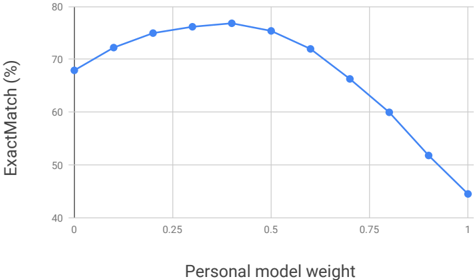
“Google’s Gmail auto-completion [1] takes a different approach: it fuses the global model and personal models using a weighted sum: the final recommendation is a linear combination of the global model output (by a weight α) and the personal modal output (by a weight (1 − α)), where the weight parameter α controls how m…”
MethodSelf-citationSemantically Driven Auto-completion
Arkoudas, K., & Yahya, M. (2019) · ACM International Conference on Information and Knowledge Management (CIKM) · doi:10.1145/3357384.3357811 · Cited by 4
“A prominent example here is Google’s SmartCompose and SmartReply systems [8].”
Shao, L., Mantravadi, S., Manzini, T., Buendia, A., Knoertzer, M., Srinivasan, S., & Quirk, C. (2020) · doi:10.18653/v1/2020.nli-1.3 · Cited by 3
CueBot: Cue-Controlled Response Generation for Assistive Interaction Usages
Kumar, S. H., Su, H., Manuvinakurike, R., Pinaroc, M., Prasad, S., Sahay, S., & Nachman, L. (2022) · Workshop on Speech and Language Processing for Assistive Technologies · doi:10.18653/v1/2022.slpat-1.9 · Cited by 3
“…of these models, novel products and applications are emerging (Bommasani et al., 2021) such as Communication Systems (eg. email response completion (Chen et al., 2019a)), Creativity Tools (story writing assistance (Roemmele and Gordon, 2018; Roemmele, 2021)), Human-AI collaboration for Software…”
BackgroundPilla, K. K., Tupakula, V., & Yerukonda, S. A. (2026) · IEEE SoutheastCon · doi:10.1109/southeastcon63549.2026.11476144 · Cited by 1
“Smart Compose [15] predicts text within Gmail but cannot generalize across applications.”
From Planning to Revision: How AI Writing Support at Different Stages Alters Ownership
Gero, K. I., Long, T., Schnitzler, C., & Dhillon, P. S. (2026) · Designing Interactive Systems Conference · doi:10.1145/3800645.3813003 · Cited by 5
“Early AI writing tools often worked in an autocomplete design paradigm [9, 10]; the rise of large language models shifting the norm towards a chatbot design.”
Identity, Agency, and Human–AI Mediation in L2 Academic Writing: An Interactional Study
Aldamen, H., Almashour, M., & Jarrah, M. (2026) · Sage Open · doi:10.1177/21582440261463001 · Cited by 1
“Research on interactive text production shows that writing assistants shape composing by offering suggestions that writers inspect, adapt, sequence, or disregard as texts develop (Arnold et al., 2016, 2018, 2020; Buschek et al., 2021; Chen et al., 2019).”
Evaluating AI-based Mental Health Interventions
Sharma, A. (2026) · ACM eBooks · doi:10.1145/3749728.3749733 · Cited by 1
ClozeSearch: A Collocation Retrieval Application to Assist in Scientific Writing
Wang, M., & Alonso, O. (2022) · ACM International Conference on Information and Knowledge Management (CIKM) · doi:10.1145/3511808.3557173 · Cited by 1
“To assist with the description of the term of interest, we incorporate an autocomplete feature [5].”
MethodLearning with User-Level Differential Privacy Under Fixed Compute Budgets
Charles, Z., Ganesh, A., McKenna, R., McMahan, H. B., Mitchell, N., Pillutla, K., & Rush, K. (2025) · IEEE Conference on Secure and Trustworthy Machine Learning (SaTML) · doi:10.1109/satml64287.2025.00055 · Cited by 6
“In settings such as AI agents [4], email assistants [5], and smartphone keyboards [6], in-domain data (agent-user interactions, emails, and texts, respectively) may be highly sensitive.”
Guided K-best Selection for Semantic Parsing Annotation
Belyy, A., Huang, C.-Y., Andreas, J., Platanios, E. A., Thomson, S., Shin, R., Roy, S., Nisnevich, A., Chen, C., & Durme, B. V. (2022) · Annual Meeting of the Association for Computational Linguistics: System Demonstrations (ACL Demo) · doi:10.18653/v1/2022.acl-demo.11 · Cited by 1
“…interface as “sluggish” unless the latency was reduced to less than 300 ms by using the phrase-based decoding algorithm to reduce the search space; Chen et al. (2019) examined the latency of LSTM as well as Transformer and concluded that Transformer’s high latency was not suitable for production…”
BackgroundPrivacy Analysis in Language Models via Training Data Leakage Report.Preprint
Inan, H. A., Ramadan, O., Wutschitz, L., Jones, D. N., Rühle, V., Withers, J., & Sim, R. B. (2021) · arXiv (Cornell University) · Cited by 7
CloneBot: Personalized Dialogue-Response PredictionsPreprint
Weitzman, T., Pyo, H., & Jeon (2021) · arXiv (Cornell University) · doi:10.48550/arxiv.2103.16750 · Cited by 2
“CloneBot improves on Gmail’s Smart Compose predictions in that the personalization piece of Gmail’s Compose is a basic n-gram language model which gets combined in a weighted average with their neural-based language model [1].”
Improving the Algorithm of Deep Learning with Differential PrivacyPreprint
Amian, M. (2021) · arXiv.org · doi:10.48550/arxiv.2107.05457 · Cited by 2
“Another example is Google’s Smart Compose which is a commercial model for email composition recommendation that is trained on emails of millions of users [3].”
BackgroundOn Privacy and Confidentiality of Communications in Organizational GraphsPreprint
Shafieinejad, M., Inan, H. A., Hasegawa, M., & Sim, R. (2021) · arXiv (Cornell University) · doi:10.48550/arxiv.2105.13418 · Cited by 3
“A number of applications in natural language understanding rely on language models (Chen et al., 2019; Adam et al., 2020).”
Email Writing Assistant System
Chang, J. S., Yang, C.-Y. H., & Peng, G.-F. (2020) · International Conference on Computational Linguistics
Data Protection in Big Data Analysis
Shafieinejad, M. (2021) · UWSpace (University of Waterloo)
Improving Text Auto-Completion with Next Phrase PredictionPreprint
Lee, D., Hu, Z., & Lee, R. K.-W. (2021) · arXiv (Cornell University) · doi:10.48550/arxiv.2109.07067 · Cited by 2
“While recent advances in deep neural models have shown impressive performance on the text auto-completion task, these models generally require a large amount of everyday text and huge amount of computing power for training to generate adequate suggestions (Chen et al., 2019).”
BackgroundPopNet: a Pop Culture Knowledge Association Network for Supporting Creative ConnectionsPreprint
Wang, S., & Chilton, L. B. (2021) · arXiv (Cornell University)
Improving Maps Auto-Complete Through Query Expansion (Demo Paper)
Mokhtari, S., Rusnak, A., Mutungu, T., & Yankov, D. (2021) · ACM SIGSPATIAL International Conference on Advances in Geographic Information Systems (SIGSPATIAL GIS) · doi:10.1145/3474717.3484218
“Text expansion is a technique applied by many modern systems, for instance it facilitates typing on mobile screens or allows smart composing of text [2].”
MethodApplying Reinforcement Learning on Real-World Data with Practical Examples in Python
Osborne, P., Singh, K., & Taylor, M. E. (2022) · Synthesis lectures on artificial intelligence and machine learning · doi:10.2200/s01170ed1v01y202202aim052 · Cited by 1
Zhao, K. (2023) · Journal of Second Language Writing · doi:10.1016/j.jslw.2023.100964
Crowdsourced Argumentation Feedback for Persuasive Writing
Ihoriya, H., & Yamamoto, Y. (2023) · Lecture notes in computer science · doi:10.1007/978-3-031-35129-7_33
Irony in Linguistic Communication
Raymond W. Gibbs, Jr., & Colston, H. L. (2023) · Cambridge University Press eBooks · doi:10.1017/9781108974004.011
Great Expectations and EPIC Fails: A Computational Perspective on Irony and Sarcasm
Veale, T. (2023) · Cambridge University Press eBooks · doi:10.1017/9781108974004.017 · Cited by 2
Machine Learning Powered Text Auto-Completion and Generation
Padmanandam, K., Nikhitha, J., Sri, P. P., Pavithra, G., & Megaha, C. S. (2023) · International Conference on Electronics, Communication and Aerospace Technology (ICECA) · doi:10.1109/iceca58529.2023.10394873
“In [1] authors suggested a unique approach for producing interactive, real-time Gmail suggestions.”
BackgroundSchwarz-Musch, A., Tauchhammer, A., & Guetz, B. (2024) · Springer eBooks · doi:10.1007/978-3-658-43990-3_4
ConvLogRecaller: Real-Time Conversational Lifelog Recaller
Lee, Y.-C., Yen, A.-Z., Huang, H., & Chen, H. (2024) · International ACM SIGIR Conference on Research and Development in Information Retrieval (SIGIR) · doi:10.1145/3626772.3657659 · Cited by 1
Mitigating Over-Unlearning in Machine Unlearning with Synthetic Data Augmentation
Wang, B., Qu, Y., Gao, L., Li, C., Li, L., & Smith, D. B. (2025) · Lecture notes in computer science · doi:10.1007/978-981-96-1545-2_18 · Cited by 2
Schwarz-Musch, A., Tauchhammer, A., & Guetz, B. (2025) · Business guides on the go · doi:10.1007/978-3-658-47100-2_4
Mamatha, K., & Banik, D. (2025) · Lecture notes in networks and systems · doi:10.1007/978-3-031-92605-1_27 · Cited by 1
Higashi, T., & Nakai, T. (2025) · doi:10.1145/3709018.3736329 · Cited by 3
Jayakannan, S. M. (2025) · International Journal of Computational and Experimental Science and Engineering · doi:10.22399/ijcesen.3895
Utilization of Large Language Models for conformity assessment: Chances, Threats, and Mitigations
Litzinger, J., Peters, D., Thiel, F., & Tschorsch, F. (2025) · Annals of Computer Science and Information Systems · doi:10.15439/2025f7772
Écrire avec les modèles de l’esprit encodés dans les dispositifs numériques
Saemmer, A. (2024) · Sens public · doi:10.7202/1118966ar
Effects of AI Confirmation Modes and User Behavior Level on User Experience and Technology Adoption
Park, Y.-S., & Yim, J.-H. (2025) · Journal of Digital Contents Society · doi:10.9728/dcs.2025.26.11.3011
AI-Powered Personal Assistant for Smart Task Scheduling, Email Deadline
Gulwade, K., Gupta, S., Gupta, R., Hapse, C., Gulbhile, S., Waikar, R., & Sable, S. (2026) · International Journal of Latest Technology in Engineering Management & Applied Science · doi:10.51583/ijltemas.2026.150100020
Rethinking Query Choices for Differential Privacy Auditing
Deng, Z., Chen, H., Jiang, S., Ma, W., Wen, S., Zhu, T., & Xiang, Y. (2026) · IEEE Transactions on Dependable and Secure Computing · doi:10.1109/tdsc.2026.3658692
“W ITH the growing use of machine learning models trained on sensitive user data [15], [16], [41], [44], such as medical images [21], personal emails [7], and text messages [11], [17], ensuring robust privacy protection has become a critical concern [14], [45].”
Duan, X., & Guo, Y. Q. (2026) · Behaviour and Information Technology · doi:10.1080/0144929x.2026.2655876
Writing with AI Can Reduce Gender Bias in Hiring Evaluations
Liu, A. T. H., Lee, M., & Bai, X. (2026) · CHI Conference on Human Factors in Computing Systems · doi:10.1145/3772318.3791136 · Cited by 1
“HCI research has long studied writing support tools, with efficiency, error rate, and predictive entry being the original central concerns [37, 121, 138, 189].”
FutureLetter: Augmenting Personal Writing for Future-Self Dialogue using LLMs
Tsuyuguchi, K., Chishima, Y., Watanabe, K., & Suzuki, K. (2026) · Augmented Humans International Conference (AHs) · doi:10.1145/3795011.3795042 · Cited by 1
“Our research is situated at the intersection of psychology, Human-Computer Interaction (HCI), and AI, specifically focusing on future self-continuity interventions, AI-generated characters and conversational agents, and AI-assisted writing systems.”
Supporting the Text Entry of Nêhiyawêwin for Lifelong Learners
Teodorescu, D., Gorgun, G., Lothian, D., Yan, J., Matalski, J., Abdullah, Y. A., Wang, H., Cai, M., & Epp, C. D. (2026) · Lecture notes in computer science · doi:10.1007/978-3-032-29773-0_13
Zheng, H., Zhao, H., & Li, Z. (2026) · doi:10.1145/3786174.3788353 · Cited by 1
DocQAC: Adaptive Trie-Guided Decoding for Effective In-Document Query Auto-Completion
Mehta, R., Kavin, R. V., Pal, I., Abhishek, T., Goyal, P., & Gupta, M. (2026) · International ACM SIGIR Conference on Research and Development in Information Retrieval (SIGIR) · doi:10.1145/3805712.3809644
Supplementary Material for Evaluating AI-Based Mental Health Interventions
Sharma, A. (2026) · ACM eBooks · doi:10.1145/3749728.3749737
Human–AI Collaboration to Empower People Seeking Support
Sharma, A. (2026) · ACM eBooks · doi:10.1145/3749728.3749732
(2026) · ACM eBooks · doi:10.1145/3749728.3749738
(2026) · ACM eBooks · doi:10.1145/3749728.3749739
Supplementary Materials for Human–AI Collaboration to Empower People Providing Support
Sharma, A. (2026) · ACM eBooks · doi:10.1145/3749728.3749735
Human–AI Collaboration to Empower People Providing Support
Sharma, A. (2026) · ACM eBooks · doi:10.1145/3749728.3749731
Sharma, A. (2026) · ACM eBooks · doi:10.1145/3749728.3749730
(2026) · ACM eBooks · doi:10.1145/3749728.3749729
Supplementary Materials for Human–AI Collaboration to Empower People Seeking Support
Sharma, A. (2026) · ACM eBooks · doi:10.1145/3749728.3749736
(2026) · ACM eBooks · doi:10.1145/3749728.3749734
EchoTwin Privacy-Aware Personalized Email Reply Generation with Low Rank Adaptation
Iskander, T., Abdelwahab, M., Atwa, H., Samir, A., & Faried, C. (2026) · Computational Discovery and Intelligent Systems (CDIS) · doi:10.66279/g71jd323
AI-Powered Academic Mass Mailing Systems: A Literature Survey
Patel, R., & Jadav, P. (2026) · Lecture notes in networks and systems · doi:10.1007/978-3-032-30957-0_43
Metadata
- Authors
- Chen, M. X., Lee, B. N., Bansal, G., Cao, Y., Zhang, S., Lu, J., Tsay, J., Wang, Y., Dai, A. M., Chen, Z., Sohn, T., & Wu, Y.
- Affiliations
- Google (United States) (US)
- Venue
- Proceedings of the 25th ACM SIGKDD International Conference on Knowledge Discovery & Data Mining
- Publisher
- ACM
- Published
- 2019-07-25
- Pages
- 2287-2295
- OpenAlex
- W2947160092
- Cited by
- 169
- References
- 46
- Citations by year
- 2026: 25 · 2025: 20 · 2024: 24 · 2023: 24 · 2022: 19 · 2021: 34 · 2020: 20 · 2019: 3
- FWCI
- 7.27
- Type
- conference paper
- Language
- en
- Open access
- hybrid
- doi.org
- Licence
- Locations
- ACM SIGKDD Conference on Knowledge Discovery and Data Mining (KDD) (publishedVersion, cc-by-nc-nd)
- Topics
- Physical Sciences › Computer Science › Artificial Intelligence › Natural Language Processing Techniques
- Physical Sciences › Computer Science › Artificial Intelligence › Topic Modeling
- Physical Sciences › Computer Science › Information Systems › Information Retrieval and Search Behavior
- Keywords
- Gmail, email writing, text prediction, neural language models, high-throughput inference, model selection
About these checks
Registry, retraction, Cites and statistics results are computed, not judged, with one exception: a printed reference that no index lists is read once by a model before it counts as a citation error. Claims are extracted by a model and kept only when their quote appears verbatim in the text; each cited source is then checked, with a model’s help, for whether it says what the claim relies on. Those verdicts can be wrong — read the claim’s quote and the cited source before relying on one.
Statistics and arithmetic are recomputed, not judged.
Confidence bands are shown only for fields calibrated on our annotated test set. None is calibrated yet, so no band is shown.
What counts as a claim ›How we measure confidence ›How we check this ›
Are you an author, or do you see a problem with this page? Request a review
Data sources
Bibliographic data: Semantic Scholar, OpenAlex, Crossref.
Contains information from the Semantic Scholar Academic Graph Datasets, made available under the ODC Attribution License (ODC-BY 1.0).
Semantic Scholar’s data is described in: Kinney, R., et al. (2023). The Semantic Scholar Open Data Platform. arXiv:2301.10140.
