

The DOI matches its Crossref record; 143 of the 143 references it cites were found in a registry or an index.
Towards Accountability for Machine Learning Datasets: Practices from Software Engineering and Infrastructure
Open accessAbstract
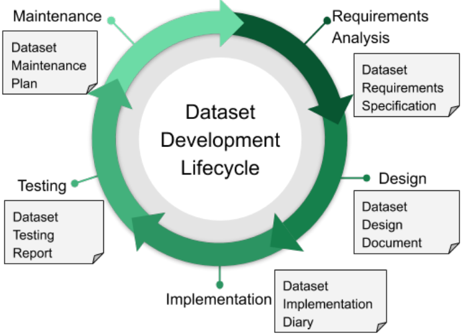
Datasets that power machine learning are often used, shared, and reused with little visibility into the processes of deliberation that led to their creation. As artificial intelligence systems are increasingly used in high-stakes tasks, system development and deployment practices must be adapted to address the very real consequences of how model development data is constructed and used in practice. This includes greater transparency about data, and accountability for decisions made when developing it. In this paper, we introduce a rigorous framework for dataset development transparency that supports decision-making and accountability. The framework uses the cyclical, infrastructural and engineering nature of dataset development to draw on best practices from the software development lifecycle. Each stage of the data development lifecycle yields documents that facilitate improved communication and decision-making, as well as drawing attention to the value and necessity of careful data work. The proposed framework makes visible the often overlooked work and decisions that go into dataset creation, a critical step in closing the accountability gap in artificial intelligence and a critical/necessary resource aligned with recent work on auditing processes.
Overview
The claims and statistics of this paper haven’t been checked yet.
Free: it reads the open-access text and checks the first 5 claims that cite a source we can check. Create a free account to check every claim.
Integrity signals
Registry
Cites
Statistics
Figures
Verification
Claims the paper makes
The claims and statistics of this paper haven’t been checked yet.
Free: it reads the open-access text and checks the first 5 claims that cite a source we can check. Create a free account to check every claim.
Claims other papers make about this one
Each is checked against this paper’s own text: does it say what the citing paper says it does?
The source backs part of the claim, not all of it — or backs it for a different population, condition or comparison.
In the citing paper
“Important constituent elements are the notions of data sheets [18, 25, 38], model cards [40], and system cards [22]: frameworks that can help structure the systematic presentation of metadata about models and systems and that feed into auditing procedures [37].”
From Rethinking open source generative AI: open washing and the EU AI Act (2024) · cites this paper as [25]
Experimental — accuracy not yet measuredThe source backs part of the claim, not all of it — or backs it for a different population, condition or comparison.
In the citing paper
“Work on AI safety and reproducibility has long pointed out the crucial importance of training data for understanding model performance, ensuring reproducibility, and assessing legal exposure [2, 25, 29, 46, 58].”
From Rethinking open source generative AI: open washing and the EU AI Act (2024) · cites this paper as [25]
Experimental — accuracy not yet measuredThe source backs part of the claim, not all of it — or backs it for a different population, condition or comparison.
In the citing paper
“This has been flagged as one of the causes of historical and representational bias in ML systems that use those data, with numerous authors urging for slower and more methodical approaches to data collection [36,53].”
From A Survey of Data Quality Requirements That Matter in ML Development Pipelines (2023) · cites this paper as [36]
Experimental — accuracy not yet measuredThe source backs part of the claim, not all of it — or backs it for a different population, condition or comparison.
In the citing paper
“Earlier trends of opportunistic data collection and post hoc justifications of large datasets are gradually moving towards a requirement for more deliberative data collection methods [35,36], sampling techniques [16] and minimal data architectures [57] to deliver better performance without reducing model accuracy.”
From A Survey of Data Quality Requirements That Matter in ML Development Pipelines (2023) · cites this paper as [36]
Experimental — accuracy not yet measuredThe source backs part of the claim, not all of it — or backs it for a different population, condition or comparison.
In the citing paper
“Numerous authors have observed that ML systems perform better for users whose demographic characteristics match those represented in the training data [9,36].”
From A Survey of Data Quality Requirements That Matter in ML Development Pipelines (2023) · cites this paper as [36]
Experimental — accuracy not yet measured
2 more claims about this paper
Create a free account to see every claim other papers make about this one.
Self-check
Percentages, sums and reported differences re-computed from the paper’s own numbers.
The self-check needs the paper’s full text.
Citations
Cites
Dilemmas in a general theory of planning
Rittel, H. W. J., & Webber, M. M. (1973) · Policy Sciences · doi:10.1007/bf01405730 · Cited by 16,338 · cited 2×
“s. Undesirable data feedback loops and unutilized data features can be mitigated with careful requirements practices. Data Postmortems and Premortems. Even the best designed systems occasionally fail [25, 119], however cyclical development practiceshelpavoidmakingthesamefailurestwice,andthepostmortem is a critical too…”
BackgroundInfluentialScience in Action: How to Follow Scientists and Engineers through Society
Bijker, W. E., & Latour, B. (1988) · Technology and Culture · doi:10.2307/3105094 · Cited by 10,767
Playing Atari with Deep Reinforcement Learning
Mnih, V., Kavukcuoglu, K., Silver, D., Graves, A., Antonoglou, I., Wierstra, D., & Riedmiller, M. (2013) · arXiv · doi:10.48550/arxiv.1312.5602 · Cited by 9,471
(1987) · Cited by 8,955
Laboratory Life: The Construction of Scientific Facts
Latour, B. (1986) · DigitalGeorgetown (Georgetown University Library) · Cited by 7,491
Situated Knowledges: The Science Question in Feminism and the Privilege of Partial Perspective
Haraway, D. (1988) · PhilPapers (PhilPapers Foundation) · Cited by 6,992
Representing and Intervening: Introductory Topics in the Philosophy of Natural Science
Hacking, I. (1983) · doi:10.1017/cbo9780511814563 · Cited by 4,814
The ethics of algorithms: Mapping the debate
Mittelstadt, B. D., Allo, P., Taddeo, M., Wachter, S., & Floridi, L. (2016) · Big Data & Society · doi:10.1177/2053951716679679 · Cited by 4,567 · cited 1×
“how consent is obtained, and the data collection process needs to keep “the receipts” as evidence of due process. To facilitate this, it is therefore necessary that dataset requirements be traceable [100], and in many cases requirements should be measurable. Non-boolean test outcomes are still useful in flagging conce…”
BackgroundThe Politics and Poetics of Infrastructure
Larkin, B. (2013) · Annual Review of Anthropology · doi:10.1146/annurev-anthro-092412-155522 · Cited by 4,095
Wicked Problems in Design Thinking
Buchanan, R. (1992) · Design Issues · doi:10.2307/1511637 · Cited by 3,539 · cited 1×
“s. Undesirable data feedback loops and unutilized data features can be mitigated with careful requirements practices. Data Postmortems and Premortems. Even the best designed systems occasionally fail [25, 119], however cyclical development practiceshelpavoidmakingthesamefailurestwice,andthepostmortem is a critical too…”
Background
Research works printed but not linked: 25
- Alain Abran, James W Moore, Pierre Bourque, Robert Dupuis, and L Tripp. 2004. Software engineering body of knowledge. IEEE Computer Society, Angela Burgess (2004).
- Anandhi S Bharadwaj. 2000. A resource-based perspective on information technology capability and firm performance: an empirical investigation. MIS quarterly (2000), 169--196.
- 10.5555/380681 · doi:10.5555/380681
- Harvey Brooks. 1994. The relationship between science and technology. Research policy 23, 5 (1994), 477--486.
- Joy Buolamwini and Timnit Gebru. 2018. Gender shades: Intersectional accuracy disparities in commercial gender classification. In Conference on fairness, accountability and transparency. 77--91.
- Lawrence Busch. 2014. A dozen ways to get lost in translation: Inherent challenges in large scale data sets. International Journal of Communication 8 (2014), 18.
- Danielle Citron and Frank Pasquale. 2014. The scored society: Due process for automated predictions. Washington Law Review 89 (03 2014), 1--33.
- IEEE Standards Coordinating Committee et al. 1990. IEEE Standard Glossary of Software Engineering Terminology (IEEE Std 610.12-1990). Los Alamitos. CA: IEEE Computer Society 169 (1990).
- Kate Crawford, Mary L Gray, and Kate Miltner. 2014. Critiquing Big Data: Politics, ethics, epistemology (special section introduction). International Journal of Communication 8 (2014), 10.
- Kate Crawford and Trevor Paglen. 2019. Excavating AI: The politics of images in machine learning training sets. Excavating AI (2019).
- Martin Glinz. 2011. A glossary of requirements engineering terminology. Standard Glossary of the Certified Professional for Requirements Engineering (CPRE) Studies and Exam, Version 1 (2011), 56.
- Ben Green. 2020. Data science as political action: Grounding data science in a politics of justice. Available at SSRN 3658431 (2020).
- Nitin Kohli, Renata Barreto, and Joshua A Kroll. 2018. Translation tutorial: a shared lexicon for research and practice in human-centered software systems. In 1st Conference on Fairness, Accountability, and Transparancy. New York, NY, USA, Vol. 7.
- Xiaoxuan Liu, Livia Faes, Aditya U Kale, Siegfried K Wagner, Dun Jack Fu, Alice Bruynseels, Thushika Mahendiran, Gabriella Moraes, Mohith Shamdas, Christoph Kern, et al. 2019. A comparison of deep learning performance against health-care professionals in detecting diseases from medical imaging: a systematic review and meta-analysis. The lancet digital health 1, 6 (2019), e271-e297.
- Helen Nissenbaum. 1996. Accountability ina computerized society. Science and engineering ethics 2, 1 (1996), 25--42.
- Roy Osherove. 2015. The art of unit testing. MITP-Verlags GmbH & Co. KG.
- Rashida Richardson, Jason M Schultz, and Kate Crawford. 2019. Dirty data, bad predictions: How civil rights violations impact police data, predictive policing systems, and justice. NYUL Rev. Online 94 (2019), 15.
- Astra Taylor. 2018. The automation charade. Logic Magazine (2018).
- Joel Walmsley. 2020. Artificial intelligence and the value of transparency. AI & SOCIETY (2020), 1--11.
- Kai Wegrich and Gerhard Hammerschmid. 2017. Infrastructure governance as political choice. The governance of infrastructure (2017), 21--42.
- 10.18653/v1 · doi:10.18653/v1
- Richard Xiao. 2010. Corpus creation. Handbook of Natural Language Processing (2n Revised edition) (2010), 147--165.
- 10.18653/v1 · doi:10.18653/v1
- Matei Zaharia, Andrew Chen, Aaron Davidson, Ali Ghodsi, Sue Ann Hong, Andy Konwinski, Siddharth Murching, Tomas Nykodym, Paul Ogilvie, Mani Parkhe, Fen Xie, and Corey Zumaret. 2018. Accelerating the Machine Learning Lifecycle with MLflow. In IEEE Data Eng. Bull. 41, no. 4. 39--45.
- Matthew Zook, Solon Barocas, Danah Boyd, Kate Crawford, Emily Keller, Seeta Peña Gangadharan, Alyssa Goodman, Rachelle Hollander, Barbara A Koenig, Jacob Metcalf, et al. 2017. Ten simple rules for responsible big data research.
Cited by
On the Dangers of Stochastic Parrots: Can Language Models Be Too Big? 🦜
Bender, E. M., Gebru, T., McMillan-Major, A., & Shmitchell, S. (2021) · Proceedings of the 2021 ACM Conference on Fairness, Accountability, and Transparency · doi:10.1145/3442188.3445922 · Cited by 6,988
Taxonomy of Risks posed by Language Models
Weidinger, L., Uesato, J., Rauh, M., Griffin, C., Huang, P.-S., Mellor, J., Glaese, A., Cheng, M., Balle, B., Kasirzadeh, A., et al. (2022) · 2022 ACM Conference on Fairness Accountability and Transparency · doi:10.1145/3531146.3533088 · Cited by 764
Ethical and social risks of harm from Language Models
Weidinger, L., Mellor, J., Rauh, M., Griffin, C., Uesato, J., Huang, P.-S., Cheng, M., Glaese, M., Balle, B., Kasirzadeh, A., et al. (2021) · arXiv · doi:10.48550/arxiv.2112.04359 · Cited by 477
Datasets: A Community Library for Natural Language Processing
Lhoest, Q., Villanova del Moral, A., Jernite, Y., Thakur, A., von Platen, P., Patil, S., Chaumond, J., Drame, M., Plu, J., Tunstall, L., et al. (2021) · Proceedings of the 2021 Conference on Empirical Methods in Natural Language Processing: System Demonstrations · doi:10.18653/v1/2021.emnlp-demo.21 · Cited by 343
“Datasets can be seen as a form of infrastructure (Hutchinson et al., 2021).”
BackgroundPower to the People? Opportunities and Challenges for Participatory AI
Birhane, A., Isaac, W., Prabhakaran, V., Diaz, M., Elish, M. C., Gabriel, I., & Mohamed, S. (2022) · Equity and Access in Algorithms Mechanisms and Optimization · doi:10.1145/3551624.3555290 · Cited by 330
Metadata
- Authors
- Hutchinson, B., Smart, A., Hanna, A., Denton, R., Greer, C., Kjartansson, O., Barnes, P., & Mitchell, M.
- Venue
- Proceedings of the 2021 ACM Conference on Fairness, Accountability, and Transparency
- Publisher
- ACM
- Published
- 2021-03
- Pages
- 560-575
- OpenAlex
- W3135371071
- Semantic Scholar
- 300fa071d990d5c48385da39dccea6b7b280edec
- Cited by
- 279
- References
- 123
- Citations by year
- 2026: 25 · 2025: 31 · 2024: 54 · 2023: 73 · 2022: 60 · 2021: 35
- FWCI
- 50.18
- Type
- conference paper
- Language
- en
- Open access
- hybrid
- doi.org
- Licence
- Locations
- ACM Conference on Fairness, Accountability, and Transparency (FAccT) (publishedVersion, cc-by)
- arXiv (Cornell University) (submittedVersion)
- arXiv (Cornell University)
- Topics
- Physical Sciences › Computer Science › Artificial Intelligence › Ethics and Social Impacts of AI
- Physical Sciences › Computer Science › Artificial Intelligence › Explainable Artificial Intelligence (XAI)
- Physical Sciences › Computer Science › Information Systems › Software Engineering Techniques and Practices
- Keywords
- accountability, software development lifecycle, data work, data documentation, auditing, decision-making, data infrastructure
About these checks
Registry, retraction, Cites and statistics results are computed, not judged, with one exception: a printed reference that no index lists is read once by a model before it counts as a citation error. Claims are extracted by a model and kept only when their quote appears verbatim in the text; each cited source is then checked, with a model’s help, for whether it says what the claim relies on. Those verdicts can be wrong — read the claim’s quote and the cited source before relying on one.
Statistics and arithmetic are recomputed, not judged.
Confidence bands are shown only for fields calibrated on our annotated test set. None is calibrated yet, so no band is shown.
What counts as a claim ›How we measure confidence ›How we check this ›
Are you an author, or do you see a problem with this page? Request a review
How to cite
Cite CoChat for the checks on this page, and the paper for its own findings.
- This page
- CoChat. (2026). Citation check: Towards Accountability for Machine Learning Datasets: Practices from Software Engineering and Infrastructure. https://app.cochat.ai/papers/10.1145/3442188.3445918
- The paper
- Hutchinson, B., Smart, A., Hanna, A., Denton, R., Greer, C., Kjartansson, O., Barnes, P., & Mitchell, M. (2021). Towards Accountability for Machine Learning Datasets: Practices from Software Engineering and Infrastructure. Proceedings of the 2021 ACM Conference on Fairness, Accountability, and Transparency. https://doi.org/10.1145/3442188.3445918
Data sources
Bibliographic data: Semantic Scholar, OpenAlex, Crossref.
Contains information from the Semantic Scholar Academic Graph Datasets, made available under the ODC Attribution License (ODC-BY 1.0).
Semantic Scholar’s data is described in: Kinney, R., et al. (2023). The Semantic Scholar Open Data Platform. arXiv:2301.10140.
