

Competitive Caching with Machine Learned Advice
Open accessThe DOI matches its Crossref record; 55 of the 55 references it cites were found in a registry or an index; none of the 10 sources its claims cite is checked for support yet.
Abstract
Traditional online algorithms encapsulate decision making under uncertainty, and give ways to hedge against all possible future events, while guaranteeing a nearly optimal solution, as compared to an offline optimum. On the other hand, machine learning algorithms are in the business of extrapolating patterns found in the data to predict the future, and usually come with strong guarantees on the expected generalization error. In this work, we develop a framework for augmenting online algorithms with a machine learned predictor to achieve competitive ratios that provably improve upon unconditional worst-case lower bounds when the predictor has low error. Our approach treats the predictor as a complete black box and is not dependent on its inner workings or the exact distribution of its errors. We apply this framework to the traditional caching problem—creating an eviction strategy for a cache of size k . We demonstrate that naively following the oracle’s recommendations may lead to very poor performance, even when the average error is quite low. Instead, we show how to modify the Marker algorithm to take into account the predictions and prove that this combined approach achieves a competitive ratio that both (i) decreases as the predictor’s error decreases and (ii) is always capped by O (log k ), which can be achieved without any assistance from the predictor. We complement our results with an empirical evaluation of our algorithm on real-world datasets and show that it performs well empirically even when using simple off-the-shelf predictions.
Overview
CoChat Summary
TL;DR
The paper introduces an OMLA framework for augmenting online algorithms with machine-learned predictions, instantiated for caching as Predictive Marker. Predictive Marker improves competitive ratio as predictor error decreases while retaining an O(log k) worst-case bound, and experiments on BrightKite/CitiBike data show it outperforms LRU, Marker, and blindly following the oracle.
Key findings
- Predictive Marker achieves competitive ratio `min(2 + 2·√(5ε), 4H_k)` under absolute loss and `min(2 + 2·3√(14ε), 4H_k)` under squared loss, where `ε` is the predictor error and `H_k` is the k-th harmonic number (Corollaries 1–2).
- Blindly following the predictor is insufficient: algorithms B and W have competitive ratio `Ω(ε)` under absolute loss (Propositions 3.1–3.2).
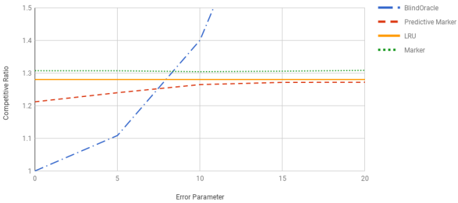
- On PLECO predictions, Predictive Marker had competitive ratios `1.266` on BK and `1.810` on Citi, versus LRU `1.280`/`1.859`, Marker `1.310`/`1.869`, and Blind Oracle `2.049`/`2.023`; it was `2.5%` better than the next best method, LRU, with `p < 0.001` (Table 2).
- LRU can be expressed as a predictor in the framework and robustified, and a black-box combination of an `α`-robust and `γ`-competitive algorithm yields a `9α`-robust and `9γ`-competitive algorithm (Theorem 4.3).
Methods
- Theoretical design: the OMLA framework treats the predictor as a black box, defines `ε`-accurate predictors, and analyzes caching where the predictor forecasts the next arrival time of each requested element; analysis uses the Marker algorithm, blame chains, and a loss-function “spread” `S_ℓ`, with extensions to randomized predictors via Jensen’s inequality.
- Experiments: two public datasets—BK (100 sequences, length 2,101, unique elements 67–800) and Citi (24 sequences, length 25,000, unique elements 593–719)—with synthetic lognormal prediction errors and off-the-shelf PLECO predictions; algorithms compared are LRU, Marker, Predictive Marker, and Blind Oracle, using competitive ratio (misses divided by optimum), with `k = 10` for BK and `k = 100` for Citi.
- Main analysis: proves consistency, robustness, and worst-case competitiveness bounds, plus a lower bound showing any deterministic `ε`-assisted marking algorithm using predictions only for tie-breaking has competitive ratio `Ω(min(S_ℓ(ε), k))` (Theorem 3.4).
Limitations
- The paper states that deciding the prediction model and loss function involves learnability trade-offs, and better understanding these exact trade-offs is “a major open direction”; it also conjectures that a randomized approach might achieve rate `log(1 + √ε)` for absolute loss, with subsequent work making progress.
- The paper states the empirical gains are modest (`2.5%` better than LRU) and that the off-the-shelf PLECO model was not tuned or optimized for predicting next appearance.
- Evident from the text: the main theoretical results focus on per-item decomposable loss functions, and the experiments cover only two datasets and specific cache sizes (`k = 10` and `k = 100`), so broader empirical and model generality is not established here.
Model-written summary. Check it against the paper before relying on it.
Integrity signals
Registry
Cites
Statistics
Figures
Verification
Claims the paper makes
0 Valid · 3 Not valid · 10 Not checked · 73 Own results and interpretations
A result the paper states — it cites no source for it, so there is none to check. The quote shows it is in the paper.
In the paper
“Lemma 3.2. Using algorithm SM , in expectation at most H k special elements cause cache misses per phase.”
plain- Asserted: passes — The authors put it forward as true.
- Checkable: passes — It can be checked against evidence.
- Load-bearing: passes — The paper’s conclusions depend on it.
- Based: passes — The paper gives a reason why it holds.
A result the paper reports from its own data — it cites no other source for it, so there is none to check. The quote shows it is in the paper.
In the paper
“At the same time, our experimental results show that even with simple predictors, our algorithm provides an improvement compared to LRU.”
plainstates a cause- Asserted: passes — The authors put it forward as true.
- Checkable: passes — It can be checked against evidence.
- Load-bearing: passes — The paper’s conclusions depend on it.
- Based: passes — The paper gives a reason why it holds.
A result the paper states — it cites no source for it, so there is none to check. The quote shows it is in the paper.
In the paper
“Theorem 4.3. For the caching problem, let A be an α -robust algorithm and B a γ -competitive algorithm. We can then create a black-box algorithm ALG that is both 9 α -robust and 9 γ -competitive.”
plainstates a cause- Asserted: passes — The authors put it forward as true.
- Checkable: passes — It can be checked against evidence.
- Load-bearing: passes — The paper’s conclusions depend on it.
- Based: passes — The paper gives a reason why it holds.
- Rests on an assumption not shown here.
A result the paper reports from its own data — it cites no other source for it, so there is none to check. The quote shows it is in the paper.
In the paper
“While the gains appear modest, we note they are statistically significant at p < 0 . 001 .”
plainstates an association- Asserted: passes — The authors put it forward as true.
- Checkable: passes — It can be checked against evidence.
- Load-bearing: passes — The paper’s conclusions depend on it.
- Based: passes — The paper gives a reason why it holds.
The paper states this without a source or data behind it here, so there is nothing to check it against. The quote shows it is in the paper.
In the paper
“Also note that any marked element needs to have arrived later than any unmarked element.”
plainstates an association- Asserted: passes — The authors put it forward as true.
- Checkable: passes — It can be checked against evidence.
- Load-bearing: passes — The paper’s conclusions depend on it.
- Based: unclear — It is unclear why the paper says it holds.
47 more claims
Create a free account to see all 86 claims and every source verdict.
- Probably not a substantial claim. 17
- It may state two separate claims as one. 20
- The quote only partly states this claim. 2
Self-check
Percentages, sums and reported differences re-computed from the paper’s own numbers.
Each contradiction between two passages listed here was confirmed by an independent check.
Rated minor: it would not touch a result — a value no result rests on, a p-value that stays on the same side of the significance level, or a conflict that is clerical, resolved elsewhere in the paper, or outside its own findings.
In the paper
§ 3.3 Analysis · p. 17
“Corollary 2. The competitive ratio of ϵ -assisted Predictive Marker with respect to the absolute loss metric ℓ 2 is bounded by cr PM ,ℓ 1 ( ϵ ) ≤ min ( 2 + 2 · 3 √ 14 ϵ, 4 H k ) .”
§ 3.3 Analysis · p. 15
“For squared loss, ℓ 2 ( A,B ) = ∑ i ( a i -b i ) 2 , the spread of ℓ 2 is S ℓ 2 ( m ) ≤ 3 √ 14 m.”
Rated minor: it would not touch a result — a value no result rests on, a p-value that stays on the same side of the significance level, or a conflict that is clerical, resolved elsewhere in the paper, or outside its own findings.
In the paper
§ 2.3 Caching with ML Advice · p. 10
“Given a sequence σ , the label of the i -th element is y ( σ i ) = min t>i { t : x ( σ t ) = x ( σ i ) } .”
§ 2.3 Caching with ML Advice · p. 10
“Note that the feature is not only a function of the element identity z ( σ i ) ; when an element reappears, its features may be drastically different.”
Rated minor: it would not touch a result — a value no result rests on, a p-value that stays on the same side of the significance level, or a conflict that is clerical, resolved elsewhere in the paper, or outside its own findings.
In the paper
§ 5 Experiments · p. 22
“We create 12 sequences, one for each month of 2017 for the New York City dataset.”
§ 5 Experiments · p. 22
“| Citi | 24 | 25,000 | 593 - 719 |”
Citations
Cites
Intriguing properties of neural networks
Szegedy, C., Zaremba, W., Sutskever, I., Bruna, J., Erhan, D., Goodfellow, I., & Fergus, R. (2013) · arXiv · doi:10.48550/arxiv.1312.6199 · Cited by 8,143
Motwani, R., & Raghavan, P. (1995) · Cambridge University Press eBooks · doi:10.1017/cbo9780511814075 · Cited by 5,123
Friendship and mobility: user movement in location-based social networks
Cho, E., Myers, S. A., & Leskovec, J. (2011) · Proceedings of the 17th ACM SIGKDD international conference on Knowledge discovery and data mining · doi:10.1145/2020408.2020579 · Cited by 2,903 · cited 1×
“This dataset is publicly available at [CML11, Bri].”
MethodOnline Computation and Competitive Analysis
Borodin, A., & El‐Yaniv, R. (1998) · Cited by 2,333
Amortized efficiency of list update and paging rules
Sleator, D. D., & Tarjan, R. E. (1985) · Communications of the ACM · doi:10.1145/2786.2793 · Cited by 2,123
A study of replacement algorithms for a virtual-storage computer
Belady, L. A. (1966) · IBM Systems Journal · doi:10.1147/sj.52.0078 · Cited by 1,659
The Case for Learned Index Structures
Kraska, T., Beutel, A., Chi, E. H., Dean, J., & Polyzotis, N. (2018) · Proceedings of the 2018 International Conference on Management of Data · doi:10.1145/3183713.3196909 · Cited by 956
(2015) · neural information processing systems · Cited by 912
The working set model for program behavior
Denning, P. J. (1983) · Communications of the ACM · doi:10.1145/357980.357997 · Cited by 845
Smoothed analysis of algorithms: Why the simplex algorithm usually takes polynomial time
Spielman, D. A., & Teng, S.-H. (2004) · Journal of the ACM · doi:10.1145/990308.990310 · Cited by 825
Research works printed but not linked: 9
- Thodoris Lykouris and Sergei Vassilvtiskii . 2018 . Competitive caching with machine learned advice . In Proceedings of the 35th International Conference on Machine Learning (Proceedings of Machine Learning Research). PMLR, 3296–3305 . Thodoris Lykouris and Sergei Vassilvtiskii. 2018. Competitive caching with machine learned advice. In Proceedings of the 35th International Conference on Machine Learning (Proceedings of Machine Learning Research). PMLR, 3296–3305.
- 10.5555/3294771.3294948 · doi:10.5555/3294771.3294948
- 10.5555/2095116.2095250 · doi:10.5555/2095116.2095250
- 10.5555/3326943.3326986 · doi:10.5555/3326943.3326986
- 10.5555/211390 · doi:10.5555/211390
- 10.5555/3327546.3327635 · doi:10.5555/3327546.3327635
- 10.5555/3381089.3381201 · doi:10.5555/3381089.3381201
- 10.5555/2969442.2969519 · doi:10.5555/2969442.2969519
- [Wei20] Alexander Wei. Better and simpler learning-augmented online caching. In International Conference on Approximation Algorithms for Combinatorial Optimization Problems (APPROX) , 2020.
Cited by
Items 101–154 of 154
Online Bipartite Matching with Predicted Degrees.Preprint
Chen, J. Y., & Indyk, P. (2021) · arXiv (Cornell University)
Can Q-Learning be Improved with Advice?Preprint
Golowich, N., & Moitra, A. (2021) · arXiv (Cornell University) · doi:10.48550/arxiv.2110.13052 · Cited by 4
“, 2019), caching (Lykouris and Vassilvitskii, 2020; Rohatgi, 2019), design of bloom filters (Kraska et al.”
BackgroundNew Directions in Streaming AlgorithmsPreprint
Vakilian, A. (2020) · doi:10.31237/osf.io/59ezx
“Other learning-augmented combinatorial optimization problems are studied in [101, 24, 128].”
BackgroundChen, M., & Chau, C.-K. (2022) · Synthesis lectures on learning, networks, and algorithms · doi:10.1007/978-3-031-11549-3_7
Making Cache Monotonic and Consistent
An, S., & Cao, Y. (2022) · Proceedings of the VLDB Endowment · doi:10.14778/3574245.3574271 · Cited by 4
“One topic for future work is to incorporate ML predictors on request sequences [17, 52, 65, 68, 74] to further improve cache performance.”
BackgroundResultMixing predictions for online metric algorithms
Antoniadis, A., Coester, C., Eliáš, M., et al. (2023) · HAL (Le Centre pour la Communication Scientifique Directe) · doi:10.48550/arxiv.2304.01781
“…prediction errors by combining an algorithm that mostly follows predictions with a classical online algorithm that ignores predictions (see, e.g., Lykouris and Vassilvitskii [2021], Purohit et al. [2018], Rohatgi [2020], Anto-niadis et al. [2020], Wei [2020], Bamas et al. [2020], Bansal et al.…”
MethodOnline Demand Peak Shaving with Machine-Learned Advice in Cyber-Physical Energy Systems
Fengl, M., Li, W., Qin, B., et al. (2023) · IEEE Intl Conf on Dependable, Autonomic and Secure Computing, Intl Conf on Pervasive Intelligence and Computing, Intl Conf on Cloud and Big Data Computing, Intl Conf on Cyber Science and Technology Congress (DASC/PiCom/CBDCom/CyberSciTech) · doi:10.1109/dasc/picom/cbdcom/cy59711.2023.10361461
“Most deterministic online peak shaving solutions operate the battery directly based on predictions of future demand, price, or energy generation [17], [11], [18].”
BackgroundSolving Multi-Task Offloading Problem in V2X with a Machine Learning-Based Online Algorithm
Zhou, Y., Li, D., Chen, Y., et al. (2023) · Globecom · doi:10.1109/globecom54140.2023.10437260
“The paper [12] suggests that online algorithms can either trust machine learning predictions or continue executing based on the original logic at each decision point.”
BackgroundSampling for Beyond-Worst-Case Online Ranking
Chen, Q., Im, S., Moseley, B., et al. (2024) · Proceedings of the AAAI Conference on Artificial Intelligence · doi:10.1609/aaai.v38i18.30051
“Works such as (Lattanzi et al. 2020; Lykouris and Vassilvitskii 2021) have been investigating how to augment online algorithms with machine-learned predictions.”
BackgroundOnline Lead Time Quotation with Predictions
Huo, T., & Cheung, W. C. (2026) · INFORMS journal on computing · doi:10.1287/ijoc.2025.1104
A Learning-Augmented Algorithm for the Parking Permit Problem with Three Permit Types
Yaroslav, K., & Kononov, A. V. (2024) · Lecture notes in computer science · doi:10.1007/978-3-031-62792-7_8 · Cited by 1
Permutation Predictions for Non-Clairvoyant Scheduling
Lindermayr, A., & Megow, N. (2025) · ACM Transactions on Parallel Computing · doi:10.1145/3711872 · Cited by 11
“This type of experiment was also performed by Purohit et al. [82] as well as in other works on learning-augmented algorithms [5, 6, 68, 69].”
Online delay management on a single train line with predictions
Eichhorn, D., & Krumke, S. O. (2025) · Information Processing Letters · doi:10.1016/j.ipl.2025.106569
Auction Design using Value Prediction with HallucinationsPreprint
Lobel, I., Moreira, H., & Mouchtaki, O. (2025) · SSRN Electronic Journal · doi:10.2139/ssrn.5134705
Shortest Paths Without a Map, but with an Entropic Regularizer
Bubeck, S., Coester, C., & Rabani, Y. (2025) · SIAM Journal on Computing · doi:10.1137/22m1539149
Hu, H., & Zhang, W. (2025) · Computers & Industrial Engineering · doi:10.1016/j.cie.2025.111186
Comparing the Hardness of Online Minimization and Maximization Problems with Predictions
Berg, M. (2025) · Lecture notes in computer science · doi:10.1007/978-981-96-8312-3_3
Boosting Double Coverage for k-Server via Imperfect Predictions
Lindermayr, A., Megow, N., & Simon, B. (2025) · Algorithmica · doi:10.1007/s00453-025-01333-9 · Cited by 2
“If a learning-augmented algorithm is µ ( η ) -competitive for some function µ , we say that the algorithm is α - consistent if α ≥ µ (0) and β - robust if µ ( η ) ≤ β for any prediction error η [42, 47].”
Online Fair Division for Personalized 2-Value Instances
Amanatidis, G., Lolos, A., Markakis, E., et al. (2025) · Lecture notes in computer science · doi:10.1007/978-3-032-03639-1_12
Improved Learning-Augmented Algorithms and (Tight) Lower Bounds for Multi-Option Ski Rental Problem
Shin, Y.-H., Lee, C., Lee, G., & An, H.-C. (2025) · ACM Transactions on Algorithms · doi:10.1145/3763239 · Cited by 11
“The performance guarantee of their algorithm was stated under the standard consistency-robustness scheme [29, 35]: for a tradeoff parameter 𝜆 > 0 , the algorithm is ( 1 + 𝜆 ) -consistent and ( 5 + 5 𝜆 ) -robust, that is, the algorithm outputs a solution whose cost is within a factor of ( 1 + 𝜆…”
InfluentialJia, R., Gu, Y., Wu, C., Li, J., Guo, M., Zhang, L., Zhang, Z., & Zhang, H. (2025) · IEEE International Conference on Cluster Computing (CLUSTER) · doi:10.1109/cluster59342.2025.11186495
Tree coloring with predictions
Frei, F., Gehnen, M., Komm, D., et al. (2025) · Discrete Applied Mathematics · doi:10.1016/j.dam.2025.10.024
CVAE-Guided QAOA Parameter Initialization and Dynamic Injection
Nana, J., Li, X., Xie, N., Li, L. T., Yu, Y., Guan, Q., Xu, H., Pu, S., Xu, S., & Chaudhary, V. (2025) · IEEE International Conference on Quantum Computing and Engineering (QCE) · doi:10.1109/qce65121.2025.10338
“Learning-augmented algorithms [7], [8] improve average-case performance by leveraging instance-specific patterns, with successes in online and clustering problems [9]–[14].”
Bari, A., Zhou, Y., & Veciana, G. A. D. (2026) · International Conference on Computer Communications and Networks (ICCCN) · doi:10.1109/icccn69946.2026.11662782
“Finally, hybrid strategies combining ML with traditional caching techniques, as in [19], aim to improve performance but often rely on complex models and incur higher computational costs.”
Abela, J., Cachia, E., & Layfield, C. (2025) · Mathematics · doi:10.3390/math14010041 · Cited by 1
Strategic Facility Location via Predictions
Chen, Q., Gravin, N., & Im, S. (2026) · Lecture notes in computer science · doi:10.1007/978-3-032-08560-3_23 · Cited by 10
Prediction-Augmented Mechanism Design for Weighted Facility Location
Shi, Y., & Xue, Z. (2026) · Lecture notes in computer science · doi:10.1007/978-981-95-4839-2_20
Learning-Augmented Online Bipartite Matching in the Random Arrival Order Model
Burathep, K., Erlebach, T., & Moses, W. K. (2026) · Lecture notes in computer science · doi:10.1007/978-3-032-17801-5_27
Learning-Based Sketches for Frequency Estimation in Data Streams Without Ground Truth
Yuan, X., Qiao, Y., Li, M., Wei, Z., Feng, C., Wang, Z., & Chen, W. (2026) · IEEE Transactions on Knowledge and Data Engineering · doi:10.1109/tkde.2026.3675012 · Cited by 2
“Ontheotherhand,recentyearshavewitnessedtheintegration ofdeeplearningtechnologywithnumerousclassicalgorithms: index[5],bloomfilter[6],[7],caching[8],graphoptimiza-tion[9]andsoon.”
Shiri, D., Shahmanzari, M., & Tanrısever, F. (2026) · Production and Operations Management · doi:10.1177/10591478261438365
“…stream of research, there has been growing interest in studying online optimization problems with unreliable predictions (Gouleakis et al., 2023; Lykouris and Vassilvitskii, 2021; Rutten and Mukherjee, 2024; Shiri et al., 2024), where online algorithms are provided with predictions in a…”
Robust Adaptive Algorithms for High-Fidelity Next-Generation Video Streaming
Chen, T. (2026) · ACM Multimedia Systems Conference (MMSys) · doi:10.1145/3793853.3798408
Learning-Augmented 360° Video Streaming: Robust Viewport Adaptation with Simple Predictors
Chen, T., Hajiesmaili, M., & Sitaraman, R. K. (2026) · ACM Multimedia Systems Conference (MMSys) · doi:10.1145/3793853.3795754
Online and Approximation Algorithms : Beyond Worst-Case Paradigms
Xefteris, M. (2024) · theses.fr (ABES) · doi:10.70675/da408374z2c23z4ab1zbabdz0a51d084ef7f
Decision-aligned eviction-value prediction for robust learning-augmented cachingPreprint
Vahidi, S. (2026) · SSRN Electronic Journal · doi:10.2139/ssrn.6636732
Strategyproof facility location with prediction: minimizing the maximum cost
Chan, H., Lin, J., & Wang, C. (2026) · Autonomous Agents and Multi-Agent Systems · doi:10.1007/s10458-026-09750-y
“To overcome these practical limitations, a powerful framework of machine learning (ML) augmented algorithms has been introduced in broader algorithm design [27].”
Prediction-Specific Design of Learning-Augmented Algorithms
李, 思., Christianson, N., & Li, T. (2026) · doi:10.1145/3801489.3806913
Distributed Caching with Delayed Hits
Liu, K., Tang, X., Chen, L., Quan, G., & Pham, X. Q. (2026) · IEEE Conference on Computer Communications (INFOCOM) · doi:10.1109/infocom59046.2026.11571218
“Caches [25], [26] have been investigated extensively for decades in both offline [10], [11], [13], [14], [21], [27] and on-line settings [12], [28]–[30].”
Memory-Efficient KV Cache Optimization for Large Language Model Inference at the Edge
ZHANG, C., Tan, H., Pan, H., Xu, Y., Du, H., Zhang, L., & Fu, X. (2026) · IEEE Conference on Computer Communications (INFOCOM) · doi:10.1109/infocom59046.2026.11571411 · Cited by 1
“Consequently, learning-based cache replacement methods, such as those that leverage page-level predictors [32], [33], hold promise for improving cache efficiency.”
Delay and risk estimation for wireless links with service interruptions
Pei, Z., Feng, L., Liu, Z., Qi, S., & Su, M. (2026) · Computer Networks · doi:10.1016/j.comnet.2026.112534
Gupta, S., & Singla, J. (2026) · Advances in computational intelligence and robotics book series · doi:10.4018/979-8-3373-3857-6.ch005
I/o for LLM inference: a survey of storage and memory bottlenecks
Chowdhury, R. (2026) · Artificial Intelligence Review · doi:10.1007/s10462-026-11651-1 · Cited by 1
“The problem can be cast as online weighted paging with variable page sizes (Lykouris and Vassilvitskii 2021 ): E experts of size w e , GPU capac - ity C < e w e , request sequence driven by input tokens—find an eviction/prefetch policy minimizing total I/O. LRU achieves competitive ratio O ( k )…”
Prediction-Specific Design of Learning-Augmented Algorithms
李, 思., Christianson, N., & Li, T. (2026) · ACM SIGMETRICS Performance Evaluation Review · doi:10.1145/3820171.3806913
On Hierarchical Caching with Delayed Hits
Liu, K., & Tang, X. (2026) · IEEE International Conference on Distributed Computing Systems (ICDCS) · doi:10.1109/2575-8411.2026.00036
“Caching algorithms have garnered significant attention in both offline [9], [12], [13], [24], [27] and online settings [11], [28], [29].”
Rethinking Cache Eviction: Low-Overhead and Precise Learning-based Design
Wang, Q., Xu, C., Zhou, W., Fang, J., Xiong, Y., & Niu, Z. (2026) · ACM Transactions on Computer Systems · doi:10.1145/3839232 · Cited by 1
Haque, A. U. (2026) · Algorithms · doi:10.3390/a19090770
Caching with Monotonicity and Consistency
An, S., Cao, Y., Li, J., & Li, Y. (2026) · ACM Transactions on Database Systems · doi:10.1145/3845609 · Cited by 1
“Nonetheless, we propose ML-augmented MCC policies that can incorporate any blackbox binary classifier as an oracle that predicts whether a cached item is obsolete.”
InfluentialReliable execution and reusable certification of dual-sourcing inventory policiesPreprint
Lian, J. J. (2026) · SSRN Electronic Journal · doi:10.2139/ssrn.7446638
Zemzami, M., Nguyen, N. Q., Yalaoui, F., & Ouazène, Y. (2026) · Journal of Industrial and Management Optimization · doi:10.3934/jimo.2026169
Bayesian Learning in Online Decision Making
Amanihamedani, A., Aouad, A., Işık, S., et al. (2026) · ACM SIGMETRICS Performance Evaluation Review · doi:10.1145/3848038.3848059
“Beyond-worst-case analysis seeks meaningful middle grounds between these extremes, where algorithms have access to imperfect but useful information, such as samples [4, 10, 15], priors [1, 3, 11, 8], predictions [12, 13], or prediction portfolios [2, 7, 9].”
Caching with Calibrated Predictions
Karisani, H., Daneshvaramoli, M., Lechowicz, A., Qiao, M., & Hajiesmaili, M. (2026) · ACM SIGMETRICS Performance Evaluation Review · doi:10.1145/3848038.3848058
“Learning-augmented caching was introduced by Lykouris and Vassilvitskii [5] and has since been studied under several prediction models, including next-request times [7], costly predictions [3], and succinct predictions [1].”
Online budget-feasible mechanism design with predictions
Amanatidis, G., Markakis, E., Santorinaios, C., et al. (2026) · Theoretical Computer Science · doi:10.1016/j.tcs.2026.116260
Unified threshold strategies for online conversion problems with transaction costs
Zhang, W., Shu, N., Zhang, X., et al. (2026) · Computers & Operations Research · doi:10.1016/j.cor.2026.107691
Shin, Y., Lee, C., Lee, G., & An, H.-C. (2023) · arXiv · doi:10.48550/arxiv.2302.06832
Tiwari, S., Chugh, T., Rickert, N., Peter, S., Mahajan, R., & Shen, H. (2026) · arXiv · doi:10.48550/arxiv.2606.16824
Metadata
- Authors
- Lykouris, T., & Vassilvitskii, S.
- Affiliations
- Microsoft (United States) (US)
- Google (United States) (US)
- Venue
- Journal of the ACM
- Published
- 2021-07-14
- Volume
- 68
- Issue
- 4
- Pages
- 1-25
- ISSN
- 0004-5411 (ISSN-L)
- 1557-735X
- OpenAlex
- W2786176077
- Cited by
- 172
- References
- 41
- Citations by year
- 2026: 36 · 2025: 32 · 2024: 31 · 2023: 18 · 2022: 25 · 2021: 17
- FWCI
- 10.19
- Type
- journal article
- Language
- en
- Open access
- hybrid
- doi.org
- Licence
- Locations
- Journal of the ACM (publishedVersion, cc-by-nc-nd)
- arXiv (Cornell University) (submittedVersion)
- arXiv (Cornell University)
- International Conference on Machine Learning
- Funders
- NSF (CCF-1563714)
- Google Ph.D. Fellowship
- Topics
- Physical Sciences › Mathematics › Theoretical Computer Science › Optimization and Search Problems
- Physical Sciences › Mathematics › Theoretical Computer Science › Algorithms and Data Compression
- Physical Sciences › Computer Science › Computer Networks and Communications › Caching and Content Delivery
- Keywords
- online algorithms, competitive ratio
About these checks
Registry, retraction, Cites and statistics results are computed, not judged, with one exception: a printed reference that no index lists is read once by a model before it counts as a citation error. Claims are extracted by a model and kept only when their quote appears verbatim in the text; each cited source is then checked, with a model’s help, for whether it says what the claim relies on. Those verdicts can be wrong — read the claim’s quote and the cited source before relying on one.
A language model drew the claims from the paper on 2026-10-10, under version 3 of the claim definition (model deepseek-v4.1-flash, prompt extract-v3).
A second model labelled each claim on 2026-10-10 (model jev-1.13-20260917, definition revision gold-guideline-v0.2).
Statistics and arithmetic are recomputed, not judged.
Confidence bands are shown only for fields calibrated on our annotated test set. None is calibrated yet, so no band is shown.
What counts as a claim ›How we measure confidence ›How we check this ›
Are you an author, or do you see a problem with this page? Request a review
Data sources
Bibliographic data: Semantic Scholar, OpenAlex, Crossref.
Contains information from the Semantic Scholar Academic Graph Datasets, made available under the ODC Attribution License (ODC-BY 1.0).
Semantic Scholar’s data is described in: Kinney, R., et al. (2023). The Semantic Scholar Open Data Platform. arXiv:2301.10140.
