

When Machine Unlearning Jeopardizes Privacy
Open accessThe DOI matches its Crossref record; 82 of the 82 references it cites were found in a registry or an index; 14 of the 28 sources its claims cite were checked for support.
Abstract
This paper performs the first study on unintended information leakage caused by machine unlearning and proposes a novel membership inference attack.
Overview
CoChat Summary
## TL;DR
The paper shows that machine unlearning can unintentionally leak membership information by letting an attacker compare outputs of the original and unlearned models. Across multiple datasets and model types, the proposed attack often outperforms classical membership inference, especially on well-generalized models.
## Key findings
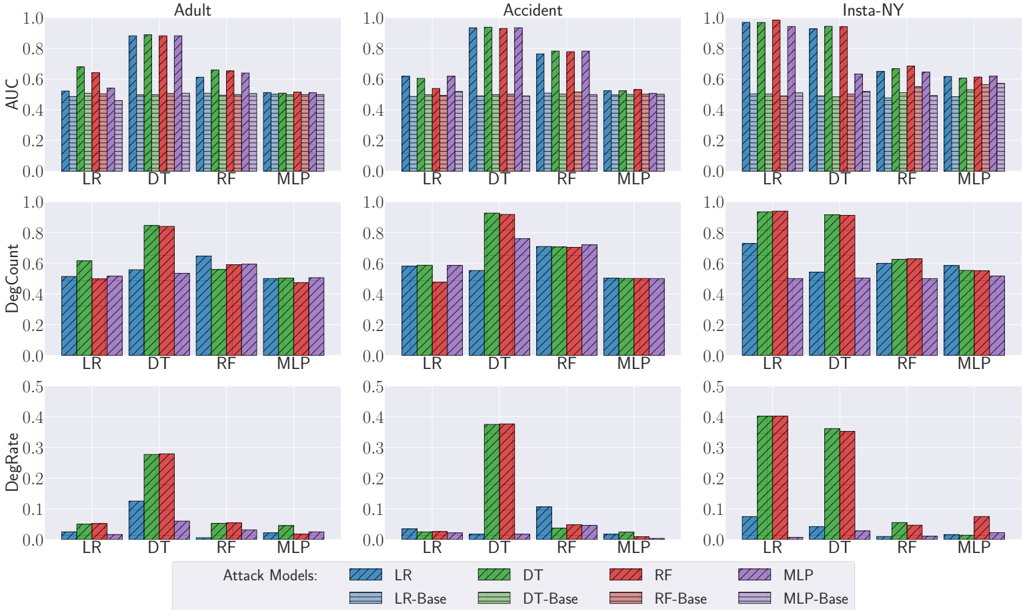
- On categorical datasets, the attack “consistently better[s] than classical membership inference” and achieves up to 0.48 improvement in AUC; the best reported DegCount and DegRate are 0.94 and 0.40.
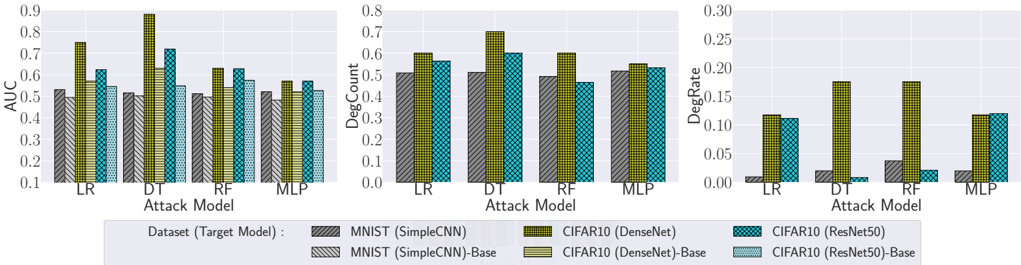
- On image datasets, the attack also outperforms classical membership inference in all settings; for CIFAR10 + DenseNet, the paper reports an overfitting level of 0.439, with the highest privacy degradation, while MNIST + SimpleCNN has overfitting < 0.05 and the lowest degradation.
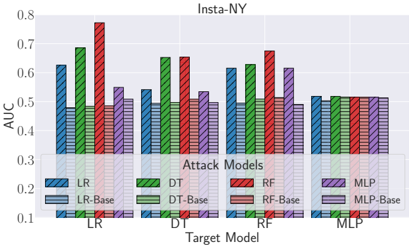
- For a well-generalized decision tree on the Adult dataset, classical membership inference is near random with AUC = 0.497, while the proposed attack reaches AUC = 0.882; the paper also reports DegCount = 0.85 and DegRate = 0.28 for this example.
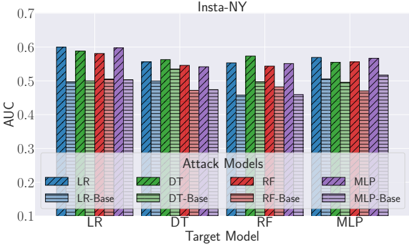
- Transfer is strong: in one dataset-transfer example, the attack AUC drops only 1% (from 0.944 to 0.931) when moving from Insta-NY → Insta-LA for a decision tree target model.
- Against the approximate SISA unlearning method, attack performance drops compared with retraining from scratch, indicating SISA reduces the influence of a specific sample on the global model.
## Methods
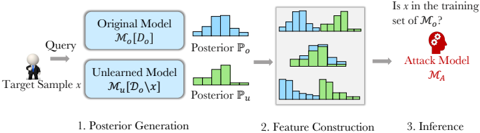
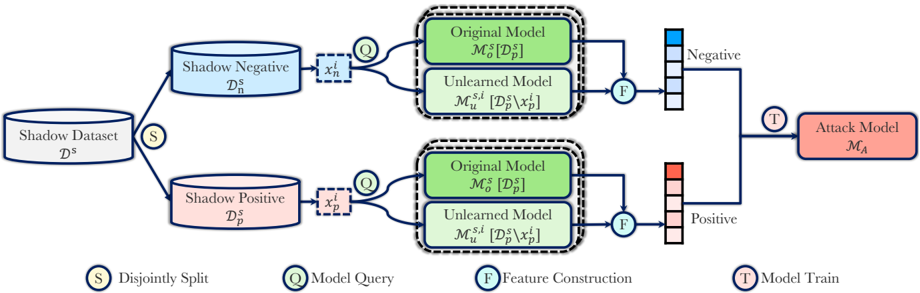
- The paper studies black-box membership inference in machine unlearning: the adversary queries both the original model and the unlearned model, extracts their posterior outputs, constructs features from both, and trains a binary attack model.
- It evaluates on categorical datasets (Adult, Accident, Insta-NY, Insta-LA) and image datasets (MNIST, CIFAR10, STL10) using target models including logistic regression, decision tree, random forest, MLP, SimpleCNN, DenseNet, and ResNet50.
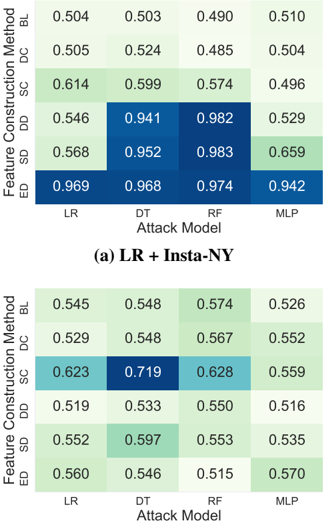
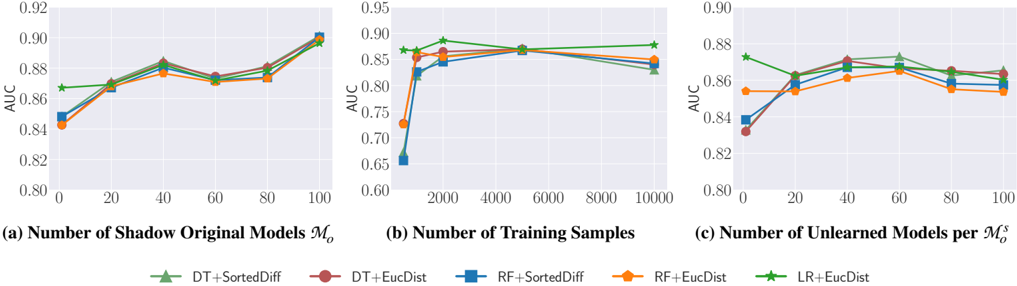
- Main analysis compares feature constructions (DirectConcat, SortedConcat, DirectDiff, SortedDiff, EucDist), tests overfitting effects, shadow-model transferability, multiple intermediate unlearned models, group deletion, online learning, and defense mechanisms.
## Limitations
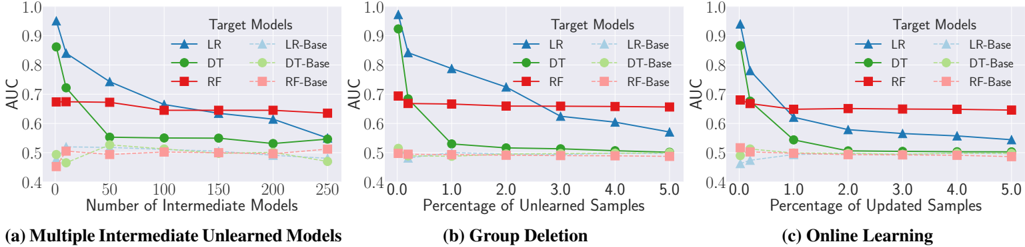
- The paper explicitly notes that the evaluation of the attack in other scenarios is deferred to Section 6, and that some experiments are limited by space; for example, the multiple-intermediate-models experiment is concentrated on Insta-NY with three target models.
- The defense DP-SGD is only reported for logistic regression because it can only be applied to models that undergo gradient updating; this is stated in the paper.
- Evident from the text: several reported results are based on selected datasets/models and some figures/tables are partially summarized in the excerpt, so the paper’s broader empirical coverage is not fully visible here.
Model-written summary. Check it against the paper before relying on it.
Integrity signals
Registry
Cites
Statistics
Figures
Verification
Claims the paper makes
5 Valid · 1 Not valid · 5 Not checked · 94 Own results and interpretations
Every source the paper cites for this claim was checked and supports it.
In the paper
“This is consistent with the conclusion of previous studies [60, 64] that classical membership inference (which uses plain posterior information) performs well on overfitted target models.”
What the sources say
- Supportedcites [60] [60] Ahmed Salem, Yang Zhang, Mathias Humbert, Pascal Berrang, Mario Fritz, and Michael Backes. ML-Leaks: Model and Data Independent Membership Inference Attacks and Defenses on Machine Learning Models. In Network and Distributed System Security Symposium (NDSS) . Internet Society, 2019. 1, 3, 4, 6, 8, 13, 14 - source
The Experimental Setup (page not provided) reports that more-overfitted target models are more vulnerable to membership inference, with substantially stronger attack performance on a highly overfitted model. The Membership Inference section (page not provided) describes an attack that uses the target model’s output posteriors to predict membership. (LLM, conf=0.91)
- Supportedcites [64] [64] Reza Shokri, Marco Stronati, Congzheng Song, and Vitaly Shmatikov. Membership Inference Attacks Against Machine Learning Models. In IEEE Symposium on Security and Privacy (S&P) , pages 3-18. IEEE, 2017. 1, 3, 4, 8, 12, 13, 14 - source
The attack overview (p. 4) says the membership-inference attack uses the target model’s prediction vector of class probabilities. “Effect of overfitting” (p. 11) reports that larger train–test accuracy gaps are associated with higher membership-inference precision. The paper also cautions that overfitting is not the only factor affecting attack success. (LLM, conf=0.92)
plainstates an association- Asserted: passes — The authors put it forward as true.
- Checkable: passes — It can be checked against evidence.
- Load-bearing: passes — The paper’s conclusions depend on it.
- Based: passes — The paper gives a reason why it holds.
- Supported
The cited sources support only part of this claim — read each source’s verdict below.
In the paper
“For the well-generalized target models, exploiting the plain posterior information has shown to perform poorly in terms of membership inference [60, 64].”
What the sources say
- Supportedcites [60] [60] Ahmed Salem, Yang Zhang, Mathias Humbert, Pascal Berrang, Mario Fritz, and Michael Backes. ML-Leaks: Model and Data Independent Membership Inference Attacks and Defenses on Machine Learning Models. In Network and Distributed System Security Symposium (NDSS) . Internet Society, 2019. 1, 3, 4, 6, 8, 13, 14 - source
The Experimental Setup discussion of Figure 2 reports that models with less overfitting are less vulnerable to membership inference: the Adult target model had only a 2% training–testing accuracy gap, and the attack achieved about 0.5 precision and recall. The paper describes this attack as using the target model’s output posteriors. (LLM, conf=0.87)
- Partly supportedcites [64] [64] Reza Shokri, Marco Stronati, Congzheng Song, and Vitaly Shmatikov. Membership Inference Attacks Against Machine Learning Models. In IEEE Symposium on Security and Privacy (S&P) , pages 3-18. IEEE, 2017. 1, 3, 4, 8, 12, 13, 14 - sourceExperimental — accuracy not yet measured
Section F (p. 11) reports near-random membership-inference precision for a target model with nearly identical training and test accuracy, and Section VII (p. 12) links attack success to generalizability. But the paper evaluates a trained attack model using prediction outputs, not a separate method that exploits only plain posterior information; it also says overfitting is not the only factor affecting leakage. (LLM, conf=0.84)
plain- Asserted: passes — The authors put it forward as true.
- Checkable: passes — It can be checked against evidence.
- Load-bearing: passes — The paper’s conclusions depend on it.
- Based: passes — The paper gives a reason why it holds.
- Supported
A result the paper reports from its own data — it cites no other source for it, so there is none to check. The quote shows it is in the paper.
In the paper
“More importantly, we show that our attack in multiple cases outperforms the classical membership inference attack on the original ML model, which indicates that machine unlearning can have counterproductive effects on privacy.”
boostedstates an association- Asserted: passes — The authors put it forward as true.
- Checkable: passes — It can be checked against evidence.
- Load-bearing: passes — The paper’s conclusions depend on it.
- Based: passes — The paper gives a reason why it holds.
- Rests on 5 assumptions not shown here.
A result the paper reports from its own data — it cites no other source for it, so there is none to check. The quote shows it is in the paper.
In the paper
“We notice that the privacy degradation is especially significant for well-generalized ML models where classical membership inference does not perform well.”
- Also stated in: § When Machine Unlearning Jeopardizes Privacy · plain
“In particular, we observe that privacy is especially degraded because of machine unlearning in the case of well-generalized models.”
plainstates a cause- Asserted: passes — The authors put it forward as true.
- Checkable: passes — It can be checked against evidence.
- Load-bearing: passes — The paper’s conclusions depend on it.
- Based: passes — The paper gives a reason why it holds.
- Rests on 5 assumptions not shown here.
- Also stated in: § When Machine Unlearning Jeopardizes Privacy · plain
A result the paper reports from its own data — it cites no other source for it, so there is none to check. The quote shows it is in the paper.
In the paper
“We further investigate four mechanisms to mitigate the newly discovered privacy risks and show that releasing the predicted label only, temperature scaling, and differential privacy are effective.”
- Also stated in: § When Machine Unlearning Jeopardizes Privacy · plain
“publishing only the predicted label, temperature scaling, and differential privacy can effectively prevent our attack.”
plainstates a cause- Asserted: passes — The authors put it forward as true.
- Checkable: passes — It can be checked against evidence.
- Load-bearing: passes — The paper’s conclusions depend on it.
- Based: passes — The paper gives a reason why it holds.
- Rests on 5 assumptions not shown here.
- Also stated in: § When Machine Unlearning Jeopardizes Privacy · plain
58 more claims
Create a free account to see all 105 claims and to verify the 8 references still open.
- Probably not a substantial claim. 16
- It may state two separate claims as one. 28
- The quote only partly states this claim. 2
Claims other papers make about this one
Each is checked against this paper’s own text: does it say what the citing paper says it does?
The source backs part of the claim, not all of it — or backs it for a different population, condition or comparison.
In the citing paper
“Thus, a membership inference attack or a poisoning attack would reveal a significant amount of detailed information about the unlearned samples [78, 108].”
From Machine Unlearning: A Survey (2024) · cites this paper as [78]
Experimental — accuracy not yet measuredThe cited source says what the claim attributes to it.
In the citing paper
“This could exacerbate user privacy issues if an attacker has access to the model before and after the unlearning operation [78].”
From Machine Unlearning: A Survey (2024) · cites this paper as [78]
Citations
Cites
Deep Residual Learning for Image Recognition
He, K., Zhang, X., Ren, S., & Sun, J. (2016) · 2016 IEEE Conference on Computer Vision and Pattern Recognition (CVPR) · doi:10.1109/cvpr.2016.90 · Cited by 235,474
Densely Connected Convolutional Networks
Huang, G., Liu, Z., Van Der Maaten, L., & Weinberger, K. Q. (2017) · 2017 IEEE Conference on Computer Vision and Pattern Recognition (CVPR) · doi:10.1109/cvpr.2017.243 · Cited by 48,566
Deep Learning with Differential Privacy
Abadi, M., Chu, A., Goodfellow, I., McMahan, H. B., Mironov, I., Talwar, K., & Zhang, L. (2016) · Proceedings of the 2016 ACM SIGSAC Conference on Computer and Communications Security · doi:10.1145/2976749.2978318 · Cited by 6,578
The Algorithmic Foundations of Differential Privacy
Dwork, C., & Roth, A. (2014) · Foundations and Trends® in Theoretical Computer Science · doi:10.1561/0400000042 · Cited by 5,557
Membership Inference Attacks Against Machine Learning Models
Shokri, R., Stronati, M., Song, C., & Shmatikov, V. (2017) · 2017 IEEE Symposium on Security and Privacy (SP) · doi:10.1109/sp.2017.41 · Cited by 4,754 · cited 10×
“, Po and Pu , also referred to as confidence values [64].”
BackgroundMethodResultInfluentialAn analysis of single-layer networks in unsupervised feature learning
Coates, A., Ng, A. Y., & Lee, H. (2011) · International Conference on Artificial Intelligence and Statistics · Cited by 4,675
The Limitations of Deep Learning in Adversarial Settings
Papernot, N., McDaniel, P., Jha, S., Fredrikson, M., Celik, Z. B., & Swami, A. (2016) · 2016 IEEE European Symposium on Security and Privacy (EuroS&P) · doi:10.1109/eurosp.2016.36 · Cited by 3,993
The Algorithmic Foundations of Differential Privacy
Dwork, C., & Roth, A. (2013) · doi:10.1561/9781601988195 · Cited by 3,856
Practical Black-Box Attacks against Machine Learning
Papernot, N., McDaniel, P., Goodfellow, I., Jha, S., Celik, Z. B., & Swami, A. (2017) · Proceedings of the 2017 ACM on Asia Conference on Computer and Communications Security · doi:10.1145/3052973.3053009 · Cited by 3,495
On calibration of modern neural networks
Guo, C., Pleiss, G., Sun, Y., & Weinberger, K. Q. (2017) · arXiv · doi:10.48550/arxiv.1706.04599 · Cited by 3,435
Research works printed but not linked: 1
- [63] Reza Shokri, Martin Strobel, and Yair Zick. Exploiting Transparency Measures for Membership Inference: a Cautionary Tale. In The AAAI Workshop on PrivacyPreserving Artificial Intelligence (PPAI) . AAAI, 2020. 14 -
Cited by
Items 101–180 of 180
Gao, H.-A., Geng, J., Hua, W., Hu, M., Juan, X., Liu, H., Liu, S., Qiu, J., Qi, X., Wu, Y., et al. (2025) · arXiv · doi:10.48550/arxiv.2507.21046 · Cited by 3
The Price of Forgetting: Incentive Mechanism Design for Machine Unlearning
Cui, Y., & Cheung, M. H. (2025) · IEEE Transactions on Mobile Computing · doi:10.1109/tmc.2025.3582904 · Cited by 6
“We conducted experiments on three real-world datasets (i.e., MNIST [20], Cifar-10 [21], and Adult Income [22]) with two popular machine unlearning algorithms (i.e., Retraining from Scratch [8] and SISA [7]) and characterized two major costs of the server: accuracy degradation and consumed time.”
InfluentialADGTrace: Achieving Adaptive Trajectory Synthesis With Generated Data
Cai, H., Chen, L., Sheng, B., Zhou, J., Yang, Y., Zhu, Y., & Xiao, F. (2025) · IEEE Transactions on Mobile Computing · doi:10.1109/tmc.2025.3590770 · Cited by 2
“Other related work [10], [11], [12] adopt local differential privacy (LDP) to defend against the untrustworthy data curator’s possible attacks like membership inference [13], where each user’s perturbed data are only sent to the curator, thus largely avoiding possible privacy disclosure.”
Defenses Against Membership Inference Attacks on Unlearned Data
Domingo‐Ferrer, J., Jebreel, N., & Sánchez, D. (2025) · Lecture notes in computer science · doi:10.1007/978-3-032-00891-6_12 · Cited by 4
Game-Theoretic Machine Unlearning: Mitigating Extra Privacy Leakage
Liu, H., Zhu, T., Zhang, L., & Xiong, P. (2025) · IEEE Transactions on Information Forensics and Security · doi:10.1109/tifs.2025.3623364 · Cited by 6
“In addition, a binary classifier was employed to train membership inference attack model M A [14].”
InfluentialUnlearning Inversion Attacks for Graph Neural Networks
Zhang, J., Wang, Y., Zhang, Z., Liu, X., & Wang, S. (2026) · ACM International Conference on Web Search and Data Mining (WSDM) · doi:10.1145/3773966.3777929 · Cited by 14
Self-citationmeMIA: Multilevel Ensemble Membership Inference Attack
Ullah, N., Aman, M. N., & Sikdar, B. (2024) · IEEE Transactions on Artificial Intelligence · doi:10.1109/tai.2024.3445326 · Cited by 4
“MI has been rigorously investigated in the literature [7], [8], [31], [36], [37], [38], [39].”
Tran, H. N., Nguyen, N. T., Nguyen, N. V., Nguyen, H. X., & Nguyen, A. D. (2025) · Engineering Science and Technology an International Journal · doi:10.1016/j.jestch.2025.101996 · Cited by 6
EFU: Enforcing Federated Unlearning via Functional Encryption
Mohammadi, S., Tsouvalas, V., Symeonidis, I., Balador, A., Özçelebi, T., Flammini, F., & Meratnia, N. (2025) · ACM International Conference on Information and Knowledge Management (CIKM) · doi:10.1145/3746252.3761091 · Cited by 3
How to Combine Membership-Inference Attacks on Multiple Updated Machine Learning Models
Jagielski, M., Wu, S. L., Oprea, A., Ullman, J., & Geambasu, R. (2023) · Proceedings on Privacy Enhancing Technologies · doi:10.56553/popets-2023-0078 · Cited by 27
“Q7 answer: ScoreDiff and ScoreRatio are more efficient (fewer shadow models) and more effective (higher accuracy) than [9].”
BackgroundMethodInfluentialModerator: Moderating Text-to-Image Diffusion Models through Fine-grained Context-based Policies
Wang, P., Li, Q., Yu, L., Wang, Z., Li, A., & Jin, H. (2024) · ACM SIGSAC Conference on Computer and Communications Security (CCS) · doi:10.1145/3658644.3690327 · Cited by 21
Using Shadow Models to Protect Private Data on Machine Unlearning
Lin, H.-C., & Yang, S. (2023) · IEEE International Conference on Consumer Electronics - Taiwan (ICCE-Taiwan) · doi:10.1109/icce-taiwan58799.2023.10226994 · Cited by 1
“But some studies have shown that machine unlearning can also pose a privacy risk because the attackers can infer the deleted data or their associated class through the observed output changes before and after machine unlearning [4].”
BackgroundTang, L., & Joshi, J. (2024) · IEEE International Conference on Trust, Privacy and Security in Intelligent Systems and Applications (TPS-ISA) · doi:10.1109/tps-isa62245.2024.00040 · Cited by 3
Federated Unlearning for Samples Based on Adaptive Gradient Ascent of Angles
Hua, Y., Xia, H., & Xu, S. (2024) · IEEE International Conference on Trust, Security and Privacy in Computing and Communications (TrustCom) · doi:10.1109/trustcom63139.2024.00125 · Cited by 5
Trojan Attack on Machine Unlearning: Security Risk of the Right to be Forgotten
Zhang, L., Zhu, T., Xiong, P., & Zhou, W. (2025) · IEEE Transactions on Dependable and Secure Computing · doi:10.1109/tdsc.2025.3567848 · Cited by 1
A2E: Black-Box Anti-Adversarial Example Based Watermarking to Verify Federated Unlearning
Gao, X., Wang, J., Zhang, Z., Chen, J., Cheng, P., & Chen, J. (2025) · IEEE Transactions on Dependable and Secure Computing · doi:10.1109/tdsc.2025.3598987 · Cited by 2
“…inference advantage in [48], we confirm the noticeable privacy leakage on those specialized watermark-dependent AEs (in line with the conclusion of [49], [50]), while negligible on the entire leaving data (owning to adversarial training induces more overfitting on these watermarking AEs [51]) in…”
Self-citationMachine Unlearning: A Comprehensive Framework for Efficient Data Removal in Deep Learning Systems
Rajwade, D., Bhardwaj, V., Vishwakarma, R., Pandey, A. K., Hashmi, S. A. A., & Hashmi, N. A. (2025) · doi:10.38124/ijisrt/25oct892 · Cited by 4
Marchant, N. G., Zhao, Y., Rubinstein, B. I. P., & Ohrimenko, O. (2025) · Springer eBooks · doi:10.1007/978-3-032-01940-0_5 · Cited by 1
Dataset ownership verification with invisible backdoors
Kim, S., & Hahn, C. (2025) · Applied Intelligence · doi:10.1007/s10489-025-06994-1 · Cited by 1
“We extended this analysis to the top-C and top-D VM datasets, adjusting the hyperparameters C and D in range of [5,9] to vary the dataset sizes and information content.”
Hou, J., Finke, A., & Cosma, G. (2025) · IEEE Transactions on Neural Networks and Learning Systems · doi:10.1109/tnnls.2025.3639808 · Cited by 2
“In this context, machine unlearning may be needed for a. addressing data-privacy concerns, e.g., for deleting data of a user who has exercised their ‘right to be forgotten’ [1, 5]; b. selectively deleting (e.g. outdated) information [6, 7].”
DeepLeak: Privacy Enhancing Hardening of Model Explanations Against Membership Leakage
Hmida, F. B., Sbeih, Z., Hailemariam, P., & Eshete, B. (2026) · IEEE Conference on Secure and Trustworthy Machine Learning (SaTML) · doi:10.1109/satml68715.2026.00064 · Cited by 3
Lee, J., Yu, S., Jang, Y., Woo, S. S., & Jo, J. (2026) · IEEE Transactions on Visualization and Computer Graphics · doi:10.1109/tvcg.2026.3658325 · Cited by 7
“OnecriticalprincipleinMUevaluationisthe privacy , which requires that no residual signals of the forgotten data remain, thereby thwarting attacks [17], [18], [19], [20], [21].”
BadFU: Backdoor Federated Learning through Adversarial Machine Unlearning
Lu, B., Hu, H., Miao, Y., Sohail, S., He, C., Wang, S., & Chen, X. (2025) · International Symposium on Research in Attacks, Intrusions and Defenses (RAID) · doi:10.1109/raid67961.2025.00020 · Cited by 8
“Although machine unlearning was initially designed to protect data privacy through removing the information of the data from the trained model, several studies [22], [25], [26] have shown that machine unlearning may exacerbate privacy leakage of training data.”
Bias-Aware Machine Unlearning: Towards Fairer Vision Models via Controllable Forgetting
Aylapuram, S. S. C., Elluru, V., & Agarwal, S. (2025) · IEEE International Conference on Computer Vision Workshops · doi:10.1109/iccvw69036.2025.00270 · Cited by 5
“• Unlearning Privacy: Unlearning methods are prone to adversarial attacks [6].”
From Forgetting to Future: A Survey of Machine Unlearning Approaches
Sehgal, S., Verma, A., & Bansal, H. (2026) · Wiley Interdisciplinary Reviews Data Mining and Knowledge Discovery · doi:10.1002/widm.70082 · Cited by 5
“Some researchers (Chen et al. 2021; Graves et al. 2021) have used the error rate of membership inference attacks (MIA) as a metric for assessing the quality of forgetting.”
A Quantifying Approach for Evaluating Differential Privacy in Deep Learning
Yin, L., Lv, Y., Sun, Z., Tao, F., & Li, R. (2022) · IEEE Smart World Congress (SWC) · doi:10.1109/smartworld-uic-atc-scalcom-digitaltwin-pricomp-metaverse56740.2022.00323 · Cited by 1
“Membership inference attacks are one of the most popular privacy attacks against ML models [19, 20, 21].”
BackgroundAdversarial for Good – Defending Training Data Privacy with Adversarial Attack Wisdom
Pang, S., Chen, Y., Deng, J., Wu, J., Bai, Y., & Xu, W. (2024) · IEEE International Conference on Metaverse Computing, Networking and Applications (MetaCom) · doi:10.1109/metacom62920.2024.00040 · Cited by 1
“MLleaks [38] CNN prediction behavior Classification clipped vector Truex [43] multiple prediction behavior Classification confidence vector Chen [7] multiple prediction behavior Classification confidence vector Pragmatic-dir [32] CNN influence on model Classification highest confidence…”
BackgroundEnhancing Privacy in Machine Unlearning: Posterior Perturbation Against Membership Inference Attack
Chen, C., Liu, H., Chi, H., & Xiong, P. (2025) · Lecture notes in computer science · doi:10.1007/978-981-96-1551-3_16 · Cited by 2
A Survey of Challenges and Opportunities in Vertical Federated Unlearning
Tae, H. X., & Chan, C. S. (2025) · IEEE Access · doi:10.1109/access.2025.3600884 · Cited by 5
“The concept was first introduced by [25] to enable selective data removal without requiring full model retraining, and has since been formalised in subsequent works [26], [27].”
The Impact of the ‘Right to Be Forgotten’ on Algorithmic Fairness
Sengewald, J., & Lackes, R. (2021) · Lecture notes in business information processing · doi:10.1007/978-3-030-87205-2_14 · Cited by 2
Walker, E., Bu, J., Pakseresht, M., Wickham, M. E., Shack, L., Robson, P. J., & Hegde, N. (2023) · Research Square · doi:10.21203/rs.3.rs-3393386/v1 · Cited by 2
Ensuring Privacy and Security in Machine Learning: A Novel Approach to Efficient Data Removal
Velammal, & Aarthy, N. (2024) · Advances in computational intelligence and robotics book series · doi:10.4018/979-8-3693-2964-1.ch009
Malnick, S., Avidan, S., & Fried, O. (2024) · IEEE Winter Conference on Applications of Computer Vision · doi:10.1109/wacv57701.2024.00458 · Cited by 6
“Machine unlearning [8] refers to the process of removing the effect that certain training data have on a model’s weights after training [22, 11].”
BackgroundAugmentmia: Data Augmentation Based Enhanced Membership Inference Attack Without Shadow ModelsPreprint
Liu, S., Qian, Y., Hao, Y., & Chen, M. (2024) · SSRN Electronic Journal · doi:10.2139/ssrn.4889219
Self-citationSelective Noise-Aided Machine Unlearning with Deep Feature Visualization
Shaheryar, M., Lee, J. T., & Jung, S. K. (2025) · Lecture notes in computer science · doi:10.1007/978-3-031-77389-1_8
A Mini-model can Make Machine Unlearning Better
Zhao, M., Yu, W., & Zhu, C. (2025) · Lecture notes in computer science · doi:10.1007/978-981-96-1525-4_8
DT-UPD: User Privacy Data Protection Through Distribution Transformation in Unlearning Cloud Service
Sun, S., Wu, F., Zhang, Y., Cui, L., Gao, L., & Yu, S. (2025) · Lecture notes in computer science · doi:10.1007/978-981-96-1548-3_5
Self-citationEnsuring Privacy and Security in Machine Learning
Velammal, B. L., & Aarthy, N. (2025) · Wiley eBooks · doi:10.1002/9781394314409.ch7
Song, Q., Wang, R., Li, Y., Yan, Y., Zhu, X.-Z., & Li, H. (2024) · IEEE International Conference on Trust, Security and Privacy in Computing and Communications (TrustCom) · doi:10.1109/trustcom63139.2024.00084
“Machine Unlearning Machine unlearning aims to remove data points from a machine learning model’s training set after training [16].”
Song, Q., Wang, R., Li, Y., Yan, Y., Zhu, X., & Li, H. (2025) · Journal of Information and Intelligence · doi:10.1016/j.jiixd.2024.11.001
Unlocking Generative Priors: A New Membership Inference Framework for Diffusion Models
Fu, X., Wang, X., Li, Q., Liu, J., Dai, J., Han, J., & Gao, X. (2025) · IEEE Transactions on Information Forensics and Security · doi:10.1109/tifs.2025.3560776 · Cited by 15
“Specifically, one prevalent approach [20] involves training a shadow model to mimic the target model’s behavior.”
Can Self Supervision Rejuvenate Similarity-Based Link Prediction?
Zhang, C., Wang, W., Tian, Z., Yu, J. J. Q., Kâafar, M. A., Liu, A., & Yu, S. (2025) · Lecture notes in computer science · doi:10.1007/978-981-96-8298-0_22
Mamatha, K., & Banik, D. (2025) · Lecture notes in networks and systems · doi:10.1007/978-3-031-92605-1_27 · Cited by 1
Zero-Shot Machine Unlearning Using Generative Adversarial Network
Ghazal, A., & Shawi, R. E. (2025) · Lecture notes in computer science · doi:10.1007/978-981-96-8183-9_6 · Cited by 2
Differentially private federated unlearning mechanism based on update residuals
Teng, W. A. N. G., Lindong, Z. H. A. I., Yong, Y. U., Yang, T., Zhang, X., & Ren, X. (2025) · Scientia Sinica Informationis · doi:10.1360/ssi-2025-0243 · Cited by 3
Self-citationBoundary-Anchored Functional Duplication Attacks on Machine Unlearning
Shangguan, C., Li, Y., Wang, Y., & Song, Q. (2025) · IEEE International Conference on Privacy Computing and Data Security (PCDS) · doi:10.1109/pcds65695.2025.00035
Gao, K., Zhu, T., Ye, D., Liu, B., & Zhou, W. (2025) · IEEE Transactions on Dependable and Secure Computing · doi:10.1109/tdsc.2025.3630811 · Cited by 5
“The process of unlearning inherently modifies the model, potentially exposing it to new forms of adversarial attacks, where malicious clients exploit the unlearning mechanism to degrade model performance or induce computational inefficiencies [11], [12].”
TVPFL: traceable and verifiable privacy-preserving federated learning
Xie, Y., Zhou, P., Meng, S. H. E. N., Zhang, C., Yazhe, K. A. N. G., & Gang, X. U. (2025) · Scientia Sinica Informationis · doi:10.1360/ssi-2025-0297
BlindU: Blind Machine Unlearning Without Revealing Erasing Data
Wang, W., Tian, Z., Zhang, C., & Yu, S. (2026) · IEEE Transactions on Pattern Analysis and Machine Intelligence · doi:10.1109/tpami.2026.3654093 · Cited by 4
“Metrics for Privacy Protection Evaluation: We evaluate the privacy protection of the proposed methods in two privacy leakage attacks: the privacy reconstruction attacks [13], [14] and the membership inference attacks (MIA) [13], [28].”
InfluentialCAUA: A Realistic and Effective Attack on Machine Unlearning Under Limited Information
Zhang, J., Zhang, Y., Cui, J., Xie, X., Fan, C., & Li, B. (2025) · Annual Computer Security Applications Conference · doi:10.1109/acsac67867.2025.00080
“While machine unlearning provides a promising solution to data deletion, several existing studies [16]–[18] have explored its potential vulnerabilities, revealing that it may inadvertently compromise the privacy of retained data and weaken the adversarial robustness of the resulting models.”
Self-citationAuditing Approximate Machine Unlearning for Differentially Private Models
Gu, Y., He, J., & Chen, K. (2025) · Proceedings · doi:10.1109/icdm65498.2025.00134
“In particular, it’s well-believed that exact unlearning methods [32] can surely achieve the privacy-protection goal as the target samples are exactly removed during the unlearning process, while approximate unlearning may leave residual information about the removed data [9].”
Customized Retrieval-Augmented Generation with LLM for Debiasing Recommendation Unlearning
Zhang, H., Zhang, C., Hu, P., Qiu, S., & Wang, J. (2025) · Proceedings · doi:10.1109/icdm65498.2025.00183 · Cited by 4
“The most straightforward unlearning approach, retraining the model from scratch on the remain dataset, guarantees complete removal but incurs prohibitive computational costs, especially for large-scale system [6], [7].”
ASG-FU: An adaptive and secure grouping framework for federated unlearning
Huang, H., Huang, Z., Ge, J., Zhou, Q., & Fang, J. (2026) · Computer Standards & Interfaces · doi:10.1016/j.csi.2026.104159
GEIA: Generative Enhancement Inversion Attack Targeting Machine Unlearning
马尧选, Xu, X., Wang, J., Yi, W., & Liu, Y. (2026) · IEEE International Conference on Acoustics Speech and Signal Processing · doi:10.1109/icassp55912.2026.11464727
Luo, Z., Li, L., Tao, X., & Shi, K. (2026) · IEEE International Conference on Acoustics Speech and Signal Processing · doi:10.1109/icassp55912.2026.11465012
Reminiscence Attack on Residuals: Exploiting Approximate Machine Unlearning for Privacy
Xiao, Y., Ye, Q., Hu, L., Zheng, H., Hu, H., Liang, Z., Li, H., & Jiao, Y. (2025) · IEEE/CVF International Conference on Computer Vision (ICCV) · doi:10.1109/iccv51701.2025.00293 · Cited by 9
“Current research identifies two primary leakage sources: (1) updates between model versions before and after unlearning [5, 9, 21], and (2) knowledge residuals caused by approximate unlearning algorithms [27].”
The Ethics of Memorization and Machine Unlearning
Sahlgren, O., & Laitinen, A. (2026) · Springer eBooks · doi:10.1007/978-3-032-15112-4_12
When Forgetting Reveals: Black-Box Inversion Attacks on Unlearning in Large Language Models
Zhang, Z., Wu, B., & Yuan, X. (2026) · Lecture notes in computer science · doi:10.1007/978-3-032-16092-8_38 · Cited by 1
Self-citationDual asymmetric momentum improves federated class unlearning in edge systems
Patra, A., Mayaluri, Z. L., Sahoo, P. K., & Kumawat, G. (2026) · Scientific Reports · doi:10.1038/s41598-026-45631-w
“For this reason, membership inference attacks (MIAs) are frequently used as privacy-oriented diagnostics in both centralized and federated settings 1,2 , and prior work has shown that post-hoc procedures can alter attack separability depending on the evaluation protocol 16 .”
Short Paper: Models in the Dark – Rectification and Erasure Under GDPR in ML Supply Chains
Graßhoff, H., Hansen, M., Jensen, M., & Ramezanian, S. (2026) · Lecture notes in computer science · doi:10.1007/978-3-032-35899-8_4 · Cited by 1
MU-MIA: Machine Unlearning for Membership Inference Attacks
Yang, H., Zhu, G., Sun, L., Jiang, W., Zhang, X., & Xiang, T. (2026) · IEEE Transactions on Information Forensics and Security · doi:10.1109/tifs.2026.3700870
“Several studies [33], [34], [35] have adopted the success rate of MIAs for evaluating the e ff ectiveness of machine unlearning.”
How Much Can We Forget? On Boosting Removal Capacity in Machine Unlearning
Lu, X., Li, L., Zhang, D., Shi, K., & Tao, X. (2026) · Lecture notes in computer science · doi:10.1007/978-981-92-1947-6_13
Cao, X., Miao, Y., Zhang, X., et al. (2026) · IEEE Transactions on Dependable and Secure Computing · doi:10.1109/tdsc.2026.3707872
“Although the anonymization and aggregation techniques to protect trajectory privacy [3], the trajectory remains vulnerable to privacy attacks, such as membership inference [4], [5] and trajectory reconstruction [6].”
pMoEFU: Class-Level Federated Unlearning with Personalized Mixture of Experts
Wang, J., Lin, Y., Gao, Z., Du, H., Wang, J., & Fan, J. (2025) · IEEE Globecom Workshops (GC Wkshps) · doi:10.1109/gcwkshps68340.2025.11591111
“Full retraining removes the target data and trains from scratch [7], [8], [13], offering exact removal but prohibitive cost in FL. Differential-privacy-based approaches such as Fe-dRecovery [14], [15] inject noise to mask individual influence, yet in non-IID settings this noise distorts rare but…”
Oren, E., Hersko, I., Cahana, Y., Shabtai, A., & Elovici, Y. (2026) · IEEE International Conference on Software Testing, Verification and Validation Workshops (ICSTW) · doi:10.1109/icstw72326.2026.00054
“MIAs have been widely studied across computer vision [3], [16], [17], natural language processing [18], [19], [20], and tabular data [21], [22], [23].”
Forgetting Similar Samples: Can Machine Unlearning Do it Better?
Xu, H., Zhu, T., Ye, D., Zhang, L., Wang, L., & Zhou, W. (2026) · IEEE Transactions on Dependable and Secure Computing · doi:10.1109/tdsc.2026.3714774
“Research Gap: Since being proposed, machine unlearning has been consistently defined as the process of eliminating the complete influence of a target sample [1], [7], [9], [15], [16], Fig.”
InfluentialGraph Unlearning for MLaaS: Toward Flexible Privacy Adjustment via Influenced Subgraph
Li, Y., Zhao, Y., Tan, Q., Wang, Y., Wang, L., Wei, T., Zhu, M., Xu, K., & Zhao, Y. (2026) · IEEE Transactions on Dependable and Secure Computing · doi:10.1109/tdsc.2026.3715465 · Cited by 1
“Deletion Inference Attack: Inspired by [45], we also evaluate whether the behavioral difference between the original and unlearned models can reveal unlearned edges.”
Machine unlearning through model forgetting techniques: application area and emerging methods
Büyüktanır, B., Kucur, E. N., Kuyumcu, Z., Ozdemir, N., Altınkaya, Ş., Baydoğmus, G. K., & Yıldız, K. (2026) · Cluster Computing · doi:10.1007/s10586-026-06300-9 · Cited by 1
“However, attacks such as MIA [ 53, 77 ] make these systems particularly vulnerable and necessitate additional security measures.”
InfluentialMachine Unlearning for Cybersecure AI in Critical Infrastructures
Kafali, E., Spartalis, C. N., Semertzidis, T., Patrikakis, C. Z., & Daras, P. (2026) · Springer eBooks · doi:10.1007/978-3-032-25917-2_11
Revisiting Privacy Leakage in Machine Unlearning: Membership Inference Beyond the Forgotten Set
Fu, J., Naderloui, N., Zhong, D., Hong, Y., & Wang, W. H. (2026) · IEEE European Symposium on Security and Privacy · doi:10.1109/eurosp68448.2026.00044 · Cited by 2
“Chen et al. [13] proposed U-Leak , a black-box MIA that leverages posterior probabilities from both the original and unlearned models.”
InfluentialPrivacy risks from medical AI tools are not shared equally
Zhang, H., & Ghassemi, M. (2026) · Nature · doi:10.1038/d41586-026-02288-9
Introduction of Machine Unlearning
Wang, W., & Yu, S. (2026) · Digital Privacy and Security · doi:10.1007/978-981-92-1142-5_1
Privacy and Security in Machine Unlearning
Wang, W., & Yu, S. (2026) · Digital Privacy and Security · doi:10.1007/978-981-92-1142-5_9
Wang, W., & Yu, S. (2026) · Digital Privacy and Security · doi:10.1007/978-981-92-1142-5_10
Wang, W., Tian, Z., Zhang, C., Chen, L., & Yu, S. (2026) · ACM SIGKDD Conference on Knowledge Discovery and Data Mining (KDD) · doi:10.1145/3770855.3817655
Beyond Accuracy: Responsible AI and Synthetic Data in GIS
Hochbauer, H., Basheer, N., Frincu, M. E., et al. (2026) · Communications in computer and information science · doi:10.1007/978-3-032-36554-5_9
Adaptive Machine Unlearning for Privacy PreservationPreprint
Markus, C., Sayeed, M. S., Mustapha, M., & Bukar, U. A. (2026) · SSRN Electronic Journal · doi:10.2139/ssrn.7353462
A Review on Machine Unlearning Algorithms and Privacy Protection
Aliprantis, J., & Kalloniatis, C. (2026) · Electronics · doi:10.3390/electronics15184057
Nabith, M. A. (2026) · Communications in computer and information science · doi:10.1007/978-3-032-31233-4_17
Real-Time Trajectory Publishing in Mobile Crowdsensing Under Local Differential Privacy
Zhang, H., Chen, L., Fang, H., Lai, J., & Sun, X. (2026) · Entropy · doi:10.3390/e28101052
Metadata
- Authors
- Chen, M., Zhang, Z., Wang, T., Backes, M., Humbert, M., & Zhang, Y.
- Affiliations
- Helmholtz Center for Information Security (DE)
- University of Virginia (US)
- CISPA Helmholtz Center for Information Security, Saarbrücken, Germany
- University of Lausanne (CH)
- Venue
- Proceedings of the 2021 ACM SIGSAC Conference on Computer and Communications Security
- Publisher
- ACM
- Published
- 2021-11-12
- Pages
- 896-911
- ISSN
- 1543-7221 (ISSN-L)
- OpenAlex
- W3023153742
- Semantic Scholar
- 4ebdc89a4dac0d05d8a2567e3b7849be198cb0ba
- Cited by
- 195
- References
- 66
- Citations by year
- 2026: 33 · 2025: 61 · 2024: 45 · 2023: 30 · 2022: 20 · 2021: 6
- FWCI
- 11.67
- Type
- conference paper
- Language
- en
- Open access
- green
- serval.unil.ch
- Locations
- ACM SIGSAC Conference on Computer and Communications Security (CCS) (publishedVersion)
- VU Research Portal (publishedVersion)
- SERVAL (Université de Lausanne) (publishedVersion, other-oa)
- arXiv (Cornell University) (submittedVersion)
- IRIS (submittedVersion)
- VU Research Portal (submittedVersion)
- arXiv (Cornell University)
- Funders
- Helmholtz Association (ZT-I-OO1 4)
- National Science Foundation (1931443)
- Purdue University (Bilsland Dissertation Fellowship)
- David and Lucile Packard Foundation (Packard Fellowship)
- Topics
- Physical Sciences › Computer Science › Artificial Intelligence › Privacy-Preserving Technologies in Data
- Physical Sciences › Computer Science › Artificial Intelligence › Adversarial Robustness in Machine Learning
- Social Sciences › Sociology and Political Science › Privacy, Security, and Data Protection
- Keywords
- machine unlearning, right to be forgotten, membership inference attacks, information leakage, temperature scaling, differential privacy, privacy preservation
About these checks
Registry, retraction, Cites and statistics results are computed, not judged, with one exception: a printed reference that no index lists is read once by a model before it counts as a citation error. Claims are extracted by a model and kept only when their quote appears verbatim in the text; each cited source is then checked, with a model’s help, for whether it says what the claim relies on. Those verdicts can be wrong — read the claim’s quote and the cited source before relying on one.
The claim verdicts this report counts are experimental: their accuracy is not yet measured.
A language model drew the claims from the paper on 2026-10-11, under version 3 of the claim definition (model deepseek-v4.1-flash, prompt extract-v3).
A second model labelled each claim on 2026-10-11 (model jev-1.13-20260917, definition revision gold-guideline-v0.2).
Cited sources are checked with a language model’s help (gpt-6-sol).
Statistics and arithmetic are recomputed, not judged.
Confidence bands are shown only for fields calibrated on our annotated test set. None is calibrated yet, so no band is shown.
What counts as a claim ›How we measure confidence ›How we check this ›
Are you an author, or do you see a problem with this page? Request a review
Data sources
Bibliographic data: Semantic Scholar, OpenAlex, Crossref.
Contains information from the Semantic Scholar Academic Graph Datasets, made available under the ODC Attribution License (ODC-BY 1.0).
Semantic Scholar’s data is described in: Kinney, R., et al. (2023). The Semantic Scholar Open Data Platform. arXiv:2301.10140.
