

ET-BERT: A Contextualized Datagram Representation with Pre-training Transformers for Encrypted Traffic Classification
Open accessThe DOI matches its Crossref record; 48 of the 48 references it cites were found in a registry or an index; 5 of the 17 sources its claims cite were checked for support.
Abstract
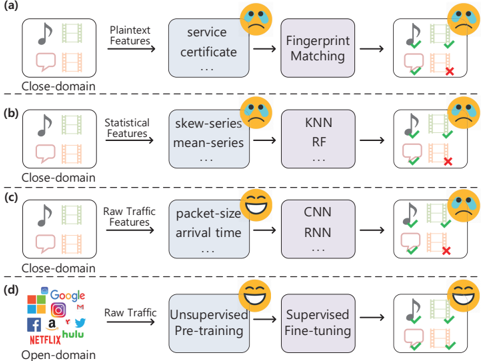
Encrypted traffic classification requires discriminative and robust traffic representation captured from content-invisible and imbalanced traffic data for accurate classification, which is challenging but indispensable to achieve network security and network management. The major limitation of existing solutions is that they highly rely on the deep features, which are overly dependent on data size and hard to generalize on unseen data. How to leverage the open-domain unlabeled traffic data to learn representation with strong generalization ability remains a key challenge. In this paper, we propose a new traffic representation model called Encrypted Traffic Bidirectional Encoder Representations from Transformer (ET-BERT), which pre-trains deep contextualized datagram-level representation from large-scale unlabeled data. The pre-trained model can be fine-tuned on a small number of task-specific labeled data and achieves state-of-the-art performance across five encrypted traffic classification tasks, remarkably pushing the F1 of ISCX-VPN-Service to 98.9% (5.2%↑), Cross-Platform (Android) to 92.5% (5.4%↑), CSTNET-TLS 1.3 to 97.4% (10.0%↑). Notably, we provide explanation of the empirically powerful pre-training model by analyzing the randomness of ciphers. It gives us insights in understanding the boundary of classification ability over encrypted traffic. The code is available at: https://github.com/linwhitehat/ET-BERT.
Overview
CoChat Summary
TL;DR
ET-BERT pre-trains a Transformer on large-scale unlabeled encrypted traffic using BURST-based datagram tokens and two self-supervised tasks, then fine-tunes for classification. It reports state-of-the-art F1 across five encrypted traffic tasks, including 98.9% on ISCX-VPN-Service and 97.4% on CSTNET-TLS 1.3.
Key findings
- ET-BERT achieves state-of-the-art performance across five encrypted traffic classification tasks; the abstract reports F1 of 98.9% on ISCX-VPN-Service (5.2%↑), 92.5% on Cross-Platform (Android) (5.4%↑), and 97.4% on CSTNET-TLS 1.3 (10.0%↑).
- In the comparison tables, ET-BERT(packet) reaches F1 of 0.9754 on Cross-Platform(iOS), 0.9206 on Cross-Platform(Android), 0.9890 on ISCX-VPN-Service, 0.9937 on ISCX-VPN-App, 0.9921 on ISCX-Tor, 0.9916 on USTC-TFC, and 0.9741 on CSTNET-TLS 1.3.
- Ablation on ISCX-VPN-App shows removing SBP lowers F1 by 3.97%, removing MBM lowers it by 9.33%, replacing BURST input with packets lowers it by 1.37%, and removing pre-training lowers it by 37.57%.
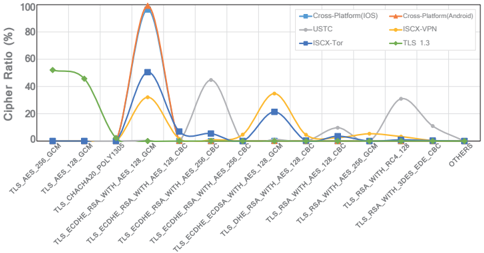
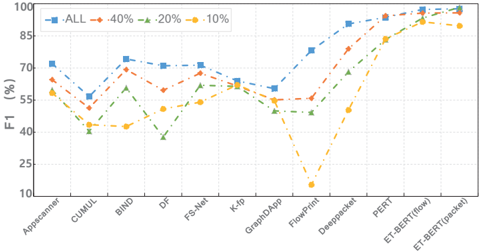
- Few-shot results on ISCX-VPN-Service show ET-BERT(packet) F1 of 95.78%, 98.33%, and 91.55% at 40%, 20%, and 10% data; Deeppacket’s performance decreases by 40.22% from full size to 10%. Randomness analysis finds ciphers fail perfect randomness, and ET-BERT reaches near-100% F1 on datasets with weaker randomness, averaging 99.14% in ETCV, 99.21% in EACT, and 99.30% in EMC.
Methods
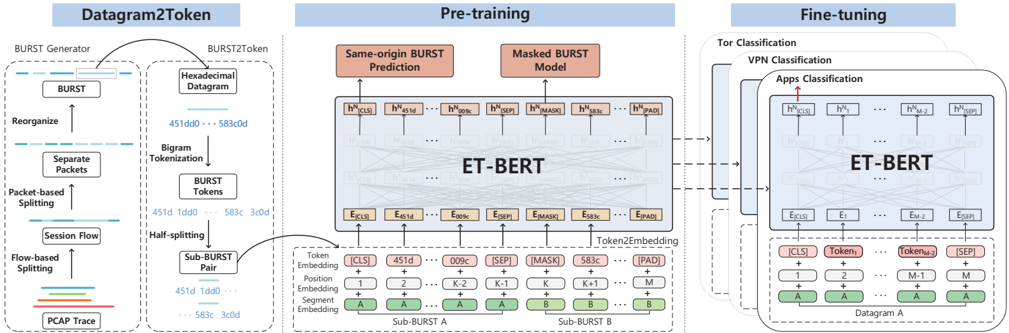
- Two-stage design: self-supervised pre-training on unlabeled traffic with a Transformer (12 blocks, 12 attention heads, token dimension 768, 512 input tokens), followed by fine-tuning on task-specific labeled data. Datagram2Token converts flows into BURSTs, then bi-gram/BPE tokens (vocabulary size 65,536), with token, position, and segment embeddings.
- Pre-training tasks: Masked BURST Model masks 15% of tokens (80% replaced with [MASK], 10% random token, 10% unchanged); Same-origin BURST Prediction uses a binary classifier to predict whether two sub-BURSTs are from the same BURST origin, with 50% actual next sub-BURST and 50% random sub-BURST. Pre-training uses about 30GB unlabeled traffic (about 15GB public datasets and 15GB passively collected CSTNET traffic).
- Downstream evaluation covers five tasks on six public datasets plus a new CSTNET-TLS 1.3 dataset; fine-tuning randomly selects at most 500 flows and 5,000 packets per class, with an 8:1:1 train/validation/test split. Metrics are Accuracy, Precision, Recall, and F1 with macro average; ET-BERT is compared with 11 methods and uses packet-level and flow-level fine-tuning strategies.
Limitations
- Stated: generalizability is challenged by variability of encrypted traffic over time; TLS 1.3 labeling via SNI will not be possible with ECH, and the authors mitigate this by active visiting and labeling with unique process identifiers.
- Stated: pre-training security depends on clean pre-training data; an attacker can add low-frequency subwords as “toxic” embeddings to create a poisoned pre-trained model with a backdoor, and how to construct such toxic tokens for encrypted traffic has not been studied.
- Evident from the text: the TLS 1.3 dataset labels rely on SNI, so evaluation may not transfer under ECH; datasets are fixed snapshots and no temporal drift evaluation is reported; pre-training mixes public and CSTNET traffic, so domain bias is possible.
Model-written summary. Check it against the paper before relying on it.
Integrity signals
Registry
Cites
Statistics
Figures
Verification
Claims the paper makes
3 Valid · 1 Not valid · 11 Not checked · 57 Own results and interpretations
The cited sources support only part of this claim — read each source’s verdict below.
In the paper
“Furthermore, due to the rapid development of encryption technology, traffic classification methods for a specific kind of encrypted traffic cannot adapt well to the new environment or unseen encryption strategies [29].”
What the sources say
- Partly supportedcites [29] [29] Shahbaz Rezaei and Xin Liu. 2019. Deep Learning for Encrypted Traffic Classification: An Overview. IEEE Commun. Mag. 57, 5 (2019), 76-81. - sourceExperimental — accuracy not yet measured
In “Stronger Encryption Protocols” (p. 7), the paper explains that TLS 1.3 and QUIC leave fewer handshake fields unencrypted, creating a challenge for methods developed for TLS 1.2. It says whether the remaining fields suffice for classification is unclear, not that such methods cannot adapt to new environments or unseen encryption strategies. (LLM, conf=0.85)
plainstates a cause- Asserted: passes — The authors put it forward as true.
- Checkable: passes — It can be checked against evidence.
- Load-bearing: passes — The paper’s conclusions depend on it.
- Based: passes — The paper gives a reason why it holds.
- Partly supported
The cited sources support only part of this claim — read each source’s verdict below.
In the paper
“However, these methods are not applicable to the newly emerging encrypted techniques ( e.g. TLS 1.3) since the plaintext becomes more sparse or obfuscated.”
What the sources say
- Partly supportedcites [37] [37] Thijs van Ede, Riccardo Bortolameotti, Andrea Continella, and et al. 2020. FlowPrint: Semi-Supervised Mobile-App Fingerprinting on Encrypted Network Traffic. In 27th Annual Network and Distributed System Security Symposium, NDSS 2020, San Diego, California, USA, February 23-26, 2020 . The Internet Society. - sourceExperimental — accuracy not yet measured
The ‘Detection of Previously Unseen Apps’ section says that two earlier detectors handle only unencrypted data and cannot be applied to encrypted traffic. The paper does not attribute that limitation specifically to TLS 1.3 or say that plaintext becomes sparser or obfuscated; the Feature Exploration section instead describes which features remain available in TLS-encrypted traffic. Page numbers are not available in our copy. (LLM, conf=0.84)
plainstates a cause- Asserted: passes — The authors put it forward as true.
- Checkable: passes — It can be checked against evidence.
- Load-bearing: passes — The paper’s conclusions depend on it.
- Based: passes — The paper gives a reason why it holds.
- Partly supported
A result the paper reports from its own data — it cites no other source for it, so there is none to check. The quote shows it is in the paper.
In the paper
“According to model '6', we perform supervised learning on labeled data by training the Transformer model directly and the F1 score decreases remarkably by 37.57% compared with ET-BERT.”
plainstates a cause- Asserted: passes — The authors put it forward as true.
- Checkable: passes — It can be checked against evidence.
- Load-bearing: passes — The paper’s conclusions depend on it.
- Based: passes — The paper gives a reason why it holds.
A result the paper reports from its own data — it cites no other source for it, so there is none to check. The quote shows it is in the paper.
In the paper
“ET-BERT achieves 5.69% and 1.72% improvement over the existing state-of-the-art model Deeppacket on ISCX-VPN-Service and ISCX-VPN-App.”
plainstates a cause- Asserted: passes — The authors put it forward as true.
- Checkable: passes — It can be checked against evidence.
- Load-bearing: passes — The paper’s conclusions depend on it.
- Based: passes — The paper gives a reason why it holds.
A result the paper reports from its own data — it cites no other source for it, so there is none to check. The quote shows it is in the paper.
In the paper
“outperforms existing works remarkably by 5.4%, 0.2%, 5.2%, 4.4%, 10.0%.”
boostedstates a cause- Asserted: passes — The authors put it forward as true.
- Checkable: passes — It can be checked against evidence.
- Load-bearing: passes — The paper’s conclusions depend on it.
- Based: passes — The paper gives a reason why it holds.
44 more claims
Create a free account to see all 72 claims and to verify the 2 references still open.
- It may state two separate claims as one. 18
- The quote only partly states this claim. 2
- Probably not a substantial claim. 6
Self-check
Percentages, sums and reported differences re-computed from the paper’s own numbers.
Each contradiction between two passages listed here was confirmed by an independent check.
Rated minor: it would not touch a result — a value no result rests on, a p-value that stays on the same side of the significance level, or a conflict that is clerical, resolved elsewhere in the paper, or outside its own findings.
In the paper
§ 4.5 Few-shot Analysis
“To validate the effectiveness and robustness of ET-BERT in fewshot settings, we design comparison experiments with different data proportions on ISCX-VPN-Service.”
§ 5 DISCUSSION
“Figure 4: Comparison Results on Few-shot ISCX-VPN-App.”
Rated minor: it would not touch a result — a value no result rests on, a p-value that stays on the same side of the significance level, or a conflict that is clerical, resolved elsewhere in the paper, or outside its own findings.
In the paper
§ 4.1 Experiment Setup
“we conduct experiments across five encrypted traffic classification tasks on six public datasets and one newly proposed dataset.”
§ 6 CONCLUSION
“We comprehensively evaluate the generalization and robustness of ET-BERT on 5 publicly available datasets and the TLS 1.3 dataset collected from CSTNET.”
Citations
Cites
Vaswani, A., Shazeer, N., Parmar, N., Uszkoreit, J., Jones, L., Gomez, A. N., Kaiser, L., & Polosukhin, I. (2017) · arXiv · doi:10.48550/arxiv.1706.03762 · Cited by 120,404
Exploiting Generative AI to Scale up Intelligent Tutoring Systems
Jakubův, J., Chvalovský, K., Goertzel, Z., Kaliszyk, C., Olšák, M., Piotrowski, B., Schulz, S., Suda, M., & Urban, J. (2023) · DROPS (Schloss Dagstuhl – Leibniz Center for Informatics) · doi:10.4230/lipics.itp.2023.19 · Cited by 76,658
BERT: Pre-training of Deep Bidirectional Transformers for Language Understanding
Devlin, J., Chang, M.-W., Lee, K., & Toutanova, K. (2018) · arXiv · doi:10.48550/arxiv.1810.04805 · Cited by 73,173
BERT: Pre-training of Deep Bidirectional Transformers for Language Understanding
Devlin, J., Chang, M.-W., Lee, K., & Toutanova, K. (2019) · Proceedings of the 2019 Conference of the North American Chapter of the Association for Computational Linguistics: Human Language Technologies, Volume 1 (Long and Short Papers) · doi:10.18653/v1/n19-1423 · Cited by 54,325
An Image is Worth 16x16 Words: Transformers for Image Recognition at Scale
Dosovitskiy, A., Beyer, L., Kolesnikov, A., Weissenborn, D., Zhai, X., Unterthiner, T., Dehghani, M., Minderer, M., Heigold, G., Gelly, S., et al. (2020) · arXiv · doi:10.48550/arxiv.2010.11929 · Cited by 47,472
RoBERTa: A Robustly Optimized BERT Pretraining Approach
Liu, Y., Ott, M., Goyal, N., Du, J., Joshi, M., Chen, D., Levy, O., Lewis, M., Zettlemoyer, L., & Stoyanov, V. (2019) · arXiv · doi:10.48550/arxiv.1907.11692 · Cited by 16,515
Elements of Information Theory
Cover, T. M., & Thomas, J. A. (2005) · doi:10.1002/047174882x · Cited by 13,791
BioBERT: a pre-trained biomedical language representation model for biomedical text mining
Lee, J., Yoon, W., Kim, S., Kim, D., Kim, S., So, C. H., & Kang, J. (2020) · Bioinformatics · doi:10.1093/bioinformatics/btz682 · Cited by 7,218
Google's Neural Machine Translation System: Bridging the Gap between Human and Machine Translation
Wu, Y., Schuster, M., Chen, Z., Le, Q. V., Norouzi, M., Macherey, W., Krikun, M., Cao, Y., Gao, Q., Macherey, K., et al. (2016) · arXiv · doi:10.48550/arxiv.1609.08144 · Cited by 5,319
Toward Generating a New Intrusion Detection Dataset and Intrusion Traffic Characterization
Sharafaldin, I., Habibi Lashkari, A., & Ghorbani, A. A. (2018) · Proceedings of the 4th International Conference on Information Systems Security and Privacy · doi:10.5220/0006639801080116 · Cited by 5,318 · cited 1×
“This dataset contains two parts: (1) about 15GB traffic from the public datasets [9, 30]; (2) about 15GB traffic from our passively collected traffic under the China Science and Technology Network (CSTNET).”
Method
Cited by
Items 101–200 of 562
Bi-ETC: A Bidirectional Encrypted Traffic Classification Model Based on BERT and BiLSTM
Ma, X., Liu, T., Hu, N., & Liu, X. (2023) · IEEE International Conference on Data Science in Cyberspace · doi:10.1109/dsc59305.2023.00037 · Cited by 11
Wedjat: Detecting Sophisticated Evasion Attacks via Real-time Causal Analysis
Gao, L., Fu, C., Deng, X., Xu, K., & Li, Q. L. (2025) · ACM SIGKDD Conference on Knowledge Discovery and Data Mining (KDD) · doi:10.1145/3690624.3709218 · Cited by 14
Li, S., Huang, Y., Gao, T., Yang, L., Chen, Y., Pan, Q., Zang, T., & Chen, F. (2023) · Wireless Communications and Mobile Computing · doi:10.1155/2023/9118153 · Cited by 15
Identifying VPN Servers through Graph-Represented Behaviors
Wang, C., Yin, J., Li, Z. C., Xu, H., Zhang, Z., & Liu, Q. (2024) · International World Wide Web Conference (WWW) · doi:10.1145/3589334.3645552 · Cited by 11
Self-citationEncrypted traffic classification encoder based on lightweight graph representation
Chen, Z., Wei, X., & Wang, Y. (2025) · Scientific Reports · doi:10.1038/s41598-025-05225-4 · Cited by 21
Beyond known threats: A novel strategy for isolating and detecting unknown malicious traffic
Meng, Q., Yuan, Q., Wang, X., Wang, Y., Li, G., Zhu, Y., & Lu, S. (2024) · Journal of Information Security and Applications · doi:10.1016/j.jisa.2024.103920 · Cited by 11
He, L., Wang, L., Cheng, K., & Xu, Y. (2023) · IET Information Security · doi:10.1049/ise2.12118 · Cited by 10
ET-Mamba: A Mamba Model for Encrypted Traffic Classification
Xu, J. F., Chen, L., Xu, W., Dai, L., Wang, C., & Hu, L. (2025) · Information · doi:10.3390/info16040314 · Cited by 14
FF-MR: A DoH-Encrypted DNS Covert Channel Detection Method Based on Feature Fusion
Wang, Y., Shen, C., Hou, D., Xiong, X., & Li, Y. (2022) · Applied Sciences · doi:10.3390/app122412644 · Cited by 9
FlowBERT: An Encrypted Traffic Classification Model Based on Transformers Using Flow Sequence
Pan, Q., Yu, Y., Yan, H., Wang, M., & Qi, B. (2023) · IEEE International Conference on Trust, Security and Privacy in Computing and Communications (TrustCom) · doi:10.1109/trustcom60117.2023.00039 · Cited by 11
Multi-Level Pre-Training for Encrypted Network Traffic Classification
Park, J.-T., Choi, Y., Cho, B., Kim, S., & Kim, M. (2025) · IEEE Access · doi:10.1109/access.2025.3559068 · Cited by 19
Verify All Traffic: Towards Zero-Trust In-Network Intrusion Detection Against Multipath Routing
Zhao, Z., Li, Z., Xie, X., Liu, Z., Li, T., Yu, J., Zhang, F., & Chen, B. (2025) · IEEE Journal on Selected Areas in Communications · doi:10.1109/jsac.2025.3560045 · Cited by 9
Self-citationBianchi, L. A. C., Pregardier, R. C., Silva, L. A. L., & dos Santos, C. R. P. (2025) · IEEE/IFIP Network Operations and Management Symposium (NOMS) · doi:10.1109/noms57970.2025.11073639 · Cited by 6
FA-Net: More Accurate Encrypted Network Traffic Classification Based on Burst with Self-Attention
Jiang, M., Cui, M., Hou, C., Cai, W., Li, Z., Xiong, G., & Gou, G. (2023) · International Joint Conference on Neural Networks (IJCNN) · doi:10.1109/ijcnn54540.2023.10191615 · Cited by 9
Self-citationUnlocking Few-Shot Encrypted Traffic Classification: A Contrastive-Driven Meta-Learning Approach
Li, Z., Wang, J., Song, Y., & Yue, S. (2025) · Electronics · doi:10.3390/electronics14214245 · Cited by 10
Self-citationExpMD: an Explainable Framework for Traffic Identification Based on Multi-Domain Features
Yang, L., Wang, Y., Liu, L., Huang, J., & Fu, S. (2024) · International Workshop on Quality of Service · doi:10.1109/iwqos61813.2024.10682894 · Cited by 6
Few-Shot Encrypted Traffic Classification: A Survey
Yang, C., Gu, Z., Bai, J., Li, Z., Xiong, G., Gou, G., Yao, S., & Chen, X. (2024) · Asia-Pacific Conference on Image Processing, Electronics and Computers (IPEC) · doi:10.1109/ipec61310.2024.00115 · Cited by 8
Self-citationMiao, G., Wu, G., Zhang, Z., Tong, Y., & Lu, B. (2024) · IEEE Transactions on Big Data · doi:10.1109/tbdata.2024.3484674 · Cited by 6
A Model of Encrypted Network Traffic Classification that Trades Off Accuracy and Efficiency
Yu, L., Yuan, J., Zheng, J., & Yang, N. (2024) · Journal of Network and Systems Management · doi:10.1007/s10922-024-09892-y · Cited by 7
Wang, X., Lu, Z., Wang, X., He, M., & Wang, X. (2024) · IEEE Transactions on Cognitive Communications and Networking · doi:10.1109/tccn.2024.3400825 · Cited by 6
Ptu: Pre-Trained Model for Network Traffic Understanding
Peng, L., Xie, X., Huang, S., Wang, Z., & Cui, Y. (2024) · IEEE International Conference on Network Protocols (ICNP) · doi:10.1109/icnp61940.2024.10858503 · Cited by 23
Malicious encrypted traffic detection based on Bert and one-dimensional CNN model
Kang, P. (2023) · IEEE International Conference on Electronic Technology, Communication and Information (ICETCI) · doi:10.1109/icetci57876.2023.10176917 · Cited by 7
A Critical Study of Few-Shot Learning for Encrypted Traffic Classification
Akbari, E., Tahmid, S. A., Malekghaini, N., Salahuddin, M. A., Limam, N., Boutaba, R., Mathieu, B., Moteau, S., & Tuffin, S. (2023) · International Conference on Network and Service Management (CNSM) · doi:10.23919/cnsm59352.2023.10327851 · Cited by 5
DLET-Classifier: A Dynamic and Lightweight Method for Encrypted Traffic Classification
Wu, J., Niu, W., Wei, F., Li, S., Huang, S., Gong, J., & Zhang, X. (2025) · IEEE Internet of Things Journal · doi:10.1109/jiot.2025.3593143 · Cited by 9
NetBench: A Large-Scale and Comprehensive Network Traffic Benchmark Dataset for Foundation Models
Qian, C., Li, X., Wang, Q., Zhou, G., & Shao, H. (2024) · 2024 IEEE International Workshop on Foundation Models for Cyber-Physical Systems & Internet of Things (FMSys) · doi:10.1109/fmsys62467.2024.00008 · Cited by 19
Towards a Graph-based Foundation Model for Network Traffic Analysis
Langendonck, L. V., Castell-Uroz, I., & Barlet‐Ros, P. (2024) · GNNet@CoNEXT · doi:10.1145/3694811.3697817 · Cited by 14
NetRen: Service Migration-Driven Network Renascence with Synthesizing Updated Configuration
Han, R., Wang, J., Qi, Q., Sun, H., Xu, C., Wan, Z., Zhuang, Z., Yu, Y., & Liao, J. (2024) · International Conference on Architectural Support for Programming Languages and Operating Systems (ASPLOS) · doi:10.1145/3620666.3651365 · Cited by 7
MateGraph: Toward Mobile Malware Detection Through Traffic Behavior Graph
Ge, R., Zhang, Y., Si, C., Zhou, G., & Zhou, W. (2022) · IEEE International Conference on High Performance Computing and Communications; IEEE International Conference on Smart City; IEEE International Conference on Data Science and Systems (HPCC/SmartCity/DSS) · doi:10.1109/hpcc-dss-smartcity-dependsys57074.2022.00132 · Cited by 7
Tabular-based self-supervised learning approach for encrypted traffic classification
Zheng, X., Ma, X., Jin, Y., Gu, D., & Wang, R. (2023) · Journal of Electronic Imaging · doi:10.1117/1.jei.32.4.043032 · Cited by 8
Lei, S., Zhang, X., & Yi, J. (2023) · Journal of Physics Conference Series · doi:10.1088/1742-6596/2504/1/012061 · Cited by 4
NEP-IDS: a Network Intrusion Detection System Based on Entropy Prediction Error
Augello, A., Re, G. L., Peri, D., & Thiyagalingam, P. (2024) · Conference on Local Computer Networks · doi:10.1109/lcn60385.2024.10639755 · Cited by 5
EM-BERT: A Language Model Based Method to Detect Encrypted Malicious Network Traffic
Liang, Y., Li, P., Lai, Q., & Wen, J. (2024) · Lecture notes in electrical engineering · doi:10.1007/978-981-97-0855-0_56 · Cited by 4
M-ETC: Improving Multi-Task Encrypted Traffic Classification by Reducing Inter-Task Interference
Xu, Y., Fang, X., Xu, Z., Song, K., Yuan, Y., & Cheng, G. (2024) · IEEE International Conference on Trust, Security and Privacy in Computing and Communications (TrustCom) · doi:10.1109/trustcom63139.2024.00060 · Cited by 4
Dillbary, N., Yozevitch, R., Dvir, A. Z., Dubin, R., & Hajaj, C. (2024) · IEEE Consumer Communications and Networking Conference · doi:10.1109/ccnc51664.2024.10454807 · Cited by 8
Masukawa, R., Yun, S., Jeong, S., Bastian, N. D., & Imani, M. (2025) · IEEE Access · doi:10.1109/access.2025.3592877 · Cited by 8
Lin, C., Jiang, Y., Zhang, W., Meng, X., Zuo, T., & Zhang, Y. (2025) · International Workshop on Quality of Service · doi:10.1109/iwqos65803.2025.11143462 · Cited by 8
MTDecipher: robust encrypted malicious traffic detection via multi-task graph neural networks
Li, F., Luo, X., Han, W., Fang, B., & Yin, L. (2026) · Cybersecurity · doi:10.1186/s42400-025-00522-x · Cited by 6
Network Traffic Classification Using Self-Supervised Learning and Confident Learning
Eslami, E., & Hamouda, W. (2025) · IEEE Open Journal of the Communications Society · doi:10.1109/ojcoms.2025.3625534 · Cited by 11
Luxemburk, J., Hynek, K., Plný, R., & Čejka, T. (2025) · IEEE Transactions on Network and Service Management · doi:10.1109/tnsm.2025.3642984 · Cited by 14
Pixel Power: Harnessing Image Processing for Optimizing Few-Shot Malicious Traffic Detection
Wang, Y., & Yan, R. (2024) · Asia Conference on Computer Vision, Image Processing and Pattern Recognition (CVIPPR) · doi:10.1145/3663976.3664005 · Cited by 5
Combo Packet: An Encryption Traffic Classification Method Based on Contextual Information
Chai, Y., Zhu, Y., Wei, L., & Ding, L. (2024) · Computers, materials & continua/Computers, materials & continua (Print) · doi:10.32604/cmc.2024.049904 · Cited by 6
TrafficCLIP: A lightweight cross-modal framework for network traffic classification
Chen, R., Luo, L., Guo, D., Wang, X., Li, S., & Qiu, C. (2025) · Computer Networks · doi:10.1016/j.comnet.2025.111662 · Cited by 5
Changrampadi, M. H., Almgren, M., Picazo‐Sanchez, P., & Ali-Eldin, A. (2025) · European Workshop on System Security · doi:10.1145/3722041.3723098 · Cited by 4
A New Imbalanced Encrypted Traffic Classification Model Based on CBAM and Re-Weighted Loss Function
Qin, J., Liu, G., & Duan, K. (2022) · Applied Sciences · doi:10.3390/app12199631 · Cited by 4
BCBA: An IIoT encrypted traffic classifier based on a serial network model
Wang, M., Chen, C., Zhang, X., & Qiu, H. (2024) · Future Generation Computer Systems · doi:10.1016/j.future.2024.107603 · Cited by 4
TRACE: A Robust Framework for Malicious Traffic Detection with Noisy Labels
Cai, Y., Peng, C., Li, S., Liu, Y., Zhang, H., & Fang, B. (2025) · IEEE International Conference on Acoustics Speech and Signal Processing · doi:10.1109/icassp49660.2025.10889853 · Cited by 5
Web-FTP: A Feature Transferring-Based Pre-Trained Model for Web Attack Detection
Guo, Z., Shang, Q., Li, X., Li, C., Zhang, Z., Zhang, Z., Hu, J., An, J., Huang, C., Chen, Y., et al. (2025) · IEEE Transactions on Knowledge and Data Engineering · doi:10.1109/tkde.2024.3512793 · Cited by 6
Luo, Z., Li, Y., Tan, S., & He, D. (2024) · International Joint Conference on Neural Networks (IJCNN) · doi:10.1109/ijcnn60899.2024.10651222 · Cited by 5
The art of time-bending: Data augmentation and early prediction for efficient traffic classification
Hajaj, C., Aharon, P., Dubin, R., & Dvir, A. Z. (2024) · Expert Systems with Applications · doi:10.1016/j.eswa.2024.124166 · Cited by 7
Lin, W., Xia, C., Wang, T., Liu, M., & Li, Y. (2025) · Computers & Security · doi:10.1016/j.cose.2025.104529 · Cited by 5
Inferring mobile applications usage from DNS traffic
Campo, C., García-Rubio, C., Jimenez-Berenguel, A., Moure-Garrido, M., Almenárez, F., & Díaz-Sánchez, D. (2024) · Ad Hoc Networks · doi:10.1016/j.adhoc.2024.103601 · Cited by 7
Cao, J., Xu, Y., & Xiang, Q. (2023) · International Conference on Communications · doi:10.1109/icc45041.2023.10279015 · Cited by 6
E-DDoS: An Evaluation System for DDoS Attack Detection
Chi, K., Xie, X., Hu, Y., Zhao, D., Xie, Y., Zhang, L., & Cui, Y. (2024) · IEEE International Conference on Network Protocols (ICNP) · doi:10.1109/icnp61940.2024.10858578 · Cited by 4
Multi-Scale Contrastive Attention Representation Learning for Encrypted Traffic Classification
Yang, S., Zheng, X., Li, J., Xu, J., & Ngai, E. C. ‐. (2024) · ACM International Conference on Information and Knowledge Management (CIKM) · doi:10.1145/3627673.3679968 · Cited by 5
Li, T., Yang, Z., Li, W., Du, L., Lan, X., & He, J. (2025) · Knowledge-Based Systems · doi:10.1016/j.knosys.2025.113320 · Cited by 4
A Large-Scale P2P Botnet Detection Framework via Topology and Traffic Co-Verification
Zhao, Z., Li, Z., Li, T., & Zhang, F. (2024) · IEEE International Conference on Sensing, Communication, and Networking (SECON) · doi:10.1109/secon64284.2024.10934888 · Cited by 3
Self-citationMFF: A Multimodal Feature Fusion Approach for Encrypted Traffic Classification
Huang, H., Zhou, Y., Jiang, F., Zhou, X., & Jiang, Q. (2025) · Electronics · doi:10.3390/electronics14132584 · Cited by 5
Shi, Y., Li, G., Wu, J., Li, J., & Fang, H. (2025) · IEEE Transactions on Information Forensics and Security · doi:10.1109/tifs.2025.3643127 · Cited by 12
RTQS: Real-time flow fairness queue scheduling policy on router devices
Zhang, H., Xu, Z., Han, F., Li, F., & Li, Q. (2025) · Computer Networks · doi:10.1016/j.comnet.2025.111443 · Cited by 5
Network traffic classification based‐ masked language regression model using CNN
Steffi, P. L., Emmanuel, W. R. S., & Rani, P. A. J. (2024) · Concurrency and Computation Practice and Experience · doi:10.1002/cpe.8223 · Cited by 4
A Survey of QUIC-Based Network Traffic Identification
Gui, X., Cao, Y., Huang, L., Luo, Y., & Xiao, J. (2023) · Lecture notes of the Institute for Computer Sciences, Social Informatics and Telecommunications Engineering · doi:10.1007/978-3-031-32443-7_26 · Cited by 3
Zheng, X., Ma, X., Xu, L., Jin, Y., & Ke, C. (2025) · IEEE Transactions on Network and Service Management · doi:10.1109/tnsm.2025.3554824 · Cited by 3
Mamba4Net: Distilled Hybrid Mamba Large Language Models For Networking
Xia, L.-H., Yang, M.-Z., Wang, J., Yan, Z.-W., Ren, Y.-K., Yu, G., & Lei, K. (2025) · IEEE International Conference on Network Protocols · doi:10.1109/icnp65844.2025.11192368 · Cited by 6
Xi, T., Zheng, Q., Chuanhui, C., Wu, T., Xie, G., Qian, X., Ye, H., & Sun, Z. (2025) · Future Internet · doi:10.3390/fi17030114 · Cited by 5
Xu, Y., Xu, Z., Cao, J., Wang, R., Yuan, Y., & Cheng, G. (2024) · Lecture notes in computer science · doi:10.1007/978-981-97-8801-9_1 · Cited by 5
Zhao, Y., Xia, C., Wang, T., Liu, M., & Yang, L. (2024) · IEEE International Conference on Trust, Security and Privacy in Computing and Communications (TrustCom) · doi:10.1109/trustcom63139.2024.00074 · Cited by 3
Li, Z., & Jin, Y. (2025) · Computer Networks · doi:10.1016/j.comnet.2025.111499 · Cited by 4
Self-citationCMAE-MTC: A Contextual Masked AutoEncoder Based Multi-Level Traffic Classifier
Yuan, Z., Luo, M., Peng, C., & Liu, Q. (2024) · IEEE International Symposium on Parallel and Distributed Processing with Applications (ISPA) · doi:10.1109/ispa63168.2024.00147 · Cited by 2
Proteus: A Difficulty-Aware Deep Learning Framework for Real-Time Malicious Traffic Detection
Cui, C., Li, Q., Xie, G., Li, R., Zhao, D., Yuan, Z., & Jiang, Y. (2024) · IEEE International Conference on Network Protocols (ICNP) · doi:10.1109/icnp61940.2024.10858520 · Cited by 3
An encrypted traffic classification method based on autoencoders and convolutional neural networks
Xu, S., Han, J., Wang, J., & Bai, Y. (2025) · PLoS ONE · doi:10.1371/journal.pone.0333276 · Cited by 6
Enhancing VPN Traffic Recognition Through CatBoost Feature Extraction and Stacking Ensemble Learning
Huang, K., Zhou, M. Q., Zhang, P., Qin, X., & Hu, X. (2024) · International Conference on Communications · doi:10.1109/icc51166.2024.10622256 · Cited by 4
A New Transfer Learning-Based Traffic Classification Algorithm for a Multi-Domain SDN Network
Hoang, N.-T., Duong, C.-S., Vu, M.-N., Nguyen, H.-H., Tran, T. X., Tong, V., & Tran, H. A. (2023) · International Symposium on Information and Communication Technology · doi:10.1145/3628797.3628804 · Cited by 2
CoMDet: A Contrastive Multimodal Pre-Training Approach to Encrypted Malicious Traffic Detection
Sun, J., Zhang, X., Wang, Y., & Jin, S. (2024) · IEEE Annual International Computer Software and Applications Conference (COMPSAC) · doi:10.1109/compsac61105.2024.00151 · Cited by 7
Zhang, S. C., Zeng, D., Liu, Y., & Zhang, S. (2025) · International Conference on Algorithms, Software Engineering and Network Security (ASENS) · doi:10.1109/asens64990.2025.11011188 · Cited by 3
Duong, S., Tran, H. A., & Tran, T. X. (2024) · Conference on Local Computer Networks · doi:10.1109/lcn60385.2024.10639717 · Cited by 2
Real-Time and Trustworthy Classification of IoT Traffic Using Lightweight Deep Learning
Sivanathan, A., Mishra, D., Ruj, S., Fernandes, N., Sheng, Q. Z., Tran, M., Luo, B., Coscia, D., Batista, G., & Gharakheili, H. H. (2025) · IEEE Transactions on Network Science and Engineering · doi:10.1109/tnse.2025.3628913 · Cited by 8
Characterizing Mobile Applications Through Analysis of DNS Traffic
Jimenez-Berenguel, A., Moure-Garrido, M., García-Rubio, C., & Campo, C. (2023) · ACM International Workshop on Performance Evaluation of Wireless Ad Hoc, Sensor, and Ubiquitous Networks · doi:10.1145/3616394.3618268 · Cited by 5
A Comprehensive Literature Review of Cybersecurity in Satellite Networks
Wang, B., Xiao, J., Dong, R., Piao, C., Guan, Y., Zhao, B., Yang, Y. J., Zhao, Z., Siqi, L. I., & Lyu, X. (2026) · Aerospace · doi:10.3390/aerospace13030249 · Cited by 5
TrafficSiam: More Realistic Few-shot Website Fingerprinting Attack with Contrastive Learning
Wang, S., Wang, Z., Li, C., Han, D., Yang, J., & Zhang, H. (2024) · IEEE/IFIP Network Operations and Management Symposium (NOMS) · doi:10.1109/noms59830.2024.10575874 · Cited by 4
Exploring the application of Time Series Foundation Models to network monitoring tasks
Wehner, N., Casas, P., Dietz, K., Geißler, S., Hoßfeld, T., & Seufert, M. (2025) · Computer Networks · doi:10.1016/j.comnet.2025.111395 · Cited by 7
Enisoglu, R., & Inan, B. A. (2026) · Computer Networks · doi:10.1016/j.comnet.2026.112578 · Cited by 4
Fu, H., Sun, D., Wei, J., Wan, W., & Long, C. (2025) · IEEE Transactions on Information Forensics and Security · doi:10.1109/tifs.2025.3613971 · Cited by 3
A fine-grained message clustering method based on message representation and identifier fingerprints
Li, D., Chen, X., Zhu, M., Yuan, Q., & Gu, C. (2025) · Computers & Security · doi:10.1016/j.cose.2025.104631 · Cited by 2
Zeng, F., Man, D., Zhao, Y., Liu, Y., Wang, H., & Yang, W. (2025) · Computer Networks · doi:10.1016/j.comnet.2025.111636 · Cited by 2
Network Flow-Based Dynamic Detection System for Android Adware Using Pre-Trained Models
Ye, W., Yin, W., & Tang, J. (2023) · International Conference on Artificial Intelligence, Human-Computer Interaction and Robotics (AIHCIR) · doi:10.1109/aihcir61661.2023.00072 · Cited by 2
Willinger, W., Ferreira, R. A., Gupta, A., Beltiukov, R., Guthula, S., Granville, L., & Jacobs, A. (2025) · Computer communication review · doi:10.1145/3727063.3727067 · Cited by 7
NadGPT: Semi-Supervised Network Anomaly Detection via Auto-Regressive Auxiliary Prediction
Hou, Y., Xu, Z., Wang, L., Wang, Y., & Li, H. (2023) · Conference proceedings/Conference proceedings - IEEE International Conference on Systems, Man, and Cybernetics · doi:10.1109/smc53992.2023.10394639 · Cited by 2
NetTrans: Robust Encrypted Network Traffic Analysis with Multi-modal Pre-training
Li, W., Li, G., Kong, W., Wang, S., & Jin, H. (2025) · Communications in computer and information science · doi:10.1007/978-981-96-4506-0_27 · Cited by 3
SD-Transformer: A System-Level Denoising Transformer for Encrypted Traffic Behavior Identification
Zhao, Y., Zhu, Y., Li, X., Chen, R., Obaidat, M. S., & Vijayakumar, P. (2023) · Globecom · doi:10.1109/globecom54140.2023.10436868 · Cited by 3
Attieh, J., & Tekli, J. (2023) · IEEE International Conference on Trust, Security and Privacy in Computing and Communications (TrustCom) · doi:10.1109/trustcom60117.2023.00330 · Cited by 3
A Personalized Federated Multi-task Learning Scheme for Encrypted Traffic Classification
Guan, X., Du, R., Wang, X., & Qu, H. (2023) · Lecture notes in computer science · doi:10.1007/978-3-031-44213-1_22 · Cited by 3
FLoV2T: A fine-grained malicious traffic classification method based on federated learning for AIoT
Zeng, F., Xu, C., Man, D., Jiang, J., & Wu, Y. (2025) · Computer Communications · doi:10.1016/j.comcom.2025.108288 · Cited by 4
Dual-view Traffic Identification for Open Source Proxy Software through Early Flows
Xu, Y., Bai, Y., Zhang, Y., Song, Y., Xiang, Q., & Cheng, G. (2024) · IEEE International Symposium on Parallel and Distributed Processing with Applications (ISPA) · doi:10.1109/ispa63168.2024.00076 · Cited by 2
A Survey of Large Language Models for Cyber Threat DetectionPreprint
chen, Y., Cui, M., Wang, D., et al. (2024) · SSRN Electronic Journal · doi:10.2139/ssrn.4799845 · Cited by 2
FlowXpert: Context-Aware Flow Embedding for Enhanced Traffic Detection in IoT Network
Zha, C., Pan, H., Bai, B., Wu, J., & Zhang, R. (2026) · IEEE Transactions on Mobile Computing · doi:10.1109/tmc.2026.3651574 · Cited by 2
A Novel Method with Transformers for Fine-grained Encrypted Traffic Classification
Kong, H., Li, T., Ge, J., Li, H., Yang, L., Zhuang, L., Xu, Z., & Xie, C. (2023) · IEEE International Conference on High Performance Computing and Communications; IEEE International Conference on Smart City; IEEE International Conference on Data Science and Systems (HPCC/SmartCity/DSS) · doi:10.1109/hpcc-dss-smartcity-dependsys60770.2023.00020 · Cited by 4
GSPB: a global-statistic and packet-byte fusion framework for encrypted traffic classification
Li, H., Tao, J., Yu, L., Luo, Y., & Wang, Z. (2025) · Cybersecurity · doi:10.1186/s42400-025-00446-6 · Cited by 4
End-to-End Open-Set Semi-Supervised Learning for Fine-Grained Encrypted Traffic Classification
Yang, Q., He, W., Chen, M., Du, H., Shao, S., Wu, F., Liu, S., Ji, Y., & Ren, K. (2026) · IEEE Transactions on Information Forensics and Security · doi:10.1109/tifs.2026.3653575 · Cited by 5
Metadata
- Authors
- Lin, X., Xiong, G., Gou, G., Li, Z., Shi, J., & Yu, J.
- Affiliations
- Chinese Academy of Sciences (CN)
- Venue
- Proceedings of the ACM Web Conference 2022
- Publisher
- ACM
- Published
- 2022-04-25
- Pages
- 633-642
- OpenAlex
- W4224315052
- Cited by
- 599
- References
- 46
- Citations by year
- 2026: 217 · 2025: 199 · 2024: 123 · 2023: 52 · 2022: 8
- FWCI
- 52.77
- Type
- conference paper
- Language
- en
- Open access
- hybrid
- doi.org
- Licence
- Locations
- International World Wide Web Conference (WWW) (publishedVersion, cc-by)
- arXiv (Cornell University) (submittedVersion)
- arXiv (Cornell University)
- Funders
- the Strategic Priority Research Program of Chinese Academy of Sciences (No. XDC02040400)
- The National Key Research and Development Program of China (No. 2021YFB3101400)
- Topics
- Physical Sciences › Computer Science › Artificial Intelligence › Internet Traffic Analysis and Secure E-voting
- Physical Sciences › Computer Science › Computer Networks and Communications › Network Security and Intrusion Detection
- Physical Sciences › Computer Science › Computer Networks and Communications › Software-Defined Networks and 5G
- Keywords
- encrypted traffic classification, BERT, context representation, network security, network management, fine-tuning
About these checks
Registry, retraction, Cites and statistics results are computed, not judged, with one exception: a printed reference that no index lists is read once by a model before it counts as a citation error. Claims are extracted by a model and kept only when their quote appears verbatim in the text; each cited source is then checked, with a model’s help, for whether it says what the claim relies on. Those verdicts can be wrong — read the claim’s quote and the cited source before relying on one.
The claim verdicts this report counts are experimental: their accuracy is not yet measured.
A language model drew the claims from the paper on 2026-10-10, under version 3 of the claim definition (model deepseek-v4.1-flash, prompt extract-v3).
A second model labelled each claim on 2026-10-10 (model jev-1.13-20260917, definition revision gold-guideline-v0.2).
Cited sources are checked with a language model’s help (gpt-6-sol).
Statistics and arithmetic are recomputed, not judged.
Confidence bands are shown only for fields calibrated on our annotated test set. None is calibrated yet, so no band is shown.
What counts as a claim ›How we measure confidence ›How we check this ›
Are you an author, or do you see a problem with this page? Request a review
Data sources
Bibliographic data: Semantic Scholar, OpenAlex, Crossref.
Contains information from the Semantic Scholar Academic Graph Datasets, made available under the ODC Attribution License (ODC-BY 1.0).
Semantic Scholar’s data is described in: Kinney, R., et al. (2023). The Semantic Scholar Open Data Platform. arXiv:2301.10140.
