

ET-BERT: A Contextualized Datagram Representation with Pre-training Transformers for Encrypted Traffic Classification
Open accessThe DOI matches its Crossref record; 48 of the 48 references it cites were found in a registry or an index; 5 of the 17 sources its claims cite were checked for support.
Abstract
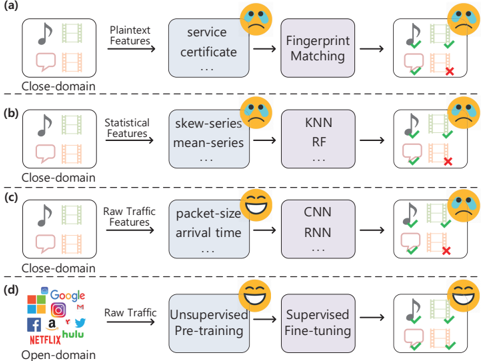
Encrypted traffic classification requires discriminative and robust traffic representation captured from content-invisible and imbalanced traffic data for accurate classification, which is challenging but indispensable to achieve network security and network management. The major limitation of existing solutions is that they highly rely on the deep features, which are overly dependent on data size and hard to generalize on unseen data. How to leverage the open-domain unlabeled traffic data to learn representation with strong generalization ability remains a key challenge. In this paper, we propose a new traffic representation model called Encrypted Traffic Bidirectional Encoder Representations from Transformer (ET-BERT), which pre-trains deep contextualized datagram-level representation from large-scale unlabeled data. The pre-trained model can be fine-tuned on a small number of task-specific labeled data and achieves state-of-the-art performance across five encrypted traffic classification tasks, remarkably pushing the F1 of ISCX-VPN-Service to 98.9% (5.2%↑), Cross-Platform (Android) to 92.5% (5.4%↑), CSTNET-TLS 1.3 to 97.4% (10.0%↑). Notably, we provide explanation of the empirically powerful pre-training model by analyzing the randomness of ciphers. It gives us insights in understanding the boundary of classification ability over encrypted traffic. The code is available at: https://github.com/linwhitehat/ET-BERT.
Overview
CoChat Summary
TL;DR
ET-BERT pre-trains a Transformer on large-scale unlabeled encrypted traffic using BURST-based datagram tokens and two self-supervised tasks, then fine-tunes for classification. It reports state-of-the-art F1 across five encrypted traffic tasks, including 98.9% on ISCX-VPN-Service and 97.4% on CSTNET-TLS 1.3.
Key findings
- ET-BERT achieves state-of-the-art performance across five encrypted traffic classification tasks; the abstract reports F1 of 98.9% on ISCX-VPN-Service (5.2%↑), 92.5% on Cross-Platform (Android) (5.4%↑), and 97.4% on CSTNET-TLS 1.3 (10.0%↑).
- In the comparison tables, ET-BERT(packet) reaches F1 of 0.9754 on Cross-Platform(iOS), 0.9206 on Cross-Platform(Android), 0.9890 on ISCX-VPN-Service, 0.9937 on ISCX-VPN-App, 0.9921 on ISCX-Tor, 0.9916 on USTC-TFC, and 0.9741 on CSTNET-TLS 1.3.
- Ablation on ISCX-VPN-App shows removing SBP lowers F1 by 3.97%, removing MBM lowers it by 9.33%, replacing BURST input with packets lowers it by 1.37%, and removing pre-training lowers it by 37.57%.
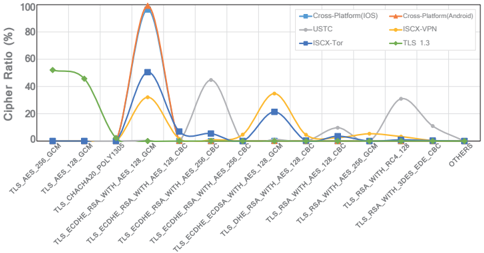
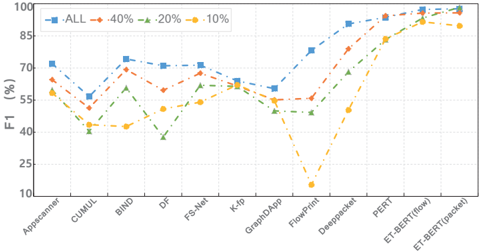
- Few-shot results on ISCX-VPN-Service show ET-BERT(packet) F1 of 95.78%, 98.33%, and 91.55% at 40%, 20%, and 10% data; Deeppacket’s performance decreases by 40.22% from full size to 10%. Randomness analysis finds ciphers fail perfect randomness, and ET-BERT reaches near-100% F1 on datasets with weaker randomness, averaging 99.14% in ETCV, 99.21% in EACT, and 99.30% in EMC.
Methods
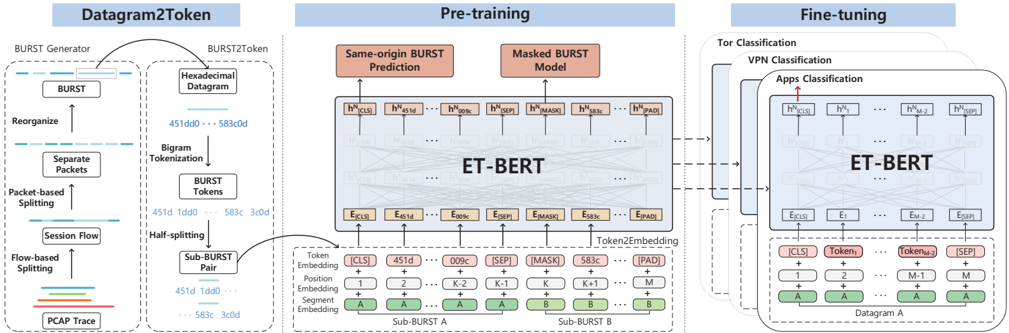
- Two-stage design: self-supervised pre-training on unlabeled traffic with a Transformer (12 blocks, 12 attention heads, token dimension 768, 512 input tokens), followed by fine-tuning on task-specific labeled data. Datagram2Token converts flows into BURSTs, then bi-gram/BPE tokens (vocabulary size 65,536), with token, position, and segment embeddings.
- Pre-training tasks: Masked BURST Model masks 15% of tokens (80% replaced with [MASK], 10% random token, 10% unchanged); Same-origin BURST Prediction uses a binary classifier to predict whether two sub-BURSTs are from the same BURST origin, with 50% actual next sub-BURST and 50% random sub-BURST. Pre-training uses about 30GB unlabeled traffic (about 15GB public datasets and 15GB passively collected CSTNET traffic).
- Downstream evaluation covers five tasks on six public datasets plus a new CSTNET-TLS 1.3 dataset; fine-tuning randomly selects at most 500 flows and 5,000 packets per class, with an 8:1:1 train/validation/test split. Metrics are Accuracy, Precision, Recall, and F1 with macro average; ET-BERT is compared with 11 methods and uses packet-level and flow-level fine-tuning strategies.
Limitations
- Stated: generalizability is challenged by variability of encrypted traffic over time; TLS 1.3 labeling via SNI will not be possible with ECH, and the authors mitigate this by active visiting and labeling with unique process identifiers.
- Stated: pre-training security depends on clean pre-training data; an attacker can add low-frequency subwords as “toxic” embeddings to create a poisoned pre-trained model with a backdoor, and how to construct such toxic tokens for encrypted traffic has not been studied.
- Evident from the text: the TLS 1.3 dataset labels rely on SNI, so evaluation may not transfer under ECH; datasets are fixed snapshots and no temporal drift evaluation is reported; pre-training mixes public and CSTNET traffic, so domain bias is possible.
Model-written summary. Check it against the paper before relying on it.
Integrity signals
Registry
Cites
Statistics
Figures
Verification
Claims the paper makes
3 Valid · 1 Not valid · 11 Not checked · 57 Own results and interpretations
The cited sources support only part of this claim — read each source’s verdict below.
In the paper
“Furthermore, due to the rapid development of encryption technology, traffic classification methods for a specific kind of encrypted traffic cannot adapt well to the new environment or unseen encryption strategies [29].”
What the sources say
- Partly supportedcites [29] [29] Shahbaz Rezaei and Xin Liu. 2019. Deep Learning for Encrypted Traffic Classification: An Overview. IEEE Commun. Mag. 57, 5 (2019), 76-81. - sourceExperimental — accuracy not yet measured
In “Stronger Encryption Protocols” (p. 7), the paper explains that TLS 1.3 and QUIC leave fewer handshake fields unencrypted, creating a challenge for methods developed for TLS 1.2. It says whether the remaining fields suffice for classification is unclear, not that such methods cannot adapt to new environments or unseen encryption strategies. (LLM, conf=0.85)
plainstates a cause- Asserted: passes — The authors put it forward as true.
- Checkable: passes — It can be checked against evidence.
- Load-bearing: passes — The paper’s conclusions depend on it.
- Based: passes — The paper gives a reason why it holds.
- Partly supported
The cited sources support only part of this claim — read each source’s verdict below.
In the paper
“However, these methods are not applicable to the newly emerging encrypted techniques ( e.g. TLS 1.3) since the plaintext becomes more sparse or obfuscated.”
What the sources say
- Partly supportedcites [37] [37] Thijs van Ede, Riccardo Bortolameotti, Andrea Continella, and et al. 2020. FlowPrint: Semi-Supervised Mobile-App Fingerprinting on Encrypted Network Traffic. In 27th Annual Network and Distributed System Security Symposium, NDSS 2020, San Diego, California, USA, February 23-26, 2020 . The Internet Society. - sourceExperimental — accuracy not yet measured
The ‘Detection of Previously Unseen Apps’ section says that two earlier detectors handle only unencrypted data and cannot be applied to encrypted traffic. The paper does not attribute that limitation specifically to TLS 1.3 or say that plaintext becomes sparser or obfuscated; the Feature Exploration section instead describes which features remain available in TLS-encrypted traffic. Page numbers are not available in our copy. (LLM, conf=0.84)
plainstates a cause- Asserted: passes — The authors put it forward as true.
- Checkable: passes — It can be checked against evidence.
- Load-bearing: passes — The paper’s conclusions depend on it.
- Based: passes — The paper gives a reason why it holds.
- Partly supported
A result the paper reports from its own data — it cites no other source for it, so there is none to check. The quote shows it is in the paper.
In the paper
“According to model '6', we perform supervised learning on labeled data by training the Transformer model directly and the F1 score decreases remarkably by 37.57% compared with ET-BERT.”
plainstates a cause- Asserted: passes — The authors put it forward as true.
- Checkable: passes — It can be checked against evidence.
- Load-bearing: passes — The paper’s conclusions depend on it.
- Based: passes — The paper gives a reason why it holds.
A result the paper reports from its own data — it cites no other source for it, so there is none to check. The quote shows it is in the paper.
In the paper
“ET-BERT achieves 5.69% and 1.72% improvement over the existing state-of-the-art model Deeppacket on ISCX-VPN-Service and ISCX-VPN-App.”
plainstates a cause- Asserted: passes — The authors put it forward as true.
- Checkable: passes — It can be checked against evidence.
- Load-bearing: passes — The paper’s conclusions depend on it.
- Based: passes — The paper gives a reason why it holds.
A result the paper reports from its own data — it cites no other source for it, so there is none to check. The quote shows it is in the paper.
In the paper
“outperforms existing works remarkably by 5.4%, 0.2%, 5.2%, 4.4%, 10.0%.”
boostedstates a cause- Asserted: passes — The authors put it forward as true.
- Checkable: passes — It can be checked against evidence.
- Load-bearing: passes — The paper’s conclusions depend on it.
- Based: passes — The paper gives a reason why it holds.
44 more claims
Create a free account to see all 72 claims and to verify the 2 references still open.
- It may state two separate claims as one. 18
- The quote only partly states this claim. 2
- Probably not a substantial claim. 6
Self-check
Percentages, sums and reported differences re-computed from the paper’s own numbers.
Each contradiction between two passages listed here was confirmed by an independent check.
Rated minor: it would not touch a result — a value no result rests on, a p-value that stays on the same side of the significance level, or a conflict that is clerical, resolved elsewhere in the paper, or outside its own findings.
In the paper
§ 4.5 Few-shot Analysis
“To validate the effectiveness and robustness of ET-BERT in fewshot settings, we design comparison experiments with different data proportions on ISCX-VPN-Service.”
§ 5 DISCUSSION
“Figure 4: Comparison Results on Few-shot ISCX-VPN-App.”
Rated minor: it would not touch a result — a value no result rests on, a p-value that stays on the same side of the significance level, or a conflict that is clerical, resolved elsewhere in the paper, or outside its own findings.
In the paper
§ 4.1 Experiment Setup
“we conduct experiments across five encrypted traffic classification tasks on six public datasets and one newly proposed dataset.”
§ 6 CONCLUSION
“We comprehensively evaluate the generalization and robustness of ET-BERT on 5 publicly available datasets and the TLS 1.3 dataset collected from CSTNET.”
Citations
Cites
Vaswani, A., Shazeer, N., Parmar, N., Uszkoreit, J., Jones, L., Gomez, A. N., Kaiser, L., & Polosukhin, I. (2017) · arXiv · doi:10.48550/arxiv.1706.03762 · Cited by 120,404
Exploiting Generative AI to Scale up Intelligent Tutoring Systems
Jakubův, J., Chvalovský, K., Goertzel, Z., Kaliszyk, C., Olšák, M., Piotrowski, B., Schulz, S., Suda, M., & Urban, J. (2023) · DROPS (Schloss Dagstuhl – Leibniz Center for Informatics) · doi:10.4230/lipics.itp.2023.19 · Cited by 76,658
BERT: Pre-training of Deep Bidirectional Transformers for Language Understanding
Devlin, J., Chang, M.-W., Lee, K., & Toutanova, K. (2018) · arXiv · doi:10.48550/arxiv.1810.04805 · Cited by 73,173
BERT: Pre-training of Deep Bidirectional Transformers for Language Understanding
Devlin, J., Chang, M.-W., Lee, K., & Toutanova, K. (2019) · Proceedings of the 2019 Conference of the North American Chapter of the Association for Computational Linguistics: Human Language Technologies, Volume 1 (Long and Short Papers) · doi:10.18653/v1/n19-1423 · Cited by 54,325
An Image is Worth 16x16 Words: Transformers for Image Recognition at Scale
Dosovitskiy, A., Beyer, L., Kolesnikov, A., Weissenborn, D., Zhai, X., Unterthiner, T., Dehghani, M., Minderer, M., Heigold, G., Gelly, S., et al. (2020) · arXiv · doi:10.48550/arxiv.2010.11929 · Cited by 47,472
RoBERTa: A Robustly Optimized BERT Pretraining Approach
Liu, Y., Ott, M., Goyal, N., Du, J., Joshi, M., Chen, D., Levy, O., Lewis, M., Zettlemoyer, L., & Stoyanov, V. (2019) · arXiv · doi:10.48550/arxiv.1907.11692 · Cited by 16,515
Elements of Information Theory
Cover, T. M., & Thomas, J. A. (2005) · doi:10.1002/047174882x · Cited by 13,791
BioBERT: a pre-trained biomedical language representation model for biomedical text mining
Lee, J., Yoon, W., Kim, S., Kim, D., Kim, S., So, C. H., & Kang, J. (2020) · Bioinformatics · doi:10.1093/bioinformatics/btz682 · Cited by 7,218
Google's Neural Machine Translation System: Bridging the Gap between Human and Machine Translation
Wu, Y., Schuster, M., Chen, Z., Le, Q. V., Norouzi, M., Macherey, W., Krikun, M., Cao, Y., Gao, Q., Macherey, K., et al. (2016) · arXiv · doi:10.48550/arxiv.1609.08144 · Cited by 5,319
Toward Generating a New Intrusion Detection Dataset and Intrusion Traffic Characterization
Sharafaldin, I., Habibi Lashkari, A., & Ghorbani, A. A. (2018) · Proceedings of the 4th International Conference on Information Systems Security and Privacy · doi:10.5220/0006639801080116 · Cited by 5,318 · cited 1×
“This dataset contains two parts: (1) about 15GB traffic from the public datasets [9, 30]; (2) about 15GB traffic from our passively collected traffic under the China Science and Technology Network (CSTNET).”
Method
Cited by
Items 301–400 of 562
Kim, D., & Yi, G. (2025) · SSRN Electronic Journal · doi:10.2139/ssrn.5374260
Liu, J., Lu, B., Yuan, Q., Niu, W., Li, D., Chai, J., & Yu, Y. (2026) · IEEE Transactions on Information Forensics and Security · doi:10.1109/tifs.2026.3712230
TrafficMoE: LLM-based mixture-of-experts framework for multi-task network traffic classification
Chen, H., Gao, D., Zhang, W., Yang, L., & Zhou, Z. (2026) · Journal of King Saud University - Computer and Information Sciences · doi:10.1007/s44443-026-01202-7
Qiao, M., Diao, Z., Zhang, G., Wang, L., Lv, K., Liang, X., Gong, Y., Jiang, H. Q., Wang, J., Li, Z., et al. (2026) · Asia-Pacific Workshop on Networking (APNet) · doi:10.1145/3820441.3820453
Self-citationPFMamba: A Lightweight Multimodal Fusion Framework for Robust Encrypted Traffic Classification
Zhang, J., Cheng, G., Chen, Z., Liang, J., & Zedong, N. I. (2026) · Lecture notes in computer science · doi:10.1007/978-981-92-2859-1_42
Enhanced Encrypted Traffic Classification Through Packet-Flow Dual Views
Feng, B., Wang, Q., Yijing, W., Li, F., Xu, X., Zang, T., & Ma, J. (2025) · IEEE Wireless Communications and Networking Conference · doi:10.1109/wcnc61545.2025.10978498
Dual Feature Extraction and Fusion for Malicious Traffic Detection based Transformer Encoders
Xu, G., Huang, Y., & Han, X. (2024) · International Conference on Big Data & Artificial Intelligence & Software Engineering (ICBASE) · doi:10.1109/icbase63199.2024.10762035
FullView: Using Bidirectional Group Sequences to Achieve Accurate Encrypted Traffic Classification
Xu, Y., Liang, Z., Xu, Z., Song, K., Xiang, Q., & Cheng, G. (2025) · Lecture notes of the Institute for Computer Sciences, Social Informatics and Telecommunications Engineering · doi:10.1007/978-3-031-94448-2_11
Alnaim, A. K., & Alwakeel, A. M. (2026) · Electronics · doi:10.3390/electronics15173995
Huang, Y., Wang, X., & He, M. (2026) · IEEE Transactions on Network and Service Management · doi:10.1109/tnsm.2026.3725912
Topologically-Aware Network Flow Classification for IoT Device Identification
Wright, E., & Wang, A. (2025) · IEEE Annual Congress on Artificial Intelligence of Things (AIoT) · doi:10.1109/aiot66900.2025.00014
A Novel Approach for Application Classification with Encrypted Traffic Using Bert and Packet HeadersPreprint
Yu, J., Choi, Y., Koo, K., et al. (2024) · SSRN Electronic Journal · doi:10.2139/ssrn.4855250
Self-citationBlind Traffic Classification From Demodulated Bitstreams in Tactical Wireless Networks
Chae, M., & Park, J.-T. (2026) · IEEE Access · doi:10.1109/access.2026.3656580
BoNC: Discovering and Classifying Novel Encrypted Botnet Traffic
Hu, H., Li, Z., & Doerr, C. (2025) · IEEE Open Journal of the Communications Society · doi:10.1109/ojcoms.2025.3638985 · Cited by 2
Self-citationToward Robust Encrypted Traffic Detection via Graph Contrastive Learning
Huang, J., Li, M., Sun, Y., & Jiang, Y. (2025) · IEEE International Conference on Trust, Security and Privacy in Computing and Communications (TrustCom) · doi:10.1109/trustcom66490.2025.00056
Shin, C.-Y., Kwon, T., Baek, U.-J., & Lee, J. (2026) · IEEE Annual International Computer Software and Applications Conference (COMPSAC) · doi:10.1109/compsac69091.2026.00164
Liu, D., Liu, W., & Fang, B. (2024) · IEEE/CIC International Conference on Communications in China (ICCC) · doi:10.1109/iccc62479.2024.10681744
Quantum-Inspired Autoencoder and LSTM Model for Encrypted Traffic Anomaly Detection
Bompally, S. D. (2026) · International Conference on Artificial Intelligence, Computer, Data Sciences and Applications (ACDSA) · doi:10.1109/acdsa67686.2026.11468129
Fu, C., Qi, L. I., & Xu, K. (2025) · Scientia Sinica Informationis · doi:10.1360/ssi-2025-0025
Btda: A Robust Framework for Encrypted Traffic Classification with Byte-Level TLS Data Augmentation
Wang, D., Yang, X., Cui, Z., Qiao, W., Wu, W.-Y., Huang, Y., Cui, S., Jiang, B., & Lu, Z. (2026) · IEEE International Conference on Acoustics Speech and Signal Processing · doi:10.1109/icassp55912.2026.11461917
Exploring the Potential and Boundaries of KAN in Encrypted Traffic Classification
Ma, S., Xia, W., Li, Z., Li, Z., Xiong, G., & Gou, G. (2025) · International Joint Conference on Neural Networks (IJCNN) · doi:10.1109/ijcnn64981.2025.11228026
Self-citationNT-Transformer: A Non-Pretrained Encrypted Network Traffic Classification Model
Yan, Z., Peng, L., Liu, P., Bao, Y., & Yang, B. (2026) · IEEE Transactions on Network and Service Management · doi:10.1109/tnsm.2026.3683410 · Cited by 1
Schema-portable adaptive early-exit transformer for resource-aware IoT intrusion detection
Chao, A. F. Y. (2026) · Journal of Network and Computer Applications · doi:10.1016/j.jnca.2026.104534 · Cited by 1
Beyond Application Identification: Fine-Grained Activity Classification in Encrypted Mobile Traffic
Poyrazoglu, R. A., Ozen, D. N., Yildiz, A., Mrah, C. E., Sakar, C. O., & Soyak, E. G. (2026) · Signal Processing and Communications Applications Conference (SIU) · doi:10.1109/siu71813.2026.11636590
Federated Contrastive Learning for Malware Detection in Encrypted Network Traffic
Krishna, G. B., Kavitha, K. R., Narendar, G., Padmalatha, E., Rani, D. S., & Rao, P. V. (2025) · International Conference on Smart Electronics and Communication (ICOSEC) · doi:10.1109/icosec67334.2025.11459570
Li, Z., Feng, Z., Zhou, X., Li, S., Fu, X., Gai, X., Lv, L., & Zhao, Y. (2025) · Communications in computer and information science · doi:10.1007/978-981-95-1340-6_21
Self-citationSRViT: A Robust Online Encrypted Traffic Classification Based on Vision Transformer
Liu, C., Han, L., Diao, Z., Wu, Z., He, X., Fan, W., & Xiao, F. (2026) · IEEE Transactions on Networking · doi:10.1109/ton.2026.3699540
Modeling and Detection of Internal Lateral Movement Based on Network TrafficPreprint
Wu, Y., Zheng, X., Yang, L., Yang, F., Nie, L., & Jiang, W. J. (2025) · SSRN Electronic Journal · doi:10.2139/ssrn.5275982
GraphWave: A Dynamic Context-Adaptive Multimodal Feature Fusion Framework for Threat Detection
Fang, P., Zhao, Z., Huang, F., Zhang, F., & Lu, J. (2026) · IEEE Transactions on Information Forensics and Security · doi:10.1109/tifs.2026.3723120
Pan, Q., Yu, Y., Yan, H., Wang, M., & Qi, B. (2024) · Conference proceedings/Conference proceedings - IEEE International Conference on Systems, Man, and Cybernetics · doi:10.1109/smc54092.2024.10831035 · Cited by 1
Echo-Traffic: Cross-Modal Feature Augmentation for Traffic Transformer Pre-Training
Feng, X., Gou, G., Dong, W., Jiang, X., Ding, Y., & Wang, X. (2026) · IEEE International Conference on Acoustics Speech and Signal Processing · doi:10.1109/icassp55912.2026.11461226
Self-citationSun, J., Wang, Y., Xiao, R., et al. (2026) · Lecture notes in computer science · doi:10.1007/978-981-92-1300-9_19
Adaptive encrypted traffic classification via online hash center evolution
Yang, Q., Chen, M., Zhang, B., Han, H., He, W., Wu, F., & Ji, Y. (2026) · Journal of King Saud University - Computer and Information Sciences · doi:10.1007/s44443-026-00949-3
CAT-Mamba: A State Space Model Approach for Encrypted Malicious Traffic Detection
Gao, Y., Wang, G., Wang, P., & Wang, Y. (2025) · IEEE International Conference on Data Science in Cyberspace · doi:10.1109/dsc67331.2025.00032
An URL Protection Approach for Apps on Smartphone by Built-in VPN Mechanism
Su, M., Lu, Y.-H., Lu, H.-Y., Lian, Y.-S., & Peng, K.-T. (2023) · International Conference on Applied System Innovation · doi:10.1109/icasi57738.2023.10179545
Tarnhelm: Using Adversarial Samples to Protect User Privacy Against Traffic Identification
Xu, Y., Bai, Y., Cao, J., Xu, Y., He, L., & Cheng, G. (2025) · Lecture notes of the Institute for Computer Sciences, Social Informatics and Telecommunications Engineering · doi:10.1007/978-3-031-94455-0_22
TFMana: A Traffic Feature Calibration Method to Empower Reliable Network Traffic Analysis
Li, Z., Zhao, S., Chen, S., Wang, F., Wang, B., & Wang, M. (2025) · IEEE International Performance, Computing, and Communications Conference · doi:10.1109/ipccc66453.2025.11304646
Self-citationZong, X., Luo, M., Peng, C., & He, D. (2024) · Lecture notes of the Institute for Computer Sciences, Social Informatics and Telecommunications Engineering · doi:10.1007/978-3-031-64948-6_2 · Cited by 1
HeraClass: Towards Open-World Network Flow Classification via Traffic-Language Mapping
Jin, N., Liu, L., Miao, Y., Chen, L., Li, D., Wang, X., Xu, X., & Cui, B. (2026) · International Workshop on Quality of Service · doi:10.1109/iwqos70441.2026.11661238
TrafficBM: A Dual-Modality Pre-Training Framework for Network Traffic Classification
Wang, M., Liao, J., Su, J., Wei, Z., Chen, S., Li, Z., & Wang, B. (2025) · IEEE International Performance, Computing, and Communications Conference · doi:10.1109/ipccc66453.2025.11304658 · Cited by 1
Self-citationPP-OpenNet: Privacy-Preserved Open Set Classification for Network Traffic
Zhang, J., Wu, L., Peng, X., Yang, Q., Liu, R., & Xu, H. (2026) · IEEE Conference on Computer Communications (INFOCOM) · doi:10.1109/infocom59046.2026.11571190
Zhou, Y., Shi, Y., Yang, X., Xiao, D., Li, G., & Li, J. (2025) · IEEE International Conference on Trust, Security and Privacy in Computing and Communications (TrustCom) · doi:10.1109/trustcom66490.2025.00364 · Cited by 1
ST-Mamba: Spatio-Temporal Feature-Based Encrypted Traffic Analysis Using Mamba Network
Zhu, J., Fan, M., Cao, R., Zuo, J., Lu, Y., & Zou, S. (2026) · Lecture notes in computer science · doi:10.1007/978-981-92-3012-9_14
MambaTIG: Fast and Robust Encrypted Traffic Detection Leveraging Selective State-Space Masking
Jia, J., Wang, A., Yang, L., Zhou, L., Sang, A., & Yang, H. (2026) · IEEE Transactions on Dependable and Secure Computing · doi:10.1109/tdsc.2026.3712032
Han, X., Qin, J., Zhao, C., Fang, W., Liu, J., Wang, W., Jiang, B., Cui, S., Lü, Z., & Liu, B. (2026) · IEEE Transactions on Information Forensics and Security · doi:10.1109/tifs.2026.3694664
Gao, L., Chen, X., Li, D., Li, Y., & Zheng, Y. (2026) · International Conference on Computer Supported Cooperative Work in Design (CSCWD) · doi:10.1109/cscwd68734.2026.11581501
Neural Collapse-Based Class-Incremental Learning for Encrypted Traffic Classification
Zeng, Q., Qu, D., Zhang, H., & Chen, Y. (2026) · IEEE Transactions on Network and Service Management · doi:10.1109/tnsm.2026.3688767
MEB: A Backdoor Detection Framework for Pre-training Based Malicious Traffic Detection
Wang, K., Zhou, J., Yang, L., Li, W., Jie, Z., Jiang, Z., & Wang, Z. (2025) · IEEE International Conference on Trust, Security and Privacy in Computing and Communications (TrustCom) · doi:10.1109/trustcom66490.2025.00043
SaGNN: Encrypted traffic classification with semantic-aware heterogeneous graph neural network
Luo, J., Liu, M., Sun, S., Chen, Y., Tang, Q., & Wang, Y. (2026) · Computer Networks · doi:10.1016/j.comnet.2026.112763
Robust LLM-Based Website Fingerprinting under Dynamic Real-World Conditions
Zhao, X., Deng, X., Cui, T., Zhang, Y., Xu, K., & Li, Q. (2026) · International World Wide Web Conference (WWW) · doi:10.1145/3774904.3792288 · Cited by 3
APK-ETC: APK-based Domain Fingerprinting for Encrypted Traffic ClassificationPreprint
Chen, Y., Gao, K., & Tang, Z. (2026) · SSRN Electronic Journal · doi:10.2139/ssrn.6496712
A Noval Encrypted Traffic Detection Framework Based on Multi-Granular Feature Fusion
Liang, D., Chen, Z., Wen, L., Yao, B., Li, J., & Pan, Y. (2025) · IEEE International Conference on Information, Communication and Networks (ICICN) · doi:10.1109/icicn67355.2025.11430467
Jiang, J., Dong, F., Guo, L., Jiang, Z., Liu, B., & Zhang, K. (2026) · Lecture notes of the Institute for Computer Sciences, Social Informatics and Telecommunications Engineering · doi:10.1007/978-3-032-23450-6_21
Learning Flow Semantics for Encrypted Traffic Analysis: A Contrastive Pre-Training Approach
Zhao, R., Zhan, M., Li, Q., Liu, Z., Deng, X., Wang, Y., Cheng, G., Xue, Z., & Xu, K. (2026) · IEEE Transactions on Dependable and Secure Computing · doi:10.1109/tdsc.2026.3677663 · Cited by 3
Research on Tor Over Socks5 Proxy Anonymous Communication Behavior Reconition
Zhang, J. (2025) · International Conference on Sensors and Information Technology (ICSI) · doi:10.1109/icsi64877.2025.11009624
Zheng, C., Ma, H., Qu, Y., Jiang, Y., & Wang, W. (2025) · SSRN Electronic Journal · doi:10.2139/ssrn.5492119
GenTI: Benchmarking LLMs for Autonomous IDPS Rule Generation for Unseen Attacks
Hadi, H. J., Khan, M. K., Ahmad, N., Yasmin, R., & Shoker, A. (2026) · IEEE Transactions on Network Science and Engineering · doi:10.1109/tnse.2026.3716998 · Cited by 5
Lightweight and Robust Encrypted Anomaly Traffic Detection Based on Improved CLT-BERT
Kong, F. (2025) · 2025 International Conference on Signal Processing, Computer Networks and Communications (SPCNC) · doi:10.1109/spcnc68200.2025.11406423
Multimodal Entity Alignment Mechanisms for Network Operation and MaintenancePreprint
Xu, Y., Hu, J., Meng, W., Ma, Y., Li, Y., & Zhu, L. (2026) · SSRN Electronic Journal · doi:10.2139/ssrn.6837688
The Impact of Generative AI on 6G Network Architecture and Service
Nurakhov, Y. S., Aibagarov, S., Kassymbek, N., Mukhanbet, A., Kumalakov, B., & Imankulov, T. (2026) · Electronics · doi:10.3390/electronics15071345 · Cited by 2
No train, no pain: a training-free few-shot traffic classifier based on LLMs
Guan, X., Li, N., Han, X., Wang, D., Huang, J., Wang, T. R., Cui, Z., Lü, Z., & Liu, B. (2026) · Cybersecurity · doi:10.1186/s42400-026-00622-2 · Cited by 1
Deng, X., Zhao, R., Zhan, M., Wu, S., Wang, Y., & Xue, Z. (2025) · Lecture notes in computer science · doi:10.1007/978-981-95-3537-8_26
Qin, J., Han, X., Li, Y., Han, D., Qiao, W., Yang, X., Cui, Z., Jiang, B., & Lu, Z. (2026) · IEEE International Conference on Acoustics Speech and Signal Processing · doi:10.1109/icassp55912.2026.11463318 · Cited by 1
Luo, M., Yang, X., & Lan, Y. (2026) · International Conference on Generative Artificial Intelligence and Information Security (GAIIS) · doi:10.1109/gaiis69281.2026.11519230
A Large-Scale Pretrained Model for Malicious URL Detection
Fu, C., Guo, D., Qi, Z., Li, J., Li, B., & Meng, X. (2025) · Lecture notes of the Institute for Computer Sciences, Social Informatics and Telecommunications Engineering · doi:10.1007/978-3-031-93254-0_5
DSPS-CNN: A Lightweight Approach for Classifying Encrypted Traffic
Wang, X., Wang, Q., Chai, A., et al. (2025) · International Conference on Computing, Robotics and System Sciences (ICRSS) · doi:10.1109/icrss67786.2025.00060
Zhang, X., Qin, J., Wang, Y., Gao, K., Yang, X., Jiang, B., & Lu, Z. (2026) · International Conference on Computer Supported Cooperative Work in Design (CSCWD) · doi:10.1109/cscwd68734.2026.11582672
Xu, Y., Xu, Y., Bai, Y., Chen, J., Song, K., Cao, J., Xiang, Q., & Cheng, G. (2026) · Computers & Security · doi:10.1016/j.cose.2026.104987 · Cited by 1
Maitín, A. M., Arranz-Luque, C., Alba, E., & García-Tejedor, Á. J. (2025) · Journal Of Big Data · doi:10.1186/s40537-025-01183-w · Cited by 3
Adaptive detection of encrypted malware traffic via fully convolutional masked autoencoders
Jia, J., Shen, M., Yuan, Q., Liu, Y., Wang, J., Kong, J., Huang, L., He, H., & Zhu, L. (2025) · Frontiers of Computer Science · doi:10.1007/s11704-025-41273-9 · Cited by 2
Efficient End-to-End Intrusion Detection with Packet and Flow-Level Mamba Sequence Models
Pletzer, B., & Mottok, J. (2025) · International Conference on Cybersecurity and AI-Based Systems (Cyber-AI) · doi:10.1109/cyber-ai66431.2025.11233569
GETA: Generalized Encrypted Traffic Analysis
Gunasekara, R., Masood, R., & Kanhere, S. S. (2026) · Conference on Local Computer Networks · doi:10.1109/lcn67947.2026.11660777 · Cited by 2
Encrypted Traffic Classification with Graph Sketch-Based Traffic Representation
Yu, S., Li, D., Guo, Y., Xie, R., & Zhang, Y. (2025) · International Joint Conference on Neural Networks (IJCNN) · doi:10.1109/ijcnn64981.2025.11228514
Dong, W., Lin, X., He, L., Gou, G., Li, Z., Shi, J., Liu, J., & Xiong, G. (2026) · International Workshop on Quality of Service · doi:10.1109/iwqos70441.2026.11661019
Self-citationTitnet: A Time-Series Model Based on Multi-Period Nesting for Encrypted Traffic ClassificationPreprint
Li, X., Hou, J., Hu, X., Cao, Y., Zhao, C. J., & Liu, Z. (2024) · SSRN Electronic Journal · doi:10.2139/ssrn.4804531
Ren, T., Dong, W., Zhang, S., & Yang, J. (2025) · Lecture notes in computer science · doi:10.1007/978-981-96-9812-7_26
TSHiRT: Traffic Session Hierarchical Representation from Transformer
Yu, G.-M., Kwon, T.-W., Baek, U.-J., et al. (2026) · IEEE Network Operations and Management Symposium (NOMS) · doi:10.1109/noms69089.2026.11668394
Nethira: A Heterogeneity-Aware Hierarchical Pre-Trained Model for Network Traffic Classification
Lin, C., Zhang, W., Luo, H., Meng, X., & Zhang, Y. (2026) · IEEE International Conference on Acoustics Speech and Signal Processing · doi:10.1109/icassp55912.2026.11461760 · Cited by 3
Zhao, F., Li, Z., Li, W., Bao, H., Zhou, G., Wang, W., Liu, F., & Ma, D. (2026) · IEEE Transactions on Information Forensics and Security · doi:10.1109/tifs.2026.3723137
Self-citationPang, H., Zhou, Y., Liu, C., Jun, J., & Jin, Q. (2026) · SSRN Electronic Journal · doi:10.2139/ssrn.6900313
Early Detection of Malicious Traffic Based on Graph Modeling and Spatio-Temporal Attention Approach
Liu, J., Tan, S., Chen, J., Zhang, Z., Lin, Q., Chen, Z., & Fu, J. (2026) · Lecture notes in computer science · doi:10.1007/978-981-95-6203-9_17
NanoTG: Automated Fine-Grained Mobile Traffic Generation with LLM GUI Agents
Wang, W., Zhu, Y. C., Li, B., Li, H., & Liu, Q. (2026) · IFIP Networking Conference (IFIP Networking) · doi:10.23919/ifipnetworking70592.2026.11578977
Fürst, D., Levi, P., & Steindl, S. (2026) · IEEE International Conference on Intelligence and Security Informatics (ISI) · doi:10.1109/isi69914.2026.11685837
Zhao, G., Yao, Y., Wang, X., et al. (2026) · 2026 IEEE 15th Data Driven Control and Learning Systems (DDCLS) · doi:10.1109/ddcls71227.2026.11610349
Li, S., Lv, Z., Zang, T., Yang, L., & Qian, Q. (2024) · International Joint Conference on Neural Networks (IJCNN) · doi:10.1109/ijcnn60899.2024.10650862
Metadata
- Authors
- Lin, X., Xiong, G., Gou, G., Li, Z., Shi, J., & Yu, J.
- Affiliations
- Chinese Academy of Sciences (CN)
- Venue
- Proceedings of the ACM Web Conference 2022
- Publisher
- ACM
- Published
- 2022-04-25
- Pages
- 633-642
- OpenAlex
- W4224315052
- Cited by
- 599
- References
- 46
- Citations by year
- 2026: 217 · 2025: 199 · 2024: 123 · 2023: 52 · 2022: 8
- FWCI
- 52.77
- Type
- conference paper
- Language
- en
- Open access
- hybrid
- doi.org
- Licence
- Locations
- International World Wide Web Conference (WWW) (publishedVersion, cc-by)
- arXiv (Cornell University) (submittedVersion)
- arXiv (Cornell University)
- Funders
- the Strategic Priority Research Program of Chinese Academy of Sciences (No. XDC02040400)
- The National Key Research and Development Program of China (No. 2021YFB3101400)
- Topics
- Physical Sciences › Computer Science › Artificial Intelligence › Internet Traffic Analysis and Secure E-voting
- Physical Sciences › Computer Science › Computer Networks and Communications › Network Security and Intrusion Detection
- Physical Sciences › Computer Science › Computer Networks and Communications › Software-Defined Networks and 5G
- Keywords
- encrypted traffic classification, BERT, context representation, network security, network management, fine-tuning
About these checks
Registry, retraction, Cites and statistics results are computed, not judged, with one exception: a printed reference that no index lists is read once by a model before it counts as a citation error. Claims are extracted by a model and kept only when their quote appears verbatim in the text; each cited source is then checked, with a model’s help, for whether it says what the claim relies on. Those verdicts can be wrong — read the claim’s quote and the cited source before relying on one.
The claim verdicts this report counts are experimental: their accuracy is not yet measured.
A language model drew the claims from the paper on 2026-10-10, under version 3 of the claim definition (model deepseek-v4.1-flash, prompt extract-v3).
A second model labelled each claim on 2026-10-10 (model jev-1.13-20260917, definition revision gold-guideline-v0.2).
Cited sources are checked with a language model’s help (gpt-6-sol).
Statistics and arithmetic are recomputed, not judged.
Confidence bands are shown only for fields calibrated on our annotated test set. None is calibrated yet, so no band is shown.
What counts as a claim ›How we measure confidence ›How we check this ›
Are you an author, or do you see a problem with this page? Request a review
Data sources
Bibliographic data: Semantic Scholar, OpenAlex, Crossref.
Contains information from the Semantic Scholar Academic Graph Datasets, made available under the ODC Attribution License (ODC-BY 1.0).
Semantic Scholar’s data is described in: Kinney, R., et al. (2023). The Semantic Scholar Open Data Platform. arXiv:2301.10140.
