

Investigating Explainability of Generative AI for Code through Scenario-based Design
Open accessThe DOI matches its Crossref record; 103 of the 104 references it cites were found in a registry or an index, and 1 are not checked yet; 35 of the 56 sources its claims cite were checked for support.
Abstract
What does it mean for a generative AI model to be explainable? The emergent discipline of explainable AI (XAI) has made great strides in helping people understand discriminative models. Less attention has been paid to generative models that produce artifacts, rather than decisions, as output. Meanwhile, generative AI (GenAI) technologies are maturing and being applied to application domains such as software engineering. Using scenario-based design and question-driven XAI design approaches, we explore users’ explainability needs for GenAI in three software engineering use cases: natural language to code, code translation, and code auto-completion. We conducted 9 workshops with 43 software engineers in which real examples from state-of-the-art generative AI models were used to elicit users’ explainability needs. Drawing from prior work, we also propose 4 types of XAI features for GenAI for code and gathered additional design ideas from participants. Our work explores explainability needs for GenAI for code and demonstrates how human-centered approaches can drive the technical development of XAI in novel domains.
Verified 2026-11-22 · 1 reference not checked yet
Overview
CoChat Summary
TL;DR
This paper uses scenario-based design and question-driven XAI methods to investigate what software engineers need to understand about generative AI for code. Across 9 workshops with 43 software engineers, it identifies 11 categories of explainability needs and proposes four XAI feature areas for code-generation use cases.
Key findings
- The study identified 11 categories of explainability needs for GenAI for code; the top five most frequent were Input, Output, How (global), Performance, and How to. Four categories did not appear as prominent needs in prior discriminative-ML decision-support work: Input, Control, System Requirements & Impact, and Limitations.
- Participants’ needs centered on understanding the scope, characteristics, and limitations of input/output spaces and on getting a global view of how code is generated, rather than on model internals or representation visualizations.
- The paper proposes four XAI feature areas: AI documentation, uncertainty indicators, attention visualization, and social transparency. For AI documentation, participants requested categories including Examples and tutorials, Software engineering capabilities, Output code quality and utility, Supported languages and frameworks, Control, and Deployment Requirements & Platform.
- For uncertainty, participants found line-level indicators useful but insufficient; they wanted alternative outputs, uncertainty explanations, fine-grained uncertainty, human input to resolve uncertainty, and interactive testing. Attention visualizations were seen as useful for understanding and improving inputs, while social transparency was mapped across software development life-cycle stages.
Methods
- Design: scenario-based design workshops combined with a question-driven XAI approach. The study ran 9 semi-structured remote workshops lasting 60–70 minutes with 3–6 participants each, using Mural for collaboration.
- Data/sample: 43 software engineers were selected from 81 survey respondents; selection required 1+ year of Python experience, or 1+ year of both Python and Java for code translation. Three use cases were studied: code translation, code autocompletion, and natural language to code. Real outputs from TransCoder and Copilot were used in scenarios.
- Analysis: content analysis of Mural content and transcribed recordings. The authors extracted 487 Mural messages and 249 relevant transcript paragraphs; around 600 minutes of interviews were recorded and transcribed. For question coding, two researchers independently coded 106 questions and reached agreement on 66 of 71 messages (93%) before finalizing the schema.
Limitations
- Stated by the paper: the method has limitations the authors reflect on, including that less experienced participants generally asked fewer questions and may need more proactive explanations; the choice of data point can sway workshop discussions; and the open-endedness of design probes required balancing concreteness and openness. The paper also notes that some transcribed comments could not be reliably attributed to individual speakers.
- Stated by the paper: the AI documentation categories in Table 3 are not meant to be an exhaustive template, and the paper raises a fundamental question about the readiness of GenAI for code that may not be addressable by explainability alone.
- Evident from the text: participants came from one large international IT company, were mostly from the United States and India, and were predominantly male; the study covers only three GenAI-for-code use cases and does not report an evaluation of the proposed XAI features with users.
Model-written summary. Check it against the paper before relying on it.
Integrity signals
Registry
Cites
Statistics
Figures
Verification
Claims the paper makes
20 Valid · 4 Not valid · 13 Not checked · 98 Own results and interpretations
The cited sources support only part of this claim — read each source’s verdict below.
In the paper
“users' explainability needs emerge in a usage context, guided by their goals and shaped by their backgrounds, expectations, as well as socio, organizational and cultural contexts [20,48,52].”
§ Investigating Explainability of Generative AI for Code through Scenario-based Design > 1 INTRODUCTION
What the sources say
- Not checked — no full text of the sourcecites [20] 20. Upol Ehsan and Mark Riedl. 2021. Explainability Pitfalls: Beyond Dark Patterns in Explainable AI -paper at HCAI@NeurIPS2021 workshop on human centered AI. https://sites.google.com/view/hcai-human-centered-ai-neurips/home Accessed January 19, 2022. source
- Partly supportedcites [48] 48. Q Vera Liao, Daniel Gruen, and Sarah Miller. 2020. Questioning the AI: informing design practices for explainable AI user experiences. In Proceedings of the 2020 CHI Conference on Human Factors in Computing Systems. 1-15. sourceExperimental — accuracy not yet measured
In “Understanding user needs for explainability” (page unavailable), the paper identifies usage points, decision contexts, and user characteristics as factors relevant to explainability needs. It also links motivation for explanation to users’ system goals and discusses backgrounds and beliefs in “In quest for human-like explanations.” Our copy does not establish that cultural contexts shape those needs, and the paper explicitly says it does not conclude how the identified factors vary them. (LLM, conf=0.84)
- Partly supportedcites [52] 52. Q Vera Liao and Kush R Varshney. 2021. Human-Centered Explainable AI (XAI): From Algorithms to User Experiences. arXiv preprint arXiv:2110.10790 (2021). sourceExperimental — accuracy not yet measured
Section 3 (p. 5) says users’ explainability needs vary with their goals, backgrounds, and usage contexts. Section 4 (p. 12) also says those needs should be situated in socio-organizational contexts. Our copy does not clearly say that users’ expectations or cultural contexts shape those needs. (LLM, conf=0.85)
plainstates a cause- Asserted: passes — The authors put it forward as true.
- Checkable: passes — It can be checked against evidence.
- Load-bearing: passes — The paper’s conclusions depend on it.
- Based: passes — The paper gives a reason why it holds.
The cited sources support only part of this claim — read each source’s verdict below.
In the paper
“Similar studies in the code space are limited to the number of few-shot examples in the prompt, and the effect of length of prompt on performance [9,15].”
§ Investigating Explainability of Generative AI for Code through Scenario-based Design > 6 DISCUSSION 6.1 Informing XAI approaches for GenAI for code
What the sources say
- Partly supportedcites [9] 9. Jacob Austin, Augustus Odena, Maxwell Nye, Maarten Bosma, Henryk Michalewski, David Dohan, Ellen Jiang, Carrie Cai, Michael Terry, Quoc Le, et al. 2021. Program Synthesis with Large Language Models. arXiv preprint arXiv:2108.07732 (2021). sourceExperimental — accuracy not yet measured
Section 4.2 (p. 7) examines performance by the number of prompting examples, and Section 4.3 (p. 8) discusses how long prompts can hurt synthesis performance. But the study is not limited to those questions: the Introduction (p. 3) also lists model size, example selection, and sampling technique among the factors analyzed. (LLM, conf=0.85)
- Partly supportedcites [15] 15. Mark Chen, Jerry Tworek, Heewoo Jun, Qiming Yuan, Henrique Ponde de Oliveira Pinto, Jared Kaplan, Harri Edwards, Yuri Burda, Nicholas Joseph, Greg Brockman, Alex Ray, Raul Puri, Gretchen Krueger, Michael Petrov, Heidy Khlaaf, Girish Sastry, Pamela Mishkin, Brooke Chan, Scott Gray, Nick Ryder, Mikhail Pavlov, Alethea Power, Lukasz Kaiser, Mohammad Bavarian, Clemens Winter, Philippe Tillet, Felipe Petroski Such, Dave Cummings, Matthias Plappert, Fotios Chantzis, Elizabeth Barnes, Ariel Herbert-Voss, William Hebgen Guss, Alex Nichol, Alex Paino, Nikolas Tezak, Jie Tang, Igor Babuschkin, Suchi sourceExperimental — accuracy not yet measured
The APPS results (section 3.5, p. 7) evaluate a one-shot prompt, and the Limitations section (p. 10) reports declining performance as synthetic docstrings grow longer. Our copy does not show an investigation of how varying the number of few-shot examples affects performance, nor establish that similar code studies are limited to these two topics. (LLM, conf=0.82)
plain- Asserted: passes — The authors put it forward as true.
- Checkable: passes — It can be checked against evidence.
- Load-bearing: unclear — It is unclear whether the paper’s conclusions depend on it.
- Based: passes — The paper gives a reason why it holds.
- Partly supported
The cited sources support only part of this claim — read each source’s verdict below.
In the paper
“Participants' questions reflected their desire for an actionable or utility-oriented understanding to support their end goal of optimizing code generation and programming productivity [18,50,52], such as asking the Input, Output, How and How-to XAI questions (described in Section 4) to facilitate strategies to get better outputs from the AI.”
§ Investigating Explainability of Generative AI for Code through Scenario-based Design > 6 DISCUSSION 6.1 Informing XAI approaches for GenAI for code
What the sources say
- Not checked — no full text of the sourcecites [18] 18. Shipi Dhanorkar, Christine T Wolf, Kun Qian, Anbang Xu, Lucian Popa, and Yunyao Li. 2021. Who needs to know what, when?: Broadening the Explainable AI (XAI) Design Space by Looking at Explanations Across the AI Lifecycle. In Designing Interactive Systems Conference 2021. 1591-1602. source
- Partly supportedcites [50] 50. Q Vera Liao, Milena Pribić, Jaesik Han, Sarah Miller, and Daby Sow. 2021. Question-Driven Design Process for Explainable AI User Experiences. arXiv preprint arXiv:2104.03483 (2021). sourceExperimental — accuracy not yet measured
In “Question Analysis” (pp. 13–14), participants’ questions are linked to practical goals, including deciding actionable next steps for patient management. The paper’s participants were healthcare providers considering patient-risk predictions; it does not support the claim that their goal was optimizing code generation or programming productivity. (LLM, conf=0.87)
- Partly supportedcites [52] 52. Q Vera Liao and Kush R Varshney. 2021. Human-Centered Explainable AI (XAI): From Algorithms to User Experiences. arXiv preprint arXiv:2110.10790 (2021). sourceExperimental — accuracy not yet measured
Section 4 (p. 8) says users seek actionable understanding that serves their objectives, and Section 3 (p. 6) describes eliciting users’ XAI questions. The paper does not report the citing study’s participants or establish that their questions aimed to optimize code generation and programming productivity. (LLM, conf=0.87)
plainstates an association- Asserted: passes — The authors put it forward as true.
- Checkable: passes — It can be checked against evidence.
- Load-bearing: passes — The paper’s conclusions depend on it.
- Based: passes — The paper gives a reason why it holds.
Every source the paper cites for this claim was checked and supports it.
In the paper
“These results move beyond Ehsan et al. [19]'s work that defined ST features at the point of AI decision-support.”
§ Investigating Explainability of Generative AI for Code through Scenario-based Design > 5.4 Social Transparency
What the sources say
- Supportedcites [19] 19. Upol Ehsan, Q Vera Liao, Michael Muller, Mark O Riedl, and Justin D Weisz. 2021. Expanding explainability: Towards social transparency in ai systems. In Proceedings of the 2021 CHI Conference on Human Factors in Computing Systems. 1-19. source
Section 3 (p. 8) calls the What, Why, Who, and When elements the constitutive design features of social transparency and presents them in a scenario built around an AI-mediated price recommendation tool. This supports the description of Ehsan et al.’s work; the citing authors’ statement that their results “move beyond” it is their own comparison. (LLM, conf=0.92)
plain- Asserted: passes — The authors put it forward as true.
- Checkable: passes — It can be checked against evidence.
- Load-bearing: passes — The paper’s conclusions depend on it.
- Based: passes — The paper gives a reason why it holds.
- Supported
A result the paper reports from its own data — it cites no other source for it, so there is none to check. The quote shows it is in the paper.
In the paper
“To understand what output the GenAI can produce is another frequent explainability need.”
§ Investigating Explainability of Generative AI for Code through Scenario-based Design > Output.
plain- Asserted: passes — The authors put it forward as true.
- Checkable: passes — It can be checked against evidence.
- Load-bearing: unclear — It is unclear whether the paper’s conclusions depend on it.
- Based: passes — The paper gives a reason why it holds.
50 more claims
Create a free account to see all 135 claims and to verify the 2 references still open.
- Probably not a substantial claim. 64
- It may state two separate claims as one. 31
- The quote only partly states this claim. 2
Claims other papers make about this one
Each is checked against this paper’s own text: does it say what the citing paper says it does?
In the citing paper
“This process is typically informal and relies on trial-and-error [104, 131, 165, 190].”
From Design Principles for Generative AI Applications (2024) · cites this paper as [165]
In the citing paper
“The recommendation to, 'Make clear what the system can do' may be difficult to implement in light of the emergent and unanticipated behaviors of generative foundation models [19], as well as the trial-and-error methods by which users iterate toward a desired outcome [104, 131, 165, 190].”
From Design Principles for Generative AI Applications (2024) · cites this paper as [165]
Self-check
Percentages, sums and reported differences re-computed from the paper’s own numbers.
Each contradiction between two passages listed here was confirmed by an independent check.
Rated minor: it would not touch a result — a value no result rests on, a p-value that stays on the same side of the significance level, or a conflict that is clerical, resolved elsewhere in the paper, or outside its own findings.
In the paper
“(N=14; 41%), with smaller numbers from Canada”
§ Investigating Explainability of Generative AI for Code through Scenario-based Design > Selection Criteria.
Reported 41 · recomputed 32.55814
Rated minor: it would not touch a result — a value no result rests on, a p-value that stays on the same side of the significance level, or a conflict that is clerical, resolved elsewhere in the paper, or outside its own findings.
In the paper
§ Investigating Explainability of Generative AI for Code through Scenario-based Design > 7 CONCLUSION
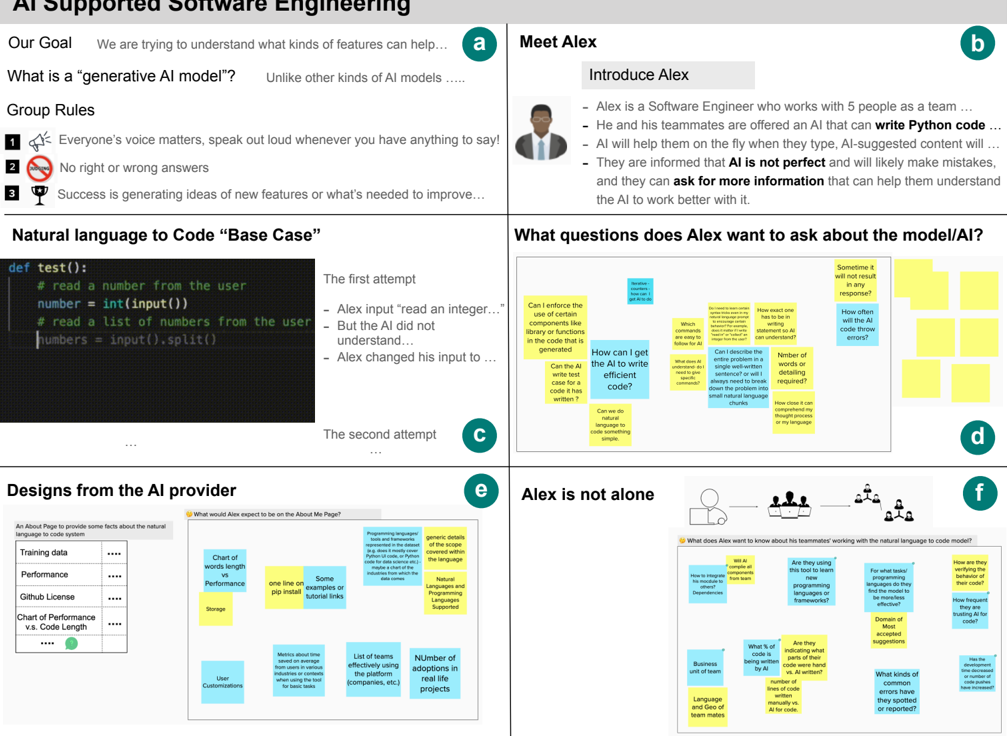
“Figure 1: Overview of the Mural used in workshop #6 (W6-NL2Code) for the code autocompletion use case.”
§ Investigating Explainability of Generative AI for Code through Scenario-based Design > Additional information
“We show the example code as the base case for workshops about natural language to code (W6-NL2Code, W7-NL2Code, W8-NL2Code) in Figure 1.”
Rated minor: it would not touch a result — a value no result rests on, a p-value that stays on the same side of the significance level, or a conflict that is clerical, resolved elsewhere in the paper, or outside its own findings.
In the paper
“the majority of our participants were from the United States (N=22; 65%)”
§ Investigating Explainability of Generative AI for Code through Scenario-based Design > Selection Criteria.
Reported 65 · recomputed 51.162791
Rated minor: it would not touch a result — a value no result rests on, a p-value that stays on the same side of the significance level, or a conflict that is clerical, resolved elsewhere in the paper, or outside its own findings.
In the paper
§ Investigating Explainability of Generative AI for Code through Scenario-based Design > How (global).
“P61 from W1-CT saying that”
§ Investigating Explainability of Generative AI for Code through Scenario-based Design > Data availability
“4 Code Autocompletion (CA) Software Engineer (P17, P39), Researcher/Scientist (P37, P55), Bioinformatician (P48), Data Scientist (P61)”
Citations
Cites
A Unified Approach to Interpreting Model Predictions
Lundberg, S., & Lee, S.-I. (2017) · arXiv · doi:10.48550/arxiv.1705.07874 · Cited by 23,707
Language Models are Few-Shot Learners
Brown, T. B., Mann, B., Ryder, N., Subbiah, M., Kaplan, J., Dhariwal, P., Neelakantan, A., Shyam, P., Sastry, G., Askell, A., et al. (2020) · arXiv · doi:10.48550/arxiv.2005.14165 · Cited by 23,372
Generative adversarial networks
Goodfellow, I., Pouget-Abadie, J., Mirza, M., Xu, B., Warde-Farley, D., Ozair, S., Courville, A., & Bengio, Y. (2020) · Communications of the ACM · doi:10.1145/3422622 · Cited by 18,384
"Why Should I Trust You?": Explaining the Predictions of Any Classifier
Ribeiro, M. T., Singh, S., & Guestrin, C. (2016) · Proceedings of the 22nd ACM SIGKDD International Conference on Knowledge Discovery and Data Mining · doi:10.1145/2939672.2939778 · Cited by 17,555 · cited 1×
“been developed for discriminative ML models, both through producing directly interpretable models [14, 44] and generating posthoc explanations for a trained opaque-box model [47, 62, 80, 104].”
MethodLearning Deep Features for Discriminative Localization
Zhou, B., Khosla, A., Lapedriza, A., Oliva, A., & Torralba, A. (2016) · 2016 IEEE Conference on Computer Vision and Pattern Recognition (CVPR) · doi:10.1109/cvpr.2016.319 · Cited by 11,428
“Why Should I Trust You?”: Explaining the Predictions of Any Classifier
Ribeiro, M., Singh, S., & Guestrin, C. (2016) · Proceedings of the 2016 Conference of the North American Chapter of the Association for Computational Linguistics: Demonstrations · doi:10.18653/v1/n16-3020 · Cited by 6,682
Peeking Inside the Black-Box: A Survey on Explainable Artificial Intelligence (XAI)
Adadi, A., & Berrada, M. (2018) · IEEE Access · doi:10.1109/access.2018.2870052 · Cited by 6,294 · cited 1×
“A full review of XAI techniques is beyond the scope of this paper and can be found in many recent survey papers [1, 29, 55, 56].”
BackgroundLipton, Z. C. (2018) · Queue · doi:10.1145/3236386.3241340 · Cited by 5,427 · cited 1×
“A full review of XAI techniques is beyond the scope of this paper and can be found in many recent survey papers [1, 29, 55, 56].”
BackgroundProceedings of the 21st International Conference on Neural Information Processing Systems
Koller, D., Schuurmans, D., Bengio, Y., & Bottou, L. (2008) · Cited by 4,461
Liu, P., Yuan, W., Fu, J., Jiang, Z., Hayashi, H., & Neubig, G. (2021) · arXiv · doi:10.48550/arxiv.2107.13586 · Cited by 4,352 · cited 1×
“To understand performance differences and limitations with regard to different types of input, solutions have been explored for natural language generation under Prompt Engineering [57, 58].”
Background
Research works printed but not linked: 6
- 6. Cecilia Aragon, Shion Guha, Marina Kogan, Michael Muller, and Gina Neff. 2022. Human-Centered Data Science: An Introduction. MIT Press, Cambridge, MA.
- 20. Upol Ehsan and Mark Riedl. 2021. Explainability Pitfalls: Beyond Dark Patterns in Explainable AI -paper at HCAI@NeurIPS2021 workshop on human centered AI. https://sites.google.com/view/hcai-human-centered-ai-neurips/home Accessed January 19, 2022.
- 60. Ryan Louie, Any Cohen, Cheng-Zhi Anna Huang, Michael Terry, and Carrie J Cai. 2020. Cococo: AI-Steering Tools for Music Novices Co-Creating with Generative Models.. In HAI-GEN+ user2agent@ IUI.
- 65. Michael Muller, Plamen Angelov, Shion Guha, Marina Kogan, Gina Neff, Nuria Oliver, Manuel Gomez Rodriquez, and Adrian Weller. 2021. HCAI@NeurIPS2021: Human Centered AI workshop at NeurIPS 2021. https://sites.google.com/view/ hcai-human-centered-ai-neurips/home Accessed January 17, 2022.
- 82. John T. Richards, David Piorkowski, M. Hind, Stephanie Houde, and Alek- sandra Mojsilovi'c. 2020. A Methodology for Creating AI FactSheets. ArXiv abs/2006.13796 (2020). · arXiv
- 84. Karl Ridgeway and Michael C. Mozer. 2018. Learning Deep Disentangled Em- beddings with the F-Statistic Loss. In NeurIPS.
Cited by
Items 101–200 of 219
Understanding graphic designers’ usage behavior of generative artificial intelligence tools
Qiu, T., Yang, D., Zeng, H., & Chen, X. (2024) · Kybernetes · doi:10.1108/k-05-2024-1159 · Cited by 18
Responsible Artificial Intelligence: A Structured Literature Review
Goellner, S., Tropmann-Frick, M., & Brumen, B. (2024) · arXiv · doi:10.48550/arxiv.2403.06910 · Cited by 8
Bertrand, A., Eagan, J., Maxwell, W., & Brand, J. L. M. (2024) · CHI Conference on Human Factors in Computing Systems · doi:10.1145/3613904.3642326 · Cited by 10
Large Language Models for the Automated Analysis of Optimization Algorithms
Sartori, C. C., Blum, C., & Ochoa, G. (2024) · Genetic and Evolutionary Computation Conference (GECCO) · doi:10.1145/3638529.3654086 · Cited by 16
“Furthermore, GitHub Copilot has demonstrated the capability of LLMs to automatically generate code [32, 36], significantly streamlining the software development process.”
MethodSampaio, S. D. S., Lima, M. H. T. D. F., Rodrigues, E., Meireles, M. A. C., Pessoa, M., & Conte, T. U. (2024) · Brazilian Symposium on Software Quality (SBQS) · doi:10.1145/3701625.3701687 · Cited by 15
Understanding and Shaping Human-Technology Assemblages in the Age of Generative AI
Andrés, J., Danta, C., Bianchi, A., Hong, S., Li, Z., Sandoval, E. B., Martin, C. P., & Cooper, N. (2024) · Designing Interactive Systems Conference · doi:10.1145/3656156.3658403 · Cited by 11
“Scenario-based design draws on various ingredients to depict evocative illustrations of the future [5, 10].”
BackgroundMethodA Review of Generative AI from Historical PerspectivesPreprint
Dasgupta, D., Venugopal, D., & Gupta, K. D. (2023) · doi:10.36227/techrxiv.22097942.v1 · Cited by 10
Stray, V., Barbala, A., & Wivestad, V. T. (2025) · Proceedings of the 33rd ACM International Conference on the Foundations of Software Engineering · doi:10.1145/3696630.3730566 · Cited by 19
Ironies of Generative AI: Understanding and mitigating productivity loss in human-AI interactions
Simkute, A., Tankelevitch, L., Kewenig, V., Scott, A. E., Sellen, A., & Rintel, S. (2024) · arXiv · doi:10.48550/arxiv.2402.11364 · Cited by 7
Emerging Data Practices: Data Work in the Era of Large Language Models
Garcia, A. A., Candello, H. C. D. S. P., Badillo-Urquiola, K. A., & Wong-Villacrés, M. (2025) · CHI Conference on Human Factors in Computing Systems · doi:10.1145/3706598.3714069 · Cited by 24
“Overall, this nascent research has stressed the difficulties of deriving definitive lessons on the impact of Gen AI on users and recommended design approaches that can help users to question and better explain models’ results [121].”
Infinity Book: Speculating Literary Expressions in the Age of Generative AI
Holopainen, J. P., Huang, Y., Shin, J., Nissinen, E., & Lucero, A. (2025) · Designing Interactive Systems Conference · doi:10.1145/3715336.3735735 · Cited by 11
“GenAI refers to a set of machine learning (ML) systems that are trained on massive amounts of existing content and are capable of generating new, plausible content (e.g., images, texts, music, code, and other forms of media), usually responding to textual or visual prompts [83, 104].”
Passi, S., Dhanorkar, S., & Vorvoreanu, M. (2025) · Springer eBooks · doi:10.1007/978-981-95-3658-0_98 · Cited by 15
Cross-Language Code Development with Generative AI: A Source-to-Source Translation Perspective
Rai, L., Khatiwada, S., Deng, C., & Liu, F. (2024) · IEEE International Conference on Electronic Information and Communication Technology (ICEICT) · doi:10.1109/iceict61637.2024.10671366 · Cited by 10
“In [11], researchers studied the explainability needs for generative AI, considering three use cases of software engineering.”
MethodBatista, S. S., Branco, B., Castro, O., & Avelino, G. A. (2024) · Brazilian Symposium on Software Quality (SBQS) · doi:10.1145/3701625.3701673 · Cited by 10
Yen, R., Xie, Y., Sultanum, N., & Zhao, J. (2025) · Designing Interactive Systems Conference · doi:10.1145/3715336.3735752 · Cited by 10
Generative AI: Impactful Considerations to Responsible Data Practices in Business Execution
Osmëni, T., & Ali, M. (2023) · International Conference on Computing, Networking, Telecommunications & Engineering Sciences Applications (CoNTESA) · doi:10.1109/contesa61248.2023.10384863 · Cited by 12
“[57] looks into this field to see ways of producing meaningful output from GenAI, especially in software engineering.”
BackgroundPeláez, C. A., Solano, A. F., V., J., Castro, D., Cardona, J. J., Duque, J. S., Espinosa, J. C., Montaño, A. S., & la Prieta, F. D. (2025) · Lecture notes in networks and systems · doi:10.1007/978-3-031-82073-1_20 · Cited by 9
Exploring the Integration of Generative AI in Modern Education Systems: A Comprehensive Analysis
Dey, A. K., Chauhan, V. K., Singh, P. K., & Sarkar, A. (2024) · International Conference on Artificial Intelligence and Quantum Computation-Based Sensor Application (ICAIQSA) · doi:10.1109/icaiqsa64000.2024.10882259 · Cited by 10
“Regarding students’ information the protection of the data involved needs to be ensured through adequate static encryption methods and adhering to the legal procedures of data protection only [23].”
Transparency of combinatorial optimisations via machine learning and explainable AI
Garn, W., & Amirghasemi, M. (2025) · Annals of Operations Research · doi:10.1007/s10479-025-06684-8 · Cited by 12
“Sun et al. ( 2022 ) apply SBD with XAI in the context of generative AI for code.”
Working with AI Sound: Exploring the Future of Workplace AI Sound Technologies
Deacon, T., & Plumbley, M. D. (2024) · Annual Symposium on Human-Computer Interaction for Work (CHIWORK) · doi:10.1145/3663384.3663391 · Cited by 7
“Previous research has already applied SBD to explore: the future of home autonomous systems [46], the explainability of AI systems in the field of generative systems [57], and gerontechnology [67].”
MethodPortaz, M., Riesco, Á. M., & Santos, O. C. (2024) · ACM Conference on User Modeling, Adaptation and Personalization (UMAP) · doi:10.1145/3631700.3664900 · Cited by 5
Introduction to Generative AI in Web Engineering: Concepts and Applications
Mahadevappa, P., Muzammal, S. M., & Tayyab, M. A. (2024) · Advances in web technologies and engineering book series · doi:10.4018/979-8-3693-3703-5.ch015 · Cited by 4
Generative Artificial Intelligence: Current Trends, Issues, and Challenges
Vyas, P., & Vyas, G. (2025) · IT Professional · doi:10.1109/mitp.2024.3516058 · Cited by 7
Less or More: Towards Glanceable Explanations for LLM Recommendations Using Ultra-Small Devices
Wang, X., Yu, M., Nguyen, H., Iuzzolino, M. L., Wang, T., Tang, P., Lynova, N., Tran, C., Zhang, T., Sendhilnathan, N., et al. (2025) · ACM International Conference on Intelligent User Interfaces (IUI) · doi:10.1145/3708359.3712074 · Cited by 17
“For example, Sun et al. [55] identified ex-plainability needs unique to generative AI for code compared to traditional discriminative machine learning models, and proposed four XAI features: AI documentation, uncertainty indicators, attention visualizations, and social transparency.”
Bridging BioSciences and technology: The impact of AI & GenAI in life sciences and agribusiness
da Cunha, N. B., Fernandes, F. C., Gil-Ley, A., Franco, O. L., Timakondu, N., & Costa, F. F. (2025) · Gene · doi:10.1016/j.gene.2025.149623 · Cited by 8
Developing a framework for addressing ethical challenges in generative AI
Lucas, S., Heinitz, R. M., Becker, S. J., & Charton, J. E. (2025) · Journal of Information Technology Case and Application Research · doi:10.1080/15228053.2025.2558443 · Cited by 8
“First, inherent risks of GAI include issues such as inaccuracy, hallucinations, explainability challenges, and bias (Alkaissi & McFarlane 2023; Li et al. 2024; Sun et al. 2022; M. Zhou et al. 2024).”
A Scenario-Based Design Pack for Exploring Multimodal Human–GenAI Relations
Andrés, J., Danta, C., Bianchi, A., Farzanfar, S., Fernandez-Nieto, G. M., Becker, A., Capel, T., Liddell, F., Hagemann, S., Cooper, N., et al. (2025) · INTERNATIONAL CONFERENCE ON MULTIMODAL INTERACTION · doi:10.1145/3716553.3750749 · Cited by 9
Co-Designing Collaborative Generative AI Tools for Freelancers
Imteyaz, K., Muller, M. J., Flores-Saviaga, C., & Savage, S. (2026) · CHI Conference on Human Factors in Computing Systems · doi:10.1145/3772318.3790280 · Cited by 8
Self-citationGenerative AI as a Supportive Tool for Scientific Research
Weinberg, A. I. (2024) · Springer eBooks · doi:10.1007/978-3-031-46238-2_1 · Cited by 8
IDEs in the age of LLMs and XR
Gonzalez-Barahona, J. M. (2024) · doi:10.1145/3643796.3648457 · Cited by 9
Mill, E., Garn, W., & Turner, C. J. (2024) · Applied Artificial Intelligence · doi:10.1080/08839514.2024.2430867 · Cited by 6
“In a more recent study, Sun et al. (2022) examines the application of scenarios in the development of an XAI model designed to explain a Generative AI (GenAI) model for code.”
How Generative AI Is Transforming Medical Imaging: A Practical Guide
ELKarazle, K., Raman, V., Then, P., & Chua, C. (2024) · Springer eBooks · doi:10.1007/978-3-031-46238-2_18 · Cited by 5
Research on User Interface Design and Interaction Experience: A Case Study from "Duolingo" Platform
Qi, Y., & Xu, R. (2024) · ICST Transactions on Scalable Information Systems · doi:10.4108/eetsis.5461 · Cited by 10
“This thesis explores how to optimize the quality of user experience of e-learning platforms through an in-depth study of the relationship between user interface design and interactive experience(Sun et al., 2022).”
BackgroundWhat is the Minimum to Trust AI?—A Requirement Analysis for (Generative) AI-Based Texts
Tomitza, C., Schaschek, M., Straub, L., & Winkelmann, A. (2025) · Lecture notes in information systems and organisation · doi:10.1007/978-3-031-80119-8_14 · Cited by 7
Harnessing Generative AI for Engineering and Product Design
Sakshi, Sharma, C. B., Verma, G., & Chanana, N. (2025) · Wiley eBooks · doi:10.1002/9781394271078.ch22 · Cited by 6
Human-Centered AI Design Principles for Generative AI
Weisz, J. D., He, J., & Muller, M. J. (2025) · Springer eBooks · doi:10.1007/978-981-95-3658-0_74 · Cited by 4
Self-citationMapping Human–AI Relationships: Intellectual Structure and Conceptual Insights
Gómez-Cruz, N. A., Castro, D. Y. R., Rey-Sarmiento, C. F., Torres, R. A. Z., & Niño, Á. M. (2026) · Technologies · doi:10.3390/technologies14020083 · Cited by 5
“Within this group, Vera Liao is a prolific and highly cited researcher at Microsoft Research, leading key studies on how human intuition influences trust in AI and its impact on decision-making [39–41].”
Leveraging Generative AI for Security Defense of Mobile Edge-Enabled Digital Twins: A Survey
Yang, Y., Sun, G., Du, H., Zhao, C., Xiong, Z., Niyato, D., Jamalipour, A., Han, Z., & Letaief, K. B. (2026) · IEEE Transactions on Cognitive Communications and Networking · doi:10.1109/tccn.2026.3683228 · Cited by 7
“The inherent model transparency and interpretability of GAI [21] enhance model understanding and management.”
Analyst’s Perception on the Use of AI-based Tools in the Software Development Life Cycle
Giffari, R., Ridho, M. M., Sensuse, D. I., Hidayat, D. S., & Purwaningsih, E. H. (2024) · Jurnal Sistem Informasi · doi:10.21609/jsi.v20i1.1399 · Cited by 11
“…helping to predict defects in software (Ahmed et al. 2020; Pradhan and Nanniyur 2021; Shrimankar et al. 2022), generating code using generative AI (Sun et al. 2022), and other techniques such as NLP which is used to classifying bugs (Picus and Serban 2022) and the use of tools such as ChatGPT…”
MethodAntar, A. D., Molaei, S., Chen, Y.-Y., Lee, M. L., & Banović, N. (2024) · ACM Symposium on User Interface Software and Technology (UIST) · doi:10.1145/3654777.3676323 · Cited by 11
Marey, N., Abu-Musa, A. A. E.-S., & Ganna, M. (2024) · International Journal of Accounting and Management Sciences · doi:10.56830/ijams10202401 · Cited by 3
Preethi, P., Ragavan, V., Abinandhana, C., Umamaheswari, G., & Suvethaa, D. R. (2024) · International Conference on Emerging Research in Computational Science (ICERCS) · doi:10.1109/icercs63125.2024.10895857 · Cited by 10
“One major recent development of GenAI is the introduction of OpenAI’s GPT-3 model [2], which can generate human-like language output and has striking versatility.”
Pedersen, T. M., Øvlisen, K., Connelly, L. C., Assent, I., & Petersen, M. G. (2026) · CHI Conference on Human Factors in Computing Systems · doi:10.1145/3772318.3791457 · Cited by 3
“This is inspired by a study by Sun et al. [63], who found it helpful to use uncertainty indicators to guide developers to poor-quality code that requires attention.”
InfluentialHow much SPACE do metrics have in GenAI assisted software development?
Sikand, S., Phokela, K. K., Sharma, V. S., Singi, K., Kaulgud, V., Tung, T., Sharma, P., & Burden, A. P. (2024) · Innovations in Software Engineering Conference (ISEC) · doi:10.1145/3641399.3641419 · Cited by 8
Exploring the Potential of Generative Artificial Intelligence
Sahu, D. K. (2024) · INTERANTIONAL JOURNAL OF SCIENTIFIC RESEARCH IN ENGINEERING AND MANAGEMENT · doi:10.55041/ijsrem30555 · Cited by 6
Anik, A. I., & Bunt, A. (2024) · IEEE Symposium on Visual Languages and Human-Centric Computing (VL/HCC) · doi:10.1109/vl/hcc60511.2024.00024 · Cited by 6
“Like other prior work involving AI explainability [19], [27], [33], [109], [110], [111], [112], [113], [114], we used a scenario-based study method.”
MethodUso do ChatGPT na Priorização de Requisitos: Uma Experiência Educacional em Engenharia de Software
Queiroz, F. K., & Lima, M. H. T. D. F. (2025) · doi:10.5753/educomp.2025.5370 · Cited by 3
Can Copyright Law Benefit from the Marking Requirement of the AI Act?
Militsyna, K. (2025) · IIC - International Review of Intellectual Property and Competition Law · doi:10.1007/s40319-025-01624-2 · Cited by 7
Data asset valuation model based on generative artificial intelligence
Tang, Y., Liu, Y., & Liu, D. (2025) · PLoS ONE · doi:10.1371/journal.pone.0328926 · Cited by 9
“Furthermore, the widespread application of Generative AI has significantly increased data usage frequency and scenario diversity, presenting new challenges for the valuation of data assets [9,12,22,23].”
Leveraging Generative AI Trained on Enterprise Data for Business Value in Large Enterprises
Vadlamudi, N. V., Panyam, S., & Gujar, P. (2025) · IEEE Technology and Engineering Management Conference - Latin America (TEMSCON LATAM) · doi:10.1109/temsconlatam65810.2025.11238798 · Cited by 4
“GenAI can generate stories, code, designs, and responses, as contrast to standard AI that categorizes or makes predictions [9].”
Irawati, D. A., Bölükbaşı, E., & Riener, A. (2025) · International Conference on Mobile and Ubiquitous Multimedia (MUM) · doi:10.1145/3771882.3771913 · Cited by 3
Sensemaking AI: Introducing a research and design agenda for human–AI networks
Comes, T. (2026) · EPJ Data Science · doi:10.1140/epjds/s13688-026-00634-5 · Cited by 7
Borg, M., Aasa, E., Etemadi, K., & Monperrus, M. (2023) · IEEE Software · doi:10.1109/ms.2023.3244638 · Cited by 3
Dancy, C. L., & Workman, D. (2024) · Proceedings of the AAAI Symposium Series · doi:10.1609/aaaiss.v2i1.27685 · Cited by 2
The Economics of Generative AI
Ivanov, S. H. (2024) · Springer eBooks · doi:10.1007/978-3-031-46238-2_25 · Cited by 5
Construction of Emergency Rescue Virtual Exercise Platform Based on AIGC Perspective
Liang, J., & Li, X. (2024) · doi:10.1145/3686424.3686477 · Cited by 2
WIP: Impact of Generative AI on Learning: Foci and Parameters for an Assessment Tool
Khan, M. M., Ford, C., Dong, Y., & Afsarimanesh, N. (2024) · IEEE Frontiers in Education Conference (FIE) · doi:10.1109/fie61694.2024.10893560 · Cited by 3
“This is often referred to as ‘lack of transparency’ which connotates missing components of explainability from the GAI systems impede understanding of their reasoning and inferences [23, 49].”
Perceptions of Educators on the Use of Text-Generative AI in South African Higher Education
Coleman, M., & Belle, J.-P. V. (2025) · Lecture notes in electrical engineering · doi:10.1007/978-981-97-9045-6_4 · Cited by 3
From Algorithms to Intelligence: The Historical Perspective of AI in Software Development
Khan, A., & Jilani, A. A. A. (2025) · Advances in computational intelligence and robotics book series · doi:10.4018/979-8-3373-0370-3.ch001 · Cited by 6
Anik, A. I., & Bunt, A. (2026) · ACM International Conference on Intelligent User Interfaces (IUI) · doi:10.1145/3742413.3789087 · Cited by 3
“Finally, although our scenario-based approach is consistent with prior work on AI explainability [5, 18, 41–43, 73, 118], it might not fully capture the complexities and nuances of real-world applications.”
Unifying Corroborative and Contributive Attributions in Large Language Models
Worledge, T., Shen, J. H., Meister, N., Winston, C., & Guestrin, C. (2024) · IEEE Conference on Secure and Trustworthy Machine Learning (SaTML) · doi:10.1109/satml59370.2024.00039 · Cited by 28
“[59] study AI-supported software engineering through several language model collaborative tasks.”
Rethinking AI Code Generation: A One-shot Correction Approach Based on User FeedbackPreprint
Le, K. T., & Andrzejak, A. (2023) · Research Square · doi:10.21203/rs.3.rs-3606400/v1 · Cited by 2
AI Assistance in Enterprise Workflows: Enhancing Design Brief Creation for DesignersPreprint
Zhu, Z., Lee, H., Cai, P., & Pan, Y. (2023) · Preprints.org · doi:10.20944/preprints202311.1231.v1 · Cited by 2
Wang, N., Liu, J., Du, B., Zhao, Q., Sun, Y., Zhang, T., Fan, D., Wenjin, L., & Li, B. (2024) · IEEE Open Journal of the Communications Society · doi:10.1109/ojcoms.2024.3514774 · Cited by 3
“By employing scenario-based design and question-driven XAI design methodologies, Sun et al. [32] examined users’ explainability requirements for GenAI across three software engineering use cases: natural language to code, code translation, and code auto-completion.”
Innovations Focusing on Artificial Intelligence in Computer Science Education
Erdağı, E. (2024) · Advances in educational technologies and instructional design book series · doi:10.4018/979-8-3693-4542-9.ch005 · Cited by 2
Enhancing Explainability in Medical AI: Developing Human-Centered Participatory Design Cards
Zhang, T., & He, X. (2024) · Lecture notes in computer science · doi:10.1007/978-3-031-76827-9_10 · Cited by 4
NLP Libraries, Energy Consumption and Runtime: An Empirical Study
Chattaraj, R., & Chimalakonda, S. (2025) · Proceedings of the ACM on software engineering. · doi:10.1145/3729396 · Cited by 3
“Despite the emergence of advanced technologies like Generative Artificial Intelligence (GenAI) [75] and Large Language Models (LLMs) [1, 18], which have transformed the landscape of NLP, traditional libraries such as NLTK 2 , spaCy 3 , Standford CoreNLP 4 and Gensim 5 maintain their significance,…”
Opportunities and Challenges of Software Engineering Bots: A Forward-Looking Analysis
Melo, G. (2025) · doi:10.1109/botse67031.2025.00014 · Cited by 1
Valdivia, J., Mauricio, D., & Jiménez, R. M. G. (2026) · IEEE Access · doi:10.1109/access.2026.3659713 · Cited by 4
“…complete key SD activities across the complete SDLC, including requirements analysis [18], project planning [37], design [31], coding [22], testing [31], debugging [31], documentation [34], deployment [36], and project closure, using GAI-based tools versus conventional development approaches [51].”
Zhang, Y., Wang, W., Li, J., Guo, W., & Sun, X. (2026) · Behaviour and Information Technology · doi:10.1080/0144929x.2026.2626745 · Cited by 2
Unravelling the Blockades in Implementing Large Language Models in Construction Sector
Singh, A., Patil, A., & Pandey, S. K. (2026) · International Journal of Mathematical Engineering and Management Sciences · doi:10.33889/ijmems.2026.11.2.041 · Cited by 2
An Eye for AI: Eye-Tracking the Micro-Interruptions of GenAI Code Suggestions
Alakmeh, T., D’Angelo, S., & Fritz, T. (2026) · ACM/IEEE International Conference on Software Engineering: Companion Proceedings (ICSE-Companion) · doi:10.1145/3744916.3773132 · Cited by 2
Fischer-Heselhaus, S., & Brüne, P. (2024) · Lecture notes in computer science · doi:10.1007/978-3-031-52426-4_14 · Cited by 1
Scaling Generative AI in Enterprise IT Operations: Challenges and Opportunities
Sagi, S. (2024) · Journal of Artificial Intelligence & Cloud Computing · doi:10.47363/jaicc/2024(3)209 · Cited by 2
“To ensure the development of AI features human centered techniques serve as a guiding principle [3].”
MethodDegen, H., & Budnik, C. J. (2024) · Lecture notes in computer science · doi:10.1007/978-3-031-60606-9_10 · Cited by 2
Khiem, H. G., Khoi, L. Q., Triet, M. N., Phuc, N. T., Khoa, T. D., Hien, N. Q., Tung, L. K., Nam, T. B., Vinh, N. T., Kha, N. H., et al. (2024) · Lecture notes in computer science · doi:10.1007/978-981-97-4246-2_10 · Cited by 2
Symons, J. (2024) · foresight · doi:10.1108/fs-05-2024-0102 · Cited by 2
Tadi, S. R. C. C. T. (2025) · International Journal of Advanced Research in Science Communication and Technology · doi:10.48175/ijarsct-26358 · Cited by 2
Pennanen, N., Welsch, R., & Guckelsberger, C. (2026) · ACM International Conference on Intelligent User Interfaces (IUI) · doi:10.1145/3742413.3789101
“More recently, Sun et al. [66] synthesized users’ explain-ability needs for GenAI and argued that explanations should surface where outputs come from, how the system works at a high level, and what its limitations are, so that people can form workable understandings of the system’s behavior.”
Kang, S., Odom, W., Chen, A. Y. S., & Neustaedter, C. (2026) · CHI Conference on Human Factors in Computing Systems · doi:10.1145/3772318.3790664
What Happened to Scenario-Based Design in HCI?: A Scoping Review
Carroll, J. M., Jo, J., Kim, J., Lin, Y.-F., & Chen, E. (2026) · CHI Conference on Human Factors in Computing Systems · doi:10.1145/3772318.3790899 · Cited by 4
Open Source and Explainable AI - FOSSASIA Summit 2023Preprint
Mustafid, A. (2023) · OSF Preprints (OSF Preprints) · doi:10.31219/osf.io/hcazy
Revealing More Details: Image Super-Resolution for Real-World Applications
Aakerberg, A. (2023) · VBN Forskningsportal (Aalborg Universitet) · doi:10.54337/aau561799641 · Cited by 1
Hai-Jew, S. (2023) · Advances in educational technologies and instructional design book series · doi:10.4018/979-8-3693-0074-9.ch010 · Cited by 1
Hai-Jew, S. (2023) · Advances in educational technologies and instructional design book series · doi:10.4018/979-8-3693-0074-9.ch005
Where has privacy gone?Preprint
Aïmeur, E., & Brassard, G. (2024) · doi:10.22541/au.170664083.33427025/v1
How Do Information Technology Professionals Use Generative Artificial Intelligence?
Santos, P. D. O., Figueiredo, A. C., Moura, P., Diirr, B., Alvim, A. C. F., & dos Santos, R. P. (2024) · Anais do Simpósio Brasileiro de Sistemas de Informação (SBSI) · doi:10.1145/3658321.3658367 · Cited by 3
“Em contraste com os modelos discrimi-nativos (condicionais) de Machine Learning (ML), que aprendem lim-iares de decisão, modelos de IA generativa produzem artefatos como saída, que podem ter uma ampla variedade e complexidade [36].”
BackgroundChatgpt for Coding: User Insights and Challenges in Program GenerationPreprint
Talib, M. W. A., Bettayeb, A. M., Altayasinah, A. Z. S., et al. (2024) · SSRN Electronic Journal · doi:10.2139/ssrn.4863669
Toward an Optimized Human-AI Reviewing Strategy for Contract Inspection
Bancilhon, M., Siu, A. F., Rossi, R. A., & Lipka, N. (2024) · Business, management and economics · doi:10.5772/intechopen.1005255
The Seamless Integration of Machine Learning Education into High School Mathematics Classrooms
Oh, H., Guo, R., Xing, W., Liu, Z., Song, Y., & Li, C. (2024) · ASEE Annual Conference & Exposition · doi:10.18260/1-2--48137
Lilholt, A., & Heverin, T. (2024) · Proceedings of the International Conference on AI Research. · doi:10.34190/icair.4.1.3034
Malheiros, P. S., Lima, R. R., & Oran, A. C. (2024) · Brazilian Symposium on Software Quality (SBQS) · doi:10.1145/3701625.3701656 · Cited by 8
Can Generative AI Serve as the Modern-Day White-Collar Knowledge Laborer?
Ramachandran, R. B., & Gupta, C. (2025) · Emerald Group Publishing Limited eBooks · doi:10.1108/978-1-83753-750-120251010
Scenarios and Requirements for Supporting Workplace Risk Assessment with Artificial Intelligence
Westhoven, M., & Herrmann, T. A. (2025) · Lecture notes in computer science · doi:10.1007/978-3-031-93418-6_23 · Cited by 1
Joshi, O. S. (2025) · ACM Joint European Software Engineering Conference and Symposium on the Foundations of Software Engineering (ESEC/FSE) · doi:10.1145/3696630.3731469
Sovrano, F., Vilone, G., Lognoul, M., & Longo, L. (2025) · SSRN Electronic Journal · doi:10.2139/ssrn.5371124 · Cited by 5
A Hybrid, Neuro-symbolic Approach for Scholarly Knowledge Organization
Hussein, H., Oelen, A., & Auer, S. (2025) · ACM Symposium on Document Engineering (DocEng) · doi:10.1145/3704268.3742700 · Cited by 2
“Generative AI is a type of machine learning (ML) that can learn from content such as images, audio, and text to generate new content [40].”
Highlight to explain: a case study on explainable AI for pattern discovery in code
Nassar, O., & Abdo, J. B. (2025) · Intelligent Cybersecurity Conference (ICSC) · doi:10.1109/icsc65596.2025.11140489 · Cited by 1
“A research team addressed the question of explainability for three code generation models: natural language to code, code translation, and code auto-completion [18] .”
The Transformative Power of Generative AI in Financial Service: A Comprehensive Review
Bayraktar, D., Stoıca, E. A., Bogoslov, I. A., & Georgescu, M. R. (2024) · Ekonomia Międzynarodowa · doi:10.18778/2082-4440.47.03
“For exam - ple, in most scenarios where either the real world has little data or the data is sen - sitive, synthetic datasets are always generated for training other AI models (Ebert and Louridas, 2023; Sun et al., 2022).”
Avaliando o Papel do GPT-4o na Aprendizagem de Engenharia de Software: Um Relato de Experiência
Branco, B. M. D. C. C., Neto, A. L. D. M., Avelino, G. A., & Machado, V. P. (2025) · Simpósio Brasileiro de Engenharia de Software (SBES) · doi:10.5753/sbes.2025.10716 · Cited by 1
Metadata
- Authors
- Sun, J., Liao, Q. V., Muller, M., Agarwal, M., Houde, S., Talamadupula, K., & Weisz, J. D.
- Affiliations
- University of Southern California (US)
- IBM (United States) (US)
- ORCID
- Venue
- 27th International Conference on Intelligent User Interfaces
- Publisher
- ACM
- Published
- 2022-03-22
- Pages
- 212-228
- OpenAlex
- W4220962633
- Semantic Scholar
- 76ebf56d6ebb833d8c8c4124f7b2f15771a4997c
- Cited by
- 219
- References
- 78
- Citations by year
- 2026: 29 · 2025: 58 · 2024: 91 · 2023: 37 · 2022: 4
- FWCI
- 26.25
- Type
- conference paper
- Language
- en
- Open access
- hybrid
- doi.org
- Licence
- Locations
- ACM International Conference on Intelligent User Interfaces (IUI) (publishedVersion, cc-by)
- arXiv (Cornell University) (submittedVersion)
- arXiv (Cornell University) (cc-by)
- Topics
- Physical Sciences › Computer Science › Artificial Intelligence › Explainable Artificial Intelligence (XAI)
- Physical Sciences › Computer Science › Information Systems › Software Engineering Research
- Physical Sciences › Computer Science › Information Systems › Software Engineering Techniques and Practices
- Keywords
- explainable AI, scenario-based design, natural language to code, program translation, human-centered AI design, software engineering
About these checks
Registry, retraction, Cites and statistics results are computed, not judged, with one exception: a printed reference that no index lists is read once by a model before it counts as a citation error. Claims are extracted by a model and kept only when their quote appears verbatim in the text; each cited source is then checked, with a model’s help, for whether it says what the claim relies on. Those verdicts can be wrong — read the claim’s quote and the cited source before relying on one.
The claim verdicts this report counts are experimental: their accuracy is not yet measured.
A language model drew the claims from the paper on 2026-09-30, under version 3 of the claim definition (model deepseek-v4.1-flash, prompt extract-v3).
A second model labelled each claim on 2026-09-30 (model jev-1.13-20260917, definition revision gold-guideline-v0.2).
Cited sources are checked with a language model’s help (gpt-6-sol).
Statistics and arithmetic are recomputed, not judged.
Confidence bands are shown only for fields calibrated on our annotated test set. None is calibrated yet, so no band is shown.
What counts as a claim ›How we measure confidence ›How we check this ›
Are you an author, or do you see a problem with this page? Request a review
Data sources
Bibliographic data: Semantic Scholar, OpenAlex, Crossref.
Contains information from the Semantic Scholar Academic Graph Datasets, made available under the ODC Attribution License (ODC-BY 1.0).
Semantic Scholar’s data is described in: Kinney, R., et al. (2023). The Semantic Scholar Open Data Platform. arXiv:2301.10140.
