

Bandwidth-Optimal Random Shuffling for GPUs
Open accessThe DOI matches its Crossref record; 69 of the 69 references it cites were found in a registry or an index; 2 of the 22 sources its claims cite were checked for support.
Abstract
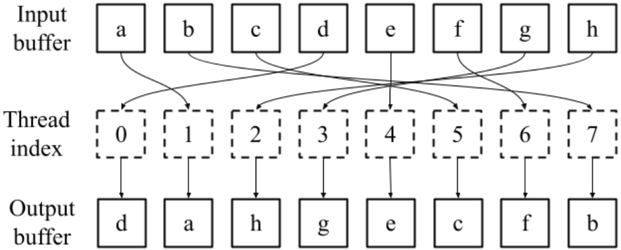
Linear-time algorithms that are traditionally used to shuffle data on CPUs, such as the method of Fisher-Yates, are not well suited to implementation on GPUs due to inherent sequential dependencies, and existing parallel shuffling algorithms are unsuitable for GPU architectures because they incur a large number of read/write operations to high latency global memory. To address this, we provide a method of generating pseudo-random permutations in parallel by fusing suitable pseudo-random bijective functions with stream compaction operations. Our algorithm, termed “bijective shuffle” trades increased per-thread arithmetic operations for reduced global memory transactions. It is work-efficient, deterministic, and only requires a single global memory read and write per shuffle input, thus maximising use of global memory bandwidth. To empirically demonstrate the correctness of the algorithm, we develop a statistical test for the quality of pseudo-random permutations based on kernel space embeddings. Experimental results show that the bijective shuffle algorithm outperforms competing algorithms on GPUs, showing improvements of between one and two orders of magnitude and approaching peak device bandwidth.
Overview
CoChat Summary
## TL;DR
The paper introduces a GPU-oriented shuffling algorithm, “bijective shuffle,” that uses pseudo-random bijective functions plus stream compaction to achieve bandwidth-optimal random shuffling with one global memory read and write per input element. It also proposes a kernel-based statistical test for permutation quality and reports GPU speedups of between one and two orders of magnitude over competing shuffle methods.
## Key findings
- The bijective shuffle is work-efficient and deterministic, and the paper states it requires a single global memory read and write per shuffle input, making it bandwidth-optimal for GPUs.
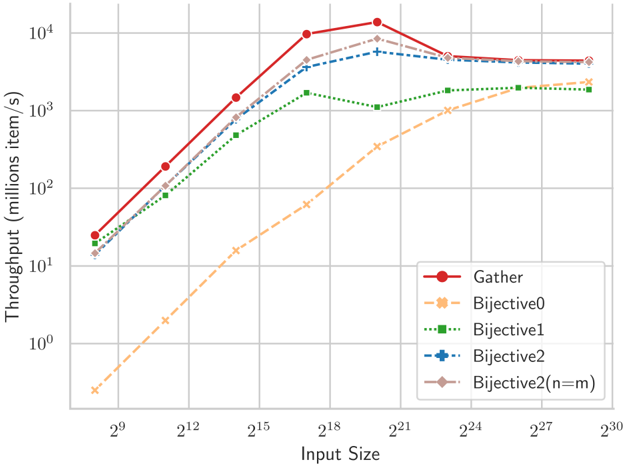
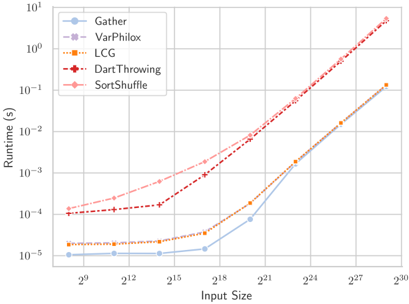
- On a Tesla V100-32GB, the optimized Bijective2 version closely matches the throughput of random gather; the paper reports it is equivalent in performance for sizes > 2^21.
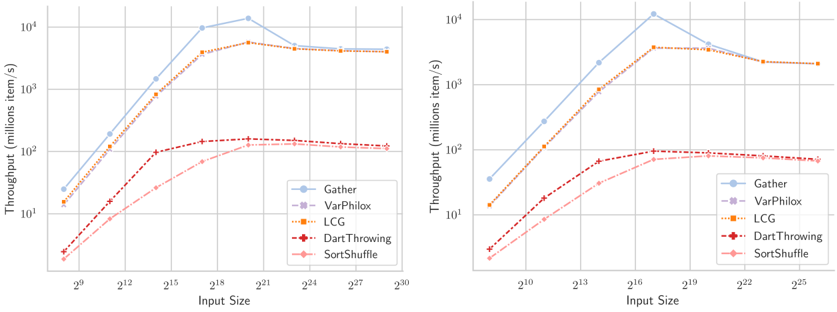
- On a GeForce RTX 2080, throughput for VarPhilox is reported at 3649.39 million items/s for input size 2^17 + 1, versus 95.38 for DartThrowing and 71.17 for SortShuffle.
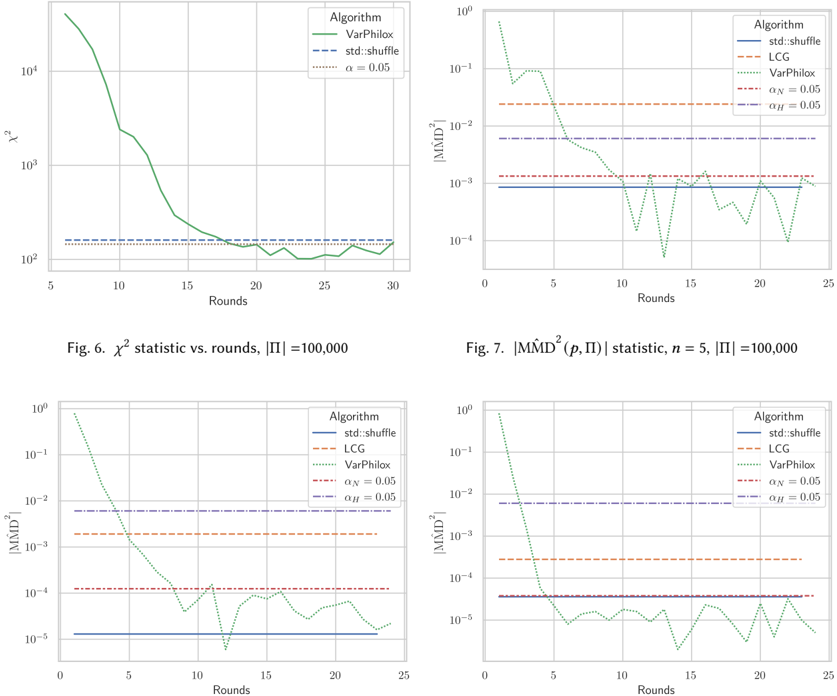
- The paper’s statistical testing recommends a 24-round VariablePhilox cipher; it reports that samples with fewer than 20 rounds are unlikely to be uniformly distributed at n = 5, and that the LCG variant “clearly fails” the chi-squared test with a statistic in the region of 500,000.
## Methods
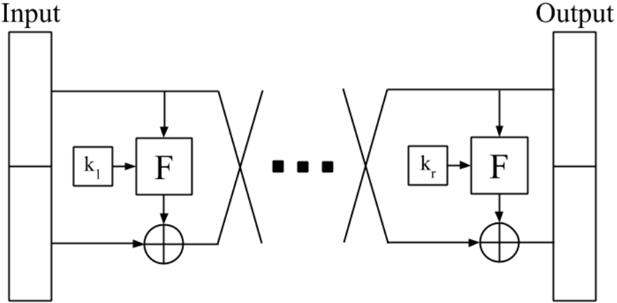
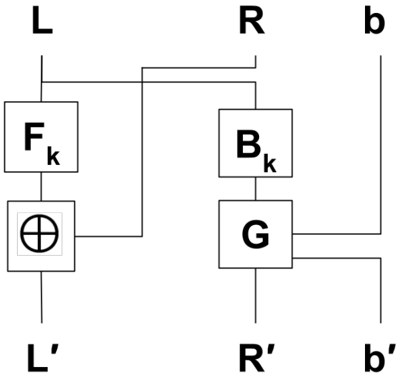
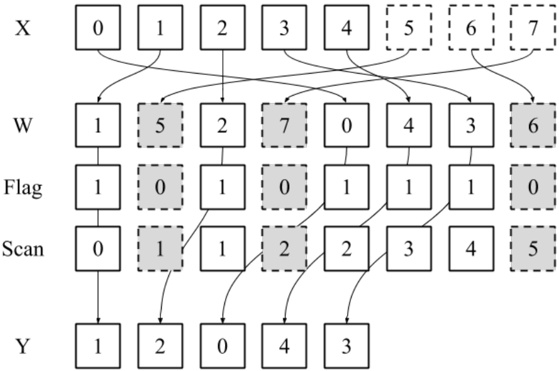
- The algorithmic design combines pseudo-random bijective functions (notably LCG and a modified Feistel/Philox variant called VariablePhilox) with exclusive scan / stream compaction to map a larger bijection down to arbitrary-length permutations.
- The paper evaluates throughput on GPUs using arrays of 64-bit keys, with input sizes of the form 2^w + 1 for w = 8 to 29, and reports the average of five trials.
- For permutation-quality assessment, it uses a chi-squared test for small n and develops an MMD-based test in an RKHS using the Mallows kernel for larger n.
## Limitations
- The paper states that the implementation’s parameterization differs from standard library shuffle interfaces: it is parameterized by a bijective function and a key of length log(n) k bits, rather than by a generic uniform random bit generator.
- The proposed GPU algorithm does not operate in-place and requires an output buffer; this is explicitly stated as a limitation relative to in-place shuffles like Fisher-Yates and Rao-Sandelius.
- Evident from the text: the statistical testing section notes that 21! > 2^64, so any shuffle using a 64-bit integer seed cannot generate all permutations for n ≥ 21; this is a limitation of the seed space, not necessarily of the algorithm itself.
Model-written summary. Check it against the paper before relying on it.
Integrity signals
Registry
Cites
Statistics
Figures
Verification
Claims the paper makes
2 Valid · 2 Not valid · 15 Not checked · 58 Own results and interpretations
The cited sources support only part of this claim — read each source’s verdict below.
In the paper
“The parallel work complexity of these recursive divide-and-conquer approaches is 𝑂 ( 𝑛 log ( 𝑛 )) .”
What the sources say
- Not checked — no full text of the sourcecites [53] [53] C. Radhakrishna Rao. 1961. Generation of Random Permutations of Given Number of Elements Using Random Sampling Numbers. Sankhy¯ a: The Indian Journal of Statistics, Series A (1961-2002) 23, 3 (1961), 305-307. -
- Not checked — no full text of the sourcecites [57] [57] Martin Sandelius. 1962. A Simple Randomization Procedure. Journal of the Royal Statistical Society. Series B (Methodological) 24, 2 (1962), 472-481. - source
- Partly supportedcites [4] [4] Axel Bacher, Olivier Bodini, Alexandros Hollender, and Jérémie O. Lumbroso. 2015. MergeShuffle: A Very Fast, Parallel Random Permutation Algorithm. CoRR abs/1508.03167 (2015). arXiv:1508.03167 http://arxiv.org/abs/1508.03167 - sourceExperimental — accuracy not yet measured
The Abstract (p. 1) says MergeShuffle runs in n log₂ n + O(1) time and can be parallelized, supporting the O(n log n) work claim for that algorithm. The discussion of Rao–Sandelius (p. 3) describes it as designed for parallelization, but the passages found do not establish its O(n log n) work complexity. (LLM, conf=0.82)
plain- Asserted: passes — The authors put it forward as true.
- Checkable: passes — It can be checked against evidence.
- Load-bearing: unclear — It is unclear whether the paper’s conclusions depend on it.
- Based: passes — The paper gives a reason why it holds.
A result the paper reports from its own data — it cites no other source for it, so there is none to check. The quote shows it is in the paper.
In the paper
“Comparing Figures 6 and 7, we see the MMD tests with the asymptotic acceptance threshold roughly coincide with the 𝜒 2 test at n = 5”
hedgedn = 5- Asserted: passes — The authors put it forward as true.
- Checkable: passes — It can be checked against evidence.
- Load-bearing: unclear — It is unclear whether the paper’s conclusions depend on it.
- Based: passes — The paper gives a reason why it holds.
A result the paper reports from its own data — it cites no other source for it, so there is none to check. The quote shows it is in the paper.
In the paper
“Experimental results show that the bijective shuffle algorithm outperforms competing algorithms on GPUs, showing improvements of between one and two orders of magnitude and approaching peak device bandwidth.”
boostedstates an association- Asserted: passes — The authors put it forward as true.
- Checkable: passes — It can be checked against evidence.
- Load-bearing: passes — The paper’s conclusions depend on it.
- Based: passes — The paper gives a reason why it holds.
A result the paper reports from its own data — it cites no other source for it, so there is none to check. The quote shows it is in the paper.
In the paper
“but VariablePhilox with 24 rounds or more passes all tests.”
plainn = 5- Asserted: passes — The authors put it forward as true.
- Checkable: passes — It can be checked against evidence.
- Load-bearing: passes — The paper’s conclusions depend on it.
- Based: passes — The paper gives a reason why it holds.
A result the paper reports from its own data — it cites no other source for it, so there is none to check. The quote shows it is in the paper.
In the paper
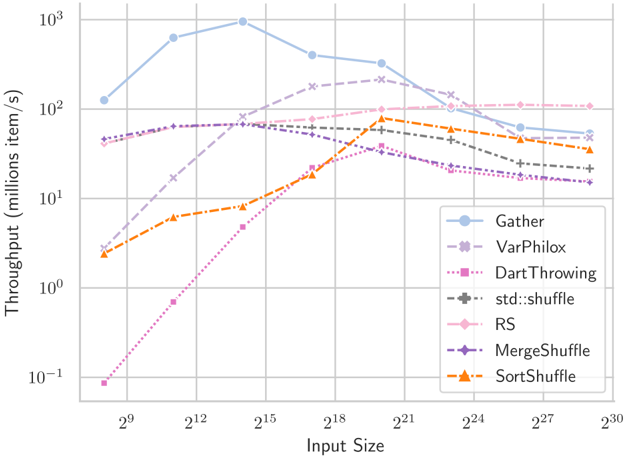
“Curiously, RS has higher throughput at large sizes than the TBB gather implementation.”
plainstates an association- Asserted: passes — The authors put it forward as true.
- Checkable: passes — It can be checked against evidence.
- Load-bearing: unclear — It is unclear whether the paper’s conclusions depend on it.
- Based: passes — The paper gives a reason why it holds.
44 more claims
Create a free account to see all 77 claims and to verify the 1 reference still open.
- Probably not a substantial claim. 15
- It may state two separate claims as one. 20
Citations
Cites
Mersenne twister: a 623-dimensionally equidistributed uniform pseudo-random number generator
Matsumoto, M., & Nishimura, T. (1998) · ACM Transactions on Modeling and Computer Simulation · doi:10.1145/272991.272995 · Cited by 5,780 · cited 2×
“This is in contrast to the canonical Mersenne twister [40], which requires a state of 2.”
BackgroundResultProbability Inequalities for Sums of Bounded Random Variables
Hoeffding, W. (1963) · Journal of the American Statistical Association · doi:10.1080/01621459.1963.10500830 · Cited by 4,852
The Art of Computer Programming. Volume 2: Seminumerical Algorithms.
Taussky, O., & Knuth, D. E. (1970) · The American Mathematical Monthly · doi:10.2307/2317055 · Cited by 3,822
(2012) · MPG.PuRe (Max Planck Society) · doi:10.5555/2188385.2188410 · Cited by 3,603
Statistical Tables for Biological, Agricultural and Medical Research.
Reed, L. J., Fisher, R. A., & Yates, F. (1944) · Journal of the American Statistical Association · doi:10.2307/2280633 · Cited by 2,998
An introduction to parallel algorithms
JáJá, J. F. (1992) · Cited by 1,600
Group representations in probability and statistics
Diaconis, P. (1988) · doi:10.1214/lnms/1215467407 · Cited by 1,381
Probability Inequalities for Sums of Bounded Random Variables
Hoeffding, W. (1963) · Journal of the American Statistical Association · doi:10.2307/2282952 · Cited by 1,166
TestU01: A C library for empirical testing of random number generators
L'Ecuyer, P., & Simard, R. (2007) · ACM Transactions on Mathematical Software · doi:10.1145/1268776.1268777 · Cited by 1,014
Intel threading building blocks : outfitting C++ for multi-core processor parallelism
Reinders, J. R. (2007) · O'Reilly eBooks · Cited by 972
Research works printed but not linked: 5
- [41] Duane Merrill. 2015. Cub. NVIDIA Research (2015). -
- [42] Duane Merrill and Michael Garland. 2016. Single-pass parallel prefix scan with decoupled look-back. NVIDIA, Tech. Rep. NVR-2016-002 (2016). -
- [51] William H. Press, Saul A. Teukolsky, William T. Vetterling, and Brian P. Flannery. 2007. Numerical Recipes 3rd Edition: The Art of Scientific Computing (3 ed.). Cambridge University Press, New York, NY, USA. - · doi:10.5555/6771
- [61] Bjarne Stroustrup. 2013. The C++ programming language . Pearson Education. - · doi:10.5555/2543987
- [63] RAPIDS Development Team. 2018. RAPIDS: Collection of Libraries for End to End GPU Data Science . https://rapids.ai
Cited by
Park, J.-Y., Lee, D., Kim, S., Lee, W., Kang, B. G., & Sakurai, K. (2024) · IEEE Transactions on Emerging Topics in Computing · doi:10.1109/tetc.2024.3478228 · Cited by 3
“(cid:2) Implementation on GPUs: Similar to the approach implemented by Mitchell et al. [22], we can consider software optimization using GPUs to generalize our results in a software environment.”
Park, J.-Y., Ju, J.-W., Lee, W., Kang, B. G., Kachi, Y., & Sakurai, K. (2024) · Journal of Information Security and Applications · doi:10.1016/j.jisa.2024.103797 · Cited by 3
d3p - A Python Package for Differentially-Private Probabilistic Programming
Prediger, L., Loppi, N., Kaski, S., & Honkela, A. (2022) · Proceedings on Privacy Enhancing Technologies · doi:10.2478/popets-2022-0052 · Cited by 7
“The remaining code implementing the logistic regression for individual records is almost identical to the implementation of the simple model, except that we use the group indicators l i provided in ls to select the entry in ws that corresponds to the w l i of the group each record belongs to.”
MethodPark, J.-Y., Kim, S., Lee, W., Kang, B. G., Song, I.-J., Oh, J. H., & Sakurai, K. (2025) · ACM Transactions on Embedded Computing Systems · doi:10.1145/3715961 · Cited by 1
Generating Permutations at Scale
Green, O., Eaton, J., Tripathy, A., Nolet, C., & Luitjens, J. (2025) · International Conference for High Performance Computing, Networking, Storage and Analysis (SC) · doi:10.1145/3731599.3767436
Metadata
- Authors
- Mitchell, R., Stokes, D., Frank, E., & Holmes, G.
- Affiliations
- University of Waikato (NZ)
- Venue
- ACM Transactions on Parallel Computing
- Published
- 2022-01-31
- Volume
- 9
- Issue
- 1
- Pages
- 1-20
- ISSN
- 2329-4949 (ISSN-L)
- 2329-4957
- OpenAlex
- W3167411928
- Cited by
- 6
- References
- 61
- Citations by year
- 2025: 2 · 2024: 2 · 2023: 1 · 2022: 1
- FWCI
- 1.15
- Type
- journal article
- Language
- en
- Open access
- green
- arxiv.org
- Locations
- ACM Transactions on Parallel Computing (publishedVersion)
- arXiv (Cornell University) (submittedVersion)
- Research Commons (University of Waikato) (submittedVersion)
- arXiv (Cornell University)
- Topics
- Physical Sciences › Computer Science › Hardware and Architecture › Parallel Computing and Optimization Techniques
- Physical Sciences › Computer Science › Computer Graphics and Computer-Aided Design › Computer Graphics and Visualization Techniques
- Physical Sciences › Computer Science › Computational Theory and Mathematics › Graph Theory and Algorithms
- Keywords
- random shuffling, GPU memory bandwidth, pseudorandom permutations, Fisher-Yates shuffle, global memory access, parallel algorithms
About these checks
Registry, retraction, Cites and statistics results are computed, not judged, with one exception: a printed reference that no index lists is read once by a model before it counts as a citation error. Claims are extracted by a model and kept only when their quote appears verbatim in the text; each cited source is then checked, with a model’s help, for whether it says what the claim relies on. Those verdicts can be wrong — read the claim’s quote and the cited source before relying on one.
The claim verdicts this report counts are experimental: their accuracy is not yet measured.
A language model drew the claims from the paper on 2026-10-10, under version 3 of the claim definition (model deepseek-v4.1-flash, prompt extract-v3).
A second model labelled each claim on 2026-10-10 (model jev-1.13-20260917, definition revision gold-guideline-v0.2).
Cited sources are checked with a language model’s help (gpt-6-sol).
Statistics and arithmetic are recomputed, not judged.
Confidence bands are shown only for fields calibrated on our annotated test set. None is calibrated yet, so no band is shown.
What counts as a claim ›How we measure confidence ›How we check this ›
Are you an author, or do you see a problem with this page? Request a review
Data sources
Bibliographic data: Semantic Scholar, OpenAlex, Crossref.
Contains information from the Semantic Scholar Academic Graph Datasets, made available under the ODC Attribution License (ODC-BY 1.0).
Semantic Scholar’s data is described in: Kinney, R., et al. (2023). The Semantic Scholar Open Data Platform. arXiv:2301.10140.
