

Bandwidth-Optimal Random Shuffling for GPUs
Open accessThe DOI matches its Crossref record; 69 of the 69 references it cites were found in a registry or an index; 2 of the 22 sources its claims cite were checked for support.
Abstract
Linear-time algorithms that are traditionally used to shuffle data on CPUs, such as the method of Fisher-Yates, are not well suited to implementation on GPUs due to inherent sequential dependencies, and existing parallel shuffling algorithms are unsuitable for GPU architectures because they incur a large number of read/write operations to high latency global memory. To address this, we provide a method of generating pseudo-random permutations in parallel by fusing suitable pseudo-random bijective functions with stream compaction operations. Our algorithm, termed “bijective shuffle” trades increased per-thread arithmetic operations for reduced global memory transactions. It is work-efficient, deterministic, and only requires a single global memory read and write per shuffle input, thus maximising use of global memory bandwidth. To empirically demonstrate the correctness of the algorithm, we develop a statistical test for the quality of pseudo-random permutations based on kernel space embeddings. Experimental results show that the bijective shuffle algorithm outperforms competing algorithms on GPUs, showing improvements of between one and two orders of magnitude and approaching peak device bandwidth.
Overview
CoChat Summary
## TL;DR
The paper introduces a GPU-oriented shuffling algorithm, “bijective shuffle,” that uses pseudo-random bijective functions plus stream compaction to achieve bandwidth-optimal random shuffling with one global memory read and write per input element. It also proposes a kernel-based statistical test for permutation quality and reports GPU speedups of between one and two orders of magnitude over competing shuffle methods.
## Key findings
- The bijective shuffle is work-efficient and deterministic, and the paper states it requires a single global memory read and write per shuffle input, making it bandwidth-optimal for GPUs.
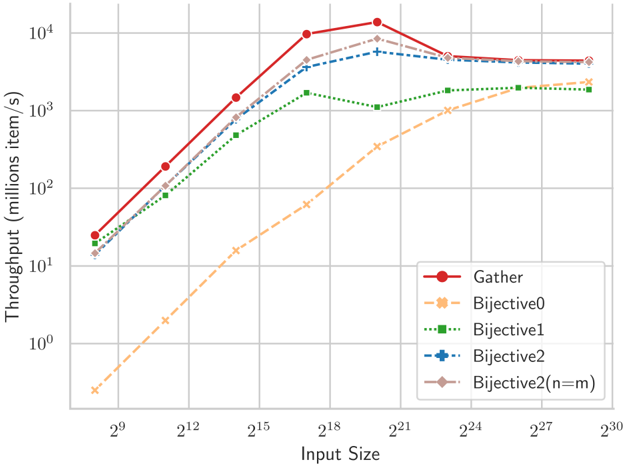
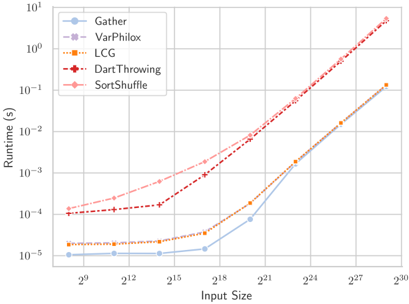
- On a Tesla V100-32GB, the optimized Bijective2 version closely matches the throughput of random gather; the paper reports it is equivalent in performance for sizes > 2^21.
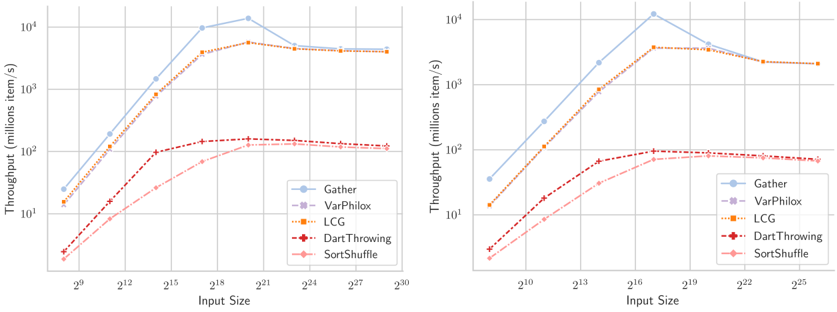
- On a GeForce RTX 2080, throughput for VarPhilox is reported at 3649.39 million items/s for input size 2^17 + 1, versus 95.38 for DartThrowing and 71.17 for SortShuffle.
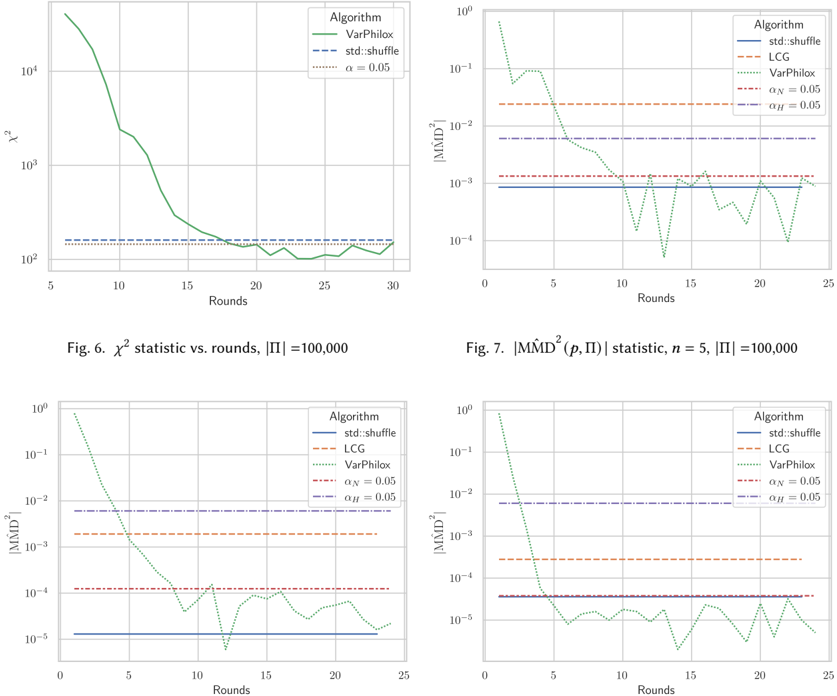
- The paper’s statistical testing recommends a 24-round VariablePhilox cipher; it reports that samples with fewer than 20 rounds are unlikely to be uniformly distributed at n = 5, and that the LCG variant “clearly fails” the chi-squared test with a statistic in the region of 500,000.
## Methods
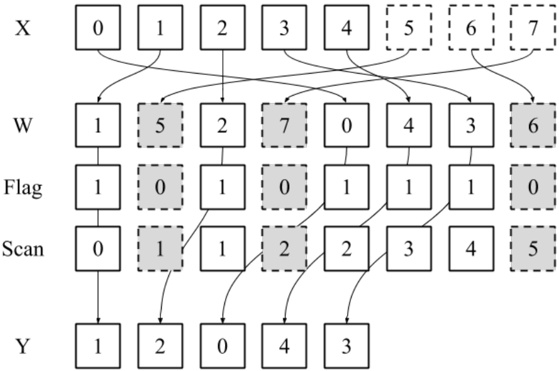
- The algorithmic design combines pseudo-random bijective functions (notably LCG and a modified Feistel/Philox variant called VariablePhilox) with exclusive scan / stream compaction to map a larger bijection down to arbitrary-length permutations.
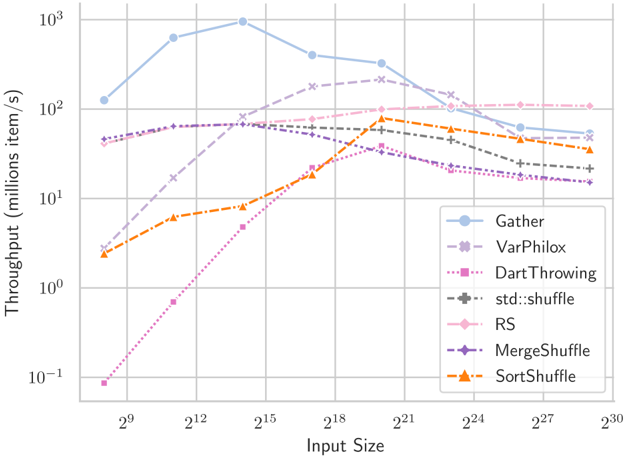
- The paper evaluates throughput on GPUs using arrays of 64-bit keys, with input sizes of the form 2^w + 1 for w = 8 to 29, and reports the average of five trials.
- For permutation-quality assessment, it uses a chi-squared test for small n and develops an MMD-based test in an RKHS using the Mallows kernel for larger n.
## Limitations
- The paper states that the implementation’s parameterization differs from standard library shuffle interfaces: it is parameterized by a bijective function and a key of length log(n) k bits, rather than by a generic uniform random bit generator.
- The proposed GPU algorithm does not operate in-place and requires an output buffer; this is explicitly stated as a limitation relative to in-place shuffles like Fisher-Yates and Rao-Sandelius.
- Evident from the text: the statistical testing section notes that 21! > 2^64, so any shuffle using a 64-bit integer seed cannot generate all permutations for n ≥ 21; this is a limitation of the seed space, not necessarily of the algorithm itself.
Model-written summary. Check it against the paper before relying on it.
Integrity signals
Registry
Cites
Statistics
Figures
Verification
Claims the paper makes
2 Valid · 2 Not valid · 15 Not checked · 58 Own results and interpretations
The cited sources support only part of this claim — read each source’s verdict below.
In the paper
“The parallel work complexity of these recursive divide-and-conquer approaches is 𝑂 ( 𝑛 log ( 𝑛 )) .”
What the sources say
- Not checked — no full text of the sourcecites [53] [53] C. Radhakrishna Rao. 1961. Generation of Random Permutations of Given Number of Elements Using Random Sampling Numbers. Sankhy¯ a: The Indian Journal of Statistics, Series A (1961-2002) 23, 3 (1961), 305-307. -
- Not checked — no full text of the sourcecites [57] [57] Martin Sandelius. 1962. A Simple Randomization Procedure. Journal of the Royal Statistical Society. Series B (Methodological) 24, 2 (1962), 472-481. - source
- Partly supportedcites [4] [4] Axel Bacher, Olivier Bodini, Alexandros Hollender, and Jérémie O. Lumbroso. 2015. MergeShuffle: A Very Fast, Parallel Random Permutation Algorithm. CoRR abs/1508.03167 (2015). arXiv:1508.03167 http://arxiv.org/abs/1508.03167 - sourceExperimental — accuracy not yet measured
The Abstract (p. 1) says MergeShuffle runs in n log₂ n + O(1) time and can be parallelized, supporting the O(n log n) work claim for that algorithm. The discussion of Rao–Sandelius (p. 3) describes it as designed for parallelization, but the passages found do not establish its O(n log n) work complexity. (LLM, conf=0.82)
plain- Asserted: passes — The authors put it forward as true.
- Checkable: passes — It can be checked against evidence.
- Load-bearing: unclear — It is unclear whether the paper’s conclusions depend on it.
- Based: passes — The paper gives a reason why it holds.
A result the paper reports from its own data — it cites no other source for it, so there is none to check. The quote shows it is in the paper.
In the paper
“Comparing Figures 6 and 7, we see the MMD tests with the asymptotic acceptance threshold roughly coincide with the 𝜒 2 test at n = 5”
hedgedn = 5- Asserted: passes — The authors put it forward as true.
- Checkable: passes — It can be checked against evidence.
- Load-bearing: unclear — It is unclear whether the paper’s conclusions depend on it.
- Based: passes — The paper gives a reason why it holds.
A result the paper reports from its own data — it cites no other source for it, so there is none to check. The quote shows it is in the paper.
In the paper
“Experimental results show that the bijective shuffle algorithm outperforms competing algorithms on GPUs, showing improvements of between one and two orders of magnitude and approaching peak device bandwidth.”
boostedstates an association- Asserted: passes — The authors put it forward as true.
- Checkable: passes — It can be checked against evidence.
- Load-bearing: passes — The paper’s conclusions depend on it.
- Based: passes — The paper gives a reason why it holds.
A result the paper reports from its own data — it cites no other source for it, so there is none to check. The quote shows it is in the paper.
In the paper
“but VariablePhilox with 24 rounds or more passes all tests.”
plainn = 5- Asserted: passes — The authors put it forward as true.
- Checkable: passes — It can be checked against evidence.
- Load-bearing: passes — The paper’s conclusions depend on it.
- Based: passes — The paper gives a reason why it holds.
A result the paper reports from its own data — it cites no other source for it, so there is none to check. The quote shows it is in the paper.
In the paper
“Curiously, RS has higher throughput at large sizes than the TBB gather implementation.”
plainstates an association- Asserted: passes — The authors put it forward as true.
- Checkable: passes — It can be checked against evidence.
- Load-bearing: unclear — It is unclear whether the paper’s conclusions depend on it.
- Based: passes — The paper gives a reason why it holds.
44 more claims
Create a free account to see all 77 claims and to verify the 1 reference still open.
- Probably not a substantial claim. 15
- It may state two separate claims as one. 20
Citations
Cites
Mersenne twister: a 623-dimensionally equidistributed uniform pseudo-random number generator
Matsumoto, M., & Nishimura, T. (1998) · ACM Transactions on Modeling and Computer Simulation · doi:10.1145/272991.272995 · Cited by 5,780 · cited 2×
“This is in contrast to the canonical Mersenne twister [40], which requires a state of 2.”
BackgroundResultProbability Inequalities for Sums of Bounded Random Variables
Hoeffding, W. (1963) · Journal of the American Statistical Association · doi:10.1080/01621459.1963.10500830 · Cited by 4,852
The Art of Computer Programming. Volume 2: Seminumerical Algorithms.
Taussky, O., & Knuth, D. E. (1970) · The American Mathematical Monthly · doi:10.2307/2317055 · Cited by 3,822
(2012) · MPG.PuRe (Max Planck Society) · doi:10.5555/2188385.2188410 · Cited by 3,603
Statistical Tables for Biological, Agricultural and Medical Research.
Reed, L. J., Fisher, R. A., & Yates, F. (1944) · Journal of the American Statistical Association · doi:10.2307/2280633 · Cited by 2,998
An introduction to parallel algorithms
JáJá, J. F. (1992) · Cited by 1,600
Group representations in probability and statistics
Diaconis, P. (1988) · doi:10.1214/lnms/1215467407 · Cited by 1,381
Probability Inequalities for Sums of Bounded Random Variables
Hoeffding, W. (1963) · Journal of the American Statistical Association · doi:10.2307/2282952 · Cited by 1,166
TestU01: A C library for empirical testing of random number generators
L'Ecuyer, P., & Simard, R. (2007) · ACM Transactions on Mathematical Software · doi:10.1145/1268776.1268777 · Cited by 1,014
Intel threading building blocks : outfitting C++ for multi-core processor parallelism
Reinders, J. R. (2007) · O'Reilly eBooks · Cited by 972
cuDNN: Efficient Primitives for Deep Learning
Chetlur, S., Woolley, C., Vandermersch, P., Cohen, J., Tran, J. J., Catanzaro, B., & Shelhamer, E. (2014) · arXiv (Cornell University) · doi:10.48550/arxiv.1410.0759 · Cited by 943 · cited 1×
“Notable examples are matrix multiplication [10, 17, 27], image processing [9, 46], deep neural networks [11, 12, 48], and sorting [23, 59].”
BackgroundHow to Construct Pseudorandom Permutations from Pseudorandom Functions
Luby, M., & Rackoff, C. (1988) · SIAM Journal on Computing · doi:10.1137/0217022 · Cited by 938
Cryptography and Computer Privacy
Feistel, H. (1973) · Scientific American · doi:10.1038/scientificamerican0573-15 · Cited by 777 · cited 1×
“A second candidate bijective function is a block cipher construction known as a Feistel network [17].”
Prefix sums and their applications
Blelloch, G. (1990) · Figshare · doi:10.1184/r1/6608579.v1 · Cited by 744 · cited 1×
“To achieve the compaction in parallel, we use the work-efficient exclusive scan of Blelloch [8].”
MethodDimensionality Reduction for Supervised Learning With Reproducing Kernel Hilbert Spaces
Fukumizu, K., Bach, F. R., & Jordan, M. I. (2003) · doi:10.21236/ada446572 · Cited by 723
Permutation, Parametric and Bootstrap Tests of Hypotheses
(2005) · Springer Series in Statistics · doi:10.1007/b138696 · Cited by 707
(2013) · Cited by 651
Parallel Prefix Sum (Scan) with CUDA
Harris, M. (2011) · Cited by 545
Statistical Tables for Biological, Agricultural and Medical Research.
K., M. G., Fisher, R. A., & Yates, F. (1939) · Journal of the Royal Statistical Society · doi:10.2307/2980011 · Cited by 436
Parallel tree contraction and its application
Miller, G. L., & Reif, J. H. (1985) · 26th Annual Symposium on Foundations of Computer Science (sfcs 1985) · doi:10.1109/sfcs.1985.43 · Cited by 404 · cited 1×
“Miller and Reif [43] and later Rajasekaran and Reif [52] describe a simple method in which a parallel prefix sum is used to perform the compaction.”
MethodBell, N., & Hoberock, J. (2012) · GPU Computing Gems Jade Edition · doi:10.1016/b978-0-12-385963-1.00026-5 · Cited by 402 · cited 2×
“The work presented in this article was motivated by a gap in GPU-oriented parallel primitive libraries, such as Thrust [6], Cub [41], and Boost.”
MethodMoreland, K., & Angel, E. (2003) · SIGGRAPH/EUROGRAPHICS Conference On Graphics Hardware · doi:10.2312/eggh03/112-119 · Cited by 401
Prefix sums and their applications
Blelloch, G. E. (2018) · Figshare · doi:10.1184/r1/6608579 · Cited by 379
Accelerating the XGBoost algorithm using GPU computing
Mitchell, R., & Frank, E. (2017) · PeerJ Computer Science · doi:10.7717/peerj-cs.127 · Cited by 359
Self-citationA Computer Method for Calculating Kendall's Tau with Ungrouped Data
Knight, W. R. (1966) · Journal of the American Statistical Association · doi:10.1080/01621459.1966.10480879 · Cited by 324 · cited 1×
“It may be implemented in time O (n logn) using the procedure presented in [31].”
MethodData Encryption Standard (DES)
Biryukov, A., & De Cannière, C. (2011) · Encyclopedia of Cryptography and Security · doi:10.1007/978-1-4419-5906-5_568 · Cited by 317
Understanding the efficiency of GPU algorithms for matrix-matrix multiplication
Fatahalian, K., Sugerman, J., & Hanrahan, P. (2004) · Proceedings of the ACM SIGGRAPH/EUROGRAPHICS conference on Graphics hardware · doi:10.1145/1058129.1058148 · Cited by 309 · cited 1×
“Notable examples are matrix multiplication [10, 16, 26], image processing [9, 44], deep neural networks [11, 12, 46], and sorting [22, 56].”
BackgroundCUDA Application Design and Development
(2011) · doi:10.1016/c2010-0-69090-0 · Cited by 294
Moreland, K., & Angel, E. S. (2003) · SIGGRAPH/EUROGRAPHICS Conference On Graphics Hardware · doi:10.5555/844174.844191 · Cited by 287
Fast sort on CPUs and GPUs: a case for bandwidth oblivious SIMD sort
Satish, N., Kim, C., Chhugani, J., Nguyen, A. D., Lee, V. W., Kim, D., & Dubey, P. (2010) · Proceedings of the 2010 ACM SIGMOD International Conference on Management of data · doi:10.1145/1807167.1807207 · Cited by 240 · cited 1×
“Notable examples are matrix multiplication [10, 17, 27], image processing [9, 46], deep neural networks [11, 12, 48], and sorting [23, 59].”
BackgroundParallel random numbers: as easy as 1, 2, 3
Salmon, J. K., Moraes, M. A., Dror, R. O., & Shaw, D. E. (2011) · Proceedings of 2011 International Conference for High Performance Computing, Networking, Storage and Analysis · doi:10.1145/2063384.2063405 · Cited by 227
Optimal and Sublogarithmic Time Randomized Parallel Sorting Algorithms
Rajasekaran, S., & Reif, J. H. (1989) · SIAM Journal on Computing · doi:10.1137/0218041 · Cited by 171 · cited 1×
“Miller and Reif [43] and later Rajasekaran and Reif [52] describe a simple method in which a parallel prefix sum is used to perform the compaction.”
MethodEfficient gather and scatter operations on graphics processors
He, B., Govindaraju, N. K., Luo, Q., & Smith, B. J. (2007) · ACM/IEEE Conference on Supercomputing (SC) · doi:10.1145/1362622.1362684 · Cited by 153 · cited 1×
“Scatter/gather operations for GPUs are discussed in detail in [28].”
BackgroundGreen, O., McColl, R., & Bader, D. A. (2012) · ACM International Conference on Supercomputing (ICS) · doi:10.1145/2304576.2304621 · Cited by 124 · cited 1×
“Notable examples are matrix multiplication [10, 17, 27], image processing [9, 46], deep neural networks [11, 12, 48], and sorting [23, 59].”
BackgroundAn optimal parallel algorithm for integer sorting
Reif, J. H. (1985) · Annual Symposium on Foundations of Computer Science · doi:10.1109/sfcs.1985.9 · Cited by 124 · cited 2×
“the sort algorithm described by Reif [54].”
BackgroundConverting high probability into nearly-constant time---with applications to parallel hashing
Matias, Y., & Vishkin, U. (1991) · ACM Symposium on Theory of Computing (STOC) · doi:10.1145/103418.103453 · Cited by 99 · cited 1×
“Matias and Vishkin [39] describe a method using the canonical cycle representation to perform the compaction step, and Hagerup [26] provides an alternative method for computing the min prefixes used when generating the cycle representation.”
MethodÉcole d'Été de Probabilités de Saint-Flour XV–XVII, 1985–87
Diaconis, P., Elworthy, D., Föllmer, H., Nelson, E., Papanicolaou, G., & Varadhan, S. R. S. (1988) · Lecture Notes in Mathematics · doi:10.1007/bfb0086177 · Cited by 78
Cache and bandwidth aware matrix multiplication on the GPU
Hall, J. D., Carr, N., & Hart, J. C. (2010) · Cited by 74
Random permutations on distributed, external and hierarchical memory
Sanders, P. (1998) · Information Processing Letters · doi:10.1016/s0020-0190(98)00127-6 · Cited by 72 · cited 1×
“Sanders [58] describes an algorithm for external memory and distributed environments where each item is allocated to a separate processor and permuted locally.”
BackgroundFast parallel generation of random permutations
Hagerup, T. (1991) · Lecture notes in computer science · doi:10.1007/3-540-54233-7_151 · Cited by 66 · cited 1×
“Matias and Vishkin [37] describe a method using the canonical cycle representation to perform the compaction step, and Hagerup [25] provides an alternative method for computing the min prefixes used when generating the cycle representation.”
MethodAutomatic tuning matrix multiplication performance on graphics hardware
Jiang, C., & Snir, M. (2005) · 14th International Conference on Parallel Architectures and Compilation Techniques (PACT'05) · doi:10.1109/pact.2005.10 · Cited by 57 · cited 1×
“Notable examples are matrix multiplication [10, 17, 27], image processing [9, 46], deep neural networks [11, 12, 48], and sorting [23, 59].”
BackgroundData encryption standard (DES)
Biryukov, A., & Cannière, C. (2006) · Encyclopedia of Cryptography and Security · doi:10.1007/0-387-23483-7_94 · Cited by 57
Fast in-place sorting with cuda based on bitonic sort
Peters, H., Schulz-Hildebrandt, O., & Luttenberger, N. (2010) · Lecture Notes in Computer Science · doi:10.1007/978-3-642-14390-8_42 · Cited by 54
Parallel algorithms for generating random permutations on a shared memory machine
Anderson, R. (1990) · Proceedings of the second annual ACM symposium on Parallel algorithms and architectures - SPAA '90 · doi:10.1145/97444.97674 · Cited by 49 · cited 4×
“parallel Fisher-Yates algorithm of [2] is non-deterministic and relies on fairly serialised atomics for correctness (GPU atomics are not fairly serialised).”
BackgroundMethodInfluentialChapter 16 – Thrust: A Productivity-Oriented Library for CUDA
Bell, N., Hoberock, J., & Rodrigues, C. (2013) · doi:10.1016/b978-0-12-415992-1.00016-x · Cited by 42
Fast Generation of Random Permutations Via Networks Simulation
Czumaj, A., Kanarek, P., Kutyłowski, M., & Loryś, K. (1998) · Algorithmica · doi:10.1007/pl00009206 · Cited by 40 · cited 3×
“[14], composes n-way “splitters” to construct a network randomly permuting the input array.”
BackgroundMethodInfluentialPerfect Block Ciphers with Small Blocks
Granboulan, L., & Pornin, T. (2007) · Lecture notes in computer science · doi:10.1007/978-3-540-74619-5_28 · Cited by 35 · cited 1×
“Granboulan and Pornin [21] use this method to generate a bijective function over an arbitrary input domain using O (log(n)) space and O (log(n)) time, but find the cost of the hyper-geometric random number generator used to construct splitters prohibitive.”
MethodA parallel algorithm for the generation of a permutation and applications
Alonso, L., & Schott, R. (1996) · Theoretical Computer Science · doi:10.1016/0304-3975(95)00198-0 · Cited by 31 · cited 2×
“uint64_t VariablePhilox(const uint64_t val) const { static const uint64_t M0 = UINT64_C(0xD2B74407B1CE6E93); uint32_t state[2] = { uint32_t(val >> right_side_bits), uint32_t(val & right_side_mask) }; for (int i = 0; i < num_rounds; i++) { uint32_t hi; uint32_t lo = mulhilo(M0, state[0], hi); lo = (lo << (right_side_bi…”
MethodBacher, A., Bodini, O., Hwang, H., & Tsai, T. (2017) · ACM Transactions on Algorithms · doi:10.1145/3009909 · Cited by 30 · cited 1×
“In particular, RS is equivalent to a most significant digit (MSD) radix sort [5] on a sequence, where each element in the sequence is an infinite length random bit stream.”
BackgroundRandomized permutations in a coarse grained parallel environment
Gustedt, J. (2003) · ACM Symposium on Parallelism in Algorithms and Architectures (SPAA) · doi:10.1145/777412.777454 · Cited by 29 · cited 1×
“Gustedt [25] also expands on this approach, describing a method of constructing a random communication matrix that ensures work is distributed fairly between all processors.”
MethodSzuppe, J. (2016) · International Workshop on OpenCL · doi:10.1145/2909437.2909454 · Cited by 28 · cited 1×
“Compute [58], which aim to implement the C++ standard library in equivalent form for”
MethodTechniques for Efficient DCT/IDCT Implementation on Generic GPU
Fang, B., Shen, G., Li, S., et al. (2005) · IEEE International Symposium on Circuits and Systems proceedings · doi:10.1109/iscas.2005.1464791 · Cited by 25 · cited 1×
“Notable examples are matrix multiplication [10, 17, 27], image processing [9, 46], deep neural networks [11, 12, 48], and sorting [23, 59].”
BackgroundSequential Random Permutation, List Contraction and Tree Contraction are Highly Parallel
Shun, J., Gu, Y., Blelloch, G. E., Fineman, J. T., & Gibbons, P. B. (2015) · Cited by 24
The Kendall and Mallows kernels for permutations
Jiao, Y., & Vert, J.-P. (2018) · IEEE Transactions on Pattern Analysis and Machine Intelligence · doi:10.1109/tpami.2017.2719680 · Cited by 21 · cited 1×
“The Mallows kernel is introduced in [32] and shown to be characteristic in [38].”
Background(1961) · Cited by 19
On kernel methods for covariates that are rankings
Mania, H., Ramdas, A., Wainwright, M. J., Jordan, M. I., & Recht, B. (2018) · Electronic Journal of Statistics · doi:10.1214/18-ejs1437 · Cited by 18 · cited 1×
“The Mallows kernel is introduced in [32] and shown to be characteristic in [38].”
BackgroundMergeShuffle: A Very Fast, Parallel Random Permutation Algorithm
Bacher, A., Bodini, O., Hollender, A., & Lumbroso, J. (2015) · arXiv · doi:10.48550/arxiv.1508.03167 · Cited by 18 · cited 4×
“The RS and MergeShuffle In particular, RS is equivalent to a most significant Likewise, MergeShuffle has strong parallels to merge sort, differing in the definition of the merge operator for each pass. similar approach, proving that the Fisher-Yates algorithm has an execution dependence graph with a depth of 𝑂 ( log (…”
MethodInfluentialAccelerating the XGBoost algorithm using GPU computingPreprint
Mitchell, R., & Frank, E. (2017) · doi:10.7287/peerj.preprints.2911v1 · Cited by 15
Self-citationA Simple Randomization Procedure
Sandelius, M. (1962) · Journal of the Royal Statistical Society Series B: Statistical Methodology · doi:10.1111/j.2517-6161.1962.tb00474.x · Cited by 13 · cited 1×
“A parallel divide-and-conquer shuffling algorithm is independently proposed by Rao [50] and Sandelius [54] (we refer to this algorithm as RS).”
MethodAn Empirical Analysis of Parallel Random Permutation Algorithms on SMPs
Cong, G., & Bader, D. A. (2006) · SMARTech Repository (Georgia Institute of Technology) · Cited by 12
GPU Implementation of Bayesian Neural Network Construction for Data-Intensive Applications
Kuchera, M., Prosper, H. B., & Meyer‐Baese, A. (2014) · Journal of Physics Conference Series · doi:10.1088/1742-6596/513/2/022027 · Cited by 9 · cited 1×
“Notable examples are matrix multiplication [10, 17, 27], image processing [9, 46], deep neural networks [11, 12, 48], and sorting [23, 59].”
BackgroundLangr, D., Tvrdı́k, P., Dytrych, T., et al. (2014) · ACM Transactions on Mathematical Software · doi:10.1145/2669372 · Cited by 9
d3p - A Python Package for Differentially-Private Probabilistic Programming
Prediger, L., Loppi, N., Kaski, S., & Honkela, A. (2022) · Proceedings on Privacy Enhancing Technologies · doi:10.2478/popets-2022-0052 · Cited by 7 · cited 1×
“Some applications motivating this work are: permutation Monte Carlo tests [21], bootstrap sampling [45], approximation of Shapley values for feature attribution [44], differentially private variational inference [50], and shuffle operators in GPU accelerated dataframe libraries [63].”
MethodEfficient Parallel Random Rearrange
Andrés, D. M., & Pérez, L. P. (2011) · Advances in Intelligent and Soft Computing · doi:10.1007/978-3-642-19934-9_23 · Cited by 2 · cited 1×
“Closest to our work is the Linear Congruential Generator (LCG) based approach of Andrés and Pérez [3], where permutations are generated by an LCG of full period.”
MethodMulti-paths Deep Convolutional Neural Network Based on Knowledge Distillation
Lin, Y., Ma, Y., Chen, B., Wang, N., & Bai, G. (2021) · International Conference on Computing and Pattern Recognition (ICCPR) · doi:10.1145/3497623.3497674 · Cited by 1
Randomized permutations in a coarse grained parallel environment
Gustedt, J. (2003) · doi:10.1145/777449.777454 · Cited by 1
Sampling Permutations for Shapley Value Estimation
Mitchell, R., Cooper, J., Frank, E., & Holmes, G. (2021) · arXiv · doi:10.48550/arxiv.2104.12199 · cited 2×
“In the following, we make use of the fact [44] that the expected value of the Mallows kernel under a uniform distribution of permutations is”
MethodSelf-citationD3p -- A Python Package for Differentially-Private Probabilistic Programming
Prediger, L., Loppi, N., Kaski, S., et al. (2021) · arXiv · doi:10.48550/arxiv.2103.11648
Sequential Random Permutation, List Contraction and Tree Contraction are Highly Parallel
Shun, J., Gu, Y., Blelloch, G. E., et al. (2015) · Proceedings of the Twenty-Sixth Annual ACM-SIAM Symposium on Discrete Algorithms · doi:10.1137/1.9781611973730.30
Research works printed but not linked: 5
- [41] Duane Merrill. 2015. Cub. NVIDIA Research (2015). -
- [42] Duane Merrill and Michael Garland. 2016. Single-pass parallel prefix scan with decoupled look-back. NVIDIA, Tech. Rep. NVR-2016-002 (2016). -
- [51] William H. Press, Saul A. Teukolsky, William T. Vetterling, and Brian P. Flannery. 2007. Numerical Recipes 3rd Edition: The Art of Scientific Computing (3 ed.). Cambridge University Press, New York, NY, USA. - · doi:10.5555/6771
- [61] Bjarne Stroustrup. 2013. The C++ programming language . Pearson Education. - · doi:10.5555/2543987
- [63] RAPIDS Development Team. 2018. RAPIDS: Collection of Libraries for End to End GPU Data Science . https://rapids.ai
Cited by
Park, J.-Y., Lee, D., Kim, S., Lee, W., Kang, B. G., & Sakurai, K. (2024) · IEEE Transactions on Emerging Topics in Computing · doi:10.1109/tetc.2024.3478228 · Cited by 3
“(cid:2) Implementation on GPUs: Similar to the approach implemented by Mitchell et al. [22], we can consider software optimization using GPUs to generalize our results in a software environment.”
Park, J.-Y., Ju, J.-W., Lee, W., Kang, B. G., Kachi, Y., & Sakurai, K. (2024) · Journal of Information Security and Applications · doi:10.1016/j.jisa.2024.103797 · Cited by 3
d3p - A Python Package for Differentially-Private Probabilistic Programming
Prediger, L., Loppi, N., Kaski, S., & Honkela, A. (2022) · Proceedings on Privacy Enhancing Technologies · doi:10.2478/popets-2022-0052 · Cited by 7
“The remaining code implementing the logistic regression for individual records is almost identical to the implementation of the simple model, except that we use the group indicators l i provided in ls to select the entry in ws that corresponds to the w l i of the group each record belongs to.”
MethodPark, J.-Y., Kim, S., Lee, W., Kang, B. G., Song, I.-J., Oh, J. H., & Sakurai, K. (2025) · ACM Transactions on Embedded Computing Systems · doi:10.1145/3715961 · Cited by 1
Generating Permutations at Scale
Green, O., Eaton, J., Tripathy, A., Nolet, C., & Luitjens, J. (2025) · International Conference for High Performance Computing, Networking, Storage and Analysis (SC) · doi:10.1145/3731599.3767436
Metadata
- Authors
- Mitchell, R., Stokes, D., Frank, E., & Holmes, G.
- Affiliations
- University of Waikato (NZ)
- Venue
- ACM Transactions on Parallel Computing
- Published
- 2022-01-31
- Volume
- 9
- Issue
- 1
- Pages
- 1-20
- ISSN
- 2329-4949 (ISSN-L)
- 2329-4957
- OpenAlex
- W3167411928
- Cited by
- 6
- References
- 61
- Citations by year
- 2025: 2 · 2024: 2 · 2023: 1 · 2022: 1
- FWCI
- 1.15
- Type
- journal article
- Language
- en
- Open access
- green
- arxiv.org
- Locations
- ACM Transactions on Parallel Computing (publishedVersion)
- arXiv (Cornell University) (submittedVersion)
- Research Commons (University of Waikato) (submittedVersion)
- arXiv (Cornell University)
- Topics
- Physical Sciences › Computer Science › Hardware and Architecture › Parallel Computing and Optimization Techniques
- Physical Sciences › Computer Science › Computer Graphics and Computer-Aided Design › Computer Graphics and Visualization Techniques
- Physical Sciences › Computer Science › Computational Theory and Mathematics › Graph Theory and Algorithms
- Keywords
- random shuffling, GPU memory bandwidth, pseudorandom permutations, Fisher-Yates shuffle, global memory access, parallel algorithms
About these checks
Registry, retraction, Cites and statistics results are computed, not judged, with one exception: a printed reference that no index lists is read once by a model before it counts as a citation error. Claims are extracted by a model and kept only when their quote appears verbatim in the text; each cited source is then checked, with a model’s help, for whether it says what the claim relies on. Those verdicts can be wrong — read the claim’s quote and the cited source before relying on one.
The claim verdicts this report counts are experimental: their accuracy is not yet measured.
A language model drew the claims from the paper on 2026-10-10, under version 3 of the claim definition (model deepseek-v4.1-flash, prompt extract-v3).
A second model labelled each claim on 2026-10-10 (model jev-1.13-20260917, definition revision gold-guideline-v0.2).
Cited sources are checked with a language model’s help (gpt-6-sol).
Statistics and arithmetic are recomputed, not judged.
Confidence bands are shown only for fields calibrated on our annotated test set. None is calibrated yet, so no band is shown.
What counts as a claim ›How we measure confidence ›How we check this ›
Are you an author, or do you see a problem with this page? Request a review
Data sources
Bibliographic data: Semantic Scholar, OpenAlex, Crossref.
Contains information from the Semantic Scholar Academic Graph Datasets, made available under the ODC Attribution License (ODC-BY 1.0).
Semantic Scholar’s data is described in: Kinney, R., et al. (2023). The Semantic Scholar Open Data Platform. arXiv:2301.10140.
