

Exploring the Use of Personalized AI for Identifying Misinformation on Social Media
Open accessThe DOI matches its Crossref record; 79 of the 79 references it cites were found in a registry or an index.
Abstract
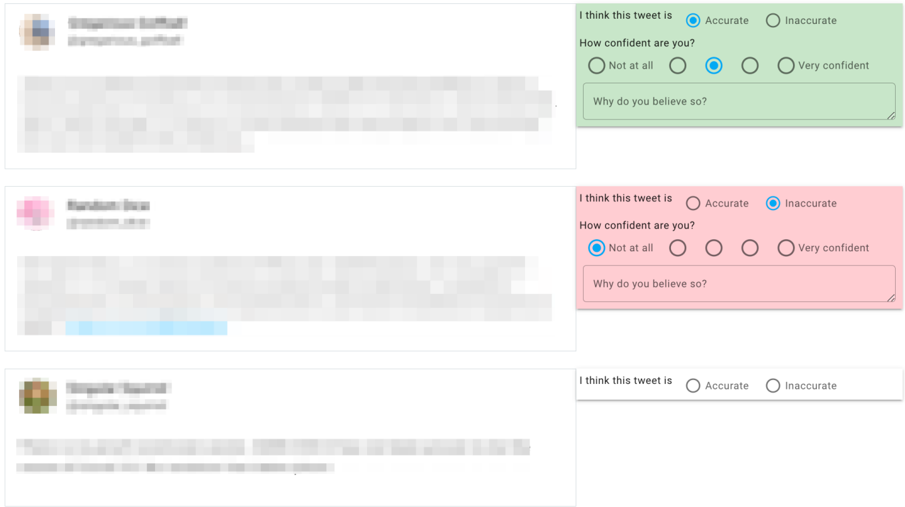
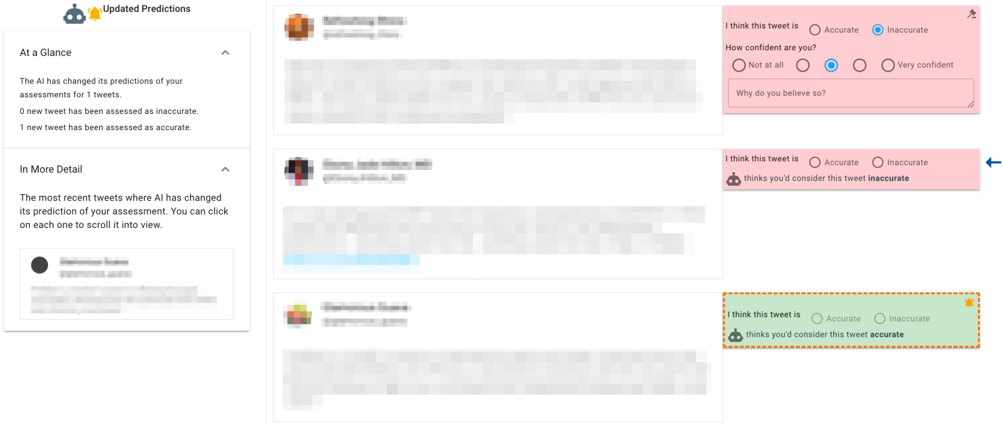
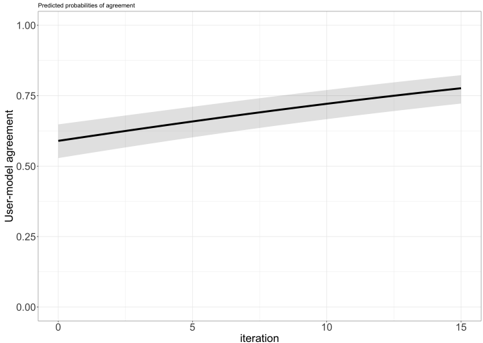
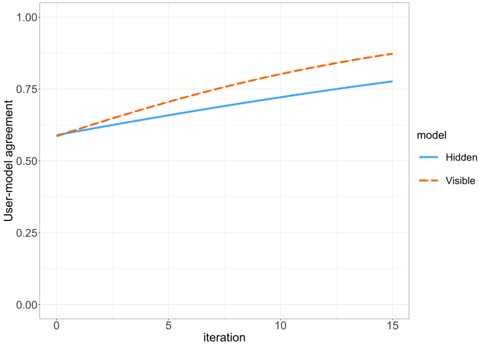
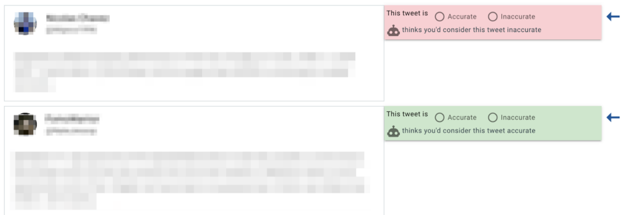
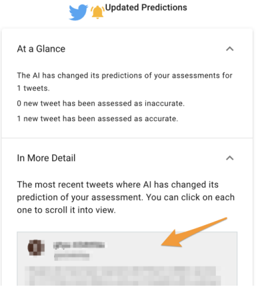
This work aims to explore how human assessments and AI predictions can be combined to identify misinformation on social media. To do so, we design a personalized AI which iteratively takes as training data a single user’s assessment of content and predicts how the same user would assess other content. We conduct a user study in which participants interact with a personalized AI that learns their assessments of a feed of tweets, shows its predictions of whether a user would find other tweets (in)accurate, and evolves according to the user feedback. We study how users perceive such an AI, and whether the AI predictions influence users’ judgment. We find that this influence does exist and it grows larger over time, but it is reduced when users provide reasoning for their assessment. We draw from our empirical observations to identify design implications and directions for future work.
Overview
The claims and statistics of this paper haven’t been checked yet.
Free: it reads the open-access text and checks the first 5 claims that cite a source we can check. Create a free account to check every claim.
Integrity signals
Registry
Cites
Statistics
Figures


Verification
Claims the paper makes
The claims and statistics of this paper haven’t been checked yet.
Free: it reads the open-access text and checks the first 5 claims that cite a source we can check. Create a free account to check every claim.
Claims other papers make about this one
Each is checked against this paper’s own text: does it say what the citing paper says it does?
The source backs part of the claim, not all of it — or backs it for a different population, condition or comparison.
In the citing paper
“Meanwhile, personalized AI applications-including personalized AI writing assistance-are becoming more common and readily accessible [9,14,27,65].”
From 'It was 80% me, 20% AI': Seeking Authenticity in Co-Writing with Large Language Models (2025) · cites this paper as [27]
Experimental — accuracy not yet measured
Self-check
Percentages, sums and reported differences re-computed from the paper’s own numbers.
The self-check needs the paper’s full text.
Citations
Cites
1 retracted
Retracted: Detecting Fake News using Machine Learning and Deep Learning Algorithms
Tanvir, A. A., Mahir, E. M., Akhter, S., & Huq, M. R. (2019) · 2019 7th International Conference on Smart Computing & Communications (ICSCC) · doi:10.1109/icscc.2019.8843612 · Cited by 151 · cited 1×
“For instance, many machine learning algorithms have been proposed to detect misinformation [5, 8, 45, 63, 65], with the general assumption that the (large) dataset of ground truth that is fed to them”
BackgroundRetractedPennycook, G., & Rand, D. G. (2019) · Cognition · doi:10.1016/j.cognition.2018.06.011 · Cited by 2,022 · cited 1×
“This argument aligns with prior work that found that people who rely more on their intuition and engage in less critical thinking are more susceptible to believing political fake news in controlled survey experiments [78] and in fact share news from lower quality sources on Twitter [72].”
ResultTechnology probes: inspiring design for and with families
Hutchinson, H., Mackay, W., Westerlund, B., Bederson, B. B., Druin, A., Plaisant, C., Beaudouin-Lafon, M., Conversy, S., Evans, H., Hansen, H., et al. (2003) · Proceedings of the SIGCHI Conference on Human Factors in Computing Systems · doi:10.1145/642611.642616 · Cited by 1,471 · cited 1×
“We investigate users’ perception of such an approach through a user study where rather than asking users to imagine the technology, we have participants interact with it in a setting similar to the one we envision, in efect conducting a technology probe [50].”
BackgroundPolarization and Partisan Selective Exposure
Stroud, N. J. (2010) · Journal of Communication · doi:10.1111/j.1460-2466.2010.01497.x · Cited by 1,346 · cited 1×
“A question that may arise is whether enabling users to use a personalized AI such as ours on social media would lead to stronger filter bubbles, causing users to only receive content that supports their views and be shielded from divergent views [59, 91, 93].”
BackgroundBuçinca, Z., Malaya, M. B., & Gajos, K. Z. (2021) · arXiv · doi:10.48550/arxiv.2102.09692 · Cited by 1,124
Artificial intelligence, bias and clinical safety
Challen, R., Denny, J., Pitt, M., Gompels, L., Edwards, T., & Tsaneva-Atanasova, K. (2019) · BMJ Quality & Safety · doi:10.1136/bmjqs-2018-008370 · Cited by 956 · cited 2×
“Research investigating the use of automated system has reported the existence of automation bias, which describes errors that occur when decision makers rely on automated cues rather than engaging in vigilant information seeking and processing [22, 40, 71].”
BackgroundFighting misinformation on social media using crowdsourced judgments of news source quality
Pennycook, G., & Rand, D. G. (2019) · Proceedings of the National Academy of Sciences · doi:10.1073/pnas.1806781116 · Cited by 947 · cited 2×
“Those that belong to the first delegate the decision of what content is false or harmful to the crowd or a set of users appointed as moderators [6, 16, 31, 56, 77], but the resulting decision is nevertheless imposed on all other users of the community as well.”
BackgroundMethodZhang, Y., Liao, Q. V., & Bellamy, R. K. E. (2020) · Proceedings of the 2020 Conference on Fairness, Accountability, and Transparency · doi:10.1145/3351095.3372852 · Cited by 895
Explainable AI: A Brief Survey on History, Research Areas, Approaches and Challenges
Xu, F., Uszkoreit, H., Du, Y., Fan, W., Zhao, D., & Zhu, J. (2019) · Lecture Notes in Computer Science · doi:10.1007/978-3-030-32236-6_51 · Cited by 758 · cited 1×
“For instance, one such concern was the lack of transparency about the reasoning behind the AI’s decisions, which can be addressed by drawing from research in the field of Explainable AI [102] or by leveraging research in the field of text generation to generate reasons by using, as training data, the reasons that a us…”
Does the Whole Exceed its Parts? The Effect of AI Explanations on Complementary Team Performance
Bansal, G., Wu, T., Zhou, J., Fok, R., Nushi, B., Kamar, E., Ribeiro, M. T., & Weld, D. (2021) · Proceedings of the 2021 CHI Conference on Human Factors in Computing Systems · doi:10.1145/3411764.3445717 · Cited by 757 · cited 2×
“Such factors include opportunity for user to provide feedback to the AI, the presence of explanations or confidence scores provided by the AI [12, 90, 101].”
BackgroundResult
Research works printed but not linked: 15
- Mike Ananny. 2018. The partnership press: Lessons for platform-publisher collaborations as Facebook and news outlets team to fght misinformation. (2018).
- Adam J Berinsky, Gregory A Huber, and Gabriel S Lenz. 2012. Evaluating online labor markets for experimental research: Amazon. com's Mechanical Turk. Political analysis 20, 3 (2012), 351-368.
- Monika Bickert. 2019. Combatting Vaccine Misinformation -About Facebook. Retrieved August 25, 2022 from https://about.fb.com/news/2019/03/combatting- vaccine-misinformation/
- Pranav Dixit and Ryan Mac. 2018. How WhatsApp Destroyed A Village. Buzzfeed News (2018).
- Yasmin Ibrahim. 2017. Facebook and the Napalm Girl: reframing the iconic as pornographic. Social Media+ Society 3, 4 (2017), 2056305117743140.
- Wolfgang Klein. 1994. Learning how to express temporality in a second language. In Società di linguistica Italiana, SLI 34: Italiano-lingua seconda/lingua straniera: Atti del XXVI Congresso. Bulzoni, 227-248.
- Pranav Malhotra. 2020. <? covid19?> A Relationship-Centered and Culturally Informed Approach to Studying Misinformation on COVID-19. Social Media+ Society 6, 3 (2020), 2056305120948224.
- Drew B Margolin, Aniko Hannak, and Ingmar Weber. 2018. Political fact- checking on Twitter: When do corrections have an efect? Political Communica- tion 35, 2 (2018), 196-219.
- Kathleen L Mosier, Linda J Skitka, Kristina J Korte, M Mouloua, and R Parasura- man. 1994. Cognitive and social psychological issues in fight crew/automation interaction. Human performance in automated systems: Current research and trends (1994), 191-197.
- Adam Mosseri. 2016. News feed fyi: Addressing hoaxes and fake news. Facebook newsroom 15 (2016), 12.
- Gordon Pennycook, Ziv Epstein, Mohsen Mosleh, Antonio A Arechar, Dean Eckles, and David G Rand. 2021. Shifting attention to accuracy can reduce misinformation online. Nature 592, 7855 (2021), 590-595.
- Gordon Pennycook, Jonathon McPhetres, Yunhao Zhang, Jackson G Lu, and David G Rand. 2020. Fighting COVID-19 misinformation on social media: Experimental evidence for a scalable accuracy-nudge intervention. Psychological science 31, 7 (2020), 770-780.
- Emily V Shaw, Mona Lynch, Sofa Laguna, and Steven J Frenda. 2021. Race, witness credibility, and jury deliberation in a simulated drug trafcking trial. Law and human behavior 45, 3 (2021), 215.
- Brent Smith and Greg Linden. 2017. Two decades of recommender systems at Amazon. com. Ieee internet computing 21, 3 (2017), 12-18.
- Sara Spray. 2016. Facebook Is Embroiled In A Row With Activists Over "Censorship". Retrieved August 25, 2022 from https://www.buzzfeed.com/saraspary/facebook- in-dispute-with-pro-kurdish-activists-over-deleted
Cited by
Did the Roll-Out of Community Notes Reduce Engagement With Misinformation on X/Twitter?
Chuai, Y., Tian, H., Pröllochs, N., & Lenzini, G. (2024) · Proceedings of the ACM on Human-Computer Interaction · doi:10.1145/3686967 · Cited by 145
The Landscape of User-centered Misinformation Interventions - A Systematic Literature Review
Hartwig, K., Doell, F., & Reuter, C. (2024) · ACM Computing Surveys · doi:10.1145/3674724 · Cited by 54
AI as Extraherics: Fostering Higher-order Thinking Skills in Human-AI InteractionPreprint
Yatani, K., Sramek, Z., & Yang, C.-L. (2024) · arXiv (Cornell University) · doi:10.48550/arxiv.2409.09218 · Cited by 64
“[70], [83] [83] Dis/mis-informationchecking [24],[64], [84], [150] [129],[153] Textual content creation (e.g., writing) [26], [35], [51], [92], [109] [35],[100], [114] Discussions, [71], [88] [52] [29] Personal informatics, behavioral changes Table 1: Categorization of existing literature related…”
'It was 80% me, 20% AI': Seeking Authenticity in Co-Writing with Large Language Models
Hwang, A. H.-C., Liao, Q. V., Blodgett, S. L., Olteanu, A., & Trischler, A. (2025) · Proceedings of the ACM on Human-Computer Interaction · doi:10.1145/3711020 · Cited by 42
“Meanwhile, personalized AI applications—including personalized AI writing assistance —are becoming more common and readily accessible [9, 14, 27, 65].”
Effect of Explanation Conceptualisations on Trust in AI-assisted Credibility Assessment
Pareek, S., van Berkel, N., Velloso, E., & Goncalves, J. (2024) · Proceedings of the ACM on Human-Computer Interaction · doi:10.1145/3686922 · Cited by 42
Danry, V., Pataranutaporn, P., Groh, M., & Epstein, Z. (2025) · Proceedings of the 2025 CHI Conference on Human Factors in Computing Systems · doi:10.1145/3706598.3713408 · Cited by 35
Mapping the Design Space of Teachable Social Media Feed Experiences
Feng, K. J. K., Koo, X., Tan, L., Bruckman, A. S., McDonald, D. W., & Zhang, A. X. (2024) · CHI Conference on Human Factors in Computing Systems · doi:10.1145/3613904.3642120 · Cited by 44
Think Fast, Think Slow, Think Critical: Designing an Automated Propaganda Detection Tool
Zavolokina, L., Sprenkamp, K., Katashinskaya, Z., Jones, D. G., & Schwabe, G. (2024) · CHI Conference on Human Factors in Computing Systems · doi:10.1145/3613904.3642805 · Cited by 52
“As participants engaged with a personalized AI system, trained to understand and adapt to individual user assessments, it was found that while the AI’s influence on users’ judgments grew over time, it decreased when users rationalized their decisions [42].”
Cultural Considerations in AI Systems for the Global South: A Systematic Review
Anuyah, O., Wan, R., Adejoro, C. O., YEH, T. P., Metoyer, R., & Badillo-Urquiola, K. A. (2023) · African Human Computer Interaction Conference (AfriCHI) · doi:10.1145/3628096.3629046 · Cited by 32
Peer-supplied credibility labels as an online misinformation intervention
Pareek, S., & Gonçalves, J. (2024) · International Journal of Human-Computer Studies · doi:10.1016/j.ijhcs.2024.103276 · Cited by 25
Conversational Agents to Facilitate Deliberation on Harmful Content in WhatsApp Groups
Agarwal, D., Shahid, F., & Vashistha, A. (2024) · Proceedings of the ACM on Human-Computer Interaction · doi:10.1145/3687030 · Cited by 27
Countering Misinformation in Private Messaging Groups: Insights From a Fact-checking Chatbot
Lee, T.-H., & Fussell, S. R. (2025) · Proceedings of the ACM on Human-Computer Interaction · doi:10.1145/3701189 · Cited by 21
Feeds of Distrust: Investigating How AI-Powered News Chatbots Shape User Trust and Perceptions
Govers, J., Pareek, S., Velloso, E., & Gonçalves, J. (2025) · ACM Transactions on Interactive Intelligent Systems · doi:10.1145/3722227 · Cited by 17
“Research into the role of factuality in opinion-making between human vs. AI sources predominantly targets the role of AI identifying misinformation as an auditing tool [39, 40, 56], rather than the role of humans auditing AI models for misinformation.”
Social Media for Activists: Reimagining Safety, Content Presentation, and Workflows
Luther, A., Heuer, H., Geise, S., Haunss, S., & Breiter, A. (2025) · CHI Conference on Human Factors in Computing Systems · doi:10.1145/3706598.3713351 · Cited by 16
AI Transforming Business and Everyday Life
Bialkova, S. (2024) · Springer eBooks · doi:10.1007/978-3-031-56471-0_9 · Cited by 13
On the Role of Large Language Models in Crowdsourcing Misinformation Assessment
Xu, J., Han, L., Sadiq, S. W., & Demartini, G. (2024) · Proceedings of the International AAAI Conference on Web and Social Media · doi:10.1609/icwsm.v18i1.31417 · Cited by 14
Generative AI in the Era of 'Alternative Facts'
Gabriel, S., Lyu, L., Siderius, J., Ghassemi, M., Andreas, J., & Ozdaglar, A. (2024) · An MIT Exploration of Generative AI · doi:10.21428/e4baedd9.82175d26 · Cited by 11
AI feedback enhances community-based content moderation through engagement with counterarguments
Mohammadi, S., & Yasseri, T. (2026) · Computers in Human Behavior Reports · doi:10.1016/j.chbr.2026.101187 · Cited by 11
It's a Match - Enhancing the Fit between Users and Phishing Training through Personalisation
Schöni, L., Roch, N., Sievers, H., Strohmeier, M., Mayer, P. B., & Zimmermann, V. (2025) · CHI Conference on Human Factors in Computing Systems · doi:10.1145/3706598.3713845 · Cited by 13
Mitigating Misinformation Sharing on Social Media through Personalised Nudging
Biselli, T., Hartwig, K., & Reuter, C. (2025) · Proceedings of the ACM on Human-Computer Interaction · doi:10.1145/3711034 · Cited by 11
Value Alignment of Social Media Ranking Algorithms
Jahanbakhsh, F., Zhao, D., Piccardi, T., Robertson, Z., Epstein, Z., Koyejo, S., & Bernstein, M. S. (2026) · CHI Conference on Human Factors in Computing Systems · doi:10.1145/3772318.3791281 · Cited by 14
Self-citationAI Agency in Fact-Checking: Role-Based Machine Heuristics and Publics’ Conspiratorial Orientation
Lan, D., Zhu, Y., Liu, M., & He, C. (2025) · Media and Communication · doi:10.17645/mac.9516 · Cited by 10
“In this context, past research has explored the potential of AI technologies in identifying and categorizing misinformation and fake news (Jahanbakhsh et al., 2023).”
Adaptive Human-Agent Teaming: A Review of Empirical Studies from the Process Dynamics PerspectivePreprint
Wang, M., Wu, J., Ma, S., Li, N., Zhang, P., Gu, N., & Lu, T. (2025) · arXiv (Cornell University) · doi:10.48550/arxiv.2504.10918 · Cited by 8
PILOT: Control Surfaces for Authoring Social Media FeedsPreprint
Goyal, A., Choi, F., & Chandrasekharan, E. (2025) · arXiv (Cornell University) · doi:10.48550/arxiv.2509.19615 · Cited by 7
Jamieson, J., Hara, T., & Akiyama, M. (2025) · CHI Conference Extended Abstracts on Human Factors in Computing Systems (CHI EA) · doi:10.1145/3706599.3719948 · Cited by 6
Lu, Z., Li, P., Wang, W., & Yin, M. (2025) · CHI Conference on Human Factors in Computing Systems · doi:10.1145/3706598.3713871 · Cited by 7
What If Moderation Didn’t Mean Suppression? A Case for Personalized Content Transformation
Rashed, R., & Jahanbakhsh, F. (2026) · CHI Conference on Human Factors in Computing Systems · doi:10.1145/3772318.3790495 · Cited by 6
Self-citationNarratives and Perspectives: How AI Summaries Steer Users' Opinions and Engagement on Social Media
Govers, J., Sew, C., Velloso, E., Kostakos, V., & Gonçalves, J. (2026) · CHI Conference on Human Factors in Computing Systems · doi:10.1145/3772318.3790945 · Cited by 7
Zhou, Y., Chen, E., Pisipati, M., Xiong, A., & Rajtmajer, S. M. (2025) · Proceedings of the ACM on Human-Computer Interaction · doi:10.1145/3757588 · Cited by 9
AI-mediated Collaborative Crowdsourcing for Social News Curation: The Case of Acropolis
Schneider, D., Chaves, R., Pimentel, A. P., de Almeida, M. A., de Souza, J. M., & Correia, A. (2025) · ACM International Conference on Interactive Media Experiences · doi:10.1145/3706370.3731644 · Cited by 5
Kaur, S., Salimzadeh, S., & Gadiraju, U. (2026) · arXiv (Cornell University) · doi:10.48550/arxiv.2601.15064 · Cited by 4
“For instance, [55] mentioned: "From our pilot studies with our research group, we determined that the average time for completing the task was approximately an hour.”
Review of AI Features to Support Mass Deliberations
Zeginis, D., Patsouras, C. F., Promikyridis, R., Tambouris, E., & Tarabanis, K. A. (2025) · Lecture notes in computer science · doi:10.1007/978-3-032-01589-1_21 · Cited by 3
Koç, L. Z., Gülşen, S., İnci, A., Buldukoğlu, O. Ç., Köker, G., & Lerma, E. V. (2026) · BMC Nephrology · doi:10.1186/s12882-026-04814-3 · Cited by 3
“However, research suggests that these systems should not only detect falsehoods but also encourage users to critically evaluate the credibility of the information they encounter[23].”
Kwon, S., Yoo, D. W., Saha, K., Bardzell, S., & Kang, Y. (2026) · Proceedings of the ACM on Human-Computer Interaction · doi:10.1145/3816958 · Cited by 3
“Earlier misinformation studies focused on tools that help users assess credibility—such as source tracking [14, 43, 59] or interface designs that flag misleading content [42, 49].”
Bialkova, S. (2024) · Springer eBooks · doi:10.1007/978-3-031-56471-0_10 · Cited by 3
West, J., Çağıltay, B., Zhang, S., Li, J., Fawaz, K., & Banerjee, S. (2025) · CHI Conference on Human Factors in Computing Systems · doi:10.1145/3706598.3713256 · Cited by 6
The Influence of Content Modality on Perceptions of Online Misinformation
Gunasekara, S., Pareek, S., Kelly, R., & Gonçalves, J. (2025) · CHI Conference on Human Factors in Computing Systems · doi:10.1145/3706598.3713098 · Cited by 3
Zhang, X., Gupta, M., Altland, E., & Lee, S. W. (2025) · Proceedings of the ACM on Human-Computer Interaction · doi:10.1145/3757692 · Cited by 3
“Research has focused on identifying misinformation, mitigating its spread, and enhancing users’ ability to assess the credibility of online content [5, 36, 38, 39].”
Designing AI-Infused Interactive Systems for Online Communities: A Systematic Literature Review
Zhang, Y., Wang, X., Hu, J., Pan, Z., Peng, Z., & Ma, X. (2026) · Proceedings of the ACM on Human-Computer Interaction · doi:10.1145/3816920 · Cited by 2
“Studying such cross-platform transitions may offer valuable insights for designing AI-infused systems that support community integration, norm negotiation, and knowledge transfer in dynamic social environments.”
Ethics in Artificial Intelligence: Ensuring Integrity in Research and Media
Cesário, V., & Campos, P. (2025) · Lecture notes of the Institute for Computer Sciences, Social Informatics and Telecommunications Engineering · doi:10.1007/978-3-031-97257-7_11 · Cited by 2
Context, Credibility, and Control: User Reflections on AI Assisted Misinformation ToolsPreprint
Sangwan, V., & Makitalo, H. (2025) · arXiv (Cornell University) · doi:10.48550/arxiv.2506.22940 · Cited by 2
“In the study, a personalized AI predicts how a user will assess content on Twitter based on the user’s previous assessments [ 3].”
InfluentialLu, Z., Lim, G., & Yin, M. (2026) · CHI Conference on Human Factors in Computing Systems · doi:10.1145/3772318.3790442 · Cited by 3
“To improve scalability, prior works also leverage automated fact-checking approaches, such as machine learning models, to detect and combat misinformation more efficiently [29, 57, 76–78, 89, 112, 123, 147, 149].”
Zhang, S., Wang, L., Li, S., Wu, Y., Chuai, Y., Chen, L., Yi, X., & Li, H. (2026) · CHI Conference on Human Factors in Computing Systems · doi:10.1145/3772318.3790501 · Cited by 6
The role of AI in combating misinformation: leveraging text mining and social networking analysis
Rohan, A., Islam, M. A., Yoshi, A. M., Islam, M. M., Kabir, M. F., & Islam, M. M. (2026) · Scientific Reports · doi:10.1038/s41598-026-51287-3 · Cited by 1
“Jahanbakhsh et al. 34 applied a more customized AI model that teaches the machine to understand the subjective evaluations of social media posts with the idea of guessing how the user might react to misinformation.”
Method, Mind, and Morality: How People Make Sense of Artificial Intelligence
Anthis, J. R., Brynjolfsson, E., & Evans, J. A. (2026) · Proceedings of the ACM on Human-Computer Interaction · doi:10.1145/3816971 · Cited by 1
Misinformation in Reels, Influence of Contextual Superimposed Texts in Short Videos
Bartlett, A., Yaqub, W., Suleiman, B., & Mohanty, M. (2024) · Lecture notes in computer science · doi:10.1007/978-981-96-0567-5_1
Introduction to the Minitrack on Mediated Conversation
Masullo, G., Kalman, Y. M., & Lewis, S. (2024) · Hawaii International Conference on System Sciences (HICSS) · doi:10.24251/hicss.2024.330
Effective Model Replacement for Solving Objective Mismatches in Pre-trained Model Compositions
Kharel, A., Baek, K., & Ko, I. (2024) · Asia-Pacific Software Engineering Conference (APSEC) · doi:10.1109/apsec65559.2024.00024
“As there exists multiple research on labeling methods [22]–[24], we concentrate on evaluating and replacing PTMs, bypassing the complexities of the labeling process.”
Disability misinformation on Facebook: a comparison of LLM-based fact-checking tools
Prazak, I., Padovani, L., Lim, Y., Hsu, J. H., & Lee, M. A. (2026) · Information Research · doi:10.47989/ir31iconf64259
The Role of Presentation Styles in Countering Misinformation on Short Video Platforms CSCW039
Gunasekara, S., Sew, C., Pareek, S., Kelly, R., Kostakos, V., & Gonçalves, J. (2026) · Proceedings of the ACM on Human-Computer Interaction · doi:10.1145/3788075
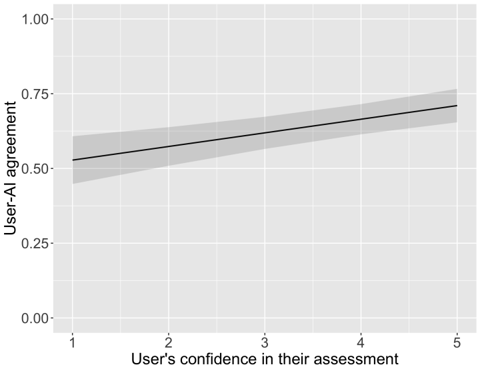
“Following prior research on opinion change, including research on misinformation [38, 107], where initial confidence was used as an indicator for participants’ knowledge or uncertainty about the task, we also measured participants’ confidence in their initial judgement.”
Verificación descentralizada en X: usos de @Grok frente a la desinformación mediática
Casado, I. G., Pérez, F. J. P., & Fernández, M. L. F. (2026) · Cuadernos info · doi:10.7764/cdi.64.98922
Altoe, F., Pinto, S. M., & Pinto, H. S. (2026) · ACM Conference on User Modeling, Adaptation and Personalization (UMAP) · doi:10.1145/3774935.3806156 · Cited by 1
Knowing What They Don’t Know: LLM Uncertainty and the Limits of Automated Misinformation Detection
Mortaga, M., Sieger, M., Diedrichs, H., Kojan, L., & Valdez, A. S. C. (2026) · Lecture notes in computer science · doi:10.1007/978-3-032-29842-3_25
LATIF, S. B. A., Islam, M. R., Tisha, Z. T., & Maria, T. Y. (2026) · ACM SIGCAS/SIGCHI Conference on Computing and Sustainable Societies (COMPASS) · doi:10.1145/3811242.3819094
Inteligencia artificial para la detección de fake news: revisión sistemática y mapa de evidencia
Diaz, N. J. D. (2026) · Institutional Repository of the National University Open and Distance UNAD (Universidad Nacional Abierta y a Distancia)
Using AI in eRulemaking: Early results from opengov.gr
Tambouris, E., Zeginis, D., Melidis, A., Promikyridis, R., & Tarabanis, K. A. (2026) · IFIP International Conference on Electronic Government, Electronic Participation and Open Government (EGOV-CeDEM-ePart) · doi:10.59490/6a91ad416096c5874dfb36a7
Lu, Z., Wang, W., Yu, Y., Wang, X., Li, Z., Liu, Z., & Ananiadou, S. (2026) · ACM Conference on Human-AI Complementarity and Alignment · doi:10.1145/3834580.3838736 · Cited by 1
YouCred: An Online Tool Co-Designed with Fact-Checkers for Misinformation Discovery on YouTube
Juneja, P., Xie, D., Ye, G., & Mitra, T. (2026) · Proceedings of the ACM on Human-Computer Interaction · doi:10.1145/3817042
“…of determining fact-check-worthy claims in text [41, 55], including crowdsourcing [3, 4, 11, 32, 43, 61, 69], artificial intelligence [13, 30, 107], natural language processing [31, 97], knowledge graphs [88], visual analytics [64], or a combination of human assessments and AI predictions [53, 76].”
Ke, Q., Cao, Y., Zhu, H., & Qin, Q. (2026) · Health Communication · doi:10.1080/10410236.2026.2759128
Metadata
- Authors
- Jahanbakhsh, F., Katsis, Y., Wang, D., Popa, L., & Muller, M.
- Affiliations
- MIT Computer Science and Artificial Intelligence Laboratory (US)
- IBM Research - Almaden (US)
- Northeastern University (US)
- IBM (United States) (US)
- Venue
- Proceedings of the 2023 CHI Conference on Human Factors in Computing Systems
- Publisher
- ACM
- Published
- 2023-04-19
- Pages
- 1-27
- OpenAlex
- W4366547816
- Cited by
- 42
- References
- 74
- Citations by year
- 2026: 11 · 2025: 17 · 2024: 13 · 2023: 1
- FWCI
- 39.00
- Type
- conference paper
- Language
- en
- Open access
- hybrid
- doi.org
- Licence
- Locations
- CHI Conference on Human Factors in Computing Systems (publishedVersion, cc-by)
- DSpace@MIT (Massachusetts Institute of Technology) (submittedVersion, cc-by-nc)
- Topics
- Social Sciences › Sociology and Political Science › Misinformation and Its Impacts
- Physical Sciences › Computer Science › Information Systems › Spam and Phishing Detection
- Physical Sciences › Computer Science › Human-Computer Interaction › Innovative Human-Technology Interaction
- Keywords
- misinformation detection, personalized AI, social media, user feedback, trust in AI predictions, user study
About these checks
Registry, retraction, Cites and statistics results are computed, not judged, with one exception: a printed reference that no index lists is read once by a model before it counts as a citation error. Claims are extracted by a model and kept only when their quote appears verbatim in the text; each cited source is then checked, with a model’s help, for whether it says what the claim relies on. Those verdicts can be wrong — read the claim’s quote and the cited source before relying on one.
Statistics and arithmetic are recomputed, not judged.
Confidence bands are shown only for fields calibrated on our annotated test set. None is calibrated yet, so no band is shown.
What counts as a claim ›How we measure confidence ›How we check this ›
Are you an author, or do you see a problem with this page? Request a review
Data sources
Bibliographic data: Semantic Scholar, OpenAlex, Crossref.
Contains information from the Semantic Scholar Academic Graph Datasets, made available under the ODC Attribution License (ODC-BY 1.0).
Semantic Scholar’s data is described in: Kinney, R., et al. (2023). The Semantic Scholar Open Data Platform. arXiv:2301.10140.
