

The DOI matches its Crossref record; 63 of the 63 references it cites were found in a registry or an index; 10 of the 31 sources its claims cite were checked for support.
Screen or No Screen? Lessons Learnt from a Real-World Deployment Study of Using Voice Assistants With and Without Touchscreen for Older Adults
Open accessAbstract
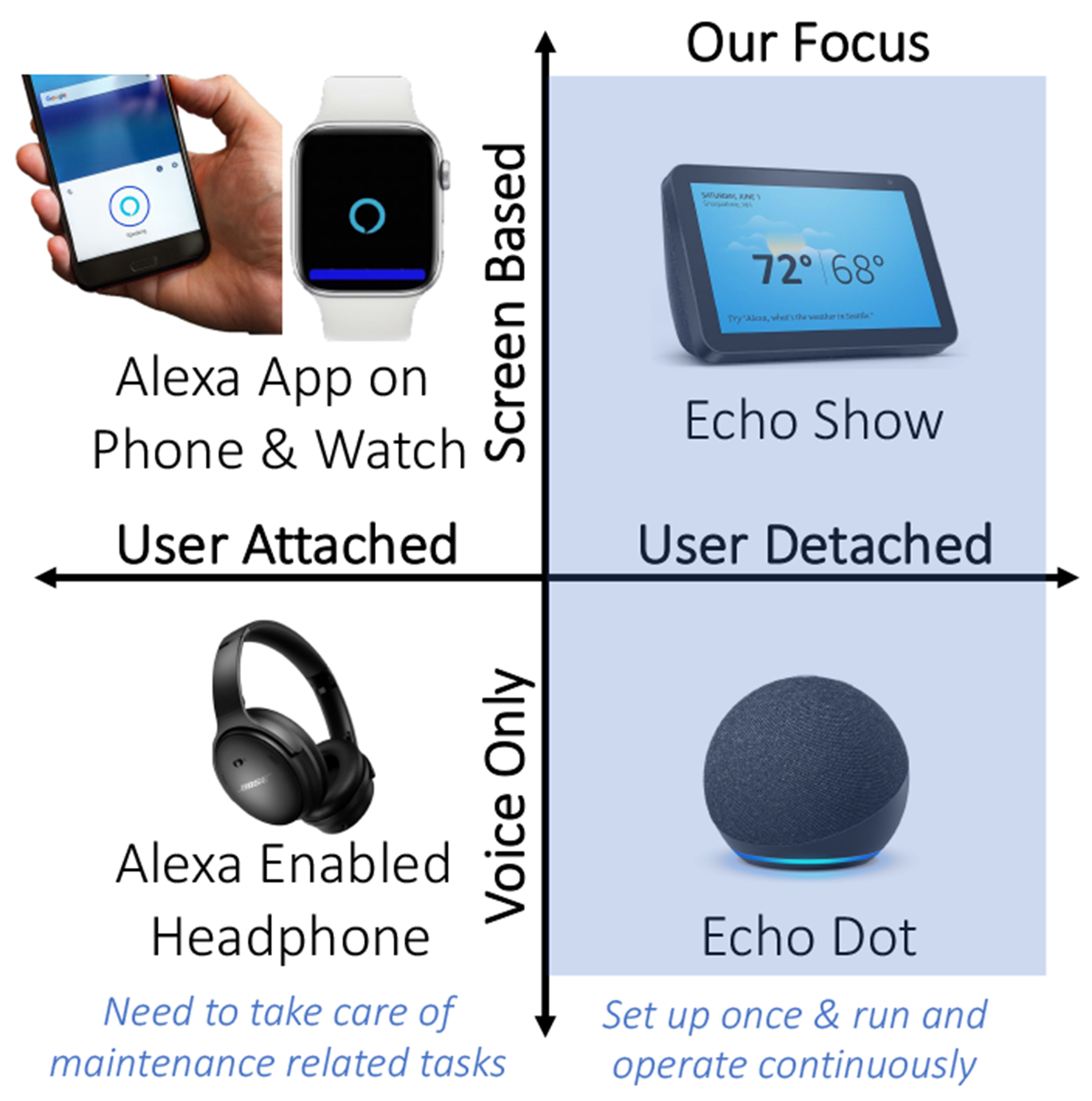
While voice user interfaces offer increased accessibility due to hands-free and eyes-free interactions, older adults often have challenges such as constructing structured requests and perceiving how such devices operate. Voice-first user interfaces have the potential to address these challenges by enabling multimodal interactions. Standalone voice + touchscreen Voice Assistants (VAs), such as Echo Show, are specific types of devices that adopt such interfaces and are gaining popularity. However, the affordances of the additional touchscreen for older adults are unknown. Through a 40-day real-world deployment with older adults living independently, we present a within-subjects study (N = 16; age M = 82.5, SD = 7.77, min. = 70, max. = 97) to understand how a built-in touchscreen might benefit older adults during device setup, conducting self-report diary survey, and general uses. We found that while participants appreciated the visual outputs, they still preferred to respond via speech instead of touch. We identified six design implications that can inform future innovations of senior-friendly VAs for managing healthcare and improving quality of life.
Overview
CoChat Summary
TL;DR
This within-subjects 40-day real-world deployment study (N = 16 older adults, mean age 82.5) compared Echo Dot versus Echo Show to see how a built-in touchscreen affects setup, daily diary reporting, and general use. The touchscreen helped most in setup and information display, but participants still preferred speech over touch for input in diary tasks and general use.
Key findings
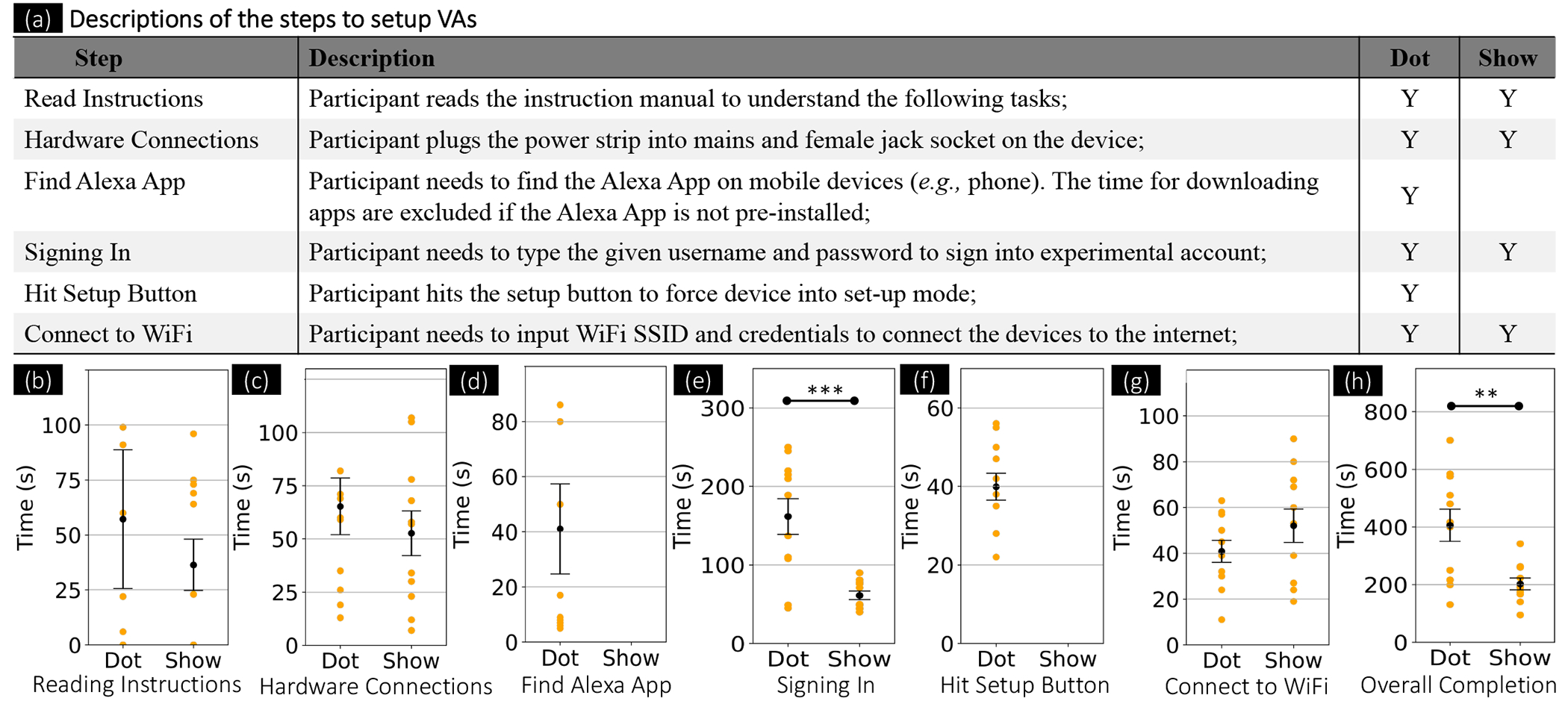
- During device setup, participants took significantly less task completion time with Echo Show than Echo Dot (F1,20 = 8.57, p = .003, η2 = 0.37); the paper also summarizes this as roughly a 50% reduction in overall setup TCT.
- For the sign-in stage specifically, touchscreen use significantly reduced TCT (F1,20 = 18.57, p < .005, η2 = 0.48), while reading instructions, hardware connections, and WiFi connections were not statistically significant (p = .543, .465, .214).
- For diary reporting, survey compliance was higher with the touchscreen device (ART: F1,15 = 10.33, p = .006, ηp2 = .41), and touch input reduced response latency: 6.056 s with touch versus 7.639 s and 7.513 s with voice input on Echo Show and Echo Dot, respectively; the paper summarizes this as about a 20% latency reduction.
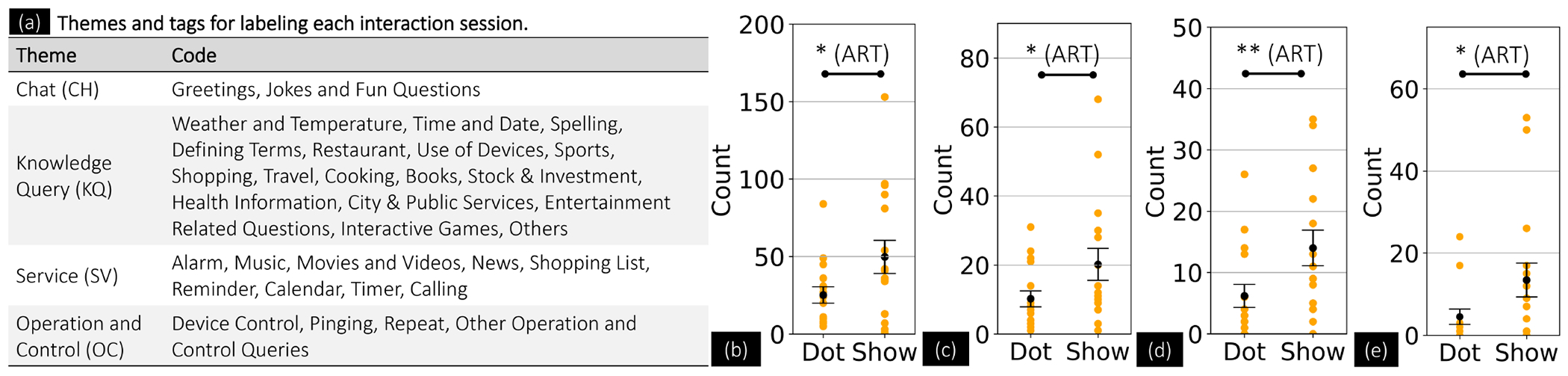
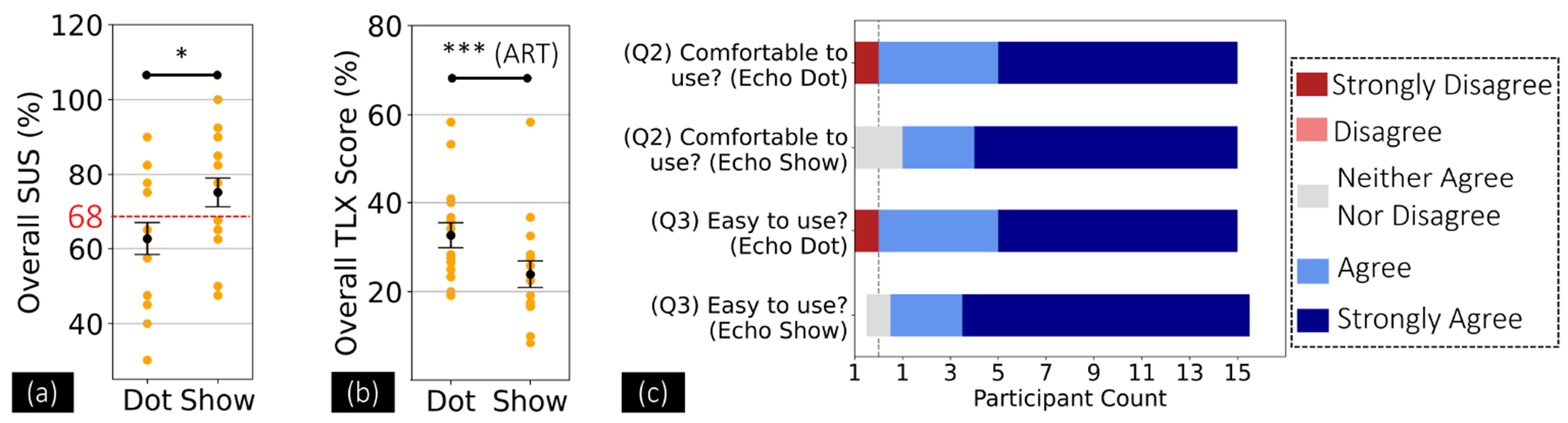
- Participants still responded more often by speech than touch for diary questions, using voice 73.06% of the time versus 26.94% for touch; in general use, Echo Show led to more interaction sessions overall (ART: F1,15 = 5.01, p = 0.041, ηp2 = 0.25) and higher SUS (F1,30 = 4.67, p = 0.040, ηp2 = 0.13) with lower overall TLX (ART: F1,15 = 29.20, p < .001, ηp2 = 0.66).
Methods
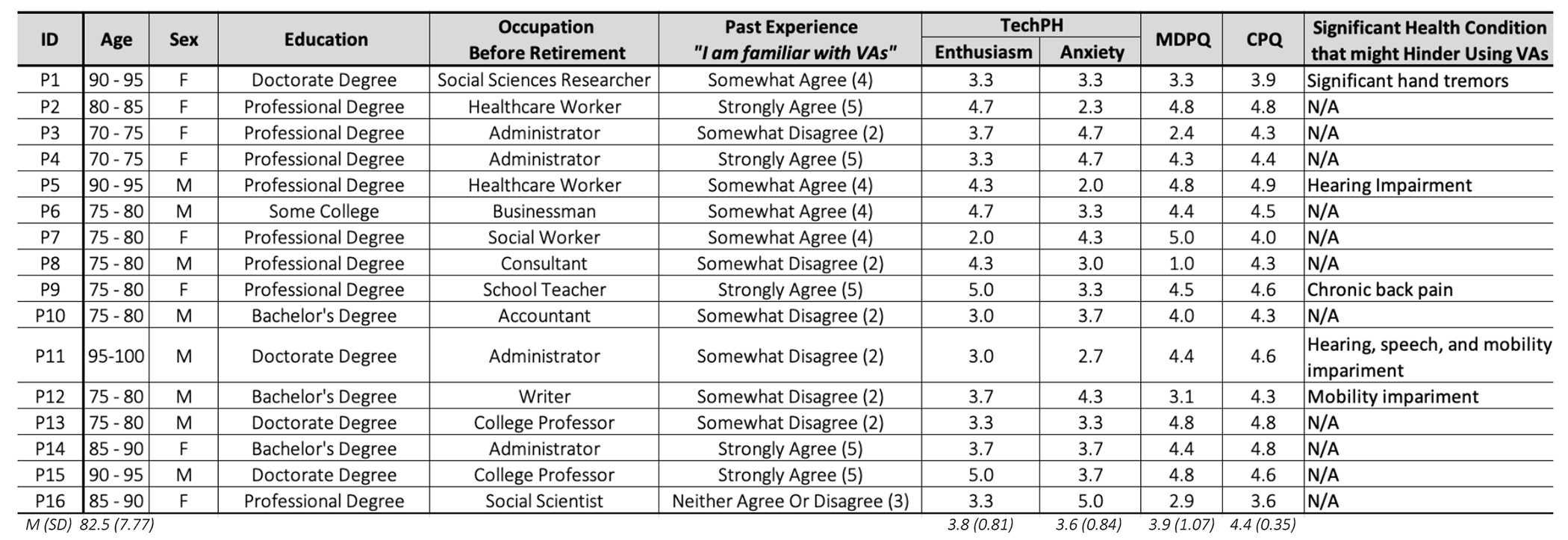
- Within-subjects deployment study over 40 days with 16 independently living older adults (8 men, 8 women; mean age 82.5, SD 7.77, range 70–97), using Echo Dot and Echo Show in counterbalanced order.
- Four phases: pre-study questionnaires; device setup; 15-day diary + general-use sessions per device with daily diary prompts; and two online focus groups.
- Quantitative analyses included RM-ANOVA, ART with Bonferroni adjustment where needed, plus Tukey HSD post hoc tests; qualitative data came from thematic analysis of interviews, focus groups, and 9.87 hours of video-audio recordings. For diary use, the paper analyzed 4,350 general-use requests from logs and computed compliance, completion, initial response rate, and latency.
Limitations
- The paper explicitly states three limitations: only 16 older adults from La Jolla, U.S.; the study focused on standalone VAs and did not assess user-attached VA interactions when away from home; and it used only Echo Dot and Echo Show, limiting vendor generalizability.
- The paper also states that, under the IRB protocol, it could not link experimental accounts to third-party services requiring private data such as email and calling, limiting those use cases.
- Evident from the text: diary results were for non-time-sensitive daily surveys and the study excluded the initial five-day training logs, so findings may not transfer to more time-critical or fully naturalistic usage.
Model-written summary. Check it against the paper before relying on it.
Integrity signals
Registry
Cites
Statistics
Figures








Verification
Claims the paper makes
7 Valid · 2 Not valid · 11 Not checked · 100 Own results and interpretations
The sources with a verdict support this claim; the rest weren’t checked yet, have no full text we could read, or their verdicts aren’t rated yet.
In the paper
“Existing research has explored how older adults have used and perceived existing features of voice-only VAs [16, 43, 57, 58, 72], but the potential merits and setbacks of the secondary touchscreen modality are underexplored.”
§ Screen or No Screen? Lessons Learnt from a Real-World Deployment Study of Using Voice Assistants With and Without Touchscreen for Older Adults > INTRODUCTION
What the sources say
- Supportedcites [16] source
The Introduction states that studies have analyzed how older adults use existing features of voice assistants in smart speakers and the barriers to adoption. Section 2.2 also describes research on older adults’ impressions, usage, and perceptions of smart-speaker assistants. These passages support the cited clause about prior research on voice-only assistants; the touchscreen clause is not attributed to this source. (LLM, conf=0.93)
- Not checked — no full text of the sourcecites [43] source
- Supportedcites [57] source
Section 3.2 describes a study of older adults using Alexa’s voice-based features, including alarms, lists, music, questions, and conversation. It says interviews and usage logs captured participants’ perceptions and use. The cited paper therefore supports the first clause; the statement about touchscreen research is not attributed to it. (LLM, conf=0.93)
plain- Asserted: passes — The authors put it forward as true.
- Checkable: passes — It can be checked against evidence.
- Load-bearing: passes — The paper’s conclusions depend on it.
- Based: passes — The paper gives a reason why it holds.
- Supported
The sources with a verdict support this claim; the rest weren’t checked yet, have no full text we could read, or their verdicts aren’t rated yet.
In the paper
“Additionally, most prior works (e.g., [57, 72]) only focused on general uses (e.g., music) of VAs for older adults, rather than healthcare applications, which are indispensable use cases [15, 16].”
§ Screen or No Screen? Lessons Learnt from a Real-World Deployment Study of Using Voice Assistants With and Without Touchscreen for Older Adults > INTRODUCTION
What the sources say
- Supportedcites [57] source
The citation is offered as an example of prior work on older adults’ general uses of voice assistants, not as evidence for the sentence’s separate healthcare claim. Section 3.2 describes a study of older adults using Alexa for activities including music, questions, games, and conversation; it does not frame the study as a healthcare application. Page numbers are unavailable in our copy. (LLM, conf=0.88)
- Not checked — no full text of the sourcecites [72] source
plain- Asserted: passes — The authors put it forward as true.
- Checkable: passes — It can be checked against evidence.
- Load-bearing: passes — The paper’s conclusions depend on it.
- Based: passes — The paper gives a reason why it holds.
- Supported
The cited sources support only part of this claim — read each source’s verdict below.
In the paper
“First, unlike the young adults, older adults are more likely to be at home more often [14, 50].”
§ Screen or No Screen? Lessons Learnt from a Real-World Deployment Study of Using Voice Assistants With and Without Touchscreen for Older Adults > RELATED WORK > Ecological Momentary Assessments (EMA) and End-Of-Day (EOD) Diaries Data Collections
What the sources say
- Partly supportedcites [14] sourceExperimental — accuracy not yet measured
The Discussion says older adults spend most of their time at home, and the study reports that 72.5% of participants’ activities occurred there. But the study included only older adults and provides no comparison with young adults, so it does not support the comparative part of the claim. (LLM, conf=0.85)
- Not checked — no full text of the sourcecites [50] source
hedgedstates an association- Asserted: passes — The authors put it forward as true.
- Checkable: passes — It can be checked against evidence.
- Load-bearing: passes — The paper’s conclusions depend on it.
- Based: passes — The paper gives a reason why it holds.
- Partly supported
A result the paper reports from its own data — it cites no other source for it, so there is none to check. The quote shows it is in the paper.
In the paper
“In contrast, no statistical significance were observed for reading instructions (p = .543), hardware connections (p = .465), and WiFi connections (p = .214).”
§ Screen or No Screen? Lessons Learnt from a Real-World Deployment Study of Using Voice Assistants With and Without Touchscreen for Older Adults > RESULTS > RQ1: How Does the Built-In Touchscreen Affect the Older Adults’ Experience of Setting Up Devices?
plain- Asserted: passes — The authors put it forward as true.
- Checkable: passes — It can be checked against evidence.
- Load-bearing: passes — The paper’s conclusions depend on it.
- Based: passes — The paper gives a reason why it holds.
A result the paper reports from its own data — it cites no other source for it, so there is none to check. The quote shows it is in the paper.
In the paper
“Fig. 9b demonstrates that slightly more participants believed that using Echo Show will not cause interruption burden to their daily life, compared to using Echo Dot.”
§ Screen or No Screen? Lessons Learnt from a Real-World Deployment Study of Using Voice Assistants With and Without Touchscreen for Older Adults > RESULTS > RQ2: How Does the Built-In Touchscreen Affect the Older Adults’ Behaviors and Experience of Conducting Self-Report Daily Diary Survey? Overall, participants demonstrated the usefulness of conducting such voice-first daily diaries (e.g., “it kind of reminded me to eat more fruit and many other aspects to keep myself healthy. So I thought it was helpful, just like a memory enforcement, as I don’t think it sometimes” (P14)). First, we demonstrate a statistical significance of the survey compliance rate (ART: F1,15 = 10.33, p = .006, ηp2=.41, Fig. 7b) while using the Echo Dot and Show. Fig. 7a further demonstrates the % of participants who complied with the diary over each of 15-day session, where participants using Echo Show exhibited a slight higher compliance rate from the second day, compared to the voice-only alternative. Second, while no statistical significance was detected in terms of question completion rate (ART: p = .600) and initial prompt response rate (ART: p = .610), a weak statistical increase of initial prompt response rate was captured (ART: F1,15 = 5.12, p = .039, ηp2=.25, Fig. 8a). Third, while using Echo Show for journaling diaries, participants adopted voice as the input modality, more frequent than that of touch input (ART: F1,15 = 9.91, p = 0.007, ηp2=0.40, Fig. 8b), with an average of 73.06% versus 26.94%. Despite this, among 12 participants (except P3, P10, P11, and P15) who have used touch input, we found that using touch input enabled a shorter response latency significantly, compared to the voice counterpart (through Echo Dot or Show) (ART, F2,34 = 14.40, p < .001, ηp2=0.56, Fig. 8c), with the average responses of using touch input being 6.056 seconds versus 7.639 seconds and 7.513 seconds using voice input by Echo Show and Echo Dot respectively. A similar observations have been captured in terms of measured response latency for binary- (F2,33 = 7.08, p = .003, ηp2=.30, Fig. 8d), number- (ART: F2,16 = 5.16, p = .019, ηp2=.39, Fig. 8e), and Likert- (ART: F2,22 = 9.63, p < .001, ηp2=0.47, Fig. 8f) type questions. Fourth, we found a higher median of preference rating of using Echo Show to report diary survey compared to the voice-only counterpart by analyzing self-reported Likert scale of the usability prompt shown in Fig. 9a. Finally, Fig. 9b demonstrates that slightly more participants believed that using Echo Show will not cause interruption burden to their daily life, compared to using Echo Dot. Through qualitative analysis, we identified four findings.
plain- Asserted: passes — The authors put it forward as true.
- Checkable: passes — It can be checked against evidence.
- Load-bearing: unclear — It is unclear whether the paper’s conclusions depend on it.
- Based: passes — The paper gives a reason why it holds.
71 more claims
Create a free account to see all 120 claims and to verify the 3 references still open.
- Probably not a substantial claim. 31
- It may state two separate claims as one. 20
- The quote only partly states this claim. 3
Citations
Cites
Using thematic analysis in psychology
Braun, V., & Clarke, V. (2006) · Qualitative Research in Psychology · doi:10.1191/1478088706qp063oa · Cited by 194,414
Statistical Power Analysis for the Behavioral Sciences
Muller, K. (1989) · Technometrics · doi:10.1080/00401706.1989.10488618 · Cited by 99,167
Statistical Power Analysis for the Behavioral Sciences
Cohen, J. (2013) · doi:10.4324/9780203771587 · Cited by 25,373
An analysis of variance test for normality (complete samples)
SHAPIRO, S. S., & WILK, M. B. (1965) · Biometrika · doi:10.1093/biomet/52.3-4.591 · Cited by 23,480 · cited 1×
“Before performing RM-ANOVA, we first conducted the normality check of measures in each catalogue using Shapiro-Wilk test [66] .”
MethodAn Analysis of Variance Test for Normality (Complete Samples)
Shapiro, S. S., & Wilk, M. B. (1965) · Biometrika · doi:10.2307/2333709 · Cited by 23,469
Development of NASA-TLX (Task Load Index): Results of Empirical and Theoretical Research
(1988) · Advances in Psychology · doi:10.1016/s0166-4115(08)62386-9 · Cited by 15,003 · cited 6×
“Participants were then invited to complete NASA TLX [33] and System Usability Scale (SUS) [12, 13] questionnaires regarding their overall user experience.”
BackgroundMethodInfluentialSUS: A 'Quick and Dirty' Usability Scale
(1996) · Usability Evaluation In Industry · doi:10.1201/9781498710411-35 · Cited by 8,989
Ecological momentary assessment
Shiffman, S., Stone, A. A., & Hufford, M. R. (2008) · Annual Review of Clinical Psychology · doi:10.1146/annurev.clinpsy.3.022806.091415 · Cited by 6,454 · cited 2×
“Ecological Momentary Assessment (EMA) involves repeated sampling of subjects’ current behaviors and experiences in real time in their environment [67].”
BackgroundMethod(1993) · Medical Entomology and Zoology · Cited by 6,226
Comparing Individual Means in the Analysis of Variance
Tukey, J. W. (1949) · Biometrics · doi:10.2307/3001913 · Cited by 4,246 · cited 1×
“The Tukey’s Honestly Significant Difference (HSD) test [73] was used for conducting post-hoc test.”
Method
Research works printed but not linked: 11
- Timothy Bickmore and Justine Cassell. 1999. Small Talk and Conversational Storytelling in Embodied Conversational Interface Agents. In AAAI Fall Symposium on Narrative Intelligence. 87–92.
- Karen Bonilla and Aqueasha Martin-Hammond. 2020. Older Adults’s Perceptions of Intelligent Voice Assistant Privacy, Transparency, and Online Privacy Guidelines. USENIX Association.
- 10.5555/2817912.2817913 · doi:10.5555/2817912.2817913
- Kemeberley Charles, Chen Chen, Janet G. Johnson, Alice Lee, Ella T. Lifset, Michael Hogarth, Nadir Weibel, Emilia Farcas, and Alison A. Moore. 2021. How might an intelligent voice assistant address older adults’ health-related needs?. In Journal of the American Geriatrics Society, Vol. 69. Wiley 111 River St, Hoboken 07030-5774, NJ, USA, S243–S244.
- Dustin A. Coates and Max Amordeluso. 2019. Voice applications for Alexa and Google assistant. Manning Publications Co.
- Margot J. Hanley and Shiri Azenkot. 2021. Understanding the Use of Voice Assistants by Older Adults. CoRR abs/2111.01210 (2021). arXiv:2111.01210https://arxiv.org/abs/2111.01210 · arXiv
- 10.2196/20427 · DOI · Paper page
- Ella T. Lifset, Kemeberley Charles, Emilia Farcas, Nadir Weibel, Michael Hogarth, Chen Chen, J Johnson, and A Moore. 2020. Can an Intelligent Virtual Assistant (IVA) Meet Older Adult Health-Related Needs in the Context of a Geriatric 5Ms Framework?. In Journal of the American Geriatrics Society, Vol. 70. Wiley 111 River St, Hoboken 07030-5774, NJ, USA, S245–S246.
- Don Norman. 2013. The design of everyday things: Revised and expanded edition. Basic books.
- Graham Thompson and Ashok Ganesan. U.S. Patent 7472162B2;, Dec. 2008. Communication System Architecture for Voice First Collaboration.
- Kathryn Whitenton. 2017. Voice First: The Future of Interaction?https://www.nngroup.com/articles/voice-first
Cited by
Anthony, B. (2024) · International Journal of Human-Computer Interaction · doi:10.1080/10447318.2024.2344145 · Cited by 20
“Chen et al. (2023) carried out a real-world use of voice assistants with older adults residing independently to investigate how a built-in touchscreen may support older adults.”
BackgroundBlavette, L., Dacunha, S., Alameda-Pineda, X., García, D. H., Gannot, S., Gras, F., Gunson, N., Lemaignan, S., Polic, M., Tandeitnik, P., et al. (2025) · JMIR Human Factors · doi:10.2196/76496 · Cited by 34
“Furthermore, the inclusion of real-time transcription improved accessibility, confirming prior findings on the value of combining auditory and visual cues for inclusive design [60].”
Alghamdi, E., Halvey, M., & Nicol, E. (2024) · ACM Conversational User Interfaces 2024 · doi:10.1145/3640794.3665558 · Cited by 36
Li, J., Ponnada, A., Wang, W., Dunton, G. F., & Intille, S. S. (2024) · Proceedings of the ACM on Interactive Mobile Wearable and Ubiquitous Technologies · doi:10.1145/3699735 · Cited by 22
“…can be used to reduce EMA response burden: improving the presentation of questions (e.g., enhancing text readability [9], using multiple modalities [6]), improving the timing of prompts (i.e., identifying less disruptive moments to prompt [35]), and reducing the need for self-report data (i.e.,…”
Le, H., Lakshminarayanan, R., Li, J., Mishra, V., & Intille, S. S. (2024) · Proceedings of the ACM on Interactive Mobile Wearable and Ubiquitous Technologies · doi:10.1145/3678584 · Cited by 18
Metadata
- Authors
- Chen, C., Lifset, E. T., Han, Y., Roy, A., Hogarth, M., Moore, A. A., Farcas, E., & Weibel, N.
- Affiliations
- University of California San Diego (US)
- Carnegie Mellon University (US)
- ORCID
- Venue
- The 25th International ACM SIGACCESS Conference on Computers and Accessibility
- Publisher
- ACM
- Published
- 2023-10-22
- Volume
- 2023
- Pages
- 1-21
- PMC
- PMC11290471
- OpenAlex
- W4384643821
- Semantic Scholar
- 69a42b0c5b3937b5215df15365e42bcd29878fae
- Cited by
- 25
- References
- 61
- Citations by year
- 2026: 5 · 2025: 13 · 2024: 7
- FWCI
- 22.86
- Type
- conference paper
- Language
- en
- Open access
- hybrid
- doi.org
- Licence
- Locations
- International ACM SIGACCESS Conference on Computers and Accessibility (ASSETS) (publishedVersion, cc-by-nc)
- PubMed (publishedVersion)
- PubMed Central (acceptedVersion, cc-by-nc)
- arXiv (Cornell University) (submittedVersion, cc-by-sa)
- eScholarship (California Digital Library) (submittedVersion, cc-by-nc-sa)
- arXiv (Cornell University)
- Funders
- National Institute on Aging - National Institutes of Health (NIH) (R56AG06739)
- Topics
- Health Sciences › Medicine › Geriatrics and Gerontology › Technology Use by Older Adults
- Health Sciences › Health Professions › Occupational Therapy › Assistive Technology in Communication and Mobility
- Physical Sciences › Computer Science › Human-Computer Interaction › Usability and User Interface Design
- Keywords
- voice assistants, voice user interface, older adults, touch screen, multimodal interaction, field deployment, user preferences, health management, quality of life
About these checks
Registry, retraction, Cites and statistics results are computed, not judged, with one exception: a printed reference that no index lists is read once by a model before it counts as a citation error. Claims are extracted by a model and kept only when their quote appears verbatim in the text; each cited source is then checked, with a model’s help, for whether it says what the claim relies on. Those verdicts can be wrong — read the claim’s quote and the cited source before relying on one.
The claim verdicts this report counts are experimental: their accuracy is not yet measured.
A language model drew the claims from the paper on 2026-10-10, under version 3 of the claim definition (model deepseek-v4.1-flash, prompt extract-v3).
A second model labelled each claim on 2026-10-10 (model jev-1.13-20260917, definition revision gold-guideline-v0.2).
Cited sources are checked with a language model’s help (gpt-6-sol).
Statistics and arithmetic are recomputed, not judged.
Confidence bands are shown only for fields calibrated on our annotated test set. None is calibrated yet, so no band is shown.
What counts as a claim ›How we measure confidence ›How we check this ›
Are you an author, or do you see a problem with this page? Request a review
How to cite
Cite CoChat for the checks on this page, and the paper for its own findings.
- This page
- CoChat. (2026). Citation check: Screen or No Screen? Lessons Learnt from a Real-World Deployment Study of Using Voice Assistants With and Without Touchscreen for Older Adults. https://app.cochat.ai/papers/10.1145/3597638.3608378
- The paper
- Chen, C., Lifset, E. T., Han, Y., Roy, A., Hogarth, M., Moore, A. A., Farcas, E., & Weibel, N. (2023). Screen or No Screen? Lessons Learnt from a Real-World Deployment Study of Using Voice Assistants With and Without Touchscreen for Older Adults. The 25th International ACM SIGACCESS Conference on Computers and Accessibility. https://doi.org/10.1145/3597638.3608378
Data sources
Bibliographic data: Semantic Scholar, OpenAlex, Crossref.
Contains information from the Semantic Scholar Academic Graph Datasets, made available under the ODC Attribution License (ODC-BY 1.0).
Semantic Scholar’s data is described in: Kinney, R., et al. (2023). The Semantic Scholar Open Data Platform. arXiv:2301.10140.
