

A Taxonomy for Human-LLM Interaction Modes: An Initial Exploration
Open accessThe DOI matches its Crossref record; 84 of the 84 references it cites were found in a registry or an index.
Abstract
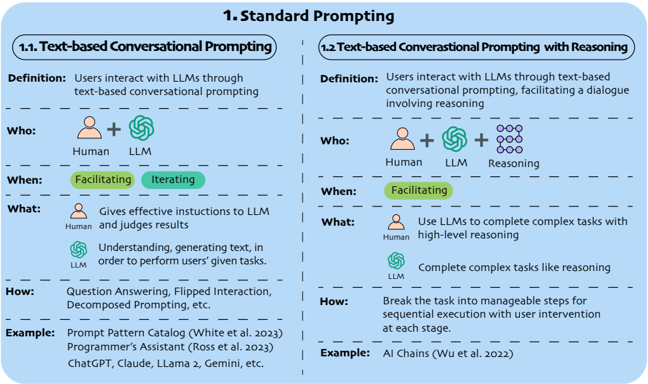
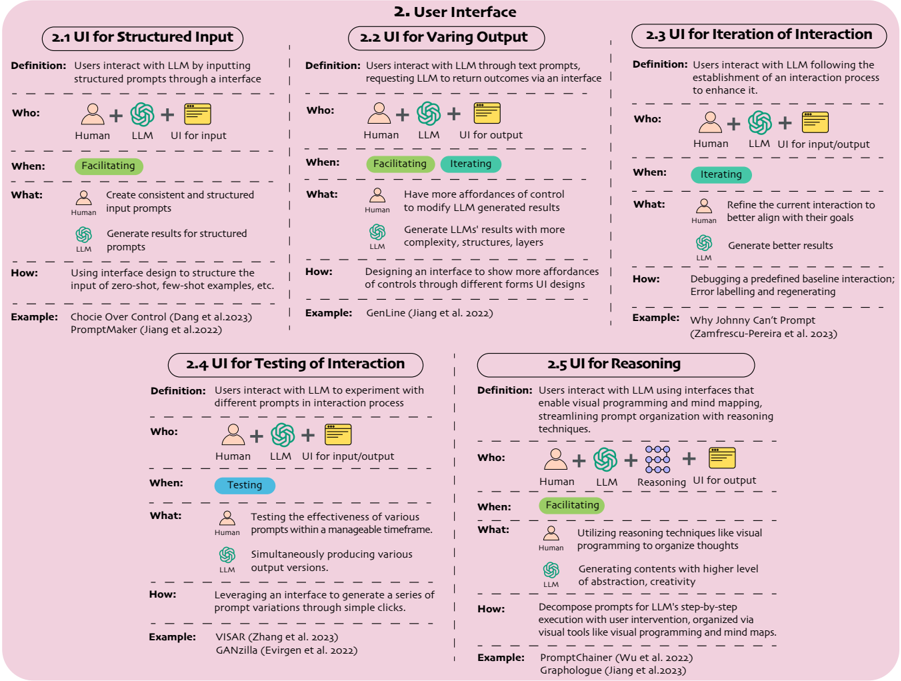
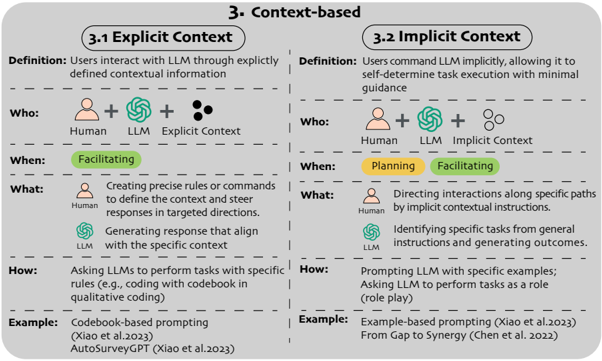
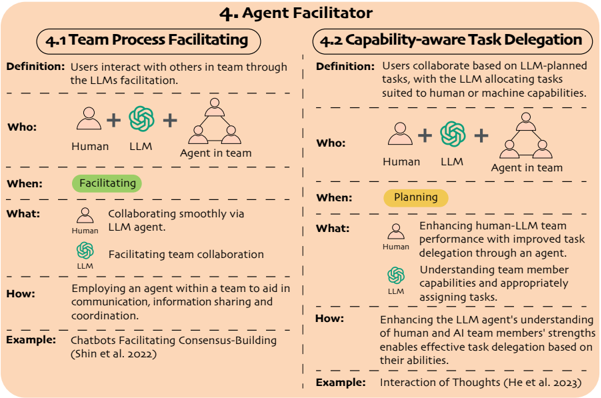
With ChatGPT’s release, conversational prompting has become the most popular form of human-LLM interaction. However, its effectiveness is limited for more complex tasks involving reasoning, creativity, and iteration. Through a systematic analysis of HCI papers published since 2021, we identified four key phases in the human-LLM interaction flow—planning, facilitating, iterating, and testing—to precisely understand the dynamics of this process. Additionally, we have developed a taxonomy of four primary interaction modes: Mode 1: Standard Prompting, Mode 2: User Interface, Mode 3: Context-based, and Mode 4: Agent Facilitator. This taxonomy was further enriched using the “5W1H” guideline method, which involved a detailed examination of definitions, participant roles (Who), the phases that happened (When), human objectives and LLM abilities (What), and the mechanics of each interaction mode (How). We anticipate this taxonomy will contribute to the future design and evaluation of human-LLM interaction.
Overview
The claims and statistics of this paper haven’t been checked yet.
Free: it reads the open-access text and checks the first 5 claims that cite a source we can check. Create a free account to check every claim.
Integrity signals
Registry
Cites
Statistics
Figures
Verification
Claims the paper makes
The claims and statistics of this paper haven’t been checked yet.
Free: it reads the open-access text and checks the first 5 claims that cite a source we can check. Create a free account to check every claim.
Claims other papers make about this one
Each is checked against this paper’s own text: does it say what the citing paper says it does?
The source backs part of the claim, not all of it — or backs it for a different population, condition or comparison.
In the citing paper
“Although other valuable frameworks detail collaborative workflows [58, 124] or communication patterns [139], they often underexplored AI's proactive capabilities.”
From Exploring Collaboration Patterns and Strategies in Human-AI Co-creation through the Lens of Agency: A Scoping Review of the Top-tier HCI Literature (2025) · cites this paper as [58]
Experimental — accuracy not yet measuredThe source backs part of the claim, not all of it — or backs it for a different population, condition or comparison.
In the citing paper
“Although empirical studies [58, 63, 65] offer valuable situated insights, their focus on individual contexts limits the cross-context synthesis required to identify overarching patterns and design principles applicable across the co-creative landscape.”
From Exploring Collaboration Patterns and Strategies in Human-AI Co-creation through the Lens of Agency: A Scoping Review of the Top-tier HCI Literature (2025) · cites this paper as [58]
Experimental — accuracy not yet measuredThe cited source says what the claim attributes to it.
In the citing paper
“Gao et al. [58] for instance, emphasized interaction patterns, leaving agency dynamics and control mechanisms less examined.”
From Exploring Collaboration Patterns and Strategies in Human-AI Co-creation through the Lens of Agency: A Scoping Review of the Top-tier HCI Literature (2025) · cites this paper as [58]
The check wasn’t confident either way, so it gives no verdict — never disputed.
In the citing paper
“Furthermore, empirical studies, while offering valuable insights [58, 63, 65], are often limited to a specific context, limiting generalizability between settings.”
From Exploring Collaboration Patterns and Strategies in Human-AI Co-creation through the Lens of Agency: A Scoping Review of the Top-tier HCI Literature (2025) · cites this paper as [58]
Experimental — accuracy not yet measured
Self-check
Percentages, sums and reported differences re-computed from the paper’s own numbers.
The self-check needs the paper’s full text.
Citations
Cites
(1994) · Cited by 21,711
Chain-Of-Thought Prompting Elicits Reasoning in Large Language Models
Wei, J., Wang, X., Schuurmans, D., Bosma, M., Ichter, B., Xia, F., Chi, E., Le, Q. V., & Zhou, D. (2022) · Advances in Neural Information Processing Systems 35 · doi:10.52202/068431-1800 · Cited by 4,505
Chain-of-Thought Prompting Elicits Reasoning in Large Language Models
Wei, J., Wang, X., Schuurmans, D., Bosma, M., Ichter, B., Xia, F., Chi, E., Le, Q., & Zhou, D. (2022) · arXiv · doi:10.48550/arxiv.2201.11903 · Cited by 4,263
Large Language Models are Zero-Shot Reasoners
Kojima, T., Gu, S. S., Reid, M., Matsuo, Y., & Iwasawa, Y. (2022) · arXiv · doi:10.48550/arxiv.2205.11916 · Cited by 2,013
Why Johnny Can’t Prompt: How Non-AI Experts Try (and Fail) to Design LLM Prompts
Zamfirescu-Pereira, J. D., Wong, R. Y., Hartmann, B., & Yang, Q. (2023) · Proceedings of the 2023 CHI Conference on Human Factors in Computing Systems · doi:10.1145/3544548.3581388 · Cited by 1,274 · cited 1×
“For instance, BotDesigner [78] aids users in refning human-LLM interactions, such as recipe conversations.”
Pattern-Oriented Software Architecture, Patterns for Concurrent and Networked Objects
Schmidt, D. C., Stal, M., Rohnert, H., & Buschmann, F. (2000) · Cited by 982
Prompt Programming for Large Language Models: Beyond the Few-Shot Paradigm
Reynolds, L., & McDonell, K. (2021) · Extended Abstracts of the 2021 CHI Conference on Human Factors in Computing Systems · doi:10.1145/3411763.3451760 · Cited by 952
A Prompt Pattern Catalog to Enhance Prompt Engineering with ChatGPT
White, J., Fu, Q., Hays, S., Sandborn, M., Olea, C., Gilbert, H., Elnashar, A., Spencer-Smith, J., & Schmidt, D. C. (2023) · arXiv · doi:10.48550/arxiv.2302.11382 · Cited by 838 · cited 3×
“Similar to other software taxonomies, such as software design patterns [19, 57] and catalogs for prompt engineering [69], our taxonomy aims to assist software designers in at least two important ways.”
Designing the user interface: Strategies for effective human-computer interaction
Sriram, D. (1987) · Artificial Intelligence in Engineering · doi:10.1016/0954-1810(87)90189-0 · Cited by 756
Wu, T., Terry, M., & Cai, C. J. (2022) · CHI Conference on Human Factors in Computing Systems · doi:10.1145/3491102.3517582 · Cited by 483 · cited 1×
“This is facilitated by employing visual programming techniques, such as chain designs [3, 71, 72] and mind maps [27, 63, 80], enabling a more interactive and user-defned reasoning framework.”
Research works printed but not linked: 3
- 15. Hai Dang, Lukas Mecke, Florian Lehmann, Sven Goller, and Daniel Buschek. 2022. How to Prompt? Opportunities and Challenges of Zero-and Few-Shot Learning for Human-AI Interaction in Creative Applications of Generative Models. http: //arxiv.org/abs/2209.01390 arXiv:2209.01390 [cs]. · arXiv
- 27. Peiling Jiang, Jude Rayan, Steven P Dow, and Haijun Xia. 2023. Graphologue: Exploring Large Language Model Responses with Interactive Diagrams. arXiv preprint arXiv:2305.11473 (2023). · arXiv
- 80. Zheng Zhang, Jie Gao, Ranjodh Singh Dhaliwal, and Toby Jia-Jun Li. 2023. VISAR: A Human-AI Argumentative Writing Assistant with Visual Programming and Rapid Draft Prototyping. arXiv preprint arXiv:2304.07810 (2023). · arXiv
Cited by
Herrera-Poyatos, D., Peláez-González, C., Zuheros, C., Herrera-Poyatos, A., Tejedor, V., Herrera, F., & Montes, R. (2025) · Frontiers in Artificial Intelligence · doi:10.3389/frai.2025.1609097 · Cited by 105
“The taxonomy presented in Gao et al. (2024) categorizes the interaction modes that structure human-LLM exchanges, providing insights into how structured prompting, UI-enhanced reasoning, and agent-facilitated collaboration affect model transparency.”
Using Large Language Models to Generate, Validate, and Apply User Intent Taxonomies
Shah, C., White, R., Andersen, R., Buscher, G., Counts, S., Das, S., Montazer, A., Manivannan, S., Neville, J., Rangan, N., et al. (2025) · ACM Transactions on the Web · doi:10.1145/3732294 · Cited by 33
“1 https://openai.com/gpt-4/ 2 https://anonymous.4open.science/r/LLM-for-taxonomy/”
Using Large Language Models to Generate, Validate, and Apply User Intent Taxonomies
Shah, C., White, R. W., Andersen, R., Buscher, G., Counts, S., Das, S. S. S., Montazer, A., Manivannan, S., Neville, J., Ni, X., et al. (2023) · arXiv · doi:10.48550/arxiv.2309.13063 · Cited by 33
Designing Interactions with Generative AI for Art and Creativity: A Systematic Review and Taxonomy
Hu, X., Xing, Y., Cai, X., Zhao, Y., Cook, M., Borgo, R., & Neate, T. (2025) · Designing Interactive Systems Conference · doi:10.1145/3715336.3735843 · Cited by 61
“Gao et al. [65] identify four distinct phases in the human–LLM interaction—planning, facilitating, iterating, and testing—and introduce a taxonomy of interaction modes that reflect how users engage with LLMs throughout language-based workflows.”
Zhang, S., Wang, H., & Yi, X. (2025) · Proceedings of the ACM on Human-Computer Interaction · doi:10.1145/3757594 · Cited by 36
A hybrid framework for creating artificial intelligence-augmented systematic literature reviews
Malik, F. S., & Terzidis, O. (2026) · Management Review Quarterly · doi:10.1007/s11301-025-00522-8 · Cited by 28
“Addi - tionally, fine-tuning pre-trained models with domain-specific datasets enhances their relevance and applicability (Anthony et al. 2023; Bolaños et al. 2024; Choudhary et al. 2023; Gao et al. 2024; Gatrell et al. 2024).”
AI-Augmented Predictions: LLM Assistants Improve Human Forecasting Accuracy
Schoenegger, P., Park, P. S., Karger, E., Trott, S., & Tetlock, P. E. (2025) · ACM Transactions on Interactive Intelligent Systems · doi:10.1145/3707649 · Cited by 69
“Our approach, which allowed for back-and-forth engagement between users and the LLM, exemplifies how interactive prompting can enhance human performance in complex tasks like forecasting, aligning with the interaction modes described by Gao et al. (2024).”
BackgroundUnraveling Human-AI Teaming: A Review and OutlookPreprint
Lou, B., Lu, T., Raghu, T. S., & Zhang, Y. (2025) · SSRN Electronic Journal · doi:10.2139/ssrn.5211067 · Cited by 68
Feedback by Design: Understanding and Overcoming User Feedback Barriers in Conversational Agents
Sharma, N., Zhang, Z., Lee, D., Krishnan, N., Ren, G.-J., Xiao, Z., & Li, Y. (2026) · Proceedings of the 2026 CHI Conference on Human Factors in Computing Systems · doi:10.1145/3772318.3791600 · Cited by 21
Dango: A Mixed-Initiative Data Wrangling System using Large Language Model
Chen, W., Tong, W., Case, A., & Zhang, T. (2025) · CHI Conference on Human Factors in Computing Systems · doi:10.1145/3706598.3714135 · Cited by 41
Prompting Generative AI with Interaction-Augmented Instructions
Shen, L., Li, H., Wang, Y., Xie, X., & Qu, H. (2025) · CHI Conference Extended Abstracts on Human Factors in Computing Systems (CHI EA) · doi:10.1145/3706599.3720080 · Cited by 36
From Text to Trust: Empowering AI-assisted Decision Making with Adaptive LLM-powered Analysis
Li, Z., Zhu, H., Lu, Z., Xiao, Z., & Yin, M. (2025) · CHI Conference on Human Factors in Computing Systems · doi:10.1145/3706598.3713133 · Cited by 38
Mental model shifts in human-LLM interactions
Schneider, J. (2025) · Journal of Intelligent Information Systems · doi:10.1007/s10844-025-00960-6 · Cited by 30
“There are a number of possible forms of human-LLM (or more generally, GenAI) interactions and prompts, as elaborated in recent taxonomies (Gao et al., 2024;Shietal.,2023;vonBrackel-Schmidtetal.,2023).”
Towards interactive evaluations for interaction harms in human-AI systems
Ibrahim, L., Huang, S., Bhatt, U., Ahmad, L., & Anderljung, M. (2024) · arXiv · doi:10.48550/arxiv.2405.10632 · Cited by 11
“Drawing on observed use cases and literature reviews, we identify five prototypical modes of human-model interaction (Gao et al. 2024”
LLMs in the SOC: An Empirical Study of Human-AI Collaboration in Security Operations Centres
Singh, R., Tariq, S., Jalalvand, F., Chhetri, M. B., Nepal, ., Paris, C., & Lochner, M. (2026) · IEEE Symposium on Security and Privacy (S&P) · doi:10.1109/sp63933.2026.00111 · Cited by 72
“Recent work highlights that prompt structure shapes explain-ability and collaboration [13], dialogue in complex tasks involves verbal and nonverbal cues [44], and human– AI interaction spans planning to testing across varying agent roles [11].”
LLM Whisperer: An Inconspicuous Attack to Bias LLM Responses
Lin, W., Gerchanovsky, A., Akgul, O., Bauer, L., Fredrikson, M., & Wang, Z. (2025) · CHI Conference on Human Factors in Computing Systems · doi:10.1145/3706598.3714025 · Cited by 28
“Researchers have also proposed defense mechanisms against deceptive designs for specific groups, such as older adults [5].”
Stakeholder-centric participation in large language models enhanced health systems
Wang, Z., Yan, R., Francis, S., Diaz, C., Flickinger, T., Lin, Y., Xiao, H., Barnes, L. E., & LeBaron, V. T. (2025) · npj Health Systems · doi:10.1038/s44401-025-00024-5 · Cited by 11
“Compared to conventional human-driven co-design, this “ Human-LLM collaboration ” approach can offer more ef fi cient and inclusive participation while preserving human creativity 37 .”
Geyer, W., He, J., Sarkar, D., Brachman, M., Hammond, C., Heins, J., Ashktorab, Z., Rosemberg, C., & Hill, C. (2025) · Annual Symposium on Human-Computer Interaction for Work (CHIWORK) · doi:10.1145/3729176.3729200 · Cited by 15
“Large language models (LLMs) 1 can be effectively used to generate documents, code, or summaries, to analyze or transform data, to translate languages, to answer questions, to classify or categorize content, to brainstorm, or to plan and organize activities [12, 15, 17, 29, 73, 75, 79].”
Interactions with Generative Information Retrieval Systems
Aliannejadi, M., Gwizdka, J., & Zamani, H. (2024) · The information retrieval series · doi:10.1007/978-3-031-73147-1_3 · Cited by 20
Coscia, A. J., Guo, S., Koh, E., & Endert, A. (2025) · ACM Symposium on User Interface Software and Technology (UIST) · doi:10.1145/3746059.3747746 · Cited by 30
Schömbs, S., Zhang, Y., Gonçalves, J., & Johal, W. (2025) · International Conference on Human-Agent Interaction (HAI) · doi:10.1145/3765766.3765795 · Cited by 19
From limitation to possibility: affordances and tactical evolution in user–GenAI interaction
Zhao, H., Han, Z., Yang, N., & Zeng, Z. (2025) · Journal of Documentation · doi:10.1108/jd-07-2025-0183 · Cited by 8
AI-generated Literature, Distant Writing and the Reader: Reflections on Floridi and Calvino
Mollema, W. J. T. (2025) · Philosophy & Technology · doi:10.1007/s13347-025-01008-x · Cited by 6
“Floridi is concerned with the latter style of human-machine interaction.”
Xu, M., Li, X., Lan, T., Zeng, X., Wang, T., Sheng, S., Deng, X., Sun, J., Fiebrink, R. A., Bryan–Kinns, N., et al. (2026) · Interactive Learning Environments · doi:10.1080/10494820.2025.2604649 · Cited by 6
A Survey on Large Language Models in Software Security: Opportunities and Threats
Rashid, M. B., Hossain, M. S. J., Khan, M. I., Tahora, S., Siddika, A., Prakash, M. I., Yeasmin, S., & Shahriar, H. (2026) · Computers · doi:10.3390/computers15040226 · Cited by 9
Zhang, S., Ye, L., Yi, X., Tang, J., Shui, B., Xing, H., Liu, P., & Li, H. (2024) · arXiv · doi:10.48550/arxiv.2410.14931 · Cited by 4
Transforming Education with Generative AI: Designing for Post-Prompting Era
Wong, L. H. (2025) · Information and Technology in Education and Learning · doi:10.12937/itel.5.1.inv.p003 · Cited by 5
Do LLMs Provide Links to Code Similar to What They Generate? A Study with Gemini and Bing CoPilot
Bifolco, D., Cassieri, P., Scanniello, G., Penta, M. D., & Zampetti, F. (2025) · International Conference on Mining Software Repositories (MSR) · doi:10.1109/msr66628.2025.00042 · Cited by 7
“Therefore, in the second attempt, we improved the query by specifying the LLM role [13] and clarifying the programming language to be used to perform the task: However, we found that simply putting the programming language near the role did not work, so in the third and final attempt, we had to…”
Generative AI in Virtual Reality Communities: A Preliminary Analysis of the VRChat Discord Community
Zhang, H., Zha, S., Cai, J., Wohn, D. Y., & Carroll, J. M. (2025) · CHI Conference Extended Abstracts on Human Factors in Computing Systems (CHI EA) · doi:10.1145/3706599.3720120 · Cited by 5
“After many years of iterative development, GenAI now frequently serves as a key engine for both innovation and debate [27].”
Zhou, S., Armstrong, M., Barbareschi, G., Ajioka, T., Hu, Z., Muto, M., Ando, R., Yoshifuji, K., & Minamizawa, K. (2025) · Augmented Humans International Conference (AHs) · doi:10.1145/3745900.3746089 · Cited by 6
“Given their strong capabilities in natural language generation, reasoning, and image understanding LLMs have become an increasingly popular topic of research in HCI and beyond [2, 6, 34, 89, 93].”
Wu, M., Liu, G., Wang, B., & Ma, Z. (2026) · International Journal of Human-Computer Interaction · doi:10.1080/10447318.2026.2633738 · Cited by 3
Co-Data: Cultivating Effective Human-LLM Collaboration for Collaborative Data Processing
Pachera, A., Mauri, A., Imteyaz, K., Yang, J., Umuhoza, E., Bonifati, A., Lahav, M., & Goyal, N. (2026) · CHI Conference Extended Abstracts on Human Factors in Computing Systems (CHI EA) · doi:10.1145/3772363.3778724 · Cited by 3
“We argue, however, that there is a currently untapped opportunity in investigating how well-designed Human-LLM interactions [15] can empower collaborative data related tasks, where individuals bring different expertise, perspectives, and goals.”
Graph neural network-based interactive clustering enhanced by human knowledge
Wang, Y., Li, Y., Fu, Q., Ji, C., Lu, Y., & Chen, J. (2025) · Applied Soft Computing · doi:10.1016/j.asoc.2025.113595 · Cited by 1
Yu, M., Wang, J., Chen, Y., Lepech, M. D., Liu, Y., & Law, K. H. (2025) · IEEE Annual International Computer Software and Applications Conference (COMPSAC) · doi:10.1109/compsac65507.2025.00081 · Cited by 1
“Prompt engineering is one of the most popular forms of human-LLM interaction [15].”
Judge AI: A Case-Study of Large Language Models as Judges
Posner, E. A., & Saran, S. (2026) · Journal of law & empirical analysis. · doi:10.1177/2755323x261433614 · Cited by 29
“For a detailed overview of interaction techniques, see Gao et al. (2024).”
Rahman, A., Niinuma, K., & Gupta, A. (2026) · CHI Conference on Human Factors in Computing Systems · doi:10.1145/3772318.3791857 · Cited by 4
“In response, recent work has explored integrating LLMs into structured interfaces that constrain inputs, guide interaction, and improve reliability [31, 38, 118, 122].”
Who Does What? Archetypes of Roles Assigned to LLMs During Human-AI Decision-Making
Chappidi, S., Singh, J., & Krauze, A. V. (2026) · CHI Conference on Human Factors in Computing Systems · doi:10.1145/3772318.3791428 · Cited by 8
“For example, Gao et al. [74] suggest four human-LLM “interaction modes” (i.e. standard prompting, user interface, context-based, and agent facilitator), distinguishing varying phases, interfaces, and information contexts that may facilitate LLM use.”
Fact-Checkers Navigating Generative AI: Practices, Boundaries, and Design Implications
Bozkurt, B., Mosleh, M., & Margetts, H. Z. (2026) · ACM Conference on Fairness, Accountability, and Transparency (FAccT) · doi:10.1145/3805689.3806474 · Cited by 1
“…interface design, such as standard prompting, structured user interfaces with tools such as forms and visualizations, context-based interactions using explicit specifications or role-play and example-based prompting, and agent facilitator modes in which the LLM facilitates tasks within a team [35].”
Individual Differences in Generative AI Effectiveness: An Empirical Puzzle for HRD Research
Lovett, N. (2026) · New Horizons in Adult Education and Human Resource Development · doi:10.1177/19394225261472792 · Cited by 1
Practical Guidelines for Building Explainable, Efficient, and Robust Machine Learning SystemsPreprint
Zheng, H., & Ru, Z. (2025) · Engineering Archive (engrXiv) · doi:10.31224/4744
An Emergent Bottom-Up Categorization of Students’ LLMs Usage in an Undergraduate Research Course
Vasquez, I. O., Mahinpei, R., Elouazizi, N., & Conati, C. (2025) · Lecture notes in computer science · doi:10.1007/978-3-031-98462-4_17 · Cited by 2
Li, J., Hu, Y., Fu, S., Wu, Z., Hui, P., Wang, H., & Fan, M. (2024) · International Symposium of Chinese CHI (Chinese CHI) · doi:10.1145/3758871.3758911 · Cited by 2
“The existing studies mainly focus on the relationship between LLMs and the non-aging population [7, 17, 32].”
Yang, H., Park, J. G., Lee, J., & Oh, H. (2025) · International Journal of Human-Computer Interaction · doi:10.1080/10447318.2025.2593550 · Cited by 2
“LLMs have the potential to augment the psychological benefits of journaling by recognizing emotions and providing personalized support through natural conversation (Abd-Alrazaq et al., 2019, 2021; Gao et al., 2024; Guo et al., 2024; Lai et al., 2023; Ma et al., 2024; Nazareth et al., 2024).”
Hyun, S., Kim, H., Jang, J., Choi, H., & Babar, M. A. (2026) · ACM Transactions on Software Engineering and Methodology · doi:10.1145/3844949 · Cited by 1
“They employed Zero-Shot and One-shot patterns and did not explore different prompting methods in experiments.”
REFLECT: Tutorial on Reflecting on Bias in LLMs through Human-Centered Perspectives
Tommasel, A., Schedl, M., & Hertwig, R. (2026) · ACM International Conference on Intelligent User Interfaces (IUI) · doi:10.1145/3742414.3794952
Awasthi, U., Krayer, L., & Sack, D. (2026) · CHI Conference on Human Factors in Computing Systems · doi:10.1145/3772318.3790459 · Cited by 1
Kim, J., & Oh, U. (2026) · CHI Conference Extended Abstracts on Human Factors in Computing Systems (CHI EA) · doi:10.1145/3772363.3798781
From Struggle to Success: Context-Aware Guidance for Screen Reader Users in Computer Use
Chen, N., Lu, J., Wang, Z., Qiu, L. K., Chen, S., & Yang, Y. (2026) · CHI Conference on Human Factors in Computing Systems · doi:10.1145/3772318.3790661 · Cited by 5
“In interactions with MLLMs, context is crucial for bridging the gap between user intent and model comprehension [27, 58], encompassing information about the user, their environment, and relevant knowledge.”
Li, Y., Li, S., He, Z., & Wang, D. (2026) · CHI Conference on Human Factors in Computing Systems · doi:10.1145/3772318.3790350
He, C., Jahangirirad, P., Kyi, L., & Biega, A. J. (2026) · CHI Conference on Human Factors in Computing Systems · doi:10.1145/3772318.3791802 · Cited by 2
“Inspired by the “5W1H” guideline [43, 59], we discuss how different design attributes of the MPC protocol for fairness monitoring presented in Section 3 may relate to user perceptions of data sharing, capturing aspects including fairness objective (Why), collected information type (What), data…”
de Carvalho, L. M., Peças, P., & Jorge, D. P. (2026) · Sustainability · doi:10.3390/su18104787 · Cited by 1
Shi, B., & Kristensson, P. O. (2026) · ACM Transactions on Computer-Human Interaction · doi:10.1145/3817601
Ponochevnyi, N., Kim, Y., Brudno, M., & Kuzminykh, A. (2026) · Designing Interactive Systems Conference · doi:10.1145/3800645.3813033 · Cited by 1
How AI ‐Generated Feedback Hinders or Helps Learning: A Heterogeneous TNA Study of Learning Dynamics
López‐Pernas, S., Misiejuk, K., & Saqr, M. (2026) · Journal of Computer Assisted Learning · doi:10.1002/jcal.70285 · Cited by 3
Bougault, P., Ma, L., & Guey, W. (2026) · Lecture notes in computer science · doi:10.1007/978-3-032-29842-3_20
From Games to Robotics: Unifying Human-Centered LLM Integration
Roso, N., Sužnjević, M., & Markuš, N. (2026) · International Convention on Information and Communication Technology, Electronics and Microelectronics · doi:10.1109/mipro70003.2026.11591744
“Human–computer interaction studies [3] identify four phases of LLM assistance: planning, facilitating, iterating, and testing.”
Peças, P., Pires, D., & Jorge, D. P. (2026) · International Journal of Mathematical Engineering and Management Sciences · doi:10.33889/ijmems.2026.11.4.062
Crafting Creativity: How Professionals Shape AI Outputs Through Prompt Engineering
Kim, S. H., Kwon, K., & Park, S.-P. (2026) · International Journal of Human-Computer Interaction · doi:10.1080/10447318.2026.2706942 · Cited by 1
How can large language models help novice programmers? An exploratory study in educational setting
Zhou, Y., Peng, J., Zhang, M., Tao, Y., & Liu, Y. (2026) · Journal of Systems and Software · doi:10.1016/j.jss.2026.113073
A Large-Scale Empirical Study of Secret Key Leakage in Hugging Face Spaces
Yun, S., Zhang, Y., Shi, Z., Wang, L., Wang, Y., & Bai, Y. (2026) · ACM/IEEE International Conference on Software Engineering: Companion Proceedings (ICSE-Companion) · doi:10.1145/3744916.3773117 · Cited by 2
“With advanced natural language understanding and generation capabilities, LLMs enable fluent human-AI interaction [14].”
Bridging the Physicality Gap: Conversational Repair Strategies in AI-Supported Maker Learning
Nazari, M., Liu, J., & Jung, Y. J. (2026) · ACM/IEEE Joint Conference on Digital Libraries · doi:10.1145/3805696.3846481
“Our findings extend Gao et al. [4] by identifying the “Physical-ity Gap”, the structural mismatch between text-optimized LLMs and real-world physical constraints [1].”
Metadata
- Authors
- Gao, J., Gebreegziabher, S. A., Choo, K. T. W., Li, T. J.-J., Perrault, S. T., & Malone, T. W.
- Affiliations
- Singapore-MIT Alliance for Research and Technology (SG)
- University of Notre Dame (US)
- Singapore University of Technology and Design (SG)
- Massachusetts Institute of Technology (US)
- ORCID
- Venue
- Extended Abstracts of the CHI Conference on Human Factors in Computing Systems
- Publisher
- ACM
- Published
- 2024-05-11
- Pages
- 1-11
- OpenAlex
- W4393904462
- Semantic Scholar
- e9d7b6a0d8e1160a1b557bff9bd86d94d3c38bc0
- Cited by
- 57
- References
- 71
- Citations by year
- 2026: 28 · 2025: 26 · 2024: 3
- FWCI
- 18.37
- Type
- conference paper
- Language
- en
- Open access
- green
- arxiv.org
- Licence
- Locations
- CHI Conference Extended Abstracts on Human Factors in Computing Systems (CHI EA) (publishedVersion)
- arXiv (Cornell University) (submittedVersion, cc-by-nc-sa)
- arXiv (Cornell University)
- Funders
- National Research Foundation
- Topics
- Physical Sciences › Computer Science › Human-Computer Interaction › Usability and User Interface Design
- Physical Sciences › Computer Science › Artificial Intelligence › Speech and dialogue systems
- Physical Sciences › Computer Science › Human-Computer Interaction › Innovative Human-Technology Interaction
- Keywords
- human-LLM interaction, interaction modes, taxonomy (general classification scheme), user interface design
About these checks
Registry, retraction, Cites and statistics results are computed, not judged, with one exception: a printed reference that no index lists is read once by a model before it counts as a citation error. Claims are extracted by a model and kept only when their quote appears verbatim in the text; each cited source is then checked, with a model’s help, for whether it says what the claim relies on. Those verdicts can be wrong — read the claim’s quote and the cited source before relying on one.
Statistics and arithmetic are recomputed, not judged.
Confidence bands are shown only for fields calibrated on our annotated test set. None is calibrated yet, so no band is shown.
What counts as a claim ›How we measure confidence ›How we check this ›
Are you an author, or do you see a problem with this page? Request a review
Data sources
Bibliographic data: Semantic Scholar, OpenAlex, Crossref.
Contains information from the Semantic Scholar Academic Graph Datasets, made available under the ODC Attribution License (ODC-BY 1.0).
Semantic Scholar’s data is described in: Kinney, R., et al. (2023). The Semantic Scholar Open Data Platform. arXiv:2301.10140.
