

A Taxonomy for Human-LLM Interaction Modes: An Initial Exploration
Open accessThe DOI matches its Crossref record; 83 of the 83 references it cites were found in a registry or an index.
Abstract
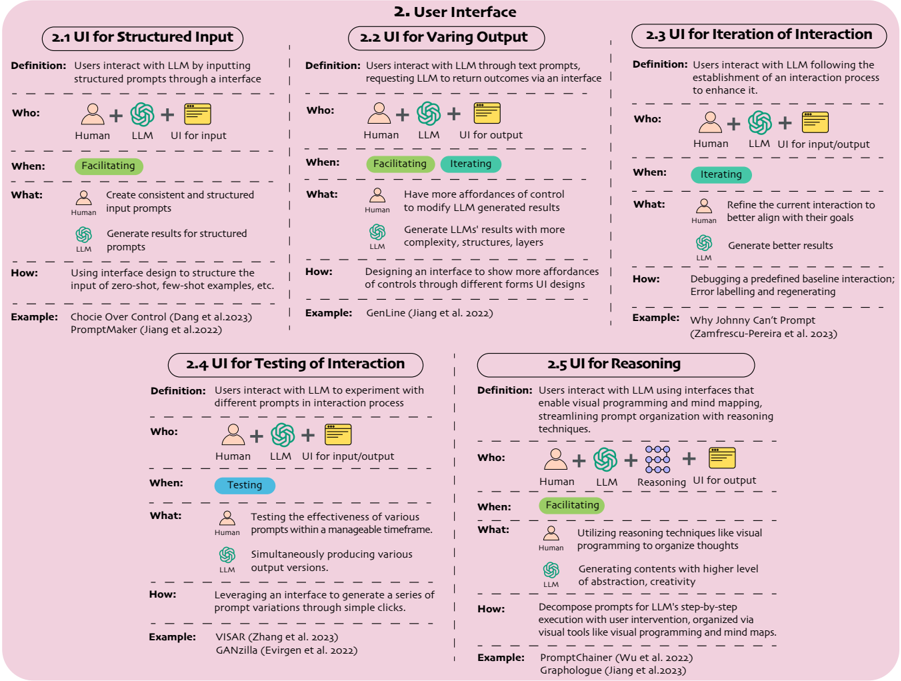
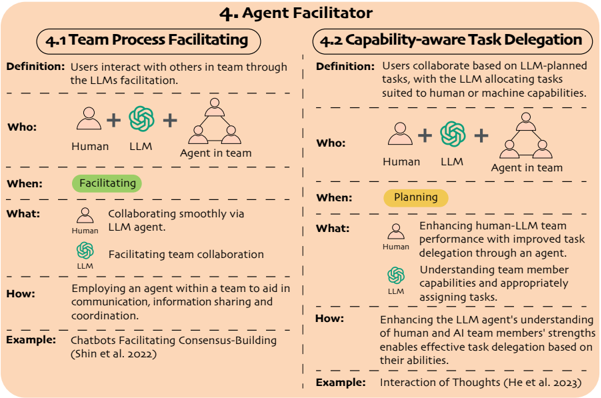
With ChatGPT’s release, conversational prompting has become the most popular form of human-LLM interaction. However, its effectiveness is limited for more complex tasks involving reasoning, creativity, and iteration. Through a systematic analysis of HCI papers published since 2021, we identified four key phases in the human-LLM interaction flow—planning, facilitating, iterating, and testing—to precisely understand the dynamics of this process. Additionally, we have developed a taxonomy of four primary interaction modes: Mode 1: Standard Prompting, Mode 2: User Interface, Mode 3: Context-based, and Mode 4: Agent Facilitator. This taxonomy was further enriched using the “5W1H” guideline method, which involved a detailed examination of definitions, participant roles (Who), the phases that happened (When), human objectives and LLM abilities (What), and the mechanics of each interaction mode (How). We anticipate this taxonomy will contribute to the future design and evaluation of human-LLM interaction.
Overview
The claims and statistics of this paper haven’t been checked yet.
Free: it reads the open-access text and checks the first 5 claims that cite a source we can check. Create a free account to check every claim.
Integrity signals
Registry
Cites
Statistics
Figures


Verification
Claims the paper makes
The claims and statistics of this paper haven’t been checked yet.
Free: it reads the open-access text and checks the first 5 claims that cite a source we can check. Create a free account to check every claim.
Claims other papers make about this one
Each is checked against this paper’s own text: does it say what the citing paper says it does?
The source backs part of the claim, not all of it — or backs it for a different population, condition or comparison.
In the citing paper
“Although other valuable frameworks detail collaborative workflows [58, 124] or communication patterns [139], they often underexplored AI's proactive capabilities.”
From Exploring Collaboration Patterns and Strategies in Human-AI Co-creation through the Lens of Agency: A Scoping Review of the Top-tier HCI Literature (2025) · cites this paper as [58]
Experimental — accuracy not yet measuredThe source backs part of the claim, not all of it — or backs it for a different population, condition or comparison.
In the citing paper
“Although empirical studies [58, 63, 65] offer valuable situated insights, their focus on individual contexts limits the cross-context synthesis required to identify overarching patterns and design principles applicable across the co-creative landscape.”
From Exploring Collaboration Patterns and Strategies in Human-AI Co-creation through the Lens of Agency: A Scoping Review of the Top-tier HCI Literature (2025) · cites this paper as [58]
Experimental — accuracy not yet measuredThe cited source says what the claim attributes to it.
In the citing paper
“Gao et al. [58] for instance, emphasized interaction patterns, leaving agency dynamics and control mechanisms less examined.”
From Exploring Collaboration Patterns and Strategies in Human-AI Co-creation through the Lens of Agency: A Scoping Review of the Top-tier HCI Literature (2025) · cites this paper as [58]
The check wasn’t confident either way, so it gives no verdict — never disputed.
In the citing paper
“Furthermore, empirical studies, while offering valuable insights [58, 63, 65], are often limited to a specific context, limiting generalizability between settings.”
From Exploring Collaboration Patterns and Strategies in Human-AI Co-creation through the Lens of Agency: A Scoping Review of the Top-tier HCI Literature (2025) · cites this paper as [58]
Experimental — accuracy not yet measured
Self-check
Percentages, sums and reported differences re-computed from the paper’s own numbers.
The self-check needs the paper’s full text.
Citations
Cites
(1994) · Cited by 21,711
Chain-Of-Thought Prompting Elicits Reasoning in Large Language Models
Wei, J., Wang, X., Schuurmans, D., Bosma, M., Ichter, B., Xia, F., Chi, E., Le, Q. V., & Zhou, D. (2022) · Advances in Neural Information Processing Systems 35 · doi:10.52202/068431-1800 · Cited by 4,505
Chain-of-Thought Prompting Elicits Reasoning in Large Language Models
Wei, J., Wang, X., Schuurmans, D., Bosma, M., Ichter, B., Xia, F., Chi, E., Le, Q., & Zhou, D. (2022) · arXiv · doi:10.48550/arxiv.2201.11903 · Cited by 4,263
Large Language Models are Zero-Shot Reasoners
Kojima, T., Gu, S. S., Reid, M., Matsuo, Y., & Iwasawa, Y. (2022) · arXiv · doi:10.48550/arxiv.2205.11916 · Cited by 2,013
Why Johnny Can’t Prompt: How Non-AI Experts Try (and Fail) to Design LLM Prompts
Zamfirescu-Pereira, J. D., Wong, R. Y., Hartmann, B., & Yang, Q. (2023) · Proceedings of the 2023 CHI Conference on Human Factors in Computing Systems · doi:10.1145/3544548.3581388 · Cited by 1,274 · cited 1×
“For instance, BotDesigner [78] aids users in refning human-LLM interactions, such as recipe conversations.”
Pattern-Oriented Software Architecture, Patterns for Concurrent and Networked Objects
Schmidt, D. C., Stal, M., Rohnert, H., & Buschmann, F. (2000) · Cited by 982
Prompt Programming for Large Language Models: Beyond the Few-Shot Paradigm
Reynolds, L., & McDonell, K. (2021) · Extended Abstracts of the 2021 CHI Conference on Human Factors in Computing Systems · doi:10.1145/3411763.3451760 · Cited by 952
A Prompt Pattern Catalog to Enhance Prompt Engineering with ChatGPT
White, J., Fu, Q., Hays, S., Sandborn, M., Olea, C., Gilbert, H., Elnashar, A., Spencer-Smith, J., & Schmidt, D. C. (2023) · arXiv · doi:10.48550/arxiv.2302.11382 · Cited by 838 · cited 3×
“Similar to other software taxonomies, such as software design patterns [19, 57] and catalogs for prompt engineering [69], our taxonomy aims to assist software designers in at least two important ways.”
Designing the user interface: Strategies for effective human-computer interaction
Sriram, D. (1987) · Artificial Intelligence in Engineering · doi:10.1016/0954-1810(87)90189-0 · Cited by 756
Wu, T., Terry, M., & Cai, C. J. (2022) · CHI Conference on Human Factors in Computing Systems · doi:10.1145/3491102.3517582 · Cited by 483 · cited 1×
“This is facilitated by employing visual programming techniques, such as chain designs [3, 71, 72] and mind maps [27, 63, 80], enabling a more interactive and user-defned reasoning framework.”
Wordcraft: Story Writing With Large Language Models
Yuan, A., Coenen, A., Reif, E., & Ippolito, D. (2022) · 27th International Conference on Intelligent User Interfaces · doi:10.1145/3490099.3511105 · Cited by 374
Lee, M., Liang, P., & Yang, Q. (2022) · CHI Conference on Human Factors in Computing Systems · doi:10.1145/3491102.3502030 · Cited by 345 · cited 1×
“One example is the OpenAI Playground; similarly, literature such as CoAuthor leverages LLMs to ofer writing suggestions based on the user’s input text [40].”
CHI Conference on Human Factors in Computing Systems
(2022) · doi:10.1145/3491102 · Cited by 308
Ross, S. I., Martinez, F., Houde, S., Muller, M., & Weisz, J. D. (2023) · Proceedings of the 28th International Conference on Intelligent User Interfaces · doi:10.1145/3581641.3584037 · Cited by 258 · cited 1×
“From the literature, Programmer’s Assistant [56] provides an interface that allows users to interact with the model conversationally.”
Cutting Down on Prompts and Parameters: Simple Few-Shot Learning with Language ModelsPreprint
Logan, R. L., IV, Balavzevi'c, I., Wallace, E., Petroni, F., Singh, S., & Riedel, S. (2021) · Findings · doi:10.48550/arxiv.2106.13353 · Cited by 253 · cited 1×
“The design strategies include zero-shot [36], few-shot [45], chain-of-thought techniques [68], etc.”
Mirowski, P., Mathewson, K. W., Pittman, J., & Evans, R. (2023) · Proceedings of the 2023 CHI Conference on Human Factors in Computing Systems · doi:10.1145/3544548.3581225 · Cited by 240 · cited 1×
“…LLM’s capability to discern user intent and generate or modify outputs accordingly, researchers have proposed augmenting LLMs with enhanced reasoning abilities to expand their problem-solving capacity beyond basic inquiries such as mathematical problem-solving [42] and argumentative writing [48].”
Xiao, Z., Yuan, X., Liao, Q. V., Abdelghani, R., & Oudeyer, P.-Y. (2023) · 28th International Conference on Intelligent User Interfaces · doi:10.1145/3581754.3584136 · Cited by 230 · cited 2×
“Similarly, example-based prompting entails providing LLMs with a handful of relevant examples that clearly demonstrate the expected input and output [76], with the LLM tasked to independently discern the underlying rationale.”
TaleBrush: Sketching Stories with Generative Pretrained Language Models
Chung, J. J. Y., Kim, W., Yoo, K. M., Lee, H., Adar, E., & Chang, M. (2022) · CHI Conference on Human Factors in Computing Systems · doi:10.1145/3491102.3501819 · Cited by 206
Brade, S., Wang, B., Sousa, M., Oore, S., & Grossman, T. (2023) · Proceedings of the 36th Annual ACM Symposium on User Interface Software and Technology · doi:10.1145/3586183.3606725 · Cited by 198 · cited 1×
“Such UI enhancements allow users to refne their original interaction fows, leading to improved fnal or intermediate outputs [6, 43].”
PromptChainer: Chaining Large Language Model Prompts through Visual Programming
Wu, T., Jiang, E., Donsbach, A., Gray, J., Molina, A., Terry, M., & Cai, C. J. (2022) · CHI Conference on Human Factors in Computing Systems Extended Abstracts · doi:10.1145/3491101.3519729 · Cited by 198 · cited 1×
“This is facilitated by employing visual programming techniques, such as chain designs [3, 71, 72] and mind maps [27, 63, 80], enabling a more interactive and user-defned reasoning framework.”
Zhang, Z., Xu, Y., Wang, Y., Yao, B., Ritchie, D., Wu, T., Yu, M., Wang, D., & Li, T. J.-J. (2022) · CHI Conference on Human Factors in Computing Systems · doi:10.1145/3491102.3517479 · Cited by 174
Self-citationJo, E., Epstein, D. A., Jung, H., & Kim, Y.-H. (2023) · Proceedings of the 2023 CHI Conference on Human Factors in Computing Systems · doi:10.1145/3544548.3581503 · Cited by 174
PromptMaker: Prompt-based Prototyping with Large Language Models
Jiang, E., Olson, K., Toh, E., Molina, A., Donsbach, A., Terry, M., & Cai, C. J. (2022) · CHI Conference on Human Factors in Computing Systems Extended Abstracts · doi:10.1145/3491101.3503564 · Cited by 157
Enabling Conversational Interaction with Mobile UI using Large Language Models
Wang, B., Li, G., & Li, Y. (2023) · Proceedings of the 2023 CHI Conference on Human Factors in Computing Systems · doi:10.1145/3544548.3580895 · Cited by 156
Sensecape: Enabling Multilevel Exploration and Sensemaking with Large Language Models
Suh, S., Min, B., Palani, S., & Xia, H. (2023) · Proceedings of the 36th Annual ACM Symposium on User Interface Software and Technology · doi:10.1145/3586183.3606756 · Cited by 151
Sensecape: Enabling Multilevel Exploration and Sensemaking with Large Language Models
Suh, S., Min, B., Palani, S., & Xia, H. (2023) · arXiv · doi:10.48550/arxiv.2305.11483 · Cited by 151
Graphologue: Exploring Large Language Model Responses with Interactive Diagrams
Jiang, P., Rayan, J., Dow, S. P., & Xia, H. (2023) · Proceedings of the 36th Annual ACM Symposium on User Interface Software and Technology · doi:10.1145/3586183.3606737 · Cited by 135 · cited 2×
“This is facilitated by employing visual programming techniques, such as chain designs [3, 71, 72] and mind maps [27, 63, 80], enabling a more interactive and user-defned reasoning framework.”
Cutting Down on Prompts and Parameters: Simple Few-Shot Learning with Language Models
Logan IV, R., Balazevic, I., Wallace, E., Petroni, F., Singh, S., & Riedel, S. (2022) · Findings of the Association for Computational Linguistics: ACL 2022 · doi:10.18653/v1/2022.findings-acl.222 · Cited by 133
On the Design of AI-powered Code Assistants for Notebooks
McNutt, A. M., Wang, C., DeLine, R. A., & Drucker, S. M. (2023) · CHI Conference on Human Factors in Computing Systems · doi:10.1145/3544548.3580940 · Cited by 126
Liu, M. X., Sarkar, A., Negreanu, C., Zorn, B., Williams, J., Toronto, N., & Gordon, A. D. (2023) · Proceedings of the 2023 CHI Conference on Human Factors in Computing Systems · doi:10.1145/3544548.3580817 · Cited by 119 · cited 1×
“Such UI enhancements allow users to refne their original interaction fows, leading to improved fnal or intermediate outputs [6, 43].”
Buschek, D., Zürn, M., & Eiband, M. (2021) · Proceedings of the 2021 CHI Conference on Human Factors in Computing Systems · doi:10.1145/3411764.3445372 · Cited by 108
Opal: Multimodal Image Generation for News Illustration
Liu, V., Qiao, H., & Chilton, L. (2022) · Proceedings of the 35th Annual ACM Symposium on User Interface Software and Technology · doi:10.1145/3526113.3545621 · Cited by 104
Low-code LLM: Graphical User Interface over Large Language ModelsPreprint
Cai, Y., Mao, S., Wu, W., Wang, Z., Liang, Y., Ge, T., Wu, C., Wang, Y., Song, T., Xia, Y., et al. (2023) · arXiv (Cornell University) · doi:10.48550/arxiv.2304.08103 · Cited by 85
Beyond Text Generation: Supporting Writers with Continuous Automatic Text Summaries
Dang, H., Benharrak, K., Lehmann, F., & Buschek, D. (2022) · Proceedings of the 35th Annual ACM Symposium on User Interface Software and Technology · doi:10.1145/3526113.3545672 · Cited by 84
Dang, H., Goller, S., Lehmann, F., & Buschek, D. (2023) · Proceedings of the 2023 CHI Conference on Human Factors in Computing Systems · doi:10.1145/3544548.3580969 · Cited by 83 · cited 1×
“Similarly, Dang et al.[14] developed UI variants that integrate user instructions with the standard prompting, enhancing more nuanced user-model interaction.”
Human-AI Collaboration for UX Evaluation: Effects of Explanation and Synchronization
Fan, M., Yang, X., Yu, T., Liao, Q. V., & Zhao, J. (2022) · Proceedings of the ACM on Human-Computer Interaction · doi:10.1145/3512943 · Cited by 81
Jiang, E., Toh, E., Molina, A., Olson, K., Kayacik, C., Donsbach, A., Cai, C. J., & Terry, M. (2022) · CHI Conference on Human Factors in Computing Systems · doi:10.1145/3491102.3501870 · Cited by 79 · cited 1×
“A typical example is GenLine, developed by Jiang et al.[26], which enables users to generate CSS styles, such as button-style HTML code, and ofers an interface for users to choose whether to accept the generated style.”
Osone, H., Lu, J.-L., & Ochiai, Y. (2021) · Extended Abstracts of the 2021 CHI Conference on Human Factors in Computing Systems · doi:10.1145/3411763.3450391 · Cited by 74
PaTAT: Human-AI Collaborative Qualitative Coding with Explainable Interactive Rule Synthesis
Gebreegziabher, S. A., Zhang, Z., Tang, X., Meng, Y., Glassman, E. L., & Li, T. J.-J. (2023) · Proceedings of the 2023 CHI Conference on Human Factors in Computing Systems · doi:10.1145/3544548.3581352 · Cited by 72
Self-citationSpellburst: A Node-based Interface for Exploratory Creative Coding with Natural Language Prompts
Angert, T., Suzara, M., Han, J., Pondoc, C., & Subramonyam, H. (2023) · Proceedings of the 36th Annual ACM Symposium on User Interface Software and Technology · doi:10.1145/3586183.3606719 · Cited by 72
Stylette: Styling the Web with Natural Language
Kim, T. S., Choi, D., Choi, Y., & Kim, J. (2022) · CHI Conference on Human Factors in Computing Systems · doi:10.1145/3491102.3501931 · Cited by 71
Chatbots Facilitating Consensus-Building in Asynchronous Co-Design
Shin, J., Hedderich, M. A., Lucero, A., & Oulasvirta, A. (2022) · ACM Symposium on User Interface Software and Technology (UIST) · doi:10.1145/3526113.3545671 · Cited by 68
PopBlends: Strategies for Conceptual Blending with Large Language Models
Wang, S., Petridis, S., Kwon, T., Ma, X., & Chilton, L. B. (2023) · Proceedings of the 2023 CHI Conference on Human Factors in Computing Systems · doi:10.1145/3544548.3580948 · Cited by 64
Gu, H., Yang, C., Haeri, M., Wang, J., Tang, S., Yan, W., He, S., Williams, C. K., Magaki, S., & Chen, X. (2023) · CHI Conference on Human Factors in Computing Systems · doi:10.1145/3544548.3580694 · Cited by 57
Kim, T. S., Lee, Y., Chang, M., & Kim, J. (2023) · Proceedings of the 36th Annual ACM Symposium on User Interface Software and Technology · doi:10.1145/3586183.3606833 · Cited by 56
Snowy: Recommending Utterances for Conversational Visual Analysis
Srinivasan, A., & Setlur, V. (2021) · ACM Symposium on User Interface Software and Technology (UIST) · doi:10.1145/3472749.3474792 · Cited by 54 · cited 1×
“In contrast, augmenting LLMs with implicit context involves providing them with limited or general queries and commands, and then expecting them to infer how to perform tasks based on a few examples or by detecting the underlying context [62].”
My Bad! Repairing Intelligent Voice Assistant Errors Improves Interaction
Cuadra, A., Li, S., Lee, H., Cho, J., & Ju, W. (2021) · Proceedings of the ACM on Human-Computer Interaction · doi:10.1145/3449101 · Cited by 52
Exploring the Use of Large Language Models for Improving the Awareness of Mindfulness
Kumar, H., Wang, Y., Shi, J., Musabirov, I., Farb, N. A. S., & Williams, J. J. (2023) · Extended Abstracts of the 2023 CHI Conference on Human Factors in Computing Systems · doi:10.1145/3544549.3585614 · Cited by 50 · cited 1×
“In role play, users enhance LLMs’ output quality by assigning them specifc roles, such as a chatbot capable of refective thinking [37].”
ScatterShot: Interactive In-context Example Curation for Text Transformation
Wu, T., Shen, H., Weld, D. S., Heer, J., & Ribeiro, M. T. (2023) · ACM International Conference on Intelligent User Interfaces (IUI) · doi:10.1145/3581641.3584059 · Cited by 49
Zheng, C., Wu, Y., Shi, C., Ma, S., Luo, J., & Ma, X. (2023) · Proceedings of the 2023 CHI Conference on Human Factors in Computing Systems · doi:10.1145/3544548.3581131 · Cited by 48 · cited 1×
“This is typically achieved by integrating an agent within the team that aids in communication [16], decision-making [83], information sharing, and coordination.”
Bhat, A., Agashe, S., Oberoi, P., Mohile, N., Jangir, R., & Joshi, A. (2023) · Proceedings of the 28th International Conference on Intelligent User Interfaces · doi:10.1145/3581641.3584060 · Cited by 47
Chen, W., Yu, C., Wang, H., Wang, Z., Yang, L., Wang, Y., Shi, W., & Shi, Y. (2023) · ACM Symposium on User Interface Software and Technology (UIST) · doi:10.1145/3586183.3606741 · Cited by 44
PromptInfuser: Bringing User Interface Mock-ups to Life with Large Language Models
Petridis, S., Terry, M., & Cai, C. J. (2023) · Extended Abstracts of the 2023 CHI Conference on Human Factors in Computing Systems · doi:10.1145/3544549.3585628 · Cited by 39
ChatGPT in Healthcare: Exploring AI Chatbot for Spontaneous Word Retrieval in Aphasia
Purohit, A. K., Upadhyaya, A., & Holzer, A. (2023) · Computer Supported Cooperative Work and Social Computing · doi:10.1145/3584931.3606993 · Cited by 38
Lee, Y., Yamashita, N., & Huang, Y. (2021) · Proceedings of the ACM on Human-Computer Interaction · doi:10.1145/3449196 · Cited by 37
DIY: Assessing the Correctness of Natural Language to SQL Systems
Narechania, A. A., Fourney, A., Lee, B., & Ramos, G. (2021) · ACM International Conference on Intelligent User Interfaces (IUI) · doi:10.1145/3397481.3450667 · Cited by 36
He, Z., Song, Y., Zhou, S., & Cai, Z. (2023) · CHI Conference on Human Factors in Computing Systems · doi:10.1145/3544548.3580983 · Cited by 34
Ito, T., Yamashita, N., Kuribayashi, T., Hidaka, M., Suzuki, J., Gao, G., Jamieson, J., & Inui, K. (2023) · ACM Symposium on User Interface Software and Technology (UIST) · doi:10.1145/3586183.3606810 · Cited by 34
Duan, W., Yamashita, N., Shirai, Y., & Fussell, S. R. (2021) · Proceedings of the ACM on Human-Computer Interaction · doi:10.1145/3479579 · Cited by 33 · cited 1×
“This is typically achieved by integrating an agent within the team that aids in communication [16], decision-making [83], information sharing, and coordination.”
Lc, R., & Mizuno, D. (2021) · CHI Conference Extended Abstracts on Human Factors in Computing Systems (CHI EA) · doi:10.1145/3411763.3450373 · Cited by 32
Louie, R., Engel, J., & Huang, C.-Z. A. (2022) · 27th International Conference on Intelligent User Interfaces · doi:10.1145/3490099.3511159 · Cited by 30
GenLine and GenForm: Two Tools for Interacting with Generative Language Models in a Code Editor
Jiang, E., Toh, E., Molina, A., Donsbach, A., Cai, C. J., & Terry, M. (2021) · Adjunct Proceedings of the 34th Annual ACM Symposium on User Interface Software and Technology · doi:10.1145/3474349.3480209 · Cited by 27 · cited 1×
“A variation of this tool is GenForm[25], which facilitates the structured generation of mixed outputs, including HTML, JavaScript, and CSS code, through a form interface.”
Zhang, M., Cheng, Z., Shiu, S. T. R., Liang, J., Fang, C., Ma, Z., Fang, L., & Wang, S. J. (2023) · Computer Supported Cooperative Work and Social Computing · doi:10.1145/3584931.3607008 · Cited by 26
Wu, T., Terry, M., & Cai, C. J. (2021) · arXiv (Cornell University) · doi:10.48550/arxiv.2110.01691 · Cited by 26 · cited 1×
“This is facilitated by employing visual programming techniques, such as chain designs [3, 71, 72] and mind maps [27, 63, 80], enabling a more interactive and user-defned reasoning framework.”
Interactive Exploration-Exploitation Balancing for Generative Melody Composition
Zhou, Y., Koyama, Y., Goto, M., & Igarashi, T. (2021) · 26th International Conference on Intelligent User Interfaces · doi:10.1145/3397481.3450663 · Cited by 24
Let Me Ask You This: How Can a Voice Assistant Elicit Explicit User Feedback?
Xiao, Z., Mennicken, S., Huber, B., Shonkoff, A., & Thom, J. (2021) · Proceedings of the ACM on Human-Computer Interaction · doi:10.1145/3479532 · Cited by 23
ChainForge: An open-source visual programming environment for prompt engineering
Arawjo, I., Vaithilingam, P., WATTENBERG, M. P., & Glassman, E. L. (2023) · ACM Symposium on User Interface Software and Technology (UIST) · doi:10.1145/3586182.3616660 · Cited by 23
GANzilla: User-Driven Direction Discovery in Generative Adversarial Networks
Evirgen, N., & Chen, X. '. (2022) · Proceedings of the 35th Annual ACM Symposium on User Interface Software and Technology · doi:10.1145/3526113.3545638 · Cited by 22
SemanticOn: Specifying Content-Based Semantic Conditions for Web Automation Programs
Pu, K., Fu, R., Dong, R., Wang, X., Chen, Y., & Grossman, T. (2022) · ACM Symposium on User Interface Software and Technology (UIST) · doi:10.1145/3526113.3545691 · Cited by 19
RetroLens: A Human-AI Collaborative System for Multi-step Retrosynthetic Route Planning
Shi, C., Hu, Y., Wang, S., Ma, S., Zheng, C., Ma, X., & Luo, Q. (2023) · Proceedings of the 2023 CHI Conference on Human Factors in Computing Systems · doi:10.1145/3544548.3581469 · Cited by 19 · cited 1×
“[58], the LLM can decide whether to assign tasks to each member of a group.”
GridBook: Natural Language Formulas for the Spreadsheet Grid
Srinivasa Ragavan, S., Hou, Z., Wang, Y., Gordon, A. D., Zhang, H., & Zhang, D. (2022) · 27th International Conference on Intelligent User Interfaces · doi:10.1145/3490099.3511161 · Cited by 15 · cited 1×
“This include single-turn conversation [61] and multiple-turn conversations [7].”
Zhu, Q., & Wang, H. (2023) · ACM Conference on Computer Supported Cooperative Work (CSCW) · doi:10.1145/3584931.3606965 · Cited by 15
Interactive User Interface for Dialogue Summarization
Jung, J., Seo, H., Jung, S., Chung, R., Ryu, H., & Chang, D.-S. (2023) · ACM International Conference on Intelligent User Interfaces (IUI) · doi:10.1145/3581641.3584057 · Cited by 14
Toward Value Scenario Generation Through Large Language Models
Jung, H., Seo, W., Song, S., & Na, S. (2023) · ACM Conference on Computer Supported Cooperative Work (CSCW) · doi:10.1145/3584931.3606960 · Cited by 13
Narratron: Collaborative Writing and Shadow-playing of Children Stories with Large Language Models
Zhao, Y., & Bao, X. (2023) · ACM Symposium on User Interface Software and Technology (UIST) · doi:10.1145/3586182.3625120 · Cited by 13
Lemmer, S. J., Guo, A., & Corso, J. J. (2023) · ACM International Conference on Intelligent User Interfaces (IUI) · doi:10.1145/3581641.3584092 · Cited by 12 · cited 1×
“…LLM’s capability to discern user intent and generate or modify outputs accordingly, researchers have proposed augmenting LLMs with enhanced reasoning abilities to expand their problem-solving capacity beyond basic inquiries such as mathematical problem-solving [42] and argumentative writing [48].”
Developing a Conversational Recommendation Systemfor Navigating Limited Options
Bursztyn, V. S., Healey, J., Koh, E., Lipka, N., & Birnbaum, L. (2021) · CHI Conference Extended Abstracts on Human Factors in Computing Systems (CHI EA) · doi:10.1145/3411763.3451596 · Cited by 11 · cited 1×
“This include single-turn conversation [61] and multiple-turn conversations [7].”
Brachman, M., Pan, Q., Do, H. J., Dugan, C., Chaudhary, A., Johnson, J. M., Rai, P., Chakraborti, T., Gschwind, T., Laredo, J. A., et al. (2023) · Proceedings of the 28th International Conference on Intelligent User Interfaces · doi:10.1145/3581641.3584088 · Cited by 11
Mukherjee, A., de Santana, V. F., & Baria, A. T. (2023) · Extended Abstracts of the CHI Conference on Human Factors in Computing Systems (CHI EA) · doi:10.1145/3544549.3573844 · Cited by 10
AutoSurveyGPT: GPT-Enhanced Automated Literature Discovery
Xiao, C. (2023) · ACM Symposium on User Interface Software and Technology (UIST) · doi:10.1145/3586182.3616648 · Cited by 6 · cited 1×
“Similarly, AutoSurveyGPT [74] enables LLMs to automatically scan abstracts and extract keywords based on pre-defned commands and rules.”
Kim, T., Guo, Q., Kim, H., Yang, W., Li, M., & Ma, X. (2022) · ACM Conference on Computer Supported Cooperative Work (CSCW) · doi:10.1145/3500868.3559441 · Cited by 5
Human-AI Collaboration via Conditional Delegation: A Case Study of Content ModerationPreprint
Lai, V. W.-M., Carton, S., Bhatnagar, R., et al. (2022) · arXiv (Cornell University) · doi:10.48550/arxiv.2204.11788 · Cited by 2
Aina, L., & Linzen, T. (2021) · arXiv (Cornell University) · doi:10.48550/arxiv.2109.07848 · cited 2×
“Furthermore, it may also be susceptible to ambiguity and misalignment in interpreting intent [1].”
Research works printed but not linked: 3
- Hai Dang Lukas Mecke Florian Lehmann Sven Goller and Daniel Buschek. 2022. How to Prompt? Opportunities and Challenges of Zero- and Few-Shot Learning for Human-AI Interaction in Creative Applications of Generative Models. http://arxiv.org/abs/2209.01390 arXiv:2209.01390 [cs]. · arXiv
- Peiling Jiang, Jude Rayan, Steven P Dow, and Haijun Xia. 2023. Graphologue: Exploring Large Language Model Responses with Interactive Diagrams. arXiv preprint arXiv:2305.11473 (2023). · arXiv
- Zheng Zhang, Jie Gao, Ranjodh Singh Dhaliwal, and Toby Jia-Jun Li. 2023. VISAR: A Human-AI Argumentative Writing Assistant with Visual Programming and Rapid Draft Prototyping. arXiv preprint arXiv:2304.07810 (2023). · arXiv
Cited by
Herrera-Poyatos, D., Peláez-González, C., Zuheros, C., Herrera-Poyatos, A., Tejedor, V., Herrera, F., & Montes, R. (2025) · Frontiers in Artificial Intelligence · doi:10.3389/frai.2025.1609097 · Cited by 105
“The taxonomy presented in Gao et al. (2024) categorizes the interaction modes that structure human-LLM exchanges, providing insights into how structured prompting, UI-enhanced reasoning, and agent-facilitated collaboration affect model transparency.”
Using Large Language Models to Generate, Validate, and Apply User Intent Taxonomies
Shah, C., White, R. W., Andersen, R., Buscher, G., Counts, S., Das, S. S. S., Montazer, A., Manivannan, S., Neville, J., Ni, X., et al. (2023) · arXiv · doi:10.48550/arxiv.2309.13063 · Cited by 33
Designing Interactions with Generative AI for Art and Creativity: A Systematic Review and Taxonomy
Hu, X., Xing, Y., Cai, X., Zhao, Y., Cook, M., Borgo, R., & Neate, T. (2025) · Designing Interactive Systems Conference · doi:10.1145/3715336.3735843 · Cited by 61
“Gao et al. [65] identify four distinct phases in the human–LLM interaction—planning, facilitating, iterating, and testing—and introduce a taxonomy of interaction modes that reflect how users engage with LLMs throughout language-based workflows.”
Zhang, S., Wang, H., & Yi, X. (2025) · Proceedings of the ACM on Human-Computer Interaction · doi:10.1145/3757594 · Cited by 36
A hybrid framework for creating artificial intelligence-augmented systematic literature reviews
Malik, F. S., & Terzidis, O. (2026) · Management Review Quarterly · doi:10.1007/s11301-025-00522-8 · Cited by 28
“Addi - tionally, fine-tuning pre-trained models with domain-specific datasets enhances their relevance and applicability (Anthony et al. 2023; Bolaños et al. 2024; Choudhary et al. 2023; Gao et al. 2024; Gatrell et al. 2024).”
Metadata
- Authors
- Gao, J., Gebreegziabher, S. A., Choo, K. T. W., Li, T. J.-J., Perrault, S. T., & Malone, T. W.
- Affiliations
- Singapore-MIT Alliance for Research and Technology (SG)
- University of Notre Dame (US)
- Singapore University of Technology and Design (SG)
- Massachusetts Institute of Technology (US)
- ORCID
- Venue
- Extended Abstracts of the CHI Conference on Human Factors in Computing Systems
- Publisher
- ACM
- Published
- 2024-05-11
- Pages
- 1-11
- OpenAlex
- W4393904462
- Semantic Scholar
- e9d7b6a0d8e1160a1b557bff9bd86d94d3c38bc0
- Cited by
- 57
- References
- 71
- Citations by year
- 2026: 28 · 2025: 26 · 2024: 3
- FWCI
- 18.37
- Type
- conference paper
- Language
- en
- Open access
- green
- arxiv.org
- Licence
- Locations
- CHI Conference Extended Abstracts on Human Factors in Computing Systems (CHI EA) (publishedVersion)
- arXiv (Cornell University) (submittedVersion, cc-by-nc-sa)
- arXiv (Cornell University)
- Funders
- National Research Foundation
- Topics
- Physical Sciences › Computer Science › Human-Computer Interaction › Usability and User Interface Design
- Physical Sciences › Computer Science › Artificial Intelligence › Speech and dialogue systems
- Physical Sciences › Computer Science › Human-Computer Interaction › Innovative Human-Technology Interaction
- Keywords
- human-LLM interaction, interaction modes, taxonomy (general classification scheme), user interface design
About these checks
Registry, retraction, Cites and statistics results are computed, not judged, with one exception: a printed reference that no index lists is read once by a model before it counts as a citation error. Claims are extracted by a model and kept only when their quote appears verbatim in the text; each cited source is then checked, with a model’s help, for whether it says what the claim relies on. Those verdicts can be wrong — read the claim’s quote and the cited source before relying on one.
Statistics and arithmetic are recomputed, not judged.
Confidence bands are shown only for fields calibrated on our annotated test set. None is calibrated yet, so no band is shown.
What counts as a claim ›How we measure confidence ›How we check this ›
Are you an author, or do you see a problem with this page? Request a review
Data sources
Bibliographic data: Semantic Scholar, OpenAlex, Crossref.
Contains information from the Semantic Scholar Academic Graph Datasets, made available under the ODC Attribution License (ODC-BY 1.0).
Semantic Scholar’s data is described in: Kinney, R., et al. (2023). The Semantic Scholar Open Data Platform. arXiv:2301.10140.
