

The DOI matches its Crossref record; 62 of the 62 references it cites were found in a registry or an index; 5 of the 20 sources its claims cite were checked for support.
From Cluttered to Clear: Improving the Web Accessibility Design for Screen Reader Users in E-commerce With Generative AI
Open accessAbstract
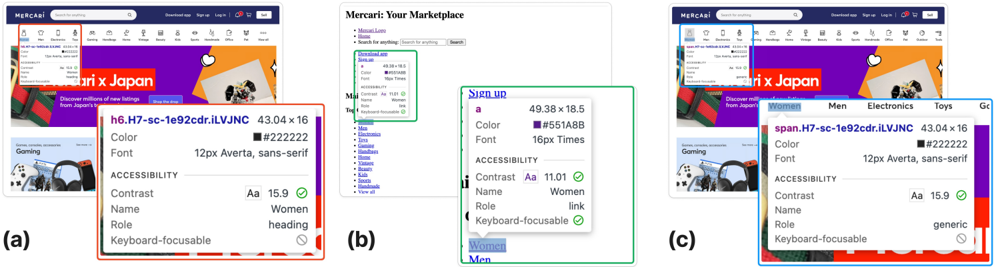
Figure 1: From left to right: (a) the original website, (b) Option 1 (Regenerated HTML), and (c) Option 2 (Reorganized HTML Tags).Option 1 is generated using a GenAI-powered extension that rewrites the HTML to enhance accessibility, while Option 2 reorganizes the original HTML tags to address accessibility issues without altering the visual design.This example highlights the changes made in both versions compared to the original website.Both versions simplify navigation by removing single-category headings, reducing clutter and minimizing fatigue for screen reader users.
Overview
CoChat Summary
TL;DR
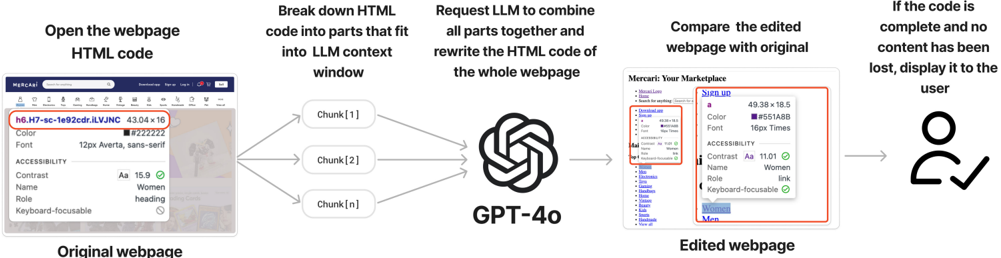
The paper presents a GenAI-powered Chrome extension that uses GPT-4o to either regenerate or reorganize e-commerce HTML to improve screen reader navigation. In formative interviews and a user evaluation, the regenerated HTML version improved accessibility audit scores, content similarity, and user ratings over the original site.
Key findings
- Automated audits across Amazon, Nordstrom, and Mercari showed both LLM versions reduced WCAG Level A violations; for example, Amazon Product Page Lighthouse violations dropped from 16 in the original to 1 in the regenerated version and 3 in the reorganized version, and Nordstrom Home SortSite violations dropped from 5 to 1 in both versions.
- Regenerated pages frequently exceeded 95% Aggregated Semantic Similarity; the lowest reported score was Nordstrom Home Page at 91.60%.
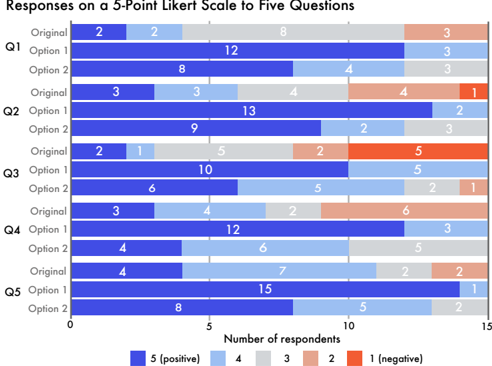
- In the user evaluation with 15 screen reader users, the regenerated HTML version received an average overall experience rating of 5.00, the reorganized tags version 4.57, and the original website 3.14; 13 participants reported the regenerated HTML version provided the best experience.
- Statistical tests showed the HTML version outperformed the Original on all five Likert questions, while the Tag version showed significant improvement only in overall user experience (Q1) compared to the Original; HTML vs. Tag differed significantly only in Q1. Task completion times differed significantly across versions (Friedman χ²(2)=30.00, p<0.001), with Option 1 significantly faster than both Original and Option 2 (W=0, p<0.001), and Option 2 significantly faster than Original (W=0, p<0.001).
Methods
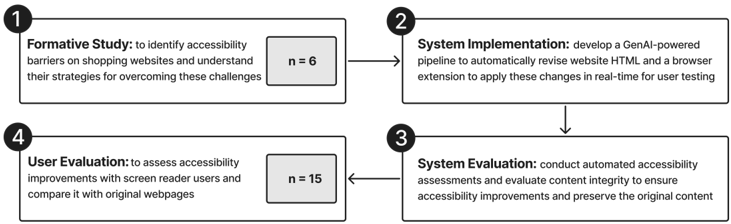
- Three-phase study: formative semi-structured interviews with 6 blind or low vision screen reader users (ages 25–54) about shopping barriers and think-aloud browsing on Mercari; development of a Chrome extension using GPT-4o (temperature=0.2, max_tokens=16,384, top_p=1, frequency_penalty=0, presence_penalty=0) with two modes—regenerated HTML (Option 1) and reorganized HTML tags (Option 2); and a within-subjects user evaluation with 15 screen reader users (ages 18–44) on Mercari, counterbalanced across original, Option 1, and Option 2, using think-aloud and a 5-question Likert survey.
- Automatic accessibility audit on Amazon, Nordstrom, and Mercari home, search results, and product pages using Google Lighthouse, SortSite, and AChecker; content integrity measured via Aggregated Semantic Similarity (cosine similarity of screen-reader-accessible elements, with a 90% acceptance threshold).
- Analysis included deductive/inductive thematic analysis for interview data, and Wilcoxon signed-rank tests with Bonferroni correction (α adjusted=0.0167) plus Friedman tests for Likert and task-completion comparisons.
Limitations
- Stated in the paper: the formative sample was fairly homogeneous (all from similar demographics); the user evaluation focused on desktop use and did not account for mobile or tablet navigation; generalizability to dynamic, JavaScript-heavy platforms remains an open challenge; LLM-driven restructuring carries risks of content loss, subtle omissions, and hallucinations; and Option 2 was limited by its inability to alter the original layout or content order.
- Evident from the text: samples were small (6 formative participants, 15 user-evaluation participants) and the user evaluation was limited to one website (Mercari); per-page processing required 1–5 minutes and around 220,000 tokens per session, costing $0.50–$2.20 per page, which may constrain deployment.
Model-written summary. Check it against the paper before relying on it.
Integrity signals
Registry
Cites
Statistics
Figures


Verification
Claims the paper makes
3 Valid · 3 Not valid · 10 Not checked · 125 Own results and interpretations
The cited sources support only part of this claim — read each source’s verdict below.
In the paper
“However, these existing solutions primarily target specific elements, such as product descriptions or image retrieval, rather than ensuring a comprehensive, end-to-end accessible experience across the entire web page, particularly for users who may be unfamiliar with a new platform.”
§ From Cluttered to Clear: Improving the Web Accessibility Design for Screen Reader Users in E-commerce With Generative AI > 1 Introduction
What the sources say
- Supportedcites [46] 46. Abigale J. Stangl, Esha Kothari, Suyog D. Jain, Tom Yeh, Kristen Grauman, and Danna Gurari. 2018. BrowseWithMe: An Online Clothes Shopping Assistant for People with Visual Impairments. In Proc. of the 20th Int. ACM SIGACCESS Conf. on Computers and Accessibility (Galway, Ireland) (ASSETS '18). Association for Computing Machinery, New York, NY, USA, 107-118. https://doi.org/10.1145/ 3234695.3236337 source
The BrowseWithMe Implementation and Front-end sections describe an assistant for product pages that answers selected queries about attributes such as price, material, and color. The Design Recommendations also report users’ difficulty learning different shopping sites. The paper therefore supports BrowseWithMe as an example of a targeted solution, rather than a comprehensive accessibility solution for every aspect of a web page. (LLM, conf=0.84)
- Partly supportedcites [56] 56. Ruolin Wang, Zixuan Chen, Mingrui Ray Zhang, Zhaoheng Li, Zhixiu Liu, Zihan Dang, Chun Yu, and Xiang 'Anthony' Chen. 2021. Revamp: Enhancing Accessible Information Seeking Experience of Online Shopping for Blind or Low Vision Users. In Proc. of the 2021 CHI Conf. on Human Factors in Computing Systems (Yokohama, Japan) (CHI '21). Association for Computing Machinery, New York, NY, USA, Article 494, 14 pages. https://doi.org/10.1145/3411764.3445547 sourceExperimental — accuracy not yet measured
Sections 2.1 and 4.2 describe limitations of tools focused on image descriptions, queries, and filtering; section 4.1 also reports difficulty navigating information across a product page. These passages support the general accessibility gap in online shopping, but do not establish that existing solutions primarily target isolated elements rather than the entire page, or specifically address users unfamiliar with a new platform. Page numbers were not available in our copy. (LLM, conf=0.82)
plain- Asserted: passes — The authors put it forward as true.
- Checkable: passes — It can be checked against evidence.
- Load-bearing: passes — The paper’s conclusions depend on it.
- Based: passes — The paper gives a reason why it holds.
- Supported
A result the paper reports from its own data — it cites no other source for it, so there is none to check. The quote shows it is in the paper.
In the paper
“Participants noted difficulties understanding product details on shopping websites due to insufficient text and image descriptions.”
§ From Cluttered to Clear: Improving the Web Accessibility Design for Screen Reader Users in E-commerce With Generative AI > Gender Visual Ability Online shopping Frequency
plainstates a cause- Asserted: passes — The authors put it forward as true.
- Checkable: passes — It can be checked against evidence.
- Load-bearing: passes — The paper’s conclusions depend on it.
- Based: passes — The paper gives a reason why it holds.
A result the paper reports from its own data — it cites no other source for it, so there is none to check. The quote shows it is in the paper.
In the paper
“Participants expressed a preference for accessibility solutions that operate within their familiar browsing environments rather than relying on external tools that add layers of complexity, such as AI assistants designed to help locate information.”
§ From Cluttered to Clear: Improving the Web Accessibility Design for Screen Reader Users in E-commerce With Generative AI > 4.5 Design Implications
plain- Asserted: passes — The authors put it forward as true.
- Checkable: passes — It can be checked against evidence.
- Load-bearing: passes — The paper’s conclusions depend on it.
- Based: passes — The paper gives a reason why it holds.
A result the paper reports from its own data — it cites no other source for it, so there is none to check. The quote shows it is in the paper.
In the paper
“On the contrary, some informal yet essential information is not placed in headings or appropriate HTML tags, misaligning with screen reader users' navigation preferences.”
§ From Cluttered to Clear: Improving the Web Accessibility Design for Screen Reader Users in E-commerce With Generative AI > Gender Visual Ability Online shopping Frequency
plain- Asserted: passes — The authors put it forward as true.
- Checkable: passes — It can be checked against evidence.
- Load-bearing: passes — The paper’s conclusions depend on it.
- Based: passes — The paper gives a reason why it holds.
A result the paper reports from its own data — it cites no other source for it, so there is none to check. The quote shows it is in the paper.
In the paper
“Option 1 consistently achieved the shortest task completion times, reflecting its effective structural and navigational enhancements.”
§ From Cluttered to Clear: Improving the Web Accessibility Design for Screen Reader Users in E-commerce With Generative AI > 7.4.1 Statistical Analysis of Likert Scale Survey Results.
plainstates a cause- Asserted: passes — The authors put it forward as true.
- Checkable: passes — It can be checked against evidence.
- Load-bearing: passes — The paper’s conclusions depend on it.
- Based: passes — The paper gives a reason why it holds.
53 more claims
Create a free account to see all 141 claims and to verify the 2 references still open.
- It may state two separate claims as one. 43
- Probably not a substantial claim. 53
- Borderline: one of the tests for a substantial claim is unclear. 1
- The quote only partly states this claim. 3
Self-check
Percentages, sums and reported differences re-computed from the paper’s own numbers.
Each contradiction between two passages listed here was confirmed by an independent check.
Rated major: it would touch a result — a value a result rests on, reported and recomputed p-values on opposite sides of the significance level, two passages that conflict with no sign which is right, or a cited work retracted before this paper was published.
In the paper
§ From Cluttered to Clear: Improving the Web Accessibility Design for Screen Reader Users in E-commerce With Generative AI > 1 Introduction
“In user evaluations, seven screen reader users tested both the original and revised versions of a shopping website.”
§ From Cluttered to Clear: Improving the Web Accessibility Design for Screen Reader Users in E-commerce With Generative AI > 7.1 Participants Demographics
“15 screen reader users participated in the study, consisting of nine females and six males.”
Rated minor: it would not touch a result — a value no result rests on, a p-value that stays on the same side of the significance level, or a conflict that is clerical, resolved elsewhere in the paper, or outside its own findings.
In the paper
§ From Cluttered to Clear: Improving the Web Accessibility Design for Screen Reader Users in E-commerce With Generative AI > 4.5 Design Implications
“The system addresses common barriers for screen reader users, such as inconsistent headings, missing alt text, and unclear button labels.”
§ From Cluttered to Clear: Improving the Web Accessibility Design for Screen Reader Users in E-commerce With Generative AI > 5 System Implementation 5.1 System Overview and Purpose
“While participants identified a lack of descriptive image labels as an issue, we excluded image description generation, as participants and prior research have already addressed this using GenAI [23,46].”
Rated minor: it would not touch a result — a value no result rests on, a p-value that stays on the same side of the significance level, or a conflict that is clerical, resolved elsewhere in the paper, or outside its own findings.
In the paper
§ From Cluttered to Clear: Improving the Web Accessibility Design for Screen Reader Users in E-commerce With Generative AI > A.5 Example Accessibility Enhancements
“In Option 2, the LLM regenerated the entire HTML file, leading to several unique improvements that version 3 could not achieve:”
§ From Cluttered to Clear: Improving the Web Accessibility Design for Screen Reader Users in E-commerce With Generative AI > 5 System Implementation 5.1 System Overview and Purpose
“(1) Rewrite the Document: Regenerated HTML Version (Option 1).In this option, we produce an HTML document which is re-created from scratch to provide an accessible screen reader experience.”
Citations
Cites
Using thematic analysis in psychology
Braun, V., & Clarke, V. (2006) · Qualitative Research in Psychology · doi:10.1191/1478088706qp063oa · Cited by 194,414
Consumer Decision Making in Online Shopping Environments: The Effects of Interactive Decision Aids
Häubl, G., & Trifts, V. (2000) · Marketing Science · doi:10.1287/mksc.19.1.4.15178 · Cited by 1,731
Learning under Concept Drift: A Review
Lu, J., Liu, A., Dong, F., Gu, F., Gama, J., & Zhang, G. (2018) · IEEE Transactions on Knowledge and Data Engineering · doi:10.1109/tkde.2018.2876857 · Cited by 1,603
Evaluating Large Language Models Trained on Code
Chen, M., Tworek, J., Jun, H., Yuan, Q., Pinto, H. P. D. O., Kaplan, J., Edwards, H., Burda, Y., Joseph, N., Brockman, G., et al. (2021) · arXiv · doi:10.48550/arxiv.2107.03374 · Cited by 1,436
Building Understanding of the Domain of Consumer Vulnerability
Baker, S. M., Gentry, J. W., & Rittenburg, T. L. (2005) · Journal of Macromarketing · doi:10.1177/0276146705280622 · Cited by 895
VizWiz: nearly real-time answers to visual questions
Bigham, J. P., Jayant, C., Ji, H., Little, G., Miller, A., Miller, R. C., Miller, R., Tatarowicz, A., White, B., White, S., et al. (2010) · Proceedings of the 23nd annual ACM symposium on User interface software and technology · doi:10.1145/1866029.1866080 · Cited by 601
VizWiz: nearly real-time answers to visual questions
Bigham, J. P., Jayant, C., Ji, H., Little, G., Miller, A., Miller, R. C., Tatarowicz, A., White, B., White, S., & Yeh, T. (2010) · Proceedings of the 2010 International Cross Disciplinary Conference on Web Accessibility (W4A) · doi:10.1145/1805986.1806020 · Cited by 536
Guidelines are only half of the story: accessibility problems encountered by blind users on the web
Power, C., Freire, A., Petrie, H., & Swallow, D. (2012) · Proceedings of the SIGCHI Conference on Human Factors in Computing Systems · doi:10.1145/2207676.2207736 · Cited by 327 · cited 2×
“However, they often introduce a steep learning curve, requiring users to adapt to an additional interface layer instead of browsing the website naturally.”
Usable gestures for blind people: understanding preference and performance
Kane, S. K., Wobbrock, J. O., & Ladner, R. E. (2011) · Proceedings of the SIGCHI Conference on Human Factors in Computing Systems · doi:10.1145/1978942.1979001 · Cited by 314 · cited 2×
“Since effective screen reader navigation depends on coherent page-wide hierarchy and logical content flow, isolated fixes often fall short of supporting seamless interaction.”
Visual challenges in the everyday lives of blind people
Brady, E., Morris, M. R., Zhong, Y., White, S., & Bigham, J. P. (2013) · Proceedings of the SIGCHI Conference on Human Factors in Computing Systems · doi:10.1145/2470654.2481291 · Cited by 230
Research works printed but not linked: 1
- Smirity Kaushik, Natã M Barbosa, Yaman Yu, Tanusree Sharma, Zachary Kilhoffer, JooYoung Seo, Sauvik Das, and Yang Wang. 2023. { GuardLens} : Supporting Safer Online Browsing for People with Visual Impairments. In Nineteenth Symp. on Usable Privacy and Security (SOUPS 2023). 361–380.
Cited by
Experiences and Perceptions of Blind and Low-Vision (BLV) People with Retail Self-Checkout Systems
Heisey, A., Shinohara, K., & Tigwell, G. W. (2026) · ACM Transactions on Accessible Computing · doi:10.1145/3816243
Shifting Accessibility Left: Embedding Inclusive Design into Frontend Developer Workflows
Pujari, N. P. (2026) · International Web for All Conference (W4A) · doi:10.1145/3800424.3800592
Large Language Models for Web Accessibility: A Systematic Literature Review
Aljedaani, W., & Mollik, R. H. (2026) · International Web for All Conference (W4A) · doi:10.1145/3800424.3800452 · Cited by 5
The Long Road to Web Accessibility: Three Decades of Retrospective Analysis
Afroz, M., Dar, M. D., & Chowdhury, O. (2026) · ACM Internet Measurement Conference (IMC) · doi:10.1145/3777912.3839806
Metadata
- Authors
- Yu, Y., Ryskeldiev, B., Tsutsui, A., Gillingham, M., & Wang, Y.
- Affiliations
- University of Illinois Urbana-Champaign (US)
- University of Tsukuba (JP)
- Mercari R4D, Tokyo, Japan
- Venue
- Proceedings of the 27th International ACM SIGACCESS Conference on Computers and Accessibility
- Publisher
- ACM
- Published
- 2025-10-22
- Pages
- 1-19
- OpenAlex
- W4415445080
- Cited by
- 8
- References
- 54
- Citations by year
- 2026: 8
- FWCI
- 9.80
- Type
- conference paper
- Language
- en
- Open access
- hybrid
- doi.org
- Licence
- cc-by
- Locations
- International ACM SIGACCESS Conference on Computers and Accessibility (ASSETS) (publishedVersion, cc-by)
- Topics
- Social Sciences › Human Factors and Ergonomics › Digital Accessibility for Disabilities
- Physical Sciences › Computer Science › Human-Computer Interaction › Usability and User Interface Design
- Physical Sciences › Computer Science › Information Systems › Web Data Mining and Analysis
- Keywords
- web accessibility, screen readers, e-commerce platforms, generative AI, user fatigue
About these checks
Registry, retraction, Cites and statistics results are computed, not judged, with one exception: a printed reference that no index lists is read once by a model before it counts as a citation error. Claims are extracted by a model and kept only when their quote appears verbatim in the text; each cited source is then checked, with a model’s help, for whether it says what the claim relies on. Those verdicts can be wrong — read the claim’s quote and the cited source before relying on one.
The claim verdicts this report counts are experimental: their accuracy is not yet measured.
A language model drew the claims from the paper on 2026-09-30, under version 3 of the claim definition (model deepseek-v4.1-flash, prompt extract-v3).
A second model labelled each claim on 2026-09-30 (model jev-1.13-20260917, definition revision gold-guideline-v0.2).
Cited sources are checked with a language model’s help (gpt-6-sol).
Statistics and arithmetic are recomputed, not judged.
Confidence bands are shown only for fields calibrated on our annotated test set. None is calibrated yet, so no band is shown.
What counts as a claim ›How we measure confidence ›How we check this ›
Are you an author, or do you see a problem with this page? Request a review
How to cite
Cite CoChat for the checks on this page, and the paper for its own findings.
- This page
- CoChat. (2026). Citation check: From Cluttered to Clear: Improving the Web Accessibility Design for Screen Reader Users in E-commerce With Generative AI. https://app.cochat.ai/papers/10.1145/3663547.3746353
- The paper
- Yu, Y., Ryskeldiev, B., Tsutsui, A., Gillingham, M., & Wang, Y. (2025). From Cluttered to Clear: Improving the Web Accessibility Design for Screen Reader Users in E-commerce With Generative AI. Proceedings of the 27th International ACM SIGACCESS Conference on Computers and Accessibility. https://doi.org/10.1145/3663547.3746353
Data sources
Bibliographic data: Semantic Scholar, OpenAlex, Crossref.
Contains information from the Semantic Scholar Academic Graph Datasets, made available under the ODC Attribution License (ODC-BY 1.0).
Semantic Scholar’s data is described in: Kinney, R., et al. (2023). The Semantic Scholar Open Data Platform. arXiv:2301.10140.
