

RCAEval: A Benchmark for Root Cause Analysis of Microservice Systems with Telemetry Data
Open accessThe DOI matches its Crossref record; 13 of the 13 references it cites were found in a registry or an index; 9 of the 32 sources its claims cite were checked for support.
Abstract
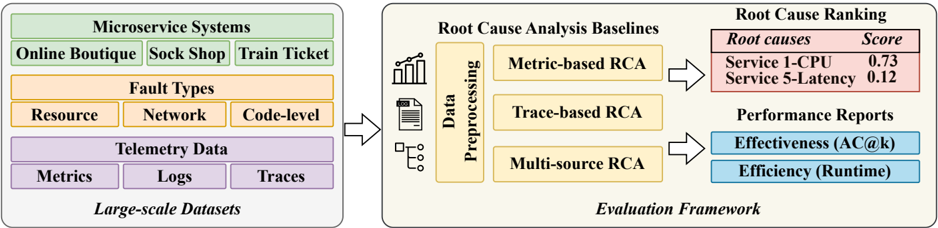
Root cause analysis (RCA) for microservice systems has gained significant attention in recent years.However, there is still no standard benchmark that includes large-scale datasets and supports comprehensive evaluation environments.In this paper, we introduce RCAEval, an open-source benchmark that provides datasets and an evaluation environment for RCA in microservice systems.First, we introduce three comprehensive datasets comprising 735 failure cases collected from three microservice systems, covering various fault types observed in real-world failures.Second, we present a comprehensive evaluation framework that includes fifteen reproducible baselines covering a wide range of RCA approaches, with the ability to evaluate both coarse-grained and fine-grained RCA.We hope that this ready-to-use benchmark will enable researchers and practitioners to conduct extensive analysis and pave the way for robust new solutions for RCA of microservice systems.
Overview
CoChat Summary
TL;DR
RCAEval is an open-source benchmark for root cause analysis in microservice systems, offering three datasets with 735 failure cases and an evaluation framework with 15 reproducible baselines. Preliminary experiments show existing methods achieve only moderate performance, with best average Avg@5 scores of 0.46 and 0.54 for CIRCA and RCD, respectively.
Key findings
- RCAEval provides three datasets: RE1 (375 failure cases, metrics only), RE2 (270 cases, metrics/logs/traces), and RE3 (90 cases, metrics/logs/traces), totaling 735 failure cases from three microservice systems and 11 fault types.
- The evaluation framework includes 15 baselines spanning metric-based, trace-based, and multi-source RCA, and supports coarse-grained (root cause service) and fine-grained (root cause indicator) evaluation using AC@k and Avg@k.
- In preliminary experiments on Train Ticket from RE2 across six fault types, CIRCA and RCD obtained the best average Avg@5 scores of 0.46 and 0.54, respectively; BARO performed well on resource faults such as DISK but showed limitations on network faults such as DELAY and LOSS.
- The paper states that existing methods mostly obtain moderate results, indicating “ample room for further improvement” and the need for a holistic RCA solution.
Methods
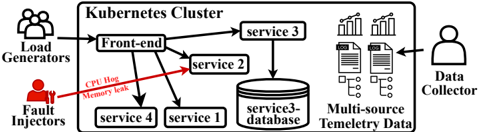
- Datasets were collected from three microservice systems: Online Boutique (12 services), Sock Shop (15 services), and Train Ticket (64 services), deployed on Kubernetes with a random load of 10–200 requests per second.
- Faults include resource faults (CPU, MEM, DISK, SOCK), network faults (DELAY, LOSS), and code-level faults (F1–F5); telemetry was collected using Prometheus, cAdvisor, Istio, Vector, Loki, Elasticsearch, and Jaeger.
- Preliminary experiments selected 11 baselines and evaluated them on the Train Ticket system in RE2 for four resource faults and two network faults, using AC@1, AC@3, and Avg@5; code-level fault diagnosis is demonstrated on GitHub rather than quantitatively reported in the paper.
Limitations
- The paper does not include a dedicated limitations section. It states that due to space constraints, preliminary experiments select only 11 baselines and evaluate on Train Ticket from RE2 across six fault types.
- The text makes evident that code-level fault diagnosis (F1–F5) is only demonstrated on the GitHub repository, not evaluated in the paper’s preliminary results.
- The paper states that “no single system can fully capture the diversity of real-world environments,” though it argues the three chosen systems include diverse languages and protocols to emulate real-world complexity.
Model-written summary. Check it against the paper before relying on it.
Integrity signals
Registry
Cites
Statistics
Figures
Verification
Claims the paper makes
8 Valid · 1 Not valid · 14 Not checked · 39 Own results and interpretations
The cited sources support only part of this claim — read each source’s verdict below.
In the paper
“Metric-based RCA baselines include causal inference-based methods such as RUN, CausalRCA, CIRCA, RCD, MicroCause, EasyRCA, MSCRED, as well as noncausal methods such as BARO, and 𝜖-Diagnosis [6,8,10,14].”
§ RCAEval: A Benchmark for Root Cause Analysis of Microservice Systems with Telemetry Data > 4.1 Evaluation Baselines
What the sources say
- Partly supportedcites [6] matched to “Root Cause Analysis for Microservice System based on Causal Inference: How Far Are We?” (2024) sourceExperimental — accuracy not yet measured
Our copy confirms most of the list: the studied metric-based RCA baselines include RUN, CausalRCA, CIRCA, RCD, MicroCause (Sections 2.4, 4.1 and 3.3 Experimental Settings) alongside the graph-free hypothesis-testing methods BARO and ε-Diagnosis ('§ ε-Diagnosis: Similar to NSigma and ε-Diagnosis, BARO also does not construct causal graphs'; §4.1 finding (1)). However, EasyRCA and MSCRED appear nowhere in our copy (searched 'EasyRCA MSCRED metric-based root cause analysis methods', 'EasyRCA', 'MSCRED' — only unrelated passages returned), so attributing those two as this paper's baselines is unsupported. The paper's own framing is 'does not construct causal graphs' rather than 'noncausal', a minor wording difference. (LLM, conf=0.82)
- Not checked — no full text of the sourcecites [8] matched to “Root Cause Analysis of Failures in Microservices Through Causal Discovery” (2022) source
- Not matchedcites [10]
The reference list we hold has no entry [10].
- Partly supportedcites [14] matched to “PyRCA: A Library for Metric-based Root Cause Analysis” (2023) sourceExperimental — accuracy not yet measured
Section 3.2.2 identifies RCD as an RCA model, Section 3.2.1 describes ε-Diagnosis, and Section 1.1 identifies CIRCA as an RCA library containing baselines. The copy does not substantiate the full list: searches for RUN, CausalRCA, MicroCause, EasyRCA, MSCRED, and BARO did not find those named methods. It also does not support the sentence’s causal/noncausal classification for the listed methods. (LLM, conf=0.86)
plain- Asserted: passes — The authors put it forward as true.
- Checkable: passes — It can be checked against evidence.
- Load-bearing: passes — The paper’s conclusions depend on it.
- Based: passes — The paper gives a reason why it holds.
- Partly supported
The sources with a verdict support this claim; the rest weren’t checked yet, have no full text we could read, or their verdicts aren’t rated yet.
In the paper
“For example, existing studies [8,10,13] typically evaluate their methods on only 1-2 systems with 2-3 fault types.”
§ RCAEval: A Benchmark for Root Cause Analysis of Microservice Systems with Telemetry Data > 1 Introduction
What the sources say
- Not checked — no full text of the sourcecites [8] matched to “Root Cause Analysis of Failures in Microservices Through Causal Discovery” (2022) source
- Not matchedcites [10]
The reference list we hold has no entry [10].
- Supportedcites [13] matched to “Root Cause Analysis in Microservice Using Neural Granger Causal Discovery” (2024) source
Section 5.1 (page not provided) describes evaluations on a synthetic dataset and one microservice test bed, Sock-shop. The sock-shop results distinguish two fault types—CPU hog and memory leak—consistent with this paper being an example of the cited evaluation scope. Its ten root-cause categories are not ten distinct fault types; the paper does not itself establish what studies typically do. (LLM, conf=0.88)
plain- Asserted: passes — The authors put it forward as true.
- Checkable: passes — It can be checked against evidence.
- Load-bearing: passes — The paper’s conclusions depend on it.
- Based: passes — The paper gives a reason why it holds.
Every source the paper cites for this claim was checked and supports it.
In the paper
“The AIOps 2020 dataset [12] contains failures with metrics and traces but omits valuable log information.”
§ RCAEval: A Benchmark for Root Cause Analysis of Microservice Systems with Telemetry Data > 1 Introduction
What the sources say
- Supportedcites [12] matched to “Constructing Large-Scale Real-World Benchmark Datasets for AIOps” (2022) source
Section 5.2 (pp. 4–5) identifies dataset C as the basis of the 2020 AIOps Challenge, says it provides failures with ground-truth time points and root causes, and lists its three monitoring-data types as traces, KPIs, and metrics. Logs are not among the listed types; the paper discusses structured logs separately in Section 4.1 (p. 3). (LLM, conf=0.90)
plain- Asserted: passes — The authors put it forward as true.
- Checkable: passes — It can be checked against evidence.
- Load-bearing: passes — The paper’s conclusions depend on it.
- Based: passes — The paper gives a reason why it holds.
- Supported
Every source the paper cites for this claim was checked and supports it.
In the paper
“However, there is still no standard benchmark that includes large-scale datasets and supports comprehensive evaluation environments.”
- Also stated in: § 1 Introduction · plain
“However, there is still no standard benchmark that includes large-scale datasets and a comprehensive evaluation framework [4].”
- Also stated in: § 2 Background & Related Work · plain
“A major limitation in this field is the absence of a reproducible and open-source public benchmark for evaluating RCA in practical scenarios.”
§ RCAEval: A Benchmark for Root Cause Analysis of Microservice Systems with Telemetry Data > Abstract
What the sources say
- Supportedcites [4] matched to “AI for IT Operations (AIOps) on Cloud Platforms: Reviews, Opportunities and Challenges” (2023) source
The Causal Discovery Issues section (page unavailable) says RCA lacks public real-world benchmarks, that few public datasets have ground-truth root causes, and that large-scale benchmarks are needed. The Typical types of Log RCA methods section (page unavailable) likewise identifies the lack of a reproducible, open-source public benchmark for fair evaluation in practical settings. (LLM, conf=0.88)
plain- Asserted: passes — The authors put it forward as true.
- Checkable: passes — It can be checked against evidence.
- Load-bearing: passes — The paper’s conclusions depend on it.
- Based: passes — The paper gives a reason why it holds.
- Also stated in: § 1 Introduction · plain
A result the paper states — it cites no source for it, so there is none to check. The quote shows it is in the paper.
In the paper
“Like RE2, RE3 includes multi-source telemetry data (metrics, logs, and traces).”
§ RCAEval: A Benchmark for Root Cause Analysis of Microservice Systems with Telemetry Data > 3 Datasets
plainn = 90- Asserted: passes — The authors put it forward as true.
- Checkable: passes — It can be checked against evidence.
- Load-bearing: passes — The paper’s conclusions depend on it.
- Based: passes — The paper gives a reason why it holds.
20 more claims
Create a free account to see all 62 claims and to verify the 9 references still open.
- It may state two separate claims as one. 21
- Probably not a substantial claim. 22
Self-check
Percentages, sums and reported differences re-computed from the paper’s own numbers.
Each contradiction between two passages listed here was confirmed by an independent check.
Rated minor: it would not touch a result — a value no result rests on, a p-value that stays on the same side of the significance level, or a conflict that is clerical, resolved elsewhere in the paper, or outside its own findings.
In the paper
§ RCAEval: A Benchmark for Root Cause Analysis of Microservice Systems with Telemetry Data > 5 Preliminary Experiments
“For example, CIRCA and RCD obtain the best average Avg@5 score of 0.46 and 0.54, respectively.”
§ RCAEval: A Benchmark for Root Cause Analysis of Microservice Systems with Telemetry Data > 6 Conclusion
“| | BARO | 0.47 | 0.8 0.75 0.93 | 1 0.99 | 1 | 1 | 1 | 0.6 | 0.8 0.79 0.47 0.67 0.61 0.67 0.67 0.71 0.69 0.82 0.81 |”
Rated minor: it would not touch a result — a value no result rests on, a p-value that stays on the same side of the significance level, or a conflict that is clerical, resolved elsewhere in the paper, or outside its own findings.
In the paper
§ RCAEval: A Benchmark for Root Cause Analysis of Microservice Systems with Telemetry Data > 5 Preliminary Experiments
“Due to space constraints, we select 11 baselines:”
§ RCAEval: A Benchmark for Root Cause Analysis of Microservice Systems with Telemetry Data > 6 Conclusion
“Table: 6 Table 6 : RCA performance of eight baselines on the Train Ticket system of the RE2 dataset, across six fault types.”
Rated minor: it would not touch a result — a value no result rests on, a p-value that stays on the same side of the significance level, or a conflict that is clerical, resolved elsewhere in the paper, or outside its own findings.
In the paper
§ RCAEval: A Benchmark for Root Cause Analysis of Microservice Systems with Telemetry Data > 1 Introduction
“PyRCA [14] offers only a limited set of metric-based RCA methods and relies on synthetic datasets.”
§ RCAEval: A Benchmark for Root Cause Analysis of Microservice Systems with Telemetry Data > References
“14. Guangba Yu et al. 2021. Microrank: End-to-end latency issue localization with extended spectrum analysis in microservice environments. In WWW'21.”
Rated minor: it would not touch a result — a value no result rests on, a p-value that stays on the same side of the significance level, or a conflict that is clerical, resolved elsewhere in the paper, or outside its own findings.
In the paper
§ RCAEval: A Benchmark for Root Cause Analysis of Microservice Systems with Telemetry Data > 3.1 Microservice Systems
“The Online Boutique system [2], developed by Google, consists of 12 services forming an e-commerce application where users can browse, add, and purchase items.”
§ RCAEval: A Benchmark for Root Cause Analysis of Microservice Systems with Telemetry Data > References
“2. Domenico Cotroneo et al. 2019. How bad can a bug get? an empirical analysis of software failures in the openstack cloud computing platform. In FSE'19.”
Rated minor: it would not touch a result — a value no result rests on, a p-value that stays on the same side of the significance level, or a conflict that is clerical, resolved elsewhere in the paper, or outside its own findings.
In the paper
§ RCAEval: A Benchmark for Root Cause Analysis of Microservice Systems with Telemetry Data > 3 Datasets
“The number of metrics ranges from 77 to 327 per failure case.”
§ RCAEval: A Benchmark for Root Cause Analysis of Microservice Systems with Telemetry Data > 6 Conclusion
“| RE2 | 3 | 4 Resource, 2 Network 270 77-376 | 8.6-26.9 | 39.6-76.7 | |”
2 more findings
Create a free account to see every finding of this check.
Citations
Cites
Practical Root Cause Localization for Microservice Systems via Trace Analysis
Li, Z., Chen, J., Jiao, R., Zhao, N., Wang, Z., Zhang, S., Wu, Y., Jiang, L., Yan, L., Wang, Z., et al. (2021) · 2021 IEEE/ACM 29th International Symposium on Quality of Service (IWQOS) · doi:10.1109/iwqos52092.2021.9521340 · Cited by 159 · cited 1×
“Given a set of failure cases A, 𝐴𝐶 @ 𝑘 is calculated as 𝐴𝐶 @ 𝑘 = , where 𝑅 [ 𝑖 ] is the 𝑖 th ranking result for the failure case 𝑎 by an RCA method, and 𝑉 𝑎𝑟𝑐 is the true root cause set of case 𝑎 .”
Yu, G., Chen, P., Chen, H., Guan, Z., Huang, Z., Jing, L., Weng, T., Sun, X., & Li, X. (2021) · Proceedings of the Web Conference 2021 · doi:10.1145/3442381.3449905 · Cited by 158
Eadro: An End-to-End Troubleshooting Framework for Microservices on Multi-source Data
Lee, C., Yang, T., Chen, Z., Su, Y., & Lyu, M. R. (2023) · 2023 IEEE/ACM 45th International Conference on Software Engineering (ICSE) · doi:10.1109/icse48619.2023.00150 · Cited by 149
Robust Failure Diagnosis of Microservice System Through Multimodal Data
Zhang, S., Jin, P., Lin, Z., Sun, Y., Zhang, B., Xia, S., Li, Z., Zhong, Z., Ma, M., Jin, W., et al. (2023) · IEEE Transactions on Services Computing · doi:10.1109/tsc.2023.3290018 · Cited by 118
Cotroneo, D., De Simone, L., Liguori, P., Natella, R., & Bidokhti, N. (2019) · Proceedings of the 2019 27th ACM Joint Meeting on European Software Engineering Conference and Symposium on the Foundations of Software Engineering · doi:10.1145/3338906.3338916 · Cited by 78
Diagnosing Performance Issues in Microservices with Heterogeneous Data Source
Hou, C., Jia, T., Wu, Y., Li, Y., & Han, J. (2021) · 2021 IEEE Intl Conf on Parallel & Distributed Processing with Applications, Big Data & Cloud Computing, Sustainable Computing & Communications, Social Computing & Networking (ISPA/BDCloud/SocialCom/SustainCom) · doi:10.1109/ispa-bdcloud-socialcom-sustaincom52081.2021.00074 · Cited by 54
Pham, L., Ha, H., & Zhang, H. (2024) · Proceedings of the ACM on Software Engineering · doi:10.1145/3660805 · Cited by 48
Self-citationRoot Cause Analysis in Microservice Using Neural Granger Causal Discovery
Lin, C.-M., Chang, C., Wang, W.-Y., Wang, K.-D., & Peng, W.-C. (2024) · Proceedings of the AAAI Conference on Artificial Intelligence · doi:10.1609/aaai.v38i1.27772 · Cited by 39
Root Cause Analysis for Microservice System based on Causal Inference: How Far Are We?
Pham, L., Ha, H., & Zhang, H. (2024) · Proceedings of the 39th IEEE/ACM International Conference on Automated Software Engineering · doi:10.1145/3691620.3695065 · Cited by 38
Self-citationRoot Cause Analysis of Failures in Microservices Through Causal Discovery
Ikram, A., Chakraborty, S., Mitra, S., Saini, S., Bagchi, S., & Kocaoglu, M. (2022) · Advances in Neural Information Processing Systems 35 · doi:10.52202/068431-2259 · Cited by 35
Research works printed but not linked: 3
- Mingjie Li et al. 2022. Causal Inference-Based Root Cause Analysis for Online Service Systems with Intervention Recognition. In KDD'22.
- Luan Pham, Huong Ha, and Hongyu Zhang. 2024. Root Cause Analysis for Microservices based on Causal Inference: How Far Are We?. In ASE'24. IEEE. · DOI · Paper page
- Guangba Yu et al. 2023. Nezha: Interpretable Fine-Grained Root Causes Analysis for Microservices on Multi-modal Observability Data. In FSE'23.
Cited by
Autonomic Microservice Management via Agentic AI and MAPE-K Integration
Esposito, M., Bakhtin, A., Ahmad, N., Robredo, M., Su, R., Lenarduzzi, V., & Taibi, D. (2025) · Lecture notes in computer science · doi:10.1007/978-3-032-04403-7_11 · Cited by 16
VeriTrail-RCA: Evidence-Verified Root Cause Localization for Microservice Backends
Hu, R., Zheng, Y., Fang, R., & Zhou, J. (2026) · International Conference on Machine Learning and Intelligent Systems Engineering (MLISE) · doi:10.1109/mlise70044.2026.11607533 · Cited by 10
“RCAEval [6] aggregates 735 real failure cases across nine datasets and shows that current RCA methods are sensitive to fault type and topology.”
TopoRCA-Lite: Dynamic Topology-Aware Root Cause Localization Under Limited Observability
Ma, W., Liu, Z., Jiang, R., & Jiang, Y. (2026) · International Conference on Machine Learning and Intelligent Systems Engineering (MLISE) · doi:10.1109/mlise70044.2026.11607564 · Cited by 8
“Site reliability engineers rely on three pillars of observability—metrics, logs, and distributed traces [2].”
Liang, S., Chen, P., Tian, B., Tan, G., Xu, M., Qu, Y., Zhao, Y., Shang, Y., & Tan, C. (2026) · Proceedings of the ACM on software engineering. · doi:10.1145/3797069 · Cited by 11
Yazdanian, P., Liu, Y., & Li, Z. (2025) · Asia-Pacific Software Engineering Conference (APSEC) · doi:10.1109/apsec66846.2025.00077 · Cited by 6
“Benchmarks of MS concentrate on assessing performance and scalability [22], comparing technology impact, establishing clear service boundaries, operational aspects such as observability and DevOps best practices, and Root Cause Analysis (RCA) [23], [24].”
Metadata
- Authors
- Pham, L., Zhang, H., Ha, H., Salim, F., & Zhang, X.
- Affiliations
- UNSW Sydney (AU)
- University of Newcastle Australia (AU)
- RMIT University (AU)
- Venue
- Companion Proceedings of the ACM on Web Conference 2025
- Publisher
- ACM
- Published
- 2025-05-08
- Pages
- 777-780
- OpenAlex
- W4410636905
- Semantic Scholar
- 92dcb926bdfedeed3b3349e0a2bd2506e8928997
- Cited by
- 72
- References
- 1
- Citations by year
- 2026: 65 · 2025: 7
- FWCI
- 56.12
- Type
- conference paper
- Language
- en
- Open access
- hybrid
- doi.org
- Licence
- Locations
- International World Wide Web Conference (WWW) (publishedVersion, cc-by)
- arXiv (Cornell University) (submittedVersion, cc-by)
- arXiv (Cornell University) (cc-by)
- Funders
- Australian Research Council (DP220103044)
- Topics
- Physical Sciences › Computer Science › Computer Networks and Communications › Software System Performance and Reliability
- Physical Sciences › Computer Science › Software › Software Testing and Debugging Techniques
- Physical Sciences › Computer Science › Information Systems › Software Engineering Research
- Keywords
- root cause analysis, microservices, benchmark, telemetry data, evaluation framework, baselines, fault diagnosis, open-source dataset
About these checks
Registry, retraction, Cites and statistics results are computed, not judged, with one exception: a printed reference that no index lists is read once by a model before it counts as a citation error. Claims are extracted by a model and kept only when their quote appears verbatim in the text; each cited source is then checked, with a model’s help, for whether it says what the claim relies on. Those verdicts can be wrong — read the claim’s quote and the cited source before relying on one.
The claim verdicts this report counts are experimental: their accuracy is not yet measured.
A language model drew the claims from the paper on 2026-10-07, under version 3 of the claim definition (model deepseek-v4.1-flash, prompt extract-v3).
A second model labelled each claim on 2026-10-07 (model jev-1.13-20260917, definition revision gold-guideline-v0.2).
Cited sources are checked with a language model’s help (qwen3.8-omni-flash and gpt-6-sol).
Statistics and arithmetic are recomputed, not judged.
Confidence bands are shown only for fields calibrated on our annotated test set. None is calibrated yet, so no band is shown.
What counts as a claim ›How we measure confidence ›How we check this ›
Are you an author, or do you see a problem with this page? Request a review
How to cite
Cite CoChat for the checks on this page, and the paper for its own findings.
- This page
- CoChat. (2026). Citation check: RCAEval: A Benchmark for Root Cause Analysis of Microservice Systems with Telemetry Data. https://app.cochat.ai/papers/10.1145/3701716.3715290
- The paper
- Pham, L., Zhang, H., Ha, H., Salim, F., & Zhang, X. (2025). RCAEval: A Benchmark for Root Cause Analysis of Microservice Systems with Telemetry Data. Companion Proceedings of the ACM on Web Conference 2025. https://doi.org/10.1145/3701716.3715290
Data sources
Bibliographic data: Semantic Scholar, OpenAlex, Crossref.
Contains information from the Semantic Scholar Academic Graph Datasets, made available under the ODC Attribution License (ODC-BY 1.0).
Semantic Scholar’s data is described in: Kinney, R., et al. (2023). The Semantic Scholar Open Data Platform. arXiv:2301.10140.
