

Rescriber: Smaller-LLM-Powered User-Led Data Minimization for LLM-Based Chatbots
Open accessThe DOI matches its Crossref record; 43 of the 43 references it cites were found in a registry or an index.
Abstract
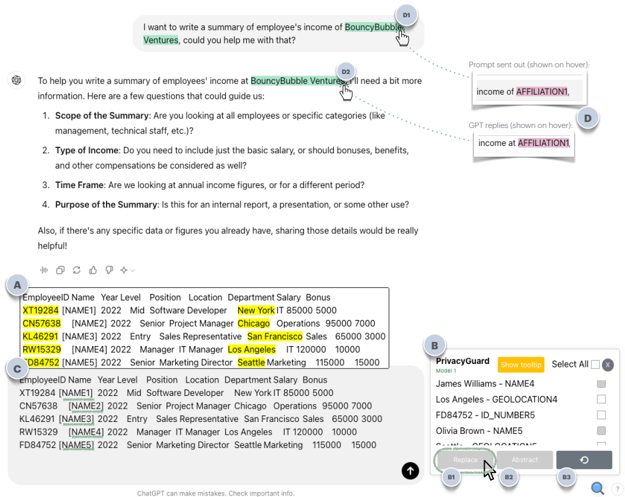
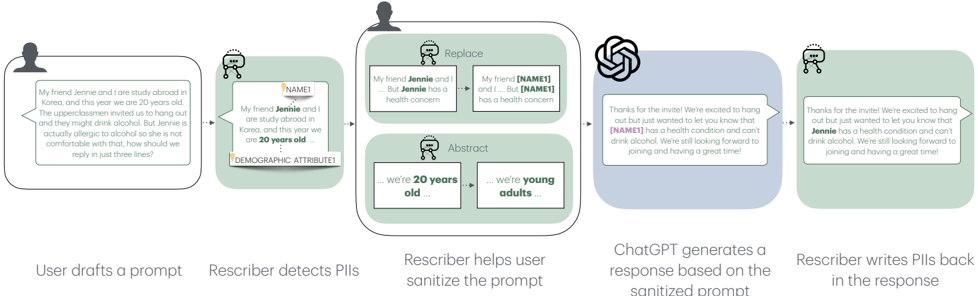
The proliferation of LLM-based conversational agents has resulted in excessive disclosure of identifiable or sensitive information.However, existing technologies fail to offer perceptible control or account for users' personal preferences about privacy-utility tradeoffs due to the lack of user involvement.To bridge this gap, we designed, built, and evaluated Rescriber, a browser extension that supports user-led data minimization in LLM-based conversational agents by helping users detect and sanitize personal information in their prompts.Our studies (N=Rescriber) showed that Rescriber helped users reduce unnecessary disclosure and addressed their privacy concerns.Users' subjective perceptions of the system powered by Llama3-8B were on par with that by GPT-4o.The comprehensiveness and consistency of the detection and sanitization emerge as essential factors that affect users' trust and perceived protection.Our findings confirm the viability of smaller-LLM-powered, userfacing, on-device privacy controls, presenting a promising approach to address the privacy and trust challenges of AI.
Overview
The claims and statistics of this paper haven’t been checked yet.
Free: it reads the open-access text and checks the first 5 claims that cite a source we can check. Create a free account to check every claim.
Integrity signals
Registry
Cites
Statistics
Figures
Verification
Claims the paper makes
The claims and statistics of this paper haven’t been checked yet.
Free: it reads the open-access text and checks the first 5 claims that cite a source we can check. Create a free account to check every claim.
Self-check
Percentages, sums and reported differences re-computed from the paper’s own numbers.
The self-check needs the paper’s full text.
Citations
Cites
LLaMA: Open and Efficient Foundation Language Models
Touvron, H., Lavril, T., Izacard, G., Martinet, X., Lachaux, M.-A., Lacroix, T., Rozière, B., Goyal, N., Hambro, E., Azhar, F., et al. (2023) · arXiv · doi:10.48550/arxiv.2302.13971 · Cited by 4,602
Internet Users' Information Privacy Concerns (IUIPC): The Construct, the Scale, and a Causal Model
Malhotra, N. K., Kim, S. S., & Agarwal, J. (2004) · Information Systems Research · doi:10.1287/isre.1040.0032 · Cited by 3,173 · cited 1×
“Additionally, providing granular control also helps users better minimize unnecessary disclosure by striking a balance between privacy and utility.”
(2011) · IEEE Software · doi:10.1109/ms.2011.67 · Cited by 1,989
Sparks of Artificial General Intelligence: Early experiments with GPT-4
Bubeck, S., Chandrasekaran, V., Eldan, R., Gehrke, J., Horvitz, E., Kamar, E., Lee, P., Lee, Y. T., Li, Y., Lundberg, S., et al. (2023) · arXiv · doi:10.48550/arxiv.2303.12712 · Cited by 1,526
Emergent Abilities of Large Language Models
Wei, J., Tay, Y., Bommasani, R., Raffel, C., Zoph, B., Borgeaud, S., Yogatama, D., Bosma, M., Zhou, D., Metzler, D., et al. (2022) · arXiv · doi:10.48550/arxiv.2206.07682 · Cited by 1,264
Schaar, P. (2010) · Identity in the Information Society · doi:10.1007/s12394-010-0055-x · Cited by 387
Beyer, H., & Holtzblatt, K. (1999) · Interactions · doi:10.1145/291224.291229 · Cited by 367
A taxonomy of privacy-preserving record linkage techniques
Vatsalan, D., Christen, P., & Verykios, V. S. (2013) · Information Systems · doi:10.1016/j.is.2012.11.005 · Cited by 295 · cited 1×
“” Concerns about identifiability also extended beyond direct identifiers to demographic details like gender, raising fears of linkage attacks [50] and broader profiles emerging from multiple data points.”
UMUX-LITE: when there's no time for the SUS
Lewis, J. R., Utesch, B. S., & Maher, D. E. (2013) · Proceedings of the SIGCHI Conference on Human Factors in Computing Systems · doi:10.1145/2470654.2481287 · Cited by 270
PrivacyLens: Evaluating Privacy Norm Awareness of Language Models in ActionPreprint
Shao, Y., Li, T.-S., Shi, W.-Y., Liu, Y., & Yang, D. (2024) · Neural Information Processing Systems · doi:10.48550/arxiv.2409.00138 · Cited by 261
Self-citationSlalom: Fast, Verifiable and Private Execution of Neural Networks in Trusted Hardware
Tramèr, F., & Boneh, D. (2018) · arXiv (Cornell University) · doi:10.48550/arxiv.1806.03287 · Cited by 233
Quantifying Memorization Across Neural Language Models
Carlini, N., Ippolito, D., Jagielski, M., Lee, K., Tramer, F., & Zhang, C. (2022) · arXiv · doi:10.48550/arxiv.2202.07646 · Cited by 204
Privacy as Trust: Information Privacy for an Information Age
Waldman, A. E. (2018) · Cambridge University Press eBooks · doi:10.1017/9781316888667 · Cited by 201
The now and future of ChatGPT and GPT in psychiatry
Cheng, S., Chang, C., Chang, W., Wang, H., Liang, C., Kishimoto, T., Chang, J. P., Kuo, J. S., & Su, K. (2023) · Psychiatry and Clinical Neurosciences · doi:10.1111/pcn.13588 · Cited by 188
What Does it Mean for a Language Model to Preserve Privacy?
Brown, H., Lee, K., Mireshghallah, F., Shokri, R., & Tramèr, F. (2022) · 2022 ACM Conference on Fairness Accountability and Transparency · doi:10.1145/3531146.3534642 · Cited by 165
Operationalizing the Legal Principle of Data Minimization for Personalization
Biega, A. J., Potash, P., Daumé, H., Díaz, F., & Finck, M. (2020) · International ACM SIGIR Conference on Research and Development in Information Retrieval (SIGIR) · doi:10.1145/3397271.3401034 · Cited by 151
Trust No Bot: Discovering Personal Disclosures in Human-LLM Conversations in the WildPreprint
Mireshghallah, N., Antoniak, M., More, Y., Choi, Y., & Farnadi, G. (2024) · arXiv (Cornell University) · doi:10.48550/arxiv.2407.11438 · Cited by 125
Differentially Private Fine-tuning of Language Models
Yu, D., Naik, S., Backurs, A., Gopi, S., Inan, H. A., Kamath, G., Kulkarni, J., Lee, Y. T., Manoel, A., Wutschitz, L., et al. (2021) · arXiv · doi:10.48550/arxiv.2110.06500 · Cited by 101 · cited 1×
“We envision our method as orthogonal and complementary to the model-centric mitigation approaches.”
Reducing Privacy Risks in Online Self-Disclosures with Language Models
Dou, Y., Krsek, I., Naous, T., Kabra, A., Das, S., Ritter, A., & Xu, W. H. (2024) · Proceedings of the conference - Association for Computational Linguistics. Meeting · doi:10.18653/v1/2024.acl-long.741 · Cited by 99
Scalable Extraction of Training Data from (Production) Language Models
Nasr, M., Carlini, N., Hayase, J., Jagielski, M., Cooper, A. F., Ippolito, D., Choquette-Choo, C. A., Wallace, E., Tramèr, F., & Lee, K. (2023) · arXiv · doi:10.48550/arxiv.2311.17035 · Cited by 96 · cited 2×
“We envision our method as orthogonal and complementary to the model-centric mitigation approaches.”
Zhang, Z., Jia, M., Lee, H.-P. (., Yao, B., Das, S., Lerner, A., Wang, D., & Li, T. (2024) · Proceedings of the CHI Conference on Human Factors in Computing Systems · doi:10.1145/3613904.3642385 · Cited by 95 · cited 8×
“…a large amount of personal or sensitive disclosure has been observed in users’ conversations with ChatGPT-like LLM-based conversational agents [30, 57], which leads to severe privacy threats in the event of database breaches and data extraction attacks targeting the memorization vulnerabilities…”
InfluentialSelf-citationCoconut: An IDE Plugin for Developing Privacy-Friendly Apps
Li, T., Agarwal, Y., & Hong, J. (2018) · Proceedings of the ACM on Interactive Mobile Wearable and Ubiquitous Technologies · doi:10.1145/3287056 · Cited by 84
Self-citationAnonymisation Models for Text Data: State of the art, Challenges and Future Directions
Lison, P., Pilán, I., Sanchez, D., Batet, M., & Øvrelid, L. (2021) · Proceedings of the 59th Annual Meeting of the Association for Computational Linguistics and the 11th International Joint Conference on Natural Language Processing (Volume 1: Long Papers) · doi:10.18653/v1/2021.acl-long.323 · Cited by 80 · cited 1×
“During model training phase, techniques such as data sanitization [19, 26] and differentially private training methods [24, 53] are commonly employed.”
Large Language Models Can Be Strong Differentially Private Learners
Li, X., Tramèr, F., Liang, P., & Hashimoto, T. (2021) · arXiv (Cornell University) · doi:10.48550/arxiv.2110.05679 · Cited by 69
Differentially Private Decoding in Large Language ModelsPreprint
Majmudar, J., Dupuy, C., Peris, C., Smaili, S., Gupta, R., & Zemel, R. S. (2022) · arXiv (Cornell University) · doi:10.48550/arxiv.2205.13621 · Cited by 63
Human-Centered Privacy Research in the Age of Large Language Models
Li, T., Das, S., Lee, H.-P., Wang, D., Yao, B., & Zhang, Z. (2024) · CHI Conference Extended Abstracts on Human Factors in Computing Systems (CHI EA) · doi:10.1145/3613905.3643983 · Cited by 59
Self-citationCounterfactual Memorization in Neural Language Models
Zhang, C., Ippolito, D., Lee, K., Jagielski, M., Tramèr, F., & Carlini, N. (2021) · arXiv · doi:10.48550/arxiv.2112.12938 · Cited by 54
Cybercrime and Privacy Threats of Large Language Models
Kshetri, N. (2023) · IT Professional · doi:10.1109/mitp.2023.3275489 · Cited by 53
Exploring the Opportunities and Challenges of ChatGPT in Academic Writing: a Roundtable Discussion
Bom, H.-S. H. (2023) · Nuclear Medicine and Molecular Imaging · doi:10.1007/s13139-023-00809-2 · Cited by 50
Beyond Memorization: Violating Privacy Via Inference with Large Language Models
Staab, R., Vero, M., Balunović, M., & Vechev, M. (2023) · arXiv · doi:10.48550/arxiv.2310.07298 · Cited by 46
Privacy in the Time of Language Models
Peris, C., Dupuy, C., Majmudar, J., Parikh, R., Smaili, S., Zemel, R., & Gupta, R. (2023) · Proceedings of the Sixteenth ACM International Conference on Web Search and Data Mining · doi:10.1145/3539597.3575792 · Cited by 41
Granular Privacy Control for Geolocation with Vision Language Models
Mendes, E., Chen, Y., Hays, J. H., Das, S., Xu, W. H., & Ritter, A. (2024) · Conference on Empirical Methods in Natural Language Processing (EMNLP) · doi:10.18653/v1/2024.emnlp-main.957 · Cited by 40
PrivacyStreams: Enabling Transparency in Personal Data Processing for Mobile Apps
Li, Y., Chen, F., Li, T. J.-J., Guo, Y., Huang, G., Fredrikson, M., Agarwal, Y., & Hong, J. I. (2017) · Proceedings of the ACM on Interactive, Mobile, Wearable and Ubiquitous Technologies · doi:10.1145/3130941 · Cited by 39
Self-citationDesigning Accessible Obfuscation Support for Blind Individuals’ Visual Privacy Management
Zhang, L., Stangl, A. J., Sharma, T., Tseng, Y., Xu, I., Gurari, D., Wang, Y., & Findlater, L. (2024) · CHI Conference on Human Factors in Computing Systems · doi:10.1145/3613904.3642713 · Cited by 38
Do, Y., Park, J.-W., Wu, Y., Basu, A., Zhang, D., Abowd, G. D., & Das, S. (2021) · Proceedings of the ACM on Interactive Mobile Wearable and Ubiquitous Technologies · doi:10.1145/3494983 · Cited by 22
Self-citationMireshghallah, N., Kim, H., Zhou, X., Tsvetkov, Y., Sap, M., Shokri, R., & Choi, Y. (2023) · arXiv · doi:10.48550/arxiv.2310.17884 · Cited by 14 · cited 1×
“We envision our method as orthogonal and complementary to the model-centric mitigation approaches.”
Understanding Software Developers' Approach towards Implementing Data MinimizationPreprint
Senarath, A., & Arachchilage, N. A. G. (2018) · arXiv (Cornell University) · doi:10.48550/arxiv.1808.01479 · Cited by 11
The Boy Who Survived: Removing Harry Potter from an LLM is harder than reportedPreprint
Shostack, A. (2024) · arXiv (Cornell University) · doi:10.48550/arxiv.2403.12082 · Cited by 8
Knowledge Unlearning for Mitigating Privacy Risks in Language Models
Jang, J., Yoon, D., Yang, S., Cha, S., Lee, M., Logeswaran, L., & Seo, M. (2022) · arXiv · doi:10.48550/arxiv.2210.01504 · Cited by 4
Zhang, Z., Guo, B., & Li, T. (2024) · arXiv · doi:10.48550/arxiv.2411.01344 · Cited by 2
Self-citationCasper: Prompt Sanitization for Protecting User Privacy in Web-Based Large Language Models
Chong, C. J., Hou, C., Yao, Z., & Talebi, S. M. S. (2024) · arXiv · doi:10.48550/arxiv.2408.07004
Research works printed but not linked: 8
- Youngwook Do, Nivedita Arora, Ali Mirzazadeh, Injoo Moon, Eryue Xu, Zhihan Zhang, Gregory D Abowd, and Sauvik Das. 2023. Powering for privacy: improving user trust in smart speaker microphones with intentional powering and perceptible assurance. In 32nd USENIX Security Symposium (USENIX Security 23). 2473–2490.
- Nikhil Kandpal, Eric Wallace, and Colin Raffel. 2022. Deduplicating training data mitigates privacy risks in language models. In International Conference on Machine Learning. PMLR, 10697–10707.
- Niloofar Mireshghallah Maria Antoniak Yash More Yejin Choi and Golnoosh Farnadi. 2024. Trust No Bot: Discovering Personal Disclosures in Human-LLM Conversations in the Wild. arXiv preprint arXiv:https://arXiv.org/abs/2407.11438 (2024). · arXiv
- Annika Willoch Olstad, Anthi Papadopoulou, and Pierre Lison. 2023. Generation of Replacement Options in Text Sanitization. In Proceedings of the 24th Nordic Conference on Computational Linguistics (NoDaLiDa). 292–300.
- Bashir Rastegarpanah Krishna Gummadi and Mark Crovella. 2021. Auditing black-box prediction models for data minimization compliance. Advances in Neural Information Processing Systems 34 (2021) 20621–20632.
- Rylan Schaeffer Brando Miranda and Sanmi Koyejo. 2024. Are emergent abilities of large language models a mirage? Advances in Neural Information Processing Systems 36 (2024).
- Tanusree Sharma, Lin Kyi, Yang Wang, and Asia J Biega. 2024. " I’m not convinced that they don’t collect more than is necessary":{ User-Controlled} Data Minimization Design in Search Engines. In 33rd USENIX Security Symposium (USENIX Security 24). 2797–2812.
- Lianmin Zheng, Wei-Lin Chiang, Ying Sheng, Siyuan Zhuang, Zhanghao Wu, Yonghao Zhuang, Zi Lin, Zhuohan Li, Dacheng Li, Eric P. Xing, Hao Zhang, Joseph E. Gonzalez, and Ion Stoica. 2024. Judging LLM-as-a-judge with MT-bench and Chatbot Arena. In Proceedings of the 37th International Conference on Neural Information Processing Systems (New Orleans, LA, USA) (NIPS ’23). Curran Associates Inc., Red Hook, NY, USA, Article 2020, 29 pages.
Cited by
Luo, H., Liu, Y., Zhang, R., Wang, J., Sun, G., Niyato, D. T., Yu, H., Xiong, Z., Wang, X., & Shen, X. (2025) · IEEE Transactions on Cognitive Communications and Networking · doi:10.1109/tccn.2025.3612760 · Cited by 94
Chen, C., Zhou, D., Ye, Y., Li, T. J.-J., & Yao, Y. (2025) · ACM International Conference on Intelligent User Interfaces (IUI) · doi:10.1145/3708359.3712156 · Cited by 63
Self-citationUnderstanding Users' Privacy Perceptions Towards LLM's RAG-based Memory
Zhang, S., Ma, R., Ma, Y., Li, S., Xu, Y., Yi, X., & Li, H. (2025) · Proceedings of the 2025 Workshop on Human-Centered AI Privacy and Security · doi:10.1145/3733816.3760750 · Cited by 6
“Some operate at the data interface: OneShield [2] filters both user inputs and model outputs, while Rescriber [50] leverages an LLM to minimize sensitive content in queries in real time.”
Sharma, T., Tseng, Y., Zhang, L., Ide, A., Mack, K., Findlater, L., Gurari, D., & Wang, Y. (2025) · International ACM SIGACCESS Conference on Computers and Accessibility (ASSETS) · doi:10.1145/3663547.3746335 · Cited by 19
Towards Aligning Personalized AI Agents with Users' Privacy Preference
Zhang, S., Ma, Y., Chen, J., Li, S., Yi, X., & Li, H. (2025) · doi:10.1145/3733816.3760752 · Cited by 19
Metadata
- Authors
- Zhou, J., Xu, E., Wu, Y., & Li, T.
- Affiliations
- Northeastern University (US)
- Venue
- Proceedings of the 2025 CHI Conference on Human Factors in Computing Systems
- Publisher
- ACM
- Published
- 2025-04-25
- Pages
- 1-28
- OpenAlex
- W4409870977
- Semantic Scholar
- f1366e505de4f1d0e901903e3c17471033758a96
- Cited by
- 17
- References
- 23
- Citations by year
- 2026: 12 · 2025: 5
- FWCI
- 57.11
- Type
- conference paper
- Language
- en
- Open access
- hybrid
- doi.org
- Licence
- Locations
- CHI Conference on Human Factors in Computing Systems (publishedVersion, cc-by)
- arXiv (Cornell University) (submittedVersion, cc-by)
- arXiv (Cornell University) (cc-by)
- Funders
- Topics
- Social Sciences › Sociology and Political Science › Privacy, Security, and Data Protection
- Physical Sciences › Computer Science › Artificial Intelligence › Privacy-Preserving Technologies in Data
- Physical Sciences › Computer Science › Artificial Intelligence › Ethics and Social Impacts of AI
- Keywords
- LLM-based chatbots, data minimization, user privacy control, personal information detection, prompt sanitization, browser extension, small language models, privacy-utility trade-off, user trust, sensitive information disclosure, Llama-3-8B, GPT-4o
About these checks
Registry, retraction, Cites and statistics results are computed, not judged, with one exception: a printed reference that no index lists is read once by a model before it counts as a citation error. Claims are extracted by a model and kept only when their quote appears verbatim in the text; each cited source is then checked, with a model’s help, for whether it says what the claim relies on. Those verdicts can be wrong — read the claim’s quote and the cited source before relying on one.
Statistics and arithmetic are recomputed, not judged.
Confidence bands are shown only for fields calibrated on our annotated test set. None is calibrated yet, so no band is shown.
What counts as a claim ›How we measure confidence ›How we check this ›
Are you an author, or do you see a problem with this page? Request a review
Data sources
Bibliographic data: Semantic Scholar, OpenAlex, Crossref.
Contains information from the Semantic Scholar Academic Graph Datasets, made available under the ODC Attribution License (ODC-BY 1.0).
Semantic Scholar’s data is described in: Kinney, R., et al. (2023). The Semantic Scholar Open Data Platform. arXiv:2301.10140.
