

Myostatin: A Skeletal Muscle Chalone
Open accessThe DOI matches its Crossref record; 145 of the 146 references it cites were found in a registry or an index.
Abstract
Myostatin (GDF-8) was discovered 25 years ago as a new transforming growth factor-β family member that acts as a master regulator of skeletal muscle mass. Myostatin is made by skeletal myofibers, circulates in the blood, and acts back on myofibers to limit growth. Myostatin appears to have all of the salient properties of a chalone, which is a term proposed over a half century ago to describe hypothetical circulating, tissue-specific growth inhibitors that control tissue size. The elucidation of the molecular, cellular, and physiological mechanisms underlying myostatin activity suggests that myostatin functions as a negative feedback regulator of muscle mass and raises the question as to whether this type of chalone mechanism is unique to skeletal muscle or whether it also operates in other tissues.
Overview
The claims and statistics of this paper haven’t been checked yet.
Free: it reads the open-access text and checks the first 5 claims that cite a source we can check. Create a free account to check every claim.
Integrity signals
Registry
Cites
Statistics
Figures
Verification
Claims the paper makes
The claims and statistics of this paper haven’t been checked yet.
Free: it reads the open-access text and checks the first 5 claims that cite a source we can check. Create a free account to check every claim.
Claims other papers make about this one
Each is checked against this paper’s own text: does it say what the citing paper says it does?
The source backs part of the claim, not all of it — or backs it for a different population, condition or comparison.
In the citing paper
“Myostatin is secreted by the myocytes and inhibits their differentiation and proliferation.”
From Sarcopenic obesity: epidemiology, pathophysiology, cardiovascular disease, mortality, and management (2023) · cites this paper as [94]
Experimental — accuracy not yet measuredThe source backs part of the claim, not all of it — or backs it for a different population, condition or comparison.
In the citing paper
“Activin are mainly secreted by gonads have been showed also to promote muscle wasting.”
From Sarcopenic obesity: epidemiology, pathophysiology, cardiovascular disease, mortality, and management (2023) · cites this paper as [94]
Experimental — accuracy not yet measuredIn the citing paper
“Its level increased in individuals with sarcopenia and/or obesity.”
From Sarcopenic obesity: epidemiology, pathophysiology, cardiovascular disease, mortality, and management (2023) · cites this paper as [94]
In the citing paper
“Myostatin and Activin receptor type 2 (ActRII) inhibitors have been developed and shown to increase muscle mass and strength and as well as improve insulin sensitivity in vitro (94, 95).”
From Sarcopenic obesity: epidemiology, pathophysiology, cardiovascular disease, mortality, and management (2023) · cites this paper as [94]
Self-check
Percentages, sums and reported differences re-computed from the paper’s own numbers.
The self-check needs the paper’s full text.
Citations
Cites
Regulation of skeletal muscle mass in mice by a new TGF-p superfamily member
McPherron, A. C., Lawler, A. M., & Lee, S.-J. (1997) · Nature · doi:10.1038/387083a0 · Cited by 4,013
Self-citationMassagué, J. (2012) · Nature Reviews Molecular Cell Biology · doi:10.1038/nrm3434 · Cited by 3,128
Pax7 Is Required for the Specification of Myogenic Satellite Cells
Seale, P., Sabourin, L. A., Girgis-Gabardo, A., Mansouri, A., Gruss, P., & Rudnicki, M. A. (2000) · Cell · doi:10.1016/s0092-8674(00)00066-0 · Cited by 2,339
Double muscling in cattle due to mutations in the myostatin gene
McPherron, A. C., & Lee, S.-J. (1997) · Proceedings of the National Academy of Sciences · doi:10.1073/pnas.94.23.12457 · Cited by 2,039
Self-citationThe Spemann Organizer Signal noggin Binds and Inactivates Bone Morphogenetic Protein 4
Zimmerman, L. B., De Jesús-Escobar, J. M., & Harland, R. M. (1996) · Cell · doi:10.1016/s0092-8674(00)80133-6 · Cited by 1,840
Regulation of myostatin activity and muscle growth
Lee, S.-J., & McPherron, A. C. (2001) · Proceedings of the National Academy of Sciences · doi:10.1073/pnas.151270098 · Cited by 1,616
Self-citationA deletion in the bovine myostatin gene causes the double–muscled phenotype in cattle
Grobet, L., Royo Martin, L. J., Poncelet, D., Pirottin, D., Brouwers, B., Riquet, J., Schoeberlein, A., Dunner, S., Ménissier, F., Massabanda, J., et al. (1997) · Nature Genetics · doi:10.1038/ng0997-71 · Cited by 1,556
Myostatin Mutation Associated with Gross Muscle Hypertrophy in a Child
Schuelke, M., Wagner, K. R., Stolz, L. E., Hübner, C., Riebel, T., Kömen, W., Braun, T., Tobin, J. F., & Lee, S.-J. (2004) · New England Journal of Medicine · doi:10.1056/nejmoa040933 · Cited by 1,399
Self-citationClop, A., Marcq, F., Takeda, H., Pirottin, D., Tordoir, X., Bibé, B., Bouix, J., Caiment, F., Elsen, J.-M., Eychenne, F., et al. (2006) · Nature Genetics · doi:10.1038/ng1810 · Cited by 1,260
Mutations in myostatin ( GDF8 ) in Double-Muscled Belgian Blue and Piedmontese Cattle
Kambadur, R., Sharma, M., Smith, T. P. L., & Bass, J. J. (1997) · Genome Research · doi:10.1101/gr.7.9.910 · Cited by 1,204
Research works printed but not linked: 1
- Cadena SM, Tomkinson KN, Monnell TE, Spaits MS, Kumar R, 2010. Administration of a soluble activin type IIB receptor promotes skeletal muscle growth independent of fiber type. J. Appl. Physiol 109(3): 635– 42 20466801 PMC2944638 · DOI · Paper page
Cited by
Sarcopenic obesity: epidemiology, pathophysiology, cardiovascular disease, mortality, and management
Wei, S., Nguyen, T. T., Zhang, Y., Ryu, D., & Gariani, K. (2023) · Frontiers in Endocrinology · doi:10.3389/fendo.2023.1185221 · Cited by 291
β−Arrestins: Structure, Function, Physiology, and Pharmacological Perspectives
Wess, J., Oteng, A., Rivera‐Gonzalez, O., Gurevich, E. V., & Gurevich, V. V. (2023) · Pharmacological Reviews · doi:10.1124/pharmrev.121.000302 · Cited by 133
Anti-Inflammatory Role of the Klotho Protein and Relevance to Aging
Prud’homme, G. J., & Wang, Q. (2024) · Cells · doi:10.3390/cells13171413 · Cited by 88
“Myostatin is a negative regulator of muscle mass [179,180].”
Pathogenesis, Intervention, and Current Status of Drug Development for Sarcopenia: A Review
Jang, J. Y., Kim, D.-H., & Kim, N. D. (2023) · Biomedicines · doi:10.3390/biomedicines11061635 · Cited by 68
Nunes-Pinto, M., de Mello, R. G. B., Pinto, M. N., Moro, C., Vellas, B. J., Martinez, L. O., Rolland, Y., & Barreto, P. D. S. (2024) · Ageing Research Reviews · doi:10.1016/j.arr.2024.102587 · Cited by 61
Permpoon, U., Moon, J., Kim, C. Y., & Nam, T. (2025) · International Journal of Molecular Sciences · doi:10.3390/ijms26157616 · Cited by 241
“Myostatin controls the balance between protein synthesis and degradation by regulating AKT/mTOR signaling and proteasome activity [110,111].”
Myostatin: a potential therapeutic target for metabolic syndrome
Yang, M., Liu, C., Jiang, N., Liu, Y., Luo, S., Li, C., Zhao, H., Han, Y., Chen, W., Li, L., et al. (2023) · Frontiers in Endocrinology · doi:10.3389/fendo.2023.1181913 · Cited by 33
Exercise as a Therapeutic Strategy for Obesity: Central and Peripheral Mechanisms
Zhang, Y., Wang, R., Liu, T., & Wang, R. (2024) · Metabolites · doi:10.3390/metabo14110589 · Cited by 27
Thürkauf, M., Lin, S., Oliveri, F., Grimm, D., Platt, R. J., & Rüegg, M. A. (2023) · Nature Communications · doi:10.1038/s41467-023-41769-7 · Cited by 27
“To test whether our system could also drive gain of muscle function, we next targeted myostatin (GDF-8), a TGF-β family protein secreted by skeletal muscle that acts as an inhibitor of muscle size 28 .”
Mechanisms of cancer cachexia and targeted therapeutic strategies
Li, L., & Ling, Z. (2024) · Biochimica et Biophysica Acta (BBA) - Reviews on Cancer · doi:10.1016/j.bbcan.2024.189208 · Cited by 32
Elsheikh, M., Sabagh, A. E., Mohamed, I. B., Bhongade, M., Hassan, M. M., & Jalal, P. K. (2023) · World Journal of Gastroenterology · doi:10.3748/wjg.v29.i46.6028 · Cited by 38
“Myostatin is a type of signaling molecule that falls under the transforming growth factor-β superfamily[187].”
Knapp, M., Supruniuk, E., & Górski, J. (2023) · Biomolecules · doi:10.3390/biom13121777 · Cited by 19
“In support, Lee et al. [50] analysed the role of myostatin in skeletal muscles in detail and came to the conclusion that because myostatin acts as a negative feedback regulator of muscle mass, it can be regarded as a skeletal muscle chalone.”
MethodLost in translation: challenges of current pharmacotherapy for sarcopenia
Tsai, S. (2024) · Trends in Molecular Medicine · doi:10.1016/j.molmed.2024.05.016 · Cited by 20
Developmental Programming and Postnatal Modulations of Muscle Development in Ruminants
Gundersen, K., & Anas, M. (2025) · Biology · doi:10.3390/biology14080929 · Cited by 29
“Myostatin, a negative regulator of muscle growth, plays a significant role in controlling muscle mass [57,58].”
Locomotor and respiratory muscle abnormalities in HFrEF and HFpEF
Mangner, N., Winzer, E. B., Linke, A. H.-P., & Adams, V. (2023) · Frontiers in Cardiovascular Medicine · doi:10.3389/fcvm.2023.1149065 · Cited by 15
“Besides the UPS, myostatin (GDF-8) is another important regulator of muscle mass. Myostatin, a negative feedback regulator of muscle growth, is generated by skeletal myo fi bers, circulates in the blood and signals back to the myo fi bers to suppress muscle growth (79).”
BackgroundEndurance exercise remodels skeletal muscle by suppressing Ythdf1-mediated myostatin expression
Huang, X., Xu, C., Zhang, J., Wu, W., Wang, Z., Pang, Q., Liu, Z., & Liu, B. (2025) · Cell Death and Disease · doi:10.1038/s41419-025-07379-5 · Cited by 18
Myostatin's marvels: From muscle regulator to diverse implications in health and disease
Sharma, S., & Patil, A. (2024) · Cell Biochemistry and Function · doi:10.1002/cbf.4106 · Cited by 13
“122,123 Growth and differentiation factor ‐ associated serum protein (GASP ‐ 1 and GASP ‐ 2) GASP ‐ 1 and GASP ‐ 2 regulate MSTN's biological activity, inducing noticeable albeit modest muscle mass increases in mice.”
Zhong, C., Zeng, X., Yi, X., Yang, Y., Hu, J., Yin, R., & Chen, X. (2025) · Current Issues in Molecular Biology · doi:10.3390/cimb47030158 · Cited by 13
“This protein comprises 376 amino acid residues and exists initially as an inactive precursor that is activated through proteolytic cleavage [39].”
Yu, K., Wang, C., Huang, K., Yang, X., Luo, Y., Huang, J., Wang, D., Li, J., Jie, B., Tang, Z., et al. (2024) · Aquaculture Reports · doi:10.1016/j.aqrep.2024.102268 · Cited by 12
Zheng, Y., Yu, Y., Feng, J., Ling, M., & Wang, X. (2024) · Journal of Agricultural and Food Chemistry · doi:10.1021/acs.jafc.3c09002 · Cited by 12
Lim, J. H., Ahmad, S. S., Hwang, Y. C., Baral, A., Hur, S. J., Lee, E. J., & Choi, I. (2025) · International Journal of Molecular Sciences · doi:10.3390/ijms26010345 · Cited by 7
miR-460b-5p promotes proliferation and differentiation of chicken myoblasts and targets RBM19 gene
Zhou, K., Wu, P., Ling, X., Zhang, J., Wang, Q., Zhang, X., Xue, Q., Zhang, T., Han, W., & Zhang, G. (2023) · Poultry Science · doi:10.1016/j.psj.2023.103231 · Cited by 7
“MSTN plays a role in limiting the quantity and weight of myo fi bers in organisms, while the loss of its activity induces excessive hypertrophy of skeletal muscle (Lee, 2023).”
BackgroundLee, H.-Y., Lee, J., Lim, H., Kim, H.-Y., Koo, Y.-S., Lim, J.-S., & Yoon, Y. (2024) · Journal of Medicinal Food · doi:10.1089/jmf.2023.k.0278 · Cited by 7
“2 Myostatin, which is a TGF-b family protein mainly secreted by skeletal muscle, is known to be a negative regulator of skeletal muscle mass. 13 Myostatininhibits Akt, which results in the elevation of nuclear FoxO3 and the expressions of MuRF1 and MAFbx.”
On RNA-programmable gene modulation as a versatile set of principles targeting muscular dystrophies
Capelletti, S., Soto, S. C. G., & Gonçalves, M. A. F. V. (2024) · Molecular Therapy · doi:10.1016/j.ymthe.2024.08.016 · Cited by 10
Zhang, X., Liu, X., Li, Q., Li, C., Li, X., Qian, J., Li, X., & Li, X. (2025) · PLoS ONE · doi:10.1371/journal.pone.0317683 · Cited by 8
Satellite Cell‐Derived Exosomes: A Novel Approach to Alleviate Skeletal Muscle Atrophy and Fibrosis
Liu, H., Yuan, S., Liu, G.-F., Li, J., Zheng, K., Zhang, Z., Zheng, S., Yin, L., & Li, Y. (2024) · Advanced Biology · doi:10.1002/adbi.202300558 · Cited by 9
Xie, Q., Ma, G., & Song, Y. (2024) · Applied Sciences · doi:10.3390/app14188222 · Cited by 5
Cao, M., Ding, Z., Wang, X., Guo, S., Kang, Y., Hu, L., Zhang, B., Pei, J., Ma, Y., & Guo, X. (2024) · International Journal of Biological Macromolecules · doi:10.1016/j.ijbiomac.2024.138071 · Cited by 10
Myostatin Exhibits an Evolutionarily Conserved Circadian Pattern in Skeletal Muscles
Liu, X., Song, C., Xiong, Y., Gu, J., Wu, L., Liu, T., Chen, X., Shu, H. G., Dong, Y., Shan, T., et al. (2025) · Journal of Cachexia Sarcopenia and Muscle · doi:10.1002/jcsm.70130 · Cited by 6
Decoding the mechanistic basis of liver–muscle communication in health and disease
Gamil, N. M., Elsayed, H. A., Salah, E. T., Mostafa, H. A., El‐Shiekh, R. A., Ghaiad, H. R., & Eitah, H. E. (2026) · Naunyn-Schmiedeberg s Archives of Pharmacology · doi:10.1007/s00210-026-05015-3 · Cited by 7
Li, M., Zhang, Q., Wang, Z., Gui, Z., Liu, J., Li, J., Jiang, M., Chang, Z., Han, Q., Yang, B., et al. (2026) · iMeta · doi:10.1002/imt2.70157 · Cited by 12
Rethinking Osteoporosis Drugs: Can We Simultaneously Address Sarcopenia?
Gavrilov, Z., & Lojk, J. (2025) · International Journal of Molecular Sciences · doi:10.3390/ijms26146924 · Cited by 7
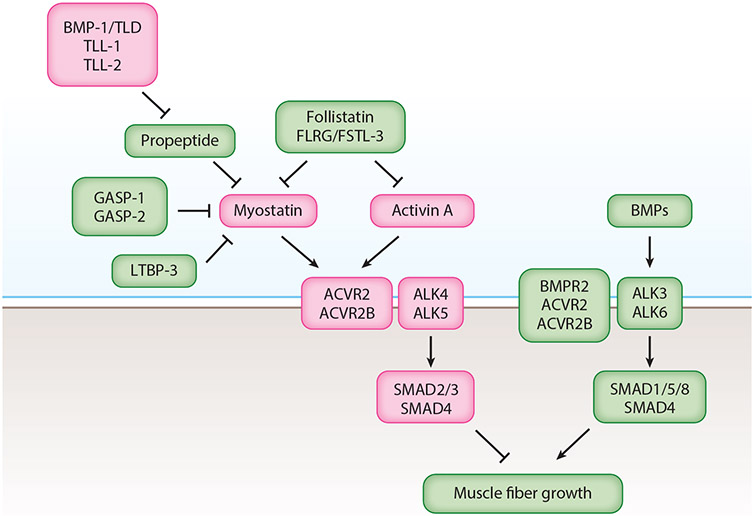
“Studies have shown that myostatin affects myofibers directly by binding to the two activin type 2 receptors (2A and 2B) (Figure 4) and limits myofiber growth, while the inhibition of myostatin or its receptors enables myofiber and muscle growth without the activation of satellite cells [257].”
MuSK-BMP signaling in adult muscle stem cells maintains quiescence and regulates myofiber sizePreprint
Madigan, L. A., Jaime, D., Chen, I., & Fallon, J. R. (2023) · bioRxiv (Cold Spring Harbor Laboratory) · doi:10.1101/2023.05.17.541238 · Cited by 5
“However, myostatin does not regulate SC activation in adults(Lee, 2022; Murphy et al., 2010).”
BackgroundLarrad-Sáinz, A., Núñez, M. G., Barabash, A., Prados, I. G., Valerio, J., Gil, J. L. E., Crespo, M. E. O., de la Muela, M. H., Madrid, B. B., Serrano‐García, I., et al. (2025) · Nutrients · doi:10.3390/nu17152487 · Cited by 5
“…mass index; CRP: C-reactive protein; dASAT: deep abdominal sub-cutaneous adipose tissue; ECW: extracellular water; FGF-21: fibroblast growth factor 21; FFM: fat-free mass; FFMI: fat-free mass index; FM: fat mass; FMI: fat mass index; Glyc: glycemia; HbA1c: glycosylated haemoglobin; HDL:…”
Kurose, S., Onishi, K., Miyauchi, T., Takahashi, K., & Kimura, Y. (2023) · Endocrine Research · doi:10.1080/07435800.2023.2253452 · Cited by 4
“On the other hand, it has been reported that FST acts as a chalone that reduces MST activity when muscle growth inhibition is not required.(37,38) This study showed significantly higher serum FST levels in the severe obesity group than in the obesity group, with no significant difference in MST and other myokine level…”
BackgroundHuman Sports Drug Testing: Analytical Challenges and Solutions
Thevis, M., Walpurgis, K., & Thomas, A. (2025) · Analytical Chemistry · doi:10.1021/acs.analchem.5c00339 · Cited by 5
Yu, Y., Zheng, Y., Zhang, H., Fan, X., Guo, J., Sun, L., Tang, L., & Ta, D. (2025) · npj Microgravity · doi:10.1038/s41526-025-00514-8 · Cited by 5
“MSTN, a well-documented inhibitory factor in muscle growth, can lead to muscle atrophy when overexpressed 45 .”
Sun, H., Huang, Y., Zhou, H., Chen, H., Dai, J., Zhao, J., Huang, X., Cai, H., & Shen, J. (2025) · Journal of Orthopaedic Translation · doi:10.1016/j.jot.2025.11.003 · Cited by 5
“Myostatin has historically been regarded as a negative regulator of skeletal muscle homeostasis by inhibiting muscle stem cells myogenesis [44].”
Alonso-Puyo, J., Izagirre-Fernandez, O., Crende, O., Seco‐Calvo, J., Fernández‐Atutxa, A., Fernández‐Lázaro, D., García-Gallastegui, P., & Sanz, B. (2024) · Proteomes · doi:10.3390/proteomes12040034 · Cited by 3
“These apparently paradoxical results could be justified by subjacent counter regulatory mechanisms according to the theory that each organ produces a “chalone”, a factor limiting its own growth [22].”
Lee, Y. J., Park, J., & Jun, W. (2025) · Journal of Medicinal Food · doi:10.1089/jmf.2025.k.0050 · Cited by 3
Morel, J., Pignard, A. S., Castells, J., Allibert, V., Hatimi, L., Buhot, B., Velarde, M., Durieux, A., & Freyssenet, D. G. (2024) · The Journal of Physiology · doi:10.1113/jp284973 · Cited by 2
“To reconcile these data with the prototypical catabolic function of myo-statin, it is important to consider that the production of myostatin is directly proportional to the amount of skeletal muscle (Lee, 2023).”
BackgroundResearch on organized method and regulatory mechanism of cell cultured meat based on modified silk
Yang, F., Hu, H., Li, Y., Li, S., Liu, W., Qi, Y., & Wang, S. (2024) · Food Science and Human Wellness · doi:10.26599/fshw.2024.9250222 · Cited by 2
Applications and challenges of dsRNA-mediated RNAi in aquaculture
Meng, L., Zhang, X., Zhou, M., Wu, Y., & Zhang, J. (2026) · Water Biology and Security · doi:10.1016/j.watbs.2025.100544 · Cited by 2
Lim, J. H., Ahmad, S. S., Lee, E. J., Choi, J.-M., & Choi, I. (2026) · Phytomedicine · doi:10.1016/j.phymed.2026.158323 · Cited by 3
Solignac, J., Dou, L., Chermiti, R., McKay, N., Giaime, P., Pedinielli, N., Benjelloun, H., Lano, G., Mancini, J., Burtey, S., et al. (2025) · Toxins · doi:10.3390/toxins17040159 · Cited by 2
“Myostatin activates TGF β signaling in VSMCs [11] and aortic endothelial cells [8] by binding to type II Ser/Thr kinase receptors ACVR2A and ACVR2B, which phosphorylate and activate type I receptors ACVR1B (ALK4) or TGFBR1 (ALK5) [12].”
Gerosa, L., Malvandi, A. M., Gomarasca, M., Verdelli, C., Sansoni, V., Faraldi, M., Ziemann, E., Olivieri, F., Banfi, G., & Lombardi, G. (2024) · The Journals of Gerontology Series A · doi:10.1093/gerona/glae022 · Cited by 2
“…that myotubes derived from SYUIQ-5 treated myoblasts could express a different myokines profile, compared to the control condition, and, among them, a different expression level of MYOSTATIN, a mediator relevant in protein metabolism in muscle and associated with the aged muscle phenotype (22).”
BackgroundLoss of Myostatin Affects m6A Modification but Not Semen Characteristics in Bull Spermatozoa
Hai, C., Wang, L., Wang, S., Di, A., Song, L., Liu, X., Bai, C., Su, G., Yang, L., & Li, G. (2025) · International Journal of Molecular Sciences · doi:10.3390/ijms26020591 · Cited by 1
“Myostatin is a member of the transforming growth factor-β (TGF-β ) family of proteins [1].”
Effects of the Dietary Supplement 5α‐Hydroxy‐Laxogenin in the Orchiectomized Rat Model
Derwand, D., Zierau, O., Wolf, C. A., Wolber, G., & Keiler, A. M. (2025) · Drug Testing and Analysis · doi:10.1002/dta.3881 · Cited by 1
“On molecular level, we quantified the mRNA levels of the AR and the myogenic regulatory factors MyoD1 and myogenin as well as myostatin, a negative regulator of myogenesis [25, 26].”
Niazi, S., Rajabi, H., & Amani-Shalamzari, S. (2025) · Sport Sciences for Health · doi:10.1007/s11332-025-01501-y · Cited by 1
El-latif, G. A., El-Messeiry, S., El-Raffa, A. M., Aliwa, I. A., & Habashy, W. S. (2025) · World Rabbit Science · doi:10.4995/wrs.2025.22797 · Cited by 1
“It is produced by skeletal myofibers, circulates in the bloodstream, and acts on other myofibers to inhibit muscle growth (Lee, 2023).”
Zhang, Y., Guo, Y., Huang, H., Zhang, M., Sun, L., & Jin, Y. (2026) · BMC Genomics · doi:10.1186/s12864-025-12119-2 · Cited by 2
van Krimpen, S. J., Simons, S. O., Schols, A. M. W. J., LANGEN, R. C. J., & Gosker, H. R. (2026) · Expert Review of Respiratory Medicine · doi:10.1080/17476348.2026.2620144 · Cited by 2
Feraco, A., Camajani, E., Muscogiuri, G., Barrea, L., Colao, A., & Caprio, M. (2026) · Current Obesity Reports · doi:10.1007/s13679-026-00695-7 · Cited by 2
Bacheva, I., Ibrayeva, L., Рыбалкина, Д. Х., Kadyrova, I., & Zhumagaliyeva, D. (2026) · Journal of Personalized Medicine · doi:10.3390/jpm16040230 · Cited by 1
“Myostatin is known as a negative regulator of skeletal muscle growth [8], but it is also expressed in the myocardium and vascular smooth muscle [35].”
Krawzow, A., Lichtenauer, U., & Willenberg, H. S. (2026) · Best Practice & Research Clinical Endocrinology & Metabolism · doi:10.1016/j.beem.2026.102131 · Cited by 1
Muscle–Tumor Crosstalk in Exercise Oncology: Exercise-Induced Myokines and Cancer Cachexia
Hekmatikar, A. H. A., Bettariga, F., López-Llorente, Á., Fernández‐Lázaro, D., Suzuki, K., & Daud, D. M. A. (2026) · Cancers · doi:10.3390/cancers18142343 · Cited by 1
“When myostatin levels are low, muscle growth ensues, whereas high expression of myostatin leads to muscle atrophy, a phenomenon commonly observed in cancer-induced cachexia [11,41].”
Nageeb, R. S., Mohamed, N. M., Soliman, A. S., Ebaid, A. M., & Mohammad, N. A. (2024) · The Egyptian Journal of Neurology Psychiatry and Neurosurgery · doi:10.1186/s41983-024-00911-y · Cited by 1
Relation between myostatin levels and malnutrition and muscle wasting in hemodialysis patients
Ibrahim, A. H., Kasim, S. A., Ezzat, A. A., Ibrahim, N. E., Hassan, D. A., Ibrahim, A. S., Abouelgreed, T. A., Abdo, E. M., Aboelsoud, N. M., Abdelmonem, N. M., et al. (2023) · Archivio Italiano di Urologia e Andrologia · doi:10.4081/aiua.2023.11869 · Cited by 1
“Myostatin is secreted by the skeletal myocytes into the bloodstream to act back on the secretory cells limiting their proliferation (18).”
Zainalaabid, M. A., Hilal, N. N., & Ahmed, A. H. (2024) · South Asian Research Journal of Pharmaceutical Sciences · doi:10.36346/sarjps.2024.v06i03.008
Association of Myostatin With Complications and Cognition in Lung Cancer Patients With Sarcopenia
Zhang, Y., Liu, R., Wang, W. J., Wu, R.-J., Dai, W.-T., Zhang, C.-L., Zhuang, Q., & Li, X. (2024) · Journal of Surgical Research · doi:10.1016/j.jss.2024.07.054 · Cited by 3
Kartika, R. W., Sidharta, V. M., Djuartina, T., Sartika, C. R., & Timotius, K. H. (2024) · Annals of African Medicine · doi:10.4103/aam.aam_205_23
“[13,14] ] Myostatin is a master growth factor in regulating muscle mass. [20] ] Learning from the above evidence, we are interested in investigating whether secretome administration is valuable in repairing sarcopenia.”
MuSK-BMP signaling in adult muscle stem cells maintains quiescence and regulates myofiber sizePreprint
Madigan, L. A., Jaime, D., Chen, I., & Fallon, J. R. (2024) · eLife · doi:10.7554/elife.101078.1 · Cited by 1
MuSK-BMP signaling in adult muscle stem cells maintains quiescence and regulates myofiber sizePreprint
Madigan, L. A., Jaime, D., Chen, I., & Fallon, J. R. (2024) · eLife · doi:10.7554/elife.101078
The Molecular Mechanisms and Treatment of Cancer-Related Cachexia
Yongfei, Y. O. U., Yong, W. A. N. G., Zhang, G., & Li, Y. (2025) · Journal of Nutritional Science and Vitaminology · doi:10.3177/jnsv.71.1 · Cited by 3
Principles of diet therapy for sarcopenic obesity: A review
Pavlovskaya, E. V., Кislyak, O. A., & Starodubova, A. V. (2025) · Terapevticheskii arkhiv · doi:10.26442/00403660.2025.07.203270 · Cited by 4
Kong, D., & Chen, J. (2025) · Frontiers in Physiology · doi:10.3389/fphys.2025.1610138 · Cited by 1
“Emerging pharmacological approaches, such as myostatin inhibitors and selective androgen receptor modulators, are also under investigation to enhance muscle mass and strength in sarcopenia patients (Lee, 2023) (Fonseca et al., 2020).”
Yin, C., Yang, S., Huang, Y., Zhou, Z., Huang, J., Yang, B., & Huang, L. (2025) · BMC Genomics · doi:10.1186/s12864-025-12063-1
“…the myosin hevay chains ( MYH ) [35], myosin light chains ( MYL ) [32], myogenic regulatory factors ( MRF ) [36] and myocyte enhancer factors ( MEF ) [37] families as well as myostatin ( MSTN ) [38] were successively identified as causal genes of the animal skeletal muscle fiber differentiation.”
Shan, J., Liu, Y., Lian, K., Xiao, X., Ma, J., Ren, R., Li, X., Wei, G., Kuang, Y., & Peng, R. (2025) · Fishes · doi:10.3390/fishes10100529
“GDF8 has been demonstrated to function as a secreted protein that negatively regulates muscle mass in vivo [22].”
Murao, M., Hamada, R., Kanda, J., Kondo, T., Miyasaka, J., Asano, T., Matsushita, M., Otagaki, A., Arai, Y., Fukuda, H., et al. (2025) · Nutrition · doi:10.1016/j.nut.2025.113015
Skrobot, W. R., Ziemann, E., Jaworska, J., Rodziewicz-Flis, E. A., Micielska, K., Ratajczak, J., Orlikowska, A., Lombardi, G., Borkowska, A., & Kortas, J. A. (2026) · Scientific Reports · doi:10.1038/s41598-025-32563-0
Exercise in a Pill: Emerging Therapeutics for Age-Related Orthopedic Diseases
Luo, J., Meng, X., Han, J., Kong, H., Wang, X., & Zhang, X. (2026) · Antioxidants and Redox Signaling · doi:10.1177/15230864251411560
“Under physiological conditions, myostatin signaling limits myo-fi ber growth and regulates muscle volume (Lee, 2023).”
Albrecht, E., Chitneedi, P., Dannenberger, D., Kühn, C., & Maak, S. (2026) · International Journal of Molecular Sciences · doi:10.3390/ijms27020882
“While direct functional effects of MSTN on muscle growth have been well-established for decades (reviewed, e.g., by Lee [34,35] and Baig et al. [36]), recent studies have provided evidence for a direct involvement of MSTN in the regulation of lipid metabolism [33].”
Myostatin in the pituitary–muscle axis: Roles in health and disease
Iglesias, P. (2026) · Endocrinología Diabetes y Nutrición (English ed ) · doi:10.1016/j.endinu.2025.501757
Park, J., & Jun, W. (2026) · Journal of Medicinal Food · doi:10.1177/1096620x261434662
Liu, Y., Zeng, J., & Xing, C. (2026) · Asian Journal of Surgery · doi:10.1016/j.asjsur.2026.04.019
Regulation of Body Size in Edible Crickets Through Myoglianin–Juvenile Hormone Signaling
Ishimaru, Y., Watanabe, T., Noji, S., & Mito, T. (2026) · Entomology monographs · doi:10.1007/978-981-95-8605-9_15
Khamoui, A. V., Abraham, A., Pórszász, J., Kovanecz, I., Constantinescu, S., Rossiter, H. B., & Reisz‐Porszasz, S. (2026) · Experimental Physiology · doi:10.1113/ep093775 · Cited by 1
“This circulating overexpression model caused severe muscle andfatwastingstemmingfromsupraphysiologicallevelsofactivemyo-statinatcirculatingconcentrationsunlikelytorepresentnormalranges (Lee, 2023; Zimmers et al., 2002).”
Hidese, S., Hattori, K., Enokida, T., Tatsumi, M., Matsumura, R., & Kunugi, H. (2026) · Biological Psychiatry Global Open Science · doi:10.1016/j.bpsgos.2026.100804
“GDF-8, also known as myostatin, is a master regulator of skeletal muscle mass (50).”
MATSUOKA, N., Yamauchi, A., & Yamaguchi, Y. (2026) · The Journal of Physiological Sciences · doi:10.1016/j.jphyss.2026.100093
“Mstn is a well-known negative regulator of skeletal muscle mass through the inhibition of both MyoD-mediated myogenic processes and mTOR-dependent protein synthesis [48, 49].”
Bogdanovich, S., Pistilli, E. E., & Khurana, T. S. (2026) · Muscles · doi:10.3390/muscles5030058
“Taken together, these data largely confirm and extend previous studies that have targeted the Myostatin/Activin pathway for increasing muscle mass in vivo, using a variety of genetic and pharmacological means [47,49].”
Régulation de l’exercice aérobique par l’os
Karsenty, G. (2026) · Revue du Rhumatisme · doi:10.1016/j.rhum.2026.09.001
Bazi Bushen attenuates musculoskeletal degeneration in Ercc1+/− mice
Huang, D., Xu, N., Chu, Q., Wang, Y., Jia, Z., & Xu, J. (2026) · Experimental Gerontology · doi:10.1016/j.exger.2026.113314
Durieux, A., Arnould, D., Velarde, M., Allibert, V., Chloé, P., Quentin, D., Esra, K., Sidney, C., Girard, E., Louise, C., et al. (2026) · Journal of Cachexia Sarcopenia and Muscle · doi:10.1002/jcsm.70338
Huang, D., Xu, N., Chu, Q., Jia, Z., Wang, Y., & Xu, J. (2026) · Journal of Cellular and Molecular Medicine · doi:10.1111/jcmm.71407
Metadata
- Authors
- Lee, S.-J.
- Affiliations
- University of Connecticut (US)
- Corresponding author
- Lee, Se-Jin
- ORCID
- Lee, Se-Jin
- Venue
- Annual Review of Physiology
- Publisher
- Annual Reviews
- Published
- 2023-02-10
- Volume
- 85
- Issue
- 1
- Pages
- 269-291
- ISSN
- 0066-4278 (ISSN-L)
- 1545-1585
- PMC
- PMC10163667
- OpenAlex
- W4306918340
- Cited by
- 84
- References
- 146
- Citations by year
- 2026: 25 · 2025: 24 · 2024: 23 · 2023: 12
- FWCI
- 1.54
- Type
- journal article
- Language
- en
- Open access
- hybrid
- doi.org
- Locations
- Annual Review of Physiology (publishedVersion, cc-by)
- PubMed (publishedVersion)
- PubMed Central (acceptedVersion, cc-by)
- The Mouseion at the JAXlibrary (Jackson Laboratory) (submittedVersion, cc-by)
- Funders
- Johns Hopkins University
- National Institutes of Health
- National Institute on Aging (R01AG052962)
- National Institute of Arthritis and Musculoskeletal and Skin Diseases (R01AR060636, R01AR081659)
- Topics
- Life Sciences › Biochemistry, Genetics and Molecular Biology › Molecular Biology › Muscle Physiology and Disorders
- Life Sciences › Biochemistry, Genetics and Molecular Biology › Molecular Biology › TGF-β signaling in diseases
- Life Sciences › Biochemistry, Genetics and Molecular Biology › Genetics › Genetics and Physical Performance
- Keywords
- myostatin, chalone, skeletal muscle mass, transforming growth factor-beta family, negative feedback regulation, muscle fibers
- MeSH terms
- Humans, Transforming Growth Factor beta, Muscle, Skeletal, Chalones, Myostatin
About these checks
Registry, retraction, Cites and statistics results are computed, not judged, with one exception: a printed reference that no index lists is read once by a model before it counts as a citation error. Claims are extracted by a model and kept only when their quote appears verbatim in the text; each cited source is then checked, with a model’s help, for whether it says what the claim relies on. Those verdicts can be wrong — read the claim’s quote and the cited source before relying on one.
Statistics and arithmetic are recomputed, not judged.
Confidence bands are shown only for fields calibrated on our annotated test set. None is calibrated yet, so no band is shown.
What counts as a claim ›How we measure confidence ›How we check this ›
Are you an author, or do you see a problem with this page? Request a review
Data sources
Bibliographic data: Semantic Scholar, OpenAlex, Crossref.
Contains information from the Semantic Scholar Academic Graph Datasets, made available under the ODC Attribution License (ODC-BY 1.0).
Semantic Scholar’s data is described in: Kinney, R., et al. (2023). The Semantic Scholar Open Data Platform. arXiv:2301.10140.
