

Improved Toluene Response of Mixed-Potential Type YSZ-Based Gas Sensors Using CeO2-Added Au Electrodes
Open accessThe DOI matches its Crossref record; 44 of the 44 references it cites were found in a registry or an index.
Abstract
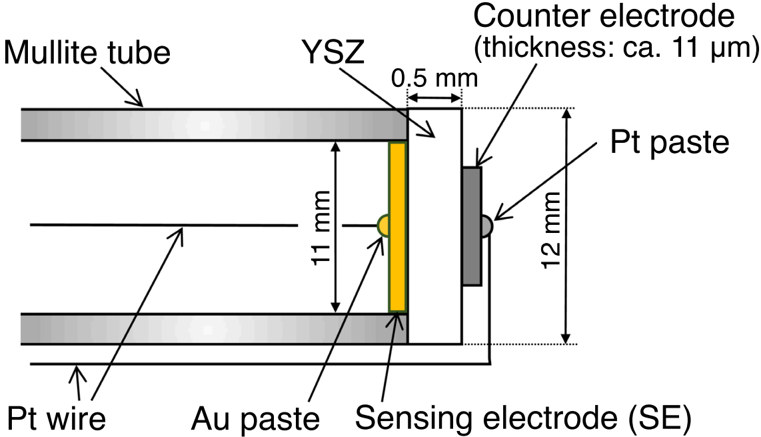
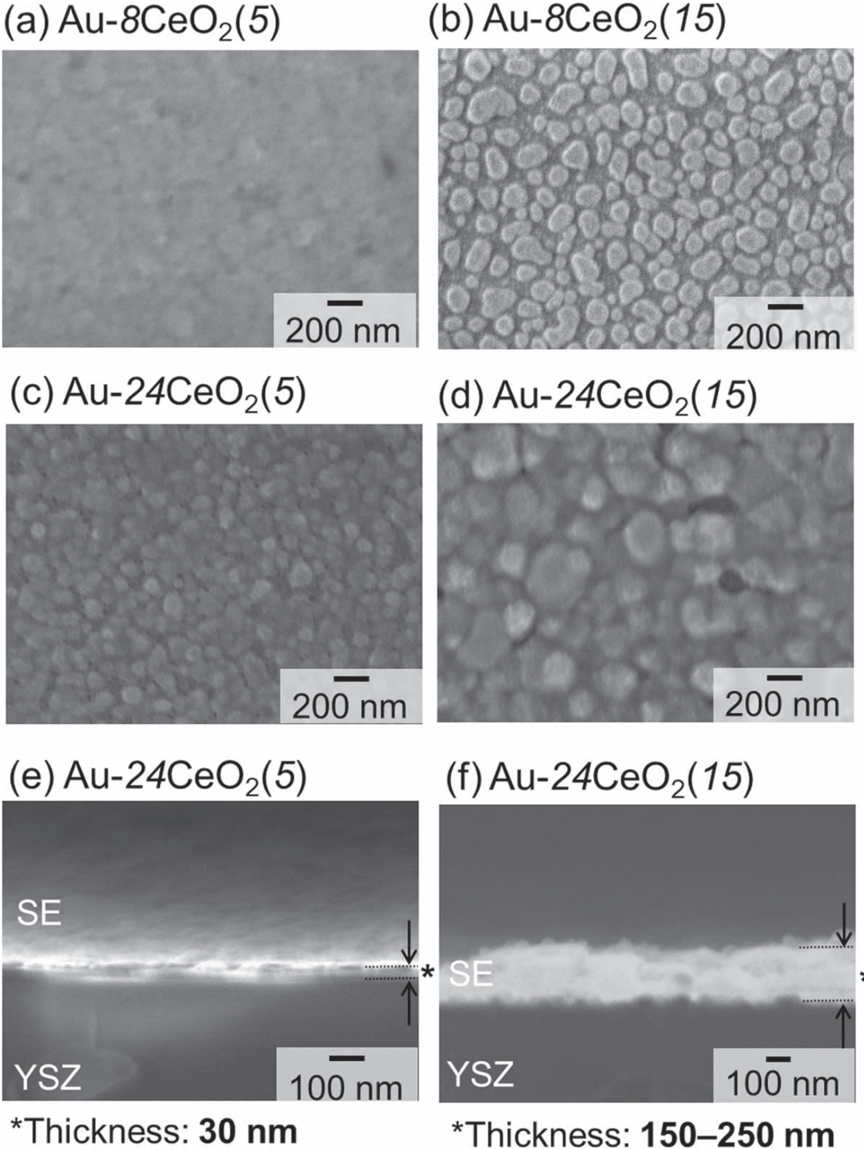
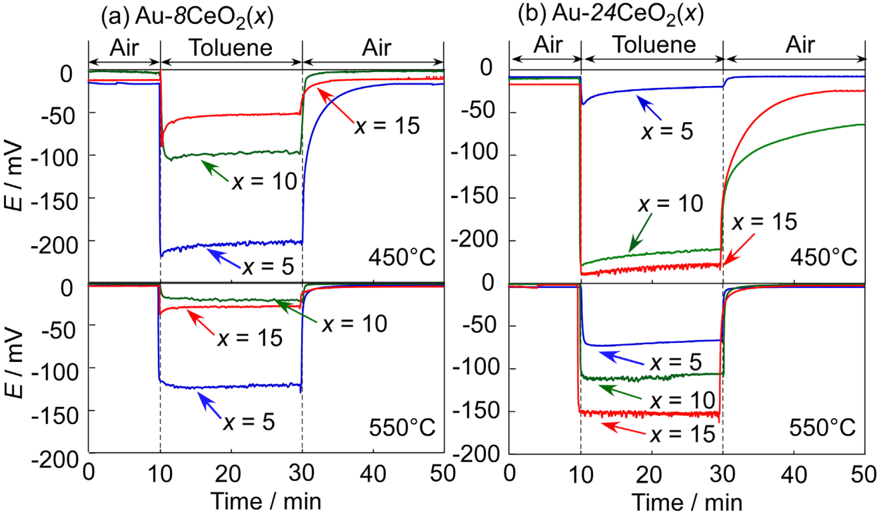
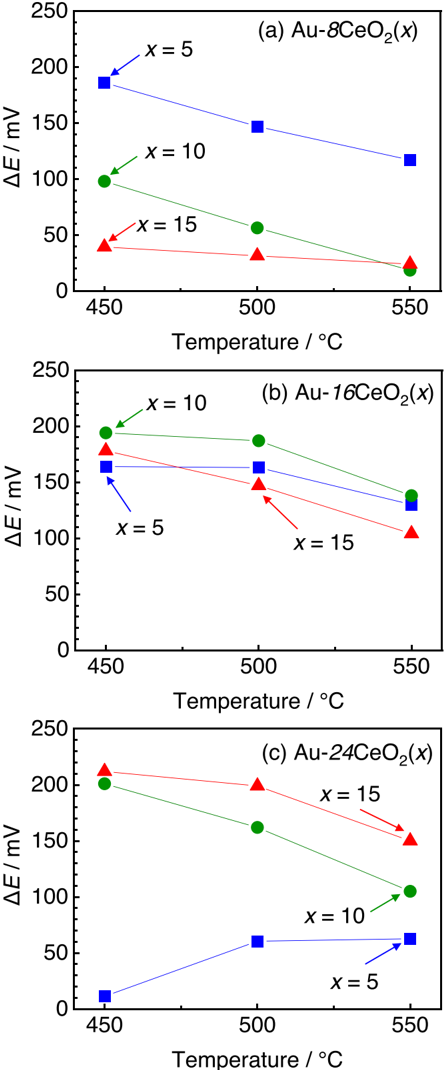
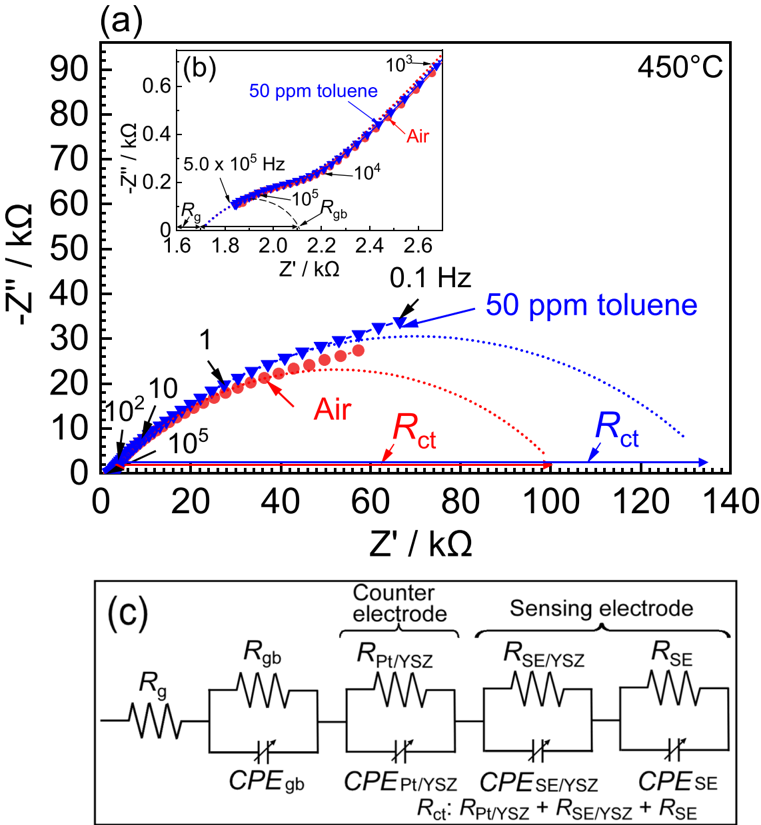
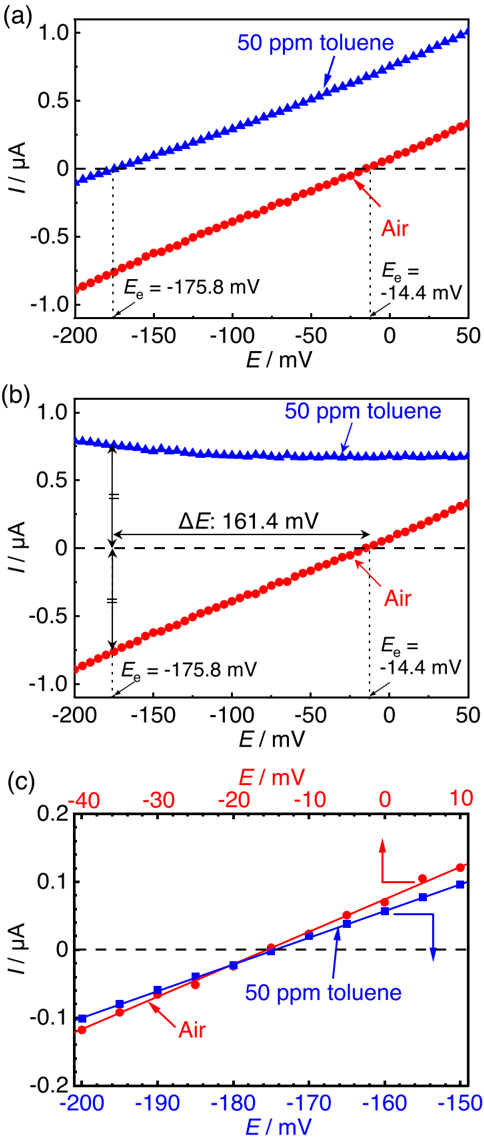
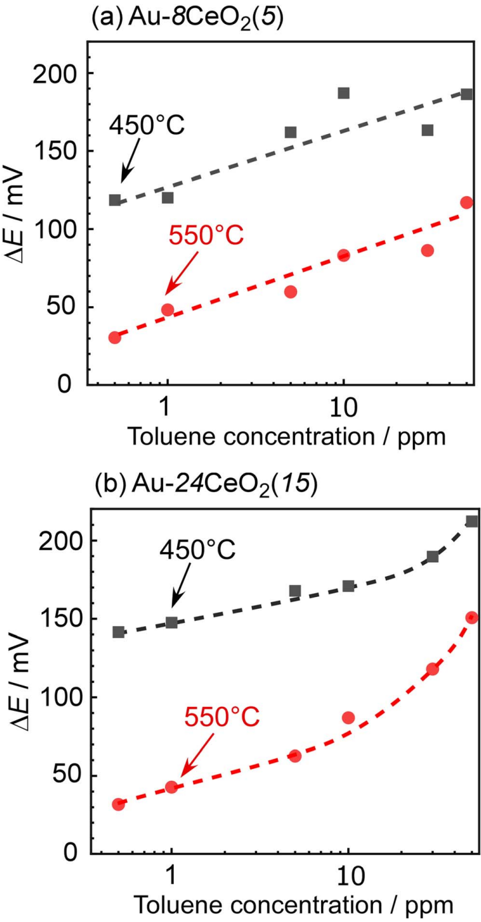
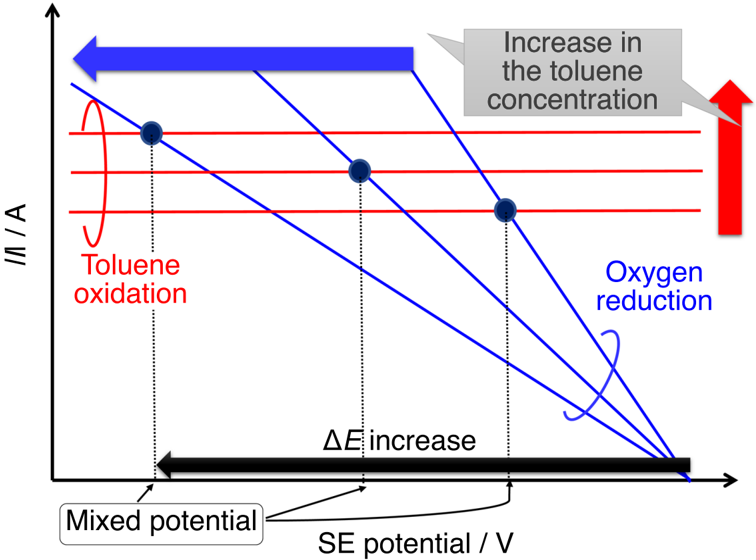
YSZ-based potentiometric sensors employing thin CeO 2 -added Au sensing electrodes (SEs) were fabricated by using a spin-coating method, and effects of the CeO 2 addition on their toluene sensing properties were examined. The sensor response (Δ E ) to 50 ppm toluene of the sensors using 8 wt% CeO 2 -added Au SEs tended to decrease with an increase in the number of spin-coating cycles ( x : 5, 10, 15; i.e., the thickness of SEs). However, Δ E of the sensors using 24 wt% CeO 2 -added Au SEs showed an opposite behavior to what was observed for 8 wt% CeO 2 -added Au SEs. The sensor using the thickest SE ( x : 15) showed the largest Δ E (e.g., ca. 212 mV for 50 ppm toluene) at 450 °C among all the sensors examined and responded even to 0.5 ppm toluene. Δ E exponentially increased with an increase in logarithmic toluene concentration in the range higher than 10 ppm. These obtained results indicate that electrochemical toluene oxidation proceeds at triple-phase boundaries in SE with gas (Au/CeO 2 /gas) in addition to conventional TPBs (SE/YSZ/gas) in addition to the conventional interface at SE/YSZ/gas, because CeO 2 is a mixed ionic and electronic conductor. The electrochemical reactions at TPBs of the sensor were also discussed on the basis of the I – E characteristics and the electrochemical impedance properties.
Overview
The claims and statistics of this paper haven’t been checked yet.
Free: it reads the open-access text and checks the first 5 claims that cite a source we can check. Create a free account to check every claim.
Integrity signals
Registry
Cites
Statistics
Figures

Verification
Claims the paper makes
The claims and statistics of this paper haven’t been checked yet.
Free: it reads the open-access text and checks the first 5 claims that cite a source we can check. Create a free account to check every claim.
Self-check
Percentages, sums and reported differences re-computed from the paper’s own numbers.
The self-check needs the paper’s full text.
Citations
Cites
Diagnosing lung cancer in exhaled breath using gold nanoparticles
Peng, G., Tisch, U., Adams, O., Hakim, M., Shehada, N., Broza, Y. Y., Billan, S., Abdah-Bortnyak, R., Kuten, A., & Haick, H. (2009) · Nature Nanotechnology · doi:10.1038/nnano.2009.235 · Cited by 1,263
Strong Metal–Support Interactions between Gold Nanoparticles and ZnO Nanorods in CO Oxidation
Liu, X., Liu, M.-H., Luo, Y.-C., Mou, C.-Y., Lin, S. D., Cheng, H., Chen, J.-M., Lee, J.-F., & Lin, T.-S. (2012) · Journal of the American Chemical Society · doi:10.1021/ja3033235 · Cited by 658
Breath gas aldehydes as biomarkers of lung cancer
Fuchs, P., Loeseken, C., Schubert, J. K., & Miekisch, W. (2010) · International Journal of Cancer · doi:10.1002/ijc.24970 · Cited by 513
Yaegaki, K., & Sanada, K. (1992) · Journal of Periodontal Research · doi:10.1111/j.1600-0765.1992.tb01673.x · Cited by 459
Cao, L., Gao, Z., Suib, S. L., Obee, T. N., Hay, S. O., & Freihaut, J. D. (2000) · Journal of Catalysis · doi:10.1006/jcat.2000.3050 · Cited by 370
A review of mixed-potential type zirconia-based gas sensors
Miura, N., Sato, T., Anggraini, S. A., Ikeda, H., & Zhuiykov, S. (2014) · Ionics · doi:10.1007/s11581-014-1140-1 · Cited by 334
Total Volatile Organic Compounds (TVOC) in Indoor Air Quality Investigations*
Molhave, L., Clausen, G., Berglund, B., Ceaurriz, J., Kettrup, A., Lindvall, T., Maroni, M., Pickering, A. C., Risse, U., Rothweiler, H., et al. (1997) · Indoor Air · doi:10.1111/j.1600-0668.1997.00002.x · Cited by 314
XPS: binding energy calibration of electron spectrometers 5?re-evaluation of the reference energies
Seah, M. P., Gilmore, I. S., & Beamson, G. (1998) · Surface and Interface Analysis · doi:10.1002/(sici)1096-9918(199808)26:9<642::aid-sia408>3.0.co;2-3 · Cited by 291
Gong, Y., Wei, Y., Cheng, J., Jiang, T., Chen, L., & Xu, B. (2017) · Science of The Total Environment · doi:10.1016/j.scitotenv.2016.08.072 · Cited by 165
Yang, X., Salles, V., Kaneti, Y. V., Liu, M., Maillard, M., Journet, C., Jiang, X., & Brioude, A. (2015) · Sensors and Actuators B: Chemical · doi:10.1016/j.snb.2015.05.121 · Cited by 161
Cited by
Review—Electrochemistry and Other Emerging Technologies for Continuous Glucose Monitoring Devices
Das, S. K., Nayak, K. K., Krishnaswamy, P. R., Kumar, V., & Bhat, N. (2022) · ECS Sensors Plus · doi:10.1149/2754-2726/ac7abb · Cited by 163
Chaudhary, V., Ashraf, N., Khalid, M., Walvekar, R., Yang, Y., Kaushik, A., & Mishra, Y. K. (2022) · Advanced Functional Materials · doi:10.1002/adfm.202112913 · Cited by 161
Detection of Methylparaben in Cosmetics by Poly L–Lysine/Reduced Graphene Oxide-Based Sensor
Nguyen, D. M., & Toàn, T. T. T. (2022) · ECS Sensors Plus · doi:10.1149/2754-2726/ac8aa7 · Cited by 67
Solid electrolyte gas sensors based on mixed potential principle – A review
Ritter, T., Zösel, J., & Guth, U. (2023) · Sensors and Actuators B Chemical · doi:10.1016/j.snb.2023.133508 · Cited by 48
Design Strategies and Emerging Applications of Perovskite-Based Sensors
Li, Y., Ding, Y., Sun, J., Tan, S., Li, Y., Wang, X., Cai, J., Bai, J., Lv, X., Guo, W., et al. (2025) · SmartMat · doi:10.1002/smm2.70022 · Cited by 41
Metadata
- Authors
- Ueda, T., Oide, N., Kamada, K., Hyodo, T., & Shimizu, Y.
- Affiliations
- Nagasaki University (JP)
- Corresponding author
- Ueda, Taro
- Venue
- ECS Sensors Plus
- Publisher
- The Electrochemical Society
- Published
- 2022-03-01
- Volume
- 1
- Issue
- 1
- Pages
- 013604
- ISSN
- 2754-2726 (ISSN-L)
- OpenAlex
- W4226505272
- Cited by
- 84
- References
- 44
- Citations by year
- 2026: 1 · 2025: 7 · 2024: 14 · 2023: 22 · 2022: 40
- FWCI
- 5.68
- Type
- journal article
- Language
- en
- Open access
- gold
- doi.org
- Licence
- cc-by
- creativecommons.org/licenses/by/4.0/ (vor, 43 d)
- iopscience.iop.org/info/page/text-and-data-mining (tdm, 43 d)
- Locations
- ECS Sensors Plus (publishedVersion, cc-by)
- Funders
- Japan Society for the Promotion of Science (KAKENHI Grant Number 19K05005.)
- Topics
- Physical Sciences › Engineering › Electrical and Electronic Engineering › Gas Sensing Nanomaterials and Sensors
- Physical Sciences › Chemistry › Analytical Chemistry › Analytical Chemistry and Sensors
- Physical Sciences › Materials Science › Materials Chemistry › Catalytic Processes in Materials Science
- Keywords
- yttria-stabilized zirconia, potentiometric gas sensor, mixed ionic-electronic conductors, three-phase boundary, spin coating, electrochemical impedance
About these checks
Registry, retraction, Cites and statistics results are computed, not judged, with one exception: a printed reference that no index lists is read once by a model before it counts as a citation error. Claims are extracted by a model and kept only when their quote appears verbatim in the text; each cited source is then checked, with a model’s help, for whether it says what the claim relies on. Those verdicts can be wrong — read the claim’s quote and the cited source before relying on one.
Statistics and arithmetic are recomputed, not judged.
Confidence bands are shown only for fields calibrated on our annotated test set. None is calibrated yet, so no band is shown.
What counts as a claim ›How we measure confidence ›How we check this ›
Are you an author, or do you see a problem with this page? Request a review
Data sources
Bibliographic data: Semantic Scholar, OpenAlex, Crossref.
Contains information from the Semantic Scholar Academic Graph Datasets, made available under the ODC Attribution License (ODC-BY 1.0).
Semantic Scholar’s data is described in: Kinney, R., et al. (2023). The Semantic Scholar Open Data Platform. arXiv:2301.10140.
