

The DOI matches its Crossref record; 12 of the 12 references it cites were found in a registry or an index.
Encountering Anger in the Emergency Department: Identification, Evaluations and Responses of Staff Members to Anger Displays
Open accessAbstract
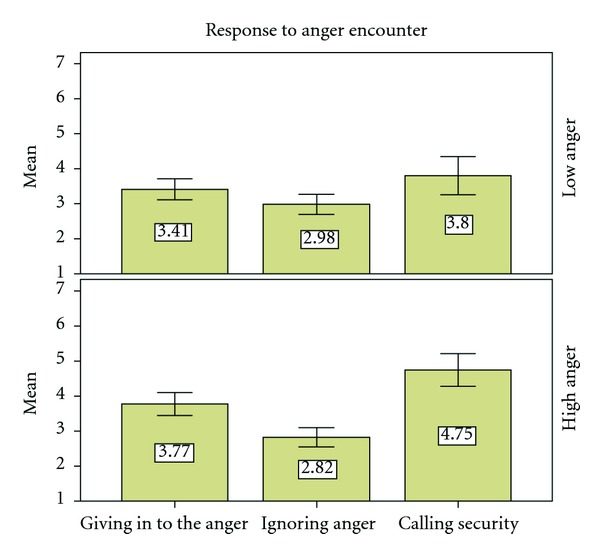
Background. Anger manifestations in emergency departments (EDs) occur daily, interrupting workflow and exposing staff to risk.Objectives. How staff assess and recognize patients’ angry outbursts in EDs and elucidate responses to anger expressions, while considering effects of institution guidelines.Methods. Observations of staff patient interaction in EDs and personal interviews of staff (n=38) were conducted. Two questionnaires were administered (n=80&n=144). Assessment was based mainly on regression statistic tests.Results. Staff recognizes two types of anger displays. Magnitude of anger expressions were correlated with staff’s fear level. Staff’s responses ranged from ignoring incidents, giving in to patients’ requests or immediately calling security. When staff felt fear and became angry they tended to call security. Staff was more likely to ignore anger when incident responsibility was assigned to patients.Discussion. Anger encounters are differentiated according to intensity level, which influences interpretations and response. Organizational policy has an effect on staff’s response.Conclusions. Staff recognizes anger at varying levels and responds accordingly. The level of danger staff feels is a catalyst in giving in or calling security. Call security is influenced by fear, and anger. Permanent guidelines can help staff in responding to anger encounters.
Overview
The claims and statistics of this paper haven’t been checked yet.
Run the check — free, no account needed. It reads the open-access text and checks the sources it cites.
Integrity signals
Registry
Cites
Statistics
Figures
Verification
Claims the paper makes
The claims and statistics of this paper haven’t been checked yet.
Run the check — free, no account needed. It reads the open-access text and checks the sources it cites.
Claims other papers make about this one
Each is checked against this paper’s own text: does it say what the citing paper says it does?
The source backs part of the claim, not all of it — or backs it for a different population, condition or comparison.
In the citing paper
“An ever-growing waiting time and shortened doctor-patient encounters cause patients to become dissatisfied and irritated, often leading to friction and hostility between patients and overworked staff8.”
From How do retired paramedics fit into remote, rural emergency departments? (2013) · cites this paper as [8]
Experimental — accuracy not yet measuredThe check wasn’t confident either way, so it gives no verdict — never disputed.
In the citing paper
“The reluctance of physicians to stay in remote and rural hospitals has resulted in a shortage of doctors in these settings, and therefore a decline in the quality of care and an intolerable overload on functioning doctors.”
From How do retired paramedics fit into remote, rural emergency departments? (2013) · cites this paper as [8]
Experimental — accuracy not yet measured
Self-check
Percentages, sums and reported differences re-computed from the paper’s own numbers.
The self-check needs the paper’s full text.
Citations
Cites
Gerberich, S. G., Church, T. R., McGovern, P. M., Hansen, H. E., Nachreiner, N. M., Geisser, M. S., Ryan, A., Mongin, S. J., & Watt, G. D. (2004) · Occupational and Environmental Medicine · doi:10.1136/oem.2003.007294 · Cited by 537
Emotion cycles: On the social influence of emotion in organizations
Hareli, S., & Rafaeli, A. (2008) · Research in Organizational Behavior · doi:10.1016/j.riob.2008.04.007 · Cited by 445
Aggression and violence in health care professions
Rippon, T. J. (2000) · Journal of Advanced Nursing · doi:10.1046/j.1365-2648.2000.01284.x · Cited by 374
Crossing the line(s): A dual threshold model of anger in organizations
Geddes, D., & Callister, R. R. (2007) · Academy of Management Review · doi:10.5465/amr.2007.25275495 · Cited by 281
Non‐somatic effects of patient aggression on nurses: a systematic review
Needham, I., Abderhalden, C., Halfens, R. J. G., Fischer, J. E., & Dassen, T. (2005) · Journal of Advanced Nursing · doi:10.1111/j.1365-2648.2004.03286.x · Cited by 260
Empathy and Patient–Physician Conflicts
Halpern, J. (2007) · Journal of General Internal Medicine · doi:10.1007/s11606-006-0102-3 · Cited by 237
Patient and visitor violence in general hospitals: A systematic review of the literature
Hahn, S., Zeller, A., Needham, I., et al. (2008) · Aggression and Violent Behavior · doi:10.1016/j.avb.2008.07.001 · Cited by 175
De‐escalating aggression and violence in the mental health setting
Cowin, L. S., Davies, R., Estall, G., Berlin, T., Fitzgerald, M., & Hoot, S. (2003) · International Journal of Mental Health Nursing · doi:10.1046/j.1440-0979.2003.00270.x · Cited by 128
Nurses' responses to patient anger: from disconnecting to connecting
Smith, M. E., & Hart, G. (1994) · Journal of Advanced Nursing · doi:10.1046/j.1365-2648.1994.20040643.x · Cited by 59
Personnel exposure to violence in hospital emergency wards: a routine activity approach
Landau, S. F., & Bendalak, Y. (2007) · Aggressive Behavior · doi:10.1002/ab.20214 · Cited by 54
Anger: an alienating communication hazard for nurses.
Duldt, B. W. (1981) · PubMed · Cited by 18
The effect of anger management by nursing staff on violence rate against them in the emergency unit.
Eslamian, J., Fard, S. H. H., Tavakol, K., & Yazdani, M. (2010) · Europe PMC (PubMed Central) · Cited by 18
Research works printed but not linked: 2
- 1981, Nursing Outlook, 29, 640
- 2010, Iranian Journal of Nursing and Midwifery Research, 15, 337
Cited by
Adam, H., & Brett, J. M. (2015) · Journal of Experimental Social Psychology · doi:10.1016/j.jesp.2015.07.001 · Cited by 62
How do retired paramedics fit into remote, rural emergency departments?
Eisenman, A. (2013) · Rural and Remote Health · doi:10.22605/rrh2057 · Cited by 1
Self-citation
Metadata
- Authors
- Arik, C., Anat, R., & Arie, E.
- Affiliations
- Department of Social Psychology, University of Amsterdam, Weesperplein 4, 1018 XA Amsterdam, The Netherlands
- William Davidson Faculty of Industrial Engineering and Management at Technion City, Technion-Israel Institute of Technology, Haifa 32000, Israel
- Department of Emergency Medicine, The Western Galilee Hospital, P.O. Box 21, Naharia 22100, Israel
- Venue
- Emergency Medicine International
- Publisher
- Hindawi Limited
- Published
- 2012
- Volume
- 2012
- Pages
- 1-5
- ISSN
- 2090-2840 (ISSN-L)
- 2090-2859
- PMC
- PMC3419399
- OpenAlex
- W2142937610
- Cited by
- 12
- References
- 12
- Citations by year
- 2025: 1 · 2024: 1 · 2023: 1 · 2021: 2 · 2020: 1 · 2019: 2 · 2018: 1 · 2017: 1 · 2015: 1 · 2013: 1
- FWCI
- 1.97
- Type
- journal article
- Language
- en
- Open access
- gold
- doi.org
- Locations
- Emergency Medicine International (publishedVersion, cc-by)
- Europe PMC (PubMed Central) (publishedVersion, cc-by)
- PubMed Central (publishedVersion, cc-by)
- PubMed (publishedVersion)
- UvA-DARE (University of Amsterdam) (submittedVersion, other-oa)
- DOAJ (DOAJ: Directory of Open Access Journals) (submittedVersion, cc-by-sa)
- Data Archiving and Networked Services (DANS) (submittedVersion, other-oa)
- Funders
- Israeli National Institute (2014746)
- Topics
- Social Sciences › Business, Management and Accounting › Organizational Behavior and Human Resource Management › Workplace Violence and Bullying
- Health Sciences › Medicine › Emergency Medicine › Emergency and Acute Care Studies
- Health Sciences › Health Professions › General Health Professions › Patient-Provider Communication in Healthcare
- Keywords
- staff-patient interaction, organizational policy, anger assessment
About these checks
Registry, retraction, Cites and statistics results are computed, not judged, with one exception: a printed reference that no index lists is read once by a model before it counts as a citation error. Claims are extracted by a model and kept only when their quote appears verbatim in the text; each cited source is then checked, with a model’s help, for whether it says what the claim relies on. Those verdicts can be wrong — read the claim’s quote and the cited source before relying on one.
Statistics and arithmetic are recomputed, not judged.
Confidence bands are shown only for fields calibrated on our annotated test set. None is calibrated yet, so no band is shown.
What counts as a claim ›How we measure confidence ›How we check this ›
Are you an author, or do you see a problem with this page? Request a review
Data sources
Bibliographic data: Semantic Scholar, OpenAlex, Crossref.
Contains information from the Semantic Scholar Academic Graph Datasets, made available under the ODC Attribution License (ODC-BY 1.0).
Semantic Scholar’s data is described in: Kinney, R., et al. (2023). The Semantic Scholar Open Data Platform. arXiv:2301.10140.
