

Conceptualizing and Treating Comorbid Chronic Pain and PTSD
Open accessThe DOI matches its Crossref record; 44 of the 44 references it cites were found in a registry or an index.
Abstract
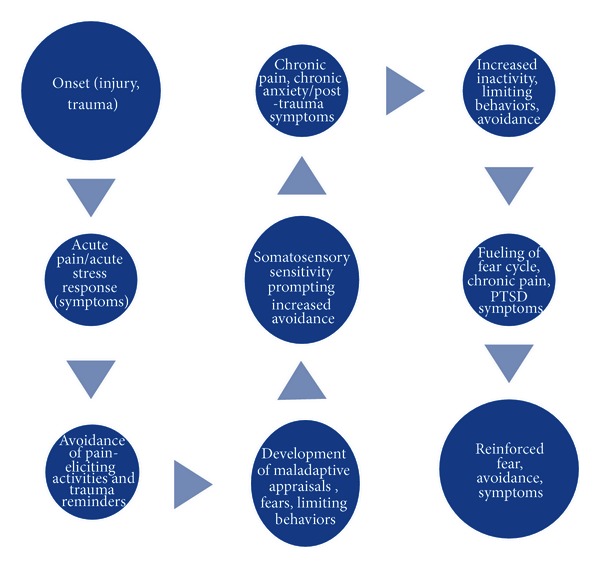
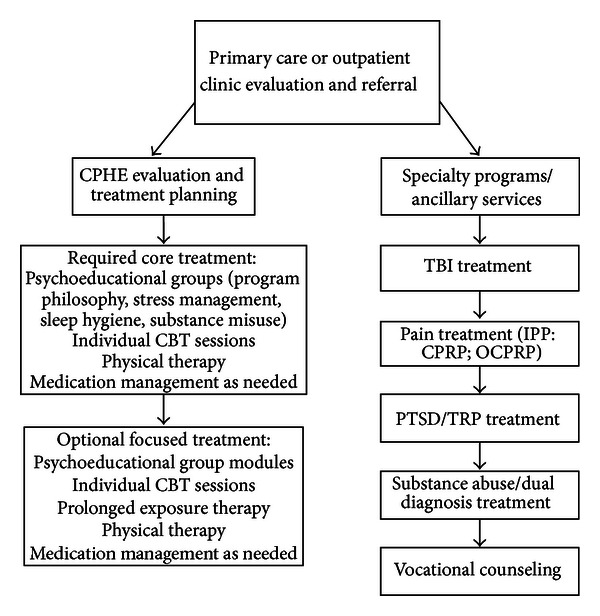
The purpose of this paper is to review the rationale for concurrent, evidence-based treatment of chronic pain and posttraumatic stress disorder (PTSD). To meet this end, we review pertinent definitions and extant theories related to the two conditions and their correlations with each other. We then synthesize theoretical components into a proposal of a comprehensive conceptual framework for understanding the relationship and clinical complexity of overlapping chronic pain and PTSD. We conclude with an example of an integrated treatment model designed specifically to address a fundamental factor associated with pain and PTSD: avoidance.
Overview
The claims and statistics of this paper haven’t been checked yet.
Free: it reads the open-access text and checks the first 5 claims that cite a source we can check. Create a free account to check every claim.
Integrity signals
Registry
Cites
Statistics
Figures
Verification
Claims the paper makes
The claims and statistics of this paper haven’t been checked yet.
Free: it reads the open-access text and checks the first 5 claims that cite a source we can check. Create a free account to check every claim.
Claims other papers make about this one
Each is checked against this paper’s own text: does it say what the citing paper says it does?
The source backs part of the claim, not all of it — or backs it for a different population, condition or comparison.
In the citing paper
“There is a growing body of research showing the benefits of simultaneously treating post-traumatic stress and chronic pain in particular.30-35”
From An updated audit of the patient selection process for pain management programmes in a speciality care service before and during the COVID-19 pandemic (2023) · cites this paper as [32]
Experimental — accuracy not yet measured
Self-check
Percentages, sums and reported differences re-computed from the paper’s own numbers.
The self-check needs the paper’s full text.
Citations
Cites
Emotional processing of fear: Exposure to corrective information.
Foa, E. B., & Kozak, M. J. (1986) · Psychological Bulletin · doi:10.1037/0033-2909.99.1.20 · Cited by 5,396
The biopsychosocial approach to chronic pain: Scientific advances and future directions.
Gatchel, R. J., Peng, Y. B., Peters, M. L., Fuchs, P. N., & Turk, D. C. (2007) · Psychological Bulletin · doi:10.1037/0033-2909.133.4.581 · Cited by 3,392
Classification of Chronic Pain: Descriptions of Chronic Pain Syndromes and Definitions of Pain Terms
Merskey, H. (1994) · Medical Entomology and Zoology · Cited by 3,362
Posttraumatic stress disorder: the burden to the individual and to society.
Kessler, R. C. (2000) · PubMed · Cited by 1,714
(1990) · Choice Reviews Online · doi:10.5860/choice.27-6366 · Cited by 1,629
Behavioral/cognitive conceptualizations of post-traumatic stress disorder
Foa, E. B., Steketee, G., & Rothbaum, B. O. (1989) · Behavior Therapy · doi:10.1016/s0005-7894(89)80067-x · Cited by 1,518
(2007) · Medical Entomology and Zoology · Cited by 1,118
Prolonged Exposure Therapy for PTSD: Therapist Guide: Emotional processing of traumatic experiences
Foa, E. B., Hembree, E., & Rothbaum, B. (2007) · doi:10.1093/med:psych/9780195308501.001.0001 · Cited by 1,050
Hoge, C. W., Terhakopian, A., Castro, C. A., Messer, S. C., & Engel, C. C. (2007) · American Journal of Psychiatry · doi:10.1176/ajp.2007.164.1.150 · Cited by 799
Chronic pain and posttraumatic stress disorder: Mutual maintenance?
Sharp, T. J., & Harvey, A. G. (2001) · Clinical Psychology Review · doi:10.1016/s0272-7358(00)00071-4 · Cited by 779 · cited 1×
“Occupational functioning is also at risk, as those with comorbid pain and PTSD demonstrate more frequent absenteeism [27] and greater loss of productivity [28].”
Background
Research works printed but not linked: 6
- Turk D Assess the person, not just the pain Pain 1993 1 3 1 19
- American Psychiatric Association Diagnostic and Statistical Manual of Mental Disorders—Fourth Edition, Text Revision 2000 Washington, DC, USA American Psychological Association
- Asmundson GJ Norton PJ Vlaeyen JWS Fear-avoidance models of chronic pain: an overview Understanding and Treating Fear of Pain 2004 Oxford, UK Oxford University Press
- Norton PJ Asmundson GJG The fear-avoidance model of chronic musculoskeletal pain Physiotherapy Pain Association News 2003 16 18 20
- Murphy L Clark ME Dubyak PJ Sanders SH Brock CW Implementing step three: components and importance of tertiary pain care Federal Practitioner 2012 29 supplement 4 4S 48S
- Rosenberger PH Philip EJ Lee A Kerns RD The VHA’s National Pain Management Strategy: implementing the stepped care model Federal Practioner 2011 28 8 39 42
Cited by
Post-traumatic stress disorder.
Yehuda, R., Hoge, C. W., McFarlane, A. C., Vermetten, E., Lanius, R. A., Nievergelt, C. M., Hobfoll, S. E., Koenen, K. C., Neylan, T. C., & Hyman, S. E. (2015) · Nature Reviews Disease Primers · doi:10.1038/nrdp.2015.57 · Cited by 870
Outcalt, S. D., Kroenke, K., Krebs, E. E., Chumbler, N. R., Wu, J., Yu, Z., & Bair, M. J. (2015) · Journal of Behavioral Medicine · doi:10.1007/s10865-015-9628-3 · Cited by 199
“The high co-prevalence of mental health conditions with chronic pain has been documented extensively (Bair et al., 2003; Banks & Kerns, 1996; Bosco et al., 2013; Haythornthwaite et al., 1991; Otis et al., 2003) and multiple studies have demonstrated that emotional distress contributes to more intense pain, greater pai…”
BackgroundVinall, J., Pavlova, M., Asmundson, G., Rasic, N., & Noel, M. (2016) · Children · doi:10.3390/children3040040 · Cited by 183
Applying a biopsychosocial model to migraine: rationale and clinical implications
Rosignoli, C., Ornello, R., Onofri, A., Caponnetto, V., Grazzi, L., Raggi, A., Leonardi, M., & Sacco, S. (2022) · The Journal of Headache and Pain · doi:10.1186/s10194-022-01471-3 · Cited by 138
Rometsch-Ogioun El Sount, C., Windthorst, P., Denkinger, J., Ziser, K., Nikendei, C., Kindermann, D., Ringwald, J., Renner, V., Zipfel, S., & Junne, F. (2019) · Journal of Psychosomatic Research · doi:10.1016/j.jpsychores.2018.07.014 · Cited by 102
Metadata
- Authors
- Bosco, M. A., Gallinati, J. L., & Clark, M. E.
- Affiliations
- University of South Florida (US)
- Corresponding author
- Bosco, Michelle A.
- Venue
- Pain Research and Treatment
- Publisher
- Wiley
- Published
- 2013-06-02
- Volume
- 2013
- Pages
- 1-10
- ISSN
- 2090-1542 (ISSN-L)
- 2090-1550
- PMC
- PMC3684116
- OpenAlex
- W1998232203
- Cited by
- 116
- References
- 42
- Citations by year
- 2026: 4 · 2025: 4 · 2024: 6 · 2023: 7 · 2022: 15 · 2021: 7 · 2020: 20 · 2019: 7 · 2018: 7 · 2017: 5 · 2016: 17 · 2015: 11 · 2014: 4 · 2013: 1
- FWCI
- 12.24
- Type
- journal article
- Language
- en
- Open access
- hybrid
- doi.org
- Locations
- Pain Research and Treatment (publishedVersion, cc-by)
- Europe PMC (PubMed Central) (publishedVersion, cc-by)
- PubMed Central (publishedVersion, cc-by)
- PubMed (publishedVersion)
- Topics
- Social Sciences › Psychology › Clinical Psychology › Posttraumatic Stress Disorder Research
- Health Sciences › Health Professions › Physical Therapy, Sports Therapy and Rehabilitation › Musculoskeletal pain and rehabilitation
- Health Sciences › Medicine › Anesthesiology and Pain Medicine › Pain Management and Treatment
- Keywords
- chronic pain, post-traumatic stress disorder, comorbidities, integrated treatment model, avoidance, conceptual framework, evidence-based treatment
About these checks
Registry, retraction, Cites and statistics results are computed, not judged, with one exception: a printed reference that no index lists is read once by a model before it counts as a citation error. Claims are extracted by a model and kept only when their quote appears verbatim in the text; each cited source is then checked, with a model’s help, for whether it says what the claim relies on. Those verdicts can be wrong — read the claim’s quote and the cited source before relying on one.
Statistics and arithmetic are recomputed, not judged.
Confidence bands are shown only for fields calibrated on our annotated test set. None is calibrated yet, so no band is shown.
What counts as a claim ›How we measure confidence ›How we check this ›
Are you an author, or do you see a problem with this page? Request a review
Data sources
Bibliographic data: Semantic Scholar, OpenAlex, Crossref.
Contains information from the Semantic Scholar Academic Graph Datasets, made available under the ODC Attribution License (ODC-BY 1.0).
Semantic Scholar’s data is described in: Kinney, R., et al. (2023). The Semantic Scholar Open Data Platform. arXiv:2301.10140.
