

The DOI matches its Crossref record.
Peroxidase(s) in Environment Protection
Abstract
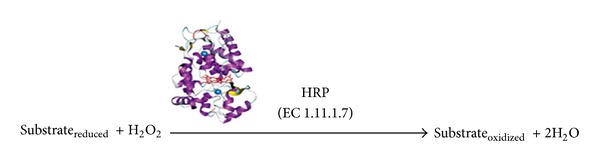
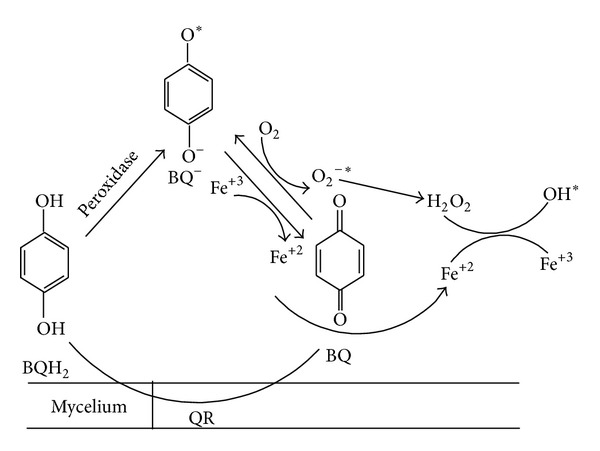
Industrial discharges of untreated effluents into water bodies and emissions into air have deteriorated the quality of water and air, respectively. The huge amount of pollutants derived from industrial activities represents a threat for the environment and ecologic equilibrium. Phenols and halogenated phenols, polycyclic aromatic hydrocarbons (PAH), endocrine disruptive chemicals (EDC), pesticides, dioxins, polychlorinated biphenyls (PCB), industrial dyes, and other xenobiotics are among the most important pollutants. Peroxidases are enzymes that are able to transform a variety of compounds following a free radical mechanism, thereby yielding oxidized or polymerized products. The peroxidase transformation of these pollutants is accompanied by a reduction in their toxicity, due to loss of biological activity, reduction in the bioavailability, or the removal from aqueous phase, especially when the pollutant is found in water. The review describes the sources of peroxidases, the reactions catalyzed by them, and their applications in the management of pollutants in the environment.
Overview
The claims and statistics of this paper haven’t been checked yet.
Run the check — free, no account needed. It reads the open-access text and checks the sources it cites.
Integrity signals
Registry
Cites
Statistics
Figures
Verification
Claims the paper makes
The claims and statistics of this paper haven’t been checked yet.
Run the check — free, no account needed. It reads the open-access text and checks the sources it cites.
Claims other papers make about this one
Each is checked against this paper’s own text: does it say what the citing paper says it does?
The cited source says what the claim attributes to it.
In the citing paper
“The enzymes responsible for dye decolorisation belong to the family of oxidoreductases (EC: 1), which catalyse oxidation and reduction reactions, finding application in various domains varying from diagnostics to wastewater treatment and production of chemicals or potentially biofuels 112-118 .”
From Degradation of anthraquinone dyes from effluents: A review focusing on enzymatic dye degradation with industrial potential (2020) · cites this paper as [114]
Self-check
Percentages, sums and reported differences re-computed from the paper’s own numbers.
The self-check needs the paper’s full text.
Citations
Cites
No references could be resolved yet.
Research works printed but not linked: 67
- 10.1016/j.biortech.2009.06.078 · DOI
- 10.1016/j.foodchem.2009.02.035 · DOI · Paper page
- 10.1186/2191-0855-3-14 · DOI
- 10.1016/j.biortech.2011.03.048 · DOI
- 10.15376/biores.7.1.1366-1382 · DOI
- 10.1002/jobm.200900338 · DOI
- 10.1007/s00253-010-2633-0 · DOI · Paper page
- 10.1007/978-3-642-23789-8_2 · DOI
- 10.3390/w3010157 · DOI
- Gopi V., 2012, Bioremediation potential of individual and consortium non-adaptedfungal strains on Azo dye containing textile effluent, Advances in Applied Science Research, 3, 303
- Tien H. T., 1988, Bilayer Lipid Membranes (BLM): an experimental system for biomolecular electronic device development, Journal of Molecular Electronics, 4, S1
- 10.1007/BF00130365 · DOI
- 10.1016/j.jhazmat.2010.06.106 · DOI
- 10.1007/BF03326155 · DOI
- 10.1111/j.1365-2672.2008.03738.x · DOI
- Krishnaveni M., 2011, Characterization and decolorization of dye and textile effluent by laccase from Pleurotus florida- A white-rot fungi, International Journal of Pharma and Bio Sciences, 2, 117
- 10.1016/S0014-5793(02)03339-2 · DOI
- 10.1002/(SICI)1097-0290(19970720)55:2<348::AID-BIT12>3.0.CO;2-D · DOI
- 10.1002/1097-0290(20010305)72:5<562::AID-BIT1020>3.0.CO;2-S · DOI
- 10.1007/s00253-013-4948 · DOI
- 10.2174/22115501113029990009 · DOI
- Hong Y., 2012, Enzyme production and lignin degradation by four basidiomycetousfungi in submerged fermentation of peat, International Journal of Biology Medium, 4, 172
- 10.1007/s10532-011-9472-2 · DOI
- 10.1016/j.biortech.2006.05.023 · DOI
- 10.1007/s10646-011-0595-3 · DOI
- Shin K. S., 2005, Purification and characterization of manganese peroxidase of the white-rot fungus Irpex lacteus, Journal of Microbiology, 43, 503
- 10.1007/s10532-009-9300-0 · DOI
- 10.1128/aem.59.12.4010-4016.1993 · DOI
- 10.1007/s11274-008-9733-3 · DOI
- 10.1007/s00253-006-0545-9 · DOI
- 10.1007/s00253-009-2173-7 · DOI
- 10.1007/s11274-006-9303-5 · DOI
- 10.1128/AEM.02138-08 · DOI
- 10.1016/j.jhazmat.2010.03.095 · DOI
- 10.1016/j.jcis.2010.03.061 · DOI
- 10.1016/j.chemosphere.2008.03.006 · DOI
- 10.1007/s00253-006-0541-0 · DOI
- Mamatha J., 2012, Degradation of phenol by turnip root enzyme extract, Journal of Microbiology and Biotechnology Research, 2, 426
- 10.1093/jxb/ern261 · DOI
- MossallamK. F. SultanovaF. M. andSalemovaN. A. Peroxidase catalysed the removal of phenol of phenol) from synthetic waste water Proceedings of the 13th International Water Technology Conference (IWTC ′13) 2009 Hurghada Egypt 1009–1020.
- 10.1016/j.chemosphere.2011.06.064 · DOI
- 10.1002/elsc.200700017 · DOI
- 10.1021/es050036x · DOI
- 10.3109/00498258009033788 · DOI
- 10.1289/ehp.8526 · DOI
- 10.1016/S0304-3894(01)00207-2 · DOI
- 10.1023/A:1027316610450 · DOI
- 10.1016/S0958-1669(97)80002-X · DOI
- 10.1007/s11356-008-0024-1 · DOI
- 10.1093/protein/13.2.121 · DOI
- 10.1016/j.ibiod.2009.10.010 · DOI
- 10.1007/s001280000090 · DOI
- 10.1007/s00284-009-9442-7 · DOI
- 10.1016/S0378-1097(02)00710-3 · DOI
- 10.1007/s00253-009-2413-x · DOI
- Quintero J. C., 2008, Screening of white rot fungal species for their capacity to degrade lindane and other isomers of hexachlorocyclohexane (HCH), Ciencia e Investigacion Agraria, 35, 123
- 10.1002/(SICI)1096-9063(199605)47:1<51::AID-PS391>3.0.CO;2-V · DOI
- 10.1016/j.ibiod.2010.04.007 · DOI
- 10.4172/2155-6210.S9-001 · DOI
- 10.1007/s00604-010-0470-6 · DOI
- 10.1007/s00604-010-0479-x · DOI
- 10.1007/s00604-010-0440-z · DOI
- 10.3390/bios2040388 · DOI
- 10.3390/bios2010032 · DOI
- 10.1016/j.watres.2008.11.045 · DOI
- 10.1016/S0032-9592(98)00138-1 · DOI
- 10.1016/j.pbi.2008.02.003 · DOI
Cited by
Sorted by citations
Routoula, E., & Patwardhan, S. V. (2020) · Environmental Science & Technology · doi:10.1021/acs.est.9b03737 · Cited by 579
Metadata
- Authors
- Bansal, N., & Kanwar, S. S.
- Venue
- The Scientific World Journal
- Publisher
- Wiley
- Published
- 2013-01
- Volume
- 2013
- Issue
- 1
- ISSN
- 2356-6140
- 1537-744X
- PMC
- PMC3886600
- Cited by
- 175
- References
- 0
- Language
- en
- Funders
- Council for Scientific and Industrial Research
About these checks
Registry, retraction, Cites and statistics results are computed, not judged, with one exception: a printed reference that no index lists is read once by a model before it counts as a citation error. Claims are extracted by a model and kept only when their quote appears verbatim in the text; each cited source is then checked, with a model’s help, for whether it says what the claim relies on. Those verdicts can be wrong — read the claim’s quote and the cited source before relying on one.
Statistics and arithmetic are recomputed, not judged.
Confidence bands are shown only for fields calibrated on our annotated test set. None is calibrated yet, so no band is shown.
What counts as a claim ›How we measure confidence ›How we check this ›
Are you an author, or do you see a problem with this page? Request a review
