

The DOI matches its Crossref record; 35 of the 36 references it cites were found in a registry or an index.
Major Pesticides Are More Toxic to Human Cells Than Their Declared Active Principles
Open accessAbstract
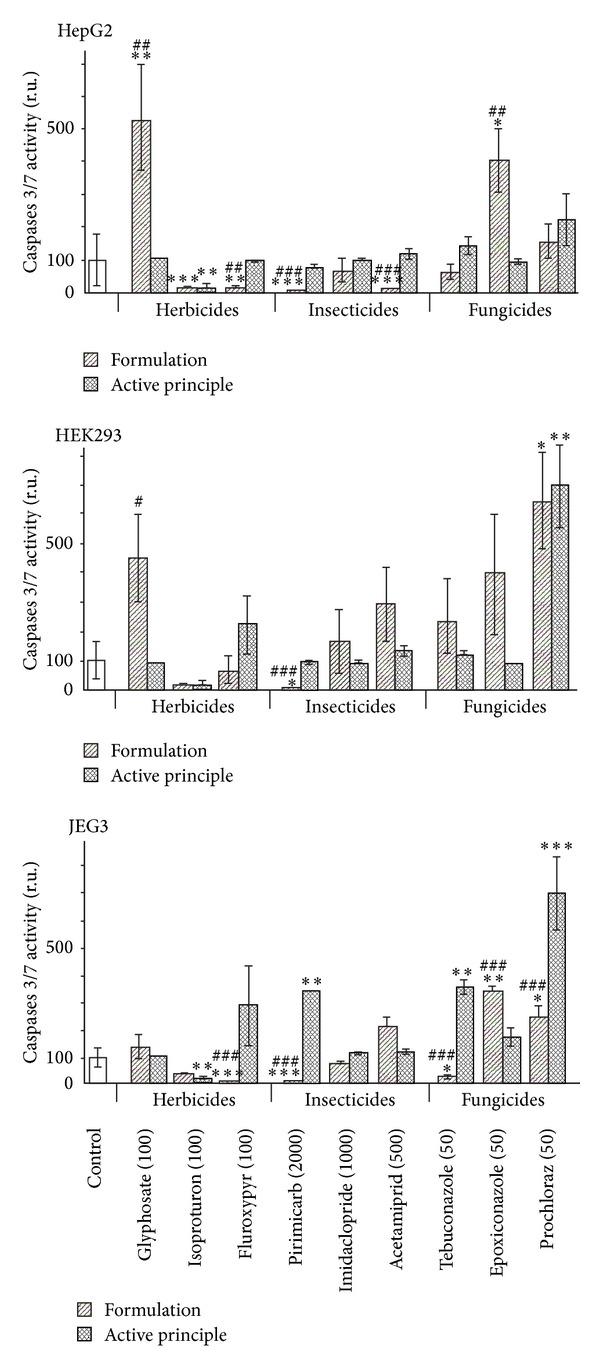
Pesticides are used throughout the world as mixtures called formulations. They contain adjuvants, which are often kept confidential and are called inerts by the manufacturing companies, plus a declared active principle, which is usually tested alone. We tested the toxicity of 9 pesticides, comparing active principles and their formulations, on three human cell lines (HepG2, HEK293, and JEG3). Glyphosate, isoproturon, fluroxypyr, pirimicarb, imidacloprid, acetamiprid, tebuconazole, epoxiconazole, and prochloraz constitute, respectively, the active principles of 3 major herbicides, 3 insecticides, and 3 fungicides. We measured mitochondrial activities, membrane degradations, and caspases 3/7 activities. Fungicides were the most toxic from concentrations 300–600 times lower than agricultural dilutions, followed by herbicides and then insecticides, with very similar profiles in all cell types. Despite its relatively benign reputation, Roundup was among the most toxic herbicides and insecticides tested. Most importantly, 8 formulations out of 9 were up to one thousand times more toxic than their active principles. Our results challenge the relevance of the acceptable daily intake for pesticides because this norm is calculated from the toxicity of the active principle alone. Chronic tests on pesticides may not reflect relevant environmental exposures if only one ingredient of these mixtures is tested alone.
Overview
The claims and statistics of this paper haven’t been checked yet.
Run the check — free, no account needed. It reads the open-access text and checks the sources it cites.
Integrity signals
Registry
Cites
Statistics
Figures
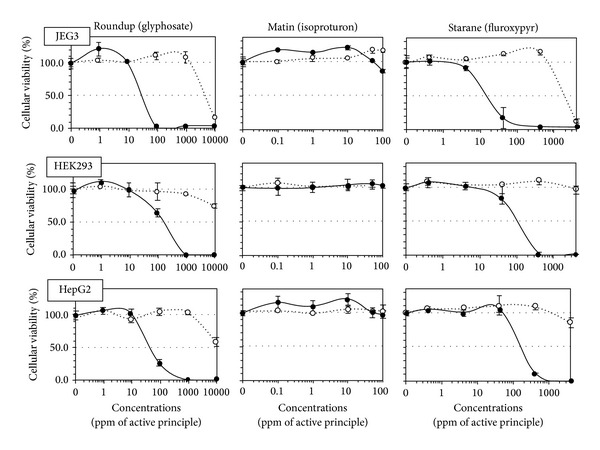
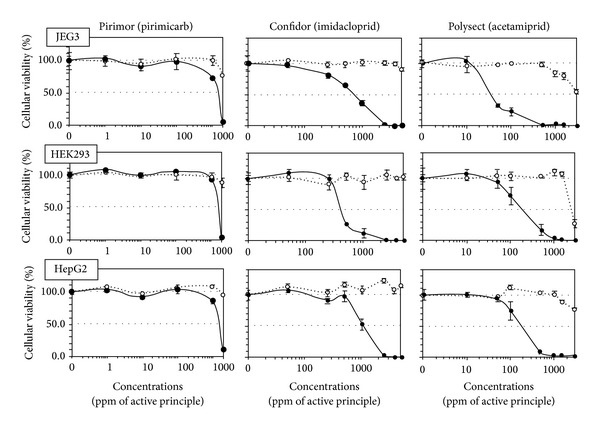
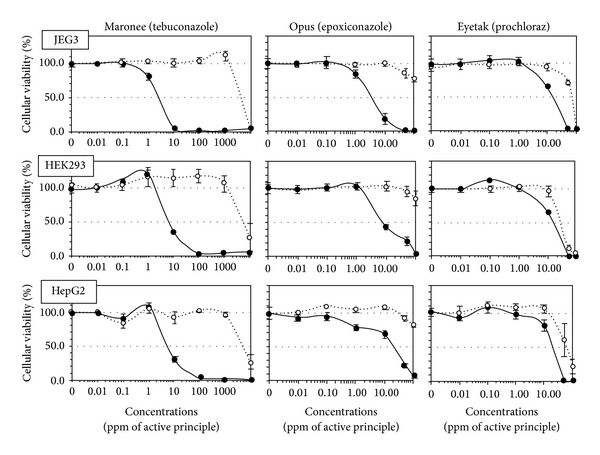
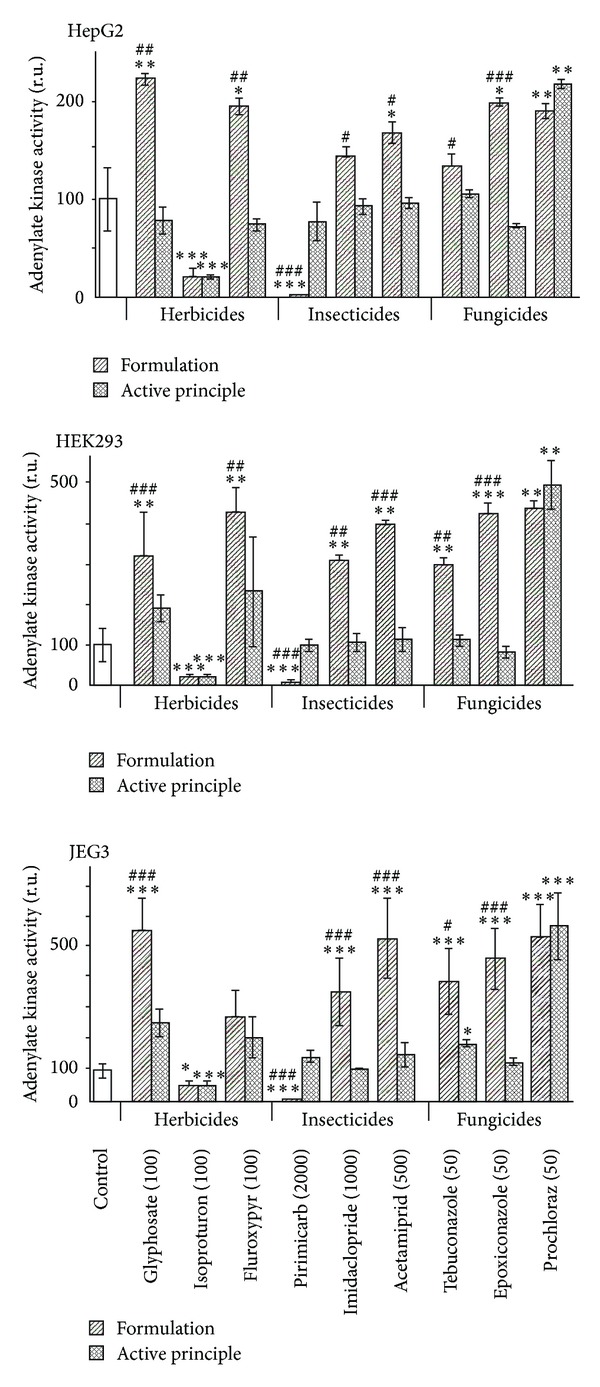
Verification
Claims the paper makes
The claims and statistics of this paper haven’t been checked yet.
Run the check — free, no account needed. It reads the open-access text and checks the sources it cites.
Claims other papers make about this one
Each is checked against this paper’s own text: does it say what the citing paper says it does?
In the citing paper
“In this regard, it is noteworthy that the far greater toxicity of full agricultural formulations compared to declared supposed active principles alone has recently been demonstrated also for six other major pesticides tested in vitro [22].”
From Republished study: long-term toxicity of a Roundup herbicide and a Roundup-tolerantgenetically modified maize (2014) · cites this paper as [22]
Self-check
Percentages, sums and reported differences re-computed from the paper’s own numbers.
The self-check needs the paper’s full text.
Citations
Cites
2 retracted
Williams, G. M., Kroes, R., & Munro, I. C. (2000) · Regulatory Toxicology and Pharmacology · doi:10.1006/rtph.1999.1371 · Cited by 864
RetractedSéralini, G.-E., Clair, E., Mesnage, R., Gress, S., Defarge, N., Malatesta, M., Hennequin, D., & de Vendômois, J. S. (2012) · Food and Chemical Toxicology · doi:10.1016/j.fct.2012.08.005 · Cited by 397 · cited 2×
“1 ppb of the formulation [2] and other toxicities that were not explained by a consideration of glyphosate alone [3-6].”
BackgroundSelf-citationRetractedNIH Image to ImageJ: 25 years of image analysis
Schneider, C. A., Rasband, W. S., & Eliceiri, K. W. (2012) · Nature Methods · doi:10.1038/nmeth.2089 · Cited by 64,638
Mosmann, T. (1983) · Journal of Immunological Methods · doi:10.1016/0022-1759(83)90303-4 · Cited by 56,104
Interaction of Estrogenic Chemicals and Phytoestrogens with Estrogen Receptor β
Kuiper, G. G. J. M., Lemmen, J. G., Carlsson, B., Corton, J. C., Safe, S. H., van der Saag, P. T., van der Burg, B., & Gustafsson, J.-Å. (1998) · Endocrinology · doi:10.1210/endo.139.10.6216 · Cited by 4,203
The use of ATP bioluminescence as a measure of cell proliferation and cytotoxicity
Crouch, S. P. M., Kozlowski, R., Slater, K. J., & Fletcher, J. (1993) · Journal of Immunological Methods · doi:10.1016/0022-1759(93)90011-u · Cited by 926
Glyphosate-based herbicides are toxic and endocrine disruptors in human cell lines
Gasnier, C., Dumont, C., Benachour, N., Clair, E., Chagnon, M.-C., & Séralini, G.-E. (2009) · Toxicology · doi:10.1016/j.tox.2009.06.006 · Cited by 658
Self-citationDifferential effects of glyphosate and roundup on human placental cells and aromatase
Richard, S., Moslemi, S., Sipahutar, H., Benachour, N., & Seralini, G.-E. (2005) · Environmental Health Perspectives · doi:10.1289/ehp.7728 · Cited by 619
Self-citationBenachour, N., & Séralini, G.-E. (2009) · Chemical Research in Toxicology · doi:10.1021/tx800218n · Cited by 428
Self-citationEthoxylated adjuvants of glyphosate-based herbicides are active principles of human cell toxicity
Mesnage, R., Bernay, B., & Séralini, G.-E. (2013) · Toxicology · doi:10.1016/j.tox.2012.09.006 · Cited by 424
Self-citationWalsh, L. P., McCormick, C., Martin, C. F., & Stocco, D. (2000) · Environmental Health Perspectives · doi:10.1289/ehp.00108769 · Cited by 341
Subchronic exposure of honeybees to sublethal doses of pesticides: Effects on behavior
Aliouane, Y., Hassani, A. K. E., Gary, V., Armengaud, C., Lambin, M., & Gauthier, M. (2008) · Environmental Toxicology and Chemistry · doi:10.1897/08-110.1 · Cited by 335
Late lessons from early warnings: science, precaution, innovation
Gee, D., Grandjean, P., Hansen, S. F., van denHove, S., MacGarvin, M., Martin, J., Nielsen, G., Quist, D., & Stanners, D. A. (2013) · Cited by 296
Bradberry, S., Proudfoot, A. T., & Vale, A. (2004) · Toxicological Reviews · doi:10.2165/00139709-200423030-00003 · Cited by 291
Time- and dose-dependent effects of Roundup on human embryonic and placental cells
Benachour, N., Sipahutar, H., Moslemi, S., Gasnier, C., Travert, C., & Séralini, G. E. (2007) · Archives of Environmental Contamination and Toxicology · doi:10.1007/s00244-006-0154-8 · Cited by 226
Self-citationWilliams, A. L., Watson, R. E., & DeSesso, J. M. (2011) · Journal of Toxicology and Environmental Health Part B · doi:10.1080/10937404.2012.632361 · Cited by 157
Székács, A., & Darvas, B. (2012) · InTech eBooks · doi:10.5772/32491 · Cited by 152
Xylene: its toxicity, measurement of exposure levels, absorption, metabolism and clearance
Langman, J. M. (1994) · Pathology · doi:10.1080/00313029400169711 · Cited by 101
A detailed study of developmental immunotoxicity of imidacloprid in Wistar rats
Gawade, L., Dadarkar, S. S., Husain, R., & Gatne, M. M. (2012) · Food and Chemical Toxicology · doi:10.1016/j.fct.2012.09.009 · Cited by 96
Developmental toxicity of N-methyl-2-pyrrolidone administered orally to rats
Saillenfait, A., Gallissot, F., Langonné, I., & Sabaté, J. (2002) · Food and Chemical Toxicology · doi:10.1016/s0278-6915(02)00115-1 · Cited by 86
Körting, H. C., Schindler, S., Hartinger, A., Kerscher, M., Angerpointner, T. A., & Maibach, H. I. (1994) · Life Sciences · doi:10.1016/0024-3205(94)00746-2 · Cited by 76
Vera-Candioti, J., Natale, G. S., Soloneski, S., Ronco, A. E., & Larramendy, M. L. (2009) · Chemosphere · doi:10.1016/j.chemosphere.2009.10.064 · Cited by 66
Letcher, R. J., van Holsteijn, I., Drenth, H., Norstrom, R. J., Bergman, Å., Safe, S. H., Pieters, R. H. H., & van den Berg, M. (1999) · Toxicology and Applied Pharmacology · doi:10.1006/taap.1999.8746 · Cited by 66
Liu, J. J., Wang, W., Dicker, D. T., & El‐Deiry, W. S. (2005) · Cancer Biology & Therapy · doi:10.4161/cbt.4.8.2133 · Cited by 58
Séralini, G., Mesnage, R., Defarge, N., Gress, S., Hennequin, D., Emilie Clair, A., Malatesta, M., & de Vendômois, J. S. (2012) · Food and Chemical Toxicology · doi:10.1016/j.fct.2012.11.007 · Cited by 56
Self-citationHuman-derived cell lines to study xenobiotic metabolism
Urani, C., Doldi, M., Crippa, S., & Camatini, M. (1998) · Chemosphere · doi:10.1016/s0045-6535(98)00321-x · Cited by 55
Bees, lies and evidence-based policy
Dicks, L. V. (2013) · Nature · doi:10.1038/494283a · Cited by 52
The oral and intratracheal toxicities of ROUNDUP and its components to rats.
Adam, A., Marzuki, A., Rahman, H. A., & Aziz, M. A. (1997) · PubMed · Cited by 49
In vitro endothelial cell susceptibility to xenobiotics: Comparison of three cell types
L'Azou, B., Fernandez, P., Bareille, R., Bénéteau, M., Bourget, C., Cambar, J., & Bordenave, L. (2005) · Cell Biology and Toxicology · doi:10.1007/s10565-005-0172-8 · Cited by 28
Krijt, J., van Holsteijn, I., Hassing, I., Vokurka, M., & Blaauboer, B. J. (1993) · Archives of Toxicology · doi:10.1007/bf01974344 · Cited by 27
Enhancement of paraquat toxicity by glutathione depletion in mice in vivo and in vitro.
Nakagawa, I., Suzuki, M., Imura, N., & NAGANUMA, A. (1995) · The Journal of Toxicological Sciences · doi:10.2131/jts.20.5_557 · Cited by 27
The Reproductive and Developmental Toxicity of High Flash Aromatic Naphtha
McKee, R. H., Wong, Z. A., Schmitt, S., Beatty, P. W., Swanson, M., Schreiner, C. A., & Schardein, J. L. (1990) · Toxicology and Industrial Health · doi:10.1177/074823379000600307 · Cited by 20
Influence of Irrigation Methods and an Adjuvant on the Persistence of Carbaryl on Pakchoi
Marutani, M., & Edirveerasingam, V. (2006) · Journal of Environmental Quality · doi:10.2134/jeq2005.0484 · Cited by 14
Ambrose, M. L. (2003) · NCSU Libraries Repository (North Carolina State University Libraries) · Cited by 11
Frijhoff, A. F. W., Krul, C. A. M., de Vries, A., KELDERS, M. C. J. M., Weeda, G., STEEG, H. V., & Baan, R. A. (1998) · Environmental and Molecular Mutagenesis · doi:10.1002/(sici)1098-2280(1998)31:1 · Cited by 6
Research works printed but not linked: 2
- 2013, Food and Chemical Toxicology, 53, 461
- 1997, Veterinary and Human Toxicology, 39, 147
Cited by
Sorted by citations
Environmental fate and exposure; neonicotinoids and fipronil
Bonmatin, J.-M., Giorio, C., Girolami, V., Goulson, D., Kreutzweiser, D. P., Krupke, C., Liess, M., Long, E., Marzaro, M., Mitchell, E. A. D., et al. (2015) · Environmental Science and Pollution Research · doi:10.1007/s11356-014-3332-7 · Cited by 1,372
Potential toxic effects of glyphosate and its commercial formulations below regulatory limits
Mesnage, R., Defarge, N., de Vendômois, J. S., & Séralini, G. (2015) · Food and Chemical Toxicology · doi:10.1016/j.fct.2015.08.012 · Cited by 536
Self-citationPesticides: formulants, distribution pathways and effects on human health – a review
Kalyabina, V. P., Esimbekova, E. N., Kopylova, K. V., & Kratasyuk, V. A. (2021) · Toxicology Reports · doi:10.1016/j.toxrep.2021.06.004 · Cited by 540
Biological control and integrated pest management in organic and conventional systems
Baker, B. P., Green, T. A., & Loker, A. J. (2019) · Biological Control · doi:10.1016/j.biocontrol.2019.104095 · Cited by 456
Natural carriers in bioremediation: A review
Dzionek, A., Wojcieszyńska, D., & Guzik, U. (2016) · Electronic Journal of Biotechnology · doi:10.1016/j.ejbt.2016.07.003 · Cited by 416
Metadata
- Authors
- Mesnage, R., Defarge, N., Spiroux de Vendômois, J., & Séralini, G.-E.
- Affiliations
- Centre National de la Recherche Scientifique (FR)
- CRIIGEN, 40 rue Monceau, 75008 Paris, France
- University of Caen, Institute of Biology, CRIIGEN and Network on Risks, Quality and Sustainable Environment MRSH-CNRS, Esplanade de la Paix, 14032 Caen Cedex, France
- Venue
- BioMed Research International
- Publisher
- Wiley
- Published
- 2014
- Volume
- 2014
- Pages
- 1-8
- ISSN
- 1110-7243 (ISSN-L)
- 2314-6133
- 2314-6141
- PMC
- PMC3955666
- OpenAlex
- W2022206707
- Cited by
- 342
- References
- 36
- Citations by year
- 2026: 13 · 2025: 19 · 2024: 18 · 2023: 27 · 2022: 35 · 2021: 39 · 2020: 41 · 2019: 45 · 2018: 33 · 2017: 22 · 2016: 19 · 2015: 22 · 2014: 9
- FWCI
- 27.87
- Type
- journal article
- Language
- en
- Open access
- hybrid
- doi.org
- Locations
- BioMed Research International (publishedVersion, cc-by)
- Europe PMC (PubMed Central) (publishedVersion, cc-by)
- PubMed Central (publishedVersion, cc-by)
- PubMed (publishedVersion)
- DOAJ (DOAJ: Directory of Open Access Journals) (submittedVersion, cc-by-sa)
- Topics
- Life Sciences › Pharmacology, Toxicology and Pharmaceutics › Toxicology › Pesticide Exposure and Toxicity
- Life Sciences › Agricultural and Biological Sciences › Food Science › Agricultural safety and regulations
- Physical Sciences › Environmental Science › Pollution › Pesticide and Herbicide Environmental Studies
- Keywords
- pesticide formulations, pesticide mixtures, active ingredients, adjuvants, herbicides, insecticides, fungicides, glyphosate, Roundup, isoproturon, fluroxypyr, pirimicarb, imidacloprid, acetamiprid, tebuconazole, epoxiconazole, prochloraz, cytotoxicity, mitochondrial activity, membrane degradation, caspase 3/7, acceptable daily intake, human cell lines, environmental exposure
- MeSH terms
- Cell Membrane, Dose-Response Relationship, Drug, Environmental Exposure, Humans, Mitochondria, Pesticides, Caspases, Hep G2 Cells, HEK293 Cells
About these checks
Registry, retraction, Cites and statistics results are computed, not judged, with one exception: a printed reference that no index lists is read once by a model before it counts as a citation error. Claims are extracted by a model and kept only when their quote appears verbatim in the text; each cited source is then checked, with a model’s help, for whether it says what the claim relies on. Those verdicts can be wrong — read the claim’s quote and the cited source before relying on one.
Statistics and arithmetic are recomputed, not judged.
Confidence bands are shown only for fields calibrated on our annotated test set. None is calibrated yet, so no band is shown.
What counts as a claim ›How we measure confidence ›How we check this ›
Are you an author, or do you see a problem with this page? Request a review
