

Navigating from a Depth Image Converted into Sound
Open accessThe DOI matches its Crossref record; 35 of the 35 references it cites were found in a registry or an index.
Abstract
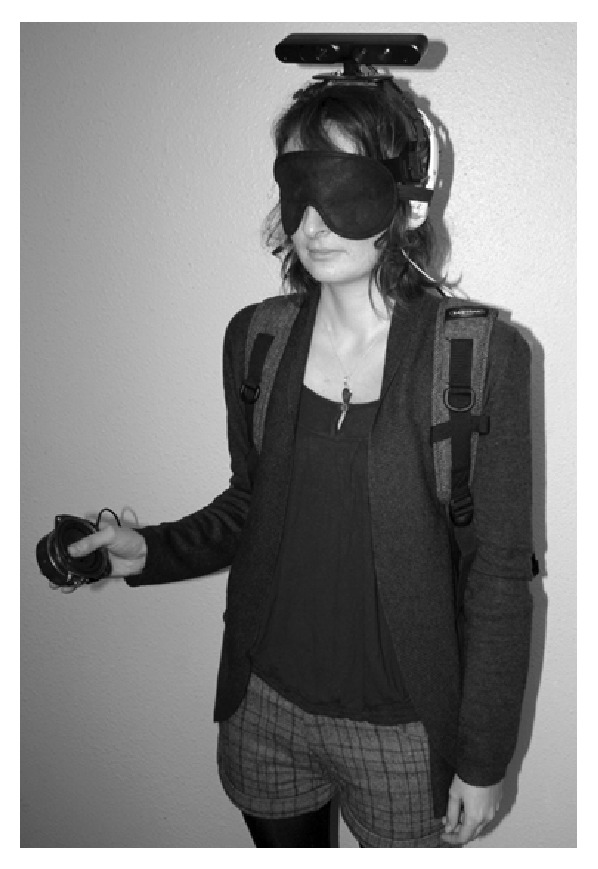
Background.Common manufactured depth sensors generate depth images that humans normally obtain from their eyes and hands. Various designs converting spatial data into sound have been recently proposed, speculating on their applicability as sensory substitution devices (SSDs).Objective.We tested such a design as a travel aid in a navigation task.Methods.Our portable device (MeloSee) converted 2D array of a depth image into melody in real-time. Distance from the sensor was translated into sound intensity, stereo-modulated laterally, and the pitch represented verticality. Twenty-one blindfolded young adults navigated along four different paths during two sessions separated by one-week interval. In some instances, a dual task required them to recognize a temporal pattern applied through a tactile vibrator while they navigated.Results.Participants learnt how to use the system on both new paths and on those they had already navigated from. Based on travel time and errors, performance improved from one week to the next. The dual task was achieved successfully, slightly affecting but not preventing effective navigation.Conclusions.The use of Kinect-type sensors to implement SSDs is promising, but it is restricted to indoor use and it is inefficient on too short range.
Overview
The claims and statistics of this paper haven’t been checked yet.
Free: it reads the open-access text and checks the first 5 claims that cite a source we can check. Create a free account to check every claim.
Integrity signals
Registry
Cites
Statistics
Figures


Verification
Claims the paper makes
The claims and statistics of this paper haven’t been checked yet.
Free: it reads the open-access text and checks the first 5 claims that cite a source we can check. Create a free account to check every claim.
Claims other papers make about this one
Each is checked against this paper’s own text: does it say what the citing paper says it does?
The cited source says what the claim attributes to it.
In the citing paper
“Behavioral studies on visual-auditory SSDs investigated the level of task performance to estimate the progress of visual perception in specific goal-related behaviors such as object recognition [2], localization [8], and navigation [9].”
From Deep Learning-Based Optimization of Visual–Auditory Sensory Substitution (2023) · cites this paper as [9]
Self-check
Percentages, sums and reported differences re-computed from the paper’s own numbers.
The self-check needs the paper’s full text.
Citations
Cites
Griffin, D. R., & Lindsay, R. B. (1958) · Medical Entomology and Zoology · Cited by 1,450
An experimental system for auditory image representations
Meijer, P. B. L. (1992) · IEEE Transactions on Biomedical Engineering · doi:10.1109/10.121642 · Cited by 900
Presence : teleoperators and virtual environments.
press, M. (2014) · Cited by 574
Representation of space in blind persons: vision as a spatial sense?
Thinus-Blanc, C., & Gaunet, F. (1997) · Psychological Bulletin · doi:10.1037/0033-2909.121.1.20 · Cited by 477
Navigation system for the blind: Auditory display modes and guidance
Loomis, J. M., Golledge, R. G., & Klatzky, R. L. (1998) · Presence: Teleoperators and Virtual Environments · doi:10.1162/105474698565677 · Cited by 366 · cited 1×
“Our results seem consistent with other studies [12, 18, 24] showing that sound can profitably convey information to navigate in an unknown environment, using either 2D light reflection (as with vision) or depth (as with echolocation) as a primary input.”
ResultStriem-Amit, E., Cohen, L., Dehaene, S., & Amedi, A. (2012) · Neuron · doi:10.1016/j.neuron.2012.08.026 · Cited by 294
Auvray, M., Hanneton, S., & O'Regan, J. K. (2007) · Perception · doi:10.1068/p5631 · Cited by 268
Navigation Assistance for the Visually Impaired Using RGB-D Sensor With Range Expansion
Aladren, A., Lopez-Nicolas, G., Puig, L., & Guerrero, J. J. (2016) · IEEE Systems Journal · doi:10.1109/jsyst.2014.2320639 · Cited by 231
Artificial vision: needs, functioning, and testing of a retinal electronic prosthesis
Chader, G. J., Weiland, J., & Humayun, M. S. (2009) · Progress in Brain Research · doi:10.1016/s0079-6123(09)17522-2 · Cited by 226
Tactile Sensory Substitution Studies
BACH‐Y‐RITA, P. (2004) · Annals of the New York Academy of Sciences · doi:10.1196/annals.1305.006 · Cited by 213
Research works printed but not linked: 1
- Lee Y. H. Medioni G. A RGB-D camera Based Navigation for the Visually Impaired, RSS 2011 RGB-D: Advanced Reasoning with Depth Camera Workshop Los Angeles, Calif, USA, June 2011
Cited by
Smart guiding glasses for visually impaired people in indoor environment
Bai, J., Lian, S., Liu, Z., Wang, K., & Liu, D. (2017) · IEEE Transactions on Consumer Electronics · doi:10.1109/tce.2017.014980 · Cited by 236
Spatial navigation by congenitally blind individuals
Schinazi, V. R., Thrash, T., & Chebat, D. (2016) · WIREs Cognitive Science · doi:10.1002/wcs.1375 · Cited by 227
A Kinect-Based Wearable Face Recognition System to Aid Visually Impaired Users
Neto, L. D. S. B., Grijalva, F., Maike, V. R. M. L., Martini, L. C., Florencio, D. A. F., Baranauskas, M. C. C., Rocha, A. D. R., & Goldenstein, S. K. (2016) · IEEE Transactions on Human-Machine Systems · doi:10.1109/thms.2016.2604367 · Cited by 122
Sensory Substitution and the Neural Correlates of Navigation in Blindness
Chebat, D., Harrar, V., Kupers, R. C., Maidenbaum, S., Amedi, A., & Ptito, M. (2017) · Springer eBooks · doi:10.1007/978-3-319-54446-5_6 · Cited by 101
Multisensory inclusive design with sensory substitution
Esenkaya, T., Lloyd‐Esenkaya, V., O'Neill, E. J., & Proulx, M. J. (2020) · Cognitive Research Principles and Implications · doi:10.1186/s41235-020-00240-7 · Cited by 94
A Navigation System for the Visually Impaired: A Fusion of Vision and Depth Sensor
Kanwal, N., Bostancı, E., Currie, K., & Clark, A. F. (2015) · Applied Bionics and Biomechanics · doi:10.1155/2015/479857 · Cited by 82
Spatial Competence and Brain Plasticity in Congenital Blindness via Sensory Substitution Devices
Chebat, D., Schneider, F., & Ptito, M. (2020) · Frontiers in Neuroscience · doi:10.3389/fnins.2020.00815 · Cited by 61
Enhanced Depth Navigation Through Augmented Reality Depth Mapping in Patients with Low Vision
Angelopoulos, A. N., Ameri, H., Mitra, D., & Humayun, M. S. (2019) · Scientific Reports · doi:10.1038/s41598-019-47397-w · Cited by 61
Kilian, J., Neugebauer, A., Scherffig, L., & Wahl, S. (2022) · Sensors · doi:10.3390/s22051859 · Cited by 59
AN OVERVIEW OF ASSISTIVE DEVICES FOR BLIND AND VISUALLY IMPAIRED PEOPLE
Hu, M., Chen, Y., Zhai, G., Gao, Z., & Fan, L. (2019) · International Journal of Robotics and Automation · doi:10.2316/j.2019.206-0302 · Cited by 56
Bouteraa, Y. (2021) · Micromachines · doi:10.3390/mi12091082 · Cited by 53
Smart real time wearable navigation support system for BVIP
Bouteraa, Y. (2022) · Alexandria Engineering Journal · doi:10.1016/j.aej.2022.06.060 · Cited by 34
Blind wayfinding with physically-based liquid sounds
Spagnol, S., Hoffmann, R., Martínez, M. H., & Unnþórsson, R. (2018) · International Journal of Human-Computer Studies · doi:10.1016/j.ijhcs.2018.02.002 · Cited by 27
Richardson, M., Thar, J., Alvarez, J., Borchers, J., Ward, J., & Hamilton-Fletcher, G. (2019) · Perception · doi:10.1177/0301006619873194 · Cited by 26
Improving Indoor Mobility of the Visually Impaired with Depth-Based Spatial Sound
Blessenohl, S., Morrison, C. P., Criminisi, A., & Shotton, J. (2015) · IEEE International Conference on Computer Vision Workshops · doi:10.1109/iccvw.2015.62 · Cited by 23
Bleau, M., Paré, S., Chebat, D., Kupers, R. C., Nemargut, J. P., & Ptito, M. (2022) · Frontiers in Neuroscience · doi:10.3389/fnins.2022.1010354 · Cited by 22
Spatial navigation with horizontally spatialized sounds in early and late blind individuals
Paré, S., Bleau, M., Djerourou, I., Malotaux, V., Kupers, R., & Ptito, M. (2021) · PLOS ONE · doi:10.1371/journal.pone.0247448 · Cited by 20
Deep video-to-video transformations for accessibility with an application to photosensitivity
Barbu, A., Banda, D., & Katz, B. (2019) · Pattern Recognition Letters · doi:10.1016/j.patrec.2019.01.019 · Cited by 19
Yao, F., Zhou, W., & Hu, H. (2025) · arXiv (Cornell University) · doi:10.48550/arxiv.2505.14298 · Cited by 18
Isaksson, J., Jansson, T. T., & Nilsson, J. (2020) · IEEE Transactions on Neural Systems and Rehabilitation Engineering · doi:10.1109/tnsre.2020.2985626 · Cited by 15
Chebat, D., Heimler, B., Hofsetter, S., & Amedi, A. (2018) · Contemporary clinical neuroscience · doi:10.1007/978-3-319-78926-2_13 · Cited by 15
Real Time Indoor 3D Pipeline for an Advanced Sensory Substitution Device
Morar, A., Moldoveanu, F., Petrescu, L., & Moldoveanu, A. D. B. (2017) · Lecture notes in computer science · doi:10.1007/978-3-319-68548-9_62 · Cited by 14
Spagnol, S., Baldan, S., & Unnþórsson, R. (2017) · IEEE International Workshop on Multimedia Signal Processing (MMSP) · doi:10.1109/mmsp.2017.8122220 · Cited by 13
Device for Acoustic Support of Orientation in the Surroundings for Blind People
Kubanek, M., & Bobulski, J. (2018) · Sensors · doi:10.3390/s18124309 · Cited by 13
Deep Learning-Based Optimization of Visual–Auditory Sensory Substitution
Kim, M., Park, Y., Moon, K., & Jeong, C. Y. (2023) · IEEE Access · doi:10.1109/access.2023.3243641 · Cited by 12
“Behavioral studies on visual–auditory SSDs investigated the level of task performance to estimate the progress of visual perception in specific goal-related behaviors such as object recognition [2], localization [8], and navigation [9].”
BackgroundEvaluation of Short-Range Depth Sonifications for Visual-to-Auditory Sensory Substitution
Commère, L., & Rouat, J. (2023) · IEEE Transactions on Human-Machine Systems · doi:10.1109/thms.2023.3265972 · Cited by 10
Maimon, A., Wald, I. Y., Snir, A., Oz, M. B., & Amedi, A. (2024) · PLoS ONE · doi:10.1371/journal.pone.0310033 · Cited by 10
Blind People Guidance System using Stereo Camera
Adi, I. P., Kusuma, H., & Attamimi, M. (2019) · International Seminar on Intelligent Technology and Its Applications · doi:10.1109/isitia.2019.8937173 · Cited by 10
Analysis and Validation of Cross-Modal Generative Adversarial Network for Sensory Substitution
Kim, M., Park, Y., Moon, K., & Jeong, C. Y. (2021) · International Journal of Environmental Research and Public Health · doi:10.3390/ijerph18126216 · Cited by 8
Can perception be extended to a “feel of north”? Tests of automaticity with the NaviEar
Witzel, C., Lübbert, A., O'Regan, J. K., Hanneton, S., & Schumann, F. (2022) · Adaptive Behavior · doi:10.1177/10597123221130235 · Cited by 8
Commère, L., Wood, S. U. N., & Rouat, J. (2020) · arXiv (Cornell University) · doi:10.48550/arxiv.2010.09041 · Cited by 5
Investigating techniques for gaining depth perception using visual-to-auditory sensory substitution*
de Klerk, J. C., Vogts, D., & Wesson, J. L. (2020) · South African Institute of Computer Scientists and Information Technologists · doi:10.1145/3410886.3410916 · Cited by 5
Prototyping and Evaluating Sensory Substitution Devices by Spatial Immersion in Virtual Environments
Guezou‐Philippe, A., Huet, S., Pellerin, D., & Graff, C. (2018) · International Joint Conference on Computer Vision, Imaging and Computer Graphics Theory and Applications (VISIGRAPP) · doi:10.5220/0006637705960602 · Cited by 4
Self-citationLearning visual to auditory sensory substitution reveals flexibility in image to sound mapping
Kucinkas, A., Retsa, C., Meijer, P. B. L., Wallace, M. T., Gori, M., & Murray, M. M. (2025) · npj Science of Learning · doi:10.1038/s41539-025-00385-4 · Cited by 3
Butorovа, A. S., & Sergeev, A. (2025) · The European Physical Journal Special Topics · doi:10.1140/epjs/s11734-025-01596-x · Cited by 3
Commère, L., & Rouat, J. (2022) · IEEE Transactions on Human-Machine Systems · doi:10.1109/thms.2022.3194715 · Cited by 3
Bordeau, C., Scalvini, F., Migniot, C., Dubois, J., & Ambard, M. (2025) · Attention Perception & Psychophysics · doi:10.3758/s13414-025-03065-y · Cited by 3
Almajdoub, R. A., & Siddiqui, M. A. (2024) · IEEE International Maghreb Meeting of the Conference on Sciences and Techniques of Automatic Control and Computer Engineering (MI-STA) · doi:10.1109/mi-sta61267.2024.10599717 · Cited by 3
A Multi-Platform Electronic Travel Aid Integrating Proxemic Sensing for the Visually Impaired
Naidoo, N., & Ghaziasgar, M. (2025) · Technologies · doi:10.3390/technologies13120550 · Cited by 3
Guo, X.-F., & Wang, S. (2020) · European Journal of Horticultural Science · doi:10.17660/ejhs.2020/85.6.2 · Cited by 1
Mono vs Stereo Modes of Visual-Auditory Sensory Substitution in Spatial Localization Task
Butorovа, A. S., Koryukin, E. A., Nurullina, N. I., Bobakov, V. S., & Sergeev, A. (2023) · International Conference Neurotechnologies and Neurointerfaces (CNN) · doi:10.1109/cnn59923.2023.10275142 · Cited by 1
Giroux, M. (2021) · theses.fr (ABES) · doi:10.70675/2cba0225z2f0fz47cdz84a6z797af8b4d1d2 · Cited by 1
Martolini, C. (2021) · CINECA IRIS Institutial Research Information System (University of Genoa) · doi:10.15167/martolini-chiara_phd2021-06-30 · Cited by 1
Jayashree, S., Jaswanthi, R., & Harshitha, S. (2021) · Advances in parallel computing · doi:10.3233/apc210058 · Cited by 1
Listen to Your Map: An Online Representation for Spatial SonificationPreprint
Wu, L., Jin, C. T., Uttsha, M. M., & Vidal‐Calleja, T. (2024) · arXiv (Cornell University) · doi:10.48550/arxiv.2412.05486 · Cited by 1
Manifold learning for spatial audio rendering
Arévalo, F. L. G. (2018) · doi:10.47749/t/unicamp.2018.1045122
Hippocampal Plasticity and Navigational Skills in Blindness
Bleau, M., Chebat, D., Schneider, F., & Ptito, M. (2025) · IntechOpen eBooks · doi:10.5772/intechopen.1011497
Akimoto, K., Fukawa, A., & Yairi, I. E. (2021) · Advances in intelligent systems and computing · doi:10.1007/978-3-030-73113-7_21
de Klerk, J. C. (2020) · Nelson Mandela University Research Repository
Ptito, M., & Chebat, D. (2026) · Directory of Open access Books (OAPEN Foundation)
Sensory Augmentation for the Visually Impaired - A Novel Navigation System.
Lyle, N. N. (2026) · University of the Western Cape Electronic Theses and Dissertations Repository (University of the Western Cape)
A Movement Guidance System for the Blind Using a Fuzzy Logic Controller
المجدوب, ر., شيبة, ع. ع., Almajdoub, R. A., & Shiba, O. A.-G. (2024) · Sebha University Conference Proceedings · doi:10.51984/sucp.v3i1.3525
Intelligent Blind Guide Assistance System Based on Large Language Model and Multi-Sensor
Wang, M., Liu, Y., Chen, M., Xiang, J., & Tang, S. (2026) · International Conference on Artificial Intelligence, Internet of Things and Cloud Computing Technology (AIoTC) · doi:10.1109/aiotc71250.2026.11689047
Metadata
- Authors
- Stoll, C., Palluel-Germain, R., Fristot, V., Pellerin, D., Alleysson, D., & Graff, C.
- Affiliations
- Centre National de la Recherche Scientifique (FR)
- GIPSA-Lab (FR)
- Corresponding author
- Graff, Christian
- Venue
- Applied Bionics and Biomechanics
- Publisher
- Wiley
- Published
- 2015
- Volume
- 2015
- Pages
- 1-9
- ISSN
- 1176-2322 (ISSN-L)
- 1754-2103
- PMC
- PMC4745448
- OpenAlex
- W1997819292
- Cited by
- 45
- References
- 33
- Citations by year
- 2026: 1 · 2025: 4 · 2024: 2 · 2023: 3 · 2022: 4 · 2021: 7 · 2020: 6 · 2019: 5 · 2018: 5 · 2017: 4 · 2016: 1 · 2015: 3
- FWCI
- 2.60
- Type
- journal article
- Language
- en
- Open access
- gold
- doi.org
- Locations
- Applied Bionics and Biomechanics (publishedVersion, cc-by)
- Europe PMC (PubMed Central) (publishedVersion, cc-by)
- PubMed Central (publishedVersion, cc-by)
- PubMed (publishedVersion)
- HAL (submittedVersion, other-oa)
- DOAJ (DOAJ: Directory of Open Access Journals) (submittedVersion)
- Funders
- French National Research Agency (ANR-12-JSH2-0008-01, ANR-11-LABX-0025)
- Labex (ANR-12-JSH2-0008-01, ANR-11-LABX-0025)
- Topics
- Life Sciences › Neuroscience › Cognitive Neuroscience › Tactile and Sensory Interactions
- Health Sciences › Health Professions › Occupational Therapy › Assistive Technology in Communication and Mobility
- Social Sciences › Psychology › Experimental and Cognitive Psychology › Spatial Cognition and Navigation
- Keywords
- sensory substitution devices, auditory navigation, depth sensors, Kinect sensor, dual-task performance, tactile feedback, travel aids
About these checks
Registry, retraction, Cites and statistics results are computed, not judged, with one exception: a printed reference that no index lists is read once by a model before it counts as a citation error. Claims are extracted by a model and kept only when their quote appears verbatim in the text; each cited source is then checked, with a model’s help, for whether it says what the claim relies on. Those verdicts can be wrong — read the claim’s quote and the cited source before relying on one.
Statistics and arithmetic are recomputed, not judged.
Confidence bands are shown only for fields calibrated on our annotated test set. None is calibrated yet, so no band is shown.
What counts as a claim ›How we measure confidence ›How we check this ›
Are you an author, or do you see a problem with this page? Request a review
Data sources
Bibliographic data: Semantic Scholar, OpenAlex, Crossref.
Contains information from the Semantic Scholar Academic Graph Datasets, made available under the ODC Attribution License (ODC-BY 1.0).
Semantic Scholar’s data is described in: Kinney, R., et al. (2023). The Semantic Scholar Open Data Platform. arXiv:2301.10140.
