

Navigating from a Depth Image Converted into Sound
Open accessThe DOI matches its Crossref record; 35 of the 35 references it cites were found in a registry or an index.
Abstract
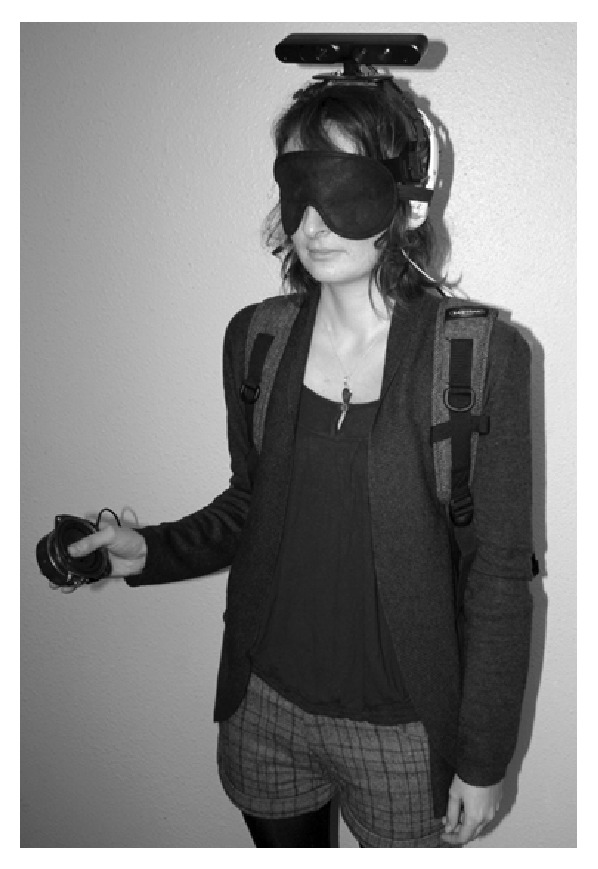
Background.Common manufactured depth sensors generate depth images that humans normally obtain from their eyes and hands. Various designs converting spatial data into sound have been recently proposed, speculating on their applicability as sensory substitution devices (SSDs).Objective.We tested such a design as a travel aid in a navigation task.Methods.Our portable device (MeloSee) converted 2D array of a depth image into melody in real-time. Distance from the sensor was translated into sound intensity, stereo-modulated laterally, and the pitch represented verticality. Twenty-one blindfolded young adults navigated along four different paths during two sessions separated by one-week interval. In some instances, a dual task required them to recognize a temporal pattern applied through a tactile vibrator while they navigated.Results.Participants learnt how to use the system on both new paths and on those they had already navigated from. Based on travel time and errors, performance improved from one week to the next. The dual task was achieved successfully, slightly affecting but not preventing effective navigation.Conclusions.The use of Kinect-type sensors to implement SSDs is promising, but it is restricted to indoor use and it is inefficient on too short range.
Overview
The claims and statistics of this paper haven’t been checked yet.
Free: it reads the open-access text and checks the first 5 claims that cite a source we can check. Create a free account to check every claim.
Integrity signals
Registry
Cites
Statistics
Figures


Verification
Claims the paper makes
The claims and statistics of this paper haven’t been checked yet.
Free: it reads the open-access text and checks the first 5 claims that cite a source we can check. Create a free account to check every claim.
Claims other papers make about this one
Each is checked against this paper’s own text: does it say what the citing paper says it does?
The cited source says what the claim attributes to it.
In the citing paper
“Behavioral studies on visual-auditory SSDs investigated the level of task performance to estimate the progress of visual perception in specific goal-related behaviors such as object recognition [2], localization [8], and navigation [9].”
From Deep Learning-Based Optimization of Visual–Auditory Sensory Substitution (2023) · cites this paper as [9]
Self-check
Percentages, sums and reported differences re-computed from the paper’s own numbers.
The self-check needs the paper’s full text.
Citations
Cites
Griffin, D. R., & Lindsay, R. B. (1958) · Medical Entomology and Zoology · Cited by 1,450
An experimental system for auditory image representations
Meijer, P. B. L. (1992) · IEEE Transactions on Biomedical Engineering · doi:10.1109/10.121642 · Cited by 900
Presence : teleoperators and virtual environments.
press, M. (2014) · Cited by 574
Representation of space in blind persons: vision as a spatial sense?
Thinus-Blanc, C., & Gaunet, F. (1997) · Psychological Bulletin · doi:10.1037/0033-2909.121.1.20 · Cited by 477
Navigation system for the blind: Auditory display modes and guidance
Loomis, J. M., Golledge, R. G., & Klatzky, R. L. (1998) · Presence: Teleoperators and Virtual Environments · doi:10.1162/105474698565677 · Cited by 366 · cited 1×
“Our results seem consistent with other studies [12, 18, 24] showing that sound can profitably convey information to navigate in an unknown environment, using either 2D light reflection (as with vision) or depth (as with echolocation) as a primary input.”
ResultStriem-Amit, E., Cohen, L., Dehaene, S., & Amedi, A. (2012) · Neuron · doi:10.1016/j.neuron.2012.08.026 · Cited by 294
Auvray, M., Hanneton, S., & O'Regan, J. K. (2007) · Perception · doi:10.1068/p5631 · Cited by 268
Navigation Assistance for the Visually Impaired Using RGB-D Sensor With Range Expansion
Aladren, A., Lopez-Nicolas, G., Puig, L., & Guerrero, J. J. (2016) · IEEE Systems Journal · doi:10.1109/jsyst.2014.2320639 · Cited by 231
Artificial vision: needs, functioning, and testing of a retinal electronic prosthesis
Chader, G. J., Weiland, J., & Humayun, M. S. (2009) · Progress in Brain Research · doi:10.1016/s0079-6123(09)17522-2 · Cited by 226
Tactile Sensory Substitution Studies
BACH‐Y‐RITA, P. (2004) · Annals of the New York Academy of Sciences · doi:10.1196/annals.1305.006 · Cited by 213
Capelle, C., Trullemans, C., Arno, P., & Veraart, C. (1998) · IEEE Transactions on Biomedical Engineering · doi:10.1109/10.720206 · Cited by 210
Kinect Depth Sensor Evaluation for Computer Vision Applications
Andersen, M. R., Jensen, T., Lisouski, P., Mortensen, A. K., Hansen, M. K., Gregersen, T., & Ahrendt, P. (2012) · Technical Report Electronics and Computer Engineering · doi:10.7146/ece.v1i6.21221 · Cited by 186
Navigating without Vision: Basic and Applied Research
LOOMIS, J. M., KLATZKY, R. L., & GOLLEDGE, A. R. G. (2001) · Optometry and Vision Science · doi:10.1097/00006324-200105000-00011 · Cited by 156
Loomis, J. M., Marston, J. R., Golledge, R. G., & Klatzky, R. L. (2005) · Journal of Visual Impairment & Blindness · doi:10.1177/0145482x0509900404 · Cited by 156 · cited 1×
“[10, 11] also developed a Personal Guidance System to improve navigation without vision.”
BackgroundCognitive load of navigating without vision when guided by virtual sound versus spatial language.
Klatzky, R. L., Marston, J. R., Giudice, N. A., Golledge, R. G., & Loomis, J. M. (2006) · Journal of Experimental Psychology: Applied · doi:10.1037/1076-898x.12.4.223 · Cited by 137
Loomis, J. M., Marston, J. R., Golledge, R. G., et al. (2018) · PubMed · doi:10.1184/r1/6617567 · Cited by 125
‘Visual’ Acuity of the Congenitally Blind Using Visual-to-Auditory Sensory Substitution
Striem-Amit, E., Guendelman, M., & Amedi, A. (2012) · PLoS ONE · doi:10.1371/journal.pone.0033136 · Cited by 117 · cited 1×
“More impressively, after only 70 hours of training, congenitally blind people passed the blindness acuity test of the World Health Organization [9].”
BackgroundA Depth-Based Head-Mounted Visual Display to Aid Navigation in Partially Sighted Individuals
Hicks, S. L., Wilson, I., Muhammed, L., Worsfold, J., Downes, S. M., & Kennard, C. (2013) · PLoS ONE · doi:10.1371/journal.pone.0067695 · Cited by 110
Kolarik, A. J., Cirstea, S., & Pardhan, S. (2012) · Experimental Brain Research · doi:10.1007/s00221-012-3340-0 · Cited by 91
González–Mora, J. L., Rodríguez-Hernández, A. F., Rodríguez-Ramos, L. F., Díaz-Saco, L., & Sosa, N. A. (1999) · Lecture notes in computer science · doi:10.1007/bfb0100499 · Cited by 88
Supporting blind navigation using depth sensing and sonification
Brock, M., & Kristensson, P. O. (2013) · Proceedings of the 2013 ACM conference on Pervasive and ubiquitous computing adjunct publication · doi:10.1145/2494091.2494173 · Cited by 79
Cronly-Dillon, J., Persaud, K., & Gregory, R. P. F. (1999) · Proceedings of the Royal Society of London. Series B: Biological Sciences · doi:10.1098/rspb.1999.0942 · Cited by 76
Auditory augmented reality: Object sonification for the visually impaired
Ribeiro, F., Florencio, D., Chou, P. A., & Zhang, Z. (2012) · 2012 IEEE 14th International Workshop on Multimedia Signal Processing (MMSP) · doi:10.1109/mmsp.2012.6343462 · Cited by 75
Wearable RGBD Indoor Navigation System for the Blind
Lee, Y. H., & Medioni, G. (2015) · Lecture notes in computer science · doi:10.1007/978-3-319-16199-0_35 · Cited by 74
Dowling, J. (2005) · Expert Review of Medical Devices · doi:10.1586/17434440.2.1.73 · Cited by 58
The Vibe: A Versatile Vision‐to‐Audition Sensory Substitution Device
Hanneton, S., Auvray, M., & Durette, B. (2010) · Applied Bionics and Biomechanics · doi:10.1080/11762322.2010.512734 · Cited by 57
Transforming 3D Coloured Pixels into Musical Instrument Notes for Vision Substitution Applications
Bologna, G., Deville, B., Pun, T., & Vinckenbosch, M. (2007) · EURASIP Journal on Image and Video Processing · doi:10.1155/2007/76204 · Cited by 42
Auditory Perception of Submerged Objects by Porpoises
Kellogg, W. N. (1959) · The Journal of the Acoustical Society of America · doi:10.1121/1.1907606 · Cited by 35
Nau, A. C., Pintar, C., Fisher, C., Jeong, J., & Jeong, K. (2014) · Journal of Visualized Experiments · doi:10.3791/51205 · Cited by 33
Segment and Label Indoor Scene Based on RGB-D for the Visually Impaired
Wang, Z., Liu, H., Wang, X., & Qian, Y. (2014) · Lecture notes in computer science · doi:10.1007/978-3-319-04114-8_38 · Cited by 24
Immersion et perception spatiale : l'exemple des dispositifs de substitution sensorielle
Auvray, M. (2004) · Cited by 8
Fristot, V., Boucheteil, J., Granjon, L., Pellerin, D., & Alleysson, D. (2012) · HAL · Cited by 6
Self-citationGeometric Fuzzy Techniques for Guidance of Visually Impaired People
Landa-Hernández, A., Casarubias-Vargas, H., & Bayro-Corrochano, E. J. (2013) · Applied Bionics and Biomechanics · doi:10.1155/2013/539521 · Cited by 3
Geometric Fuzzy Techniques for Guidance of Visually Impaired People
Landa-Hernández, A., Casarubias-Vargas, H., & Bayro-Corrochano, E. J. (2013) · DOAJ (DOAJ: Directory of Open Access Journals) · doi:10.3233/abb-140081 · Cited by 2
USING THE BRAINPORT FOR INDEPENDENT TRAVEL AND OBSTACLE AVOIDANCE
Kaiser, J. (2014) · D-Scholarship@Pitt (University of Pittsburgh) · Cited by 2
Cited by
Spatial navigation by congenitally blind individuals
Schinazi, V. R., Thrash, T., & Chebat, D. (2016) · WIREs Cognitive Science · doi:10.1002/wcs.1375 · Cited by 227
Spatial navigation with horizontally spatialized sounds in early and late blind individuals
Paré, S., Bleau, M., Djerourou, I., Malotaux, V., Kupers, R., & Ptito, M. (2021) · PLOS ONE · doi:10.1371/journal.pone.0247448 · Cited by 20
Deep Learning-Based Optimization of Visual–Auditory Sensory Substitution
Kim, M., Park, Y., Moon, K., & Jeong, C. Y. (2023) · IEEE Access · doi:10.1109/access.2023.3243641 · Cited by 12
“Behavioral studies on visual–auditory SSDs investigated the level of task performance to estimate the progress of visual perception in specific goal-related behaviors such as object recognition [2], localization [8], and navigation [9].”
BackgroundAnalysis and Validation of Cross-Modal Generative Adversarial Network for Sensory Substitution
Kim, M., Park, Y., Moon, K., & Jeong, C. Y. (2021) · International Journal of Environmental Research and Public Health · doi:10.3390/ijerph18126216 · Cited by 8
Metadata
- Authors
- Stoll, C., Palluel-Germain, R., Fristot, V., Pellerin, D., Alleysson, D., & Graff, C.
- Affiliations
- Centre National de la Recherche Scientifique (FR)
- GIPSA-Lab (FR)
- Corresponding author
- Graff, Christian
- Venue
- Applied Bionics and Biomechanics
- Publisher
- Wiley
- Published
- 2015
- Volume
- 2015
- Pages
- 1-9
- ISSN
- 1176-2322 (ISSN-L)
- 1754-2103
- PMC
- PMC4745448
- OpenAlex
- W1997819292
- Cited by
- 45
- References
- 35
- Citations by year
- 2026: 1 · 2025: 4 · 2024: 2 · 2023: 3 · 2022: 4 · 2021: 7 · 2020: 6 · 2019: 5 · 2018: 5 · 2017: 4 · 2016: 1 · 2015: 3
- FWCI
- 2.60
- Type
- journal article
- Language
- en
- Open access
- gold
- doi.org
- Locations
- Applied Bionics and Biomechanics (publishedVersion, cc-by)
- Europe PMC (PubMed Central) (publishedVersion, cc-by)
- PubMed Central (publishedVersion, cc-by)
- PubMed (publishedVersion)
- HAL (submittedVersion, other-oa)
- DOAJ (DOAJ: Directory of Open Access Journals) (submittedVersion)
- Funders
- French National Research Agency (ANR-12-JSH2-0008-01, ANR-11-LABX-0025)
- Labex (ANR-12-JSH2-0008-01, ANR-11-LABX-0025)
- Topics
- Life Sciences › Neuroscience › Cognitive Neuroscience › Tactile and Sensory Interactions
- Health Sciences › Health Professions › Occupational Therapy › Assistive Technology in Communication and Mobility
- Social Sciences › Psychology › Experimental and Cognitive Psychology › Spatial Cognition and Navigation
- Keywords
- sensory substitution devices, auditory navigation, depth sensors, Kinect sensor, dual-task performance, tactile feedback, travel aids
About these checks
Registry, retraction, Cites and statistics results are computed, not judged, with one exception: a printed reference that no index lists is read once by a model before it counts as a citation error. Claims are extracted by a model and kept only when their quote appears verbatim in the text; each cited source is then checked, with a model’s help, for whether it says what the claim relies on. Those verdicts can be wrong — read the claim’s quote and the cited source before relying on one.
Statistics and arithmetic are recomputed, not judged.
Confidence bands are shown only for fields calibrated on our annotated test set. None is calibrated yet, so no band is shown.
What counts as a claim ›How we measure confidence ›How we check this ›
Are you an author, or do you see a problem with this page? Request a review
Data sources
Bibliographic data: Semantic Scholar, OpenAlex, Crossref.
Contains information from the Semantic Scholar Academic Graph Datasets, made available under the ODC Attribution License (ODC-BY 1.0).
Semantic Scholar’s data is described in: Kinney, R., et al. (2023). The Semantic Scholar Open Data Platform. arXiv:2301.10140.
