

Vision-Based Fall Detection with Convolutional Neural Networks
Open accessThe DOI matches its Crossref record; 38 of the 38 references it cites were found in a registry or an index.
Abstract
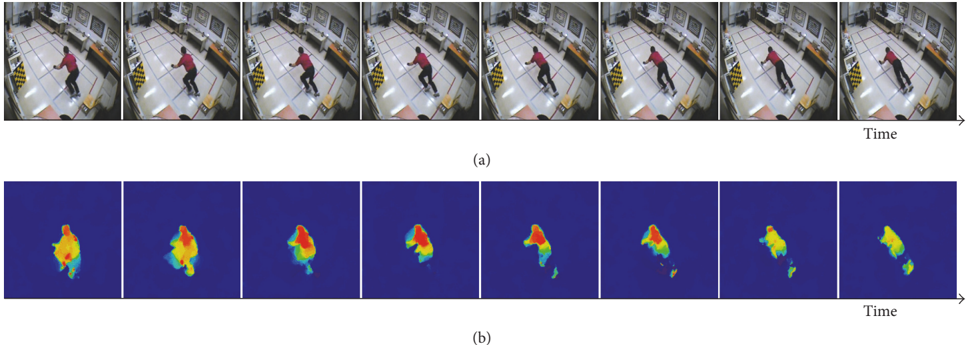
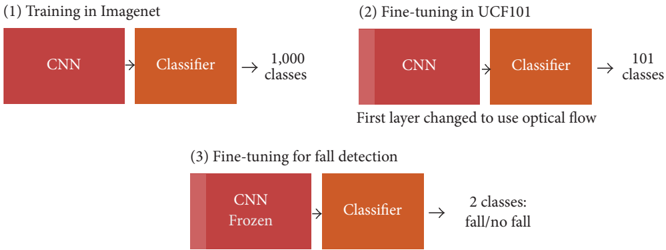
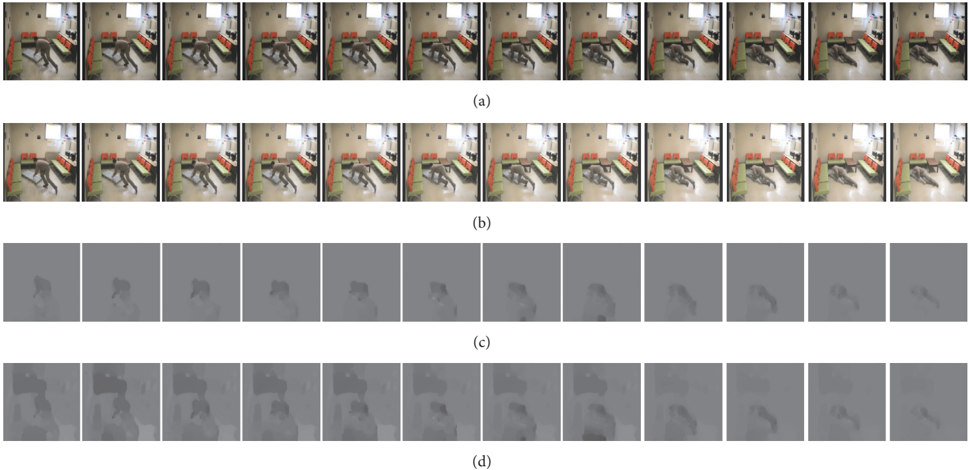
One of the biggest challenges in modern societies is the improvement of healthy aging and the support to older persons in their daily activities. In particular, given its social and economic impact, the automatic detection of falls has attracted considerable attention in the computer vision and pattern recognition communities. Although the approaches based on wearable sensors have provided high detection rates, some of the potential users are reluctant to wear them and thus their use is not yet normalized. As a consequence, alternative approaches such as vision-based methods have emerged. We firmly believe that the irruption of the Smart Environments and the Internet of Things paradigms, together with the increasing number of cameras in our daily environment, forms an optimal context for vision-based systems. Consequently, here we propose a vision-based solution using Convolutional Neural Networks to decide if a sequence of frames contains a person falling. To model the video motion and make the system scenario independent, we use optical flow images as input to the networks followed by a novel three-step training phase. Furthermore, our method is evaluated in three public datasets achieving the state-of-the-art results in all three of them.
Overview
The claims and statistics of this paper haven’t been checked yet.
Free: it reads the open-access text and checks the first 5 claims that cite a source we can check. Create a free account to check every claim.
Integrity signals
Registry
Cites
Statistics
Figures



















Verification
Claims the paper makes
The claims and statistics of this paper haven’t been checked yet.
Free: it reads the open-access text and checks the first 5 claims that cite a source we can check. Create a free account to check every claim.
Claims other papers make about this one
Each is checked against this paper’s own text: does it say what the citing paper says it does?
In the citing paper
“For instance, it could enable at-risk seniors to live independently at home, by monitoring for safety and abnormalities in daily activities (e.g.detecting falls, which are particularly dangerous for the elderly 134,135 ), assisted living, and physiological measurement.”
From Deep learning-enabled medical computer vision (2021) · cites this paper as [135]
Self-check
Percentages, sums and reported differences re-computed from the paper’s own numbers.
The self-check needs the paper’s full text.
Citations
Cites
Deep Residual Learning for Image Recognition
He, K., Zhang, X., Ren, S., & Sun, J. (2016) · 2016 IEEE Conference on Computer Vision and Pattern Recognition (CVPR) · doi:10.1109/cvpr.2016.90 · Cited by 235,474
Very Deep Convolutional Networks for Large-Scale Image Recognition
Simonyan, K., & Zisserman, A. (2014) · arXiv · doi:10.48550/arxiv.1409.1556 · Cited by 114,148
LeCun, Y., Bengio, Y., & Hinton, G. (2015) · Nature · doi:10.1038/nature14539 · Cited by 84,126
ImageNet: A large-scale hierarchical image database
Deng, J., Dong, W., Socher, R., Li, L.-J., Li, K., & Fei-Fei, L. (2009) · 2009 IEEE Conference on Computer Vision and Pattern Recognition · doi:10.1109/cvpr.2009.5206848 · Cited by 65,333
(2014) · Cited by 33,419
Batch Normalization: Accelerating Deep Network Training by Reducing Internal Covariate Shift
Ioffe, S. (2024) · arXiv (Cornell University) · doi:10.57702/o9raffed · Cited by 14,214
Fast and Accurate Deep Network Learning by Exponential Linear Units (ELUs)
Clevert, D.-A., Unterthiner, T., & Hochreiter, S. (2015) · arXiv · doi:10.48550/arxiv.1511.07289 · Cited by 4,513 · cited 9×
“In any case, we can assume that ELU is not as reliable as the combination of ReLU and Batch Normalization which, following our experiments, shows a more stable behavior.”
MethodInfluentialTemporal Segment Networks: Towards Good Practices for Deep Action Recognition
Wang, L., Xiong, Y., Wang, Z., Qiao, Y., Lin, D., Tang, X., & Van Gool, L. (2016) · Lecture Notes in Computer Science · doi:10.1007/978-3-319-46484-8_2 · Cited by 3,958
Perception of the Visual World
(1952) · Archives of Ophthalmology · doi:10.1001/archopht.1952.01700030123016 · Cited by 3,732
Caragliu, A., Del Bo, C., & Nijkamp, P. (2011) · Journal of Urban Technology · doi:10.1080/10630732.2011.601117 · Cited by 3,409
Learning and Transferring Mid-level Image Representations Using Convolutional Neural Networks
Oquab, M., Bottou, L., Laptev, I., & Sivic, J. (2014) · 2014 IEEE Conference on Computer Vision and Pattern Recognition · doi:10.1109/cvpr.2014.222 · Cited by 3,150 · cited 1×
“In such cases, transfer learning has shown to be a suitable solution [41].”
BackgroundRegion-based convolutional networks for accurate object detection and segmentation
Girshick, R., Donahue, J., Darrell, T., & Malik, J. (2016) · IEEE Transactions on Pattern Analysis and Machine Intelligence · doi:10.1109/tpami.2015.2437384 · Cited by 2,912
Risk factors for falls among older adults: A review of the literature
Ambrose, A. F., Paul, G., & Hausdorff, J. M. (2013) · Maturitas · doi:10.1016/j.maturitas.2013.02.009 · Cited by 1,888
PCANet: A Simple Deep Learning Baseline for Image Classification?
Chan, T.-H., Jia, K., Gao, S., Lu, J., Zeng, Z., & Ma, Y. (2015) · IEEE Transactions on Image Processing · doi:10.1109/tip.2015.2475625 · Cited by 1,362
The computation of optical flow
Beauchemin, S. S., & Barron, J. L. (1995) · ACM Computing Surveys · doi:10.1145/212094.212141 · Cited by 1,278
Sensor-Based Activity Recognition
Chen, L., Hoey, J., Nugent, C. D., Cook, D. J., & Yu, Z. (2012) · IEEE Transactions on Systems, Man, and Cybernetics, Part C (Applications and Reviews) · doi:10.1109/tsmcc.2012.2198883 · Cited by 1,074
A survey on fall detection: Principles and approaches
Mubashir, M., Shao, L., & Seed, L. (2013) · Neurocomputing · doi:10.1016/j.neucom.2011.09.037 · Cited by 869
Human fall detection on embedded platform using depth maps and wireless accelerometer
Kwolek, B., & Kepski, M. (2014) · Computer Methods and Programs in Biomedicine · doi:10.1016/j.cmpb.2014.09.005 · Cited by 650 · cited 2×
“Kwolek and Kepski [12] applied an Inertial Measurement Unit (IMU) combined with the depth maps obtained from a Kinect camera.”
MethodGoing deeper into action recognition: A survey
Herath, S., Harandi, M., & Porikli, F. (2017) · Image and Vision Computing · doi:10.1016/j.imavis.2017.01.010 · Cited by 634
The Perception of Visual Surfaces
Gibson, J. J. (1950) · The American Journal of Psychology · doi:10.2307/1418003 · Cited by 591
Robust Video Surveillance for Fall Detection Based on Human Shape Deformation
Rougier, C., Meunier, J., St-Arnaud, A., & Rousseau, J. (2011) · IEEE Transactions on Circuits and Systems for Video Technology · doi:10.1109/tcsvt.2011.2129370 · Cited by 490
Theory of the backpropagation neural network
Hecht-Nielsen, R. (1988) · Neural Networks · doi:10.1016/0893-6080(88)90469-8 · Cited by 472
Fall detection system using Kinect’s infrared sensor
Mastorakis, G., & Makris, D. (2014) · Journal of Real-Time Image Processing · doi:10.1007/s11554-012-0246-9 · Cited by 356
Davis, J. C., Robertson, M. C., Ashe, M. C., Liu-Ambrose, T., Khan, K. M., & Marra, C. A. (2010) · Osteoporosis International · doi:10.1007/s00198-009-1162-0 · Cited by 311
Auvinet, E., Multon, F., Saint-Arnaud, A., Rousseau, J., & Meunier, J. (2011) · IEEE Transactions on Information Technology in Biomedicine · doi:10.1109/titb.2010.2087385 · Cited by 256
A Customized Human Fall Detection System Using Omni-Camera Images and Personal Information
Miaou, S.-G., Sung, P.-H., & Huang, C.-Y. (2006) · 1st Transdisciplinary Conference on Distributed Diagnosis and Home Healthcare, 2006. D2H2. · doi:10.1109/ddhh.2006.1624792 · Cited by 253
Lee, T., & Mihailidis, A. (2005) · Journal of Telemedicine and Telecare · doi:10.1258/1357633054068946 · Cited by 237
A fall detection system using k-nearest neighbor classifier
Liu, C.-L., Lee, C.-H., & Lin, P.-M. (2010) · Expert Systems with Applications · doi:10.1016/j.eswa.2010.04.014 · Cited by 203
A Depth-Based Fall Detection System Using a Kinect® Sensor
Gasparrini, S., Cippitelli, E., Spinsante, S., & Gambi, E. (2014) · Sensors · doi:10.3390/s140202756 · Cited by 199
An active vision system for fall detection and posture recognition in elderly healthcare
Diraco, G., Leone, A., & Siciliano, P. A. (2010) · Design, Automation, and Test in Europe · doi:10.1109/date.2010.5457055 · Cited by 153
Human fall detection in surveillance video based on PCANet
Wang, S., Chen, L., Zhou, Z., Sun, X., & Dong, J. (2016) · Multimedia Tools and Applications · doi:10.1007/s11042-015-2698-y · Cited by 132
Introducing the use of depth data for fall detection
Planinc, R., & Kampel, M. (2012) · Personal and Ubiquitous Computing · doi:10.1007/s00779-012-0552-z · Cited by 105
Combined curvelets and hidden Markov models for human fall detection
Zerrouki, N., & Houacine, A. (2017) · Multimedia Tools and Applications · doi:10.1007/s11042-017-4549-5 · Cited by 74
Automatic fall detection of human in video using combination of features
Wang, K., Cao, G., Meng, D., Chen, W., & Cao, W. (2016) · IEEE International Conference on Bioinformatics and Biomedicine (BIBM) · doi:10.1109/bibm.2016.7822694 · Cited by 54
Fall detection using supervised machine learning algorithms: A comparative study
Zerrouki, N., Harrou, F., Houacine, A., & Sun, Y. (2016) · International Conference on Modelling, Identification and Control · doi:10.1109/icmic.2016.7804195 · Cited by 44
A simple strategy for fall events detection
Harrou, F., Zerrouki, N., Sun, Y., & Houacine, A. (2016) · IEEE International Conference on Industrial Informatics (INDIN) · doi:10.1109/indin.2016.7819182 · Cited by 13
Rectified factor networks for biclustering of omics data
Clevert, D.-A., Unterthiner, T., Povysil, G., & Hochreiter, S. (2017) · Bioinformatics · doi:10.1093/bioinformatics/btx226 · Cited by 11
Statistical control chart and neural network classification for improving human fall detection
Harrou, F., Zerrouki, N., Sun, Y., & Houacine, A. (2016) · International Conference on Modelling, Identification and Control · doi:10.1109/icmic.2016.7804269 · Cited by 10
Research works printed but not linked: 8
- M. Vallejo, C. V. Isaza, and J. D. Lopez, "Artificial Neural Net- works as an alternative to traditional fall detection methods, " in Proceedings of the 2013 35th Annual International Conference of the IEEE Engineering in Medicine and Biology Society, EMBC 2013, pp. 1648-1651, Japan, July 2013.
- A. Sengto and T. Leauhatong, "Human falling detection algo- rithm using back propagation neural network, " in Proceedings of the 5th 2012 Biomedical Engineering International Conference, BMEiCON 2012, Thailand, December 2012.
- I. Charfi, J. Miteran, J. Dubois, M. Atri, and R. Tourki, "Def- inition and performance evaluation of a robust SVM based fall detection solution, " in Proceedings of the 8th International Conference on Signal Image Technology and Internet Based Systems, SITIS 2012, pp. 218-224, Italy, November 2012.
- V. Vishwakarma, C. Mandal, and S. Sural, in Pattern Recognition and Machine Intelligence, Automatic detection of human fall in video, Ed., pp. 616-623, 2007.
- Y. Jia, E. Shelhamer, J. Donahue et al., "Caffe: convolutional architecture for fast feature embedding, " in Proceedings of the ACM International Conference on Multimedia, pp. 675-678, ACM, Orlando, Fla, USA, November 2014.
- F. A. Hamprecht, C. Schnörr, and B. Jähne, ""A duality based approach for realtime TV-L 1 optical flow, " in Pattern Recogni- tion, pp. 214-223, 2007.
- A. Krizhevsky, I. Sutskever, and G. E. Hinton, "Imagenet classifi- cation with deep convolutional neural networks, " in Proceedings of the 26th Annual Conference on Neural Information Processing Systems (NIPS '12), pp. 1097-1105, Lake Tahoe, Nev, USA, December 2012.
- K. Simonyan and A. Zisserman, "Two-stream convolutional networks for action recognition in videos, " in Proceedings of the 28th Annual Conference on Neural Information Processing Sys- tems 2014, NIPS 2014, pp. 568-576, can, December 2014.
Cited by
Deep learning-enabled medical computer vision
Esteva, A., Chou, K., Yeung, S., Naik, N., Madani, A., Mottaghi, A., Liu, Y., Topol, E., Dean, J., & Socher, R. (2021) · npj Digital Medicine · doi:10.1038/s41746-020-00376-2 · Cited by 1,406
UP-Fall Detection Dataset: A Multimodal Approach
Martínez-Villaseñor, L., Ponce, H., Brieva, J., Moya-Albor, E., Núñez-Martínez, J., & Peñafort-Asturiano, C. (2019) · Sensors · doi:10.3390/s19091988 · Cited by 403
Deep Learning for Fall Detection: Three-Dimensional CNN Combined With LSTM on Video Kinematic Data
Lu, N., Wu, Y., Feng, L., & Song, J. (2019) · IEEE Journal of Biomedical and Health Informatics · doi:10.1109/jbhi.2018.2808281 · Cited by 339
Sensor Technologies for Fall Detection Systems: A Review
Singh, A., Rehman, S. U., Yongchareon, S., & Chong, P. H. J. (2020) · IEEE Sensors Journal · doi:10.1109/jsen.2020.2976554 · Cited by 178
Fall Detection and Activity Recognition Using Human Skeleton Features
Ramirez, H., Velastin, S. A., Meza, I., Fabregas, E., Makris, D., & Farias, G. (2021) · IEEE Access · doi:10.1109/access.2021.3061626 · Cited by 175
Metadata
- Authors
- Núñez-Marcos, A., Azkune, G., & Arganda-Carreras, I.
- Affiliations
- Universidad de Deusto (ES)
- Department of Computer Science and Artificial Intelligence, Basque Country University, P. Manuel Lardizabal 1, 20018 San Sebastian, Spain
- Corresponding author
- Núñez-Marcos, Adrián
- Venue
- Wireless Communications and Mobile Computing
- Publisher
- Wiley
- Published
- 2017
- Volume
- 2017
- Pages
- 1-16
- ISSN
- 1530-8669 (ISSN-L)
- 1530-8677
- OpenAlex
- W2772973030
- Cited by
- 282
- References
- 38
- Citations by year
- 2026: 14 · 2025: 30 · 2024: 30 · 2023: 35 · 2022: 58 · 2021: 40 · 2020: 43 · 2019: 25 · 2018: 7
- FWCI
- 8.52
- Type
- journal article
- Language
- en
- Open access
- hybrid
- doi.org
- Locations
- Wireless Communications and Mobile Computing (publishedVersion, cc-by)
- DOAJ (DOAJ: Directory of Open Access Journals) (submittedVersion, cc-by-sa)
- Funders
- Basque Government’s Department of Education
- Topics
- Physical Sciences › Computer Science › Computer Vision and Pattern Recognition › Context-Aware Activity Recognition Systems
- Physical Sciences › Computer Science › Computer Vision and Pattern Recognition › Human Pose and Action Recognition
- Health Sciences › Health Professions › Physical Therapy, Sports Therapy and Rehabilitation › Balance, Gait, and Falls Prevention
- Keywords
- fall detection, vision-based monitoring, convolutional neural networks, optical flow, older adults, healthy aging, smart environments, Internet of Things
About these checks
Registry, retraction, Cites and statistics results are computed, not judged, with one exception: a printed reference that no index lists is read once by a model before it counts as a citation error. Claims are extracted by a model and kept only when their quote appears verbatim in the text; each cited source is then checked, with a model’s help, for whether it says what the claim relies on. Those verdicts can be wrong — read the claim’s quote and the cited source before relying on one.
Statistics and arithmetic are recomputed, not judged.
Confidence bands are shown only for fields calibrated on our annotated test set. None is calibrated yet, so no band is shown.
What counts as a claim ›How we measure confidence ›How we check this ›
Are you an author, or do you see a problem with this page? Request a review
Data sources
Bibliographic data: Semantic Scholar, OpenAlex, Crossref.
Contains information from the Semantic Scholar Academic Graph Datasets, made available under the ODC Attribution License (ODC-BY 1.0).
Semantic Scholar’s data is described in: Kinney, R., et al. (2023). The Semantic Scholar Open Data Platform. arXiv:2301.10140.
