

The DOI matches its Crossref record; 48 of the 48 references it cites were found in a registry or an index.
Degradation of the Reactive Blue 4 Dye in Aqueous Solution Using Zero-Valent Copper Nanoparticles
Abstract
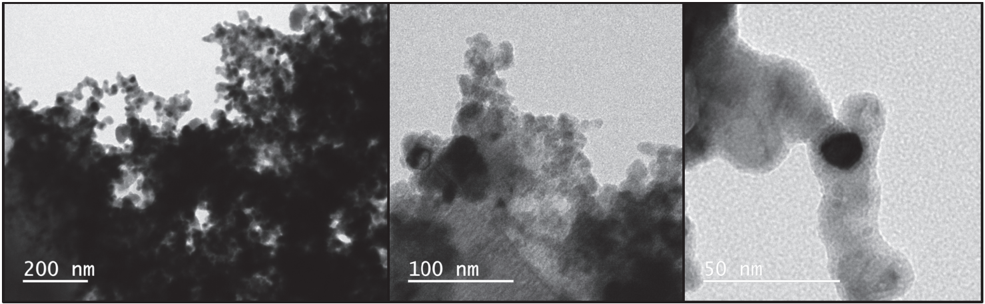
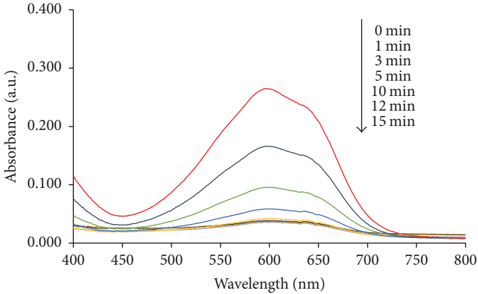
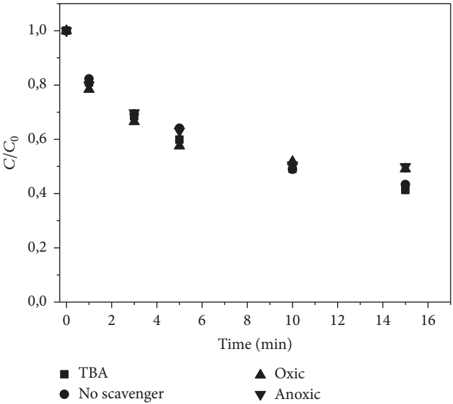
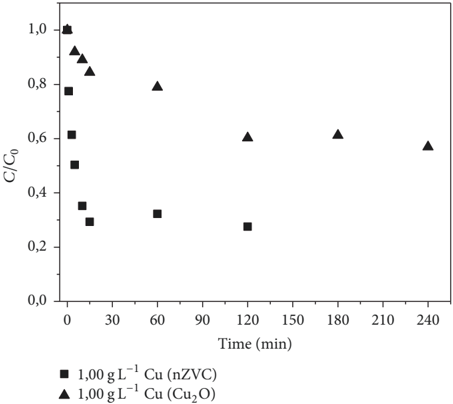
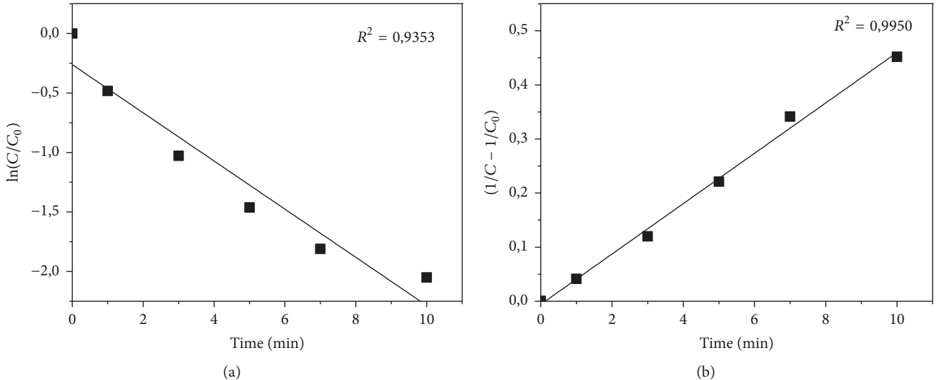
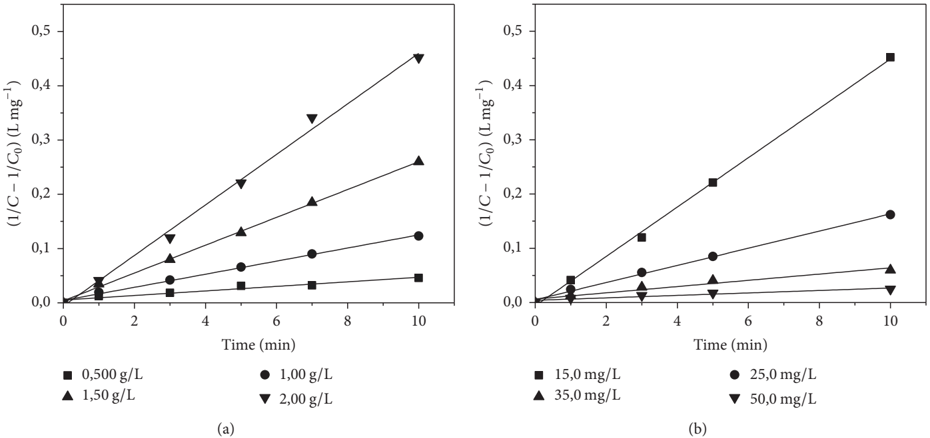
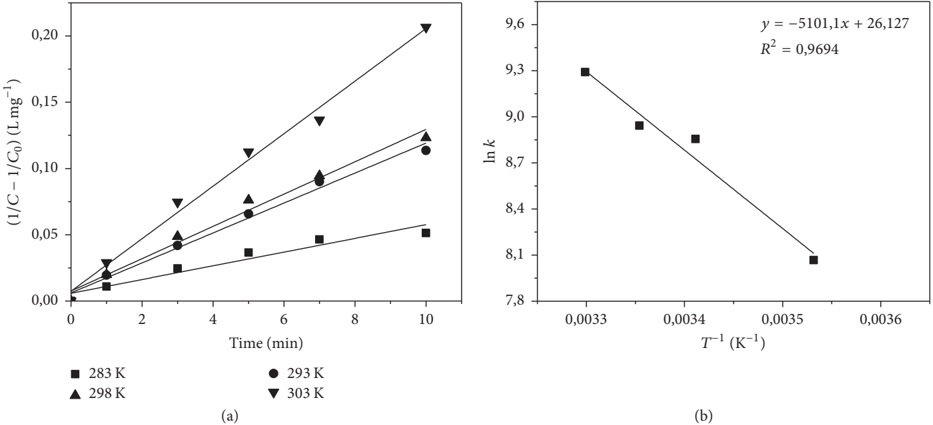
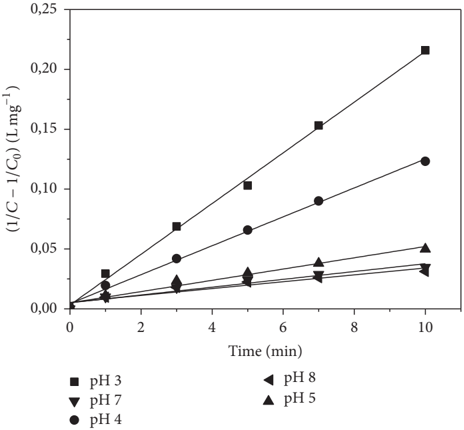
The degradation of the Reactive Blue 4 (RB4) dye by zero-valent copper nanoparticles (nZVC) was investigated. Degradation rates of approximately 90% were reached within 10 minutes of reaction. Total Organic Carbon (TOC) analysis shows that the dye molecules undergo mineralization, therefore indicating the degradation process is oxidative. Experimental tests, held in the presence of tertiary butyl alcohol, acting as a hydroxyl radicals (∙OH) captor, and copper (I) oxide, demonstrated that the reaction mechanism is governed by the concentration of Cu (I) instead of ∙OH. The second-order kinetics model was the most appropriate one to explain the experimental data. Higher values of the reaction rate constant were obtained in higher temperatures and higher nZVC doses and in lower RB4 initial concentrations. The initial pH in more acidic conditions (3 and 4) was kinetically more favorable to the degradation reaction; the activation energy was estimated to be 42 kJ mol−1 based on calculations using the experimental data. Finally, the recovered nanoparticles were utilized on a new reaction cycle, showing a small loss of their efficiency and catalytic activity.
Overview
The claims and statistics of this paper haven’t been checked yet.
Run the check — free, no account needed. It reads the open-access text and checks the sources it cites.
Integrity signals
Registry
Cites
Statistics
Figures







Verification
Claims the paper makes
The claims and statistics of this paper haven’t been checked yet.
Run the check — free, no account needed. It reads the open-access text and checks the sources it cites.
Claims other papers make about this one
Each is checked against this paper’s own text: does it say what the citing paper says it does?
The cited source doesn’t support the claim as written.
In the citing paper
“A more recent study examined the degradation of Reactive Blue 4 based on the coupled use of copper nanoparticles and showed that initially the dye gets adsorbed onto the nanoparticles and then is oxidised based on the production of hydroxyl radicals from added mediators and the action of monovalent copper 76 .”
From Degradation of anthraquinone dyes from effluents: A review focusing on enzymatic dye degradation with industrial potential (2020) · cites this paper as [76]
Checked by a reasoning model — may be wrong.
Experimental — accuracy not yet measured
Self-check
Percentages, sums and reported differences re-computed from the paper’s own numbers.
The self-check needs the paper’s full text.
Citations
Cites
Review of iron-free Fenton-like systems for activating H2O2 in advanced oxidation processes
Bokare, A. D., & Choi, W. (2014) · Journal of Hazardous Materials · doi:10.1016/j.jhazmat.2014.04.054 · Cited by 2,368
Nanoscale zero-valent iron: Future prospects for an emerging water treatment technology
Crane, R. A., & Scott, T. B. (2012) · Journal of Hazardous Materials · doi:10.1016/j.jhazmat.2011.11.073 · Cited by 1,154
Nanoscale zero valent iron and bimetallic particles for contaminated site remediation
O’Carroll, D., Sleep, B., Krol, M., Boparai, H., & Kocur, C. (2013) · Advances in Water Resources · doi:10.1016/j.advwatres.2012.02.005 · Cited by 872
Removal of Chromium (VI) from wastewater using bentonite-supported nanoscale zero-valent iron
Shi, L., Zhang, X., & Chen, Z. (2010) · Water Research · doi:10.1016/j.watres.2010.09.025 · Cited by 695
Hydrodechlorination of Trichloroethylene to Hydrocarbons Using Bimetallic Nickel−Iron Nanoparticles
Schrick, B., Blough, J. L., Jones, A. D., & Mallouk, T. E. (2002) · Chemistry of Materials · doi:10.1021/cm020737i · Cited by 562
Textile dye degradation using nano zero valent iron: A review
Raman, C. D., & Kanmani, S. (2016) · Journal of Environmental Management · doi:10.1016/j.jenvman.2016.04.034 · Cited by 351
Bokare, A. D., Chikate, R. C., Rode, C. V., & Paknikar, K. M. (2008) · Applied Catalysis B: Environmental · doi:10.1016/j.apcatb.2007.10.033 · Cited by 338
Liu, W., Qian, T., & Jiang, H. T. (2013) · Chemical Engineering Journal · doi:10.1016/j.cej.2013.10.062 · Cited by 259
Fang, Z., Qiu, X., Chen, J.-H., et al. (2010) · Journal of Hazardous Materials · doi:10.1016/j.jhazmat.2010.09.113 · Cited by 221
Environmental impact of Recover cotton in textile industry
Esteve-Turrillas, F. A., & de la Guárdia, M. (2016) · Resources Conservation and Recycling · doi:10.1016/j.resconrec.2016.09.034 · Cited by 220
Guaratini, C. C. I., & Zanoni, M. V. B. (2000) · Química Nova · doi:10.1590/s0100-40422000000100013 · Cited by 208
Weng, X., Lin, S., Zhong, Y., & Chen, Z. (2013) · Chemical Engineering Journal · doi:10.1016/j.cej.2013.05.096 · Cited by 185
Carneiro, P. A., Nogueira, R. F. P., & Zanoni, M. V. B. (2006) · Dyes and Pigments · doi:10.1016/j.dyepig.2006.01.022 · Cited by 179
Shih, Y., Hsu, C., & Su, Y.-F. (2010) · Separation and Purification Technology · doi:10.1016/j.seppur.2010.10.015 · Cited by 175
Bayramoğlu, G., Çelik, G., & Arica, M. Y. (2006) · Journal of Hazardous Materials · doi:10.1016/j.jhazmat.2006.05.005 · Cited by 171
Effect of Surface Chemistry of Fe−Ni Nanoparticles on Mechanistic Pathways of Azo Dye Degradation
Bokare, A. D., Chikate, R. C., Rode, C. V., & Paknikar, K. M. (2007) · Environmental Science & Technology · doi:10.1021/es071107q · Cited by 166
Karaer, H., & Kaya, İ. (2016) · Microporous and Mesoporous Materials · doi:10.1016/j.micromeso.2016.06.006 · Cited by 164
Characterization of the textile anthraquinone dye Reactive Blue 4
Epolito, W. J., LEE, Y., Bottomley, L. A., & Pavlostathis, S. G. (2005) · Dyes and Pigments · doi:10.1016/j.dyepig.2004.10.006 · Cited by 146
Dong, G., Ai, Z., & Zhang, L. (2014) · Water Research · doi:10.1016/j.watres.2014.08.011 · Cited by 145
Carneiro, P. A., Osugi, M. E., Fugivara, C. S., Boralle, N., Furlan, M., & Zanoni, M. V. B. (2004) · Chemosphere · doi:10.1016/j.chemosphere.2004.10.043 · Cited by 142
He, Y., Gao, J., Feng, F.-Q., Liu, C., Peng, Y., & Wang, S. (2011) · Chemical Engineering Journal · doi:10.1016/j.cej.2011.05.107 · Cited by 138
Li, P., Song, Y., Wang, S., Tao, Z., Yu, S., & Liu, Y. (2014) · Ultrasonics Sonochemistry · doi:10.1016/j.ultsonch.2014.05.025 · Cited by 130
Wen, G., Wang, S., Ma, J., Huang, T., Liu, Z.-Q., Zhao, L., & Xu, J. (2014) · Journal of Hazardous Materials · doi:10.1016/j.jhazmat.2014.05.002 · Cited by 129
Weng, X., Sun, Q., Lin, S., Chen, Z., Megharaj, M., & Naidu, R. (2013) · Chemosphere · doi:10.1016/j.chemosphere.2013.11.033 · Cited by 117
Oxidative degradations of reactive blue 4 dye by different advanced oxidation methods
Gözmen, B., Kayan, B., Gizir, A. M., & Hesenov, A. (2009) · Journal of Hazardous Materials · doi:10.1016/j.jhazmat.2009.02.011 · Cited by 114
Huang, C.-C., Lo, S., & Lien, H. (2012) · Chemical Engineering Journal · doi:10.1016/j.cej.2012.07.002 · Cited by 114
Shih, Y., Chen, M., & Su, Y.-F. (2011) · Applied Catalysis B: Environmental · doi:10.1016/j.apcatb.2011.03.024 · Cited by 109
Zhou, T., Li, Y., & Lim, T. (2010) · Separation and Purification Technology · doi:10.1016/j.seppur.2010.10.010 · Cited by 102
A review of the toxicity and carcinogenicity of anthraquinone derivatives
Sendelbach, L. E. (1989) · Toxicology · doi:10.1016/0300-483x(89)90113-3 · Cited by 87
Kinetics of zero-valent iron reductive transformation of the anthraquinone dye Reactive Blue 4
Epolito, W. J., Yang, H., Bottomley, L. A., & Pavlostathis, S. G. (2008) · Journal of Hazardous Materials · doi:10.1016/j.jhazmat.2008.03.033 · Cited by 79
Mekewi, M. A., Darwish, A. S., Amin, M. S., et al. (2016) · Egyptian Journal of Petroleum · doi:10.1016/j.ejpe.2015.06.011 · Cited by 79
Axelsson, J., Nilsson, U., Terrazas, E., Aliaga, T. A., & Welander, U. (2005) · Enzyme and Microbial Technology · doi:10.1016/j.enzmictec.2005.09.006 · Cited by 75
Solar photo-Fenton degradation of Reactive Blue 4 in a CPC reactor
Durán, A., Monteagudo, J. M., & Amores, E. (2007) · Applied Catalysis B: Environmental · doi:10.1016/j.apcatb.2007.11.016 · Cited by 70
Ultrasound-assisted homogeneous photocatalytic degradation of Reactive Blue 4 in aqueous solution
Monteagudo, J. M., Durán, A., Martín, I. S., & García, S. (2014) · Applied Catalysis B: Environmental · doi:10.1016/j.apcatb.2014.01.014 · Cited by 69
Efficient degradation of Reactive Blue 4 in carbon bed electrochemical reactor
Neti, N. R., & Misra, R. (2011) · Chemical Engineering Journal · doi:10.1016/j.cej.2011.12.014 · Cited by 69
Binupriya, A. R., Sathishkumar, M., Ku, C. S., & Yun, S. (2009) · Colloids and Surfaces B Biointerfaces · doi:10.1016/j.colsurfb.2009.10.031 · Cited by 65
Rapid reductive degradation of azo and anthraquinone dyes by nanoscale zero-valent iron
Dutta, S., Saha, R., Kalita, H., & Bezbaruah, A. N. (2016) · Environmental Technology & Innovation · doi:10.1016/j.eti.2016.03.001 · Cited by 65
Degradation of aqueous carbon tetrachloride by nanoscale zerovalent copper on a cation resin
Lin, C., Lo, S., & Liou, S. Y. H. (2005) · Chemosphere · doi:10.1016/j.chemosphere.2004.11.064 · Cited by 61
Pereira, W. D. S., & Freire, R. S. (2005) · Química Nova · doi:10.1590/s0100-40422005000100022 · Cited by 56
Monteagudo, J. M., Durán, A., Aguirre, M., & Martín, I. S. (2010) · Chemical Engineering Journal · doi:10.1016/j.cej.2010.06.029 · Cited by 55
Raut, S. S., Kamble, S. P., & Kulkarni, P. S. (2016) · Chemosphere · doi:10.1016/j.chemosphere.2016.06.031 · Cited by 45
Ayodele, O. B., & Togunwa, O. S. (2013) · Applied Catalysis A General · doi:10.1016/j.apcata.2013.11.013 · Cited by 43
Textile Waste Waters: Treatment and Environmental Effects
Gardiner, D. K., & Borne, B. J. (1978) · Journal of the Society of Dyers and Colourists · doi:10.1111/j.1478-4408.1978.tb03420.x · Cited by 40
Solar photocatalytic degradation of reactive blue 4 using a Fresnel lens
Durán, A., & Monteagudo, J. M. (2006) · Water Research · doi:10.1016/j.watres.2006.06.042 · Cited by 39
Tkachenko, O., Panteleimonov, A., Padalko, I., Korobov, A. I., Gushikem, Y., & Kholin, Y. V. (2014) · Chemical Engineering Journal · doi:10.1016/j.cej.2014.05.117 · Cited by 32
Modified chitosan for the collection of reactive blue 4, arsenic and mercury from aqueous media
Dhanapal, V., & Subramanian, K. G. (2014) · Carbohydrate Polymers · doi:10.1016/j.carbpol.2014.09.027 · Cited by 31
Wang, F., Gao, Y., Sun, Q., Chen, Z., Megharaj, M., & Naidu, R. (2014) · Chemical Engineering Journal · doi:10.1016/j.cej.2014.06.003 · Cited by 27
Vakili, M., Rafatullah, M., Ibrahim, M. H., Abdullah, A. Z., Gholami, Z., & Salamatinia, B. (2016) · Journal of Water Process Engineering · doi:10.1016/j.jwpe.2016.06.005 · Cited by 27
Cited by
Routoula, E., & Patwardhan, S. V. (2020) · Environmental Science & Technology · doi:10.1021/acs.est.9b03737 · Cited by 579
Abidli, A., Huang, Y., Ben Rejeb, Z., Zaoui, A., & Park, C. B. (2022) · Chemosphere · doi:10.1016/j.chemosphere.2021.133102 · Cited by 194
Metadata
- Authors
- Marcelo, C. R., Puiatti, G. A., Nascimento, M. A., Oliveira, A. F., & Lopes, R. P.
- Venue
- Journal of Nanomaterials
- Publisher
- Wiley
- Published
- 2018
- Volume
- 2018
- Pages
- 1-9
- ISSN
- 1687-4110
- 1687-4129
- Cited by
- 39
- References
- 48
- Language
- en
- Funders
- CNPq/FAPEMIG (793988/2013, 449909/2014-0)
- Fundação de Amparo à Pesquisa do Estado de Minas Gerais (793988/2013, 449909/2014-0)
- Coordenação de Aperfeiçoamento de Pessoal de Nível Superior (793988/2013, 449909/2014-0)
- Conselho Nacional de Desenvolvimento Científico e Tecnológico (793988/2013, 449909/2014-0)
About these checks
Registry, retraction, Cites and statistics results are computed, not judged, with one exception: a printed reference that no index lists is read once by a model before it counts as a citation error. Claims are extracted by a model and kept only when their quote appears verbatim in the text; each cited source is then checked, with a model’s help, for whether it says what the claim relies on. Those verdicts can be wrong — read the claim’s quote and the cited source before relying on one.
Statistics and arithmetic are recomputed, not judged.
Confidence bands are shown only for fields calibrated on our annotated test set. None is calibrated yet, so no band is shown.
What counts as a claim ›How we measure confidence ›How we check this ›
Are you an author, or do you see a problem with this page? Request a review
Data sources
Bibliographic data: Semantic Scholar, OpenAlex, Crossref.
Contains information from the Semantic Scholar Academic Graph Datasets, made available under the ODC Attribution License (ODC-BY 1.0).
Semantic Scholar’s data is described in: Kinney, R., et al. (2023). The Semantic Scholar Open Data Platform. arXiv:2301.10140.
