

Increased Outdoor PM 2.5 Concentration Is Associated with Moderate/Severe Anemia in Children Aged 6–59 Months in Lima, Peru
Open accessThe DOI matches its Crossref record; 33 of the 33 references it cites were found in a registry or an index.
Abstract
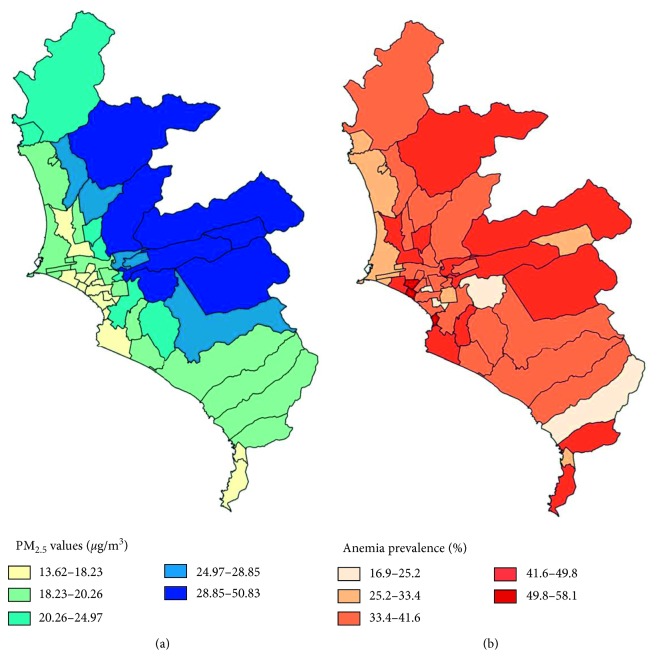
Anemia affects 1.62 billion people worldwide. Although iron deficiency is the main cause of anemia, several other factors may explain its high prevalence. In this study, we sought to analyze the association between outdoor particulate matter PM 2.5 levels with anemia prevalence in children aged 6–59 months residing in Lima, Peru ( n = 139,368), one of the cities with the worst air pollution in Latin America. The study period was from 2012 to 2016. Anemia was defined according to the World Health Organization (Hb < 11 g/dL). PM 2.5 values were estimated by a mathematical model that combined data observed from monitors, with satellite and meteorological data. PM 2.5 was analyzed by quintiles. Multiple linear and logistic regressions were used to estimate the associations between hemoglobin concentration (beta) and anemia (odds ratio) with PM 2.5 , after adjusting by covariates. Prevalence of anemia was 39.6% (95% confidence interval (CI): 39.3–39.9). Mild anemia was observed in 30.8% of children and moderate/severe in 8.84% of children. Anemic children compared with nonanemic children are mainly males, have low body weight, higher rate of stunting, and live in an environment with high PM 2.5 concentration. A slight decrease in hemoglobin (4Q B: −0.03, 95% CI: −0.05 to − 0.02; 5Q B: −0.04, 95% CI: −0.06 to −0.01) and an increase in the probability of moderate/severe anemia (4Q OR: 1.18, 95% CI: 1.10–1.27; 5Q OR: 1.18, 95% CI: 1.08–1.29) were observed with increased exposure to PM 2.5 . We conclude that outdoor PM 2.5 levels were significantly associated with decreased hemoglobin values and an increase in prevalence of moderate/severe anemia in children under 5 years old.
Overview
The claims and statistics of this paper haven’t been checked yet.
Free: it reads the open-access text and checks the first 5 claims that cite a source we can check. Create a free account to check every claim.
Integrity signals
Registry
Cites
Statistics
Figures
Verification
Claims the paper makes
The claims and statistics of this paper haven’t been checked yet.
Free: it reads the open-access text and checks the first 5 claims that cite a source we can check. Create a free account to check every claim.
Claims other papers make about this one
Each is checked against this paper’s own text: does it say what the citing paper says it does?
The source backs part of the claim, not all of it — or backs it for a different population, condition or comparison.
In the citing paper
“Living in an area with high levels of ambient PM2.5 is a particularly strong risk factor for childhood anemia [72, 74, 75].”
From Environmental Contaminants, Iron Deficiency, and Iron‐Deficiency Anemia: A Review of the Literature (2025) · cites this paper as [75]
Experimental — accuracy not yet measured
Self-check
Percentages, sums and reported differences re-computed from the paper’s own numbers.
The self-check needs the paper’s full text.
Citations
Cites
Air Pollution and Cardiovascular Disease
Rajagopalan, S., Al-Kindi, S. G., & Brook, R. D. (2018) · Journal of the American College of Cardiology · doi:10.1016/j.jacc.2018.07.099 · Cited by 1,299 · cited 1×
“5 has been shown to increase systemic inflammation [28] and produce chronic inflammation [29].”
BackgroundWeiss, G., Ganz, T., & Goodnough, L. T. (2019) · Blood · doi:10.1182/blood-2018-06-856500 · Cited by 1,219 · cited 1×
“Evidence suggests that chronic diseases such as chronic kidney disease, congestive heart failure, chronic pulmonary disease, and obesity may result in AI [4, 5].”
BackgroundKassebaum, N. J. (2016) · Hematology/Oncology Clinics of North America · doi:10.1016/j.hoc.2015.11.002 · Cited by 748
Cappellini, M. D., Comin‐Colet, J., de Francisco, A., Dignass, A., Doehner, W., Lam, C. S., Macdougall, I. C., Rogler, G., Camaschella, C., Kadir, R., et al. (2017) · American Journal of Hematology · doi:10.1002/ajh.24820 · Cited by 502 · cited 1×
“)is iron deficiency can lead to an inflammatory anemia [39].”
BackgroundPo, J. Y. T., FitzGerald, J. M., & Carlsten, C. (2011) · Thorax · doi:10.1136/thx.2010.147884 · Cited by 450 · cited 1×
“5 is associated with cardiovascular disease and chronic obstructive pulmonary disease [9] and may cause oxidative stress-dependent inflammation in the lungs [10, 11].”
BackgroundLong- and Short-Term Exposure to PM2.5 and Mortality: Using Novel Exposure Models
Kloog, I., Ridgway, B., Koutrakis, P., Coull, B. A., & Schwartz, J. D. (2013) · Epidemiology · doi:10.1097/ede.0b013e318294beaa · Cited by 362 · cited 1×
“8% increase in mortality rates with adverse effects in human health [8].”
BackgroundOxidative stress, eryptosis and anemia: a pivotal mechanistic nexus in systemic diseases
Bissinger, R., Bhuyan, A. A. M., Qadri, S. M., & Lang, F. (2019) · The FEBS Journal · doi:10.1111/febs.14606 · Cited by 239 · cited 1×
“Oxidative stress has been considered as a cause of eryptosis or shortening of erythrocyte half-life [12].”
BackgroundQuay, J. L., Reed, W., Samet, J., & Devlin, R. B. (1998) · American Journal of Respiratory Cell and Molecular Biology · doi:10.1165/ajrcmb.19.1.3132 · Cited by 230
He, M., Ichinose, T., Yoshida, S., Ito, T., He, C., Yoshida, Y., Arashidani, K., Takano, H., Sun, G., & Shibamoto, T. (2017) · Journal of Applied Toxicology · doi:10.1002/jat.3482 · Cited by 200 · cited 1×
“5 has been shown to increase systemic inflammation [28] and produce chronic inflammation [29].”
BackgroundDoes biofuel smoke contribute to anaemia and stunting in early childhood?
Mishra, V., & Retherford, R. D. (2007) · International Journal of Epidemiology · doi:10.1093/ije/dyl234 · Cited by 194
Research works printed but not linked: 1
- WHO WHO Air Quality Guidelines for Particulate Matter, Ozone, Nitrogen Dioxide and Sulfur Dioxide 2006 Geneva, Switzerland WHO 34662007
Cited by
Mehta, U., Dey, S., Chowdhury, S., Ghosh, S., Hart, J. E., & Kurpad, A. (2021) · Environmental Epidemiology · doi:10.1097/ee9.0000000000000125 · Cited by 62
Fongsodsri, K., Chamnanchanunt, S., Desakorn, V., Thanachartwet, V., Sahassananda, D., Rojnuckarin, P., & Umemura, T. (2021) · Frontiers in Medicine · doi:10.3389/fmed.2021.692008 · Cited by 61
“(17) was performed in 139,368 children (age 6–35 months) to evaluate the association between Hb and air pollution in their residential areas.”
BackgroundTapia, V., Vasquez, B., Vu, B. N., Liu, Y., Steenland, K., & Gonzales, G. F. (2020) · Journal of Exposure Science & Environmental Epidemiology · doi:10.1038/s41370-020-0223-5 · Cited by 58
Self-citationXu, X., Zhang, C., & Liang, Y. (2021) · Atmospheric Environment · doi:10.1016/j.atmosenv.2021.118302 · Cited by 57
Elbarbary, M., Honda, T., Morgan, G., Guo, Y., Guo, Y., Kowal, P., & Negin, J. (2020) · International Journal of Environmental Research and Public Health · doi:10.3390/ijerph17093209 · Cited by 55
Mechanisms of cardiovascular toxicity induced by PM2.5: a review
Zhao, T., Qi, W., Pan, Y., Yang, L., Shi, Y., Zhou, L., & Ye, L. (2021) · Environmental Science and Pollution Research · doi:10.1007/s11356-021-16735-9 · Cited by 55
Reducing the burden of anaemia in Indian women of reproductive age with clean-air targets
Chaudhary, E., Dey, S., Ghosh, S., Sharma, S., Singh, N., Agarwal, S., Tibrewal, K., Venkataraman, C., Kurpad, A. V., Cohen, A., et al. (2022) · Nature Sustainability · doi:10.1038/s41893-022-00944-2 · Cited by 51
Bhattarai, G., Shrestha, S. K., Sim, H., Lee, J., & Kook, S. (2024) · Experimental & Molecular Medicine · doi:10.1038/s12276-023-01149-z · Cited by 38
“Anemia was detected in 30.8% of the exposed children, and moderate to severe anemia was detected in 8.8% 154 .”
BackgroundInfluentialYu, X., Addo, O. Y., Williams, A. M., Engle‐Stone, R., Ou, J., Huang, W., Guo, J., Suchdev, P. S., & Young, M. F. (2020) · American Journal of Clinical Nutrition · doi:10.1093/ajcn/nqaa148 · Cited by 35
“It is also noteworthy that the home environment is complex, where many other unmeasured factors in the home environment might be associated with childhood anemia, such as solid fuel use (33) or air pollution (34).”
BackgroundEffects of PM2.5 and its constituents on hemoglobin during the third trimester in pregnant women
Xie, G., Yue, J., Yang, W., Yang, L., Xu, M., Sun, L., Zhang, B., Guo, L., & Chung, M. C. (2022) · Environmental Science and Pollution Research · doi:10.1007/s11356-022-18693-2 · Cited by 34
Hwang, J., & Kim, H. (2024) · BMC Public Health · doi:10.1186/s12889-024-18492-z · Cited by 32
Odo, D. B., Yang, I. A., Dey, S., Hammer, M. S., van Donkelaar, A., Martin, R. V., Dong, G.-H., Yang, B.-Y., Hystad, P., & Knibbs, L. D. (2023) · Environmental Research · doi:10.1016/j.envres.2023.115734 · Cited by 31
Direct and Indirect Effects of Indoor Particulate Matter on Blood Indicators Related to Anemia
Kwag, Y., Ye, S., Oh, J., Lee, D.-W., Yang, W., Kim, Y., & Ha, E. (2021) · International Journal of Environmental Research and Public Health · doi:10.3390/ijerph182412890 · Cited by 25
Association between Long-Term Ambient PM2.5 Exposure and under-5 Mortality: A Scoping Review
Anita, W. M., Ueda, K., Uttajug, A., Seposo, X., & Takano, H. (2023) · International Journal of Environmental Research and Public Health · doi:10.3390/ijerph20043270 · Cited by 25
Ahn, T. G., Kim, Y. J., Lee, G., You, Y., Kim, S. Y., Chae, R., Hur, Y. M., Park, M. H., Bae, J. G., Lee, S.-J., et al. (2024) · Journal of Korean Medical Science · doi:10.3346/jkms.2024.39.e131 · Cited by 25
He, C., Xie, L., Gu, L., Yan, H., Feng, S., Zeng, C., Danzhen, W., Zhang, X., Han, M., Li, Z., et al. (2023) · Therapeutic Advances in Hematology · doi:10.1177/20406207231189922 · Cited by 24
Li, Z., Li, X., Song, H., Tao, B., Qiu, B., Tian, D., Zhan, M., Wu, Z., Wu, J., Zhang, Q., et al. (2021) · The Science of The Total Environment · doi:10.1016/j.scitotenv.2021.146046 · Cited by 20
Pace, A., Villamediana, P., Rezamand, P., & Skibiel, A. L. (2023) · Journal of Animal Science · doi:10.1093/jas/skad246 · Cited by 19
Espinoza-Guillen, J. A., Alderete-Malpartida, M. B., Navarro-Abarca, U. F., & Gómez-Muñoz, H. K. (2024) · Environmental Monitoring and Assessment · doi:10.1007/s10661-024-12611-4 · Cited by 19
“Although these findings could confirm the importance of long-distance transport of atmospheric pollutants such as PM 2.5 from forest fires that occurred in the Peruvian Amazon or neighboring countries, a deeper study of the impact of long-distance transport of smoke from forest fires in MALC may be a relevant topic fo…”
InfluentialBora, K. (2021) · Journal of Tropical Pediatrics · doi:10.1093/tropej/fmab089 · Cited by 16
Risk analysis of air pollutants and types of anemia: a UK Biobank prospective cohort study
Li, L., Ran, Y., Zhuang, Y., Wang, L., Chen, J., Sun, Y., Lu, S., Ye, F., Mei, L., Ning, Y., et al. (2024) · International Journal of Biometeorology · doi:10.1007/s00484-024-02670-0 · Cited by 14
“Although studies have investigated the association between PM and indicators of anemia, most of them focus on specific populations, such as the elderly, children, and pregnant women (Elbarbary et al. 2020 ; Honda et al. 2017 ; Mehta et al. 2021 ; Morales-Ancajima et al. 2019 ).”
Kang, N., Wang, R., Lu, H. S., Onyai, F., Tang, M., Tong, M., Ni, X., Zhong, M., Deng, J., Dong, Y., et al. (2024) · Environmental Science & Technology · doi:10.1021/acs.est.4c05305 · Cited by 14
Estimations of infiltration factors of diurnal PM 2.5 and heavy metals in children’s bedrooms
Su, H.-J. J., Jung, C., Wang, J., Chen, N.-T., & Chang, W. (2022) · Indoor Air · doi:10.1111/ina.13037 · Cited by 14
Exposure to air pollution as a risk factor for anaemia: a global scoping review
Khan, Y., & Banerjee, R. (2024) · International Journal of Environmental Health Research · doi:10.1080/09603123.2024.2327532 · Cited by 13
“5 and its constituents, viz., BC, NH4+, NO3−, OM, SO42−, SOIL and Dust (Stanković et al. 2006; Honda et al. 2017; Morales-Ancajima et al. 2019; Elbarbary et al. 2020; Vieira et al. 2020; Mehta et al. 2021; Xie et al. 2022; Chaudhary et al. 2022; He et al. 2023; Wu et al. 2023; Odo et al. 2023).”
InfluentialArmo-Annor, D., Colecraft, E. K., Adu‐Afarwuah, S., Christian, A. K., & Jones, A. D. (2021) · BMC Nutrition · doi:10.1186/s40795-021-00456-w · Cited by 13
Coal Plants, Air Pollution and Anaemia: Evidence from India
Datt, G., Maitra, P., Menon, N., Ray, R., Dey, S., & Chowdhury, S. (2022) · The Journal of Development Studies · doi:10.1080/00220388.2022.2132151 · Cited by 12
“We follow the ‘dose function’ framework in Moretti and Neidell (2011) to implement a simple back–of–the–envelope calculation.”
MethodAppiah-Dwomoh, C., Tettey, P., Akyeampong, E., Amegbor, P. M., Okello, G., Botwe, P. K., & Quansah, R. (2024) · BMC Public Health · doi:10.1186/s12889-024-18304-4 · Cited by 11
Tong, J., Tong, M., Kang, N., Liu, F., Zhang, K., Liang, W., Peng, S., Li, Z., Xue, T., Xiang, H., et al. (2025) · Environmental Science & Technology · doi:10.1021/acs.est.4c07787 · Cited by 9
Li, P., Wu, J., Ni, X., Tong, M., Lu, H., Liu, H., Xue, T., & Zhu, T. (2023) · Journal of Hazardous Materials · doi:10.1016/j.jhazmat.2023.132061 · Cited by 8
Espinoza-Guillen, J. A., Alderete-Malpartida, M. B., Roncal-Romero, F. D., & Vilcanqui-Sarmiento, J. C. (2025) · Environmental Monitoring and Assessment · doi:10.1007/s10661-025-13696-1 · Cited by 7
“PM is measured by a Thermo Beta 5014i monitor applying the beta ray attenuation technique, and the instrument is calibrated three times a year (October, February, and June, starting in October 2014) (Espinoza-Guillen et al., 2024a; Silva et al., 2017; Vu et al., 2019).”
Environmental Contaminants, Iron Deficiency, and Iron‐Deficiency Anemia: A Review of the Literature
Lichtler, R., & Cowley, M. (2025) · Scientifica · doi:10.1155/sci5/5007983 · Cited by 6
“5 is a particularly strong risk factor for childhood anemia [72, 74, 75].”
Paz-Aparicio, V. M., Tapia, V., Vasquez-Apestegui, B. V., Steenland, K., & Gonzales, G. F. (2022) · Toxics · doi:10.3390/toxics10080487 · Cited by 7
“5 levels were significantly associated with decreased hemoglobin values and an increase in prevalence of moderate/severe anemia in children under 5 years old [19].”
BackgroundSelf-citationPrevalencia de parasitosis y anemia en niños y adultos en una zona altoandina de Peru
Delgado-Huancas, D. (2022) · Revista Cientifica Ciencia Medica · doi:10.51581/rccm.v24i2.395 · Cited by 6
The role of antioxidant nutrients in mitigating PM2.5-related health risks in young Indian children
George, F., Chaudhary, E., Dey, S., Thomas, T. S., Sachdev, H. S., Kurpad, A. V., & Ghosh, S. (2025) · Frontiers in Public Health · doi:10.3389/fpubh.2025.1575950 · Cited by 5
Montag, D., Delgado, C., Quispe, C., Wareham, D. W., Gallo, V., Sánchez-Choy, J., Sánchez, V., Anaya, R., Flores, E. C., Roca, L., et al. (2021) · BMJ Open · doi:10.1136/bmjopen-2020-045609 · Cited by 5
The New WHO Cut-off Point for Defining High-altitude Anemia may be Inadequate
Gonzales, G. F., Vásquez‐Velásquez, C., Yucra, S., Tapia, V., Gasco, M., Suchdev, P. S., Rees, C. A., & Vilca, J. A. (2025) · INQUIRY The Journal of Health Care Organization Provision and Financing · doi:10.1177/00469580251372827 · Cited by 4
“49”
Self-citationCeballos, R. F., Gallano, R. C., & Visaya, L. D. (2024) · Applied Environmental Research · doi:10.35762/aer.2024033 · Cited by 4
Szyszkowicz, M., Lukina, A. O., & Dinu, T. (2022) · International Journal of Environmental Research and Public Health · doi:10.3390/ijerph19095603 · Cited by 4
“5 was significantly associated with an increase in the prevalence of moderate and severe anemia (ICD-10 codes: C65 and C64, respectively), and decreased hemoglobin values in children under 5 years of age [8].”
BackgroundLi, X., Li, Z., Sun, Y., Zhang, M., Zhong, M., Wu, Y., Chen, X., Sun, X., Chen, D., Cai, H., et al. (2025) · Atmospheric Environment · doi:10.1016/j.atmosenv.2025.121432 · Cited by 3
Mensah, M. M., Opoku, S., Babah, R., & Nsiah, E. O. (2025) · International Journal of Gynecology & Obstetrics · doi:10.1002/ijgo.70655 · Cited by 3
Parikh, G., Mehta, A. U., Siddiqui, N. A., Kumar, K., Adhikary, M., & Patel, B. M. (2025) · Reproductive Toxicology · doi:10.1016/j.reprotox.2025.109127 · Cited by 3
Bede-Ojimadu, O. O., Frazzoli, C., Orish, C. N., Orish, F. C., Bocca, B., Battistini, B., Ruggieri, F., Offor, S. J., Uwah, A. F., Ndem, J. I., et al. (2025) · Environmental Research · doi:10.1016/j.envres.2025.122815 · Cited by 2
Khushboo, Chaudhary, E., Ghosh, S., Singh, N., Knibbs, L. D., West, J. J., Kumar, A., Imam, F., & Dey, S. (2025) · Environmental Research Health · doi:10.1088/2752-5309/ae11cc · Cited by 2
“We observe that the innate immune system can be triggered by obesity, and inflammation can rise in several clinical circumstances (such as cancer and several organ dysfunctions) [48].”
Zhang, Q., Yang, J., Zhou, T., Cui, Y., Zhang, H., Chen, L., Wang, Y., Meng, Q., Xiao, Q., Jiang, J., et al. (2025) · Ecotoxicology and Environmental Safety · doi:10.1016/j.ecoenv.2025.119372 · Cited by 2
Xiaofei, A., Kang, N., Li, P., Tong, M., Li, F., Jiahui, T., Xu, H., Tao, X., & Xiang, H. (2025) · BMJ Global Health · doi:10.1136/bmjgh-2024-018260 · Cited by 2
Anemia crisis among children in Peru: a scoping review
Lobo, K., Vásquez‐Velásquez, C., Suchdev, P. S., Young, M. F., Rogers, H. P., Cyrus, E., Beguiristain, K., Swords, C., Sarah, L., Parmar, Y., et al. (2026) · Revista Panamericana de Salud Pública · doi:10.26633/rpsp.2026.58 · Cited by 2
Self-citationEspinoza-Guillen, J. A., Alderete-Malpartida, M. B., Bernabé-Meza, S. J., Rosa, D. F. V.-L., & Cañari-Cancho, J. H. (2024) · Air Quality Atmosphere & Health · doi:10.1007/s11869-024-01654-8 · Cited by 2
“This city experiences high levels of air pollution, primarily caused by particulate matter (Espinoza 2021; Encalada-Malca et al. 2021; Morales-Ancajima et al. 2019).”
Particulates and anaemia in India
Pillarisetti, A., & Balakrishnan, K. (2022) · Nature Sustainability · doi:10.1038/s41893-022-00943-3 · Cited by 2
Li, X., Wu, Z., Zhao, Y., Chen, X., Li, Z., Sun, Y., Gong, Y., Hu, P., Huang, X., Pan, W., et al. (2025) · Journal of Global Health · doi:10.7189/jogh.15.04346 · Cited by 1
“Similar findings were reported in other areas such as the USA [ 9 ] and Peru [ 11 ].”
InfluentialFenta, H. M., Amegah, A. K., Rantala, A. K., Paciência, I., & Jaakkola, J. J. K. (2026) · Scientific Reports · doi:10.1038/s41598-025-33837-3 · Cited by 1
“This is in line with previous studies in different countries that the effects of using unclean fuel for cooking, unimproved water, and unimproved toilet facilities may increase the odds of being anemic among children 6,8,17,20,38 .”
InfluentialA rapid spectrophotometric method to identify inhibitors of human erythropoiesis
Ilboudo, D. P., D’Alessandro, S., Parapini, S., Alvarez, E. C., Misiano, P., Taramelli, D., & Basilico, N. (2021) · Journal of Pharmacological and Toxicological Methods · doi:10.1016/j.vascn.2021.107134 · Cited by 1
Saving lives with cooking gas? Unintended effects of targeted LPG subsidies in PeruPreprint
Thivillon, T. (2022) · SocArXiv (OSF Preprints) · doi:10.31235/osf.io/yh5xs · Cited by 1
Mustafa, Z., Belal, A. A., Mami, A. M., Latif, M. T., & Rusli, M. N. (2024) · Research Square · doi:10.21203/rs.3.rs-4802687/v1 · Cited by 1
Espinoza Ancco, L. M. (2021) · LA Referencia (Red Federada de Repositorios Institucionales de Publicaciones Científicas) · Cited by 1
Paridad de género en las ciencias de la salud en el Perú: Una deuda urgente
Flores, E. C. (2022) · Revista del Cuerpo Médico Hospital Nacional Almanzor Aguinaga Asenjo · doi:10.35434/rcmhnaaa.2022.151.1491
Szyszkowicz, M. (2025) · Preprints.org · doi:10.20944/preprints202505.1938.v1
An economical in vitro model of wood smoke exposure
Krznarich, J., Schumann, T., Bjork, J. A., Slattery, M. G., & Lacher, S. E. (2025) · Inhalation Toxicology · doi:10.1080/08958378.2025.2523297
The Impact of The Pico Y Placa Policy On Fine Particulate Matter In Lima, PeruPreprint
Romero, Y., deSouza, P., Duarte, F., Kinney, P. L., Ratti, C., & Noel, J. G. (2021) · Research Square · doi:10.21203/rs.3.rs-785315/v1
“Other crucial research has examined the impact of tra c regulations on certain main avenues in Lima on air pollution (Morales-Ancajima et al., 2019).”
BackgroundAspajo Vidal, N. J. (2020) · Universidad Peruana Cayetano Heredia Institutional Repository
Paz-Aparicio, V. M. (2020) · Universidad Peruana Cayetano Heredia Institutional Repository
Essays on Household Production, Human Capital and the Environment in Developing Countries
Thivillon, T. (2022) · theses.fr (ABES) · doi:10.70675/37472bf4z3698z4a5dz850bz0d3d8b128871
Zheng, K., Zhang, F., Chu, L., Yang, Y., Sun, L., Huang, Y., Qu, S., Huang, S., Qi, W., Yang, D., et al. (2026) · BMC Public Health · doi:10.1186/s12889-026-27895-z
“Subsequent investigations have concentrated on the impact of fine particulate matter (PM 2.5 ) on the development of anemia in children, yielding consistent findings that link PM 2.5 exposure to reduced Hb levels and an increased risk of anemia [7, 21, 26, 29, 31].”
InfluentialReversible disruption of proresolving lipid mediator pathways and erythroid homeostasis by PM2.5
Asplund, H., Dreyer, H. H., O’Toole, T. E., Haberzettl, P., Conklin, D. J., Hellmann, J. L., & Sansbury, B. E. (2026) · Toxicological Sciences · doi:10.1093/toxsci/kfag092
Wang, H., Xiao, X., Sun, X., Zheng, Y., Li, Y., Huang, Y., Peng, W., Li, Y., Xiao, X., He, G., et al. (2026) · Ecotoxicology and Environmental Safety · doi:10.1016/j.ecoenv.2026.120658
Aerosoles atmosféricos en el contexto de cambio climático
Vasquez, R. J. A., Suazo, J. M. Á., Meza, C. L., Yupanqui, G. M. L., Salas, L. S., & Karam, H. A. (2024) · Universidad Nacional Autónoma de Tayacaja Daniel Hernández Morillo (UNAT) - Fondo Editorial. eBooks · doi:10.46908/ediunat.58
Lee, K., Reynolds, B.-L., Dinesh, A., Lipke, L., & Thomas, D. B. (2026) · International Journal of Environmental Research and Public Health · doi:10.3390/ijerph23091224
Gong, Z., Wu, W., Li, P., Yan, Z., Zhou, X., Zhang, Y., & Liu, J. (2026) · Advances in World Medical Research · doi:10.71204/zvj1qm86
“₅, PM₁₀, SO₂, CO, and O₃ was associated with lower mean corpuscular hemoglobin concentration (MCHC) (Morales-Ancajima et al., 2019; Odo et al., 2023).”
Zhu, Y., Zhao, X., Ma, Y., Chen, N., Tang, R., Shao, W., Sun, B., Li, H., Zhou, Z., Zhu, M., et al. (2026) · Ecotoxicology and Environmental Safety · doi:10.1016/j.ecoenv.2026.120980
Metadata
- Authors
- Morales-Ancajima, V. C., Tapia, V., Vu, B. N., Liu, Y., Alarcón-Yaquetto, D. E., & Gonzales, G. F.
- Affiliations
- Universidad Peruana Cayetano Heredia (PE)
- Emory University (US)
- Endocrinology and Reproduction Unit, Research and Development Laboratories (LID), Faculty of Sciences and Philosophy, Universidad Peruana Cayetano Heredia, Lima, Peru
- Corresponding author
- Tapia, Vilma
- ORCID
- Venue
- Journal of Environmental and Public Health
- Publisher
- Wiley
- Published
- 2019-07-24
- Volume
- 2019
- Pages
- 1-8
- ISSN
- 1687-9805 (ISSN-L)
- 1687-9813
- PMC
- PMC6681625
- OpenAlex
- W2963773217
- Cited by
- 57
- References
- 33
- Citations by year
- 2026: 6 · 2025: 14 · 2024: 11 · 2023: 4 · 2022: 8 · 2021: 11 · 2020: 3
- FWCI
- 2.38
- Type
- journal article
- Language
- en
- Open access
- hybrid
- doi.org
- Locations
- Journal of Environmental and Public Health (publishedVersion, cc-by)
- Europe PMC (PubMed Central) (publishedVersion, cc-by)
- PubMed Central (publishedVersion, cc-by)
- PubMed (publishedVersion)
- DOAJ (DOAJ: Directory of Open Access Journals) (submittedVersion, cc-by-sa)
- Funders
- National Institutes of Health (U01TW010107)
- Topics
- Physical Sciences › Environmental Science › Health, Toxicology and Mutagenesis › Air Quality and Health Impacts
- Health Sciences › Medicine › Hematology › Iron Metabolism and Disorders
- Physical Sciences › Environmental Science › Pollution › Energy and Environment Impacts
- Keywords
- PM2.5, particulate matter, air pollution, anemia, children under five, hemoglobin, iron deficiency, anemia prevalence, stunting, Lima
- MeSH terms
- Air Pollutants, Anemia, Child, Preschool, Cities, Erythrocyte Indices, Female, Humans, Infant, Male, Particle Size, Peru, Risk Factors, Prevalence, Inhalation Exposure, Particulate Matter
About these checks
Registry, retraction, Cites and statistics results are computed, not judged, with one exception: a printed reference that no index lists is read once by a model before it counts as a citation error. Claims are extracted by a model and kept only when their quote appears verbatim in the text; each cited source is then checked, with a model’s help, for whether it says what the claim relies on. Those verdicts can be wrong — read the claim’s quote and the cited source before relying on one.
Statistics and arithmetic are recomputed, not judged.
Confidence bands are shown only for fields calibrated on our annotated test set. None is calibrated yet, so no band is shown.
What counts as a claim ›How we measure confidence ›How we check this ›
Are you an author, or do you see a problem with this page? Request a review
Data sources
Bibliographic data: Semantic Scholar, OpenAlex, Crossref.
Contains information from the Semantic Scholar Academic Graph Datasets, made available under the ODC Attribution License (ODC-BY 1.0).
Semantic Scholar’s data is described in: Kinney, R., et al. (2023). The Semantic Scholar Open Data Platform. arXiv:2301.10140.
