

An Isometric and Functionally Based 4-Stage Progressive Loading Program in Achilles Tendinopathy: A 12-Month Pilot Study
Open accessThe DOI matches its Crossref record; 63 of the 63 references it cites were found in a registry or an index; none of the 35 sources its claims cite is checked for support yet.
Abstract
Background. Achilles tendinopathy (AT) is a common musculoskeletal disorder, and its management remains challenging. Hypothesis/Purpose. By conducting a pilot study, we aimed to assess the feasibility, safety, and clinical improvement of a new home-based 4-stage rehabilitation program with progressive loading including isometric exercises on a small scale prior to setting up a randomized controlled trial. Methods. Ten recreational athletes with chronic midportion AT were included. The primary outcome was change in VISA-A score after 1, 2, 3, 6, and 12 months. Secondary outcomes included tenderness on palpation of the tendon and ultrasonographic changes after 6 months. Results. Average VISA-A improvements of 26.9 points ( P = 0.004 ) and 35.4 points ( P = 0.006 ) were observed at 6- and 12-month follow-up, respectively. Tenderness on palpation of the tendon (0–10) was reduced from 5.5 to 2.5 ( P < 0.001 ). Color Doppler ultrasound activity (0–4) was reduced by 50%, from an average of grade 2 to grade 1 ( P = 0.023 ). The hypoechoic cross-sectional area of the Achilles tendon was reduced from an average of 29.1% to 8.5% ( P = 0.001 ). Tendon thickness showed no statistically significant change ( P = 0.415 ). Conclusion. Following the 4-stage rehabilitation program for AT based on isometric training and progressive loading, we observed improvement in both VISA-A score and ultrasonography in a group of athletes who had previously failed to benefit from standard AT rehabilitation. The study was feasible in terms of high adherence to the program and with no observed safety issues. The results of this pilot study support a further assessment of this specific approach for rehabilitation in a future randomized controlled trial.
Overview
CoChat Summary
TL;DR
In a 12-month pilot cohort of 10 recreational athletes with chronic midportion Achilles tendinopathy who had failed standard rehabilitation, a home-based 4-stage progressive loading program including isometric exercises was feasible and associated with improved VISA-A and some ultrasound measures. No control group means effectiveness cannot be established, but the authors report high adherence and no safety issues and support a future RCT.
Key findings
- Mean VISA-A improved by 26.9 points at 6 months (P=0.004) and 35.4 points at 12 months (P=0.006); baseline mean VISA-A was 52.4 and 12-month mean was 87.8.
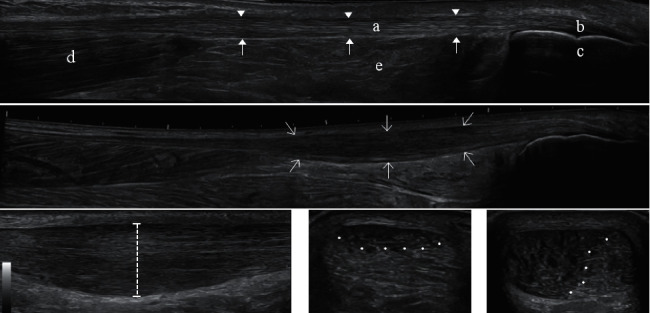
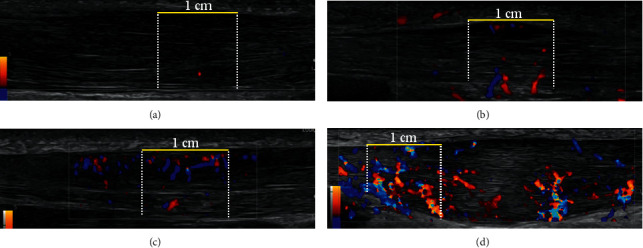
- Tenderness on palpation decreased from 5.5 to 2.5 (P<0.001); color Doppler activity decreased by 50%, from grade 2 to grade 1 (P=0.023); hypoechoic cross-sectional area decreased from 29.1% to 8.5% (P=0.001); tendon thickness showed no statistically significant change (P=0.415).
- At 12 months, 7 of 10 participants had VISA-A >90 and 4 of 10 had >95; 90% were engaged in sports and 50% were running. One treatment failure received a glucocorticoid injection after 3.5 months, with VISA-A improving from 45 to 78 at 6 months but relapsing to 57 at 12 months.
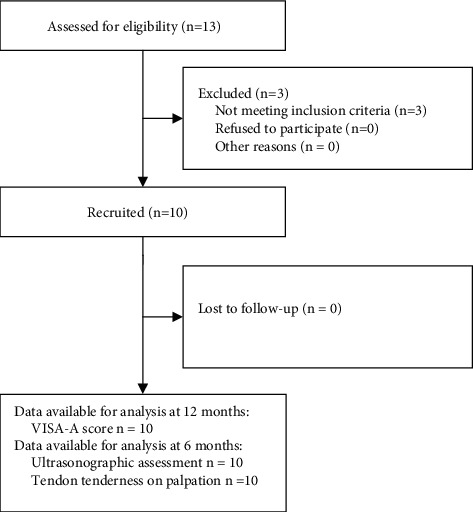
- No patients were lost to follow-up; 6-month ultrasound found no signs of partial ruptures; the study reported high adherence and no observed safety issues.
Methods
- Pilot cohort study with no control group, including 10 patients with chronic midportion AT for more than 6 months, referred to the Department of Sports Medicine at Silkeborg Regional Hospital; reported according to STROBE, with written informed consent.
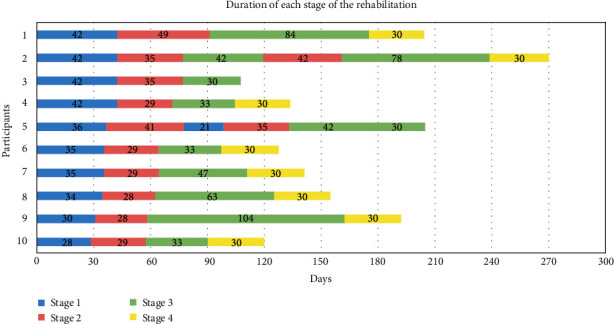
- Intervention was a home-based 4-stage progressive loading program, each stage scheduled for 1 month, with isometric exercises as a key element and individualized progression; progression required pain response after loading not exceeding 3 on a 0–10 numeric rating scale and abating within a few hours. Exercises were unsupervised at home, instructions were given by a single physiotherapist who developed the program, and a glucocorticoid injection was offered as an escape strategy for unsatisfactory response.
- Primary outcome was VISA-A at baseline and 1, 2, 3, 6, and 12 months (12-month assessment by telephone); secondary outcomes included tenderness on palpation (1–10 numeric rating scale) and ultrasound changes (thickness, hypoechogenicity, color Doppler 0–4) at baseline and 6 months. Differences were calculated with paired samples t-tests using SPSS version 17.0; descriptive data presented as mean ± SD, with median and range for disease duration.
Limitations
- Stated: being a small cohort study with no control group, it cannot document effectiveness and no strong conclusions can be drawn; quantification of hypoechogenicity percentage was not validated or documented; tenderness on palpation on a 0–10 numeric rating scale is not scientifically documented, and pressure algometry would improve reliability; 12-month data came from telephone interviews that were sometimes delayed, with average follow-up ranging from 386 to 615 days.
- Evident from the text: the sample size of 10 and absence of a control or wait-and-see group limit causal inference and generalizability; several secondary outcomes, including adherence and return-to-sport questions, were not validated.
- Evident from the text: the single physiotherapist who developed the program delivered all instructions and follow-up visits, which may affect fidelity and generalizability; safety was assessed by ultrasound at 6 months only.
Model-written summary. Check it against the paper before relying on it.
Integrity signals
Registry
Cites
Statistics
Figures
Verification
Claims the paper makes
0 Valid · 0 Not valid · 22 Not checked · 54 Own results and interpretations
A result the paper reports from its own data — it cites no other source for it, so there is none to check. The quote shows it is in the paper.
In the paper
“The 6-month US follow-up did not identify any patients with signs suggesting development of partial ruptures.”
§ An Isometric and Functionally Based 4-Stage Progressive Loading Program in Achilles Tendinopathy: A 12-Month Pilot Study > 3. Results > 3.2. Clinical Outcomes
hedged- Asserted: passes — The authors put it forward as true.
- Checkable: passes — It can be checked against evidence.
- Load-bearing: passes — The paper’s conclusions depend on it.
- Based: passes — The paper gives a reason why it holds.
A result the paper reports from its own data — it cites no other source for it, so there is none to check. The quote shows it is in the paper.
In the paper
“Tendon thickness showed no statistically significant change (P=0.415).”
§ An Isometric and Functionally Based 4-Stage Progressive Loading Program in Achilles Tendinopathy: A 12-Month Pilot Study > Abstract > Results
plain- Asserted: passes — The authors put it forward as true.
- Checkable: passes — It can be checked against evidence.
- Load-bearing: unclear — It is unclear whether the paper’s conclusions depend on it.
- Based: passes — The paper gives a reason why it holds.
A result the paper reports from its own data — it cites no other source for it, so there is none to check. The quote shows it is in the paper.
In the paper
“Despite experiencing failure in a standard course of rehabilitation, participants in this study were able to achieve promising VISA-A results.”
§ An Isometric and Functionally Based 4-Stage Progressive Loading Program in Achilles Tendinopathy: A 12-Month Pilot Study > 4. Discussion
plain- Asserted: passes — The authors put it forward as true.
- Checkable: passes — It can be checked against evidence.
- Load-bearing: passes — The paper’s conclusions depend on it.
- Based: passes — The paper gives a reason why it holds.
A result the paper states — it cites no source for it, so there is none to check. The quote shows it is in the paper.
In the paper
“None of the participants was able to run on entering the study.”
§ An Isometric and Functionally Based 4-Stage Progressive Loading Program in Achilles Tendinopathy: A 12-Month Pilot Study > 4. Discussion
plain- Asserted: passes — The authors put it forward as true.
- Checkable: passes — It can be checked against evidence.
- Load-bearing: unclear — It is unclear whether the paper’s conclusions depend on it.
- Based: passes — The paper gives a reason why it holds.
A result the paper reports from its own data — it cites no other source for it, so there is none to check. The quote shows it is in the paper.
In the paper
“Tenderness on palpation of the tendon (0–10) was reduced from 5.5 to 2.5 (P < 0.001).”
§ An Isometric and Functionally Based 4-Stage Progressive Loading Program in Achilles Tendinopathy: A 12-Month Pilot Study > Abstract > Results
plainstates a cause- Asserted: passes — The authors put it forward as true.
- Checkable: passes — It can be checked against evidence.
- Load-bearing: passes — The paper’s conclusions depend on it.
- Based: passes — The paper gives a reason why it holds.
24 more claims
Create a free account to see all 76 claims and to verify the 35 references still open.
- The quote only partly states this claim. 3
- It may state two separate claims as one. 25
- Probably not a substantial claim. 28
Self-check
Percentages, sums and reported differences re-computed from the paper’s own numbers.
Each contradiction between two passages listed here was confirmed by an independent check.
Rated minor: it would not touch a result — a value no result rests on, a p-value that stays on the same side of the significance level, or a conflict that is clerical, resolved elsewhere in the paper, or outside its own findings.
In the paper
§ An Isometric and Functionally Based 4-Stage Progressive Loading Program in Achilles Tendinopathy: A 12-Month Pilot Study > 2. Methods > 2.5. Outcomes
“Secondary outcome was tenderness on palpation of the tendon on a 1–10 numeric rating scale when the Achilles tendon was palpated by the physician [29].”
§ An Isometric and Functionally Based 4-Stage Progressive Loading Program in Achilles Tendinopathy: A 12-Month Pilot Study > 4. Discussion > 4.1. Limitations
“Tenderness on palpation is traditionally used as a present or absent assessment and not scientifically documented when applied to a 0–10 numeric rating scale.”
Citations
Cites
Vandenbroucke, J. P., Elm, E. V., Altman, D. G., Gøtzsche, P. C., Mulrow, C. D., Pocock, S. J., Poole, C., Schlesselman, J. J., Egger, M., & initiative, F. T. S. (2007) · Annals of Internal Medicine · doi:10.7326/0003-4819-147-8-200710160-00010-w1 · Cited by 3,543
Heavy-Load Eccentric Calf Muscle Training For the Treatment of Chronic Achilles Tendinosis
Alfredson, H., Pietilä, T., Jonsson, P., & Lorentzon, R. (1998) · The American Journal of Sports Medicine · doi:10.1177/03635465980260030301 · Cited by 1,199
Cook, J. L., & Purdam, C. R. (2009) · British Journal of Sports Medicine · doi:10.1136/bjsm.2008.051193 · Cited by 1,051
Consensus on Exercise Reporting Template (CERT): Explanation and elaboration statement
Slade, S. C., Dionne, C. E., Underwood, M., & Buchbinder, R. (2016) · British Journal of Sports Medicine · doi:10.1136/bjsports-2016-096651 · Cited by 961
Platelet-Rich Plasma Injection for Chronic Achilles Tendinopathy: A Randomized Controlled Trial
de Vos, R. J., Weir, A., van Schie, H. T. M., Bierma-Zeinstra, S. M. A., Verhaar, J. A. N., Weinans, H., & Tol, J. L. (2010) · JAMA · doi:10.1001/jama.2009.1986 · Cited by 834
Smidt, N., van der Windt, D. A., Assendelft, W. J., Devillé, W. L., Korthals-de Bos, I. B., & Bouter, L. M. (2002) · The Lancet · doi:10.1016/s0140-6736(02)07811-x · Cited by 816
Millar, N. L., Silbernagel, K. G., Thorborg, K., Kirwan, P. D., Galatz, L. M., Abrams, G. D., Murrell, G. A. C., McInnes, I. B., & Rodeo, S. A. (2021) · Nature Reviews Disease Primers · doi:10.1038/s41572-020-00234-1 · Cited by 801
Robinson, J. M., Cook, J. L., Purdam, C., Visentini, P. J., Ross, J., Maffulli, N., Taunton, J. E., & Khan, K. M. (2001) · British Journal of Sports Medicine · doi:10.1136/bjsm.35.5.335 · Cited by 753
Lysholm, J., & Wiklander, J. (1987) · The American Journal of Sports Medicine · doi:10.1177/036354658701500213 · Cited by 618
Incidence of midportion Achilles tendinopathy in the general population
de Jonge, S., van den Berg, C., de Vos, R. J., van der Heide, H. J. L., Weir, A., Verhaar, J. A. N., Bierma-Zeinstra, S. M. A., & Tol, J. L. (2011) · British Journal of Sports Medicine · doi:10.1136/bjsports-2011-090342 · Cited by 471
Research works printed but not linked: 2
- T. T. Jensen, 2017, Behandling af Achilles tendinopati - en anden vej?, Dansk Sportsmedicin, 21, 17
- J. L. Cook, 2017, Pain in the achilles region, 865
Cited by
Beamish, N., Davenport, M. H., Ali, M. U., Gervais, M. J., Sjwed, T. N., Bains, G., Sivak, A., Deering, R. E., & Ruchat, S.-M. (2024) · British Journal of Sports Medicine · doi:10.1136/bjsports-2024-108619 · Cited by 90
Behaviour change and rehabilitation adherence in adults with tendinopathy: a scoping review
Phillips, R., Hilton, C., Filho, L. F. S., Farlie, M. K., Morrissey, D., & Malliaras, P. (2024) · Disability and Rehabilitation · doi:10.1080/09638288.2024.2320832 · Cited by 18
Merry, K. J., MacPherson, M., Vis‐Dunbar, M., Whittaker, J. L., Silbernagel, K. G., & Scott, A. (2023) · Physical Therapy in Sport · doi:10.1016/j.ptsp.2023.06.002 · Cited by 15
Radovanović, G., Böhm, S., Arampatzis, A., & Legerlotz, K. (2023) · Journal of Clinical Medicine · doi:10.3390/jcm12031102 · Cited by 13
Kuliś, S., Kłobuchowski, W., Skorulski, M., Ornowski, K., Gołaś, A., Maszczyk, A., & Pietraszewski, P. (2025) · Journal of Clinical Medicine · doi:10.3390/jcm14217480 · Cited by 5
Metadata
- Authors
- Krogh, T. P., Jensen, T. T., Madsen, M. N., & Fredberg, U.
- Affiliations
- North Denmark Region (DK)
- Regionshospitalet Silkeborg (DK)
- University of Southern Denmark (DK)
- Corresponding author
- Krogh, Thøger Persson
- Venue
- Translational Sports Medicine
- Publisher
- Wiley
- Published
- 2022-05-24
- Volume
- 2022
- Pages
- 1-11
- ISSN
- 2573-8488 (ISSN-L)
- PMC
- PMC11022783
- OpenAlex
- W4281481076
- Cited by
- 9
- References
- 63
- Citations by year
- 2026: 3 · 2025: 1 · 2024: 3 · 2023: 2
- FWCI
- 1.15
- Type
- journal article
- Language
- en
- Open access
- gold
- doi.org
- Locations
- Translational Sports Medicine (publishedVersion, cc-by)
- PubMed (publishedVersion)
- PubMed Central (publishedVersion, cc-by)
- VBN Forskningsportal (Aalborg Universitet) (publishedVersion, cc-by)
- University of Southern Denmark Research Portal (University of Southern Denmark) (publishedVersion, cc-by)
- Topics
- Health Sciences › Medicine › Orthopedics and Sports Medicine › Tendon Structure and Treatment
- Physical Sciences › Engineering › Biomedical Engineering › Lower Extremity Biomechanics and Pathologies
- Health Sciences › Medicine › Surgery › Shoulder Injury and Treatment
- Keywords
- Achilles tendinopathy, isometric training, progressive loading, home-based rehabilitation, VISA-A score, color Doppler ultrasound, tendon cross-sectional area, tendon thickness, recreational athletes, feasibility and safety
About these checks
Registry, retraction, Cites and statistics results are computed, not judged, with one exception: a printed reference that no index lists is read once by a model before it counts as a citation error. Claims are extracted by a model and kept only when their quote appears verbatim in the text; each cited source is then checked, with a model’s help, for whether it says what the claim relies on. Those verdicts can be wrong — read the claim’s quote and the cited source before relying on one.
A language model drew the claims from the paper on 2026-11-19, under version 3 of the claim definition (model deepseek-v4.1-flash, prompt extract-v3).
A second model labelled each claim on 2026-11-19 (model jev-1.13-20260917, definition revision gold-guideline-v0.2).
Statistics and arithmetic are recomputed, not judged.
Confidence bands are shown only for fields calibrated on our annotated test set. None is calibrated yet, so no band is shown.
What counts as a claim ›How we measure confidence ›How we check this ›
Are you an author, or do you see a problem with this page? Request a review
How to cite
Cite CoChat for the checks on this page, and the paper for its own findings.
- This page
- CoChat. (2026). Citation check: An Isometric and Functionally Based 4-Stage Progressive Loading Program in Achilles Tendinopathy: A 12-Month Pilot Study. https://app.cochat.ai/papers/10.1155/2022/6268590
- The paper
- Krogh, T. P., Jensen, T. T., Madsen, M. N., & Fredberg, U. (2022). An Isometric and Functionally Based 4-Stage Progressive Loading Program in Achilles Tendinopathy: A 12-Month Pilot Study. Translational Sports Medicine. https://doi.org/10.1155/2022/6268590
Data sources
Bibliographic data: Semantic Scholar, OpenAlex, Crossref.
Contains information from the Semantic Scholar Academic Graph Datasets, made available under the ODC Attribution License (ODC-BY 1.0).
Semantic Scholar’s data is described in: Kinney, R., et al. (2023). The Semantic Scholar Open Data Platform. arXiv:2301.10140.
