

The DOI matches its Crossref record; 36 of the 36 references it cites were found in a registry or an index.
Next-Day Medical Activities Recommendation Model with Double Attention Mechanism Using Generative Adversarial Network
Open accessAbstract
Medical activities recommendation is a key aspect of an intelligent healthcare system, which can assist doctors with little clinical experience in clinical decision making. Medical activities recommendation can be seen as a kind of temporal set prediction. Previous studies about them are based on Recurrent Neural Network (RNN), which does not incorporate personalized medical history or differentiate between the impact of medical activities. To address the above-given issues, this paper proposes a Next-Day Medical Activities Recommendation (NDMARec) model. Specifically, our model firstly proposes an inpatient day embedding method based on soft-attention which balances the impact of different medical activities to get a joint representation of medical activities that occurred within the same day. Then, a fusion module is designed to combine features of inpatient day and medical history to achieve personalization. These features are learned by the self-attention mechanism that solves the long-term dependency problem of RNNs. Last, adversarial training is introduced to improve the generalization ability of our model. Extensive experiments on a real dataset from a hospital are conducted to show that NDMARec outperformed both classical and state-of-the-art methods.
Overview
The claims and statistics of this paper haven’t been checked yet.
Run the check — free, no account needed. It reads the open-access text and checks the sources it cites.
Integrity signals
Registry
Cites
Statistics
Figures
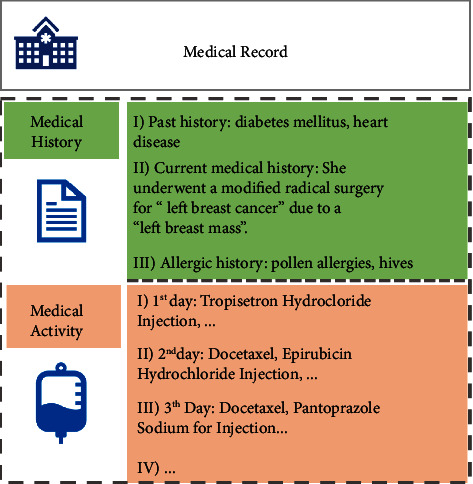
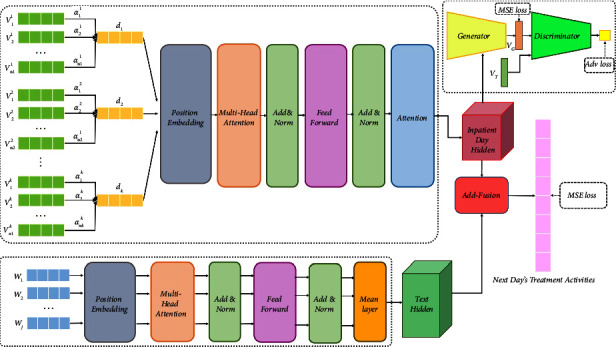
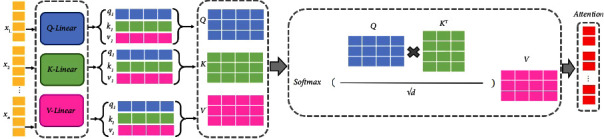
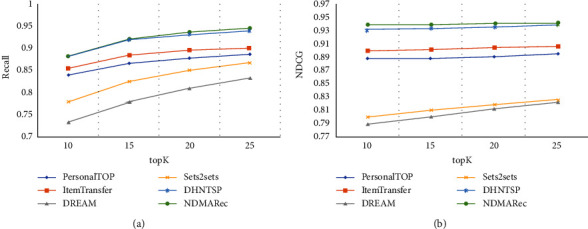
Verification
Claims the paper makes
The claims and statistics of this paper haven’t been checked yet.
Run the check — free, no account needed. It reads the open-access text and checks the sources it cites.
Claims other papers make about this one
Each is checked against this paper’s own text: does it say what the citing paper says it does?
The source backs part of the claim, not all of it — or backs it for a different population, condition or comparison.
In the citing paper
“Synthetic data generation using generative models can create realistic, diverse data sets that mimic real-world multimodal medical scenarios, thus expanding the training data set without compromising privacy or ethical standards [149-151].”
From Multimodal Large Language Models in Health Care: Applications, Challenges, and Future Outlook. (2024) · cites this paper as [150]
Experimental — accuracy not yet measured
Self-check
Percentages, sums and reported differences re-computed from the paper’s own numbers.
The self-check needs the paper’s full text.
Citations
Cites
Deep Residual Learning for Image Recognition
He, K., Zhang, X., Ren, S., & Sun, J. (2016) · 2016 IEEE Conference on Computer Vision and Pattern Recognition (CVPR) · doi:10.1109/cvpr.2016.90 · Cited by 235,474
Adam: A Method for Stochastic Optimization
Kingma, D. P., & Ba, J. (2014) · arXiv · doi:10.48550/arxiv.1412.6980 · Cited by 98,946
Jakubův, J., Chvalovský, K., Goertzel, Z., et al. (2023) · DROPS (Schloss Dagstuhl – Leibniz Center for Informatics) · doi:10.4230/lipics.itp.2023.19 · Cited by 76,648
Swin Transformer: Hierarchical Vision Transformer using Shifted Windows
Liu, Z., Lin, Y., Cao, Y., Hu, H., Wei, Y., Zhang, Z., Lin, S., & Guo, B. (2021) · 2021 IEEE/CVF International Conference on Computer Vision (ICCV) · doi:10.1109/iccv48922.2021.00986 · Cited by 35,534
Labaca-Castro, R. (2023) · Springer eBooks · doi:10.1007/978-3-658-40442-0_9 · Cited by 21,119
Advances in Neural Information Processing Systems 19
(2007) · The MIT Press eBooks · doi:10.52202/085713 · Cited by 16,043
Layer NormalizationPreprint
Ba, J., Kiros, J., & Hinton, G. E. (2016) · arXiv.org · doi:10.48550/arxiv.1607.06450 · Cited by 13,762
BioBERT: a pre-trained biomedical language representation model for biomedical text mining
Lee, J., Yoon, W., Kim, S., Kim, D., Kim, S., So, C. H., & Kang, J. (2020) · Bioinformatics · doi:10.1093/bioinformatics/btz682 · Cited by 7,218
Self-Attentive Sequential Recommendation
Kang, W.-C., & McAuley, J. (2018) · Proceedings · doi:10.1109/icdm.2018.00035 · Cited by 3,730
A Review on Multi-Label Learning Algorithms
Zhang, M.-L., & Zhou, Z. (2013) · IEEE Transactions on Knowledge and Data Engineering · doi:10.1109/tkde.2013.39 · Cited by 3,336
Research works printed but not linked: 2
- M. Zaheer, 2020, Big Bird: Transformers for Longer Sequences, 17283
- X. He, Trirank: review-aware explainable recommendation by modeling aspects, 1661
Cited by
Sorted by citations
Multimodal Large Language Models in Health Care: Applications, Challenges, and Future Outlook.
AlSaad, R., Abd-alrazaq, A., Boughorbel, S., Ahmed, A., Renault, M.-A., Damseh, R., & Sheikh, J. (2024) · Journal of medical Internet research · doi:10.2196/59505 · Cited by 349
Metadata
- Authors
- Li, W., Yang, J., & Min, X.
- Affiliations
- Northeastern University (CN)
- Corresponding author
- Li, Wei
- Venue
- Journal of Healthcare Engineering
- Publisher
- Wiley
- Published
- 2022-11-07
- Volume
- 2022
- Pages
- 1-14
- ISSN
- 2040-2295 (ISSN-L)
- 2040-2309
- PMC
- PMC9663225
- OpenAlex
- W4308393531
- Cited by
- 2
- References
- 36
- Citations by year
- 2026: 1 · 2024: 1
- FWCI
- 0.08
- Type
- journal article
- Language
- en
- Open access
- hybrid
- doi.org
- Locations
- Journal of Healthcare Engineering (publishedVersion, cc-by)
- PubMed Central (publishedVersion, cc-by)
- PubMed (publishedVersion)
- DOAJ (DOAJ: Directory of Open Access Journals) (submittedVersion)
- Funders
- National Basic Research Program of China (2021YFC2701003, N2016006)
- Fundamental Research Funds for the Central Universities (2021YFC2701003, N2016006)
- Topics
- Physical Sciences › Computer Science › Artificial Intelligence › Machine Learning in Healthcare
- Physical Sciences › Computer Science › Information Systems › Recommender Systems and Techniques
- Health Sciences › Medicine › Health Informatics › Artificial Intelligence in Healthcare and Education
- Keywords
- soft attention, self-attention, personalized recommendation, generative adversarial networks, adversarial training, clinical decision support, hospital data
- MeSH terms
- Computer Simulation, Delivery of Health Care, Humans, Neural Networks, Computer
About these checks
Registry, retraction, Cites and statistics results are computed, not judged, with one exception: a printed reference that no index lists is read once by a model before it counts as a citation error. Claims are extracted by a model and kept only when their quote appears verbatim in the text; each cited source is then checked, with a model’s help, for whether it says what the claim relies on. Those verdicts can be wrong — read the claim’s quote and the cited source before relying on one.
Statistics and arithmetic are recomputed, not judged.
Confidence bands are shown only for fields calibrated on our annotated test set. None is calibrated yet, so no band is shown.
What counts as a claim ›How we measure confidence ›How we check this ›
Are you an author, or do you see a problem with this page? Request a review
