

AI Trust: Can Explainable AI Enhance Warranted Trust?
Open accessThe DOI matches its Crossref record; 54 of the 59 references it cites were found in a registry or an index; 7 of the 11 sources its claims cite were checked for support.
Abstract
Explainable artificial intelligence (XAI), known to produce explanations so that predictions from AI models can be understood, is commonly used to mitigate possible AI mistrust. The underlying premise is that the explanations of the XAI models enhance AI trust. However, such an increase may depend on many factors. This article examined how trust in an AI recommendation system is affected by the presence of explanations, the performance of the system, and the level of risk. Our experimental study, conducted with 215 participants, has shown that the presence of explanations increases AI trust, but only in certain conditions. AI trust was higher when explanations with feature importance were provided than with counterfactual explanations. Moreover, when the system performance is not guaranteed, the use of explanations seems to lead to an overreliance on the system. Lastly, system performance had a stronger impact on trust, compared to the effects of other factors (explanation and risk).
Overview
CoChat Summary
## TL;DR
This experiment tested whether explainable AI increases trust in an AI recommender system, using a mushroom-judgment game with 215 participants. Explanations helped trust in some cases—especially feature-importance explanations (LIME)—but AI performance had a stronger effect than explanations or risk.
## Key findings
- In the main sample, 211 participants remained after attention checks; the study used a 3 × 2 × 2 design with XAI type, risk level, and model performance.
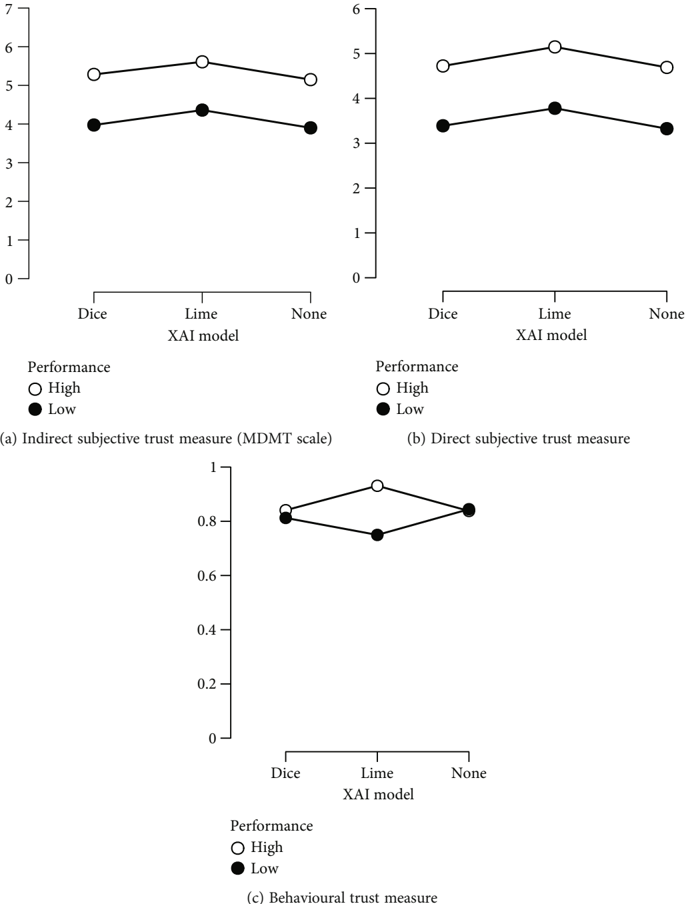
- High AI performance increased all five measured outcomes: MDMT (5.34 vs 4.05), direct subjective trust (4.84 vs 3.46), behavioral trust (0.87 vs 0.80), AI understandability (4.53 vs 3.92), and XAI quality (4.85 vs 4.11); all were significant at p < 0.001.
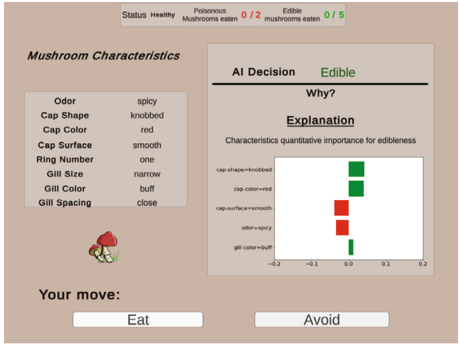
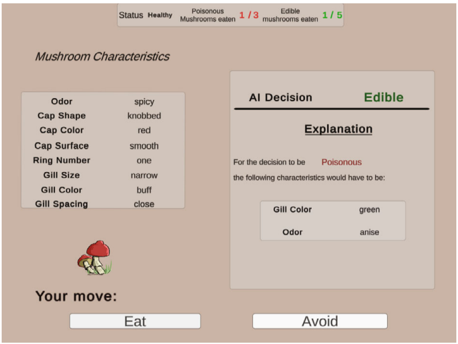
- Feature-importance explanations (LIME) outperformed counterfactual explanations (DICE) and control on self-reported trust and understanding: MDMT (4.98 vs 4.60 and 4.50), AI understandability (4.70 vs 3.99 and 4.00), and XAI quality (5.01 vs 4.40 and 4.04).
- Behavioral trust depended on an XAI × performance interaction (F2,205 = 25.40, p < 0.001, η²p = 0.20): with high performance, LIME had the highest adherence to recommendations (0.93 ± 0.02), but with low performance LIME had the lowest adherence (0.75 ± 0.02) versus DICE (0.81 ± 0.02) and control (0.84 ± 0.02).
- Risk mattered mainly when performance was low: in that case, trust and related ratings were lower in the high-risk condition than the low-risk condition; the paper reports delegation was more pronounced in low risk when performance was low (χ²1 = 9.52, p = 0.002).
## Methods
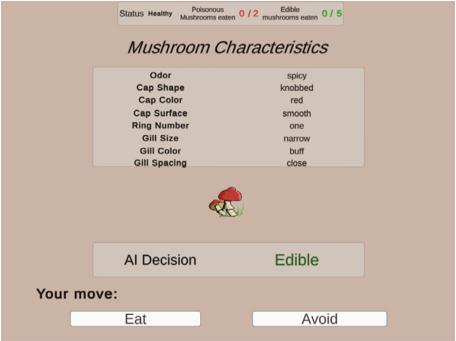
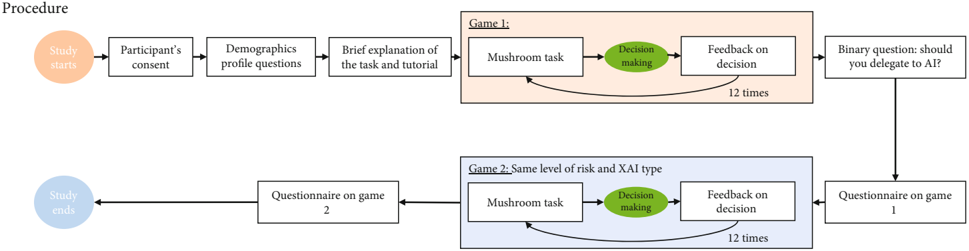
- Experimental user study built around a web-based mushroom game in which participants made 12 eat/avoid decisions per round with advice from an AI recommender system.
- Participants were recruited from Prolific; 215 were recruited, 211 remained after attention checks, and they were non-experts presumed to be lay users. The sample included 114 women, 94 men, and 3 nonbinary participants; mean age was 27 years.
- XAI type was between-subjects (LIME feature importance, DICE counterfactuals, or no explanation), risk was between-subjects (high vs low), and AI performance was within-subjects (high vs low, counterbalanced). Analysis used mixed-design ANOVA in SPSS 26 plus a chi-squared test for delegation, with Bonferroni correction.
## Limitations
- The paper states it only examined two XAI categories: counterfactual explanations and feature-importance explanations.
- The authors note the study used online participants assumed to be lay users, so findings may not extend directly to expert–AI collaboration. They also say the trustworthiness meaning of the 60% “low performance” condition is debatable and may not generalize to even lower-performance systems.
- Evident from the text: the study used a game-based mushroom task, so external validity to other real-world decision contexts is limited.
Model-written summary. Check it against the paper before relying on it.
Integrity signals
Registry
Cites
Statistics
Figures
Verification
Claims the paper makes
5 Valid · 1 Not valid · 4 Not checked · 71 Own results and interpretations
A result the paper reports from its own data — it cites no other source for it, so there is none to check. The quote shows it is in the paper.
In the paper
“However, in cases where performance was lower, participants in the LIME condition (0 75 ± 0 02) displayed significantly reduced behavioural trust compared to the other two conditions (0 81 ± 0 02 in DICE and 0 84 ± 0 02 in the control condition).”
§ AI Trust: Can Explainable AI Enhance Warranted Trust? > 5.2. Behavioural Trust and Delegation.
plainstates a cause- Asserted: passes — The authors put it forward as true.
- Checkable: passes — It can be checked against evidence.
- Load-bearing: passes — The paper’s conclusions depend on it.
- Based: passes — The paper gives a reason why it holds.
A result the paper reports from its own data — it cites no other source for it, so there is none to check. The quote shows it is in the paper.
In the paper
“Furthermore, the XAI factor exhibits a significant main effect on MDMT, AI understandability, and XAI quality.”
§ AI Trust: Can Explainable AI Enhance Warranted Trust? > 5.1. Self-Reported Measures.
plainstates a cause- Asserted: passes — The authors put it forward as true.
- Checkable: passes — It can be checked against evidence.
- Load-bearing: passes — The paper’s conclusions depend on it.
- Based: passes — The paper gives a reason why it holds.
A result the paper reports from its own data — it cites no other source for it, so there is none to check. The quote shows it is in the paper.
In the paper
“An intriguing discovery from the research was that explanations can increase trust in AI even when the AI model itself is not reliable.”
§ AI Trust: Can Explainable AI Enhance Warranted Trust? > 8. Conclusion
plainstates a cause- Asserted: passes — The authors put it forward as true.
- Checkable: passes — It can be checked against evidence.
- Load-bearing: passes — The paper’s conclusions depend on it.
- Based: passes — The paper gives a reason why it holds.
- Rests on an assumption not shown here.
A result the paper reports from its own data — it cites no other source for it, so there is none to check. The quote shows it is in the paper.
In the paper
“Participants' compliance with recommendations did not differ based on risk, even when the model's performance was low.”
§ AI Trust: Can Explainable AI Enhance Warranted Trust? > 5.2. Behavioural Trust and Delegation.
plain- Asserted: passes — The authors put it forward as true.
- Checkable: passes — It can be checked against evidence.
- Load-bearing: unclear — It is unclear whether the paper’s conclusions depend on it.
- Based: passes — The paper gives a reason why it holds.
A result the paper reports from its own data — it cites no other source for it, so there is none to check. The quote shows it is in the paper.
In the paper
“In terms of subjective trust measures, it becomes evident that when the AI model's performance is reduced, reported trust diminishes in comparison to instances where the system performs better.”
§ AI Trust: Can Explainable AI Enhance Warranted Trust? > Dependent variable
boostedstates a cause- Asserted: passes — The authors put it forward as true.
- Checkable: passes — It can be checked against evidence.
- Load-bearing: passes — The paper’s conclusions depend on it.
- Based: passes — The paper gives a reason why it holds.
41 more claims
Create a free account to see all 81 claims and every source verdict.
- Probably not a substantial claim. 16
- It may state two separate claims as one. 21
- The quote only partly states this claim. 1
Self-check
Percentages, sums and reported differences re-computed from the paper’s own numbers.
Each contradiction between two passages listed here was confirmed by an independent check.
Rated minor: it would not touch a result — a value no result rests on, a p-value that stays on the same side of the significance level, or a conflict that is clerical, resolved elsewhere in the paper, or outside its own findings.
In the paper
§ AI Trust: Can Explainable AI Enhance Warranted Trust? > 4.5. Outcomes.
“To evaluate subjective trust in the AI system, we employed two measures: (1) The multidimensional measure of trust (MDMT) [40], which gauges indirect subjective trust through participants' assessments of eight-related traits associated with the AI system”
§ AI Trust: Can Explainable AI Enhance Warranted Trust? > References
“40. D. Dua and C. Graff, UCI Machine Learning Repository, 2017.”
Rated minor: it would not touch a result — a value no result rests on, a p-value that stays on the same side of the significance level, or a conflict that is clerical, resolved elsewhere in the paper, or outside its own findings.
In the paper
§ AI Trust: Can Explainable AI Enhance Warranted Trust? > 4.2. AI Model Development.
“This dataset contains 8124 entries, encompassing 22 categorical variables and a binary target variable indicating the mushroom's edibility.”
§ AI Trust: Can Explainable AI Enhance Warranted Trust? > References
“39. R. C. Mayer, J. H. Davis, and F. D. Schoorman, "An integrative model of organizational trust," Academy of Management Review, vol. 20, no. 3, pp. 709-734, 1995.”
Citations
Cites
A Unified Approach to Interpreting Model Predictions
Lundberg, S., & Lee, S.-I. (2017) · arXiv · doi:10.48550/arxiv.1705.07874 · Cited by 23,707
"Why Should I Trust You?": Explaining the Predictions of Any Classifier
Ribeiro, M. T., Singh, S., & Guestrin, C. (2016) · Proceedings of the 22nd ACM SIGKDD International Conference on Knowledge Discovery and Data Mining · doi:10.1145/2939672.2939778 · Cited by 17,555
Advances in Neural Information Processing Systems 29
Teymur, O., Zygalakis, K., & Calderhead, B. (2016) · Cited by 13,887
Arrieta, A. B., Díaz-Rodríguez, N., Del Ser, J., Bennetot, A., Tabik, S., Barbado, A., García, S., Gil-López, S., Molina, D., Benjamins, R., et al. (2019) · arXiv · doi:10.48550/arxiv.1910.10045 · Cited by 11,321
An integrative model of organizational trust
Mayer, R. C., Davis, J. H., & Schoorman, F. D. (1995) · The Academy of Management Review · doi:10.2307/258792 · Cited by 10,736
Rudin, C. (2019) · Nature Machine Intelligence · doi:10.1038/s42256-019-0048-x · Cited by 10,561
Barredo Arrieta, A., Díaz-Rodríguez, N., Del Ser, J., Bennetot, A., Tabik, S., Barbado, A., Garcia, S., Gil-Lopez, S., Molina, D., Benjamins, R., et al. (2020) · Information Fusion · doi:10.1016/j.inffus.2019.12.012 · Cited by 10,423
“Why Should I Trust You?”: Explaining the Predictions of Any Classifier
Ribeiro, M., Singh, S., & Guestrin, C. (2016) · Proceedings of the 2016 Conference of the North American Chapter of the Association for Computational Linguistics: Demonstrations · doi:10.18653/v1/n16-3020 · Cited by 6,682
Explanation in Artificial Intelligence: Insights from the Social Sciences
Miller, T. (2017) · arXiv · doi:10.48550/arxiv.1706.07269 · Cited by 5,338
Explanation in artificial intelligence: Insights from the social sciences
Miller, T. (2019) · Artificial Intelligence · doi:10.1016/j.artint.2018.07.007 · Cited by 5,302
Research works printed but not linked: 1
- 18. Guyon, U. V. Luxburg, S. Bengio, H. Wallach, R. Fergus, S. Vishwanathan, and R. Garnett, Eds., pp. 4765-4774, Curran Associates, Inc., 2017.
Cited by
Shifa, N., Saleh, M., Akbari, Y., & Al Maadeed, S. (2025) · Clinical Imaging · doi:10.1016/j.clinimag.2025.110492 · Cited by 45
Silalahi, A. D. K. (2025) · Technology in Society · doi:10.1016/j.techsoc.2025.102995 · Cited by 53
Choudhury, A., Shahsavar, Y., & Shamszare, H. (2025) · JMIR Human Factors · doi:10.2196/72867 · Cited by 46
“For example, prior research has shown that while user engagement may be generated through conversational style and interactive query handling, these features fall short in fostering enduring user reliance without a foundational trust in the response quality [34,35] or robust data governance.”
Aquilino, L., Dio, C. D., Manzi, F., Massaro, D., Bisconti, P., & Marchetti, A. (2025) · Informatics · doi:10.3390/informatics12030070 · Cited by 44
“Nine papers studied trust in decision-making assistants [47,50,60,71,76,80,83,85,88].”
InfluentialBetween transparency and trust: identifying key factors in AI system perception
Cetinkaya, N. E., & Krämer, N. (2025) · Behaviour and Information Technology · doi:10.1080/0144929x.2025.2533358 · Cited by 46
“Each attribute contributes to overall trust in a distinct manner (Angerschmid et al. 2022; De Brito Duarte et al. 2023; Dorton and Harper 2022; Shin 2021; Wischnewski, Krämer, and Müller 2023).”
Investigating Trust in Human-AI Collaboration for a Speech-Based Data Analytics Task
Tutul, A. A., Nirjhar, E. H., & Chaspari, T. (2024) · International Journal of Human-Computer Interaction · doi:10.1080/10447318.2024.2328910 · Cited by 28
“This aligns with similar findings in prior studies, such as the work by Sharan and Romano (2020), which also identified a moderate positive correlation between self-reported and behavioral measures of trust, the latter captured via reaction time and user agreement with the AI.”
InfluentialFreel, A., Pias, S. B. H., Šabanović, S., & Kapadia, A. (2025) · Proceedings of the 2025 ACM Conference on Fairness, Accountability, and Transparency · doi:10.1145/3715275.3732187 · Cited by 11
Phuong, D. T. T., Silalahi, A. D. K., Chang, W., Tedjakusuma, A. P., & Eunike, I. J. (2025) · Business Strategy & Development · doi:10.1002/bsd2.70122 · Cited by 12
Je-Gal, H., Park, Y.-S., Park, S.-H., Kim, J.-U., Yang, J.-H., Kim, S., & Lee, H.-S. (2024) · Journal of Marine Science and Engineering · doi:10.3390/jmse12081296 · Cited by 16
The Amplifying Effect of Explainability in AI-assisted Decision-making in Groups
Duarte, R. D. B., Abreu, M. C., Campos, J., & Paiva, A. (2025) · CHI Conference on Human Factors in Computing Systems · doi:10.1145/3706598.3713534 · Cited by 19
“Different types of explanations have been shown to yield varied effects, and feature importance explanations, in particular, can elicit multiple responses in terms of trust and reliance [14, 16].”
InfluentialSelf-citationSuryadi, N., Zulfikar, R., Prasarry, Y. V., & Islam, M. F. (2025) · Cogent Social Sciences · doi:10.1080/23311886.2025.2526799 · Cited by 15
“…an ai product, that knowledge does not necessarily increase or decrease their trust in that technology. trust is more influenced by external factors such as brand reputation, personal experience, or social influence, which are more emotional and subjective in nature (de Brito duarte et al., 2023).”
Liu, X., Chen, Y., Guan, W., Jiang, P., Yan, L., Fan, M., & Zhou, Q. (2025) · Journal of Advanced Nursing · doi:10.1111/jan.70250 · Cited by 9
“Moreover, involving nurses in decision-making regarding AI implementation may foster a greater sense of ownership and trust in these technologies (De Brito Duarte et al. 2023).”
Silalahi, A. D. K. (2024) · SSRN Electronic Journal · doi:10.2139/ssrn.5037486 · Cited by 3
Fan, G. F., Liu, D., & Huang, Y. (2025) · International Journal of Human-Computer Interaction · doi:10.1080/10447318.2025.2574513 · Cited by 4
“Studies on user perception of automated content suggest that trust is contingent on multiple factors, such as prior familiarity with AI, perceived system transparency, and the broader context of use (de Brito Duarte et al., 2023; Markowitz, 2024).”
Mondol, R. K., Millar, E. K. A., Graham, P., Browne, L. H., Sowmya, A., & Meijering, E. H. W. (2025) · Computers in Biology and Medicine · doi:10.1016/j.compbiomed.2025.111106 · Cited by 10
Song, H., Kim, J., Kim, M., Kwak, D., Shin, M., Suh, B., & Jung, H. (2026) · CHI Conference on Human Factors in Computing Systems · doi:10.1145/3772318.3790752 · Cited by 1
Autonomy in Transition: AI, Self-Identity, and the Evolution of Human Agency
Margondai, A., Willox, S., & Mouloua, M. (2025) · Proceedings of the Human Factors and Ergonomics Society Annual Meeting · doi:10.1177/10711813251364790 · Cited by 7
“Evidence from 12 XAI studies (N = 3,127) suggests that explainable AI enhances trust (d = 0.52, 95% CI [0.38, 0.66]) (de Brito Duarte et al., 2023), with transparency mechanisms facilitating confident engagement.”
InfluentialIn Search of Answers: Supporting Educators to Understand AI Through Heuristic Thinking
Anthis, Z., & Mavrikis, M. (2025) · Lecture notes in computer science · doi:10.1007/978-3-031-98459-4_9 · Cited by 4
Akgun, M., & Toker, S. (2026) · Proceedings of the 2026 CHI Conference on Human Factors in Computing Systems · doi:10.1145/3772318.3790980 · Cited by 2
Non-experts’ Trust in XAI is Unreasonably High
Brdnik, S., Colakovic, I., & Karakatič, S. (2025) · Communications in computer and information science · doi:10.1007/978-3-032-08333-3_9 · Cited by 5
Algocracy in the Judiciary: Challenging Trust in the System
Rojas, M. L. F. (2025) · Revista de Estudios Sociales · doi:10.7440/res93.2025.06 · Cited by 3
Yim, C., & Lin, C. A. (2026) · Telematics and Informatics · doi:10.1016/j.tele.2026.102405 · Cited by 1
Willingness to buy at AI powered retail stores in Saudi Arabia: Empirical study
Alam, S. S. (2026) · Electronic Markets · doi:10.1007/s12525-025-00865-w · Cited by 2
“Studies demonstrate that higher levels of AIT reduce perceptions of PR by increasing consumer confidence in the system’s reliability and functionality (de Brito Duarte et al., 2023; Xiong et al., 2023).”
Möhle, M. H., Zall, M., Thorwart-Gumpert, T., Elbert, N., Thiesse, F., & Flath, C. M. (2026) · Lecture notes in computer science · doi:10.1007/978-3-032-30860-3_30 · Cited by 3
Trust Me, I'm Probably Right: Investigating AI Explanations for Establishing Appropriate Trust
Hartvig, F. D., Egelund, A. L., & Elmqvist, N. (2026) · International Conference on Advanced Visual Interfaces (AVI) · doi:10.1145/3811427.3811445 · Cited by 1
“While prior work has examined how different explanation types influence trust [7, 19, 41], less attention has been paid to how variations within the same explanation type impact trust.”
Venkateswaran, P. S., Manimaran, S., & Suba, S. (2026) · Advances in computational intelligence and robotics book series · doi:10.4018/979-8-3373-9195-3.ch001 · Cited by 1
From Acceptance to Thinking Partner
Wu, M. (2026) · Springer eBooks · doi:10.1007/978-3-032-15872-7_9
Zhang, H., Zhu, X., Liu, T., & Zhang, L. (2026) · Journal of Renewable and Sustainable Energy · doi:10.1063/5.0308980
Affective Explanations for Autonomous Vehicles: From Framework to Scenario-Based Design Guidelines
Jin, S., Zhu, Y., Chen, X., Liu, M. Q., & Wang, S. J. (2026) · Designing Interactive Systems Conference · doi:10.1145/3800645.3812927
“While core factual information is essential for establishing trust [15, 72, 126], excessive detail or redundancy may trigger anxiety or negative emotions.”
The Impact of Explanation Characteristics on the Effects of Recommender Systems Explanations
Wardatzky, K., Inel, O., Rossetto, L., Kyriakou, A., & Bernstein, A. (2026) · ACM Computing Surveys · doi:10.1145/3856207
Phan, T. M., & Pham, N. B. M. (2026) · Asian Journal of Business Ethics · doi:10.1007/s13520-026-00264-0 · Cited by 1
Mohammad, Z. (2026) · Journal of Applied Finance and Banking · doi:10.47260/jafb/1661
Explanation Transparency and Trust Perception After Generative AI Failure: A Dual-Path Model
Yang, Q., & Dong, H. (2026) · International Journal of Human-Computer Interaction · doi:10.1080/10447318.2026.2734323
Verma, M., & Beg, M. J. (2026) · Advances in computational intelligence and robotics book series · doi:10.4018/979-8-3373-1325-2.ch003
Innocent, D. C., Innocent, R. C., & Innocent, I. P. (2026) · Frontiers in Tropical Diseases · doi:10.3389/fitd.2026.1894145
Wright, L., Legarda, I., Lasa, G., & Escallada, O. (2026) · Open Research Europe · doi:10.12688/openreseurope.22034.1 · Cited by 2
How AI transforms the workplace: implications for creativity, risk-taking and social innovation
Hassanzadeh, M., Arabkarami, S., Farivar, F., & Olfat, M. (2026) · Aslib Journal of Information Management · doi:10.1108/ajim-05-2025-0289 · Cited by 1
Dasirin, S. A. P., Styawan, A. A., & Ghozali, M. T. (2025) · International Conference on Electronic and Electrical Engineering and Intelligent System (ICE3IS) · doi:10.1109/ice3is66769.2025.11281276 · Cited by 1
“Visualization tools, rule-based reasoning systems, and post-hoc interpretability methods can assist both patients and pharmacists understand chatbot-generated recommendations, therefore encouraging confidence and regulatory compliance [53].”
Sahin, A., & ŞAHİN, A. (2026) · Advances in computational intelligence and robotics book series · doi:10.4018/979-8-3373-9159-5.ch003
Nejat, S., Goudarzi, F. A., Khanjanzadeh, N., & Firoozjaei, A. A. (2026) · Journal of Islamic marketing · doi:10.1108/jima-08-2025-0524 · Cited by 1
Ravikumar, R. N., & Aarthi, S. (2026) · Advances in computational intelligence and robotics book series · doi:10.4018/979-8-3373-8217-3.ch002
(2025) · doi:10.1109/eecsi67060.2025.11290147
“The presence of explanations, particularly those that emphasize feature importance, has been shown to increase trust in AI systems, although this trust is contingent on the system’s performance and the context in which it is applied [23].”
Anywar, M., Maron, E., & Ross, P. (2026) · doi:10.2196/preprints.101569
Assistant Robots with an Agenda foster Uncooperative Behaviors *
Brito, J., Duarte, R. D. B., Fonseca, H. C., Campos, J., Correia, F., & Paiva, A. (2025) · IEEE RO-MAN · doi:10.1109/ro-man63969.2025.11217891 · Cited by 2
“Research on robots assisting decision-making often focuses on nonmoral, objective contexts [25], [14], [15], [26].”
Self-citationHasim, N. K., Zainon, N., & Salleh, H. (2026) · International Journal of Building Pathology and Adaptation · doi:10.1108/ijbpa-03-2026-0086
Andrianto, T., Susanto, E., Nguyen, M. C., Fakfare, P., & Tangit, T. M. (2026) · Journal of Hospitality and Tourism Technology · doi:10.1108/jhtt-09-2025-0765 · Cited by 2
An Example Showing Lime Explanation Instability Across Semantically Equivalent Teacher QuestionsPreprint
Ramadhani, D. G., Muna, N. I., Harjono, H., & Sumarti, S. S. (2025) · SSRN Electronic Journal · doi:10.2139/ssrn.5261678
Toudjui, S., Tang, J., Akhter, H., Cho, E., Côté, É., & Plaks, J. E. (2026) · Discover Artificial Intelligence · doi:10.1007/s44163-026-02150-x · Cited by 1
Drawing Attributions From Evolved Counterfactuals
Jakubík, J., & Kwaśnicka, H. (2024) · Genetic and Evolutionary Computation Conference Companion (GECCO Companion) · doi:10.1145/3638530.3664122 · Cited by 1
Acceptance of AI in Education Systems: An Analysis Based on User Perceptions
Nanang, H., Sukmana, H. T., Durachman, Y., Khairani, D., Arifin, V., & Sobri, M. (2025) · International Conference on Informatics and Computing (ICIC) · doi:10.1109/icic68054.2025.11309657 · Cited by 1
“AI technology uses algorithms, which affect trust which includes the provision and transparency of how the algorithm works, the reliability and actions of the AI, the risk factors associated with the predictive model, and the correctness of the AI predictions [8][12][7].”
Metadata
- Authors
- de Brito Duarte, R., Correia, F., Arriaga, P., & Paiva, A.
- Affiliations
- INESC-ID, Instituto Superior Técnico, Universidade de Lisboa, Portugal
- University of Lisbon (PT)
- ISCTE-Instituto Universitário de Lisboa (IUL), CIS-IUL, Lisboa, Portugal
- Instituto de Engenharia de Sistemas e Computadores Investigação e Desenvolvimento (PT)
- Venue
- Human Behavior and Emerging Technologies
- Publisher
- Wiley
- Published
- 2023-10-31
- Volume
- 2023
- Pages
- 1-12
- ISSN
- 2578-1863 (ISSN-L)
- OpenAlex
- W4388040162
- Cited by
- 52
- References
- 59
- Citations by year
- 2026: 26 · 2025: 22 · 2024: 4
- FWCI
- 4.89
- Type
- journal article
- Language
- en
- Open access
- gold
- doi.org
- Locations
- Human Behavior and Emerging Technologies (publishedVersion, cc-by)
- DOAJ (DOAJ: Directory of Open Access Journals) (submittedVersion, cc-by-sa)
- Repositório do ISCTE-IUL (submittedVersion, other-oa)
- Funders
- LARSyS (UIDP/50009/2020, LA/P/0083/2020, UIDB/50021/2020, C628696807-00454142, H2020-ICT-48-2020/952215, H2020-ICT-48-2020/952026)
- INESC-ID (UIDP/50009/2020, LA/P/0083/2020, UIDB/50021/2020, C628696807-00454142, H2020-ICT-48-2020/952215, H2020-ICT-48-2020/952026)
- Topics
- Physical Sciences › Computer Science › Artificial Intelligence › Explainable Artificial Intelligence (XAI)
- Physical Sciences › Computer Science › Artificial Intelligence › Ethics and Social Impacts of AI
- Social Sciences › Human Factors and Ergonomics › Human-Automation Interaction and Safety
- Keywords
- explainable AI, trust in AI, AI recommendation systems, counterfactual explanations, system performance, risk perception, overreliance on AI
About these checks
Registry, retraction, Cites and statistics results are computed, not judged, with one exception: a printed reference that no index lists is read once by a model before it counts as a citation error. Claims are extracted by a model and kept only when their quote appears verbatim in the text; each cited source is then checked, with a model’s help, for whether it says what the claim relies on. Those verdicts can be wrong — read the claim’s quote and the cited source before relying on one.
The claim verdicts this report counts are experimental: their accuracy is not yet measured.
A language model drew the claims from the paper on 2026-10-10, under version 3 of the claim definition (model deepseek-v4.1-flash, prompt extract-v3).
A second model labelled each claim on 2026-10-10 (model jev-1.13-20260917, definition revision gold-guideline-v0.2).
Statistics and arithmetic are recomputed, not judged.
Confidence bands are shown only for fields calibrated on our annotated test set. None is calibrated yet, so no band is shown.
What counts as a claim ›How we measure confidence ›How we check this ›
Are you an author, or do you see a problem with this page? Request a review
Data sources
Bibliographic data: Semantic Scholar, OpenAlex, Crossref.
Contains information from the Semantic Scholar Academic Graph Datasets, made available under the ODC Attribution License (ODC-BY 1.0).
Semantic Scholar’s data is described in: Kinney, R., et al. (2023). The Semantic Scholar Open Data Platform. arXiv:2301.10140.
