

The DOI matches its Crossref record; 41 of the 41 references it cites were found in a registry or an index; 2 of the 8 sources its claims cite were checked for support.
Realtime Vehicle Tracking Method Based on YOLOv5 + DeepSORT
Open accessAbstract
In actual traffic scenarios, the environment is complex and constantly changing, with many vehicles that have substantial similarities, posing significant challenges to vehicle tracking research based on deep learning. To address these challenges, this article investigates the application of the DeepSORT (simple online and realtime tracking with a deep association metric) multitarget tracking algorithm in vehicle tracking. Due to the strong dependence of the DeepSORT algorithm on target detection, a YOLOv5s_DSC vehicle detection algorithm based on the YOLOv5s algorithm is proposed, which provides accurate and fast vehicle detection data to the DeepSORT algorithm. Compared to YOLOv5s, YOLOv5s_DSC has no more than a 1% difference in optimal mAP0.5 (mean average precision), precision rate, and recall rate, while reducing the number of parameters by 23.5%, the amount of computation by 32.3%, the size of the weight file by 20%, and increasing the average processing speed of each image by 18.8%. After integrating the DeepSORT algorithm, the processing speed of YOLOv5s_DSC + DeepSORT reaches up to 25 FPS, and the system exhibits better robustness to occlusion.
Overview
CoChat Summary
TL;DR
The paper proposes a vehicle tracking pipeline that combines an improved YOLOv5s detector (YOLOv5s_DSC) with DeepSORT to improve realtime performance and robustness in occluded traffic scenes. On their reported test setup, the combined system reaches 25 FPS and the detector keeps mAP0.5, precision, and recall within 1% of YOLOv5s while reducing parameters, FLOPS, and model size.
Key findings
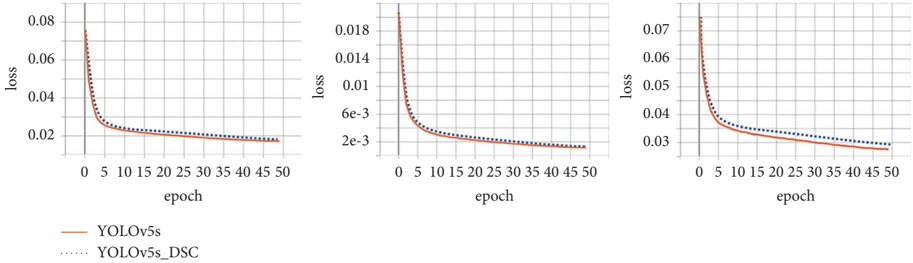
- YOLOv5s_DSC is reported to differ from YOLOv5s by no more than 1% in optimal mAP0.5, precision, and recall, while reducing parameters by 23.5%, computation by 32.3%, and weight-file size by 20%; average image processing speed increases by 18.8%.
- In Table 5, YOLOv5s reports mAP0.5 = 0.993, mAP0.5:0.95 = 0.865, accuracy = 0.981, recall = 0.983, parameters = 7,071,633, computation = 16.4 GFLOPS, and model size = 14.4 M; YOLOv5s_DSC reports mAP0.5 = 0.993, mAP0.5:0.95 = 0.851, accuracy = 0.980, recall = 0.976, parameters = 5,622,481, computation = 12.3 GFLOPS, and model size = 11.5 M.
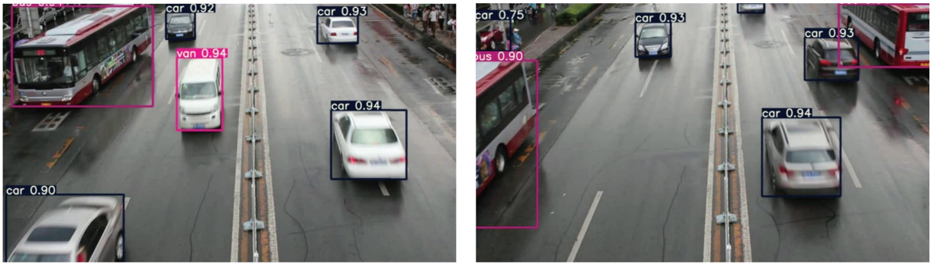
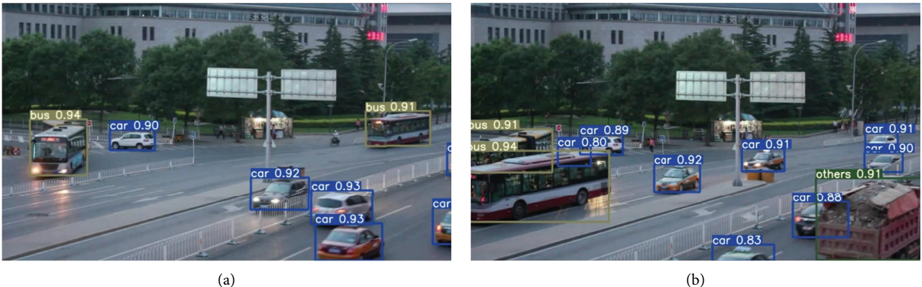
- After integrating DeepSORT, the YOLOv5s_DSC + DeepSORT system reaches up to 25 FPS and is described as more robust to occlusion.
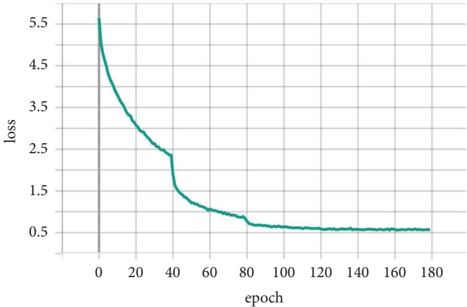
- The DeepSORT appearance network trained on the vehicle re-recognition dataset reaches 88% test accuracy after 100 epochs.
Methods
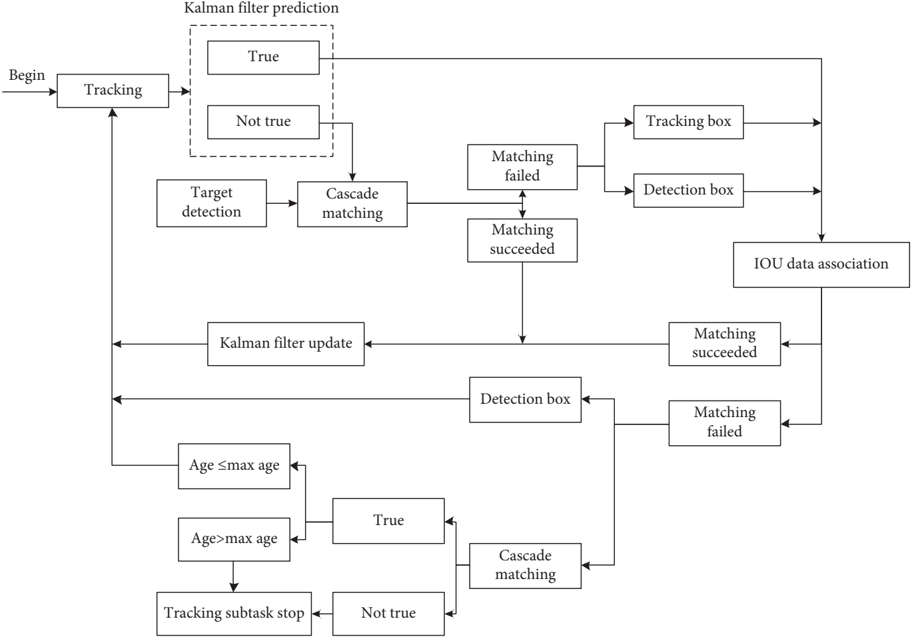
- The study proposes a two-stage vehicle tracking framework: YOLOv5s_DSC for vehicle detection followed by DeepSORT for multi-object tracking, using Kalman filtering and Hungarian matching with Mahalanobis distance plus cosine appearance distance.
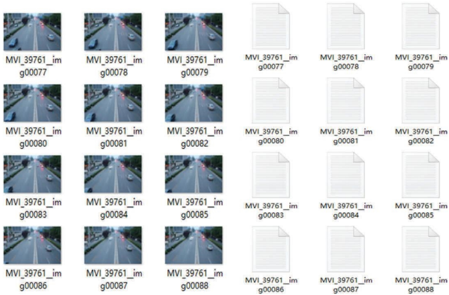
- Experiments use the VeRi dataset for training the DeepSORT re-identification network and the UA-DETRAC dataset for training/evaluating YOLOv5s and YOLOv5s_DSC; the VeRi split is 8:1 and UA-DETRAC is split 9:1, with 73,876 training and 8,209 test images reported for UA-DETRAC.
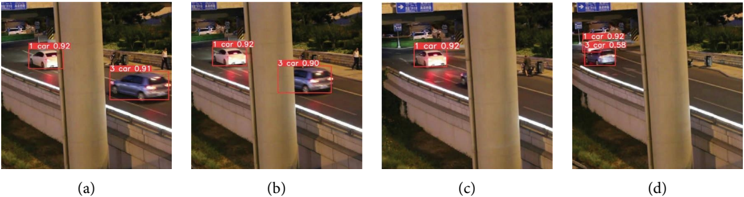
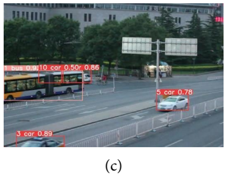
- The main analysis compares YOLOv5s and YOLOv5s_DSC on mAP, precision, recall, parameter count, GFLOPS, model size, and image processing speed, and then verifies tracking on traffic videos with frontal and oblique views plus occlusion scenarios.
Limitations
- The authors state that the algorithm does not consider detection performance in adverse weather or blurred vehicle videos such as rainy days and foggy weather.
- The paper notes data used to support the findings are available upon request from the corresponding author, which implies the underlying data are not openly provided in the text.
- Evidence from the text: the evaluation is limited to the reported datasets and traffic videos described in the paper, so generalization beyond those scenarios is not demonstrated here.
Model-written summary. Check it against the paper before relying on it.
Integrity signals
Registry
Cites
Statistics
Figures



Verification
Claims the paper makes
1 Valid · 1 Not valid · 5 Not checked · 42 Own results and interpretations
A result the paper reports from its own data — it cites no other source for it, so there is none to check. The quote shows it is in the paper.
In the paper
“Compared to YOLOv5s, YOLOv5s_DSC has no more than a 1% diference in optimal mAP0.5 (mean average precision), precision rate, and recall rate, while reducing the number of parameters by 23.5%, the amount of computation by 32.3%, the size of the weight fle by 20%, and increasing the average processing speed of each image by 18.8%.”
§ Realtime Vehicle Tracking Method Based on YOLOv5 + DeepSORT > Abstract
plain- Asserted: passes — The authors put it forward as true.
- Checkable: passes — It can be checked against evidence.
- Load-bearing: passes — The paper’s conclusions depend on it.
- Based: passes — The paper gives a reason why it holds.
A result the paper states — it cites no source for it, so there is none to check. The quote shows it is in the paper.
In the paper
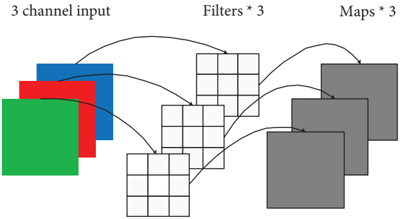
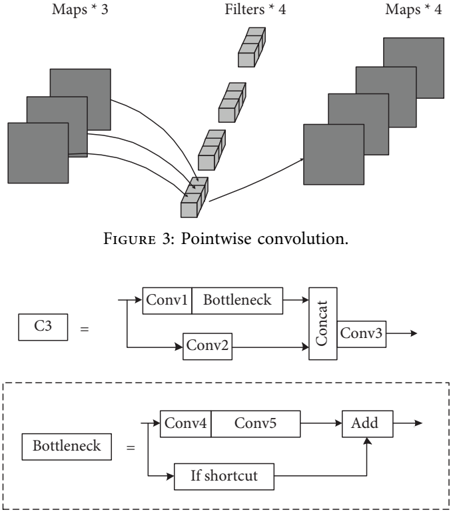
“Terefore, the number of parameters of the frst C3 structure in the YOLOv5s network amounts to 18,432.”
§ Realtime Vehicle Tracking Method Based on YOLOv5 + DeepSORT > 3.2. Yolov5s Improvement Strategy.
plain- Asserted: passes — The authors put it forward as true.
- Checkable: passes — It can be checked against evidence.
- Load-bearing: passes — The paper’s conclusions depend on it.
- Based: passes — The paper gives a reason why it holds.
A result the paper reports from its own data — it cites no other source for it, so there is none to check. The quote shows it is in the paper.
In the paper
“Compared to YOLOv5s, YOLOv5s_DSC has no more than a 1% diference in optimal mAP0.5 (mean average precision), precision rate, and recall rate, while reducing the number of parameters by 23.5%, the amount of computation by 32.3%, the size of the weight fle by 20%, and increasing the average processing speed of each image by 18.8%.”
§ Realtime Vehicle Tracking Method Based on YOLOv5 + DeepSORT > Abstract
plainstates a cause- Asserted: passes — The authors put it forward as true.
- Checkable: passes — It can be checked against evidence.
- Load-bearing: passes — The paper’s conclusions depend on it.
- Based: passes — The paper gives a reason why it holds.
A result the paper reports from its own data — it cites no other source for it, so there is none to check. The quote shows it is in the paper.
In the paper
“After integrating the DeepSORTalgorithm, the processing speed of YOLOv5s_DSC + DeepSORTreaches up to 25 FPS, and the system exhibits better robustness to occlusion.”
§ Realtime Vehicle Tracking Method Based on YOLOv5 + DeepSORT > Abstract
plainstates a cause- Asserted: passes — The authors put it forward as true.
- Checkable: passes — It can be checked against evidence.
- Load-bearing: passes — The paper’s conclusions depend on it.
- Based: passes — The paper gives a reason why it holds.
A result the paper reports from its own data — it cites no other source for it, so there is none to check. The quote shows it is in the paper.
In the paper
“and the size of the weight fle is decreased by 20%.”
§ Realtime Vehicle Tracking Method Based on YOLOv5 + DeepSORT > Maps * 4
plainstates a cause- Asserted: passes — The authors put it forward as true.
- Checkable: passes — It can be checked against evidence.
- Load-bearing: passes — The paper’s conclusions depend on it.
- Based: passes — The paper gives a reason why it holds.
19 more claims
Create a free account to see all 49 claims and to verify the 1 reference still open.
- It may state two separate claims as one. 22
- Probably not a substantial claim. 4
- The quote only partly states this claim. 3
Self-check
Percentages, sums and reported differences re-computed from the paper’s own numbers.
Self-check results appear here once an independent check has confirmed them.
Cited works that were retracted
Works this paper cites that were later retracted, from the retraction notices publishers deposit. Major when the notice came out before this paper was published.
A note, not an issue: for example, a cited work that was retracted only after this paper was published, which its authors could not have known.
In the paper
“10.1155/2022/2682921”
Cited work 10.1155/2022/2682921 · retracted 2023-07-12 · notice 10.1155/2023/9831917 · this paper published 2023-01
Citations
Cites
1 retracted
Yolo-Based Traffic Sign Recognition Algorithm
Li, M., Zhang, L., Li, L., & Song, W. (2022) · Computational Intelligence and Neuroscience · doi:10.1155/2022/2682921 · Cited by 17
RetractedFaster R-CNN: Towards Real-Time Object Detection with Region Proposal Networks
Ren, S., He, K., Girshick, R., & Sun, J. (2017) · IEEE Transactions on Pattern Analysis and Machine Intelligence · doi:10.1109/tpami.2016.2577031 · Cited by 73,472
Faster R-CNN: Towards Real-Time Object Detection with Region Proposal Networks
Ren, S., He, K., Girshick, R., & Sun, J. (2015) · arXiv · doi:10.48550/arxiv.1506.01497 · Cited by 70,812
You Only Look Once: Unified, Real-Time Object Detection
Redmon, J., Divvala, S., Girshick, R., & Farhadi, A. (2016) · 2016 IEEE Conference on Computer Vision and Pattern Recognition (CVPR) · doi:10.1109/cvpr.2016.91 · Cited by 53,803
Rich Feature Hierarchies for Accurate Object Detection and Semantic Segmentation
Girshick, R., Donahue, J., Darrell, T., & Malik, J. (2014) · 2014 IEEE Conference on Computer Vision and Pattern Recognition · doi:10.1109/cvpr.2014.81 · Cited by 32,684
Girshick, R. (2015) · 2015 IEEE International Conference on Computer Vision (ICCV) · doi:10.1109/iccv.2015.169 · Cited by 28,105
YOLO9000: Better, Faster, Stronger
Redmon, J., & Farhadi, A. (2017) · 2017 IEEE Conference on Computer Vision and Pattern Recognition (CVPR) · doi:10.1109/cvpr.2017.690 · Cited by 19,892 · cited 1×
“Te YOLOv2 algorithm introduced batch normalization and used DarkNet-19 as the backbone network, which could dynamically adjust the input and achieve better precision for small targets [26].”
MethodYOLOv3: An Incremental Improvement
Redmon, J., & Farhadi, A. (2018) · arXiv · doi:10.48550/arxiv.1804.02767 · Cited by 17,141
YOLOv4: Optimal Speed and Accuracy of Object Detection
Bochkovskiy, A., Wang, C.-Y., & Liao, H.-Y. M. (2020) · arXiv · doi:10.48550/arxiv.2004.10934 · Cited by 10,307
Joint Face Detection and Alignment Using Multitask Cascaded Convolutional Networks
Zhang, K., Zhang, Z., Li, Z., & Qiao, Y. (2016) · IEEE Signal Processing Letters · doi:10.1109/lsp.2016.2603342 · Cited by 6,214 · cited 1×
“Traditional target detection algorithms rely on image features and classifers such as SVM (support vector machine) [16], Adaboost [17], Random Forest [18], artifcially designed color features [19], gradient features [20], and pattern features [21].”
Research works printed but not linked: 2
- Yan G., 2017, Real-time L1-tracker based on hear-like features, Computer Science, 44, 300
- Li J., 2019, YOLOv3 based object tracking method, Electronics Optics and Control, 26
Cited by
Bihanda, Y. G., Fatichah, C., & Yuniarti, A. (2024) · IEEE Access · doi:10.1109/access.2024.3453249 · Cited by 26
“SORT and Deep-SORT-based approaches have also been applied to vehicle tracking tasks [13], [36], [37].”
MethodVehicle Detection and Tracking Based on Improved YOLOv8
Liu, Y., & Shen, S. (2025) · IEEE Access · doi:10.1109/access.2025.3538556 · Cited by 26
“Lin et al. [13] adopted Depthwise Separable Convolution based on YOLOv5s, reducing the model’s computational load and weight size without sacrificing accuracy.”
InfluentialJayasekara, N., Kulathunge, B., Premaratne, H., Nilam, I., Rajapaksha, S., & Krishara, J. (2023) · Journal of Robotics and Control (JRC) · doi:10.18196/jrc.v5i1.20057 · Cited by 15
“We harnessed the power of YoloV8, a state-of-the-art object detection model that has achieved impressive results in previous works [56], [57], [99].”
MethodKıratlı, R., & Eroğlu, A. (2025) · Journal of Real-Time Image Processing · doi:10.1007/s11554-025-01758-z · Cited by 12
“YOLOv4–DeepSORT improved drone surveillance in overlapping-object scenarios [29], and YOLOv5 with Kernel Correlation Filter (KCF) and Kalman Filter enhanced small-target infrared detection [30].”
Intelligent Traffic System: Yolov8 and Deepsort in Car Detection, Tracking and Counting
Ratnam, M. C. V. (2024) · International Journal for Research in Applied Science and Engineering Technology · doi:10.22214/ijraset.2024.59201 · Cited by 4
Metadata
- Authors
- Lin, L., He, H., Xu, Z., & Wu, D.
- Affiliations
- Jimei University (CN)
- Dahua Technology (China) (CN)
- Xiamen University (CN)
- Corresponding author
- Lin, Lixiong
- Venue
- Computational Intelligence and Neuroscience
- Publisher
- Wiley
- Published
- 2023-01
- Volume
- 2023
- Issue
- 1
- ISSN
- 1687-5265 (ISSN-L)
- 1687-5273
- OpenAlex
- W4380882674
- Cited by
- 18
- References
- 38
- Citations by year
- 2026: 4 · 2025: 6 · 2024: 7 · 2023: 1
- FWCI
- 1.64
- Type
- journal article
- Language
- en
- Open access
- hybrid
- doi.org
- Locations
- Computational Intelligence and Neuroscience (publishedVersion, cc-by)
- Funders
- Jimei University (ZQ2022002)
- Department of Education, Fujian Province (JAT220169)
- Topics
- Physical Sciences › Computer Science › Computer Vision and Pattern Recognition › Video Surveillance and Tracking Methods
- Physical Sciences › Computer Science › Computer Vision and Pattern Recognition › Advanced Neural Network Applications
- Physical Sciences › Engineering › Automotive Engineering › Autonomous Vehicle Technology and Safety
- Keywords
- vehicle tracking, multi-target tracking, DeepSORT, YOLOv5, vehicle detection, real-time tracking, occlusion robustness, lightweight models, traffic scenarios
About these checks
Registry, retraction, Cites and statistics results are computed, not judged, with one exception: a printed reference that no index lists is read once by a model before it counts as a citation error. Claims are extracted by a model and kept only when their quote appears verbatim in the text; each cited source is then checked, with a model’s help, for whether it says what the claim relies on. Those verdicts can be wrong — read the claim’s quote and the cited source before relying on one.
The claim verdicts this report counts are experimental: their accuracy is not yet measured.
A language model drew the claims from the paper on 2026-10-10, under version 3 of the claim definition (model deepseek-v4.1-flash, prompt extract-v3).
A second model labelled each claim on 2026-10-10 (model jev-1.13-20260917, definition revision gold-guideline-v0.2).
Statistics and arithmetic are recomputed, not judged.
Confidence bands are shown only for fields calibrated on our annotated test set. None is calibrated yet, so no band is shown.
What counts as a claim ›How we measure confidence ›How we check this ›
Are you an author, or do you see a problem with this page? Request a review
How to cite
Cite CoChat for the checks on this page, and the paper for its own findings.
- This page
- CoChat. (2026). Citation check: Realtime Vehicle Tracking Method Based on YOLOv5 + DeepSORT. https://app.cochat.ai/papers/10.1155/2023/7974201
- The paper
- Lin, L., He, H., Xu, Z., & Wu, D. (2023). Realtime Vehicle Tracking Method Based on YOLOv5 + DeepSORT. Computational Intelligence and Neuroscience. https://doi.org/10.1155/2023/7974201
Data sources
Bibliographic data: Semantic Scholar, OpenAlex, Crossref.
Contains information from the Semantic Scholar Academic Graph Datasets, made available under the ODC Attribution License (ODC-BY 1.0).
Semantic Scholar’s data is described in: Kinney, R., et al. (2023). The Semantic Scholar Open Data Platform. arXiv:2301.10140.
