

Can an Acceptance and Commitment Therapy-Based Smartphone App Help Individuals with Mental Health Disorders Quit Smoking?
Open accessThe DOI matches its Crossref record; 82 of the 82 references it cites were found in a registry or an index; 27 of the 54 sources its claims cite were checked for support.
Abstract
Background. Individuals with mental health disorders face major barriers in accessing smoking cessation care, often due to the stigmas associated with mental disorders and addiction. Consequently, accessible population-based smoking cessation interventions are needed for this vulnerable group. Objective. This secondary analysis utilized data from a 12-month randomized trial to examine whether an acceptance and commitment therapy-based app (iCanQuit) demonstrated greater efficacy, engagement, and satisfaction compared to a United States (US) Clinical Practice Guidelines-based app (QuitGuide) in helping adults with mental health disorders quit smoking. Materials and Methods. Participants self-reported having bipolar disorder or schizophrenia, or screened positive for depression, generalized anxiety, panic disorder, posttraumatic stress disorder, or social anxiety. We compared the primary outcome of self-reported 30-day cigarette abstinence at 12 months between iCanQuit (n = 770) and QuitGuide (n = 785) using complete-case and multiple imputation analyses and compared engagement and satisfaction between arms. Mediation analyses were conducted to examine whether the intervention apps functioned by reinforcing hypothesized mechanisms of action, namely, acceptance of triggers to smoke and through app engagement. Results. Participants represented all 50 US states and had 30.2% non-White or Hispanic backgrounds. Among participants with any mental health disorder, iCanQuit demonstrated higher 30-day cigarette abstinence than QuitGuide at 12 months (complete-case: 24.4% vs. 20.4%, P=0.04; multiple imputation: 24.6% vs. 20.4%, P=0.04). A comparable effect size was observed in iCanQuit participants with bipolar disorder or schizophrenia compared to QuitGuide, albeit not statistically significant (multiple imputation: 27.1% vs. 20.9%; P=0.06). iCanQuit's cessation efficacy was mediated by acceptance of emotions triggering smoking (P<0.001) and app engagement (P<0.001). iCanQuit was more satisfying than QuitGuide (88.5% vs. 77.2%; P<0.001). Conclusions. In the largest known study of ACT for smoking cessation among adults with mental health disorders, the smoking cessation, engagement, and satisfaction outcomes were all significantly greater with iCanQuit than QuitGuide. Acceptance of emotions triggering smoking and iCanQuit app engagement were important mechanisms of efficacy. This trial is registered with NCT02724462. © 2024 Margarita Santiago-Torres et al.
Overview
CoChat Summary
## TL;DR
In a secondary analysis of a 12-month randomized trial, the ACT-based app iCanQuit outperformed QuitGuide for smoking cessation among adults with mental health disorders. It also had higher engagement and satisfaction, with effects mediated by acceptance of emotions triggering smoking and app engagement.
## Key findings
- Among participants with any mental health disorder, 12-month 30-day cigarette abstinence was higher with iCanQuit than QuitGuide: 24.4% vs. 20.4% in complete-case analysis (P=0.04) and 24.6% vs. 20.4% in multiple imputation (P=0.04).
- For cessation of both combustible cigarettes and e-cigarettes, iCanQuit was higher: 20.9% vs. 16.4% (P=0.02); for cessation of all nicotine and tobacco products, it was 20.1% vs. 15.7% (P=0.02).
- iCanQuit showed greater engagement: 25.3 vs. 8.3 logins, 4.2 vs. 2.6 min session duration, and 16.2 vs. 6.2 days of unique use, all P < 0.001.
- iCanQuit was more satisfying than QuitGuide: 88.5% vs. 77.2% (P < 0.001). Mediation analyses found indirect effects through acceptance of emotions triggering smoking (indirect effect = 0.13, 95% CI: 0.04, 0.23) and app engagement (indirect effect = 0.07, 95% CI: 0.01, 0.19).
## Methods
- Secondary analysis of data from a 12-month randomized trial comparing iCanQuit (ACT-based) with QuitGuide (US Clinical Practice Guidelines-based).
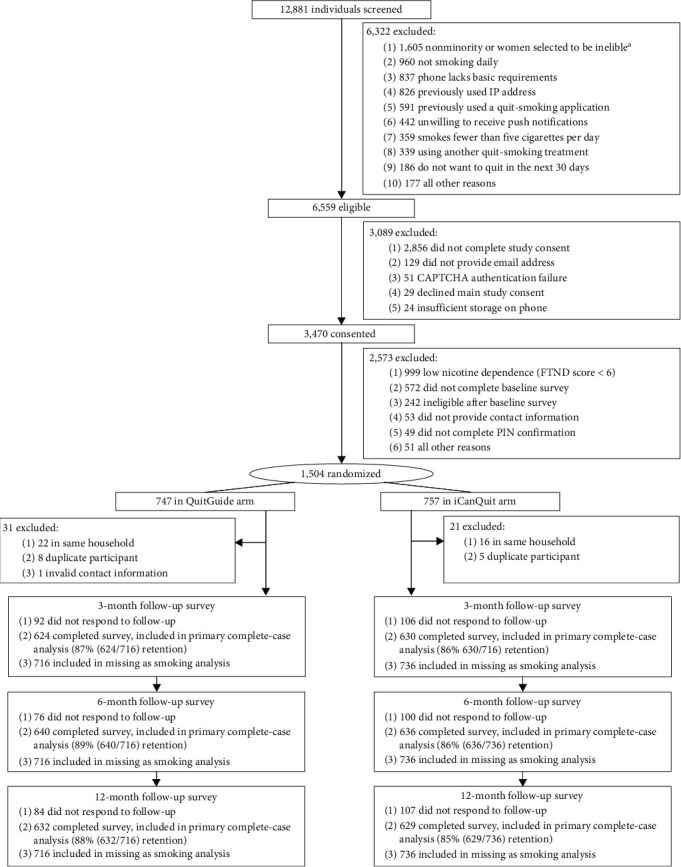
- Sample for this analysis: 1,555 adults who self-reported bipolar disorder or schizophrenia or screened positive for depression, generalized anxiety disorder, panic disorder, PTSD, or social anxiety disorder; parent trial enrolled 2,415 adults from all 50 US states.
- Main analyses used logistic regression for smoking cessation and satisfaction, linear/negative binomial models for engagement, and PROCESS mediation analyses; the paper reports complete-case analysis plus multiple imputation and missing-as-smoking sensitivity analyses.
## Limitations
- The paper states this was a secondary analysis, which it explicitly notes as an inherent limitation.
- There was differential attrition between arms at 12 months (83.9% for iCanQuit vs. 88.3% for QuitGuide; P=0.01), though the authors say they used sensitivity analyses to mitigate this.
- Mental health disorders and smoking cessation outcomes were self-reported, and mental health status was based on self-report/screening tools, which the authors say introduces subjectivity and potential reporting bias.
- The authors note the subgroup analyses were likely underpowered, as several subgroup effects were similar in size but not statistically significant.
Model-written summary. Check it against the paper before relying on it.
Integrity signals
Registry
Cites
Statistics
Figures
Verification
Claims the paper makes
19 Valid · 0 Not valid · 7 Not checked · 44 Own results and interpretations
The cited sources support only part of this claim — read each source’s verdict below.
In the paper
“In fact, in the US, individuals with mental health disorders are nearly twice as likely to report cigarette smoking when compared to those without mental health disorders (28.2% vs. 15.8% for past-month cigarette smoking) [4, 5].”
§ Can an Acceptance and Commitment Therapy-Based Smartphone App Help Individuals with Mental Health Disorders Quit Smoking? > 1. Introduction
What the sources say
- Not matchedcites [4]
Couldn’t be matched to a paper in Crossref, so it can’t be checked.
- Partly supportedcites [5] sourceExperimental — accuracy not yet measured
The Results section (page unavailable) supports the general association: smoking prevalence was higher among people with psychiatric diagnoses. It reports 39.0% for those with a past-year diagnosis versus 15.5% for those with no diagnosis, not 28.2% versus 15.8%. The Methods section defines current smoking as smoking during the past year, not the past month. (LLM, conf=0.90)
plainstates an association- Asserted: passes — The authors put it forward as true.
- Checkable: passes — It can be checked against evidence.
- Load-bearing: passes — The paper’s conclusions depend on it.
- Based: passes — The paper gives a reason why it holds.
- Not matched
The cited sources support only part of this claim — read each source’s verdict below.
In the paper
“Various factors contribute to such challenges in quitting, including elevated negative affect states and emotion dysregulation deficits [8, 9].”
§ Can an Acceptance and Commitment Therapy-Based Smartphone App Help Individuals with Mental Health Disorders Quit Smoking? > 1. Introduction
What the sources say
- Supportedcites [8] source
The Introduction (page not supplied) says smokers with psychopathology who have difficulty regulating negative emotions may struggle to maintain abstinence. The Discussion (page not supplied) links negative affect to smoking craving and possible early lapse, and identifies emotion-regulation difficulties as a marker of lapse vulnerability. (LLM, conf=0.88)
- Partly supportedcites [9] sourceExperimental — accuracy not yet measured
The Introduction (page unavailable) links psychological distress with difficulty quitting and says smoking may alleviate negative affect. The Discussion (page unavailable) says smoking can serve an affect-regulatory role, but calls for further research on emotion-regulatory mechanisms; it does not establish that emotion dysregulation deficits contribute to quitting difficulties among people with mental health disorders. (LLM, conf=0.85)
plainstates a cause- Asserted: passes — The authors put it forward as true.
- Checkable: passes — It can be checked against evidence.
- Load-bearing: passes — The paper’s conclusions depend on it.
- Based: passes — The paper gives a reason why it holds.
- Supported
The cited sources support only part of this claim — read each source’s verdict below.
In the paper
“This method has shown promise in smoking cessation interventions targeting the broader adult population [21, 22, 23].”
§ Can an Acceptance and Commitment Therapy-Based Smartphone App Help Individuals with Mental Health Disorders Quit Smoking? > 1. Introduction
What the sources say
- Not checked — no full text of the sourcecites [21] source
- Partly supportedcites [22] sourceExperimental — accuracy not yet measured
The Conclusions (no page available) report improved psychological flexibility and confidence about quitting among smokers in the general population in Hong Kong, which supports the cautious description of ACT as promising. But the Discussion (no page available) says ACT did not significantly improve quit rates over the control treatment, so this study does not show a smoking-cessation benefit in the broader adult population. (LLM, conf=0.84)
- Not checked — no full text of the sourcecites [23] source
plainstates a possible cause- Asserted: passes — The authors put it forward as true.
- Checkable: passes — It can be checked against evidence.
- Load-bearing: passes — The paper’s conclusions depend on it.
- Based: passes — The paper gives a reason why it holds.
The cited sources support only part of this claim — read each source’s verdict below.
In the paper
“Although people with mental health disorders share a similar desire to quit smoking compared to people without such disorders, their success rate is 25% lower [6, 7].”
§ Can an Acceptance and Commitment Therapy-Based Smartphone App Help Individuals with Mental Health Disorders Quit Smoking? > 1. Introduction
What the sources say
- Not checked — no full text of the sourcecites [6] source
- Partly supportedcites [7] sourceExperimental — accuracy not yet measured
The Discussion reports that people with moderate or high psychological distress were more likely to want to quit but less likely to quit successfully. Results Tables 4 and 6 support that pattern, but the study measures psychological distress rather than diagnosed mental health disorders, and it does not report a uniform 25% lower success rate: adjusted odds of successful quitting vary by distress level. (LLM, conf=0.88)
plainstates an association- Asserted: passes — The authors put it forward as true.
- Checkable: passes — It can be checked against evidence.
- Load-bearing: passes — The paper’s conclusions depend on it.
- Based: passes — The paper gives a reason why it holds.
The cited sources support only part of this claim — read each source’s verdict below.
In the paper
“Moreover, mental health professionals may lack knowledge of and experience with tobacco treatments for encouraging and supporting cessation for this population [30, 31].”
§ Can an Acceptance and Commitment Therapy-Based Smartphone App Help Individuals with Mental Health Disorders Quit Smoking? > 1. Introduction
What the sources say
- Partly supportedcites [30] sourceExperimental — accuracy not yet measured
The Discussion reports that healthcare providers do not adequately address tobacco use among adults with mental health and substance use disorders and recommends physician training to improve cessation support. It does not establish that mental health professionals specifically lack knowledge of, or experience with, tobacco treatments. (LLM, conf=0.78)
- Not checked — no full text of the sourcecites [31] source
hedged- Asserted: passes — The authors put it forward as true.
- Checkable: passes — It can be checked against evidence.
- Load-bearing: passes — The paper’s conclusions depend on it.
- Based: passes — The paper gives a reason why it holds.
- Partly supported
37 more claims · 5 with their cited sources checked
Create a free account to see all 70 claims and to verify the 2 references still open.
- It may state two separate claims as one. 22
- Probably not a substantial claim. 10
- The quote only partly states this claim. 1
Citations
Cites
The CES-D Scale: A Self-Report Depression Scale for Research in the General Population
Radloff, L. S. (1977) · Applied Psychological Measurement · doi:10.1177/014662167700100306 · Cited by 53,267
(2013) · Cited by 44,563
Preacher, K. J., & Hayes, A. F. (2008) · Behavior Research Methods · doi:10.3758/brm.40.3.879 · Cited by 34,117 · cited 1×
“We used the PROCESS macro in SAS to explore potential mediators for the interventions ’ impact on 12-month cessation [71], including changes in smoking-related abstinence and engagement at 6 months [72].”
A Brief Measure for Assessing Generalized Anxiety Disorder: The GAD-7
Spitzer, R. L., Kroenke, K., Williams, J. B. W., & Löwe, B. (2006) · Archives of Internal Medicine · doi:10.1001/archinte.166.10.1092 · Cited by 31,765 · cited 1×
“…higher indicating major depression symptoms; (2) the 7-item Generalized Anxiety Disorder (GAD-7) scale, with scores of 10 or higher indicating GAD [59]; (3) the 5-item Autonomic Ner-vous System Questionnaire [60], with indication of a panic disorder recorded for individuals reporting at least one…”
Modern Applied Statistics with S
Venables, W. N., & Ripley, B. D. (2002) · Statistics and Computing · doi:10.1007/978-0-387-21706-2 · Cited by 24,305 · cited 1×
“App engagement differences were assessed with linear models and negative binomial models using the “ MASS ” package in R [70].”
mice: Multivariate Imputation by Chained Equations in R
Buuren, S. V., & Groothuis-Oudshoorn, K. (2011) · Journal of Statistical Software · doi:10.18637/jss.v045.i03 · Cited by 13,870
The Fagerstrom Test for Nicotine Dependence: a revision of the Fagerstrom Tolerance Questionnaire
HEATHERTON, T. F., KOZLOWSKI, L. T., FRECKER, R. C., & FAGERSTROM, K. (1991) · British Journal of Addiction · doi:10.1111/j.1360-0443.1991.tb01879.x · Cited by 10,738
Smoking and Mental Illness: A Population-Based Prevalence Study
Lasser, K., Boyd, J. W., Woolhandler, S., Himmelstein, D. U., McCormick, D., & Bor, D. H. (2000) · JAMA · doi:10.1001/jama.284.20.2606 · Cited by 2,508
A Clinical Practice Guideline for Treating Tobacco Use and Dependence: 2008 Update
(2008) · American Journal of Preventive Medicine · doi:10.1016/j.amepre.2008.04.009 · Cited by 1,410
The association of cigarette smoking with depression and anxiety: a systematic review
Fluharty, M., Taylor, A. E., Grabski, M., & Munafò, M. R. (2017) · Nicotine & Tobacco Research · doi:10.1093/ntr/ntw140 · Cited by 1,299 · cited 1×
“For example, some people may smoke more during heightened levels of emotional distress [10].”
Research works printed but not linked: 2
- Larson E. H., 2021, Geographic Access to Health Care for Rural Medicare Beneficiaries in Five States: An Update
- Ratcliffe M., 2016, Defining Rural at the U.S. Census Bureau
Cited by
Kelly, M. M., Dempsey, A. E., Ameral, V., Petrakis, B. A., Reilly, E. D., Quigley, K. S., Bricker, J. B., & Heffner, J. L. (2025) · JMIR Formative Research · doi:10.2196/75394
Self-citation
Metadata
- Authors
- Santiago-Torres, M., Mull, K. E., Sullivan, B. M., Prochaska, J. J., Zvolensky, M. J., & Bricker, J. B.
- Affiliations
- Fred Hutch Cancer Center (US)
- Stanford University (US)
- The University of Texas MD Anderson Cancer Center (US)
- University of Washington (US)
- ORCID
- Venue
- Depression and Anxiety
- Publisher
- Wiley
- Published
- 2024-01
- Volume
- 2024
- Issue
- 1
- ISSN
- 1091-4269 (ISSN-L)
- 1520-6394
- PMC
- PMC11753409
- OpenAlex
- W4399889781
- Cited by
- 3
- References
- 82
- Citations by year
- 2026: 2 · 2025: 1
- FWCI
- 0.85
- Type
- journal article
- Language
- en
- Open access
- hybrid
- doi.org
- Locations
- Depression and Anxiety (publishedVersion, cc-by)
- PubMed Central (publishedVersion, cc-by)
- PubMed (publishedVersion)
- Funders
- National Cancer Institute (R01 CA192849)
- Topics
- Health Sciences › Medicine › Public Health, Environmental and Occupational Health › Smoking Behavior and Cessation
- Social Sciences › Psychology › Applied Psychology › Digital Mental Health Interventions
- Health Sciences › Health Professions › General Health Professions › Mobile Health and mHealth Applications
- Keywords
- smoking cessation, acceptance and commitment therapy, mobile application, mental illness, bipolar disorder, schizophrenia, depression, anxiety disorders, post-traumatic stress disorder, social anxiety, smoking triggers, app engagement, user satisfaction, mediation analysis, smoking abstinence, mental health stigma, addiction stigma, digital health interventions, population-level interventions
- MeSH terms
- Smartphone, Adult, Mental Disorders, Female, Humans, Male, Middle Aged, United States, Smoking Cessation, Mobile Applications, Acceptance and Commitment Therapy
About these checks
Registry, retraction, Cites and statistics results are computed, not judged, with one exception: a printed reference that no index lists is read once by a model before it counts as a citation error. Claims are extracted by a model and kept only when their quote appears verbatim in the text; each cited source is then checked, with a model’s help, for whether it says what the claim relies on. Those verdicts can be wrong — read the claim’s quote and the cited source before relying on one.
The claim verdicts this report counts are experimental: their accuracy is not yet measured.
A language model drew the claims from the paper on 2026-10-11, under version 3 of the claim definition (model deepseek-v4.1-flash, prompt extract-v3).
A second model labelled each claim on 2026-10-11 (model jev-1.13-20260917, definition revision gold-guideline-v0.2).
Cited sources are checked with a language model’s help (gpt-6-sol).
Statistics and arithmetic are recomputed, not judged.
Confidence bands are shown only for fields calibrated on our annotated test set. None is calibrated yet, so no band is shown.
What counts as a claim ›How we measure confidence ›How we check this ›
Are you an author, or do you see a problem with this page? Request a review
How to cite
Cite CoChat for the checks on this page, and the paper for its own findings.
- This page
- CoChat. (2026). Citation check: Can an Acceptance and Commitment Therapy-Based Smartphone App Help Individuals with Mental Health Disorders Quit Smoking? https://app.cochat.ai/papers/10.1155/2024/1055801
- The paper
- Santiago-Torres, M., Mull, K. E., Sullivan, B. M., Prochaska, J. J., Zvolensky, M. J., & Bricker, J. B. (2024). Can an Acceptance and Commitment Therapy-Based Smartphone App Help Individuals with Mental Health Disorders Quit Smoking? Depression and Anxiety. https://doi.org/10.1155/2024/1055801
Data sources
Bibliographic data: Semantic Scholar, OpenAlex, Crossref.
Contains information from the Semantic Scholar Academic Graph Datasets, made available under the ODC Attribution License (ODC-BY 1.0).
Semantic Scholar’s data is described in: Kinney, R., et al. (2023). The Semantic Scholar Open Data Platform. arXiv:2301.10140.
