

Onvansertib in Combination with FOLFIRI and Bevacizumab in Second-Line Treatment of KRAS -Mutant Metastatic Colorectal Cancer: A Phase Ib Clinical Study
Open accessPublished version of a preprint
The DOI matches its Crossref record; 36 of the 36 references it cites were found in a registry or an index.
Abstract
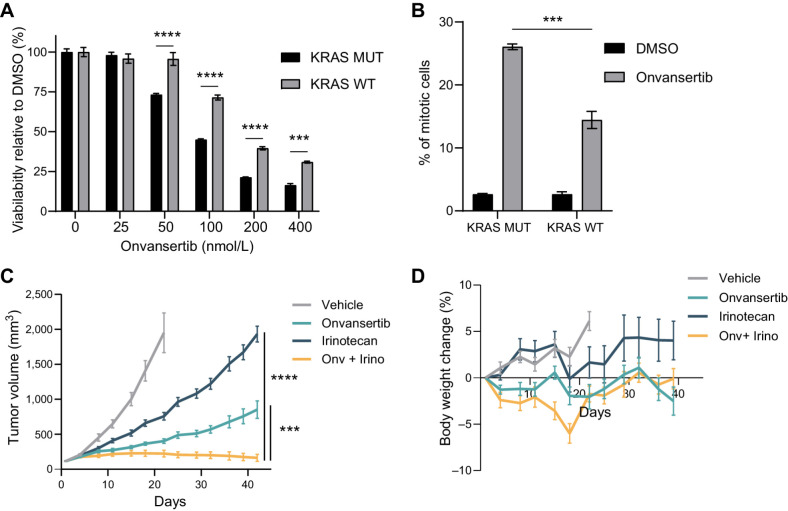
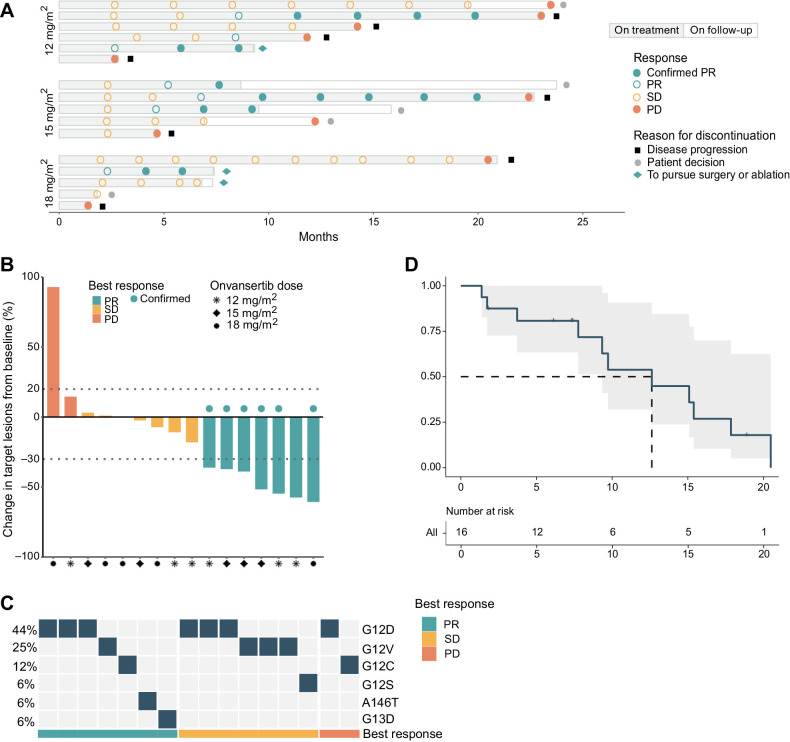
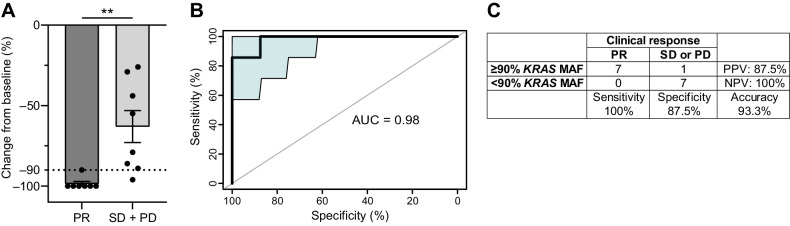
Purpose: Onvansertib is a highly specific inhibitor of polo-like kinase 1 (PLK1), with demonstrated safety in solid tumors. We evaluated, preclinically and clinically, the potential of onvansertib in combination with chemotherapy as a therapeutic option for KRAS-mutant colorectal cancer. Patients and Methods: Preclinical activity of onvansertib was assessed (i) in vitro in KRAS wild-type and -mutant isogenic colorectal cancer cells and (ii) in vivo, in combination with irinotecan, in a KRAS-mutant xenograft model. Clinically, a phase Ib trial was conducted to investigate onvansertib at doses 12, 15, and 18 mg/m2 (days 1–5 and 14–19 of a 28-day cycle) in combination with FOLFIRI/bevacizumab (days 1 and 15) in patients with KRAS-mutant metastatic colorectal cancer who had prior oxaliplatin exposure. Safety, efficacy, and changes in circulating tumor DNA (ctDNA) were assessed. Results: In preclinical models, onvansertib displayed superior activity in KRAS-mutant than wild-type isogenic colorectal cancer cells and demonstrated potent antitumor activity in combination with irinotecan in vivo. Eighteen patients enrolled in the phase Ib study. Onvansertib recommended phase II dose was established at 15 mg/m2. Grade 3 and 4 adverse events (AE) represented 15% of all treatment-related AEs, with neutropenia being the most common. Partial responses were observed in 44% of patients, with a median duration of response of 9.5 months. Early ctDNA dynamics were predictive of treatment efficacy. Conclusions: Onvansertib combined with FOLIFRI/bevacizumab exhibited manageable safety and promising efficacy in second-line treatment of patients with KRAS-mutant metastatic colorectal cancer. Further exploration of this combination therapy is ongoing. See related commentary by Stebbing and Bullock, p. 2005
Overview
The claims and statistics of this paper haven’t been checked yet.
Free: it reads the open-access text and checks the first 5 claims that cite a source we can check. Create a free account to check every claim.
Integrity signals
Registry
Cites
Statistics
Figures
Verification
Claims the paper makes
The claims and statistics of this paper haven’t been checked yet.
Free: it reads the open-access text and checks the first 5 claims that cite a source we can check. Create a free account to check every claim.
Claims other papers make about this one
Each is checked against this paper’s own text: does it say what the citing paper says it does?
The cited source says what the claim attributes to it.
In the citing paper
“KRAS-mutant CRC cells were found to be more sensitive to PLK1 inhibition than their wild-type counterparts [141].”
From Differential Response and Resistance to KRAS-Targeted Therapy (2025) · cites this paper as [141]
The cited source says what the claim attributes to it.
In the citing paper
“A clinical study showed promising efficacy of combining the PLK1 inhibitor onvansertib with FOLIFRI/bevacizumab in in KRAS-mutant CRC [141].”
From Differential Response and Resistance to KRAS-Targeted Therapy (2025) · cites this paper as [141]
Self-check
Percentages, sums and reported differences re-computed from the paper’s own numbers.
The self-check needs the paper’s full text.
Citations
Cites
A genetic model for colorectal tumorigenesis
Fearon, E. R., & Vogelstein, B. (1990) · Cell · doi:10.1016/0092-8674(90)90186-i · Cited by 12,132
Bevacizumab plus Irinotecan, Fluorouracil, and Leucovorin for Metastatic Colorectal Cancer
Hurwitz, H., Fehrenbacher, L., Novotny, W., Cartwright, T., Hainsworth, J., Heim, W., Berlin, J., Baron, A., Griffing, S., Holmgren, E., et al. (2004) · New England Journal of Medicine · doi:10.1056/nejmoa032691 · Cited by 10,968 · cited 1×
“In the past two decades, development and approval of mAbs that target angiogenesis (e.g., bevacizumab) and EGFR(cetuximabandpanitumumab)havebeenshowntoenhancethe ef fi cacy of chemotherapy (2, 3).”
Self-citationCunningham, D., Humblet, Y., Siena, S., Khayat, D., Bleiberg, H., Santoro, A., Bets, D., Mueser, M., Harstrick, A., Verslype, C., et al. (2004) · New England Journal of Medicine · doi:10.1056/nejmoa033025 · Cited by 5,035
Drugging the undruggable RAS: Mission Possible?
Cox, A. D., Fesik, S. W., Kimmelman, A. C., Luo, J., & Der, C. J. (2014) · Nature Reviews Drug Discovery · doi:10.1038/nrd4389 · Cited by 1,997 · cited 1×
“Efforts for targeting KRAS in colorectal cancer and other cancers has had very limited progress so far (9), with the exception of the recent success in targeting KRAS-G12C, a relatively rare mutation in colorectal cancer (6, 10).”
KRAS G12C Inhibition with Sotorasib in Advanced Solid Tumors
Hong, D. S., Fakih, M. G., Strickler, J. H., Desai, J., Durm, G. A., Shapiro, G. I., Falchook, G. S., Price, T. J., Sacher, A., Denlinger, C. S., et al. (2020) · New England Journal of Medicine · doi:10.1056/nejmoa1917239 · Cited by 1,733
Colon Cancer, Version 2.2021, NCCN Clinical Practice Guidelines in Oncology
Benson, A. B., Venook, A. P., Al-Hawary, M. M., Arain, M. A., Chen, Y.-J., Ciombor, K. K., Cohen, S., Cooper, H. S., Deming, D., Farkas, L., et al. (2021) · Journal of the National Comprehensive Cancer Network · doi:10.6004/jnccn.2021.0012 · Cited by 1,696 · cited 1×
“Chemotherapy is still the backbone of treatment for the majority of patients in the fi rst-and second-line settings (1).”
Bennouna, J., Sastre, J., Arnold, D., Österlund, P., Greil, R., Van Cutsem, E., von Moos, R., Viéitez, J. M., Bouché, O., Borg, C., et al. (2013) · The Lancet Oncology · doi:10.1016/s1470-2045(12)70477-1 · Cited by 1,166 · cited 2×
“This responserateissigni fi cantlygreaterthanthehistorical responserateto FOLFIRI/bevacizumab (12, 13).”
A Genome-wide RNAi Screen Identifies Multiple Synthetic Lethal Interactions with the Ras Oncogene
Luo, J., Emanuele, M. J., Li, D., Creighton, C. J., Schlabach, M. R., Westbrook, T. F., Wong, K.-K., & Elledge, S. J. (2009) · Cell · doi:10.1016/j.cell.2009.05.006 · Cited by 1,017 · cited 1×
“A genome-wide short hairpin RNA screen identi fi ed PLK1 inhibition to be synthetic lethal with mutant KRAS in colorectal cancer cells, suggesting that KRAS -mutant colorectal cancer cells are particularly sensitive to PLK1 inhibition (27).”
Hochster, H. S., Hart, L. L., Ramanathan, R. K., Childs, B. H., Hainsworth, J. D., Cohn, A. L., Wong, L., Fehrenbacher, L., Abubakr, Y., Saif, M. W., et al. (2008) · Journal of Clinical Oncology · doi:10.1200/jco.2007.15.4138 · Cited by 613 · cited 1×
“The most commonly used fi rst-line treatment in patients with mCRC is FOLFOX (folinic acid, fl uorouracil, and oxaliplatin) in combination with bevacizumab, and is associated with a median PFS (mPFS)of8 – 10months(11).”
Douillard, J. Y., Siena, S., Cassidy, J., Tabernero, J., Burkes, R., Barugel, M., Humblet, Y., Bodoky, G., Cunningham, D., Jassem, J., et al. (2014) · Annals of Oncology · doi:10.1093/annonc/mdu141 · Cited by 606 · cited 1×
“However, the bene fi t of EGFR inhibitors is limited to patients with RAS wild-type tumors (3, 4).”
Polo-like kinases: structural variations lead to multiple functions
Zitouni, S., Nabais, C., Jana, S. C., Guerrero, A., & Bettencourt-Dias, M. (2014) · Nature Reviews Molecular Cell Biology · doi:10.1038/nrm3819 · Cited by 489
Modest, D. P., Ricard, I., Heinemann, V., Hegewisch-Becker, S., Schmiegel, W., Porschen, R., Stintzing, S., Graeven, U., Arnold, D., von Weikersthal, L. F., et al. (2016) · Annals of Oncology · doi:10.1093/annonc/mdw261 · Cited by 351
Ou, S.-H. I., Jänne, P. A., Leal, T. A., Rybkin, I. I., Sabari, J. K., Barve, M. A., Bazhenova, L., Johnson, M. L., Velastegui, K. L., Cilliers, C., et al. (2022) · Journal of Clinical Oncology · doi:10.1200/jco.21.02752 · Cited by 322 · cited 1×
“While targeting KRAS G12C variant has made signi fi cant progress, it is worth noting that G12C mutations are relatively rare in colorectal cancer ( (cid:5) 3%), and the effectiveness of KRAS G12C inhibitors is limited and accompanied by notable toxicities (32, 33).”
Genomic and Biological Characterization of Exon 4 KRAS Mutations in Human Cancer
Janakiraman, M., Vakiani, E., Zeng, Z., Pratilas, C. A., Taylor, B. S., Chitale, D., Halilovic, E., Wilson, M., Huberman, K., Ricarte Filho, J. C., et al. (2010) · Cancer Research · doi:10.1158/0008-5472.can-10-0192 · Cited by 290 · cited 1×
“Efforts for targeting KRAS in colorectal cancer and other cancers has had very limited progress so far (9), with the exception of the recent success in targeting KRAS-G12C, a relatively rare mutation in colorectal cancer (6, 10).”
Polo‐like kinase 1 (PLK1) is overexpressed in primary colorectal cancers
Takahashi, T., Sano, B., Nagata, T., Kato, H., Sugiyama, Y., Kunieda, K., Kimura, M., Okano, Y., & Saji, S. (2003) · Cancer Science · doi:10.1111/j.1349-7006.2003.tb01411.x · Cited by 265
Jones, R. P., Sutton, P. A., Evans, J. P., Clifford, R., McAvoy, A., Lewis, J., Rousseau, A., Mountford, R., McWhirter, D., & Malik, H. Z. (2017) · British Journal of Cancer · doi:10.1038/bjc.2017.37 · Cited by 166
Xu, R., Muro, K., Morita, S., Iwasa, S., Han, S., Wang, W., Kotaka, M., Nakamura, M., Ahn, J. B., Deng, Y., et al. (2018) · The Lancet Oncology · doi:10.1016/s1470-2045(18)30140-2 · Cited by 165
Polθ is phosphorylated by PLK1 to repair double-strand breaks in mitosis
Gelot, C., Kovacs, M. T., Miron, S. M., Mylne, E., Haan, A., Boeffard-Dosierre, L., Ghouil, R., Popova, T. G., Dingli, F., Loew, D., et al. (2023) · Nature · doi:10.1038/s41586-023-06506-6 · Cited by 156 · cited 1×
“M checkpoint arrest following DNA damage (15, 16).”
InfluentialHecht, J. R., Cohn, A. L., Dakhil, S. R., Saleh, M. N., Piperdi, B., Cline-Burkhardt, M., Tian, Y., & Go, W. Y. (2015) · Clinical Colorectal Cancer · doi:10.1016/j.clcc.2014.12.009 · Cited by 128 · cited 1×
“While neutropenia is a potential toxicity of onvansertib, FOLFIRI/bevacizumab is associated with 30% – 40% risk of G3 and G4 neutropenia (28, 29).”
Valsasina, B., Beria, I., Alli, C., Alzani, R., Avanzi, N., Ballinari, D., Cappella, P., Caruso, M., Casolaro, A., Ciavolella, A., et al. (2012) · Molecular Cancer Therapeutics · doi:10.1158/1535-7163.mct-11-0765 · Cited by 123 · cited 2×
“Onvansertib is ahighlypotent,reversible, andselectivePLK1 kinase inhibitor, inducing mitotic arrest and ultimately apoptosis in cancer cells (21).”
Present and Future Perspective on PLK1 Inhibition in Cancer Treatment
Chiappa, M., Petrella, S., Damia, G., Broggini, M., Guffanti, F., & Ricci, F. (2022) · Frontiers in Oncology · doi:10.3389/fonc.2022.903016 · Cited by 120
The Use of Circulating Tumor DNA to Monitor and Predict Response to Treatment in Colorectal Cancer
Reece, M. M., Saluja, H., Hollington, P., Karapetis, C. S., Vatandoust, S., Young, G. P., & Symonds, E. L. (2019) · Frontiers in Genetics · doi:10.3389/fgene.2019.01118 · Cited by 106
Yu, Z., Deng, P., Chen, Y., Liu, S., Chen, J., Yang, Z., Chen, J., Fan, X., Wang, P., Cai, Z., et al. (2021) · Advanced Science · doi:10.1002/advs.202100759 · Cited by 98
Zeidan, A. M., Ridinger, M., Lin, T. L., Becker, P. S., Schiller, G. J., Patel, P. A., Spira, A. I., Tsai, M. L., Samuëlsz, E., Silberman, S., et al. (2020) · Clinical Cancer Research · doi:10.1158/1078-0432.ccr-20-2586 · Cited by 97
Self-citationKnowledge, perceptions, and management of cancer-related fatigue: the patients' perspective
Schmidt, M. E., Bergbold, S., Hermann, S., & Steindorf, K. (2020) · Supportive Care in Cancer · doi:10.1007/s00520-020-05686-5 · Cited by 94 · cited 1×
“Strategiestoreducetheimpactoffatigueon thelikelihoodoftreatmentdiscontinuationshouldbeconsidered,for example dose reduction and/or patient education for life style changes to reduce the experience of fatigue (31).”
Han, D., Zhu, Q.-L., Cui, J., Wang, P., Qu, S., Cao, Q.-F., Zong, Y., Feng, B., Zheng, M.-H., & Lu, A. (2012) · Medical Science Monitor · doi:10.12659/msm.882900 · Cited by 77
Iwamoto, S., Takahashi, T., Tamagawa, H., Nakamura, M., Munemoto, Y., Kato, T., Hata, T., Denda, T., Morita, Y., Inukai, M., et al. (2015) · Annals of Oncology · doi:10.1093/annonc/mdv197 · Cited by 70 · cited 2×
“This responserateissigni fi cantlygreaterthanthehistorical responserateto FOLFIRI/bevacizumab (12, 13).”
Petrelli, F., Coinu, A., Cabiddu, M., Ghilardi, M., & Barni, S. (2013) · Medical Oncology · doi:10.1007/s12032-013-0650-4 · Cited by 56 · cited 1×
“Contemporary data suggest that patients with KRAS -mutated mCRC have poorer overall survivalandprogression-freesurvival(PFS)compared withthosewith KRAS wild-type (7, 8).”
Callesen, L. B., Hamfjord, J., Boysen, A. K., Pallisgaard, N., Guren, T. K., Kure, E. H., & Spindler, K. G. (2022) · British Journal of Cancer · doi:10.1038/s41416-022-01816-4 · Cited by 47
Weiss, G. J., Jameson, G., Hoff, D. D. V., Valsasina, B., Davite, C., Giulio, C. D., Fiorentini, F., Alzani, R., Carpinelli, P., Sanzo, A. D., et al. (2017) · Investigational New Drugs · doi:10.1007/s10637-017-0491-7 · Cited by 45 · cited 1×
“The fi rst dose of onvansertib was 12 mg/m 2 , which was half of the RP2D established in the phase I single-agent study for solid tumors (24).”
Targeting KRAS in Colorectal Cancer: A Bench to Bedside Review
Bteich, F., Mohammadi, M., Li, T., Bhat, M. A., Sofianidi, A. A., Wei, N., & Kuang, C. (2023) · International Journal of Molecular Sciences · doi:10.3390/ijms241512030 · Cited by 36 · cited 1×
“Other efforts to develop pan-KRAS mutant therapeutics involve the exploration of inhibitors targeting RAS upstream and downstream pathways, including MEK, SHP2, and SOS1 inhibitors, either as single agents or in combination therapies (34).”
Ran, Z., Chen, W., Shang, J., Li, X., Nie, Z., Yang, J., & Li, N. (2019) · Gene · doi:10.1016/j.gene.2019.144097 · Cited by 21
Amorim, L. C., & Peixoto, R. D. (2021) · International Cancer Conference Journal · doi:10.1007/s13691-021-00526-7 · Cited by 18
Fan, P., ZHANG, S., Tian, H., YAN, N., Dai, L., ZHANG, X., Cheng, L., LI, C., LI, Y., Chen, X., et al. (2012) · Neoplasma · doi:10.4149/neo_2012_086 · Cited by 7
Kopetz, S., Ridinger, M., Sorokin, A. V., Kanikarla, P., Gao, F., Liu, Z., Samuëlsz, E., Smeal, T., Starr, J. S., & Sharma, M. R. (2022) · Annals of Oncology · doi:10.1016/j.annonc.2022.07.504 · Cited by 4 · cited 1×
“Moreover, PLK1 inhibitors, including onvansertib, enhanced the ef fi cacy of DNA damage agents such as oxaliplatin and irinotecan in colorectal cancer preclinical models (20 – 23), supporting theuse ofPLK1 inhibitors incombination with chemotherapy.”
Self-citation(1950) · doi:10.1002/1097-0142(1950)3:1<32::aid-cncr2820030106>3.0.co;2-3 · cited 1×
“The ROC curve was used to select the best threshold for prediction based on the Youden method (26) and the sensitivity and speci fi city at this threshold were estimated.”
Cited by
Ahn, D. H., Ridinger, M., Cannon, T. L., Mendelsohn, L., Starr, J. S., Hubbard, J. M., Kasi, A., Barzi, A., Samuëlsz, E., Karki, A., et al. (2024) · Journal of Clinical Oncology · doi:10.1200/jco-24-01266 · Cited by 43
Self-citationStructural insights into small-molecule KRAS inhibitors for targeting KRAS mutant cancers
Pandey, D., Chauhan, S. C., Kashyap, V. K., & Roy, K. K. (2024) · European Journal of Medicinal Chemistry · doi:10.1016/j.ejmech.2024.116771 · Cited by 32
Holz, A., Paul, B., Zapf, A., Pantel, K., & Joosse, S. A. (2025) · Cancer Treatment Reviews · doi:10.1016/j.ctrv.2025.102999 · Cited by 27
Onvansertib treatment overcomes olaparib resistance in high-grade ovarian carcinomas
Chiappa, M., Decio, A., Guarrera, L., Mengoli, I., Karki, A., Yemane, D., Ghilardi, C., Scanziani, E., Canesi, S., Barbera, M. C., et al. (2024) · Cell Death and Disease · doi:10.1038/s41419-024-06894-1 · Cited by 24
“Onvansertib is an orally available, highly selective PLK1 inhibitor undergoing clinical investigation [21, 22].”
Self-citationExploring Predictive and Prognostic Biomarkers in Colorectal Cancer: A Comprehensive Review
Ashouri, K., Wong, A., Mittal, P., Torres‐Gonzalez, L., Lo, J. H., Soni, S., Algaze, S. D., Khoukaz, T., Zhang, W., Yang, Y., et al. (2024) · Cancers · doi:10.3390/cancers16162796 · Cited by 24
“A Phase 1b/2 trial studied onvansertib, an oral highly selective PLK1 inhibitor, in combination with FOLFIRI and bevacizumab as a second-line treat-ment for KRAS -mutated mCRC and found that the combination was well-tolerated with durable responses [140].”
BackgroundSelf-citation
Metadata
- Authors
- Ahn, D. H., Barzi, A., Ridinger, M., Samuëlsz, E., Subramanian, R. A., Wu, C.-C., Croucher, P. J. P., Smeal, T., Kabbinavar, F. F., & Lenz, H.-J.
- Affiliations
- Mayo Clinic (US)
- City Of Hope National Medical Center (US)
- 3Cardiff Oncology Inc., San Diego, California.
- USC Norris Comprehensive Cancer Center (US)
- Corresponding author
- Lenz, Heinz-Josef
- ORCID
- Venue
- Clinical Cancer Research
- Published
- 2024-01-16
- Volume
- 30
- Issue
- 10
- Pages
- 2039-2047
- ISSN
- 1078-0432 (ISSN-L)
- 1557-3265
- PMC
- PMC11094418
- OpenAlex
- W4390942811
- Cited by
- 49
- References
- 36
- Citations by year
- 2026: 13 · 2025: 24 · 2024: 12
- FWCI
- 8.39
- Type
- journal article
- Language
- en
- Update notices
- correction (2026-03-16)
- Open access
- hybrid
- doi.org
- Licence
- Locations
- Clinical Cancer Research (publishedVersion, cc-by-nc-nd)
- PubMed Central (publishedVersion, cc-by-nc-nd)
- PubMed (publishedVersion)
- Funders
- n/a (n/a)
- Topics
- Health Sciences › Medicine › Oncology › Colorectal Cancer Treatments and Studies
- Health Sciences › Medicine › Pulmonary and Respiratory Medicine › Lung Cancer Treatments and Mutations
- Health Sciences › Medicine › Oncology › Colorectal Cancer Surgical Treatments
- Keywords
- onvansertib, polo-like kinase 1 inhibitor, KRAS-mutant colorectal cancer, metastatic colorectal cancer, second-line therapy, FOLFIRI, bevacizumab, irinotecan, circulating tumor DNA, predictive biomarkers, combination chemotherapy, dose escalation, neutropenia
- MeSH terms
- Bevacizumab, Adult, Aged, Animals, Antineoplastic Combined Chemotherapy Protocols, Camptothecin, Leucovorin, Female, Fluorouracil, Humans, Male, Middle Aged, Mutation, Neoplasm Metastasis, Colorectal Neoplasms, Proto-Oncogene Proteins p21(ras), Treatment Outcome, Protein Serine-Threonine Kinases, Xenograft Model Antitumor Assays, Cell Line, Tumor, Mice
About these checks
Registry, retraction, Cites and statistics results are computed, not judged, with one exception: a printed reference that no index lists is read once by a model before it counts as a citation error. Claims are extracted by a model and kept only when their quote appears verbatim in the text; each cited source is then checked, with a model’s help, for whether it says what the claim relies on. Those verdicts can be wrong — read the claim’s quote and the cited source before relying on one.
Statistics and arithmetic are recomputed, not judged.
Confidence bands are shown only for fields calibrated on our annotated test set. None is calibrated yet, so no band is shown.
What counts as a claim ›How we measure confidence ›How we check this ›
Are you an author, or do you see a problem with this page? Request a review
Data sources
Bibliographic data: Semantic Scholar, OpenAlex, Crossref.
Contains information from the Semantic Scholar Academic Graph Datasets, made available under the ODC Attribution License (ODC-BY 1.0).
Semantic Scholar’s data is described in: Kinney, R., et al. (2023). The Semantic Scholar Open Data Platform. arXiv:2301.10140.
