

Circulating Tumor DNA Dynamics Reveal KRAS G12C Mutation Heterogeneity and Response to Treatment with the KRAS G12C Inhibitor Divarasib in Solid Tumors
Open accessPublished version of a preprint
The DOI matches its Crossref record; 34 of the 34 references it cites were found in a registry or an index.
Abstract
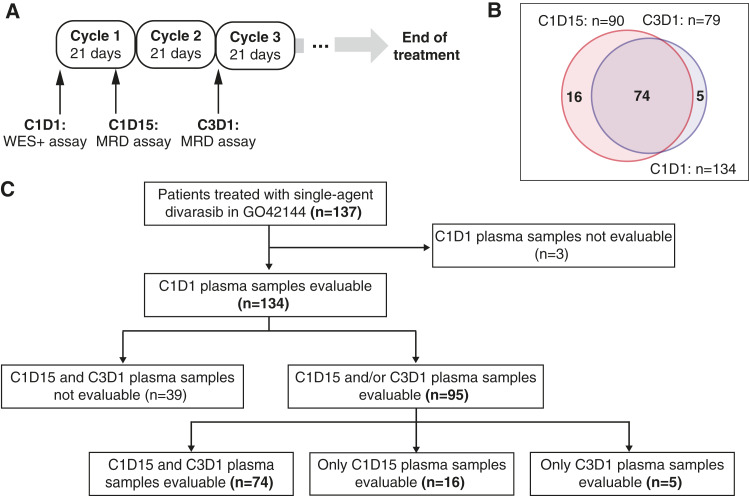
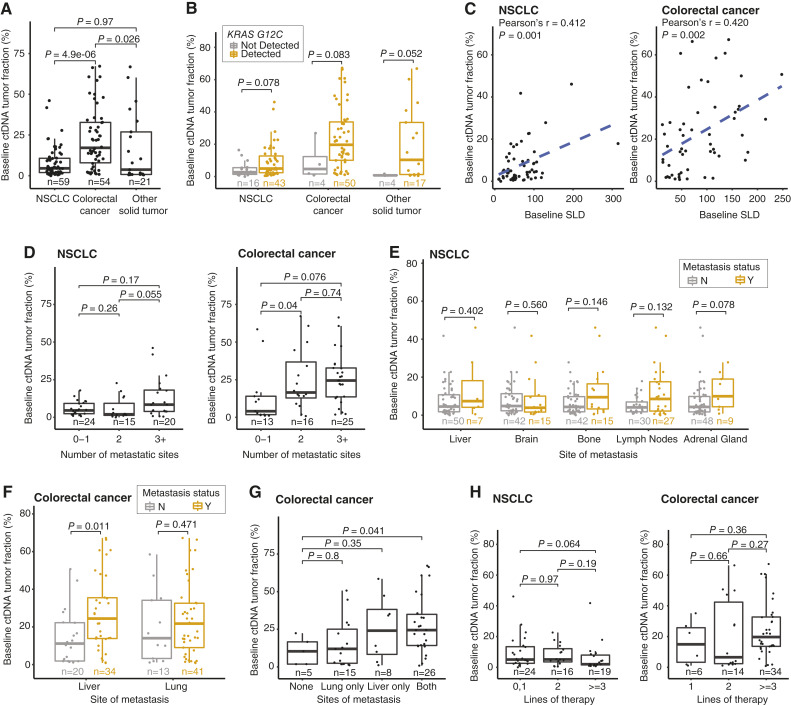
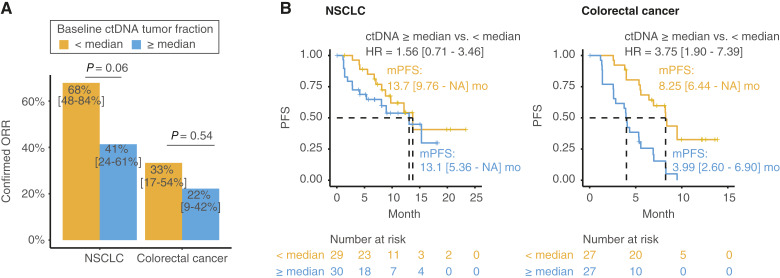
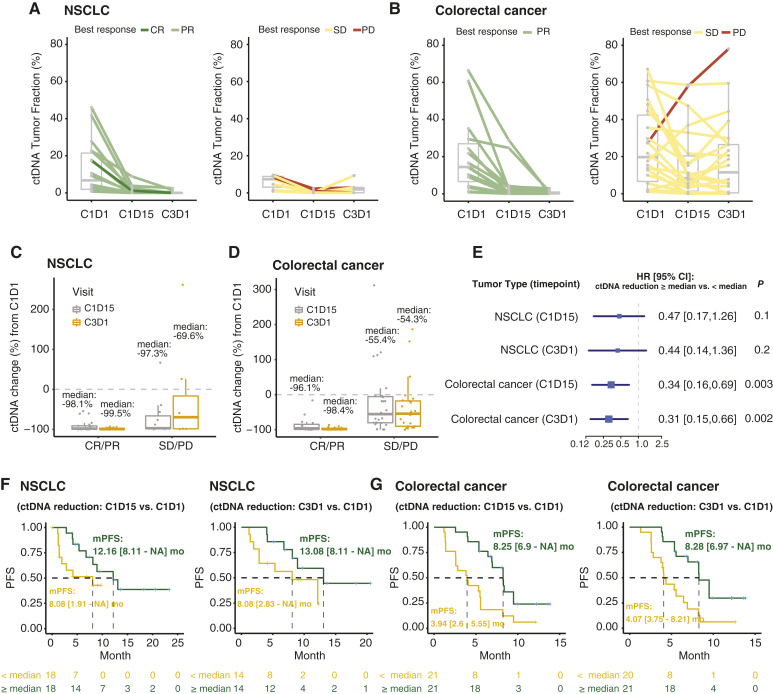
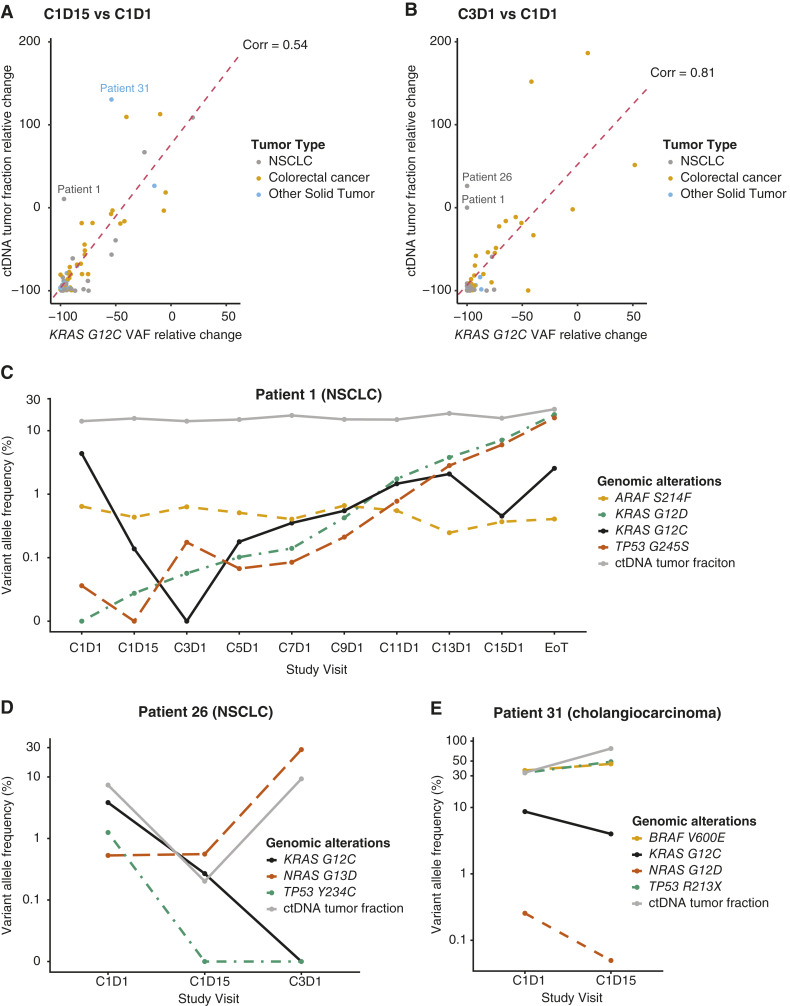
Purpose: To inform prognosis, treatment response, disease biology, and KRAS G12C mutation heterogeneity, we conducted exploratory circulating tumor DNA (ctDNA) profiling on 134 patients with solid tumors harboring a KRAS G12C mutation treated with single-agent divarasib (GDC-6036) in a phase 1 study. Experimental Design: Plasma samples were collected for serial ctDNA profiling at baseline (cycle 1 day 1 prior to treatment) and multiple on-treatment time points (cycle 1 day 15 and cycle 3 day 1). Results: KRAS G12C ctDNA was detectable from plasma samples in 72.9% (43/59) and 92.6% (50/54) of patients with non–small cell lung cancer and colorectal cancer, respectively, the majority of whom were eligible for study participation based on a local test detecting the KRAS G12C mutation in tumor tissue. Baseline ctDNA tumor fraction was associated with tumor type, disease burden, and metastatic sites. A decline in ctDNA level was observed as early as cycle 1 day 15. Serial assessment showed a decline in ctDNA tumor fraction associated with response and progression-free survival. Except for a few cases of KRAS G12C sub-clonality, on-treatment changes in KRAS G12C variant allele frequency mirrored changes in the overall ctDNA tumor fraction. Conclusions: Across tumor types, the KRAS G12C mutation likely represents a truncal mutation in the majority of patients. Rapid and deep decline in ctDNA tumor fraction was observed in patients responding to divarasib treatment. Early on-treatment dynamics of ctDNA were associated with patient outcomes and tumor response to divarasib treatment.
Overview
The claims and statistics of this paper haven’t been checked yet.
Free: it reads the open-access text and checks the first 5 claims that cite a source we can check. Create a free account to check every claim.
Integrity signals
Registry
Cites
Statistics
Figures
Verification
Claims the paper makes
The claims and statistics of this paper haven’t been checked yet.
Free: it reads the open-access text and checks the first 5 claims that cite a source we can check. Create a free account to check every claim.
Claims other papers make about this one
Each is checked against this paper’s own text: does it say what the citing paper says it does?
The source backs part of the claim, not all of it — or backs it for a different population, condition or comparison.
In the citing paper
“Levels of KRAS G12C in ctDNA were found to be associated with the response of NSCLC and CRC patients treated with sotorasib or divarasib, suggesting KRAS gene amplification as a resistance mechanism [57, 58].”
From Differential Response and Resistance to KRAS-Targeted Therapy (2025) · cites this paper as [58]
Experimental — accuracy not yet measured
Self-check
Percentages, sums and reported differences re-computed from the paper’s own numbers.
The self-check needs the paper’s full text.
Citations
Cites
Liquid biopsies come of age: Towards implementation of circulating tumour DNA
Wan, J. C. M., Massie, C., Garcia-Corbacho, J., Mouliere, F., Brenton, J. D., Caldas, C., Pacey, S., Baird, R., & Rosenfeld, N. (2017) · Nature Reviews Cancer · doi:10.1038/nrc.2017.7 · Cited by 2,809
Circulating mutant DNA to assess tumor dynamics
Diehl, F., Schmidt, K., Choti, M. A., Romans, K., Goodman, S., Li, M., Thornton, K., Agrawal, N., Sokoll, L., Szabo, S. A., et al. (2008) · Nature Medicine · doi:10.1038/nm.1789 · Cited by 2,734
Tracking the Evolution of Non–Small-Cell Lung Cancer
Jamal-Hanjani, M., Wilson, G. A., McGranahan, N., Birkbak, N. J., Watkins, T. B. K., Veeriah, S., Shafi, S., Johnson, D. H., Mitter, R., Rosenthal, R., et al. (2017) · New England Journal of Medicine · doi:10.1056/nejmoa1616288 · Cited by 2,349
RAS Proteins and Their Regulators in Human Disease
Simanshu, D. K., Nissley, D. V., & McCormick, F. (2017) · Cell · doi:10.1016/j.cell.2017.06.009 · Cited by 1,943
Phylogenetic ctDNA analysis depicts early-stage lung cancer evolution
The TRACERx consortium, Abbosh, C., The PEACE consortium, Birkbak, N. J., Wilson, G. A., Jamal-Hanjani, M., Constantin, T., Salari, R., Le Quesne, J., Moore, D. A., et al. (2017) · Nature · doi:10.1038/nature22364 · Cited by 1,874
RAS-targeted therapies: is the undruggable drugged?
Moore, A. R., Rosenberg, S. C., McCormick, F., & Malek, S. (2020) · Nature Reviews Drug Discovery · doi:10.1038/s41573-020-0068-6 · Cited by 1,103
Scalable whole-exome sequencing of cell-free DNA reveals high concordance with metastatic tumors
Adalsteinsson, V. A., Ha, G., Freeman, S. S., Choudhury, A. D., Stover, D. G., Parsons, H. A., Gydush, G., Reed, S. C., Rotem, D., Rhoades, J., et al. (2017) · Nature Communications · doi:10.1038/s41467-017-00965-y · Cited by 1,051
Application of Cell-free DNA Analysis to Cancer Treatment
Corcoran, R. B., & Chabner, B. A. (2018) · New England Journal of Medicine · doi:10.1056/nejmra1706174 · Cited by 950
ctDNA guiding adjuvant immunotherapy in urothelial carcinoma
Powles, T., Assaf, Z. J., Davarpanah, N., Banchereau, R., Szabados, B. E., Yuen, K. C., Grivas, P., Hussain, M., Oudard, S., Gschwend, J. E., et al. (2021) · Nature · doi:10.1038/s41586-021-03642-9 · Cited by 646
Self-citationSingal, G., Miller, P. G., Agarwala, V., Li, G., Kaushik, G., Backenroth, D., Gossai, A., Frampton, G. M., Torres, A. Z., Lehnert, E. M., et al. (2019) · JAMA · doi:10.1001/jama.2019.3241 · Cited by 549
Research works printed but not linked: 1
- TAGRISSO. EMA summary of product characteristics. Cambridge, United Kingdom: AstraZeneca.
Cited by
Frontiers in pancreatic cancer on biomarkers, microenvironment, and immunotherapy
Yu, B., Shao, S., & Ma, W. (2024) · Cancer Letters · doi:10.1016/j.canlet.2024.217350 · Cited by 132
Molecular determinants of sotorasib clinical efficacy in KRASG12C-mutated non-small-cell lung cancer
Skoulidis, F., Li, B. T., Langen, A. J. D., Hong, D. S., Léna, H., Wolf, J., Dy, G. K., Fontecedro, A. C., Tomasini, P., Velcheti, V., et al. (2025) · Nature Medicine · doi:10.1038/s41591-025-03732-5 · Cited by 68
“In CB200 at baseline, KRAS G12C detection with ctDNA was 82.5% for the sotorasib arm versus 73.7% for the docetaxel arm, consistent with what was previously observed with liquid biopsies from KRAS G12C -mutated NSCLC 42,43 .”
InfluentialSelf-citationHolz, A., Paul, B., Zapf, A., Pantel, K., & Joosse, S. A. (2025) · Cancer Treatment Reviews · doi:10.1016/j.ctrv.2025.102999 · Cited by 27
Targeting the KRAS Oncogene for Patients with Metastatic Colorectal Cancer
Miao, R., Yu, J. B., & Kim, R. D. (2025) · Cancers · doi:10.3390/cancers17091512 · Cited by 21
Attili, I., Corvaja, C., Aliaga, P. T., Signore, E. D., Spitaleri, G., Passaro, A., & de Marinis, F. (2025) · Cancer Treatment Reviews · doi:10.1016/j.ctrv.2025.102957 · Cited by 20
An updated overview of K-RAS G12C inhibitors in advanced stage non-small cell lung cancer
Tenekeci, A. K., Unal, A. A., Ceylan, F., & Sendur, M. A. N. (2024) · Future Oncology · doi:10.1080/14796694.2024.2407280 · Cited by 19
Applications and advances of multi-omics technologies in gastrointestinal tumors
Liu, Y., Gao, F., Cheng, Y., Qi, L., & Yu, H. (2025) · Frontiers in Medicine · doi:10.3389/fmed.2025.1630788 · Cited by 21
Zeng, J., Jiang, W., & Wu, L. (2025) · Journal of Translational Research · doi:10.1080/29947448.2024.2427647 · Cited by 9
Differential Response and Resistance to KRAS-Targeted Therapy
Liu, Z., Lenz, H., Yu, J., & Zhang, L. (2025) · Molecular Carcinogenesis · doi:10.1002/mc.23908 · Cited by 7
“Levels of KRAS G12C in ctDNA were found to be associated with the response of NSCLC and CRC patients treated with sotorasib or divarasib, suggesting KRAS gene amplification as a resistance mechanism [59, 60].”
Ruiz‐Torres, D. A., Roberts, T. J., Du, P., Mendel, J., Neagele, S., Bonora, G., Zhang, F., Efthymiou, V., Merkin, R. D., Lin, D. T., et al. (2026) · JAMA Otolaryngology–Head & Neck Surgery · doi:10.1001/jamaoto.2025.4837 · Cited by 6
Transforming Gastric Biopsy Diagnostics: Integrating Omics Technologies and Artificial Intelligence
Alwahaibi, N. (2026) · Biomedicines · doi:10.3390/biomedicines14020407 · Cited by 6
Systematic and precise interventions for KRAS-mutant cancers
Liang, J., Wu, J., Zhang, Y., Wang, H., Zheng, Y., & He, Q. (2026) · Experimental Hematology and Oncology · doi:10.1186/s40164-026-00763-7 · Cited by 4
“On this basis, the development of ctDNA monitoring technology enables early detection of resistance and personalized treatment adjustments [262, 263].”
KRAS G12C-mutant non-small cell lung cancer: A practical guide for clinicians
Remón, J., Cava, G. L., Borgeaud, M., Saw, S. P. L., Hendriks, L. E. L., & Ricciuti, B. (2026) · Cancer Treatment Reviews · doi:10.1016/j.ctrv.2026.103144 · Cited by 3
Song, Z., Li, X., Lin, R., Shi, H., Yuan, Y., Liu, Y., Luo, Y., Lv, T., Zhang, Y., Zhu, L., et al. (2026) · The Lancet Respiratory Medicine · doi:10.1016/s2213-2600(26)00142-6 · Cited by 4
Novel paradigms in KRAS targeting: Unveiling strategies to combat drug resistance
Luo, X., Zhou, F., Tang, Y., Liu, X., Xiao, R., Gu, M., Bai, J., Jiang, D., Yang, G., You, L., et al. (2025) · Chinese Medical Journal · doi:10.1097/cm9.0000000000003776 · Cited by 2
“[123,124] These achievements have sparked the development of novel KRAS G12C inhibitors, which have revealed encouraging outcomes.”
Mediating kinase activity in Ras-mutant cancer: potential for an individualised approach?
Healy, F. M., Turner, A. L., Marensi, V., & MacEwan, D. J. (2024) · Frontiers in Pharmacology · doi:10.3389/fphar.2024.1441938 · Cited by 1
Exome‐wide molecular insights from blood and urine liquid biopsies in genitourinary cancers
Jia, E., Zheng, T., Huang, Y., & Du, P. (2025) · UroPrecision · doi:10.1002/uro2.114
MAGNET-seq: A tandem PCR and hybrid capture method for enhanced target enrichment
Lee, D., Kim, T., & Bang, D. (2025) · PLoS ONE · doi:10.1371/journal.pone.0325385 · Cited by 1
Prognostic value of tumor-informed ctDNA in HPV-independent head and neck squamous cell carcinomaPreprint
Ruiz‐Torres, D. A., Roberts, T. J., Du, P., Mendel, J., Neagele, S., Bonora, G., Zhang, F., Efthymiou, V., Merkin, R. D., Lin, D. T., et al. (2026) · medRxiv · doi:10.64898/2026.01.09.26343802
“This assay utilizes PredicineWES+, a boosted whole-exome sequencing (WES) on tumor specimens to evaluate 20,000 genes across the whole exome in addition to the boosted sequencing of 600 cancer-related genes for baseline variant profiling 13,19,21,22 .”
Callesen, L. B., & Spindler, K. L. G. (2026) · ESMO Gastrointestinal Oncology · doi:10.1016/j.esmogo.2026.100314 · Cited by 2
“Cut-offs were determined by receiver operating characteristic analyses ( n = 6), 19,27,33,44,66,73 median value ( n = 3), 61,72,80 previously reported cut-offs ( n = 2), 71,82 recursive partitioning analysis ( n = 1), 65 best separation of survival curves ( n = 1), 43 log-rank test statistics ( n =…”
Koryukov, M., Mikheeva, R., & Андреевич, К. А. (2026) · Methods · doi:10.1016/j.ymeth.2026.05.004
Gąsiorowska, V., Grodkowska-Szukała, K., Jachimczuk, E., Smyczyńska, N., Wojtanowska, E., Jaruga, P., Paczyna, J., Kozicka, J., Michalak, M., & Mazur, M. (2026) · International Journal of Innovative Technologies in Social Science · doi:10.31435/ijitss.3(51).2026.6672
王海英, Chen, H., Li, S., & Zhao, J. (2026) · Cancer Innovation · doi:10.1002/cai2.70082
“Early ctDNA decline or clearance during KRAS G12C inhibition is associated with radiographic response and prolonged PFS and may precede imaging progression [28, 42–44].”
Metadata
- Authors
- Choi, Y., Dharia, N. V., Jun, T., Chang, J., Royer-Joo, S., Yau, K. K., Assaf, Z. J., Aimi, J., Sivakumar, S., Montesion, M., Sacher, A., LoRusso, P., Desai, J., Schutzman, J. L., Shi, Z., & and the GO42144 study group
- Affiliations
- Genentech (US)
- Genentech, Inc., South San Francisco, California. 1
- Roche (Canada) (CA)
- Foundation Medicine (United States) (US)
- University Health Network (CA)
- Yale Cancer Center (US)
- The University of Melbourne (AU)
- Corresponding author
- Shi, Zhen
- ORCID
- Venue
- Clinical Cancer Research
- Published
- 2024-07-12
- Volume
- 30
- Issue
- 17
- Pages
- 3788-3797
- ISSN
- 1078-0432 (ISSN-L)
- 1557-3265
- PMC
- PMC11369623
- OpenAlex
- W4400582488
- Cited by
- 23
- References
- 34
- Citations by year
- 2026: 10 · 2025: 10 · 2024: 3
- FWCI
- 4.61
- Type
- journal article
- Language
- en
- Open access
- hybrid
- doi.org
- Licence
- Locations
- Clinical Cancer Research (publishedVersion, cc-by-nc-nd)
- PubMed Central (publishedVersion, cc-by-nc-nd)
- PubMed (publishedVersion)
- Minerva Access (University of Melbourne) (submittedVersion, cc-by-nc-nd)
- Funders
- National Institutes of Health (UL1TR001863)
- National Center for Advancing Translational Sciences
- Topics
- Life Sciences › Biochemistry, Genetics and Molecular Biology › Cancer Research › Cancer Genomics and Diagnostics
- Health Sciences › Medicine › Pulmonary and Respiratory Medicine › Lung Cancer Treatments and Mutations
- Health Sciences › Medicine › Oncology › Colorectal Cancer Treatments and Studies
- Keywords
- circulating tumor DNA, KRAS G12C mutation, divarasib, KRAS G12C inhibitors, treatment response monitoring, variant allele frequency, non-small cell lung cancer, colorectal cancer, solid tumors, liquid biopsy
- MeSH terms
- Circulating Tumor DNA, Adult, Aged, Aged, 80 and over, Carcinoma, Non-Small-Cell Lung, Female, Humans, Male, Middle Aged, Mutation, Neoplasms, Prognosis, Biomarkers, Tumor, Proto-Oncogene Proteins p21(ras), Treatment Outcome, Genetic Heterogeneity
About these checks
Registry, retraction, Cites and statistics results are computed, not judged, with one exception: a printed reference that no index lists is read once by a model before it counts as a citation error. Claims are extracted by a model and kept only when their quote appears verbatim in the text; each cited source is then checked, with a model’s help, for whether it says what the claim relies on. Those verdicts can be wrong — read the claim’s quote and the cited source before relying on one.
Statistics and arithmetic are recomputed, not judged.
Confidence bands are shown only for fields calibrated on our annotated test set. None is calibrated yet, so no band is shown.
What counts as a claim ›How we measure confidence ›How we check this ›
Are you an author, or do you see a problem with this page? Request a review
Data sources
Bibliographic data: Semantic Scholar, OpenAlex, Crossref.
Contains information from the Semantic Scholar Academic Graph Datasets, made available under the ODC Attribution License (ODC-BY 1.0).
Semantic Scholar’s data is described in: Kinney, R., et al. (2023). The Semantic Scholar Open Data Platform. arXiv:2301.10140.
