

Expression of Oncogenic Molecules in Pediatric Ulcerative Colitis
Open accessThe DOI matches its Crossref record; 33 of the 33 references it cites were found in a registry or an index.
Abstract
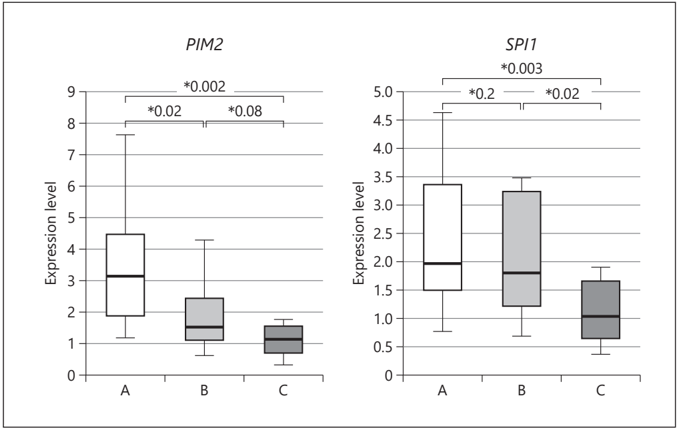
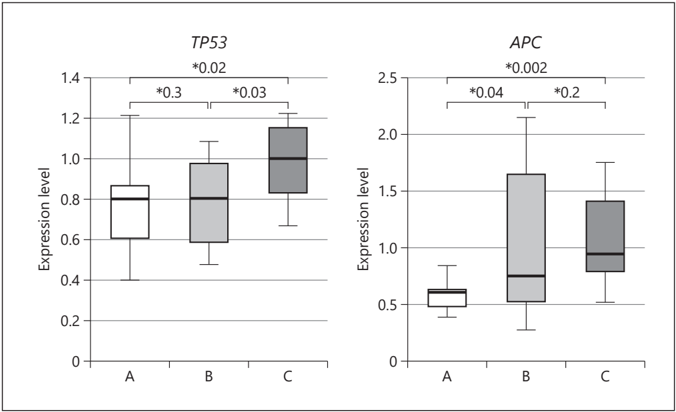
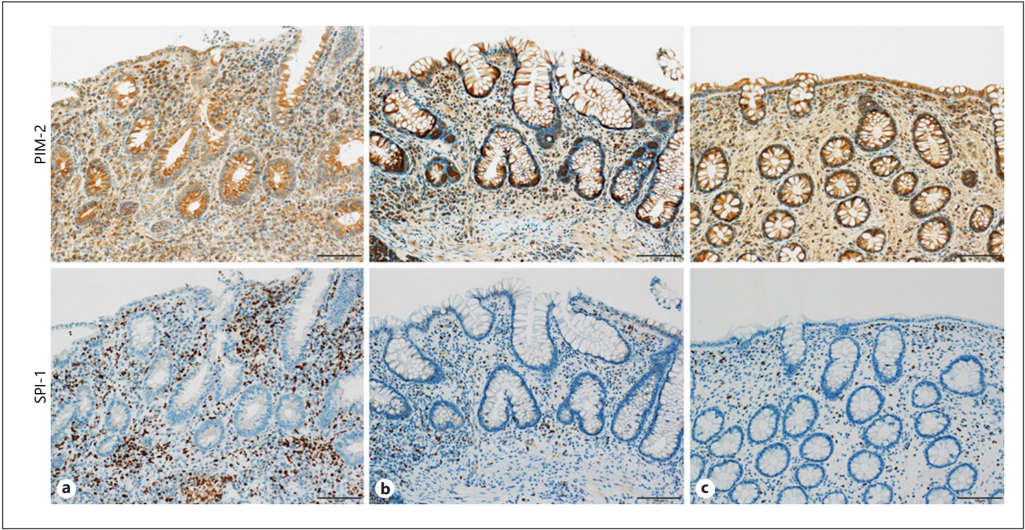
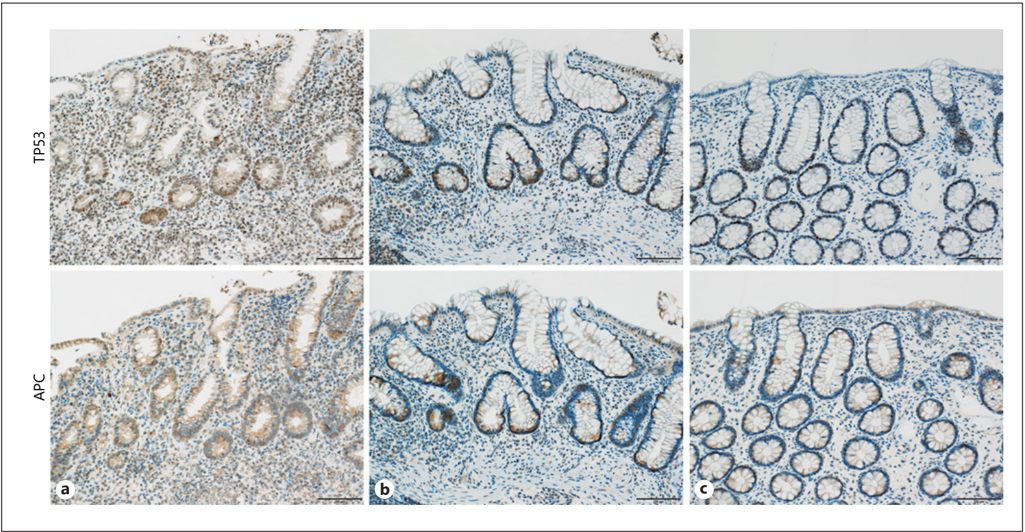
Introduction: Long-term disease duration of ulcerative colitis (UC) is known to increase the risk of developing colorectal cancer in adults; however, this association has not been genetically analyzed in children with UC. Herein, we examined the expression of cancer-related genes in the colonic mucosa of pediatric UC patients and their risk of developing colorectal cancer. Methods: Microarray analysis of cancer-related gene expression was conducted on rectal mucosa biopsy specimens randomly selected from pediatric cases, including 4 active-phase UC cases, 3 remission-phase UC cases, and 3 irritable bowel syndrome control cases. The subject pool was then expanded to 10 active-phase cases, 10 remission-phase cases, and 10 controls, which were analyzed by real-time polymerase chain reaction (PCR) and immunohistochemical staining. Results: The microarray results indicated significantly higher expression levels of cancer-related genes PIM2 and SPI1 in the active group than in the remission and control groups (p < 0.05). Real-time PCR confirmed that PIM2 and SPI1 expression levels were significantly higher, whereas TP53 and APC expression levels were significantly lower, in the active-phase group than in the remission and control groups (p < 0.05). Immunohistochemical staining for PIM2, SPI1, TP53, and APC proteins supported the real-time PCR results. Conclusions: Expression levels of previously unreported cancer-related genes in adult UC patients were significantly higher in pediatric UC patients than in controls. Inflammation of the gastrointestinal mucosa increased the expression levels of cancer-related genes even in childhood-onset UC cases, suggesting that chronic inflammation from childhood may increase the risk of colorectal cancer development.
Overview
The claims and statistics of this paper haven’t been checked yet.
Free: it reads the open-access text and checks the first 5 claims that cite a source we can check. Create a free account to check every claim.
Integrity signals
Registry
Cites
Statistics
Figures
Verification
Claims the paper makes
The claims and statistics of this paper haven’t been checked yet.
Free: it reads the open-access text and checks the first 5 claims that cite a source we can check. Create a free account to check every claim.
Claims other papers make about this one
Each is checked against this paper’s own text: does it say what the citing paper says it does?
The cited source says what the claim attributes to it.
In the citing paper
“Importantly, SPI1 has also been associated with ulcerative colitis (UC) [27] and shown to transcriptionally regulate S100A8/A9 expression [28–30].”
From Inhibition of SPI1 by ADAP Regulates S100A8/A9 Signaling in Macrophages to Control the Development of Colitis (2026) · cites this paper as [27]
Self-check
Percentages, sums and reported differences re-computed from the paper’s own numbers.
The self-check needs the paper’s full text.
Citations
Cites
Investigation of the freely available easy-to-use software ‘EZR’ for medical statistics
Kanda, Y. (2013) · Bone Marrow Transplantation · doi:10.1038/bmt.2012.244 · Cited by 18,767
Erdogan, D., Heijnen, B. H. M., Bennink, R. J., Kok, M., Dinant, S., Straatsburg, I. H., Gouma, D. J., & van Gulik, T. M. (2004) · Liver International · doi:10.1111/j.1478-3231.2004.00901.x · Cited by 11,700
Genetic Alterations during Colorectal-Tumor Development
Vogelstein, B., Fearon, E. R., Hamilton, S. R., Kern, S. E., Preisinger, A. C., Leppert, M., Smits, A. M. M., & Bos, J. L. (1988) · New England Journal of Medicine · doi:10.1056/nejm198809013190901 · Cited by 6,728
Coated Oral 5-Aminosalicylic Acid Therapy for Mildly to Moderately Active Ulcerative Colitis
Schroeder, K. W., Tremaine, W. J., & Ilstrup, D. M. (1987) · New England Journal of Medicine · doi:10.1056/nejm198712243172603 · Cited by 3,026
The risk of colorectal cancer in ulcerative colitis: a meta-analysis
Eaden, J. A., Abrams, K. R., & Mayberry, J. F. (2001) · Gut · doi:10.1136/gut.48.4.526 · Cited by 2,959
Rome IV—Functional GI Disorders: Disorders of Gut-Brain Interaction
Drossman, D. A., & Hasler, W. L. (2016) · Gastroenterology · doi:10.1053/j.gastro.2016.03.035 · Cited by 1,928
Ulcerative Colitis and Colorectal Cancer: A Population-Based Study
Ekbom, A., Helmick, C., Zack, M., & Adami, H.-O. (1990) · New England Journal of Medicine · doi:10.1056/nejm199011013231802 · Cited by 1,777
Requirement of transcription factor PU.1 in the development of multiple hematopoietic lineages
Scott, E. W., Simon, M. C., Anastasi, J., & Singh, H. (1994) · Science · doi:10.1126/science.8079170 · Cited by 1,532
Intestinal Inflammation and Cancer
Ullman, T. A., & Itzkowitz, S. H. (2011) · Gastroenterology · doi:10.1053/j.gastro.2011.01.057 · Cited by 1,119
Rectal biopsy as an aid to cancer control in ulcerative colitis.
Morson, B. C., & Pang, L. S. (1967) · Gut · doi:10.1136/gut.8.5.423 · Cited by 575
Research works printed but not linked: 1
- Drossman DA, Hasler WL. Rome IV-func- tional GI disorders: disorders of gut-brain in- teraction. Gastroenterology. 2016; 150: 1257- 61.
Cited by
Yang, Y., Hua, Y., Chen, W., Zheng, H., Wu, H., Qin, S., & Huang, S. (2022) · Frontiers in Pharmacology · doi:10.3389/fphar.2022.1037856 · Cited by 25
“According to reports, TP53 is frequently mutated in UC and colorectal neoplasia that develop fromUC, over 50% of colitis-induced colorectal cancer and colon neoplasia could be found with the TP53 mutation (MäkiNevala et al., 2021; Matsumoto et al., 2021; Arai et al., 2022).”
BackgroundBiological, genetic and epigenetic markers in ulcerative colitis
Caliendo, G., D’Elia, G., Makker, J., Passariello, L., Albanese, L., Molinari, A. M., & Vietri, M. T. (2023) · Advances in Medical Sciences · doi:10.1016/j.advms.2023.09.010 · Cited by 21
Zou, C., Zan, X., Jia, Z., Zheng, L., Gu, Y., Liu, F., Han, Y., Xu, C., Wu, A., & Zhi, Q. (2023) · Clinical and Translational Medicine · doi:10.1002/ctm2.1479 · Cited by 19
“164 From this, using the Affymetrix Human Transcriptome Array 2.0, a similar study from the Asia Pacific region had been conducted to screen the transcriptome profiling, including DEGs and AS events, in inflamed colonic biopsies of long-and short-duration UC patients.”
MethodInfluentialAng, Q. Y., Plichta, D. R., Kim, S. T., Kim, I., Gregory, S. A., Xia, Y., Lau, H., Xavier, R. J., & Ananthakrishnan, A. N. (2023) · Inflammatory Bowel Diseases · doi:10.1093/ibd/izad268 · Cited by 20
Ding, Y., Deng, A., Yu, H., Zhang, H., Qi, T., He, J., He, C., Hou, J., Wang, Z., & Wu, L. (2024) · Computers in Biology and Medicine · doi:10.1016/j.compbiomed.2024.109365 · Cited by 14
Metadata
- Authors
- Arai, N., Kudo, T., Tokita, K., Kyodo, R., Sato, M., Miyata, E., Hosoi, K., Ikuse, T., Jimbo, K., Ohtsuka, Y., & Shimizu, T.
- Affiliations
- Juntendo University (JP)
- ORCID
- Venue
- Digestion
- Publisher
- S. Karger AG
- Published
- 2021-10-29
- Volume
- 103
- Issue
- 2
- Pages
- 150-158
- ISSN
- 0012-2823 (ISSN-L)
- 1421-9867
- PMC
- PMC8985031
- OpenAlex
- W3208594475
- Cited by
- 9
- References
- 33
- Citations by year
- 2026: 1 · 2025: 1 · 2024: 1 · 2023: 4 · 2022: 2
- FWCI
- 0.99
- Type
- journal article
- Language
- en
- Open access
- hybrid
- doi.org
- Licence
- cc-by-nc
- creativecommons.org/licenses/by-nc/4.0/ (vor)
- creativecommons.org/licenses/by-nc/4.0/ (tdm)
- Locations
- Digestion (publishedVersion, cc-by-nc)
- PubMed Central (publishedVersion)
- PubMed (publishedVersion)
- Topics
- Health Sciences › Medicine › Gastroenterology › Inflammatory Bowel Disease
- Health Sciences › Medicine › Pathology and Forensic Medicine › Genetic factors in colorectal cancer
- Health Sciences › Medicine › Oncology › Colorectal Cancer Screening and Detection
- Keywords
- pediatric ulcerative colitis, colorectal cancer risk, cancer gene expression, PIM2, PU.1, TP53, APC, colonic mucosa, disease activity, chronic inflammation
- MeSH terms
- Adult, Child, Colitis, Ulcerative, Humans, Intestinal Mucosa, Irritable Bowel Syndrome
About these checks
Registry, retraction, Cites and statistics results are computed, not judged, with one exception: a printed reference that no index lists is read once by a model before it counts as a citation error. Claims are extracted by a model and kept only when their quote appears verbatim in the text; each cited source is then checked, with a model’s help, for whether it says what the claim relies on. Those verdicts can be wrong — read the claim’s quote and the cited source before relying on one.
Statistics and arithmetic are recomputed, not judged.
Confidence bands are shown only for fields calibrated on our annotated test set. None is calibrated yet, so no band is shown.
What counts as a claim ›How we measure confidence ›How we check this ›
Are you an author, or do you see a problem with this page? Request a review
How to cite
Cite CoChat for the checks on this page, and the paper for its own findings.
- This page
- CoChat. (2026). Citation check: Expression of Oncogenic Molecules in Pediatric Ulcerative Colitis. https://app.cochat.ai/papers/10.1159/000519559
- The paper
- Arai, N., Kudo, T., Tokita, K., Kyodo, R., Sato, M., Miyata, E., Hosoi, K., Ikuse, T., Jimbo, K., Ohtsuka, Y., & Shimizu, T. (2022). Expression of Oncogenic Molecules in Pediatric Ulcerative Colitis. Digestion. https://doi.org/10.1159/000519559
Data sources
Bibliographic data: Semantic Scholar, OpenAlex, Crossref.
Contains information from the Semantic Scholar Academic Graph Datasets, made available under the ODC Attribution License (ODC-BY 1.0).
Semantic Scholar’s data is described in: Kinney, R., et al. (2023). The Semantic Scholar Open Data Platform. arXiv:2301.10140.
