

Honey as an alternative wound healing therapy: a systematic review of clinical and preclinical evidence (2020-2024)
Open accessThe DOI matches its Crossref record; 42 of the 42 references it cites were found in a registry or an index; none of the 72 sources its claims cite is checked for support yet.
Abstract
Wound management remains a significant global public health challenge, contributing to substantial morbidity, mortality, and healthcare costs. Honey has been increasingly investigated as a complementary wound care agent due to its antimicrobial, anti-inflammatory, and wound-healing properties. This systematic review aimed to synthesize and critically evaluate the current evidence on the use of honey as an alternative wound treatment. A systematic review was conducted following PRISMA guidelines. Six electronic databases (Scopus, Nature, ProQuest, EBSCO, SpringerLink, and ScienceDirect) were searched using predefined search terms for studies published between 2020 and 2024. Inclusion criteria encompassed human studies, mixed-methods or quantitative designs, and interventions using honey for wound care. Study quality was assessed using the Joanna Briggs Institute (JBI) critical appraisal tools. From 302 initially identified articles, 16 studies met the inclusion criteria after removing duplicates and screening. The included studies comprised randomized controlled trials, prospective controlled studies, case series, and in vitro investigations. Three themes emerged: i) Honey as a wound-healing therapy, demonstrating antimicrobial, anti-inflammatory, and biofilm-inhibiting properties; ii) Benefits of medical-grade honey (MGH), including accelerated epithelialization, reduced infection rates, and shorter recovery times; and iii) Recommendations for honey as a cost-effective, accessible alternative treatment. The evidence supports honey as a promising adjunctive therapy for wound management, particularly in resource-limited settings. However, the heterogeneity in study designs, honey types, and wound categories limits definitive conclusions. Future large-scale randomized controlled trials with standardized outcomes are needed to establish clinical guidelines for honey-based wound care.
Overview
CoChat Summary
TL;DR
This PRISMA systematic review synthesized 16 studies on honey for wound care, finding antimicrobial, anti-inflammatory, and healing benefits, especially for medical-grade honey (MGH). Honey is supported as a promising adjunctive and cost-effective therapy, but heterogeneity and limited evidence preclude routine standalone use.
Key findings
- From 302 records, 16 studies met inclusion criteria: six randomized controlled trials, three prospective studies, four case series, and three in vitro/laboratory studies. Three themes emerged: honey as a wound-healing therapy, benefits of MGH, and recommendations for honey as a cost-effective, accessible alternative.
- Honey and MGH demonstrated antimicrobial, anti-inflammatory, and biofilm-inhibiting properties; Manuka honey and MGH consistently showed broad-spectrum antibacterial activity, while other honey types (e.g., chestnut, heather) were more strain-specific.
- Clinical outcomes included complete epithelialization of lateral palatal defects in 66.7% of test-group participants at two weeks post-surgery, significantly faster healing up to day 42 post-caesarean section with MGH, and resolution of infected heel pressure ulcers within 3–4 weeks with complete healing.
- The review concludes honey is a promising adjunctive therapy for wound management, particularly in resource-limited settings, but heterogeneity in study designs, honey types, and wound categories limits definitive conclusions.
Methods
- Systematic review following PRISMA guidelines; six databases (Scopus, Nature, ProQuest, EBSCO, SpringerLink, ScienceDirect) were searched between January and March 2024 for English-language, full-text, open-access articles published January 2020–December 2024.
- Inclusion criteria: human participants or in vitro models relevant to wound care, honey interventions for wound care, reports on honey as an alternative wound treatment, and quantitative, qualitative, or mixed-methods designs. Exclusion criteria: animal-based wound care studies, studies focused exclusively on modern wound dressings without honey, and systematic reviews, literature reviews, or editorials.
- Study quality was assessed with Joanna Briggs Institute (JBI) critical appraisal tools by two independent reviewers, with a third resolving disagreements. Due to substantial heterogeneity, a quantitative meta-analysis was not feasible; findings were synthesized narratively.
Limitations
- Stated by the paper: heterogeneity in study designs, honey types and concentrations, wound categories, patient populations, and outcome measures limits definitive conclusions; small sample sizes, variability in protocols, and predominance of studies from high-income settings further constrain generalizability. The evidence is not sufficient to recommend honey as a routine standalone replacement for conventional treatments, and pediatric evidence remains limited.
- Evident from the text: the included table lists Guthrie et al. (2014), outside the stated 2020–2024 publication window, and includes Agbagwa et al. (2022), an animal-model study, despite the exclusion of animal-based wound care studies. Many included studies are case series or in vitro investigations, and no quantitative meta-analysis was performed.
Model-written summary. Check it against the paper before relying on it.
Integrity signals
Registry
Cites
Statistics
Figures




Verification
Claims the paper makes
0 Valid · 0 Not valid · 63 Not checked · 24 Own results and interpretations
In the paper
“MGH demonstrated significantly faster recovery up to day 42 post-caesarean section [23], reduced bacterial burden and infection risk [28], and improved surgical outcomes with shortened recovery time [21].”
§ Honey as an alternative wound healing therapy: a systematic review of clinical and preclinical evidence (2020-2024) > 3.2. Theme 2: The advantages of medical-grade honey (MGH) in wound healing
What the sources say
- Not matchedcites [23]
The reference list we hold has no entry [23].
boostedstates a cause- Asserted: passes — The authors put it forward as true.
- Checkable: passes — It can be checked against evidence.
- Load-bearing: passes — The paper’s conclusions depend on it.
- Based: passes — The paper gives a reason why it holds.
- Not matched
A result the paper states — it cites no source for it, so there is none to check. The quote shows it is in the paper.
In the paper
“However, specific evidence for pediatric populations remains limited and warrants further investigation.”
§ Honey as an alternative wound healing therapy: a systematic review of clinical and preclinical evidence (2020-2024) > 4.6. Public health, policy, and economic implications
plain- Asserted: passes — The authors put it forward as true.
- Checkable: passes — It can be checked against evidence.
- Load-bearing: unclear — It is unclear whether the paper’s conclusions depend on it.
- Based: passes — The paper gives a reason why it holds.
In the paper
“Furthermore, incubating honey with the strongest wound exudate causes considerable degradation of the GOX enzyme, a quick and potent H2O2 producer [31].”
§ Honey as an alternative wound healing therapy: a systematic review of clinical and preclinical evidence (2020-2024) > 4.3. Benefits of medical grade honey (MGH) on the wound healing process
What the sources say
- Not matchedcites [31]
The reference list we hold has no entry [31].
plainstates a cause- Asserted: passes — The authors put it forward as true.
- Checkable: passes — It can be checked against evidence.
- Load-bearing: unclear — It is unclear whether the paper’s conclusions depend on it.
- Based: passes — The paper gives a reason why it holds.
- Not matched
A result the paper reports from its own data — it cites no other source for it, so there is none to check. The quote shows it is in the paper.
In the paper
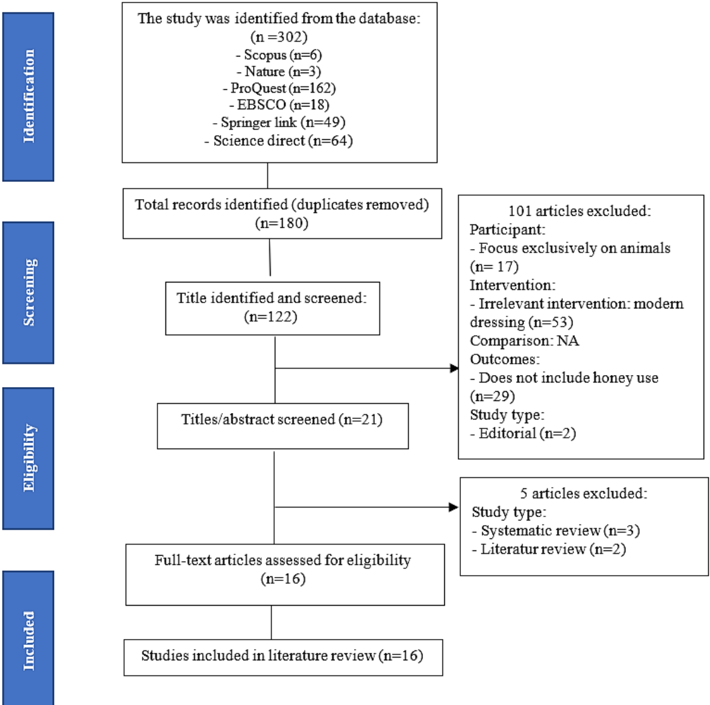
“From 302 initially identified articles, 16 studies met the inclusion criteria after removing duplicates and screening.”
- Also stated in: § 3. RESULTS · plain
“A total of 302 articles were identified across six databases, and 180 duplicate articles were removed.Titles and abstracts of 122 articles were screened, resulting in 21 articles deemed eligible.After full-text screening and applying exclusion criteria, 16 studies met the inclusion criteria and were included in the review (Table 1 (see Appendix)) [18]- [32].”
§ Honey as an alternative wound healing therapy: a systematic review of clinical and preclinical evidence (2020-2024) > Abstract
plain- Asserted: passes — The authors put it forward as true.
- Checkable: passes — It can be checked against evidence.
- Load-bearing: passes — The paper’s conclusions depend on it.
- Based: passes — The paper gives a reason why it holds.
- Also stated in: § 3. RESULTS · plain
A result the paper states — it cites no source for it, so there is none to check. The quote shows it is in the paper.
In the paper
“A critical consideration is the substantial heterogeneity observed across the included studies.Variations in honey types (Manuka, chestnut, heather, medical-grade), concentrations, wound types (surgical, chronic, diabetic, pressure ulcers), patient populations, and outcome measures limit the ability to draw definitive conclusions regarding optimal protocols.”
- Also stated in: § Abstract · plain
“However, the heterogeneity in study designs, honey types, and wound categories limits definitive conclusions.”
§ Honey as an alternative wound healing therapy: a systematic review of clinical and preclinical evidence (2020-2024) > 4.5. Heterogeneity across studies
plainstates a cause- Asserted: passes — The authors put it forward as true.
- Checkable: passes — It can be checked against evidence.
- Load-bearing: passes — The paper’s conclusions depend on it.
- Based: passes — The paper gives a reason why it holds.
- Also stated in: § Abstract · plain
24 more claims
Create a free account to see all 87 claims and every source verdict.
- It may state two separate claims as one. 43
- The quote only partly states this claim. 13
- Probably not a substantial claim. 15
Self-check
Percentages, sums and reported differences re-computed from the paper’s own numbers.
Each contradiction between two passages listed here was confirmed by an independent check.
Rated major: it would touch a result — a value a result rests on, reported and recomputed p-values on opposite sides of the significance level, two passages that conflict with no sign which is right, or a cited work retracted before this paper was published.
In the paper
§ Honey as an alternative wound healing therapy: a systematic review of clinical and preclinical evidence (2020-2024) > 2.3. Inclusion and exclusion criteria
“Exclusion criteria: i) animal-based wound care studies”
§ Honey as an alternative wound healing therapy: a systematic review of clinical and preclinical evidence (2020-2024) > Additional information
“11 Agbagwa et | Experimental | Diabetic wounds | Moringa- | Honey infused with moringa | JBI quasi- |”
Rated minor: it would not touch a result — a value no result rests on, a p-value that stays on the same side of the significance level, or a conflict that is clerical, resolved elsewhere in the paper, or outside its own findings.
In the paper
§ Honey as an alternative wound healing therapy: a systematic review of clinical and preclinical evidence (2020-2024) > 3. RESULTS
“16 studies met the inclusion criteria and were included in the review (Table 1 (see Appendix)) [18]- [32].”
§ Honey as an alternative wound healing therapy: a systematic review of clinical and preclinical evidence (2020-2024) > Additional information
“| 9 | Ahmed et al. | Case series / | Orthopaedic | Natural honey Honey served as an efficient, | JBI case series | |”
Citations
Cites
Rudd, K. E., Johnson, S. C., Agesa, K. M., Shackelford, K. A., Tsoi, D., Kievlan, D. R., Colombara, D. V., Ikuta, K. S., Kissoon, N., Finfer, S., et al. (2020) · The Lancet · doi:10.1016/s0140-6736(19)32989-7 · Cited by 7,971 · cited 2×
“Approximately 85% of sepsis cases occur in LMICs, underscoring the disproportionate impact on vulnerable populations [4], [11].”
Tacconelli, E., Carrara, E., Savoldi, A., Harbarth, S., Mendelson, M., Monnet, D. L., Pulcini, C., Kahlmeter, G., Kluytmans, J., Carmeli, Y., et al. (2018) · The Lancet Infectious Diseases · doi:10.1016/s1473-3099(17)30753-3 · Cited by 6,142
Skin Wound Healing Process and New Emerging Technologies for Skin Wound Care and Regeneration
Tottoli, E. M., Dorati, R., Genta, I., Chiesa, E., Pisani, S., & Conti, B. (2020) · Pharmaceutics · doi:10.3390/pharmaceutics12080735 · Cited by 1,340
Armstrong, D. G., Swerdlow, M. A., Armstrong, A. A., Conte, M. S., Padula, W. V., & Bus, S. A. (2020) · Journal of Foot and Ankle Research · doi:10.1186/s13047-020-00383-2 · Cited by 975 · cited 1×
“The growing elderly population and rising prevalence of diabetes have substantially increased the burden of chronic wounds, including diabetic foot ulcers and pressure sores, posing particular challenges for healthcare systems worldwide [2], [5], [9].”
Propolis: An update on its chemistry and pharmacological applications
Hossain, R., Quispe, C., Khan, R. A., Saikat, A. S. M., Ray, P., Ongalbek, D., Yeskaliyeva, B., Jain, D., Smeriglio, A., Trombetta, D., et al. (2022) · Chinese Medicine · doi:10.1186/s13020-022-00651-2 · Cited by 215
Human Wound and Its Burden: Updated 2025 Compendium of Estimates
Sen, C. K. (2025) · Advances in Wound Care · doi:10.1177/21621918251359554 · Cited by 142
Honey: An Advanced Antimicrobial and Wound Healing Biomaterial for Tissue Engineering Applications
Yupanqui Mieles, J., Vyas, C., Aslan, E., Humphreys, G., Diver, C., & Bartolo, P. (2022) · Pharmaceutics · doi:10.3390/pharmaceutics14081663 · Cited by 128
Role of Honey in Advanced Wound Care
Scepankova, H., Combarros-Fuertes, P., Fresno, J. M., Tornadijo, M. E., Dias, M. S., Pinto, C. A., Saraiva, J. A., & Estevinho, L. M. (2021) · Molecules · doi:10.3390/molecules26164784 · Cited by 126
Lee, J.-H., Park, J.-H., Kim, J.-A., Neupane, G. P., Cho, M. H., Lee, C.-S., & Lee, J. (2011) · Biofouling · doi:10.1080/08927014.2011.633704 · Cited by 92
Pleeging, C. C. F., Wagener, F. A. D. T. G., de Rooster, H., & Cremers, N. A. J. (2022) · Drug Resistance Updates · doi:10.1016/j.drup.2022.100834 · Cited by 86
Research works printed but not linked: 5
- A. Bocoum et al., "EP323 medical grade honey enhances the healing of Caesarean section wounds and does not compromise in the prevention of infections when compared to antibiotics combined with povidone-iodine --a prospective controlled trial," Journal of Wound Management, vol. 24, no. 2, p. 210, 2023.
- G. Papanikolaou, G. Gousios, and N. Cremers, "EP096 use of medical grade honey in the management of heel pressure ulcers: a case series," Journal of Wound Management, vol. 24, no. 2, p. 84, 2023.
- D. Chrysostomou, A. Pokorna, and N. Cremers, "EP186 medical grade honey, an alternative to decrease bacterial load in the wound bed," Journal of Wound Management, vol. 24, no. 2, p. 133, 2023.
- R. Angioi, L. Holland, A. Morrin, and B. White, "EP371 honey antimicrobial properties: is there only room for Manuka honey?," Journal of Wound Management, vol. 24, no. 2, p. 239, 2023.
- J. Majtan, V. Bugarova, M. Bucekova, J. Godocikova, and J. Farkasovska, "EP320 antibacterial efficacy of honey in proteolytic wound-like environment," Journal of Wound Management, vol. 24, no. 2, p. 209, 2023.
Cited by
Still being checked.
Metadata
- Authors
- Kusyati, E., Iswanti, D. I., Mujahidah, S., & Mayangsari, D.
- Affiliations
- Universitas Karya Husada Semarang (ID)
- Corresponding author
- Kusyati, Eni
- Venue
- International Journal of Public Health Science (IJPHS)
- Published
- 2026-06-01
- Volume
- 15
- Issue
- 2
- Pages
- 605
- ISSN
- 2252-8806 (ISSN-L)
- 2620-4126
- OpenAlex
- W7163930094
- Cited by
- 0
- References
- 42
- FWCI
- 0.00
- Type
- journal article
- Language
- en
- Open access
- diamond
- doi.org
- Licence
- Locations
- International Journal of Public Health Science (IJPHS) (publishedVersion, cc-by-sa)
- Zenodo (CERN European Organization for Nuclear Research) (submittedVersion, cc-by)
- Topics
- Life Sciences › Agricultural and Biological Sciences › Insect Science › Bee Products Chemical Analysis
- Health Sciences › Medicine › Surgery › Wound Healing and Treatments
- Health Sciences › Medicine › Endocrinology, Diabetes and Metabolism › Diabetic Foot Ulcer Assessment and Management
- Keywords
- honey, wound healing, wound care, medical-grade honey, antimicrobial activity, anti-inflammatory activity, biofilm inhibition, re-epithelialization, wound infection, cost-effective treatment, resource-limited settings
About these checks
Registry, retraction, Cites and statistics results are computed, not judged, with one exception: a printed reference that no index lists is read once by a model before it counts as a citation error. Claims are extracted by a model and kept only when their quote appears verbatim in the text; each cited source is then checked, with a model’s help, for whether it says what the claim relies on. Those verdicts can be wrong — read the claim’s quote and the cited source before relying on one.
A language model drew the claims from the paper on 2026-11-22, under version 3 of the claim definition (model deepseek-v4.1-flash, prompt extract-v3).
A second model labelled each claim on 2026-11-22 (model jev-1.13-20260917, definition revision gold-guideline-v0.2).
Statistics and arithmetic are recomputed, not judged.
Confidence bands are shown only for fields calibrated on our annotated test set. None is calibrated yet, so no band is shown.
What counts as a claim ›How we measure confidence ›How we check this ›
Are you an author, or do you see a problem with this page? Request a review
How to cite
Cite CoChat for the checks on this page, and the paper for its own findings.
- This page
- CoChat. (2026). Citation check: Honey as an alternative wound healing therapy: a systematic review of clinical and preclinical evidence (2020-2024). https://app.cochat.ai/papers/10.11591/ijphs.v15i2.26951
- The paper
- Kusyati, E., Iswanti, D. I., Mujahidah, S., & Mayangsari, D. (2026). Honey as an alternative wound healing therapy: a systematic review of clinical and preclinical evidence (2020-2024). International Journal of Public Health Science (IJPHS). https://doi.org/10.11591/ijphs.v15i2.26951
Data sources
Bibliographic data: Semantic Scholar, OpenAlex, Crossref.
Contains information from the Semantic Scholar Academic Graph Datasets, made available under the ODC Attribution License (ODC-BY 1.0).
Semantic Scholar’s data is described in: Kinney, R., et al. (2023). The Semantic Scholar Open Data Platform. arXiv:2301.10140.
