

Efetividade de uma intervenção digital na diminuição da prática de binge drinking entre frequentadores de baladas
Open accessThe DOI matches its Crossref record; 35 of the 36 references it cites were found in a registry or an index; 2 of the 12 sources its claims cite were checked for support.
Abstract
OBJECTIVE To evaluate the effectiveness of a web-based intervention in reducing binge drinking among nightclub patrons after six months. METHODS We carried out a website survey with probabilistic sample in 31 nightclubs in the city of São Paulo, Brazil, which originated a randomized controlled trial with 1,057 participants. Those classified as problem drinkers (n = 465) using the Alcohol Use Disorders Identification Test were randomized into two study groups - intervention and control. The web-based intervention consisted of exposing the participants to a normative feedback screen about their alcohol consumption, characterizing the risks associated with amount consumed, money spent on drinks, drinking and driving, risk classification of Alcohol Use Disorders Identification Test, and tips to reduce damage. RESULTS There was a significant reduction in the practice of binge drinking in the week estimated at 38% among participants in the intervention group after six months (p < 0.05). However, there was no significant reduction in the outcomes when we analyzed the intervention and control groups and at baseline and after sixth months, simultaneously. CONCLUSIONS We cannot conclude that digital tools reduce the pattern of binge drinking among party goers in São Paulo. More studies are needed with this methodology because of its attractiveness to this type of group, given the privacy and speed that personalized information is transmitted.
Overview
CoChat Summary
TL;DR
This randomized controlled trial tested a web-based personalized normative feedback intervention among nightclub patrons in São Paulo and found a within-group 38% reduction in binge drinking in the intervention group at six months. However, the authors conclude they cannot state that the digital tool was effective overall because the group-by-time analyses were not significant and the result disappeared under LOCF.
Key findings
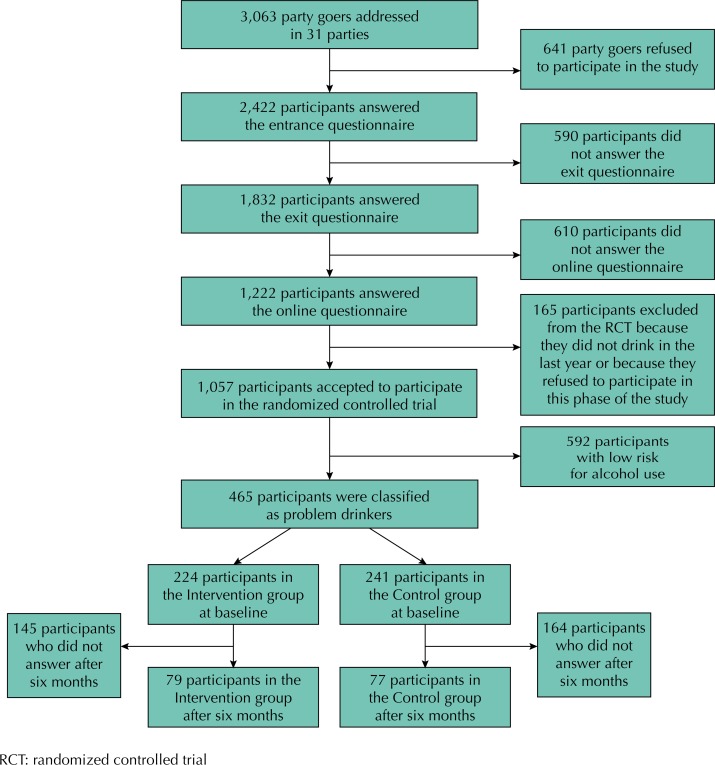
- Of 1,057 randomized participants, 465 (44.0%; 95%CI 41.0–47.0) had AUDIT scores ≥ 8 and were classified as “problem drinkers”; these were randomized to intervention (n = 224) and control (n = 241).
- At baseline, among the 465 problem drinkers, 344 (74.0%; 95%CI 69.7–77.9) reported binge drinking in the month and 256 (55.2%; 95%CI 50.5–59.7) reported binge drinking in the week; about 50% reported lack of control over drinking behavior (n = 231, 95%CI 45.1–54.4).
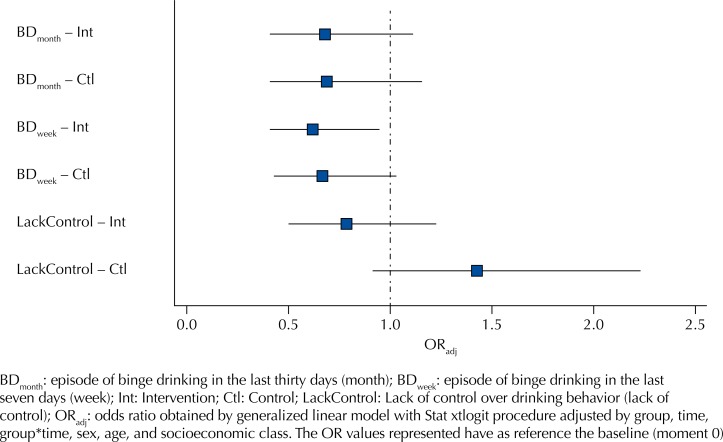
- In the intervention group, binge drinking in the week decreased by 38% after six months (p = 0.026) after adjustment for sex, age, and socioeconomic class; the control group did not show a significant change (p = 0.062).
- The main group-time effect was not significant for binge drinking outcomes, and lack of control over drinking showed only a marginal result (ORadj = 0.55, 95%CI 0.30–1.02; p = 0.058); with LOCF, there was no trend of significance.
Methods
- Website survey and randomized controlled trial among nightclub patrons in 31 nightclubs in São Paulo, Brazil; recruitment occurred in 2013, with follow-up at six months.
- Systematic sampling in nightclub queues: 3,063 approached, 2,422 accepted the interview (79%), 1,222 accessed the online questionnaire, and 1,057 entered the RCT; analysis focused on 465 “problem drinkers” (AUDIT ≥ 8).
- Intervention: personalized normative feedback web screens about alcohol consumption, risks, spending, drinking and driving, AUDIT risk, and harm-reduction tips; analysis used intention-to-treat generalized linear models with panel data (xtlogit), adjusted for sex, age, and socioeconomic class, plus a LOCF reanalysis.
Limitations
- The paper states limitations including loss of subjects at different stages, difficulty of Internet access for some party goers, limited RCT reach, impossibility of comparison with other studies because the intervention among nightclub patrons was unprecedented, and the use of a binge-drinking criterion of five or more drinks for women as well as men.
- Evident from the text: follow-up response was limited, with only 79 intervention participants and 77 control participants responding at six months, which likely reduced power and precision.
- Evident from the text: the main conclusion depends on analytic choice; the significant within-group reduction did not hold in the group-time interaction or under LOCF, making causal inference uncertain.
Model-written summary. Check it against the paper before relying on it.
Integrity signals
Registry
Cites
Statistics
Figures
Verification
Claims the paper makes
2 Valid · 0 Not valid · 5 Not checked · 21 Own results and interpretations
Every source the paper cites for this claim was checked and supports it.
In the paper
“Binge drinking (BD) 5 is common in nightclubs,”
- Also stated in: § INTRODUCTION · plain
“Binge drinking (BD) 5 is common in nightclubs”
§ Effectiveness of a web-based intervention in reducing binge drinking among nightclub patrons > INTRODUCTION
What the sources say
- Supportedcites [5] Calafat A Blay NT Hughes K Bellis M Juan M Duch M Kokkevi A Nightlife young risk behaviours in Mediterranean versus other European cities: are stereotypes true? Eur J Public Health 2011 21 3 311 315 https://doi.org/10.1093/eurpub/ckq141 20884662 source
The introduction says that much alcohol consumption among young Europeans occurs in bars and nightclubs, especially on weekend nights. The Discussion explicitly identifies binge drinking as a nightlife risk behaviour, supporting the broad claim. (LLM, conf=0.86)
plain- Asserted: passes — The authors put it forward as true.
- Checkable: passes — It can be checked against evidence.
- Load-bearing: passes — The paper’s conclusions depend on it.
- Based: passes — The paper gives a reason why it holds.
- Also stated in: § INTRODUCTION · plain
The cited sources support only part of this claim — read each source’s verdict below.
In the paper
“International studies have shown a significant reduction in the practice of BD in university students after six months of personalized normative feedback via the Internet 18 , 19 .”
§ Effectiveness of a web-based intervention in reducing binge drinking among nightclub patrons > INTRODUCTION
What the sources say
- Partly supportedcites [18] Lewis MA Patrick ME Litt DM Atkins DC Kim T Blayney JA Randomized controlled trial of a web-delivered personalized normative feedback intervention to reduce alcohol-related risky sexual behavior among college students J Consult Clin Psychol 2014 82 3 429 440 https://doi.org/10.1037/a0035550 24491076 PMC4029925 sourceExperimental — accuracy not yet measured
Lewis et al. (2014) is a single U.S. (University of Washington) RCT in which all measures and interventions were completed entirely via the Internet (Method > Procedures), and the Results (Models for Main Effects) state that interventions containing alcohol PNF produced significant reductions on drinking outcomes and that 'Most intervention effects on drinking outcomes remained significant at the 6 month assessment.' That supports web-delivered PNF reducing drinking among college students at six months. However, the paper did not measure binge drinking as an outcome — its six outcomes were typical drinks per week, drinking frequency, drinks per occasion, alcohol-related consequences, frequency of drinking prior to sex, and drinks prior to sex (Method > Data Analyses; Measures) — so the specific claim of a significant reduction in 'the practice of binge drinking' is not stated in this source, nor is any international/multi-country sampling (participants were U.S. students, mean age 20.08, an indicated sample selected for 4/5+ drinks on one occasion). (LLM, conf=0.75)
- Not checked yetcites [19] Kypri K Hallett J Howat P McManus A Maycock B Bowe S Horton NJ Randomized controlled trial of proactive web-based alcohol screening and brief intervention for university students Arch Intern Med 2009 169 16 1508 1514 https://doi.org/10.1001/archinternmed.2009.249 19752409 source
plainstates a cause- Asserted: passes — The authors put it forward as true.
- Checkable: passes — It can be checked against evidence.
- Load-bearing: passes — The paper’s conclusions depend on it.
- Based: passes — The paper gives a reason why it holds.
- Partly supported
A result the paper reports from its own data — it cites no other source for it, so there is none to check. The quote shows it is in the paper.
In the paper
“Thus, 465 patrons (44.0%, 95%CI 41.0–47.0) were classified as “problem drinkers”.”
§ Effectiveness of a web-based intervention in reducing binge drinking among nightclub patrons > RESULTS
plain- Asserted: passes — The authors put it forward as true.
- Checkable: passes — It can be checked against evidence.
- Load-bearing: unclear — It is unclear whether the paper’s conclusions depend on it.
- Based: passes — The paper gives a reason why it holds.
A result the paper reports from its own data — it cites no other source for it, so there is none to check. The quote shows it is in the paper.
In the paper
“In addition, we can note a marginally significant result (p = 0.058) for the intervention effect in reducing the prevalence of lack of control over drinking behavior (ORadj = 0.55, 95%CI 0.30–1.02).”
§ Effectiveness of a web-based intervention in reducing binge drinking among nightclub patrons > RESULTS
plainstates a possible causen = 156 ·- Asserted: passes — The authors put it forward as true.
- Checkable: passes — It can be checked against evidence.
- Load-bearing: unclear — It is unclear whether the paper’s conclusions depend on it.
- Based: passes — The paper gives a reason why it holds.
A result the paper reports from its own data — it cites no other source for it, so there is none to check. The quote shows it is in the paper.
In the paper
“for the control group, no significant effect was observed (p = 0.062) for this same outcome.”
§ Effectiveness of a web-based intervention in reducing binge drinking among nightclub patrons > RESULTS
plain- Asserted: passes — The authors put it forward as true.
- Checkable: passes — It can be checked against evidence.
- Load-bearing: passes — The paper’s conclusions depend on it.
- Based: passes — The paper gives a reason why it holds.
8 more claims
Create a free account to see all 28 claims and to verify the 10 references still open.
- It may state two separate claims as one. 8
- Probably not a substantial claim. 8
- The quote only partly states this claim. 1
Claims other papers make about this one
Each is checked against this paper’s own text: does it say what the citing paper says it does?
The source backs part of the claim, not all of it — or backs it for a different population, condition or comparison.
In the citing paper
“Blinding of participants and personnel (performance bias) All outcomes High risk”
From Psychosocial and pharmacologic interventions to reduce harmful alcohol use in low- and middle-income countries (2023) · cites this paper as Baldin 2018
Experimental — accuracy not yet measuredThe source backs part of the claim, not all of it — or backs it for a different population, condition or comparison.
In the citing paper
“Incomplete outcome data (attrition bias) All outcomes Unclear risk”
From Psychosocial and pharmacologic interventions to reduce harmful alcohol use in low- and middle-income countries (2023) · cites this paper as Baldin 2018
Experimental — accuracy not yet measuredThe source backs part of the claim, not all of it — or backs it for a different population, condition or comparison.
In the citing paper
“Allocation concealment (selection bias) Low risk”
From Psychosocial and pharmacologic interventions to reduce harmful alcohol use in low- and middle-income countries (2023) · cites this paper as Baldin 2018
Experimental — accuracy not yet measuredThe source backs part of the claim, not all of it — or backs it for a different population, condition or comparison.
In the citing paper
“However, in a “low-risk” group, AUDIT scores increased in those receiving the intervention and a control group, and there were no differences in the prevalence of binge drinking across groups or compared with baseline levels.”
From Internet-Based Interventions for the Prevention and Treatment of Mental Disorders in Latin America: A Scoping Review (2019) · cites this paper as [21]
Experimental — accuracy not yet measuredThe source backs part of the claim, not all of it — or backs it for a different population, condition or comparison.
In the citing paper
“a web-based intervention aimed at decreasing alcohol consumption and/or preventing alcohol abuse among nightclub patrons demonstrated significant reductions in reducing scores on the Alcohol Use Disorders Identification Test (AUDIT) and the prevalence of binge drinking over time in a “high-risk” group (21, 22).”
From Internet-Based Interventions for the Prevention and Treatment of Mental Disorders in Latin America: A Scoping Review (2019) · cites this paper as [21]
Experimental — accuracy not yet measured
9 more claims about this paper
Create a free account to see every claim other papers make about this one.
Citations
Cites
(2001) · Cited by 5,455
The alcohol use disorders identification test: an update of research findings
Reinert, D. F., & Allen, J. P. (2007) · Alcoholism: Clinical and Experimental Research · doi:10.1111/j.1530-0277.2006.00295.x · Cited by 1,397
Binge Drinking Among US Adults
Naimi, T. S., Brewer, R. D., Mokdad, A., Denny, C., Serdula, M. K., & Marks, J. S. (2003) · JAMA · doi:10.1001/jama.289.1.70 · Cited by 987
NIAAA Council Approves Definition of Binge Drinking: (306662005-004)
US Department of Health & Human Services; NIH; National Institute on Alcohol Abuse & Alcoholism (2004) · PsycEXTRA Dataset · doi:10.1037/e306662005-004 · Cited by 653
Feedback interventions for college alcohol misuse: What, why and for whom?
Walters, S. T., & Neighbors, C. (2005) · Addictive Behaviors · doi:10.1016/j.addbeh.2004.12.005 · Cited by 329
Online Alcohol Interventions: A Systematic Review
White, A., Kavanagh, D., Stallman, H., Klein, B., Kay-Lambkin, F., Proudfoot, J., Drennan, J., Connor, J., Baker, A., Hines, E., et al. (2010) · Journal of Medical Internet Research · doi:10.2196/jmir.1479 · Cited by 305
Kypri, K., Saunders, J. B., Williams, S. M., McGee, R. O., Langley, J. D., Cashell‐Smith, M. L., & Gallagher, S. J. (2004) · Addiction · doi:10.1111/j.1360-0443.2004.00847.x · Cited by 287
Computer‐delivered interventions for alcohol and tobacco use: a meta‐analysis
Rooke, S., Thorsteinsson, E., Karpin, A., Copeland, J., & Allsop, D. (2010) · Addiction · doi:10.1111/j.1360-0443.2010.02975.x · Cited by 262
Graham, K., Bernards, S., Osgood, D. W., & Wells, S. (2006) · Addiction · doi:10.1111/j.1360-0443.2006.01608.x · Cited by 229
Curbing Problem Drinking with Personalized-Feedback Interventions
Riper, H., van Straten, A., Keuken, M., Smit, F., Schippers, G., & Cuijpers, P. (2009) · American Journal of Preventive Medicine · doi:10.1016/j.amepre.2008.10.016 · Cited by 203
Randomized Controlled Trial of Web-Based Alcohol Screening and Brief Intervention in Primary Care
Kypri, K. (2008) · Archives of Internal Medicine · doi:10.1001/archinternmed.2007.109 · Cited by 192
Kypri, K. (2009) · Archives of Internal Medicine · doi:10.1001/archinternmed.2009.249 · Cited by 170
Alcohol use patterns among Brazilian adults
Laranjeira, R., Pinsky, I., Sanches, M., Zaleski, M., & Caetano, R. (2009) · Revista Brasileira de Psiquiatria · doi:10.1590/s1516-44462009005000012 · Cited by 168
Social norms information for alcohol misuse in university and college students
Foxcroft, D. R., Moreira, M. T., Almeida Santimano, N. M., & Smith, L. A. (2015) · Cochrane Database of Systematic Reviews · doi:10.1002/14651858.cd006748.pub4 · Cited by 159
Perceived social norms and their relation to university student drinking.
Kypri, K., & Langley, J. D. (2003) · Journal of Studies on Alcohol · doi:10.15288/jsa.2003.64.829 · Cited by 151
Internet-based interventions for young people with problematic substance use: a systematic review
Tait, R. J., & Christensen, H. (2010) · Medical Journal of Australia · doi:10.5694/j.1326-5377.2010.tb03687.x · Cited by 115
The international development of the ‘Social Norms’ approach to drug education and prevention
McAlaney, J., Bewick, B., & Hughes, C. (2011) · Drugs: Education, Prevention and Policy · doi:10.3109/09687631003610977 · Cited by 113
Lewis, M. A., Patrick, M. E., Litt, D. M., Atkins, D. C., Kim, T., Blayney, J. A., Norris, J., George, W. H., & Larimer, M. E. (2014) · Journal of Consulting and Clinical Psychology · doi:10.1037/a0035550 · Cited by 108
Social norms information for alcohol misuse in university and college students
Foxcroft, D. R., Moreira, M. T., Almeida Santimano, N. M., & Smith, L. A. (2015) · Cochrane Database of Systematic Reviews · doi:10.1002/14651858.cd006748.pub3 · Cited by 99
Christoff, A. D. O., & Boerngen-Lacerda, R. (2015) · Addictive Behaviors · doi:10.1016/j.addbeh.2015.01.019 · Cited by 87
Portal Surveys of Time-Out Drinking Locations: A Tool for Studying Binge Drinking and AOD Use
Voas, R. B., Furr-Holden, D., Lauer, E., Bright, K., Johnson, M. B., & Miller, B. (2006) · Evaluation Review · doi:10.1177/0193841x05277285 · Cited by 85
Effects of a community intervention to reduce the serving of alcohol to intoxicated patrons
Warpenius, K., Holmila, M. J., & Mustonen, H. (2010) · Addiction · doi:10.1111/j.1360-0443.2009.02873.x · Cited by 73
Nightlife young risk behaviours in Mediterranean versus other European cities: are stereotypes true?
Calafat, A., Blay, N. T., Hughes, K., Bellis, M., Juan, M., Duch, M., & Kokkevi, A. (2011) · The European Journal of Public Health · doi:10.1093/eurpub/ckq141 · Cited by 55
Palfai, T. P., Winter, M., Lu, J., Rosenbloom, D., & Saitz, R. (2014) · The Journal of Primary Prevention · doi:10.1007/s10935-013-0337-9 · Cited by 42
Enjoying the nightlife in Europe: the role of moderation.
Calafat, A., Fernández, C. F., Juan, M., Anttila, A.-H., Árias, R., Bellis, M. A., Bohrn, K., Fenk, R., Hughes, K., Kerschl, A. V., et al. (2003) · Cited by 42
Andrade, A. L. M., de Lacerda, R. B., Gomide, H. P., Ronzani, T. M., Sartes, L. M. A., Martins, L. F., Bedendo, A., Souza-Formigoni, M. L. O., Vromans, I. S. Y., Poznyak, V., et al. (2016) · Addictive Behaviors · doi:10.1016/j.addbeh.2016.06.027 · Cited by 40
Carlini, C., Andreoni, S., Martins, S. S., Benjamin, M., Sanudo, A., & Sanchez, Z. M. (2014) · Drug and Alcohol Review · doi:10.1111/dar.12155 · Cited by 37
Self-citationAn Exploratory Study of Bar and Nightclub Expectancies
Reingle, J. M., Thombs, D. L., Weiler, R. M., Dodd, V. J. N., O'Mara, R. J., & Pokorny, S. B. (2009) · Journal of American College Health · doi:10.3200/jach.57.6.629-638 · Cited by 33
Simon-Arndt, C. M., Hurtado, S. L., & Patriarca-Troyk, L. A. (2006) · Health Communication · doi:10.1207/s15327027hc2001_2 · Cited by 27
Prevalência do beber e dirigir em Belo Horizonte, Minas Gerais, Brasil
Campos, V. R., Salgado, R. D. S., Rocha, M. C., et al. (2008) · Cadernos de Saúde Pública · doi:10.1590/s0102-311x2008000400013 · Cited by 25
Factors Associated with Pre-drinking Among Nightclub Patrons in the City of São Paulo
Santos, M. G. R., Paes, Â. T., Sañudo, A., & Sanchez, Z. M. (2014) · Alcohol and Alcoholism · doi:10.1093/alcalc/agu055 · Cited by 25
Self-citationTaking a Chance: Sex, Alcohol and Acquaintance Rape
Demant, J., & Heinskou, M. B. (2011) · Young · doi:10.1177/110330881101900403 · Cited by 25
Sanchez, Z. M., Ribeiro, K. J., & Wagner, G. A. (2015) · PLoS ONE · doi:10.1371/journal.pone.0133646 · Cited by 16
Self-citationBinge drinking and psychoactive drug use in a cohort of European youths
Siliquini, R., Colombo, A., Berchialla, P., Bert, F., TEN-D Group, Alamar, B., Alonso, F., Calatayud, C., Carena, F., Piat, S. C., et al. (2012) · Journal of Public Health Research · doi:10.4081/jphr.2012.e15 · Cited by 10
Santos, R., Baldin, Y., Carlini, C. M., & Sanchez, Z. M. (2015) · The American Journal of Drug and Alcohol Abuse · doi:10.3109/00952990.2015.1050497 · Cited by 7
Self-citation
Research works printed but not linked: 1
- Associação Brasileira de Empresas de Pesquisa Critério de Classificação Econômica no Brasil Rio de Janeiro ABEP 2012
Cited by
Fu, Z., Burger, H., Arjadi, R., & Bockting, C. L. H. (2020) · The Lancet Psychiatry · doi:10.1016/s2215-0366(20)30256-x · Cited by 336
Carter, H., Araya, R., Anjur, K., Deng, D., & Naslund, J. A. (2021) · Journal of Psychiatric Research · doi:10.1016/j.jpsychires.2020.12.016 · Cited by 138
“…or adaptations to existing evidence-based psychosocial treatments such as CBT or mindfulness therapy (Anttila et al., 2019; Arjadi et al., 2018; Baldin et al., 2018; Bedendo et al., 2019; Ciuca et al., 2018; Guo et al., 2020; Han et al., 2018; Karbasi and Haratian, 2018; Kishimoto et al.,…”
BackgroundInfluentialJiménez-Molina, Á., Franco, P., Martínez, V., Martínez, P., Rojas, G., & Araya, R. (2019) · Frontiers in Psychiatry · doi:10.3389/fpsyt.2019.00664 · Cited by 85
“We identified three RCTs testing the effectiveness of Internetbased interventions: a web-based mental health training program for school teachers (20), an unguided web-based alcohol intervention (21, 22), and a remote collaborative care program (23).”
BackgroundMethodInfluentialSaxton, J., Rodda, S. N., Booth, N., Merkouris, S., & Dowling, N. A. (2021) · PLoS ONE · doi:10.1371/journal.pone.0248262 · Cited by 94
“Most mixed PNF studies were judged to be at low risk of bias (k = 18, 75%), with five studies judged to have ‘some concerns’ overall [53, 70, 73, 85, 88] and one study judged to be at overall high risk of bias [87].”
BackgroundClosing the treatment gap for alcohol use disorders in low- and middle-income countries
Nadkarni, A., Gandhi, Y., Bhatia, U., & Velleman, R. (2023) · Cambridge Prisms: Global Mental Health · doi:10.1017/gmh.2022.57 · Cited by 46
“…using motivational interviewing techniques (Pengpid et al., 2013; Signor et al., 2013; Ward et al., 2015; Kamal et al., 2020); delivered by non-specialist health workers (NSHWs; Noknoy et al., 2010; Mertens et al., 2014) or through digital platforms (Baldin et al., 2018; Bedendo et al., 2019).”
Method
Metadata
- Authors
- Baldin, Y. C., Sanudo, A., & Sanchez, Z. M.
- Affiliations
- Universidade Federal de São Paulo (BR)
- ORCID
- Sanchez, Zila M
- Venue
- Revista de Saúde Pública
- Published
- 2018-01-16
- Volume
- 52
- Pages
- 2
- ISSN
- 0034-8910 (ISSN-L)
- 1518-8787
- PMC
- PMC5777341
- OpenAlex
- W2926785121
- Semantic Scholar
- 3476446e3a634e96ceceaf2a6899265fc6027895
- Cited by
- 15
- References
- 36
- Citations by year
- 2025: 2 · 2024: 1 · 2023: 1 · 2022: 4 · 2021: 3 · 2020: 2 · 2019: 2
- FWCI
- 1.36
- Type
- journal article
- Language
- pt
- Open access
- gold
- doi.org
- Locations
- Revista de Saúde Pública (publishedVersion, cc-by)
- Europe PMC (PubMed Central) (publishedVersion, cc-by)
- PubMed Central (publishedVersion, cc-by)
- PubMed (publishedVersion)
- LA Referencia (Red Federada de Repositorios Institucionales de Publicaciones Científicas) (publishedVersion)
- LA Referencia (Red Federada de Repositorios Institucionales de Publicaciones Científicas) (publishedVersion, other-oa)
- Americanae (AECID Library) (submittedVersion, cc-by)
- DOAJ (DOAJ: Directory of Open Access Journals) (submittedVersion, cc-by-sa)
- LA Referencia (Red Federada de Repositorios Institucionales de Publicaciones Científicas) (submittedVersion, other-oa)
- Funders
- Fundação de Amparo à Pesquisa do Estado de São Paulo (11/51658-0)
- Topics
- Health Sciences › Medicine › Epidemiology › Substance Abuse Treatment and Outcomes
- Social Sciences › Psychology › Applied Psychology › Digital Mental Health Interventions
- Health Sciences › Medicine › Pathology and Forensic Medicine › Alcohol Consumption and Health Effects
- Keywords
- binge drinking, online intervention, digital health interventions, problem drinking, normative feedback, alcohol consumption, drinking and driving, alcohol use disorder screening
- MeSH terms
- Adolescent, Adult, Brazil, Female, Follow-Up Studies, Humans, Male, Surveys and Questionnaires, Socioeconomic Factors, Urban Population, Prevalence, Sex Distribution, Internet, Feedback, Psychological, Young Adult, Binge Drinking
About these checks
Registry, retraction, Cites and statistics results are computed, not judged, with one exception: a printed reference that no index lists is read once by a model before it counts as a citation error. Claims are extracted by a model and kept only when their quote appears verbatim in the text; each cited source is then checked, with a model’s help, for whether it says what the claim relies on. Those verdicts can be wrong — read the claim’s quote and the cited source before relying on one.
The claim verdicts this report counts are experimental: their accuracy is not yet measured.
A language model drew the claims from the paper on 2026-10-11, under version 3 of the claim definition (model deepseek-v4.1-flash, prompt extract-v3).
A second model labelled each claim on 2026-10-11 (model jev-1.13-20260917, definition revision gold-guideline-v0.2).
Cited sources are checked with a language model’s help (gpt-6-sol and qwen3.8-omni-flash).
Statistics and arithmetic are recomputed, not judged.
Confidence bands are shown only for fields calibrated on our annotated test set. None is calibrated yet, so no band is shown.
What counts as a claim ›How we measure confidence ›How we check this ›
Are you an author, or do you see a problem with this page? Request a review
Data sources
Bibliographic data: Semantic Scholar, OpenAlex, Crossref.
Contains information from the Semantic Scholar Academic Graph Datasets, made available under the ODC Attribution License (ODC-BY 1.0).
Semantic Scholar’s data is described in: Kinney, R., et al. (2023). The Semantic Scholar Open Data Platform. arXiv:2301.10140.
