

The DOI matches its Crossref record; 25 of the 25 references it cites were found in a registry or an index.
Patient‐Reported Reasons for Declining or Discontinuing Statin Therapy: Insights From the PALM Registry
Open accessAbstract
Background: Many adults eligible for statin therapy for cardiovascular disease prevention are untreated. Our objective was to investigate patient‐reported reasons for statin underutilization, including noninitiation, refusal, and discontinuation. Methods and Results: This study included the 5693 adults recommended for statin therapy in the PALM (Patient and Provider Assessment of Lipid Management) registry. Patient surveys evaluated statin experience, reasons for declining or discontinuing statins, and beliefs about statins and cardiovascular disease risk. Overall, 1511 of 5693 adults (26.5%) were not on treatment. Of those not on a statin, 894 (59.2%) reported never being offered a statin, 153 (10.1%) declined a statin, and 464 (30.7%) had discontinued therapy. Women (relative risk: 1.22), black adults (relative risk: 1.48), and those without insurance (relative risk: 1.38) were most likely to report never being offered a statin. Fear of side effects and perceived side effects were the most common reasons cited for declining or discontinuing a statin. Compared with statin users, those who declined or discontinued statins were less likely to believe statins are safe (70.4% of current users vs. 36.9% of those who declined and 37.4% of those who discontinued) or effective (86.3%, 67.4%, and 69.1%, respectively). Willingness to take a statin was high; 67.7% of those never offered and 59.7% of patients who discontinued a statin would consider initiating or retrying a statin. Conclusions: More than half of patients eligible for statin therapy but not on treatment reported never being offered one by their doctor. Concern about side effects was the leading reason for statin refusal or discontinuation. Many patients were willing to reconsider statin therapy if offered.
Overview
The claims and statistics of this paper haven’t been checked yet.
Run the check — free, no account needed. It reads the open-access text and checks the sources it cites.
Integrity signals
Registry
Cites
Statistics
Figures
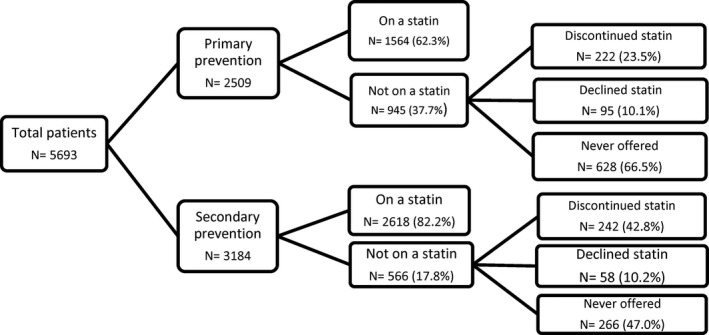
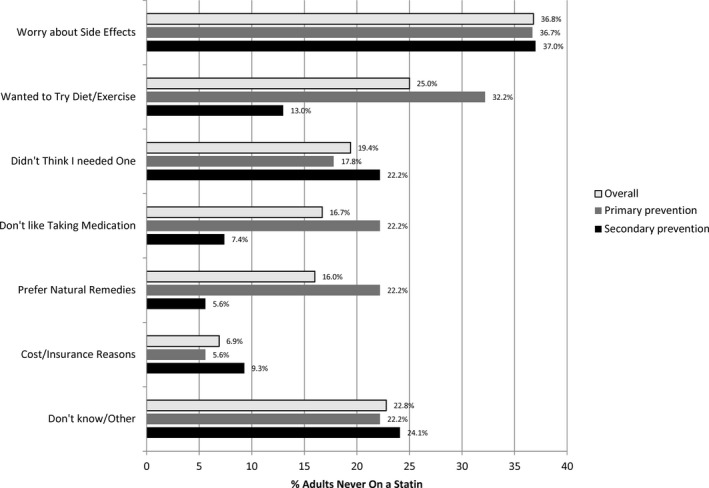
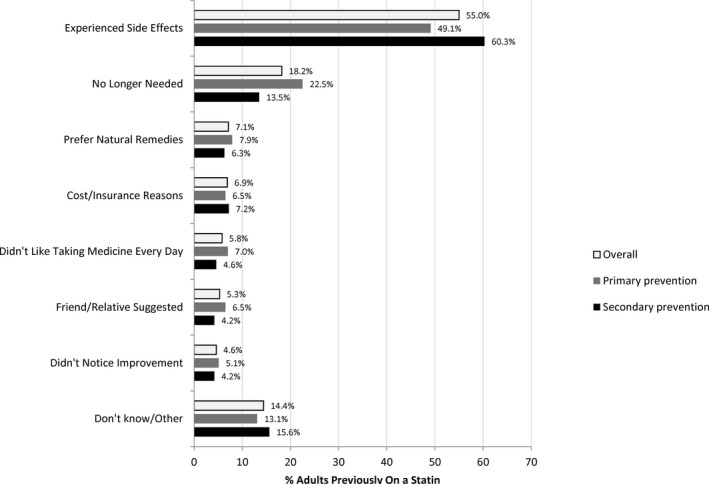
Verification
Claims the paper makes
The claims and statistics of this paper haven’t been checked yet.
Run the check — free, no account needed. It reads the open-access text and checks the sources it cites.
Claims other papers make about this one
Each is checked against this paper’s own text: does it say what the citing paper says it does?
The cited source says what the claim attributes to it.
In the citing paper
“In a registry that studied reasons why eligible patients were not taking a statin, 59% reported never being offered treatment, 10% declined a statin, and 31% discontinued therapy.18”
From Bempedoic Acid for Primary Prevention of Cardiovascular Events in Statin-Intolerant Patients (2023) · cites this paper as [18]
Self-check
Percentages, sums and reported differences re-computed from the paper’s own numbers.
The self-check needs the paper’s full text.
Citations
Cites
Heart Disease and Stroke Statistics—2017 Update: A Report From the American Heart Association
Benjamin, E. J., Blaha, M. J., Chiuve, S. E., Cushman, M., Das, S. R., Deo, R., de Ferranti, S. D., Floyd, J., Fornage, M., Gillespie, C., et al. (2017) · Circulation · doi:10.1161/cir.0000000000000485 · Cited by 12,591
Self-citationA Modified Poisson Regression Approach to Prospective Studies with Binary Data
Zou, G. (2004) · American Journal of Epidemiology · doi:10.1093/aje/kwh090 · Cited by 9,920
Longitudinal Data Analysis for Discrete and Continuous Outcomes
Zeger, S. L., & Liang, K. (1986) · Biometrics · doi:10.2307/2531248 · Cited by 7,781
Stone, N. J., Robinson, J. G., Lichtenstein, A. H., Bairey Merz, C. N., Blum, C. B., Eckel, R. H., Goldberg, A. C., Gordon, D., Levy, D., Lloyd-Jones, D. M., et al. (2014) · Circulation · doi:10.1161/01.cir.0000437738.63853.7a · Cited by 7,081
Self-citationAdherence with statin therapy in elderly patients with and without acute coronary syndromes
Jackevicius, C. A. (2002) · JAMA · doi:10.1001/jama.288.4.462 · Cited by 1,077
Persistence of Use of Lipid-Lowering Medications
Avorn, J., Monette, J., Lacour, A. S., Bohn, R. L., Monane, M., Mogun, H., & LeLorier, J. (1998) · JAMA · doi:10.1001/jama.279.18.1458 · Cited by 635
Application of New Cholesterol Guidelines to a Population-Based Sample
Pencina, M. J., Navar‐Boggan, A. M., D’Agostino, R. B., Williams, K., Neely, B., Sniderman, A. D., & Peterson, E. D. (2014) · New England Journal of Medicine · doi:10.1056/nejmoa1315665 · Cited by 612
Self-citationNissen, S. E., Stroes, E., Dent-Acosta, R. E., Rosenson, R. S., Lehman, S. J., Sattar, N., Preiss, D., Bruckert, E., Ceška, R., Lepor, N., et al. (2016) · JAMA · doi:10.1001/jama.2016.3608 · Cited by 522
Risks Associated With Statin Therapy: A Systematic Overview of Randomized Clinical Trials
Kashani, A., Phillips, C. O., Foody, J. M., Wang, Y., Mangalmurti, S., Ko, D. T., & Krumholz, H. M. (2006) · Circulation · doi:10.1161/circulationaha.106.624890 · Cited by 474
Cited by
Sorted by citations
Prevalence of statin intolerance: a meta-analysis
Bytyçi, I., Penson, P. E., Mikhailidis, D. P., Wong, N. D., Hernandez, A. V., Sahebkar, A., Thompson, P. D., Mazidi, M., Rysz, J., Pella, D., et al. (2022) · European Heart Journal · doi:10.1093/eurheartj/ehac015 · Cited by 481
Nanna, M. G., Wang, T. Y., Xiang, Q., Goldberg, A. C., Robinson, J. G., Roger, V. L., Virani, S. S., Wilson, P. W. F., Louie, M. J., Koren, A., et al. (2019) · Circulation: Cardiovascular Quality and Outcomes · doi:10.1161/circoutcomes.118.005562 · Cited by 313
Self-citationZhao, M., Woodward, M., Vaartjes, I. C. H., Millett, E. R. C., Klipstein‐Grobusch, K., Hyun, K. K., Carcel, C., & Peters, S. A. E. (2020) · Journal of the American Heart Association · doi:10.1161/jaha.119.014742 · Cited by 253
Managing Atherosclerotic Cardiovascular Risk in Young Adults
Stone, N. J., Smith, S. C., Orringer, C. E., Rigotti, N. A., Návar, A. M., Khan, S. S., Jones, D. W., Goldberg, R. B., Mora, S., Blaha, M. J., et al. (2022) · Journal of the American College of Cardiology · doi:10.1016/j.jacc.2021.12.016 · Cited by 255
Roeters van Lennep, J. E., Tokgözoğlu, L. S., Badimon, L., Dumanski, S. M., Gulati, M., Hess, C. N., Holven, K. B., Kavousi, M., Kayıkçıoğlu, M., Lutgens, E., et al. (2023) · European Heart Journal · doi:10.1093/eurheartj/ehad472 · Cited by 229
Metadata
- Authors
- Bradley, C. K., Wang, T. Y., Li, S., Robinson, J. G., Roger, V. L., Goldberg, A. C., Virani, S. S., Louie, M. J., Lee, L. V., Peterson, E. D., & Navar, A. M.
- Affiliations
- Duke University (US)
- University of Iowa (US)
- Mayo Clinic (US)
- Washington University in St. Louis (US)
- Baylor College of Medicine (US)
- Regeneron (United States) (US)
- Sanofi (United States) (US)
- Department of Medicine and Duke Clinical Research Institute Duke University School of Medicine Durham NC
- Corresponding author
- Bradley, Corey K.
- ORCID
- Venue
- Journal of the American Heart Association
- Published
- 2019-04-02
- Volume
- 8
- Issue
- 7
- Pages
- e011765-e011765
- ISSN
- 2047-9980 (ISSN-L)
- PMC
- PMC6509731
- OpenAlex
- W2923928888
- Cited by
- 286
- References
- 25
- Citations by year
- 2026: 34 · 2025: 41 · 2024: 56 · 2023: 43 · 2022: 30 · 2021: 41 · 2020: 28 · 2019: 13
- FWCI
- 26.76
- Type
- journal article
- Language
- en
- Open access
- gold
- doi.org
- Licence
- cc-by-nc
- Locations
- Journal of the American Heart Association (publishedVersion, cc-by-nc)
- PubMed Central (publishedVersion, cc-by-nc)
- PubMed (publishedVersion)
- Digital Commons@Becker (Washington University School of Medicine) (submittedVersion, cc-by)
- eCommons - AKU (Aga Khan University) (submittedVersion, cc-by-nc)
- DOAJ (DOAJ: Directory of Open Access Journals) (submittedVersion)
- Funders
- National Heart, Lung, and Blood Institute (K01HL133416)
- Duke Clinical Research Institute
- Topics
- Health Sciences › Medicine › Cardiology and Cardiovascular Medicine › Lipoproteins and Cardiovascular Health
- Health Sciences › Medicine › Family Practice › Medication Adherence and Compliance
- Health Sciences › Medicine › Public Health, Environmental and Occupational Health › Health Promotion and Cardiovascular Prevention
- Keywords
- statin therapy, statin discontinuation, fear of side effects, cardiovascular disease prevention, lipid control, health beliefs, racial and ethnic disparities, insurance status
- MeSH terms
- Patient Reported Outcome Measures, Adult, Aged, Attitude to Health, Black or African American, Cardiovascular Diseases, Fear, Female, Humans, Male, Middle Aged, Motivation, Practice Patterns, Physicians', Primary Prevention, Registries, Sex Factors, United States, Treatment Refusal, Hydroxymethylglutaryl-CoA Reductase Inhibitors, White People, Atherosclerosis, Healthcare Disparities, Medication Adherence, Secondary Prevention, Drug-Related Side Effects and Adverse Reactions
About these checks
Registry, retraction, Cites and statistics results are computed, not judged, with one exception: a printed reference that no index lists is read once by a model before it counts as a citation error. Claims are extracted by a model and kept only when their quote appears verbatim in the text; each cited source is then checked, with a model’s help, for whether it says what the claim relies on. Those verdicts can be wrong — read the claim’s quote and the cited source before relying on one.
Statistics and arithmetic are recomputed, not judged.
Confidence bands are shown only for fields calibrated on our annotated test set. None is calibrated yet, so no band is shown.
What counts as a claim ›How we measure confidence ›How we check this ›
Are you an author, or do you see a problem with this page? Request a review
