

The DOI matches its Crossref record; 1 of the 1 references it cites were found in a registry or an index.
Effect of Asymptomatic Common Carotid Artery Dissection on the Prognosis of Patients With Acute Type A Aortic Dissection
Open accessAbstract
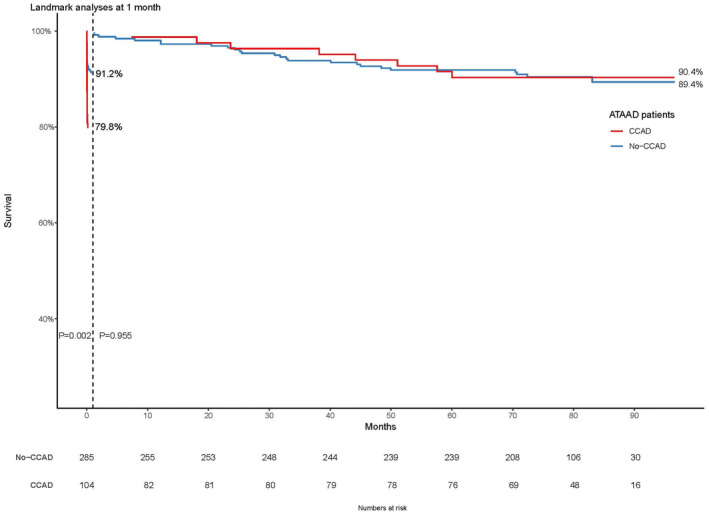
Background: Acute type A aortic dissection can extend upwards to involve the common carotid artery. However, whether asymptomatic common carotid artery dissection (CCAD) requires surgical repair remains controversial. This study aimed to explore the effect of asymptomatic CCAD without surgical intervention on the prognosis of patients who underwent surgery for acute type A aortic dissection. Methods and Results: Between January 2015 and December 2017, 485 patients with no neurological symptoms who underwent surgery for acute type A aortic dissection were enrolled in this retrospective cohort study. The patients were divided into 2 groups based on the exposure factor of CCAD. CCAD was detected in 111 patients (22.9%), and after adjusting baseline data (standardized mean difference <0.1), the 30‐day mortality (17.1% versus 6.0%, P <0.001) and incidence of fatal stroke (7.7% versus 1.6%, P =0.001) were significantly higher in the group with CCAD. Univariable and multivariable Cox regression analyses found CCAD as an independent risk factor for 30‐day mortality (hazard ratio [HR], 2.8 [95% CI, 1.5–5.2]; P =0.001). At a median follow‐up of 6.2 years (interquartile range, 5.6–6.9 years), landmark analysis with a cutoff value of 1 month postoperatively showed a significant increase in mortality in the group with CCAD, especially in the first month (log‐rank P =0.002) and no significant difference in survival after the first month postoperatively between the 2 groups (log‐rank P =0.955). Conclusions: Asymptomatic CCAD increased the risk of early fatal stroke and death in patients with acute type A aortic dissection after surgery but did not affect midterm survival in patients who survived the early postoperative period.
Overview
The claims and statistics of this paper haven’t been checked yet.
Run the check — free, no account needed. It reads the open-access text and checks the sources it cites.
Integrity signals
Registry
Cites
Statistics
Figures
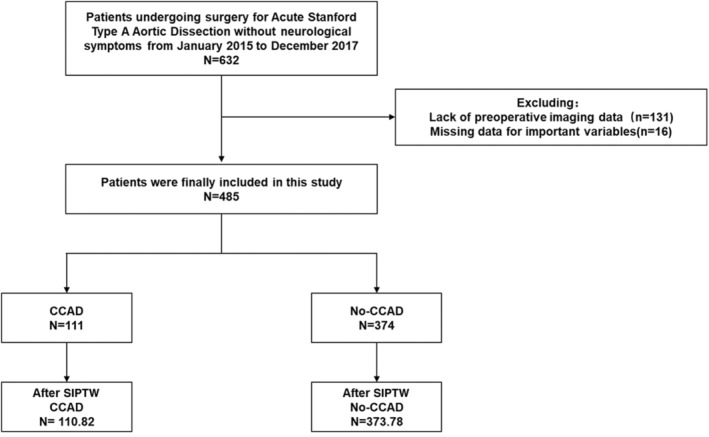
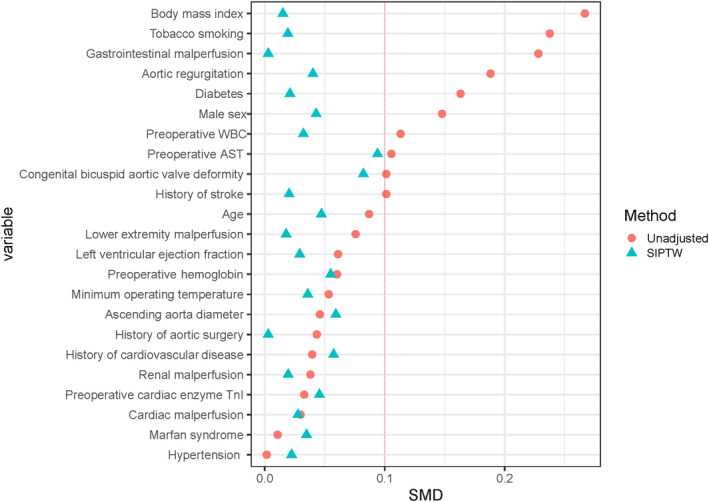
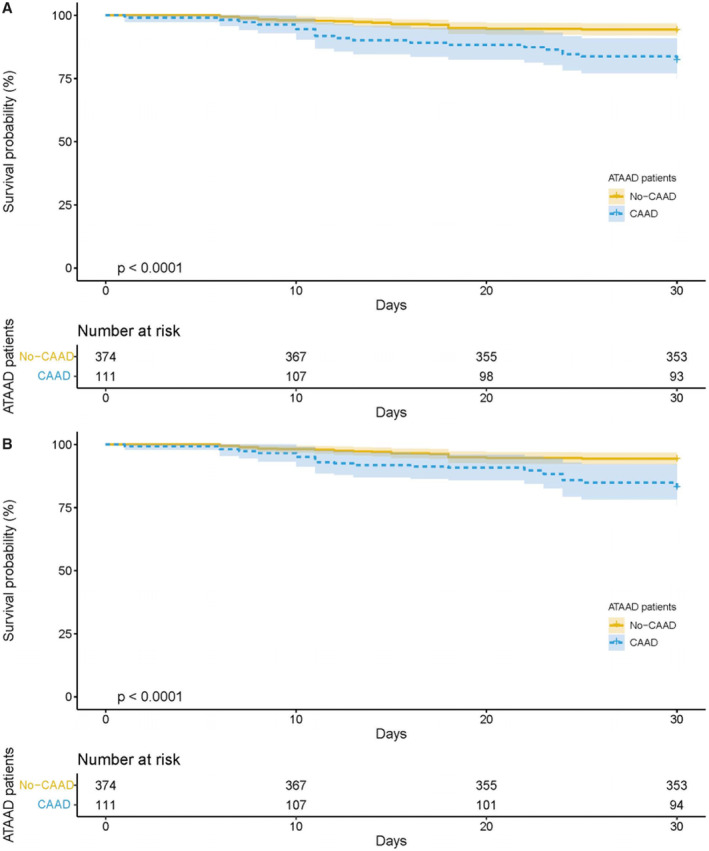
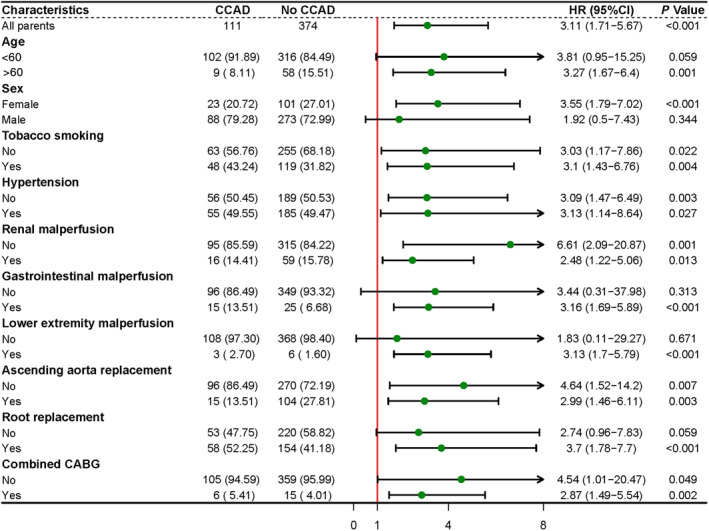
Verification
Claims the paper makes
The claims and statistics of this paper haven’t been checked yet.
Run the check — free, no account needed. It reads the open-access text and checks the sources it cites.
Self-check
Percentages, sums and reported differences re-computed from the paper’s own numbers.
The self-check needs the paper’s full text.
Citations
Cites
Isselbacher, E. M., Preventza, O., Hamilton Black, J., Augoustides, J. G., Beck, A. W., Bolen, M. A., Braverman, A. C., Bray, B. E., Brown-Zimmerman, M. M., Chen, E. P., et al. (2022) · Circulation · doi:10.1161/cir.0000000000001106 · Cited by 2,082
Research works printed but not linked: 24
- 10.1016/j.jacc.2015.05.029 · DOI
- 10.1097/SLA.0000000000005840 · DOI
- 10.1016/j.jtcvs.2018.10.134 · DOI
- 10.1016/j.jacc.2015.04.030 · DOI
- 10.1161/CIRCULATIONAHA.118.038099 · DOI
- 10.1016/j.athoracsur.2020.09.043 · DOI
- 10.1093/ejcts/ezaa322 · DOI
- 10.1016/j.jtcvs.2004.02.030 · DOI
- 10.1093/eurheartj/ehu281 · DOI
- 10.1097/CM9.0000000000001416 · DOI
- 10.1161/CIRCULATIONAHA.110.015081 · DOI
- 10.1093/jnci/djw323 · DOI
- 10.1016/j.jvs.2013.03.042 · DOI
- 10.1016/j.xjon.2022.01.024 · DOI
- 10.1016/j.jtcvs.2017.03.041 · DOI
- 10.3389/fcvm.2022.988619 · DOI
- 10.1161/CIRCULATIONAHA.110.011551 · DOI
- 10.1016/j.athoracsur.2006.11.018 · DOI
- 10.1016/j.jtcvs.2022.09.058 · DOI
- 10.1161/CIRCULATIONAHA.110.009282 · DOI
- 10.1016/j.jtcvs.2019.06.057 · DOI
- 10.1093/ejcts/ezv064 · DOI
- 10.1016/j.jvs.2006.05.053 · DOI
- 10.1001/jamaneurol.2019.0072 · DOI
Metadata
- Authors
- Jia, S., Wang, M., Liu, Y., Gong, M., Jiang, W., & Zhang, H.
- Affiliations
- Capital Medical University (CN)
- Corresponding author
- Gong, Ming
- Jiang, Wenjian
- Zhang, Hongjia
- Venue
- Journal of the American Heart Association
- Published
- 2024-01-02
- Volume
- 13
- Issue
- 1
- Pages
- e031542-e031542
- ISSN
- 2047-9980 (ISSN-L)
- PMC
- PMC10863841
- OpenAlex
- W4390406149
- Cited by
- 6
- References
- 1
- Citations by year
- 2025: 6
- FWCI
- 1.11
- Type
- journal article
- Language
- en
- Open access
- gold
- doi.org
- Licence
- cc-by-nc-nd
- Locations
- Journal of the American Heart Association (publishedVersion, cc-by-nc-nd)
- PubMed Central (publishedVersion, cc-by-nc-nd)
- PubMed (publishedVersion)
- DOAJ (DOAJ: Directory of Open Access Journals) (submittedVersion, cc-by-sa)
- Topics
- Health Sciences › Medicine › Cardiology and Cardiovascular Medicine › Aortic Disease and Treatment Approaches
- Health Sciences › Medicine › Cardiology and Cardiovascular Medicine › Cerebrovascular and Carotid Artery Diseases
- Life Sciences › Biochemistry, Genetics and Molecular Biology › Genetics › Connective tissue disorders research
- Keywords
- acute type A aortic dissection, postoperative mortality, fatal stroke, prognosis, carotid artery dissection, surgical repair
- MeSH terms
- Aortic Dissection, Carotid Artery Diseases, Humans, Prognosis, Retrospective Studies, Risk Factors, Treatment Outcome, Carotid Artery, Common, Stroke
About these checks
Registry, retraction, Cites and statistics results are computed, not judged, with one exception: a printed reference that no index lists is read once by a model before it counts as a citation error. Claims are extracted by a model and kept only when their quote appears verbatim in the text; each cited source is then checked, with a model’s help, for whether it says what the claim relies on. Those verdicts can be wrong — read the claim’s quote and the cited source before relying on one.
Statistics and arithmetic are recomputed, not judged.
Confidence bands are shown only for fields calibrated on our annotated test set. None is calibrated yet, so no band is shown.
What counts as a claim ›How we measure confidence ›How we check this ›
Are you an author, or do you see a problem with this page? Request a review
