Cited by 32

The DOI matches its Crossref record; 1 of the 1 references it cites were found in a registry or an index.

Relationship Between Genotype Status and Clinical Outcome in Hypertrophic Cardiomyopathy

Bonaventura, Jiri, Rowin, Ethan J., Chan, Raymond H., Chin, Michael T., Puchnerova, Veronika, Polakova, Eva, Macek, Milan, Votypka, Pavel, Batorsky, Rebecca, Perera, Gayani, Koethe, Benjamin, Veselka, Josef, Maron, Barry J., Maron, Martin S.·2024·Journal of the American Heart Association

Abstract

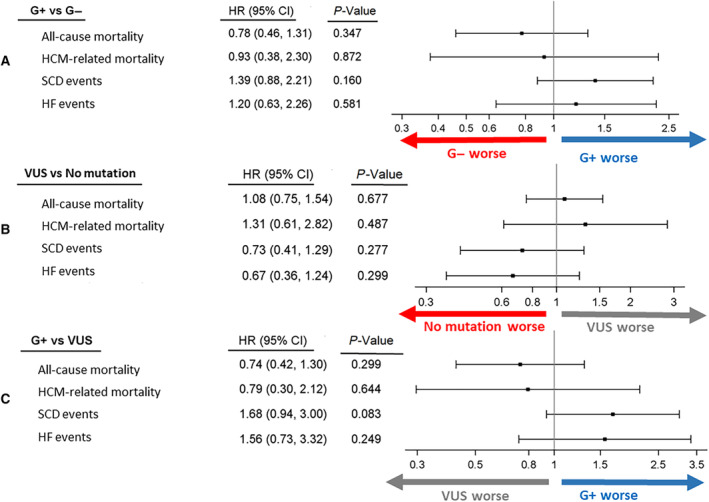
Background: The genetic basis of hypertrophic cardiomyopathy (HCM) is complex, and the relationship between genotype status and clinical outcome is incompletely resolved. Methods and Results: We assessed a large international HCM cohort to define in contemporary terms natural history and clinical consequences of genotype. Consecutive patients (n=1468) with established HCM diagnosis underwent genetic testing. Patients with pathogenic (or likely pathogenic) variants were considered genotype positive (G+; n=312; 21%); those without definite disease‐causing mutations (n=651; 44%) or variants of uncertain significance (n=505; 35%) were considered genotype negative (G−). Patients were followed up for a median of 7.8 years (interquartile range, 3.5–13.4 years); HCM end points were examined by cumulative event incidence. Over follow‐up, 135 (9%) patients died, 33 from a variety of HCM‐related causes. After adjusting for age, all‐cause and HCM‐related mortality did not differ between G− versus G+ patients (hazard ratio [HR], 0.78 [95% CI, 0.46–1.31]; P =0.37; HR, 0.93 [95% CI, 0.38–2.30]; P =0.87, respectively). Adverse event rates, including heart failure progression to class III/IV, heart transplant, or heart failure death, did not differ (G− versus G+) when adjusted for age (HR, 1.20 [95% CI, 0.63–2.26]; P =0.58), nor was genotype independently associated with sudden death event risk (HR, 1.39 [95% CI, 0.88–2.21]; P =0.16). In multivariable analysis, age was the only independent predictor of all‐cause and HCM‐related mortality, heart failure progression, and sudden death events. Conclusions: In this large consecutive cohort of patients with HCM, genotype (G+ or G−) was not a predictor of clinical course, including all‐cause and HCM‐related mortality and risk for heart failure progression or sudden death. G+ status should not be used to dictate clinical management or predict outcome in HCM.

Overview

The claims and statistics of this paper haven’t been checked yet.

Run the check — free, no account needed. It reads the open-access text and checks the sources it cites.

A few free checks a day · papers already verified open instantly · results are public

Integrity signals

Registry

Crossref · 10.1161/jaha.123.033565

Cites

1 of 1 references verified0 citation errors · 0 not checkable

Statistics

Figures

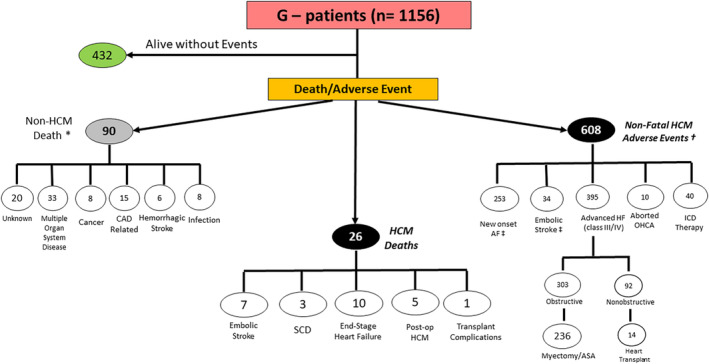
Figure 1 Diagram summarizing clinical outcome of 1156 individual genotype‐negative (G−) patients with hypertrophic cardiomyopathy (HCM), tabulating the number and causes for death and nonfatal adverse HCM events. *Includes unknown cause of death. Twenty‐three (17%) patients died from unknown causes at 69±14 years; with no significant difference (P=0.45) in proportion of unknown deaths between G− (n=20; 2%) and genotype‐positive patients (n=3; 1%). †More than 1 adverse event occurred over follow‐up, most commonly atrial fibrillation (AF) and heart failure (HF) in 122 patients, and HF with implantable cardioverter‐defibrillator (ICD) shocks in 17 patients, other combinations of adverse events were rare (<1%). ‡Sixteen (6%) of 256 patients with AF experienced embolic stroke, 4 of them (0.3%) developed concomitant progressive HF. ASA indicates alcohol ablation; CAD, coronary artery disease; OHCA, out‐of‐hospital cardiac arrest; and SCD, sudden cardiac death.
Figure 1 Diagram summarizing clinical outcome of 1156 individual genotype‐negative (G−) patients with hypertrophic cardiomyopathy (HCM), tabulating the number and causes for death and nonfatal adverse HCM events. *Includes unknown cause of death. Twenty‐three (17%) patients died from unknown causes at 69±14 years; with no significant difference (P=0.45) in proportion of unknown deaths between G− (n=20; 2%) and genotype‐positive patients (n=3; 1%). †More than 1 adverse event occurred over follow‐up, most commonly atrial fibrillation (AF) and heart failure (HF) in 122 patients, and HF with implantable cardioverter‐defibrillator (ICD) shocks in 17 patients, other combinations of adverse events were rare (<1%). ‡Sixteen (6%) of 256 patients with AF experienced embolic stroke, 4 of them (0.3%) developed concomitant progressive HF. ASA indicates alcohol ablation; CAD, coronary artery disease; OHCA, out‐of‐hospital cardiac arrest; and SCD, sudden cardiac death.CC BY-NC-ND · PubMed Central
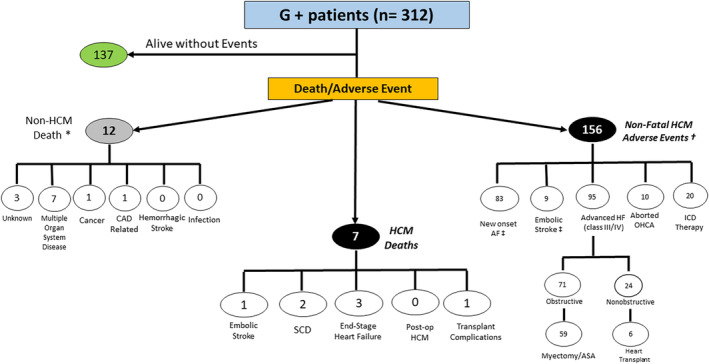
Figure 2 Diagram summarizing clinical outcome of 312 individual genotype‐positive (G+) patients with hypertrophic cardiomyopathy (HCM), tabulating the number and causes for death and nonfatal adverse HCM events. *Includes unknown cause of death in 3 patients. †More than 1 adverse event occurred over follow‐up, most commonly atrial fibrillation (AF) and heart failure (HF) in 39 patients, and HF with implantable cardioverter‐defibrillator (ICD) therapy in 5 patients, other combinations of adverse events were rare (<1%). ‡Eight of 83 patients with AF experienced embolic stroke, including 2 who developed concomitant progressive HF. ASA indicates alcohol ablation; CAD, coronary artery disease; OHCA, out‐of‐hospital cardiac arrest; and SCD, sudden cardiac death.
Figure 2 Diagram summarizing clinical outcome of 312 individual genotype‐positive (G+) patients with hypertrophic cardiomyopathy (HCM), tabulating the number and causes for death and nonfatal adverse HCM events. *Includes unknown cause of death in 3 patients. †More than 1 adverse event occurred over follow‐up, most commonly atrial fibrillation (AF) and heart failure (HF) in 39 patients, and HF with implantable cardioverter‐defibrillator (ICD) therapy in 5 patients, other combinations of adverse events were rare (<1%). ‡Eight of 83 patients with AF experienced embolic stroke, including 2 who developed concomitant progressive HF. ASA indicates alcohol ablation; CAD, coronary artery disease; OHCA, out‐of‐hospital cardiac arrest; and SCD, sudden cardiac death.CC BY-NC-ND · PubMed Central
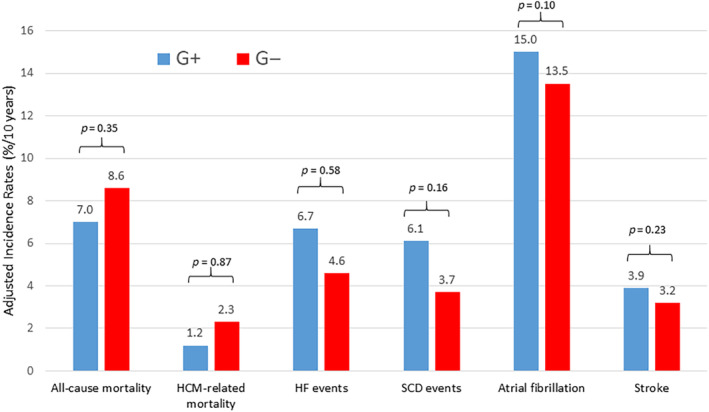
Figure 3 Comparison of 10‐year incidence rates in genotype‐positive (G+) vs genotype‐negative (G−) patients with hypertrophic cardiomyopathy (HCM). There were no significant differences in rates between G+ and G− patients adjusted for age at diagnosis, and for sudden cardiac death (SCD) adjusted for age and ≥1 established American Heart Association/American College of Cardiology risk markers. Shown for all‐cause and HCM‐related mortality, SCD events, heart failure (HF), atrial fibrillation, and embolic stroke. The rates were obtained from the cumulative incidence function.
Figure 3 Comparison of 10‐year incidence rates in genotype‐positive (G+) vs genotype‐negative (G−) patients with hypertrophic cardiomyopathy (HCM). There were no significant differences in rates between G+ and G− patients adjusted for age at diagnosis, and for sudden cardiac death (SCD) adjusted for age and ≥1 established American Heart Association/American College of Cardiology risk markers. Shown for all‐cause and HCM‐related mortality, SCD events, heart failure (HF), atrial fibrillation, and embolic stroke. The rates were obtained from the cumulative incidence function.CC BY-NC-ND · PubMed Central
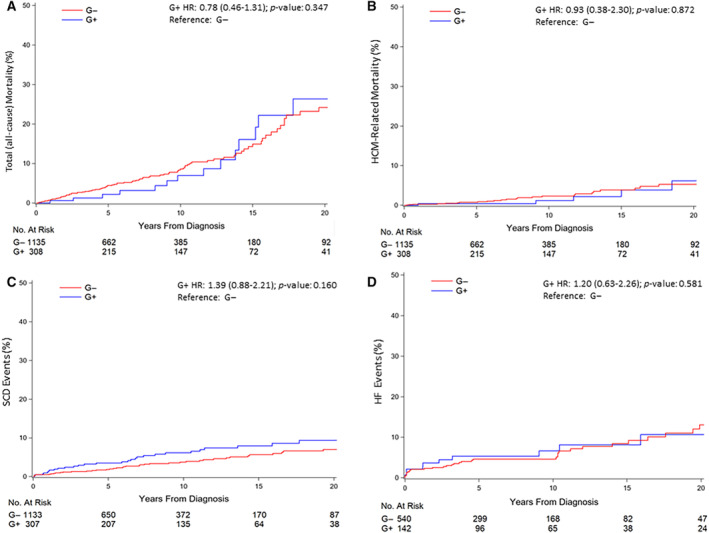
Figure 4 Cumulative incidence (Kaplan‐Meier) curves adjusted for age at diagnosis, demonstrating no difference between genotype‐positive (G+) and genotype‐negative (G−) patients with hypertrophic cardiomyopathy (HCM). A, All‐cause mortality. B, HCM‐related mortality. C, Sudden cardiac death (SCD) events. D, Heart failure (HF) events. HR indicates hazard ratio.
Figure 4 Cumulative incidence (Kaplan‐Meier) curves adjusted for age at diagnosis, demonstrating no difference between genotype‐positive (G+) and genotype‐negative (G−) patients with hypertrophic cardiomyopathy (HCM). A, All‐cause mortality. B, HCM‐related mortality. C, Sudden cardiac death (SCD) events. D, Heart failure (HF) events. HR indicates hazard ratio.CC BY-NC-ND · PubMed Central
Figure 5 Forest plots demonstrate no significant difference in hazard ratios (HRs) between genotype‐positive (G+) and genotype‐negative (G−) patients adjusted for age at diagnosis, and for sudden cardiac death (SCD) adjusted for age and ≥1 established American Heart Assocation/American College of Cardiology risk markers. Shown for all‐cause and HCM‐related mortality, SCD events, and heart failure (HF). Comparison are: A) G+ vs G−; B) variant of uncertain significance (VUS) vs no mutation; and C) G+ vs VUS. Numbers along the horizontal axis represent hazard ratios. HCM indicates hypertrophic cardiomyopathy.
Figure 5 Forest plots demonstrate no significant difference in hazard ratios (HRs) between genotype‐positive (G+) and genotype‐negative (G−) patients adjusted for age at diagnosis, and for sudden cardiac death (SCD) adjusted for age and ≥1 established American Heart Assocation/American College of Cardiology risk markers. Shown for all‐cause and HCM‐related mortality, SCD events, and heart failure (HF). Comparison are: A) G+ vs G−; B) variant of uncertain significance (VUS) vs no mutation; and C) G+ vs VUS. Numbers along the horizontal axis represent hazard ratios. HCM indicates hypertrophic cardiomyopathy.CC BY-NC-ND · PubMed Central

Verification

Claims the paper makes

The claims and statistics of this paper haven’t been checked yet.

Run the check — free, no account needed. It reads the open-access text and checks the sources it cites.

A few free checks a day · papers already verified open instantly · results are public

Claims other papers make about this one

Each is checked against this paper’s own text: does it say what the citing paper says it does?

Self-check

Percentages, sums and reported differences re-computed from the paper’s own numbers.

The self-check needs the paper’s full text.

Citations

Cites

Research works printed but not linked: 50

  1. 10.1056/NEJM199204233261703 · DOI
  2. 10.1136/heartjnl-2013-303939 · DOI
  3. 10.1136/jmg.2005.033886 · DOI
  4. 10.1161/CIRCULATIONAHA.117.033200 · DOI · Paper page
  5. 10.3390/ijms221910401 · DOI
  6. 10.1016/j.jacc.2012.02.068 · DOI
  7. 10.1007/s00392-017-1155-5 · DOI
  8. 10.1161/CIR.0000000000000937 · DOI
  9. 10.1093/eurheartj/ehad194 · DOI · Paper page
  10. 10.1016/j.amjcard.2020.04.020 · DOI
  11. 10.5114/aoms.2018.78767 · DOI
  12. 10.1038/gim.2017.258 · DOI
  13. 10.1038/gim.2016.90 · DOI
  14. 10.1016/j.jacc.2021.11.021 · DOI
  15. 10.1001/jamacardio.2019.1391 · DOI
  16. 10.1016/j.cmpb.2010.07.005 · DOI
  17. 10.33678/cor.2020.023 · DOI
  18. 10.1016/j.jacc.2019.01.061 · DOI
  19. 10.1161/CIRCGENETICS.113.000331 · DOI
  20. 10.1016/j.jacc.2020.06.011 · DOI
  21. 10.1136/heartjnl-2014-306387 · DOI · Paper page
  22. 10.1016/j.jacc.2015.02.061 · DOI · Paper page
  23. 10.1016/j.amjcard.2016.06.038 · DOI · Paper page
  24. 10.21037/cdt.2020.01.12 · DOI
  25. 10.1016/S0140-6736(20)31792-X · DOI · Paper page
  26. 10.1001/jamacardio.2023.3342 · DOI
  27. 10.1093/eurheartj/ehad637 · DOI
  28. 10.1007/s12265-016-9681-5 · DOI
  29. 10.1016/j.jacc.2019.08.1057 · DOI
  30. 10.1161/CIRCGENETICS.112.963363 · DOI
  31. 10.1016/S0022-2828(03)00146-9 · DOI
  32. 10.1016/S0300-8932(09)70020-X · DOI
  33. 10.1157/13093977 · DOI
  34. 10.1186/1471-2350-11-67 · DOI
  35. 10.1186/s12872-021-01927-5 · DOI
  36. 10.1161/CIRCGEN.120.003062 · DOI
  37. 10.1161/CIRCGENETICS.116.001620 · DOI
  38. 10.1038/gim.2013.44 · DOI
  39. 10.1002/humu.20862 · DOI
  40. 10.1093/eurheartj/ehx819 · DOI
  41. 10.1161/CIRCGEN.119.002460 · DOI
  42. 10.1038/gim.2013.138 · DOI
  43. 10.1161/CIRCGENETICS.116.001700 · DOI
  44. 10.1016/j.amjcard.2022.06.017 · DOI
  45. 10.1161/JAHA.122.028974 · DOI
  46. Walsh R, Offerhaus JA, Tadros R, Bezzina CR. Minor hypertrophic cardiomyopathy genes, major insights into the genetics of cardiomyopathies. Nat Rev Cardiol. 2021;19:1–17.
  47. 10.1038/s41588-020-00764-0 · DOI · Paper page
  48. 10.1038/s41588-020-00762-2 · DOI
  49. 10.1016/j.cjca.2021.08.022 · DOI
  50. 10.1161/CIRCULATIONAHA.121.053527 · DOI

Cited by

Sorted by citations

See all 32

Metadata

Authors
Bonaventura, J., Rowin, E. J., Chan, R. H., Chin, M. T., Puchnerova, V., Polakova, E., Macek, M., Votypka, P., Batorsky, R., Perera, G., Koethe, B., Veselka, J., Maron, B. J., & Maron, M. S.
Venue
Journal of the American Heart Association
Published
2024-05-21
Volume
13
Issue
10
ISSN
2047-9980
Cited by
32
References
1
Language
en

About these checks

Registry, retraction, Cites and statistics results are computed, not judged, with one exception: a printed reference that no index lists is read once by a model before it counts as a citation error. Claims are extracted by a model and kept only when their quote appears verbatim in the text; each cited source is then checked, with a model’s help, for whether it says what the claim relies on. Those verdicts can be wrong — read the claim’s quote and the cited source before relying on one.

Statistics and arithmetic are recomputed, not judged.

Confidence bands are shown only for fields calibrated on our annotated test set. None is calibrated yet, so no band is shown.

What counts as a claim ›How we measure confidence ›How we check this ›

Are you an author, or do you see a problem with this page? Request a review